REVIEW 3 major objections 5 minor 47 references
KDA: A Knowledge-Distilled Attacker for Generating Diverse Prompts to Jailbreak LLMs
T0 review · 3 major / 5 minor · reviewed 2026-08-09 · deepseek-v4-flash
Pith's one-line read A single fine-tuned open-source model can absorb three jailbreak attack strategies and beat each of them on success rate, speed, and diversity.
desk verdict Plausible and useful distillation approach; the matched-budget results are convincing, but the train/eval judge circularity and unmatched headline budgets need fixing before I fully trust the ASR numbers. read the letter →
The pith
A machine-rendered reading of the paper's core claim, the machinery that carries it, and where it could break.
The reading
What carries the argument
The central object is the format-conditioned distillation objective. KDA is trained by minimizing $\mathbb{E}_{(Q,A,\hat{A}_\theta,F)}[L(\hat{A}_\theta(Q,F), A)]$, where $L$ is cross-entropy, $A$ is a ground-truth attack collected by Algorithm 1, and $F$ indicates whether the prompt is AutoDAN-style, PAIR-style, GPTFuzzer-style, or a mixed format. Algorithm 1 is the load-bearing filter: it generates candidate attacks with a teacher, scores the target response with the binary judge $J(Q,R)$, and keeps only the successful $(Q,A)$ pairs. At generation time, Algorithm 2 samples a format by one of three strategies—uniform, inference-guided softmax over success counts, or training-guided softmax over success counts—so diversity comes from the ensemble of formats rather than from any single prompt template.
What would settle it
Audit a random sample of responses the HB evaluator marks as successful by having independent human annotators judge whether the response actually satisfies the harmful query; if a large share are judged harmless, off-topic, or merely free of refusal phrases, the reported attack-success gains would not reflect real jailbreaks.
Extended reading notes
Core claim
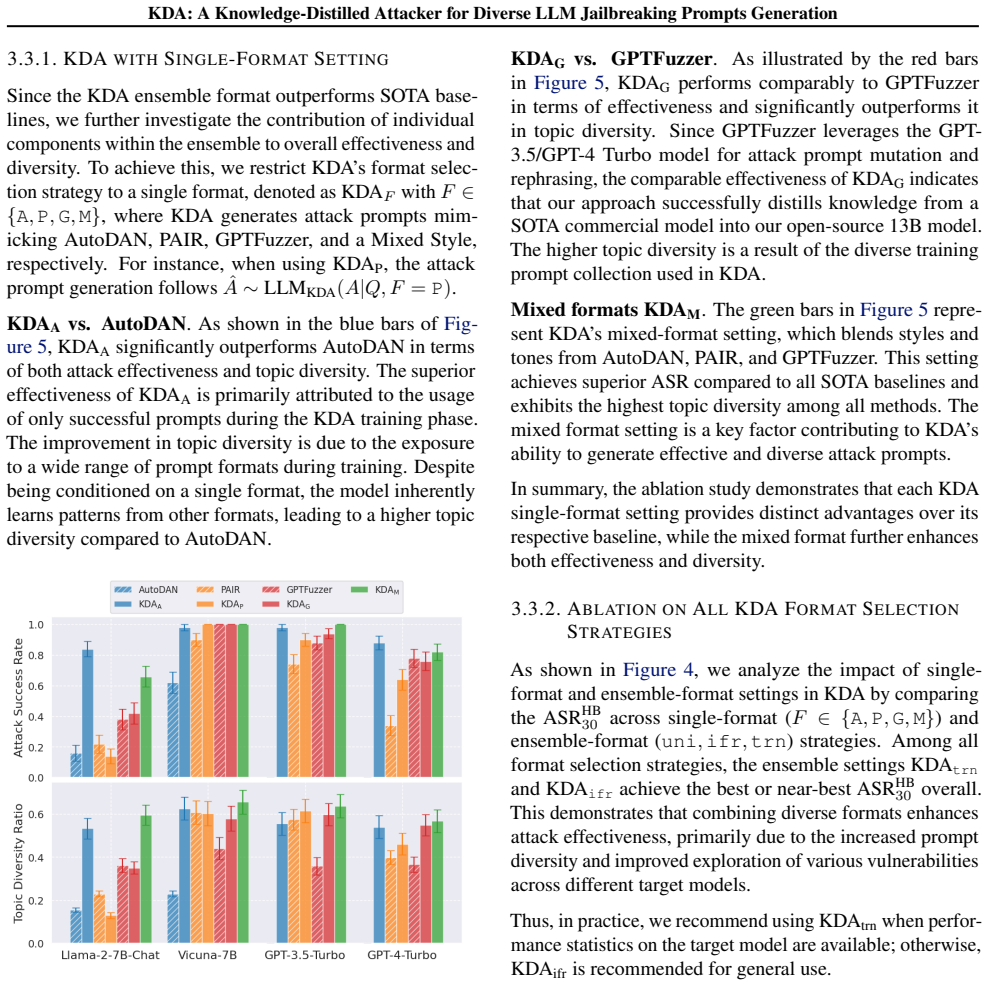
KDA is a LoRA-fine-tuned Vicuna-13B model trained to map a harmful query $Q$ and a format label $F$ to an attack prompt $A$, where $F \in \{A, P, G, M\}$ names the style of AutoDAN, PAIR, GPTFuzzer, or a GPT-4o-synthesized mix. The training set is built by running the three teachers against open and commercial targets and keeping only $(Q, A)$ pairs for which the binary evaluator $J(Q, R) = 1$, so KDA learns from verified successes rather than from the teachers' full output distributions. At inference, KDA samples a format, generates a prompt, queries the target, and returns the first prompt the evaluator accepts; format selection can be uniform, guided by inference-time success counts, or guided by training-time success counts. The paper reports that this recipe raises the HB-evaluated attack success rate at a 30-query budget on Llama-2-7B from 38% for GPTFuzzer and 16% for AutoDAN to 84%, and on the HarmBench standard set reaches 88.5% on Llama-2-7B-Chat and 100% on Vicuna, Qwen, and Mistral targets. The ablation attributes the gain to format ensembling and topic diversity rather than to any single teacher's template.
Load-bearing premise
The load-bearing premise is that the binary evaluator $J$ faithfully measures genuine harm, because KDA is trained only on prompts $J$ accepts and every reported success rate is measured by $J$; if $J$ can be gamed by benign but refusal-free text, the claimed superiority would not carry over to real-world harm.
Editorial extensions
If this is right
- With KDA, a single saved model can replace the teacher attack pipelines, so red-teaming a new target reduces to sampling formats, generating prompts, and checking the judge—no per-target prompt design or mutation loop.
- The reported numbers imply that KDA generalizes beyond its training targets: it keeps high attack success on the HarmBench dataset and on models such as Claude 2.1 that were never used in dataset construction, although there its success rate is still low.
- The format ensemble is the active ingredient: the ablation shows ensemble strategies reach higher HB-ASR at a 30-query budget than any single format, so KDA's edge is diversity of attack topics rather than one secret template.
- Because the training data contains only successful prompts, extending KDA to a new jailbreak method is cheap: generate that method's hits, label them with a new format, and fine-tune.
Reading between the lines
- The same distillation recipe, with a different binary success signal, could produce specialized attackers or auditors for properties like privacy leakage, misinformation, or toxicity; the paper's machinery does not depend on the semantics of jailbreaking.
- A stronger or human-calibrated judge would likely raise KDA's true ceiling, because the current filter and all reported success rates inherit the evaluator's blind spots; an evaluator that rewards only substantive harmful content would make the measured gains more meaningful.
- Defenders should evaluate under a format ensemble rather than any single attacker, since KDA's ablations tie success to topic diversity; a safety evaluation that uses only one attack style may overstate robustness.
- The small 800-prompt training set suggests the method is easy to reproduce and extend, which points toward an arms race where both attackers and defenses can be updated cheaply.
Editorial analysis
A structured set of objections, weighed in public.
Referee Report
Summary. This paper proposes KDA, a Vicuna-13B model fine-tuned with LoRA to generate jailbreak prompts conditioned on a style/format variable F in {A, P, G, M}, representing AutoDAN, PAIR, GPTFuzzer, and a GPT-4o-synthesized mixed style. The training set is constructed by running the three teacher attackers against four target LLMs and retaining only (query, attack) pairs for which the binary evaluator J(Q,R) (HarmBench or text-matching) labels the target response as a successful jailbreak (Algorithm 1). At attack time, KDA samples a format using one of three strategies (uniform, inference-guided, or training-guided) and generates candidate prompts in a single forward pass. The paper reports that KDA achieves higher attack success rates than HarmBench baselines (Table 1), higher ASR_{30}^{HB} and lower average attack time than AutoDAN/PAIR/GPTFuzzer at a fixed budget of M=30 (Table 2), higher topic diversity with comparable coherence, and presents ablations showing that ensemble and mixed formats are key to its performance.
Significance. If the results are corroborated by an independent evaluator, KDA is a practical contribution: it distills three expensive iterative attackers into a single open-source model that generates diverse, coherent prompts with large query-budget and latency savings, and the format-ensemble mechanism is a plausible explanation for the gains. The paper is transparent in providing pseudocode for training and generation, detailed hyperparameters, bootstrap confidence intervals, and extensive ablations across format-selection strategies and query budgets in appendices. The budget-controlled evidence in Table 2 (M=30) is strong on Llama-2-7B and GPT-3.5/GPT-4, and Appendix E shows that the inference-guided and uniform variants largely preserve the advantage, partially mitigating concerns that the headline numbers depend on an unfair budget or target-specific training statistics. The main unresolved issue is the absence of any independent or human evaluation that would separate real jailbreaks from optimization against the automated judge used both for training-data filtering and for scoring.
major comments (3)
- [Algorithm 1, Eq. (1), Section 3.1, Tables 1-2, Appendix D.3] The binary evaluator J is used twice in the same role: Algorithm 1 filters the KDA training set by keeping only (Q,A) pairs with J(Q,R)=1, and every reported ASR (Tables 1, 2, Figures 3-5) is computed with the same J. No independent human evaluation is reported, and the 'human-aligned judge LLM' mentioned in Appendix D.3 is not described or validated. The second evaluator, text matching, is a refusal-keyword list that is easy to game. Consequently, the central claim that KDA 'causes the LLM to generate harmful content' is not yet distinguished from the alternative that KDA learns prompts that satisfy J without eliciting genuinely harmful responses. Please add a human-annotated sample of J-positive responses, or agreement statistics between J and a second independently implemented judge, and discuss any disagreement cases.
- [Section 3.2.1, Table 1] The headline comparison in Table 1 is not budget-controlled: the text states that baseline hyperparameters and maximum query budgets are undisclosed, while KDA is granted M=120 queries per behavior. Since ASR is nondecreasing in the query budget, KDA's large apparent advantage (e.g., 88.5% vs 34.5% on Llama-2-7B-Chat) may be partly an artifact of budget asymmetry. The fixed-budget comparison in Table 2 (M=30) is the appropriate primary evidence; please either report the baseline budgets used by HarmBench or restructure the presentation so that the main claim rests on the budget-controlled comparison.
- [Section 2.3, Appendix C Table 5, Table 2] The 'trn' format-selection strategy uses training-time success counts Nsuccess,F from Appendix C Table 5 for exactly the target models evaluated in Tables 1 and 2 (Vicuna, Llama-2, GPT-3.5, GPT-4), giving KDA target-specific information from the training phase that the baseline attackers do not have. Although Appendix E shows that KDAifr and KDAuni also outperform or match baselines on several targets (e.g., Llama-2-7B ASR_HB30 of 82 for KDAifr vs 38 for GPTFuzzer), the main-text tables should report a variant that does not use per-target training statistics, or explicitly label KDAtrn as an upper-bound result.
minor comments (5)
- [Section 3.2.3] 'KDA generate coherence attack prompts with PPL below 60' should read 'coherent attack prompts'; the same paragraph contains a few grammatical errors that should be corrected.
- [Equation (4)] The expression 'F ∼ exp(SF )P F ′ exp(SF ′)' is malformed; it should be written as a proper categorical softmax distribution, e.g., P(F) = exp(S_F) / sum_{F'} exp(S_{F'}).
- [Table 6] Qwen-7B-Chat is listed twice; one of the entries should presumably be Qwen-14B-Chat.
- [Section 2.2, Algorithm 1] The text says 'Assuming Ntrain = 50 samples are generated for each F and Q', but Algorithm 1 stops once the per-format dataset DF reaches Ntrain; clarify how the stated total of 3x4x50=600 samples follows from the algorithm.
- [Appendix C, Table 5] The success counts for Llama-2-7B and Llama-2-13B are identical; state explicitly whether the 13B counts were measured separately or transferred from the 7B model, as this affects the interpretation of KDAtrn results on Llama-2-13B.
Circularity Check
No significant circularity: KDA's core comparison is empirical, externally benchmarked, and no reported result reduces to a fitted parameter or definition.
full rationale
This is an empirical systems paper, not a mathematical derivation, so most circularity categories do not apply. The training pipeline (Algorithm 1) filters teacher-generated attack prompts using the same binary evaluator J that is later used to measure ASR; this creates a validity concern (does KDA satisfy J rather than produce genuinely harmful content?), but it is not circularity by construction: KDA is trained by cross-entropy on fixed successful prompts, not by optimizing J directly, and the primary HB evaluator is an external HarmBench classifier from Mazeika et al. (2024), not a parameter fitted by this paper. The KDAtrn format-selection strategy uses per-target training success counts (Appendix C, Table 5) on targets that also appear in Table 2, so those comparisons are partly in-sample; however, the main HarmBench comparison (Table 1) uses the uni strategy, and generalization is also demonstrated on target models with no training data (Qwen, Mistral, Claude), so the central claim has independent content. Self-citations (Liang et al. 2023a,b; Luo et al. 2024) support peripheral claims about diversity and harmful categories and are not load-bearing. No equation in the paper reduces a reported result to a fitted parameter or to a definition, so no circularity is exhibited.
Assumptions & free parameters
free parameters (4)
- format selection temperature beta =
0.1
- format success counts N_success,F for KDAtrn =
per-target table (e.g., Vicuna-7B: 96/68/96/94 for A/P/G/M)
- dataset gating threshold =
120 harmful queries kept after discarding queries consistently refused by four gate models
- coherence PPL threshold =
60
assumptions (6)
- domain assumption The joint distribution factorizes as P(Q,A,F) = P(A|Q,F)P(Q)P(F)
- domain assumption The binary evaluator J correctly identifies harmful jailbreaks
- ad hoc to paper Only successful attacks should be used as training targets
- domain assumption The four training target models are representative for transfer
- domain assumption BERTopic topics and GPT-2 perplexity are valid diversity and coherence measures
- domain assumption The Harmful-Query-KDA dataset is representative of harmful behaviors in HarmBench
Cite this review
Pith. "Pith review of KDA: A Knowledge-Distilled Attacker for Generating Diverse Prompts to Jailbreak LLMs." pith.science (2026). https://pith.science/paper/KWXXUUHV
@misc{pith2026250205223,
  author       = {Pith},
  title        = {Pith review of: KDA: A Knowledge-Distilled Attacker for Generating Diverse Prompts to Jailbreak LLMs},
  year         = {2026},
  howpublished = {\url{https://pith.science/paper/KWXXUUHV}},
  note         = {Machine review of arXiv:2502.05223}
}
read the original abstract
Jailbreak attacks exploit specific prompts to bypass LLM safeguards, causing the LLM to generate harmful, inappropriate, and misaligned content. Current jailbreaking methods rely heavily on carefully designed system prompts and numerous queries to achieve a single successful attack, which is costly and impractical for large-scale red-teaming. To address this challenge, we propose to distill the knowledge of an ensemble of SOTA attackers into a single open-source model, called Knowledge-Distilled Attacker (KDA), which is finetuned to automatically generate coherent and diverse attack prompts without the need for meticulous system prompt engineering. Compared to existing attackers, KDA achieves higher attack success rates and greater cost-time efficiency when targeting multiple SOTA open-source and commercial black-box LLMs. Furthermore, we conducted a quantitative diversity analysis of prompts generated by baseline methods and KDA, identifying diverse and ensemble attacks as key factors behind KDA's effectiveness and efficiency.
Figures


Figures from the paper (6 more)



Reference graph
Works this paper leans on
-
[1]
write newline
" write newline "" before.all 'output.state := FUNCTION n.dashify 't := "" t empty not t #1 #1 substring "-" = t #1 #2 substring "--" = not "--" * t #2 global.max substring 't := t #1 #1 substring "-" = "-" * t #2 global.max substring 't := while if t #1 #1 substring * t #2 global.max substring 't := if while FUNCTION format.date year duplicate empty "emp...
-
[2]
Alon, G. and Kamfonas, M. Detecting Language Model Attacks with Perplexity , November 2023. URL http://arxiv.org/abs/2308.14132. arXiv:2308.14132 [cs]
arXiv 2023
-
[3]
Jailbreaking Leading Safety - Aligned LLMs with Simple Adaptive Attacks , June 2024
Andriushchenko, M., Croce, F., and Flammarion, N. Jailbreaking Leading Safety - Aligned LLMs with Simple Adaptive Attacks , June 2024. URL http://arxiv.org/abs/2404.02151. arXiv:2404.02151 [cs, stat]
arXiv 2024
-
[4]
Play Guessing Game with LLM : Indirect Jailbreak Attack with Implicit Clues , February 2024
Chang, Z., Li, M., Liu, Y., Wang, J., Wang, Q., and Liu, Y. Play Guessing Game with LLM : Indirect Jailbreak Attack with Implicit Clues , February 2024. URL http://arxiv.org/abs/2402.09091. arXiv:2402.09091 [cs]
arXiv 2024
-
[5]
Chao, P., Robey, A., Dobriban, E., Hassani, H., Pappas, G. J., and Wong, E. Jailbreaking Black Box Large Language Models in Twenty Queries , July 2024. URL http://arxiv.org/abs/2310.08419. arXiv:2310.08419 [cs]
arXiv 2024
-
[6]
Ding, P., Kuang, J., Ma, D., Cao, X., Xian, Y., Chen, J., and Huang, S. A Wolf in Sheep 's Clothing : Generalized Nested Jailbreak Prompts can Fool Large Language Models Easily , April 2024. URL http://arxiv.org/abs/2311.08268. arXiv:2311.08268 [cs]
arXiv 2024
-
[7]
Dubey, A., Kadian, A., Letman, A., Mathur, A., Schelten, A., Yang, A., Goyal, A., Hartshorn, A., Yang, A., Mitra, A., Sravankumar, A., Korenev, A., Hinsvark, A., Rao, A., Zhang, A., Rodriguez, A., Gregerson, A., Spataru, A., Roziere, B., Biron, B., Tang, B., Chern, B., Caucheteux, C., Nayak, C., Bi, C., Marra, C., McConnell, C., Keller, C., Touret, C., Wu...
arXiv 2024
-
[8]
BERTopic : Neural topic modeling with a class-based TF - IDF procedure, March 2022
Grootendorst, M. BERTopic : Neural topic modeling with a class-based TF - IDF procedure, March 2022. URL http://arxiv.org/abs/2203.05794. arXiv:2203.05794 [cs]
arXiv 2022
Show all 47 references
-
[9]
COLD - Attack : Jailbreaking LLMs with Stealthiness and Controllability , June 2024
Guo, X., Yu, F., Zhang, H., Qin, L., and Hu, B. COLD - Attack : Jailbreaking LLMs with Stealthiness and Controllability , June 2024. URL http://arxiv.org/abs/2402.08679. arXiv:2402.08679 [cs]
2024 arXiv
-
[10]
J., Shen, Y., Wallis, P., Allen-Zhu, Z., Li, Y., Wang, S., Wang, L., and Chen, W
Hu, E. J., Shen, Y., Wallis, P., Allen-Zhu, Z., Li, Y., Wang, S., Wang, L., and Chen, W. LoRA : Low - Rank Adaptation of Large Language Models , October 2021. URL http://arxiv.org/abs/2106.09685. arXiv:2106.09685 [cs]
2021 arXiv
-
[11]
ArtPrompt : ASCII Art -based Jailbreak Attacks against Aligned LLMs , June 2024
Jiang, F., Xu, Z., Niu, L., Xiang, Z., Ramasubramanian, B., Li, B., and Poovendran, R. ArtPrompt : ASCII Art -based Jailbreak Attacks against Aligned LLMs , June 2024. URL http://arxiv.org/abs/2402.11753. arXiv:2402.11753 [cs]
2024 arXiv
-
[12]
ChatGPT for good? On opportunities and challenges of large language models for education
Kasneci, E., Sessler, K., Küchemann, S., Bannert, M., Dementieva, D., Fischer, F., Gasser, U., Groh, G., Günnemann, S., Hüllermeier, E., Krusche, S., Kutyniok, G., Michaeli, T., Nerdel, C., Pfeffer, J., Poquet, O., Sailer, M., Schmidt, A., Seidel, T., Stadler, M., Weller, J., ...
2023
-
[13]
Open Sesame ! Universal Black Box Jailbreaking of Large Language Models , November 2023
Lapid, R., Langberg, R., and Sipper, M. Open Sesame ! Universal Black Box Jailbreaking of Large Language Models , November 2023. URL http://arxiv.org/abs/2309.01446. arXiv:2309.01446 [cs]
2023 arXiv
-
[14]
Multi-step Jailbreaking Privacy Attacks on ChatGPT , November 2023
Li, H., Guo, D., Fan, W., Xu, M., Huang, J., Meng, F., and Song, Y. Multi-step Jailbreaking Privacy Attacks on ChatGPT , November 2023. URL http://arxiv.org/abs/2304.05197. arXiv:2304.05197 [cs]
2023 arXiv
-
[15]
Semantic Mirror Jailbreak : Genetic Algorithm Based Jailbreak Prompts Against Open -source LLMs , February 2024 a
Li, X., Liang, S., Zhang, J., Fang, H., Liu, A., and Chang, E.-C. Semantic Mirror Jailbreak : Genetic Algorithm Based Jailbreak Prompts Against Open -source LLMs , February 2024 a . URL http://arxiv.org/abs/2402.14872. arXiv:2402.14872 [cs]
2024 arXiv
-
[16]
DrAttack : Prompt Decomposition and Reconstruction Makes Powerful LLM Jailbreakers , March 2024 b
Li, X., Wang, R., Cheng, M., Zhou, T., and Hsieh, C.-J. DrAttack : Prompt Decomposition and Reconstruction Makes Powerful LLM Jailbreakers , March 2024 b . URL http://arxiv.org/abs/2402.16914. arXiv:2402.16914 [cs]
2024 arXiv
-
[17]
DeepInception : Hypnotize Large Language Model to Be Jailbreaker , May 2024 c
Li, X., Zhou, Z., Zhu, J., Yao, J., Liu, T., and Han, B. DeepInception : Hypnotize Large Language Model to Be Jailbreaker , May 2024 c . URL http://arxiv.org/abs/2311.03191. arXiv:2311.03191 [cs]
2024 arXiv
-
[18]
Optimization and Optimizers for Adversarial Robustness , March 2023 a
Liang, H., Liang, B., Peng, L., Cui, Y., Mitchell, T., and Sun, J. Optimization and Optimizers for Adversarial Robustness , March 2023 a . URL http://arxiv.org/abs/2303.13401. arXiv:2303.13401 [cs]
2023 arXiv
-
[19]
Implications of Solution Patterns on Adversarial Robustness
Liang, H., Liang, B., Sun, J., Cui, Y., and Mitchell, T. Implications of Solution Patterns on Adversarial Robustness . In 2023 IEEE / CVF Conference on Computer Vision and Pattern Recognition Workshops ( CVPRW ) , pp.\ 2393--2400, Vancouver, BC, Canada, June 2023 b . IEEE. ISB...
2023
-
[20]
and Sun, H
Liao, Z. and Sun, H. AmpleGCG : Learning a Universal and Transferable Generative Model of Adversarial Suffixes for Jailbreaking Both Open and Closed LLMs , May 2024. URL http://arxiv.org/abs/2404.07921. arXiv:2404.07921 [cs]
2024 arXiv
-
[21]
Making Them Ask and Answer : Jailbreaking Large Language Models in Few Queries via Disguise and Reconstruction , June 2024 a
Liu, T., Zhang, Y., Zhao, Z., Dong, Y., Meng, G., and Chen, K. Making Them Ask and Answer : Jailbreaking Large Language Models in Few Queries via Disguise and Reconstruction , June 2024 a . URL http://arxiv.org/abs/2402.18104. arXiv:2402.18104 [cs]
2024 arXiv
-
[22]
AutoDAN - Turbo : A Lifelong Agent for Strategy Self - Exploration to Jailbreak LLMs , November 2024 b
Liu, X., Li, P., Suh, E., Vorobeychik, Y., Mao, Z., Jha, S., McDaniel, P., Sun, H., Li, B., and Xiao, C. AutoDAN - Turbo : A Lifelong Agent for Strategy Self - Exploration to Jailbreak LLMs , November 2024 b . URL http://arxiv.org/abs/2410.05295. arXiv:2410.05295 [cs]
2024 arXiv
-
[23]
AutoDAN : Generating Stealthy Jailbreak Prompts on Aligned Large Language Models , March 2024 c
Liu, X., Xu, N., Chen, M., and Xiao, C. AutoDAN : Generating Stealthy Jailbreak Prompts on Aligned Large Language Models , March 2024 c . URL http://arxiv.org/abs/2310.04451. arXiv:2310.04451 [cs]
2024 arXiv
-
[24]
Luo, J., Ding, T., Chan, K. H. R., Thaker, D., Chattopadhyay, A., Callison-Burch, C., and Vidal, R. PaCE : Parsimonious Concept Engineering for Large Language Models , June 2024. URL http://arxiv.org/abs/2406.04331. arXiv:2406.04331 [cs]
2024 arXiv
-
[25]
CodeChameleon : Personalized Encryption Framework for Jailbreaking Large Language Models , February 2024
Lv, H., Wang, X., Zhang, Y., Huang, C., Dou, S., Ye, J., Gui, T., Zhang, Q., and Huang, X. CodeChameleon : Personalized Encryption Framework for Jailbreaking Large Language Models , February 2024. URL http://arxiv.org/abs/2402.16717. arXiv:2402.16717 [cs]
2024 arXiv
-
[26]
HarmBench : A Standardized Evaluation Framework for Automated Red Teaming and Robust Refusal , February 2024
Mazeika, M., Phan, L., Yin, X., Zou, A., Wang, Z., Mu, N., Sakhaee, E., Li, N., Basart, S., Li, B., Forsyth, D., and Hendrycks, D. HarmBench : A Standardized Evaluation Framework for Automated Red Teaming and Robust Refusal , February 2024. URL http://arxiv.org/abs/2402.04249....
2024 arXiv
-
[27]
Tree of Attacks : Jailbreaking Black - Box LLMs Automatically , February 2024
Mehrotra, A., Zampetakis, M., Kassianik, P., Nelson, B., Anderson, H., Singer, Y., and Karbasi, A. Tree of Attacks : Jailbreaking Black - Box LLMs Automatically , February 2024. URL http://arxiv.org/abs/2312.02119. arXiv:2312.02119 [cs, stat]
2024 arXiv
-
[28]
OpenAI, Achiam, J., Adler, S., Agarwal, S., Ahmad, L., Akkaya, I., Aleman, F. L., Almeida, D., Altenschmidt, J., Altman, S., Anadkat, S., Avila, R., Babuschkin, I., Balaji, S., Balcom, V., Baltescu, P., Bao, H., Bavarian, M., Belgum, J., Bello, I., Berdine, J., Bernadett-Shapi...
2024 arXiv
-
[29]
AdvPrompter : Fast Adaptive Adversarial Prompting for LLMs , April 2024
Paulus, A., Zharmagambetov, A., Guo, C., Amos, B., and Tian, Y. AdvPrompter : Fast Adaptive Adversarial Prompting for LLMs , April 2024. URL http://arxiv.org/abs/2404.16873. arXiv:2404.16873 [cs]
2024 arXiv
-
[30]
Language Models are Unsupervised Multitask Learners
Radford, A., Wu, J., Child, R., Luan, D., Amodei, D., and Sutskever, I. Language Models are Unsupervised Multitask Learners
-
[31]
Robey, A., Wong, E., Hassani, H., and Pappas, G. J. SmoothLLM : Defending Large Language Models Against Jailbreaking Attacks , June 2024. URL http://arxiv.org/abs/2310.03684. arXiv:2310.03684 [cs, stat]
2024 arXiv
-
[32]
E., Adi, Y., Liu, J., Sauvestre, R., Remez, T., Rapin, J., Kozhevnikov, A., Evtimov, I., Bitton, J., Bhatt, M., Ferrer, C
Rozière, B., Gehring, J., Gloeckle, F., Sootla, S., Gat, I., Tan, X. E., Adi, Y., Liu, J., Sauvestre, R., Remez, T., Rapin, J., Kozhevnikov, A., Evtimov, I., Bitton, J., Bhatt, M., Ferrer, C. C., Grattafiori, A., Xiong, W., Défossez, A., Copet, J., Azhar, F., Touvron, H., Mart...
2024 arXiv
-
[33]
C., Lupu, A., Hambro, E., Markosyan, A
Samvelyan, M., Raparthy, S. C., Lupu, A., Hambro, E., Markosyan, A. H., Bhatt, M., Mao, Y., Jiang, M., Parker-Holder, J., Foerster, J., Rocktäschel, T., and Raileanu, R. Rainbow Teaming : Open - Ended Generation of Diverse Adversarial Prompts , July 2024. URL http://arxiv.org/...
2024 arXiv
-
[34]
Do Anything Now
Shen, X., Chen, Z., Backes, M., Shen, Y., and Zhang, Y. " Do Anything Now ": Characterizing and Evaluating In - The - Wild Jailbreak Prompts on Large Language Models , May 2024. URL http://arxiv.org/abs/2308.03825. arXiv:2308.03825 [cs]
2024 arXiv
-
[35]
PAL : Proxy - Guided Black - Box Attack on Large Language Models , February 2024
Sitawarin, C., Mu, N., Wagner, D., and Araujo, A. PAL : Proxy - Guided Black - Box Attack on Large Language Models , February 2024. URL http://arxiv.org/abs/2402.09674. arXiv:2402.09674 [cs]
2024 arXiv
-
[36]
Fine-tuning large neural language models for biomedical natural language processing
Tinn, R., Cheng, H., Gu, Y., Usuyama, N., Liu, X., Naumann, T., Gao, J., and Poon, H. Fine-tuning large neural language models for biomedical natural language processing. Patterns, 4 0 (4): 0 100729, April 2023. ISSN 26663899. doi:10.1016/j.patter.2023.100729. URL https://link...
2023
-
[37]
DAN is my new friend, 2022
walkerspider. DAN is my new friend, 2022. URL https://old.reddit.com/r/ChatGPT/comments/zlcyr9/dan_is_my_new_friend/
2022
-
[38]
ASETF : A Novel Method for Jailbreak Attack on LLMs through Translate Suffix Embeddings , June 2024 a
Wang, H., Li, H., Huang, M., and Sha, L. ASETF : A Novel Method for Jailbreak Attack on LLMs through Translate Suffix Embeddings , June 2024 a . URL http://arxiv.org/abs/2402.16006. arXiv:2402.16006 [cs]
2024 arXiv
-
[39]
Detoxifying Large Language Models via Knowledge Editing , May 2024 b
Wang, M., Zhang, N., Xu, Z., Xi, Z., Deng, S., Yao, Y., Zhang, Q., Yang, L., Wang, J., and Chen, H. Detoxifying Large Language Models via Knowledge Editing , May 2024 b . URL http://arxiv.org/abs/2403.14472. arXiv:2403.14472 [cs]
2024 arXiv
-
[40]
Jailbroken: How Does LLM Safety Training Fail ?, July 2023
Wei, A., Haghtalab, N., and Steinhardt, J. Jailbroken: How Does LLM Safety Training Fail ?, July 2023. URL http://arxiv.org/abs/2307.02483. arXiv:2307.02483 [cs]
2023 arXiv
-
[41]
BloombergGPT : A Large Language Model for Finance , December 2023
Wu, S., Irsoy, O., Lu, S., Dabravolski, V., Dredze, M., Gehrmann, S., Kambadur, P., Rosenberg, D., and Mann, G. BloombergGPT : A Large Language Model for Finance , December 2023. URL http://arxiv.org/abs/2303.17564. arXiv:2303.17564 [cs, q-fin]
2023 arXiv
-
[42]
Yong, Z.-X., Menghini, C., and Bach, S. H. Low- Resource Languages Jailbreak GPT -4, January 2024. URL http://arxiv.org/abs/2310.02446. arXiv:2310.02446 [cs]
2024 arXiv
-
[43]
GPTFUZZER : Red Teaming Large Language Models with Auto - Generated Jailbreak Prompts , June 2024
Yu, J., Lin, X., Yu, Z., and Xing, X. GPTFUZZER : Red Teaming Large Language Models with Auto - Generated Jailbreak Prompts , June 2024. URL http://arxiv.org/abs/2309.10253. arXiv:2309.10253 [cs]
2024 arXiv
-
[44]
How Johnny Can Persuade LLMs to Jailbreak Them : Rethinking Persuasion to Challenge AI Safety by Humanizing LLMs , January 2024
Zeng, Y., Lin, H., Zhang, J., Yang, D., Jia, R., and Shi, W. How Johnny Can Persuade LLMs to Jailbreak Them : Rethinking Persuasion to Challenge AI Safety by Humanizing LLMs , January 2024. URL http://arxiv.org/abs/2401.06373. arXiv:2401.06373 [cs]
2024 arXiv
-
[45]
P., Zhang, H., Gonzalez, J
Zheng, L., Chiang, W.-L., Sheng, Y., Zhuang, S., Wu, Z., Zhuang, Y., Lin, Z., Li, Z., Li, D., Xing, E. P., Zhang, H., Gonzalez, J. E., and Stoica, I. Judging LLM -as-a- Judge with MT - Bench and Chatbot Arena , December 2023. URL http://arxiv.org/abs/2306.05685. arXiv:2306.05685 [cs]
2023 arXiv
-
[46]
AutoDAN : Interpretable Gradient - Based Adversarial Attacks on Large Language Models , December 2023
Zhu, S., Zhang, R., An, B., Wu, G., Barrow, J., Wang, Z., Huang, F., Nenkova, A., and Sun, T. AutoDAN : Interpretable Gradient - Based Adversarial Attacks on Large Language Models , December 2023. URL http://arxiv.org/abs/2310.15140. arXiv:2310.15140 [cs]
2023 arXiv
-
[47]
Z., and Fredrikson, M
Zou, A., Wang, Z., Carlini, N., Nasr, M., Kolter, J. Z., and Fredrikson, M. Universal and Transferable Adversarial Attacks on Aligned Language Models , December 2023. URL http://arxiv.org/abs/2307.15043. arXiv:2307.15043 [cs]
2023 arXiv
Reviewed August 9, 2026 · model on record in the stance chip above.
Discussion (0). Continue with ORCID to comment.