REVIEW 3 major objections 6 minor 2 cited by
An infinitesimal amount of noise in a monitored quantum circuit eliminates the volume-law entanglement phase and enforces a universal q^{-1/3} area-law scaling, while the timescale for information protection depends on whether noise is temp
Reviewed by Pith at T0; open to challenge. T0 means a machine referee read the full paper against a public rubric. the ladder, T0–T4 →
2026-08-03 14:51 UTC pith:L2SD3VBZ
load-bearing objection Useful review, but the universality claim outruns the derivation: the q^{-1/3} scaling is worked out for reset noise, and channel-independence is asserted, not shown. the 3 major comments →
Noisy Monitored Quantum Circuits
The pith
A machine-rendered reading of the paper's core claim, the machinery that carries it, and where it could break.
Core claim
A unified statistical-model description of noisy monitored quantum circuits yields universal scaling laws: the steady-state bipartite entanglement (mutual information and logarithmic negativity) obeys IA:B ~ EN ~ q^{-1/3} for any nonzero noise rate q; temporally uncorrelated bulk noise gives an information-protection timescale ~ q^{-1/2}, while temporally correlated bulk noise gives ~ q^{-2/3}, consistent with KPZ wandering exponent 2/3; and at a marginal noise scaling q = p/L, noise-induced entanglement and coding transitions emerge at the same critical point. The central claim is that quantum noise reshapes the dominant permutation-spin configuration of the associated classical model, repl
What carries the argument
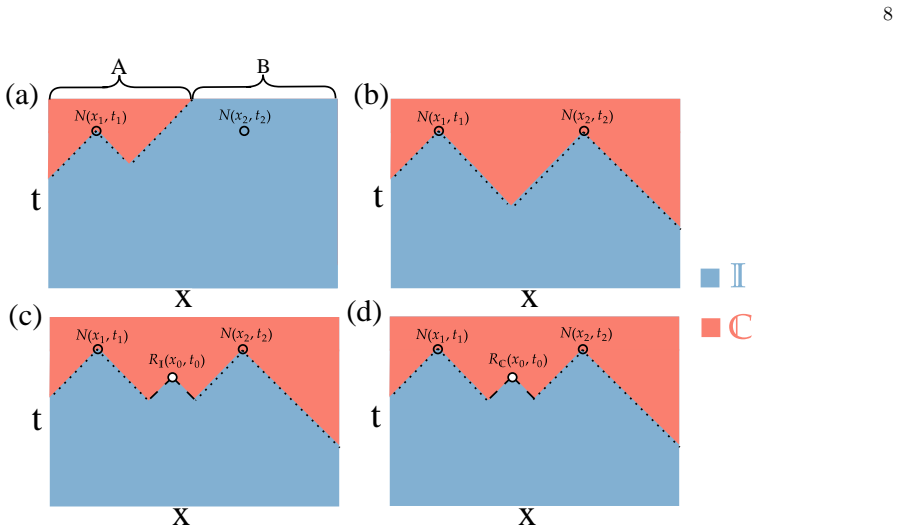
The central object is the replica statistical-mechanics mapping: after averaging over Haar-random gates, permutation spins live on a triangular lattice; quantum noise lowers the weight of non-identity configurations, acting as a symmetry-breaking field, while projective measurements remove bonds and act as a random Gaussian potential. The load-bearing mechanism is the noise-determined domain wall between identity and cyclic-permutation regions, which undergoes Kardar-Parisi-Zhang fluctuations with wandering exponent 2/3; the q^{-1/3} entanglement scaling follows from the free-energy cost of KPZ fluctuations of a domain wall of characteristic length scale ~q^{-1}.
Load-bearing premise
The load-bearing premise is that the large-d replica calculation gives the correct effective statistical model, in which projective measurements make the noise-defined domain wall fluctuate with the KPZ wandering exponent 2/3; if this domain-wall picture fails (for instance, at finite d or if the replica limits do not commute), the predicted q^{-1/3} and q^{-2/3} laws have no derivation.
What would settle it
Direct numerical simulation of a qubit (d=2) brick-wall circuit at small noise rates q with system sizes large enough to see clean scaling: if IA:B(q) deviates from q^{-1/3} (for example, a different exponent or a logarithmic correction) while the volume-law phase is already killed, the central scaling claim is refuted. Likewise, extracting the wandering exponent of the domain wall in the effective statistical model and finding χ ≠ 2/3 would falsify the KPZ mechanism.
If this is right
- Even arbitrarily small noise destroys the measurement-induced volume-law phase, so conventional MIPTs cannot survive in decohering circuits.
- The universal q^{-1/3} law gives a concrete, quantitative prediction for entanglement in noisy intermediate-scale quantum devices.
- Distinguishing uncorrelated versus correlated noise is observable through the information-retention timescale, q^{-1/2} versus q^{-2/3}.
- At noise probability q = p/L, noise-induced entanglement and coding transitions share a critical point, connecting to practical error-correction thresholds.
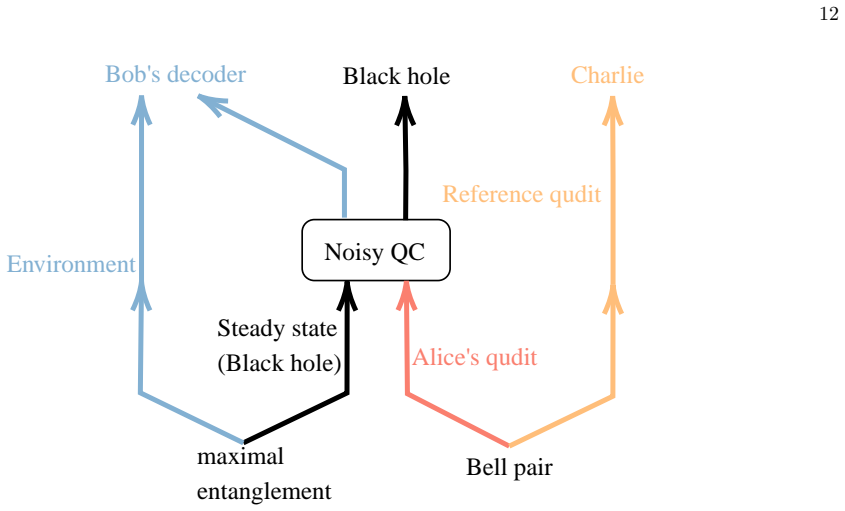
- The Hayden-Preskill-style mapping links information-loss timescales to black-hole evaporation and decoding, suggesting operational probes of information dynamics.
Where Pith is reading between the lines
- The same statistical-model framework likely predicts analogous q^{-1/3} scaling for other non-classical resources, such as magic, in noisy monitored circuits—a testable extension of the paper's claims.
- If the KPZ wandering exponent controls the domain wall, changing the noise disorder geometry (e.g., spatially correlated or quasiperiodic noise) could produce different exponents, a prediction the framework implies but the paper does not explore.
- The claimed absence of a volume-law phase for any q>0 suggests a general no-go statement—local noise always enforces area law in monitored circuits—which could be probed with other noise channels like amplitude damping.
- The Hayden-Preskill analogy suggests a concrete experimental decoder: collecting the noise qudits (the environment) after a time ~q^{-1/2} should suffice to recover Alice's message; a small-scale trapped-ion or superconducting experiment could test this.
Editorial analysis
A structured set of objections, weighed in public.
Referee Report
Summary. This review surveys recent work on noisy monitored quantum circuits, in which random unitary brick-wall circuits are subjected to projective measurements and local quantum noise with probability q. It develops the replica/statistical-model mapping and uses it to organize the field: any infinitesimal noise rate q removes the volume-law phase and produces area-law entanglement with IA:B ~ q^{-1/3} for both temporally uncorrelated and temporally correlated bulk noise (Tables I–II), while information-protection timescales are q^{-1/2} (uncorrelated) and q^{-2/3} (correlated); boundary-localized noise gives L^{1/3} entanglement and O(L^{2/3}) protection. The review also covers noise-induced entanglement, coding, and complexity transitions, and discusses applications to variational algorithms, classical simulation, mixed-state phases, and quantum error mitigation/correction. The central quantitative claims are the q^{-1/3} law and the distinct information-protection exponents, presented as consequences of KPZ-type domain-wall fluctuations in the statistical model.
Significance. If the reported scaling laws hold, the review provides a useful and timely synthesis: it connects entanglement in noisy monitored circuits to KPZ fluctuations, links information protection to the Hayden–Preskill protocol, and presents the exponents in compact tables. The paper is a review rather than an original derivation, but it is valuable for its concise presentation of the replica mapping and its explicit numerical cross-checks (Fig. 3 fits b ≈ −0.350/−0.349 against −1/3; Fig. 6 data collapse). Strengths include the candid admission of the finite-d limitation in the boundary-noise coding transition (§VI.B) and the broad, well-referenced survey of applications. The main caveat is that channel-independence is asserted rather than demonstrated, and the analytic route to the central exponents is not clearly marked as a large-d replica argument whose finite-d validity rests on numerics.
major comments (3)
- [§III.C, Eq. (20)–(21)] The text states that the mapping is illustrated using the reset channel 'though the resulting structure is independent of the specific choice of local noise channel.' This is a load-bearing universality claim: the abstract and §IV.A present q^{-1/3} as a universal scaling in the noise probability q, and Table I makes no channel restriction. Only the reset channel is actually mapped (Eqs. (20)–(21)); no derivation or citation is given for depolarizing, amplitude-damping, or other channels. Different channels have different replica-space actions, so the effective domain-wall length Leff ~ q^{-1} and the KPZ free-energy argument are not obviously channel-independent. Please either supply a derivation for at least one other channel or cite the original computations and state explicitly that channel independence is an expectation inferred from the reset-channel calculation, not a proven gener
- [§IV.A, Eqs. (22)–(24)] The derivation of q^{-1/3} is a heuristic 'random Gaussian potential' argument that relies on two nontrivial assumptions: (i) the large-d replica limit and Weingarten expansion describe the d=2 physics relevant to Fig. 3, and (ii) the n→1 and k→0 limits in Eq. (19) can be interchanged with the disorder average. The text presents these steps as if they were straightforward. Because the review's central claim is the universal exponent, the authors should add an explicit statement of the derivation's status: the analytic route is a large-d statistical-mechanics argument, and its finite-d validity is confirmed by the numerical data shown in Fig. 3 rather than by a controlled analytical calculation. This is especially important in light of the admitted mismatch in §VI.B.
- [§VI.B] The paper admits that the large-d analytical model 'does not qualitatively match numerical results obtained at finite d' for the boundary-noise coding transition. Since the q^{-1/3} and q^{-2/3} exponents in §IV–V are derived with the same large-d replica machinery, the reader needs to know whether this finite-d failure is specific to the boundary-noise setup (where entropic contributions become important) or whether it also affects the bulk-noise scaling. The text discusses the former but should explicitly state that the bulk q^{-1/3} result has direct numerical support at d=2 (Fig. 3), so the mismatch is a known boundary-specific effect rather than a general invalidation of the replica approach in the bulk.
minor comments (6)
- [§III.A, Eqs. (11)–(12)] The notation |σ| is used for the minimal number of transpositions of a permutation, but this is not defined. A one-sentence definition would help readers unfamiliar with permutation-group statistics.
- [§III.C, Eq. (20)] The reset-channel weight is written d^{r−|τ|}; for consistency with Eq. (12), specify the convention for |τ| (distance to the identity permutation) and the channel normalization.
- [Fig. 6] The inset quotes fitted exponents b = −0.350 and −0.349. Please include fit ranges or error bars so the reader can assess the quality of the agreement with −1/3.
- [§VI.A] The constant s0 is introduced as 'a constant' in the free energy s0L. It would be clearer to identify it as the domain-wall free-energy density and to note that it is not fixed by the statistical model but is a non-universal input from microscopic data.
- [Table II] The row 'Subsystem (LA < L/2) without noise' mixes two different protocols (initial-state and steady-state encoding). Consider splitting the row or explaining the protocol in the caption.
- [General] The review would benefit from a brief note that several analytical claims are sketches of published derivations (Refs. [119,120,124,125]) and that the original papers should be consulted for details; this would set the right expectation for the level of rigor.
Circularity Check
No circular derivation chain: the scaling results are applications of established KPZ/directed-polymer scalings with independent numerical checks, not redefinitions of the inputs.
full rationale
The central claims — q^{-1/3} entanglement scaling, q^{-1/2} and q^{-2/3} information-protection timescales — are presented as consequences of a statistical-model mapping: noise sets an effective domain-wall scale L_eff ~ q^{-1} (Sec. IV.A), and projective measurements induce KPZ/DPRE fluctuations whose free-energy correction for length L scales as L^{1/3}, yielding q^{-1/3}; the timescale arguments combine this scale with either Hayden–Preskill light-cone counting (q t^2 ~ 1) or vertical domain-wall wandering (q^{-1})^{2/3}. No equation is defined in terms of the target observable, and no fitted parameter is relabeled as a prediction: the numerical fits in Figs. 3 and 6 are comparisons to, not definitions of, the predicted exponents. The paper explicitly concedes a finite-d failure of the large-d model for the boundary-noise coding transition (Sec. VI.B), which lowers confidence in that derivation but is the opposite of circularity. The load-bearing results are drawn largely from the authors' prior papers [119,120,124,125], but those are cited with reproduced numerical support, and the KPZ exponent itself is standard directed-polymer physics; a review citing and reproducing the authors' earlier work does not constitute a circular derivation. The unsupported assertion of channel-independence in Sec. III.C is a scope/rigor gap, not a self-referential reduction. Therefore no circular step satisfying the quoted-reduction requirement is present.
Axiom & Free-Parameter Ledger
free parameters (1)
- s0 (domain-wall free-energy density)
axioms (6)
- standard math Replica trick and Weingarten large-d expansion produce a ferromagnetic permutation-spin model with positive weights after integrating out τ spins.
- standard math Replica limits n→1 and k→0 can be taken smoothly and commute with the Haar average.
- domain assumption Quantum noise acts as a permutation-symmetry-breaking field that favors the identity spin.
- domain assumption Projective measurements act as a random attractive Gaussian potential inducing KPZ domain-wall wandering with χ=2/3 in 1+1D.
- domain assumption Large-d statistical-model predictions continue to describe finite-d (d=2) numerical data for bulk noise.
- domain assumption Noise probability q = p/L^α is a sensible scaling ansatz for phase transitions.
read the original abstract
Noisy monitored quantum circuits have emerged as a versatile and unifying framework connecting quantum many-body physics, quantum information, and quantum computation. In this review, we provide a comprehensive overview of recent advances in understanding the dynamics of such circuits, with an emphasis on their entanglement structure, information-protection capabilities, and noise-induced phase transitions. A central theme is the mapping to classical statistical models, which reveals how quantum noise reshapes dominant spin configurations. This framework elucidates universal scaling behaviors, including the characteristic $q^{-1/3}$ entanglement scaling with noise probability $q$ and distinct timescales for information protection. We further highlight a broad range of constructions and applications inspired by noisy monitored circuits, spanning variational quantum algorithms, classical simulation methods, mixed-state phases of matter, and emerging approaches to quantum error mitigation and quantum error correction. These developments collectively establish noisy monitored circuits as a powerful platform for probing and controlling quantum dynamics in realistic, decohering environments.
Figures






Forward citations
Cited by 2 Pith papers
-
Light-Cone Structure of Propagation of Entanglement
Existence of an effective light-cone for entanglement propagation in bipartite systems with localized couplings, yielding a hard lower bound on transport time under ideal conditions.
-
Light-Cone Structure of Propagation of Entanglement
Establishes existence of effective light-cone for entanglement propagation in bipartite systems with localized couplings, yielding lower bound on transport time under ideal conditions.
Reference graph
Works this paper leans on
-
[1]
M. P. Fisher, V. Khemani, A. Nahum, and S. Vi- jay, Random quantum circuits, Annual Review of Con- densed Matter Physics 14, 335 (2023)
2023
-
[2]
Chandran and C
A. Chandran and C. R. Laumann, Semiclassical limit for the many-body localization transition, Phys. Rev. B 92, 024301 (2015)
2015
-
[3]
Nahum, J
A. Nahum, J. Ruhman, S. Vijay, and J. Haah, Quantum entanglement growth under random unitary dynamics, Phys. Rev. X 7, 031016 (2017)
2017
-
[4]
Nahum, S
A. Nahum, S. Vijay, and J. Haah, Operator spreading in random unitary circuits, Phys. Rev. X 8, 021014 (2018)
2018
-
[5]
Rakovszky, F
T. Rakovszky, F. Pollmann, and C. W. von Keyserlingk, Diffusive hydrodynamics of out-of-time-ordered correla- tors with charge conservation, Phys. Rev. X 8, 031058 (2018)
2018
-
[6]
Bertini, P
B. Bertini, P. Kos, and T. c. v. Prosen, Exact spectral form factor in a minimal model of many-body quantum chaos, Phys. Rev. Lett. 121, 264101 (2018)
2018
-
[7]
C. W. von Keyserlingk, T. Rakovszky, F. Pollmann, and S. L. Sondhi, Operator hydrodynamics, otocs, and entanglement growth in systems without conservation laws, Phys. Rev. X 8, 021013 (2018)
2018
-
[8]
Khemani, A
V. Khemani, A. Vishwanath, and D. A. Huse, Opera- tor spreading and the emergence of dissipative hydrody- namics under unitary evolution with conservation laws, Phys. Rev. X 8, 031057 (2018)
2018
-
[9]
Zhou and A
T. Zhou and A. Nahum, Emergent statistical mechanics of entanglement in random unitary circuits, Phys. Rev. B 99, 174205 (2019)
2019
-
[10]
Gopalakrishnan and A
S. Gopalakrishnan and A. Lamacraft, Unitary circuits of finite depth and infinite width from quantum channels, Phys. Rev. B 100, 064309 (2019)
2019
-
[11]
Bertini, P
B. Bertini, P. Kos, and T. c. v. Prosen, Exact correla- tion functions for dual-unitary lattice models in 1 + 1 dimensions, Phys. Rev. Lett. 123, 210601 (2019)
2019
-
[12]
Zhou and A
T. Zhou and A. Nahum, Entanglement membrane in chaotic many-body systems, Phys. Rev. X 10, 031066 (2020)
2020
-
[13]
P. Kos, B. Bertini, and T. c. v. Prosen, Correlations in perturbed dual-unitary circuits: Efficient path-integral formula, Phys. Rev. X 11, 011022 (2021)
2021
-
[14]
Foligno, T
A. Foligno, T. Zhou, and B. Bertini, Temporal entan- glement in chaotic quantum circuits, Phys. Rev. X 13, 041008 (2023)
2023
-
[15]
Liu, H.-K
S. Liu, H.-K. Zhang, S. Yin, and S.-X. Zhang, Sym- metry restoration and quantum mpemba effect in sym- metric random circuits, Phys. Rev. Lett. 133, 140405 (2024)
2024
-
[16]
Turkeshi, P
X. Turkeshi, P. Calabrese, and A. De Luca, Quantum mpemba effect in random circuits, Phys. Rev. Lett. 135, 040403 (2025)
2025
-
[17]
Foligno, P
A. Foligno, P. Calabrese, and B. Bertini, Nonequilib- rium dynamics of charged dual-unitary circuits, PRX Quantum 6, 010324 (2025)
2025
-
[18]
Y.-Q. Chen, S. Liu, and S.-X. Zhang, Subsystem Infor- mation Capacity in Random Circuits and Hamiltonian Dynamics, Quantum 9, 1783 (2025)
2025
-
[19]
F. Ares, S. Murciano, P. Calabrese, and L. Piroli, En- tanglement asymmetry dynamics in random quantum circuits, Phys. Rev. Res. 7, 033135 (2025)
2025
-
[20]
H.-Z. Li, C. H. Lee, S. Liu, S.-X. Zhang, and J.-X. Zhong, Quantum mpemba effect in long-ranged u(1)- symmetric random circuits, arXiv:2512.06775 (2025)
arXiv 2025
-
[21]
C.-Y. Zhang, Z.-X. Li, and S.-X. Zhang, Entangle- ment growth from entangled states: A unified per- spective on entanglement generation and transport, arXiv:2510.08344 (2025)
Pith/arXiv arXiv 2025
-
[22]
Z. Li, H. Zheng, J. Liu, L. Jiang, and Z.-W. Liu, De- signs from local random quantum circuits with SU(d) symmetry, PRX Quantum 5, 040349 (2024)
2024
-
[23]
Z. Li, H. Zheng, and Z.-W. Liu, Efficient quantum pseudorandomness under conservation laws, arXiv:2411.04893 (2024)
Pith/arXiv arXiv 2024
-
[24]
Schuster, J
T. Schuster, J. Haferkamp, and H.-Y. Huang, Ran- dom unitaries in extremely low depth, Science 389, 92 (2025)
2025
-
[25]
T. Schuster, F. Ma, A. Lombardi, F. Brandao, and H.- Y. Huang, Strong random unitaries and fast scrambling, arXiv:2509.26310 (2025)
arXiv 2025
-
[26]
L. Cui, T. Schuster, F. Brandao, and H.-Y. Huang, Uni- tary designs in nearly optimal depth, arXiv:2507.06216 (2025)
Pith/arXiv arXiv 2025
- [27]
-
[28]
L. Mao, L. Cui, T. Schuster, and H.-Y. Huang, Ran- dom unitaries that conserve energy, arXiv:2510.08448 (2025)
arXiv 2025
-
[29]
Z. Li, H. Zheng, Y. Wang, L. Jiang, Z.-W. Liu, and J. Liu, SU(d)-symmetric random unitaries: quantum scrambling, error correction, and machine learning, npj Quantum Information 11, 158 (2025)
2025
- [30]
-
[31]
Arute, K
F. Arute, K. Arya, R. Babbush, D. Bacon, J. C. Bardin, R. Barends, R. Biswas, S. Boixo, F. G. S. L. Brandao, D. A. Buell, B. Burkett, Y. Chen, Z. Chen, B. Chiaro, R. Collins, W. Courtney, A. Dunsworth, E. Farhi, B. Foxen, A. Fowler, C. Gidney, M. Giustina, R. Graff, K. Guerin, S. Habegger, M. P. Harrigan, M. J. Hartmann, A. Ho, M. Hoffmann, T. Huang, T. S. ...
2019
-
[32]
M.-C. Chen, R. Li, L. Gan, X. Zhu, G. Yang, C.-Y. Lu, and J.-W. Pan, Quantum-teleportation-inspired al- gorithm for sampling large random quantum circuits, Phys. Rev. Lett. 124, 080502 (2020)
2020
-
[33]
Wu, W.-S
Y. Wu, W.-S. Bao, S. Cao, F. Chen, M.-C. Chen, X. Chen, T.-H. Chung, H. Deng, Y. Du, D. Fan, M. Gong, C. Guo, C. Guo, S. Guo, L. Han, L. Hong, H.-L. Huang, Y.-H. Huo, L. Li, N. Li, S. Li, Y. Li, F. Liang, C. Lin, J. Lin, H. Qian, D. Qiao, H. Rong, H. Su, L. Sun, L. Wang, S. Wang, D. Wu, Y. Xu, K. Yan, W. Yang, Y. Yang, Y. Ye, J. Yin, C. Ying, J. Yu, C. Zh...
2021
-
[34]
Q. Zhu, S. Cao, F. Chen, M.-C. Chen, X. Chen, T.-H. Chung, H. Deng, Y. Du, D. Fan, M. Gong, C. Guo, C. Guo, S. Guo, L. Han, L. Hong, H.-L. Huang, Y.- H. Huo, L. Li, N. Li, S. Li, Y. Li, F. Liang, C. Lin, J. Lin, H. Qian, D. Qiao, H. Rong, H. Su, L. Sun, L. Wang, S. Wang, D. Wu, Y. Wu, Y. Xu, K. Yan, W. Yang, Y. Yang, Y. Ye, J. Yin, C. Ying, J. Yu, C. Zha,...
2022
-
[35]
Morvan, B
A. Morvan, B. Villalonga, X. Mi, S. MandrÃă, A. Bengtsson, P. V. Klimov, Z. Chen, S. Hong, C. Er- ickson, I. K. Drozdov, J. Chau, G. Laun, R. Movas- sagh, A. Asfaw, L. T. A. N. BrandÃčo, R. Peralta, D. Abanin, R. Acharya, R. Allen, T. I. Andersen, K. An- derson, M. Ansmann, F. Arute, K. Arya, J. Atalaya, J. C. Bardin, A. Bilmes, G. Bortoli, A. Bourassa, J...
2024
-
[36]
Huang, R
H.-Y. Huang, R. Kueng, and J. Preskill, Predicting many properties of a quantum system from very few measurements, Nature Physics 16, 1050 (2020)
2020
-
[37]
Elben, S
A. Elben, S. T. Flammia, H.-Y. Huang, R. Kueng, J. Preskill, B. Vermersch, and P. Zoller, The random- ized measurement toolbox, Nature Reviews Physics 5, 9 (2023)
2023
-
[38]
Cerezo, A
M. Cerezo, A. Arrasmith, R. Babbush, S. C. Benjamin, S. Endo, K. Fujii, J. R. McClean, K. Mitarai, X. Yuan, L. Cincio, and P. J. Coles, Variational quantum algo- rithms, Nature Reviews Physics 3, 625 (2021)
2021
-
[39]
Bharti, A
K. Bharti, A. Cervera-Lierta, T. H. Kyaw, T. Haug, S. Alperin-Lea, A. Anand, M. Degroote, H. Heimonen, J. S. Kottmann, T. Menke, W.-K. Mok, S. Sim, L.- C. Kwek, and A. Aspuru-Guzik, Noisy intermediate- scale quantum algorithms, Rev. Mod. Phys. 94, 015004 (2022)
2022
-
[40]
Y. Li, X. Chen, and M. P. A. Fisher, Quantum zeno ef- fect and the many-body entanglement transition, Phys. Rev. B 98, 205136 (2018)
2018
-
[41]
Y. Li, X. Chen, and M. P. A. Fisher, Measurement- driven entanglement transition in hybrid quantum cir- cuits, Phys. Rev. B 100, 134306 (2019)
2019
-
[42]
Skinner, J
B. Skinner, J. Ruhman, and A. Nahum, Measurement- induced phase transitions in the dynamics of entangle- ment, Phys. Rev. X 9, 031009 (2019)
2019
-
[43]
A. Chan, R. M. Nandkishore, M. Pretko, and G. Smith, Unitary-projective entanglement dynamics, Phys. Rev. B 99, 224307 (2019)
2019
-
[44]
M. J. Gullans and D. A. Huse, Dynamical purification phase transition induced by quantum measurements, Phys. Rev. X 10, 041020 (2020)
2020
-
[45]
S. Choi, Y. Bao, X.-L. Qi, and E. Altman, Quan- tum error correction in scrambling dynamics and measurement-induced phase transition, Phys. Rev. Lett. 125, 030505 (2020)
2020
-
[46]
Y. Bao, S. Choi, and E. Altman, Theory of the phase transition in random unitary circuits with measure- ments, Phys. Rev. B 101, 104301 (2020)
2020
-
[47]
Jian, Y.-Z
C.-M. Jian, Y.-Z. You, R. Vasseur, and A. W. W. Lud- wig, Measurement-induced criticality in random quan- tum circuits, Phys. Rev. B 101, 104302 (2020)
2020
-
[48]
Turkeshi, R
X. Turkeshi, R. Fazio, and M. Dalmonte, Measurement- induced criticality in (2 + 1) -dimensional hybrid quan- tum circuits, Phys. Rev. B 102, 014315 (2020)
2020
-
[49]
Zabalo, M
A. Zabalo, M. J. Gullans, J. H. Wilson, S. Gopalakrish- nan, D. A. Huse, and J. H. Pixley, Critical properties of the measurement-induced transition in random quan- tum circuits, Phys. Rev. B 101, 060301 (2020)
2020
-
[50]
Iaconis, A
J. Iaconis, A. Lucas, and X. Chen, Measurement- induced phase transitions in quantum automaton cir- cuits, Phys. Rev. B 102, 224311 (2020)
2020
-
[51]
M. J. Gullans and D. A. Huse, Scalable probes of measurement-induced criticality, Phys. Rev. Lett. 125, 20 070606 (2020)
2020
-
[52]
Ippoliti and V
M. Ippoliti and V. Khemani, Postselection-free entan- glement dynamics via spacetime duality, Phys. Rev. Lett. 126, 060501 (2021)
2021
-
[53]
Lu and T
T.-C. Lu and T. Grover, Spacetime duality between lo- calization transitions and measurement-induced transi- tions, PRX Quantum 2, 040319 (2021)
2021
-
[54]
R. Fan, S. Vijay, A. Vishwanath, and Y.-Z. You, Self- organized error correction in random unitary circuits with measurement, Phys. Rev. B 103, 174309 (2021)
2021
-
[55]
Li and M
Y. Li and M. P. A. Fisher, Statistical mechanics of quan- tum error correcting codes, Phys. Rev. B 103, 104306 (2021)
2021
-
[56]
Ippoliti, T
M. Ippoliti, T. Rakovszky, and V. Khemani, Frac- tal, logarithmic, and volume-law entangled nonthermal steady states via spacetime duality, Phys. Rev. X 12, 011045 (2022)
2022
-
[57]
Z.-C. Yang, Y. Li, M. P. A. Fisher, and X. Chen, En- tanglement phase transitions in random stabilizer tensor networks, Phys. Rev. B 105, 104306 (2022)
2022
-
[58]
Sierant, M
P. Sierant, M. Schirò, M. Lewenstein, and X. Turkeshi, Measurement-induced phase transitions in (d + 1) - dimensional stabilizer circuits, Phys. Rev. B 106, 214316 (2022)
2022
-
[59]
H. Liu, T. Zhou, and X. Chen, Measurement-induced entanglement transition in a two-dimensional shallow circuit, Phys. Rev. B 106, 144311 (2022)
2022
-
[60]
Zhang and G.-M
Q. Zhang and G.-M. Zhang, Noise-induced entangle- ment transition in one-dimensional random quantum circuits, Chinese Physics Letters 39, 050302 (2022)
2022
-
[61]
Han and X
Y. Han and X. Chen, Entanglement dynamics in U(1) symmetric hybrid quantum automaton circuits, Quan- tum 7, 1200 (2023)
2023
-
[62]
S. J. Garratt and E. Altman, Probing postmeasurement entanglement without postselection, PRX Quantum 5, 030311 (2024)
2024
-
[63]
A. A. Akhtar, H.-Y. Hu, and Y.-Z. You, Measurement- induced criticality is tomographically optimal, Phys. Rev. B 109, 094209 (2024)
2024
-
[64]
W. Wang, S. Liu, J. Li, S.-X. Zhang, and S. Yin, Driven critical dynamics in measurement-induced phase transi- tions, arXiv:2411.06648 (2024)
Pith/arXiv arXiv 2024
-
[65]
G. M. Sommers, S. Gopalakrishnan, M. J. Gullans, and D. A. Huse, Zero-temperature entanglement membranes in quantum circuits, Phys. Rev. B 110, 064311 (2024)
2024
-
[66]
S. P. Kelly and J. Marino, Entanglement transitions in- duced by quantum-data collection, Phys. Rev. A 111, L010402 (2025)
2025
-
[67]
S. P. Kelly and J. Marino, Generalizing measurement- induced phase transitions to information exchange sym- metry breaking, Phys. Rev. A 111, 012425 (2025)
2025
-
[68]
W. Wang, S. Liu, J. Li, S.-X. Zhang, and S. Yin, Relax- ation critical dynamics in measurement-induced phase transitions, arXiv:2502.13408 (2025)
arXiv 2025
- [69]
-
[70]
G. Xu and Y.-X. Zhang, Multipartite greenberger- horne-zeilinger entanglement in monitored random clif- ford circuits, arXiv:2407.03206 (2025)
arXiv 2025
-
[71]
Li and Z.-X
Z. Li and Z.-X. Luo, Exact, A verage, and Broken Sym- metries in a Simple Adaptive Monitored Circuit, Quan- tum 9, 1771 (2025)
2025
-
[72]
H. Tang, H.-Y. Wang, Z. Wang, and X.-L. Qi, Mea- surement induced scrambling and emergent symmetries in random circuits, arXiv:2506.18121 (2025)
Pith/arXiv arXiv 2025
-
[73]
Tang and W
Q. Tang and W. Zhu, Measurement-induced phase transition: A case study in the nonintegrable model by density-matrix renormalization group calculations, Phys. Rev. Res. 2, 013022 (2020)
2020
-
[74]
S.-K. Jian, C. Liu, X. Chen, B. Swingle, and P. Zhang, Measurement-induced phase transition in the monitored sachdev-ye-kitaev model, Phys. Rev. Lett. 127, 140601 (2021)
2021
-
[75]
Turkeshi, A
X. Turkeshi, A. Biella, R. Fazio, M. Dalmonte, and M. Schiró, Measurement-induced entanglement transi- tions in the quantum ising chain: From infinite to zero clicks, Phys. Rev. B 103, 224210 (2021)
2021
-
[76]
Sierant, G
P. Sierant, G. Chiriacò, F. M. Surace, S. Sharma, X. Turkeshi, M. Dalmonte, R. Fazio, and G. Pagano, Dissipative Floquet Dynamics: from Steady State to Measurement Induced Criticality in Trapped-ion Chains, Quantum 6, 638 (2022)
2022
-
[77]
Weinstein, R
Z. Weinstein, R. Sajith, E. Altman, and S. J. Gar- ratt, Nonlocality and entanglement in measured critical quantum ising chains, Phys. Rev. B 107, 245132 (2023)
2023
-
[78]
Fuji and Y
Y. Fuji and Y. Ashida, Measurement-induced quantum criticality under continuous monitoring, Phys. Rev. B 102, 054302 (2020)
2020
-
[79]
Lunt and A
O. Lunt and A. Pal, Measurement-induced entangle- ment transitions in many-body localized systems, Phys. Rev. Res. 2, 043072 (2020)
2020
-
[80]
Q. Tang, X. Chen, and W. Zhu, Quantum criticality in the nonunitary dynamics of (2 + 1)-dimensional free fermions, Phys. Rev. B 103, 174303 (2021)
2021
This paper was first reviewed by deepseek-v4-flash on August 3, 2026.
discussion (0)
Sign in with ORCID, Apple, or X to comment. Anyone can read and Pith papers without signing in.