REVIEW 3 major objections 4 minor 4 cited by
GEMINUS: Dual-aware Global and Scene-Adaptive Mixture-of-Experts for End-to-End Autonomous Driving
T0 review · 3 major / 4 minor · reviewed 2026-08-06 · deepseek-v4-flash
Pith's one-line read GEMINUS claims that a dual-aware mixture-of-experts planner, with scenario-specialist experts and a global fallback triggered by routing uncertainty, achieves state-of-the-art closed-loop driving from a single camera.
desk verdict A sensible MoE extension of TCP with honest ablations, but the closed-loop SOTA claim is not yet established because the uncertainty threshold is tuned on the same benchmark used for the headline number, and there are no repeated runs. read the letter →
The pith
A machine-rendered reading of the paper's core claim, the machinery that carries it, and where it could break.
The reading
What carries the argument
The load-bearing mechanism is the Dual-aware Router. Scenario awareness is implemented by a cross-entropy router loss that maps each of the five Bench2Drive scenario categories to its own expert. Uncertainty awareness is implemented as the normalized information entropy of the router's expert-selection probabilities, $U(x) = -\sum_i p_i(x)\log p_i(x) / \log N$, with threshold $\tau=0.5$: for $U(x) \ge \tau$ the model invokes the Global Expert, otherwise it invokes the scene expert with the highest routing score. This mechanism turns router indecision into an explicit fallback switch, which the paper credits for the jump from ScenarioMoE-E2E to GEMINUS.
What would settle it
Run GEMINUS on a held-out set of Bench2Drive routes that were excluded from the threshold sweep, with $\tau$ fixed at 0.5, and compare it against ScenarioMoE-E2E and against the best $\tau$ found on those routes; if fixed $\tau=0.5$ does not outperform the scenario-only model, the uncertainty-fallback claim is not validated.
Extended reading notes
Core claim
The paper claims that driving policies in diverse scenarios are better learned as a hard-assignment mixture: each input goes to one expert rather than being averaged across all experts. During training, the scenario-aware routing assigns samples from five Bench2Drive scenario categories to five dedicated experts using a cross-entropy router loss, while the Global Expert trains on the full dataset. At inference, the Dual-aware Router computes a normalized information entropy of the expert-choice distribution; below a threshold it activates the highest-scoring scene expert, and above that threshold it activates the Global Expert. GEMINUS uses this architecture with monocular vision and reports state-of-the-art Bench2Drive closed-loop results, and its ablation attributes the gain specifically to scenario-aware routing over vanilla MoE and to the uncertainty-based Global Expert fallback over scenario routing alone.
Load-bearing premise
The gain over scenario routing alone rests on one premise: the normalized entropy of the router's expert-choice probabilities measures situation ambiguity, and the threshold $\tau=0.5$, selected on the evaluation benchmark, keeps working on routes it was not tuned for.
Editorial extensions
If this is right
- If the claim holds, a monocular camera plus ego state is enough to beat six-camera systems on closed-loop Bench2Drive by using expert specialization instead of extra sensors.
- The threshold $\tau$ becomes a transparent safety dial: lower values favor adaptive experts, higher values favor the global fallback, and the operating point can be chosen per deployment.
- Routing by predefined scenario categories yields interpretable expert-utilization statistics, making planner behavior easier to audit in specific scenario classes.
- The design suggests that generic LLM-style MoE is not directly useful for driving; only with scenario-level routing does MoE improve over a single expert.
- The reported benchmark gains imply that closed-loop driving rewards short-horizon adaptive skills, such as merging and braking, more than it rewards dense geometric perception alone.
Reading between the lines
- A natural extension the paper does not test is calibrating the uncertainty threshold separately for each scenario, since router accuracy varies widely across the five classes; per-scenario thresholds might improve the fallback policy.
- Because monocular input cannot see rear-approaching vehicles, a multi-camera version could raise router accuracy in give-way situations and reduce unnecessary Global Expert activations; the paper itself lists multi-camera input as future work.
- The same entropy-based gating could be reused as a handoff signal to a non-learned safety controller, treating router indecision as a trigger for conservative behavior rather than only choosing between two learned planners.
- The benchmark gap would be more convincing if the threshold were validated on a held-out split, since the paper selects $\tau=0.5$ from a sweep over the same evaluation set used for the headline result.
Editorial analysis
A structured set of objections, weighed in public.
Referee Report
Summary. GEMINUS proposes a Mixture-of-Experts end-to-end driving framework with a Global Expert, a group of five scene-adaptive experts, and a Dual-aware Router. The router dispatches each input either to the highest-scoring scene expert or, when the normalized entropy of its scenario-classification distribution exceeds a threshold tau, to the Global Expert. Training uses Bench2Drive scenario labels to supervise the router, and the model is evaluated on the Bench2Drive closed-loop benchmark, reporting a Driving Score of 65.39 and a Success Rate of 37.73% with monocular vision only, outperforming prior six-camera methods in Table I. The paper also provides ablations, router accuracy, expert utilization, and qualitative closed-loop examples.
Significance. If the reported results are validated, GEMINUS makes a useful contribution: the combination of a robust global expert with scenario-specialized experts is a sensible answer to the mode-averaging problem in end-to-end driving, and the Dual-aware Router is a concrete, simple mechanism for implementing it. The paper's strengths include a clear ablation chain (Table III), an honest analysis of router accuracy and expert utilization (Tables IV and V), and public code release. However, the central closed-loop SOTA claim currently rests on an uncertainty threshold that is selected on the same benchmark used for the headline numbers, and the paper does not yet demonstrate that the entropy-based fallback is a calibrated measure of planning ambiguity. These issues are fixable but are load-bearing for the headline comparison, so the manuscript needs a major revision before the claims can be accepted as stated.
major comments (3)
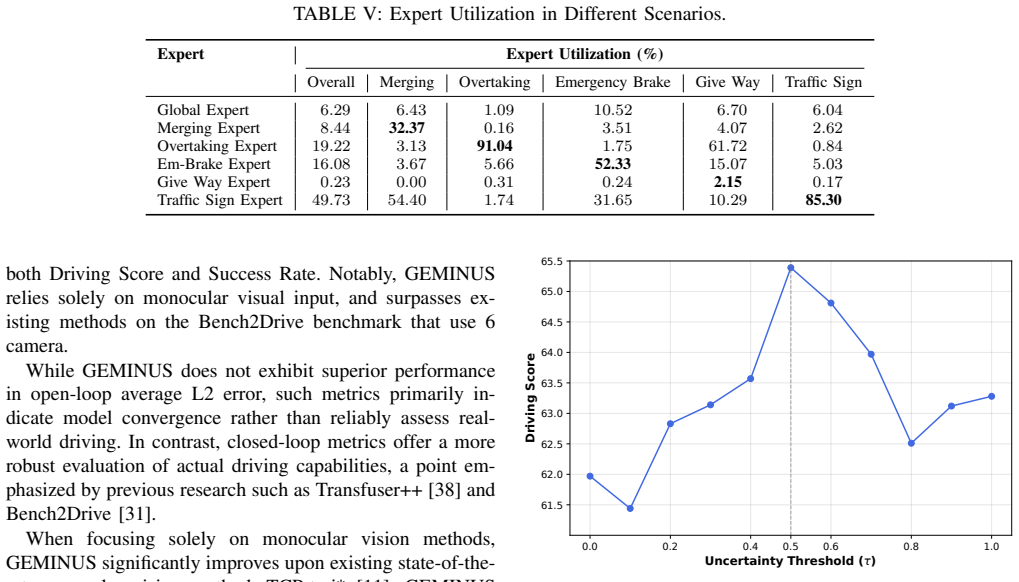
- [Section IV-D, Fig. 4, and Table III] The uncertainty threshold tau=0.5 used in Eq. (2) is selected by sweeping tau over the same 220-route closed-loop Bench2Drive set that produces the headline results in Table I. Since Table III isolates uncertainty-aware routing plus the Global Expert as the only component separating GEMINUS (DS 65.39, SR 37.73) from ScenarioMoE-E2E (DS 62.38, SR 32.27), the reported +3.01 DS and +5.46 SR gains are not distinguishable from benchmark-specific hyperparameter fitting. Please report results on a held-out route split or with a pre-specified threshold, and provide either repeated-run variance estimates or a sensitivity analysis showing that the gain over ScenarioMoE-E2E remains positive over a reasonable interval of tau rather than only at the single optimum.
- [Section III-D, Eq. (5)] The uncertainty measure U(x) is the normalized entropy of the router's scenario-classification probabilities, but the paper does not demonstrate that high-entropy states are precisely the states where the Global Expert is safer or more accurate than the highest-scoring scene expert. The aggregate improvement at tau=0.5 in Fig. 4 is indirect evidence. Please validate the fallback mechanism directly, for example by comparing per-route or per-state closed-loop outcomes under top-expert routing versus Global Expert routing as a function of U(x), or by replacing the entropy with a calibrated planning-uncertainty estimate and showing the result is not sensitive to that choice.
- [Section IV-E, Tables IV and V] The Give Way expert is activated in only 0.23% of samples and has a router accuracy of 2.87%, so the group of five scene-adaptive experts is effectively four experts in operation. This makes it questionable whether the MultiAbility Give Way score of 40.00 in Table II can be attributed to the Give Way expert, and it weakens the claim that the scenario-aware routing provides specialized handling across all five Bench2Drive categories. Please provide a per-expert contribution analysis or explicitly discuss how the Global Expert and the other adaptive experts compensate for the nearly unused Give Way expert, and consider whether the scenario taxonomy should be rebalanced or merged.
minor comments (4)
- [Section IV-B] The text reports percentage improvements such as '9.17% increase in Driving Score' and '25.77% increase in Success Rate' when comparing GEMINUS with TCP-traj*; please clarify whether these are relative or absolute percentage changes, since Table I shows +5.49 points and +7.73 points respectively.
- [Section III-D, Eq. (5)] Equation (5) has a typesetting issue in the displayed formula: the summation and division are rendered ambiguously as '- PN i=1 pi log(pi) / log(N)' rather than as a clear fraction; please fix the LaTeX for readability.
- [Section IV-E] The definition of router prediction accuracy should be stated more precisely for samples that belong to multiple scenario types, since the paper notes that Traffic Sign overlaps with Merging and Emergency Brake; an explicit rule for counting such samples as correct would remove ambiguity.
- [Section IV-A] The implementation details state that the model is trained for 32 epochs with a learning-rate halving after 30 epochs; please clarify whether the reported closed-loop results correspond to the final checkpoint or to the best checkpoint on the open-loop validation set.
Circularity Check
The uncertainty threshold τ=0.5 is selected by sweeping the same Bench2Drive closed-loop benchmark used for the headline result, so the reported SOTA gain of the uncertainty fallback is a fitted input rather than an independent prediction.
-
fitted input called prediction
[Section IV-D (Analysis of Uncertainty Threshold) and Section IV-A Implementation Details; Fig. 4; Tables I and III]
"To investigate the impact of the uncertainty threshold τ on model performance, the uncertainty threshold τ is varied from 0.0 to 1.0 with a step size of 0.1 to conduct a series of closed-loop evaluations on the Bench2Drive Benchmark. As depicted in Fig. 4, the Driving Score shows a trend of initial increase followed by a decrease as τ gradually increases, reaching its optimum at τ=0.5. ... The uncertainty threshold is set to τ=0.5."
Table III isolates the uncertainty-aware routing plus Global Expert as the sole component separating GEMINUS (65.39 Driving Score) from ScenarioMoE-E2E (62.38). The threshold τ is not derived from first principles; Section IV-D sweeps τ over the same 220-route Bench2Drive closed-loop evaluation set used for the headline Table I, and then Implementation Details fixes τ=0.5. Thus the reported improvement of +3.01 Driving Score and +5.46 Success Rate is partly a selection artifact: the headline number is the maximum of a benchmark-specific curve, not a prediction on a held-out or independent evaluation. No held-out routes, repeated runs, or error bars are reported, and the baselines are not given an equivalent benchmark-specific hyperparameter sweep.
full rationale
The architectural derivation of GEMINUS is largely self-contained: the mixture-of-experts formulation is standard, the scenario-aware routing loss is a cross-entropy against predefined Bench2Drive scenario labels, and the uncertainty measure is the normalized entropy of the router's own probabilities (Eqs. 3-5). There is no load-bearing self-citation chain, no imported uniqueness theorem, and no ansatz smuggled in via citation; references to the authors' prior work are not used to justify the central claim. The one significant circularity-adjacent defect is the selection of the uncertainty threshold τ. Section IV-D tunes τ on the exact 220-route Bench2Drive closed-loop benchmark that produces the headline Driving Score and Success Rate, and Section IV-A then fixes τ=0.5. Because the ablation in Table III attributes the entire improvement over ScenarioMoE-E2E to 'uncertainty-aware routing and Global Expert,' the reported gain is partly an artifact of fitting this threshold to the evaluation set. This falls under fitted-input-called-prediction and makes the closed-loop SOTA claim partially circular, but it does not invalidate the architecture or the other ablations; hence a score of 6 rather than 8 or 10.
Assumptions & free parameters
free parameters (3)
- Uncertainty threshold tau =
0.5
- Loss weights (lambda_traj, lambda_F, lambda_V, lambda_Global, lambda_Adaptive, lambda_scenario, lambda_speed) =
1, 0.05, 0.001, 1, 1, 1, 0.05
- Number of scene experts N and scenario-to-expert mapping =
N=5, identity mapping on Bench2Drive categories
assumptions (4)
- domain assumption The five predefined Bench2Drive scenario categories (Merging, Overtaking, Emergency Brake, Give Way, Traffic Sign) are a sufficient partition of driving-scenario diversity.
- domain assumption Entropy of the router's softmax distribution over experts is a valid proxy for scenario ambiguity or uncertainty.
- domain assumption The Bench2Drive closed-loop benchmark and its MultiAbility metrics measure real-world driving competence.
- domain assumption Distillation from Think2Drive expert [18] provides useful supervision for both Global and Adaptive experts.
Cite this review
Pith. "Pith review of GEMINUS: Dual-aware Global and Scene-Adaptive Mixture-of-Experts for End-to-End Autonomous Driving." pith.science (2026). https://pith.science/paper/L46G2RRM
@misc{pith2026250714456,
  author       = {Pith},
  title        = {Pith review of: GEMINUS: Dual-aware Global and Scene-Adaptive Mixture-of-Experts for End-to-End Autonomous Driving},
  year         = {2026},
  howpublished = {\url{https://pith.science/paper/L46G2RRM}},
  note         = {Machine review of arXiv:2507.14456}
}
read the original abstract
End-to-end autonomous driving requires adaptive and robust handling of complex and diverse traffic environments. However, prevalent single-mode planning methods attempt to learn an overall policy while struggling to acquire diversified driving skills to handle diverse scenarios. Therefore, this paper proposes GEMINUS, a Mixture-of-Experts end-to-end autonomous driving framework featuring a Global Expert and a Scene-Adaptive Experts Group, equipped with a Dual-aware Router. Specifically, the Global Expert is trained on the overall dataset, possessing robust performance. The Scene-Adaptive Experts are trained on corresponding scene subsets, achieving adaptive performance. The Dual-aware Router simultaneously considers scenario-level features and routing uncertainty to dynamically activate expert modules. Through the effective coupling of the Global Expert and the Scene-Adaptive Experts Group via the Dual-aware Router, GEMINUS achieves both adaptability and robustness across diverse scenarios. GEMINUS outperforms existing methods in the Bench2Drive closed-loop benchmark and achieves state-of-the-art performance in Driving Score and Success Rate, even with only monocular vision input. The code is available at https://github.com/newbrains1/GEMINUS.
Figures


Figures from the paper (2 more)

Forward citations
Cited by 4 Pith papers
-
OmniSpace: Efficient Geometry Awareness for Autonomous Vehicles MLLMs
OmniSpace is a plug-and-play method that improves spatial reasoning in MLLMs for AV by injecting camera pose, using epipolar attention across views, and distilling 3D geometric knowledge to overcome weak cross-view co...
-
D$^3$-MoE:Dual Disentangled Diffusion Mixture-of-Experts for Style-Controllable End-to-End Autonomous Driving
D³-MoE disentangles style and physical axes with diffusion and self-supervised MoE experts to produce style-controllable trajectories, reporting SOTA 88.2 PDMS on NAVSIM.
-
SpaceDrive: Infusing Spatial Awareness into VLM-based Autonomous Driving
SpaceDrive integrates 3D positional encodings derived from depth and ego-states into VLMs, replacing digit tokens to improve spatial reasoning and trajectory regression in autonomous driving.
-
SpaceDrive: Infusing Spatial Awareness into VLM-based Autonomous Driving
SpaceDrive replaces textual coordinate tokens with shared 3D positional encodings in a VLM driving planner, achieving state-of-the-art open-loop planning on nuScenes and 78.02 Driving Score on Bench2Drive.
Reference graph
Works this paper leans on
-
[1]
End-to-end autonomous driving: Challenges and frontiers,
L. Chen, P. Wu, K. Chitta, B. Jaeger, A. Geiger, and H. Li, “End-to-end autonomous driving: Challenges and frontiers,”IEEE Transactions on Pattern Analysis and Machine Intelligence, 2024
2024
-
[2]
Bev- former: learning bird’s-eye-view representation from lidar-camera via spatiotemporal transformers,
Z. Li, W. Wang, H. Li, E. Xie, C. Sima, T. Lu, Q. Yu, and J. Dai, “Bev- former: learning bird’s-eye-view representation from lidar-camera via spatiotemporal transformers,”IEEE Transactions on Pattern Analysis and Machine Intelligence, 2024
2024
-
[3]
Co-mtp: A cooperative trajectory prediction framework with multi-temporal fu- sion for autonomous driving,
X. Zhang, Z. Zhou, Z. Wang, Y . Ji, Y . Huang, and H. Chen, “Co-mtp: A cooperative trajectory prediction framework with multi-temporal fu- sion for autonomous driving,” in2025 IEEE International Conference on Robotics and Automation (ICRA). IEEE, 2025, pp. 801–807
2025
-
[4]
J. Ji, A. Khajepour, W. W. Melek, and Y . Huang, “Path planning and tracking for vehicle collision avoidance based on model predictive control with multiconstraints,”IEEE Transactions on Vehicular Tech- nology, vol. 66, no. 2, pp. 952–964, 2016
work page 2016
-
[5]
Transfuser: Imitation with transformer-based sensor fusion for au- tonomous driving,
K. Chitta, A. Prakash, B. Jaeger, Z. Yu, K. Renz, and A. Geiger, “Transfuser: Imitation with transformer-based sensor fusion for au- tonomous driving,”IEEE transactions on pattern analysis and machine intelligence, vol. 45, no. 11, pp. 12 878–12 895, 2022
2022
-
[6]
Planning-oriented autonomous driving,
Y . Hu, J. Yang, L. Chen, K. Li, C. Sima, X. Zhu, S. Chai, S. Du, T. Lin, W. Wang,et al., “Planning-oriented autonomous driving,” in Proceedings of the IEEE/CVF conference on computer vision and pattern recognition, 2023, pp. 17 853–17 862
2023
-
[7]
Vad: Vectorized scene representation for efficient autonomous driving,
B. Jiang, S. Chen, Q. Xu, B. Liao, J. Chen, H. Zhou, Q. Zhang, W. Liu, C. Huang, and X. Wang, “Vad: Vectorized scene representation for efficient autonomous driving,” inProceedings of the IEEE/CVF International Conference on Computer Vision, 2023, pp. 8340–8350
2023
-
[8]
Drivetransformer: Unified trans- former for scalable end-to-end autonomous driving,
X. Jia, J. You, Z. Zhang, and J. Yan, “Drivetransformer: Unified trans- former for scalable end-to-end autonomous driving,” inInternational Conference on Learning Representations (ICLR), 2025
work page 2025
Show all 38 references
-
[9]
End-to-end driving via conditional imitation learning,
F. Codevilla, M. M ¨uller, A. L ´opez, V . Koltun, and A. Dosovitskiy, “End-to-end driving via conditional imitation learning,” in2018 IEEE international conference on robotics and automation (ICRA). IEEE, 2018, pp. 4693–4700
2018
-
[10]
Driveadapter: Breaking the coupling barrier of perception and planning in end-to-end autonomous driving,
X. Jia, Y . Gao, L. Chen, J. Yan, P. L. Liu, and H. Li, “Driveadapter: Breaking the coupling barrier of perception and planning in end-to-end autonomous driving,” inProceedings of the IEEE/CVF International Conference on Computer Vision, 2023, pp. 7953–7963
2023
-
[11]
Trajectory-guided control prediction for end-to-end autonomous driving: A simple yet strong baseline,
P. Wu, X. Jia, L. Chen, J. Yan, H. Li, and Y . Qiao, “Trajectory-guided control prediction for end-to-end autonomous driving: A simple yet strong baseline,”Advances in Neural Information Processing Systems, vol. 35, pp. 6119–6132, 2022
2022
-
[12]
Multi-task adaptive gating network for trajectory distilled control prediction,
S. Azam and V . Kyrki, “Multi-task adaptive gating network for trajectory distilled control prediction,”IEEE Robotics and Automation Letters, 2024
2024
-
[13]
Learning lane graph representations for motion forecasting,
M. Liang, B. Yang, R. Hu, Y . Chen, R. Liao, S. Feng, and R. Urta- sun, “Learning lane graph representations for motion forecasting,” in Computer Vision–ECCV 2020: 16th European Conference, Glasgow, UK, August 23–28, 2020, Proceedings, Part II 16. Springer, 2020, pp. 541–556
2020
-
[14]
Exploring the limitations of behavior cloning for autonomous driving,
F. Codevilla, E. Santana, A. M. L ´opez, and A. Gaidon, “Exploring the limitations of behavior cloning for autonomous driving,” inProceed- ings of the IEEE/CVF international conference on computer vision, 2019, pp. 9329–9338
2019
-
[15]
A comprehensive survey of mixture-of-experts: Al- gorithms, theory, and applications,
S. Mu and S. Lin, “A comprehensive survey of mixture-of-experts: Al- gorithms, theory, and applications,”arXiv preprint arXiv:2503.07137, 2025
2025
-
[16]
Learning to drive in a day,
A. Kendall, J. Hawke, D. Janz, P. Mazur, D. Reda, J.-M. Allen, V .-D. Lam, A. Bewley, and A. Shah, “Learning to drive in a day,” in2019 international conference on robotics and automation (ICRA). IEEE, 2019, pp. 8248–8254
2019
-
[17]
End-to- end urban driving by imitating a reinforcement learning coach,
Z. Zhang, A. Liniger, D. Dai, F. Yu, and L. Van Gool, “End-to- end urban driving by imitating a reinforcement learning coach,” in Proceedings of the IEEE/CVF international conference on computer vision, 2021, pp. 15 222–15 232
2021
-
[18]
Think2drive: Efficient reinforce- ment learning by thinking with latent world model for autonomous driving (in carla-v2),
Q. Li, X. Jia, S. Wang, and J. Yan, “Think2drive: Efficient reinforce- ment learning by thinking with latent world model for autonomous driving (in carla-v2),” inEuropean Conference on Computer Vision. Springer, 2024, pp. 142–158
2024
-
[19]
Diffusiondrive: Truncated diffusion model for end-to-end autonomous driving,
B. Liao, S. Chen, H. Yin, B. Jiang, C. Wang, S. Yan, X. Zhang, X. Li, Y . Zhang, Q. Zhang,et al., “Diffusiondrive: Truncated diffusion model for end-to-end autonomous driving,” inProceedings of the Computer Vision and Pattern Recognition Conference, 2025, pp. 12 037–12 047
2025
-
[20]
Boosting rare scenario perception in autonomous driving: An adaptive approach with moes and lora,
Y . Li, Y . Lin, L. Zhong, R. Yin, Y . Ji, C. T. Calafate, and C. Wu, “Boosting rare scenario perception in autonomous driving: An adaptive approach with moes and lora,”IEEE Internet of Things Journal, 2024
2024
-
[21]
Amend: A mixture of experts framework for long-tailed trajectory prediction,
R. C. Mercurius, E. Ahmadi, S. M. A. Shabestary, and A. Rasouli, “Amend: A mixture of experts framework for long-tailed trajectory prediction,”arXiv preprint arXiv:2402.08698, 2024
2024 arXiv
-
[22]
Learning mixture of domain-specific ex- perts via disentangled factors for autonomous driving,
I. Kim, J. Lee, and D. Kim, “Learning mixture of domain-specific ex- perts via disentangled factors for autonomous driving,” inProceedings of the AAAI Conference on Artificial Intelligence, vol. 36, no. 1, 2022, pp. 1148–1156
2022
-
[23]
Safe real-world autonomous driving by learning to predict and plan with a mixture of experts,
S. Pini, C. S. Perone, A. Ahuja, A. S. R. Ferreira, M. Niendorf, and S. Zagoruyko, “Safe real-world autonomous driving by learning to predict and plan with a mixture of experts,” in2023 IEEE International Conference on Robotics and Automation (ICRA). IEEE, 2023, pp. 10 069–10 075
2023
-
[24]
Continual adaptation for autonomous driving with the mix- ture of progressive experts network,
Y . Cui, S. Yang, C. Wan, X. Li, J. Xing, Y . Zhang, Y . Huang, and H. Chen, “Continual adaptation for autonomous driving with the mix- ture of progressive experts network,”arXiv preprint arXiv:2502.05943, 2025
2025 arXiv
-
[25]
Generalizing motion planners with mixture of experts for autonomous driving,
Q. Sun, H. Wang, J. Zhan, F. Nie, X. Wen, L. Xu, K. Zhan, P. Jia, X. Lang, and H. Zhao, “Generalizing motion planners with mixture of experts for autonomous driving,”arXiv preprint arXiv:2410.15774, 2024
2024 arXiv
-
[26]
Eda: Evolving and distinct anchors for multimodal motion prediction,
L. Lin, X. Lin, T. Lin, L. Huang, R. Xiong, and Y . Wang, “Eda: Evolving and distinct anchors for multimodal motion prediction,” in Proceedings of the AAAI Conference on Artificial Intelligence, vol. 38, no. 4, 2024, pp. 3432–3440
2024
-
[27]
Online aggregation of trajectory predictors,
A. Tong, A. Sharma, S. Veer, M. Pavone, and H. Yang, “Online aggregation of trajectory predictors,”arXiv preprint arXiv:2502.07178, 2025
2025 arXiv
-
[28]
Imagenet: A large-scale hierarchical image database,
J. Deng, W. Dong, R. Socher, L.-J. Li, K. Li, and L. Fei-Fei, “Imagenet: A large-scale hierarchical image database,” in2009 IEEE conference on computer vision and pattern recognition. Ieee, 2009, pp. 248–255
2009
-
[29]
Learning phrase representations using rnn encoder-decoder for statistical machine translation,
K. Cho, B. Van Merri ¨enboer, C. Gulcehre, D. Bahdanau, F. Bougares, H. Schwenk, and Y . Bengio, “Learning phrase representations using rnn encoder-decoder for statistical machine translation,”arXiv preprint arXiv:1406.1078, 2014
2014 arXiv
-
[30]
Damex: Dataset-aware mixture-of-experts for visual understanding of mixture-of-datasets,
Y . Jain, H. Behl, Z. Kira, and V . Vineet, “Damex: Dataset-aware mixture-of-experts for visual understanding of mixture-of-datasets,” Advances in Neural Information Processing Systems, vol. 36, pp. 69 625–69 637, 2023
2023
-
[31]
Bench2drive: Towards multi-ability benchmarking of closed-loop end-to-end autonomous driving,
X. Jia, Z. Yang, Q. Li, Z. Zhang, and J. Yan, “Bench2drive: Towards multi-ability benchmarking of closed-loop end-to-end autonomous driving,”arXiv preprint arXiv:2406.03877, 2024
2024 arXiv
-
[32]
A mathematical theory of communication,
C. E. Shannon, “A mathematical theory of communication,”The Bell system technical journal, vol. 27, no. 3, pp. 379–423, 1948
1948
-
[33]
Think twice before driving: Towards scalable decoders for end-to-end autonomous driving,
X. Jia, P. Wu, L. Chen, J. Xie, C. He, J. Yan, and H. Li, “Think twice before driving: Towards scalable decoders for end-to-end autonomous driving,” inProceedings of the IEEE/CVF Conference on Computer Vision and Pattern Recognition, 2023, pp. 21 983–21 994
2023
-
[34]
Genad: Generative end-to-end autonomous driving,
W. Zheng, R. Song, X. Guo, C. Zhang, and L. Chen, “Genad: Generative end-to-end autonomous driving,” inEuropean Conference on Computer Vision. Springer, 2024, pp. 87–104
2024
-
[35]
Don’t shake the wheel: Momentum- aware planning in end-to-end autonomous driving,
Z. Song, C. Jia, L. Liu, H. Pan, Y . Zhang, J. Wang, X. Zhang, S. Xu, L. Yang, and Y . Luo, “Don’t shake the wheel: Momentum- aware planning in end-to-end autonomous driving,” inProceedings of the Computer Vision and Pattern Recognition Conference, 2025, pp. 22 432–22 441
2025
-
[36]
Sparsedrive: End-to-end autonomous driving via sparse scene representation,
W. Sun, X. Lin, Y . Shi, C. Zhang, H. Wu, and S. Zheng, “Sparsedrive: End-to-end autonomous driving via sparse scene representation,”arXiv preprint arXiv:2405.19620, 2024
2024 arXiv
-
[37]
Two tasks, one goal: Uniting motion and planning for excellent end to end autonomous driving performance,
L. Liu, Z. Song, H. Pan, L. Yang, and C. Jia, “Two tasks, one goal: Uniting motion and planning for excellent end to end autonomous driving performance,”arXiv preprint arXiv:2504.12667, 2025
2025 arXiv
-
[38]
Hidden biases of end-to- end driving models,
B. Jaeger, K. Chitta, and A. Geiger, “Hidden biases of end-to- end driving models,” inProceedings of the IEEE/CVF International Conference on Computer Vision, 2023, pp. 8240–8249
2023
Reviewed August 6, 2026 · model on record in the stance chip above.
Discussion (0). Sign in to comment.