REVIEW 4 major objections 5 minor 114 references
The paper claims that the thermal decay rate of a metastable phase is exactly the equilibrium transition-state rate times a dynamical factor (1 minus the re-crossing probability), unifying previously conflicting formulas in thermal field th
Reviewed by Pith at T0; open to challenge. T0 means a machine referee read the full paper against a public rubric. the ladder, T0–T4 →
T0 review · deepseek-v4-flash
2026-08-04 01:07 UTC pith:L7C3LKJV
load-bearing objection A serious, mostly convincing unification of thermal nucleation-rate formulas, with the exactness claim stated a bit stronger than the proof warrants. the 4 major comments →
Dynamics of nucleation in thermal phase transitions
The pith
A machine-rendered reading of the paper's core claim, the machinery that carries it, and where it could break.
Core claim
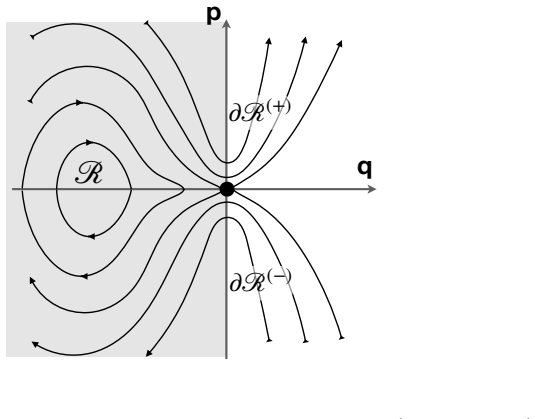
The paper’s central claim is Eq. (13): in the stationary-flux regime, the physical thermal decay rate equals the equilibrium transition-state rate multiplied by a dynamical factor, Γ = Γ_TST (1 − R), with R = R^(+) + R^(−). Here R^(+)/R^(−) are the probabilities that a trajectory crossing the dividing surface outward/inward turns around and ends up on its starting side. The relation is argued to be exact up to corrections of order e^{−E_ts/T} whenever the thermostat is large and fast, and to hold for any dividing surface connecting the deep metastable and stable regions. Because R is a probability, the real rate never exceeds the TST rate. The factorisation is derived twice: by following the
What carries the argument
The load-bearing object is the re-crossing probability R, evaluated from surface-flux ensembles: phase-space initial conditions placed on the dividing surface with weight |n·ż| e^{−H/T}, evolved for times long compared with the dynamical time but short compared with the decay time; the plateau value of the returning fraction defines R^(±). Sloshing re-crossings — trajectories that oscillate one or more times in the false vacuum before finally escaping — constitute the non-perturbative part of R and are the mechanism behind both the weak-damping suppression and the oscillon effect. Dividing-surface independence follows because a change of surface changes Γ_TST and R in compensating direction
Load-bearing premise
That a stationary-flux plateau exists between the dynamical time and the decay time whenever the bath is large and thermalization fast; if the plateau never forms, the 'thermal decay rate' in Eq. (13) is not a well-defined constant.
What would settle it
Measure R from surface-flux ensembles prepared with the fully non-perturbative criticality condition (Appendix C.2) and compare with the quadratic-ensemble results at, say, T/E_ts = 0.02 in the quartic model; a statistically significant difference would show the Gaussian initial-state approximation misses re-crossings that Eq. (13) must include. Equivalently, test the claimed dividing-surface independence by evaluating Γ_TST·(1−R) on a surface moved well away from the TS, where any residual dependence signals a breakdown of the plateau argument.
If this is right
- The dynamical prefactor is always ≤ 1; oscillons and other long-lived sloshing states lower the rate relative to the equilibrium TST prediction, not raise it.
- The steady-state rate is independent of the dividing surface over a wide range, so the troublesome question of choosing the right transition state is circumvented.
- Thermal rates exist only with a large, fast thermostat (t_th ≪ t_dec and heat capacity C ≫ E_ts²/T²); otherwise the rate drifts and decays are non-exponential.
- The surface-flux method computes rates at arbitrarily strong exponential suppression at a cost set by t_plat, exponentially shorter than direct decay simulation.
- The formula unifies the known perturbative prefactor and the non-perturbative weak-damping turnover as the prompt and sloshing contributions, respectively.
Where Pith is reading between the lines
- If Eq. (13) survives scrutiny, cosmological bubble-nucleation estimates at moderate E_ts/T may need revision, since sloshing re-crossings can contribute at a level comparable to perturbative corrections.
- The same re-crossing logic should apply to other thermally activated processes with a dividing surface, such as sphaleron-like transitions or soliton production, where long-lived intermediates could suppress the rate.
- A direct testable corollary: in the quartic model at T/E_ts ≈ 0.04, replacing the Gaussian initial surface ensemble with a fully non-perturbative one should alter R if the quadratic approximation misses essential sloshing states; agreement would strengthen the exactness claim.
- The predicted exponential suppression R_non-pert ∝ exp(−α E_ts/T) with α ≈ 0.044 means the non-perturbative correction is formally exponentially small but numerically significant at moderate suppression, a window accessible to analogue condensed-matter experiments.
Editorial analysis
A structured set of objections, weighed in public.
Referee Report
Summary. The paper develops a general dynamical theory of thermal nucleation in classical systems, centered on Eq. (13): Γ = Γ_TST·(1−R), where the TST rate is corrected by a re-crossing probability R = R^(+) + R^(−). The authors give two derivations (probability-flux evolution and trajectory classification), relate them to the MRT approach, reproduce Langer's dissipative prefactor and the Mel'nikov–Meshkov weak-noise turnover, and implement the surface-flux method in 1+1-dimensional scalar field theory with quartic and Liouville potentials. They report significant non-perturbative 'sloshing' re-crossings, enhanced by oscillons, an exponential fit R_non-pert ∝ exp(−αE_ts/T) with α≈0.044, and a discussion of finite-time and quasi-stationary rates when the thermality conditions (11)–(12) are violated.
Significance. If the central formula is valid, it unifies previously conflicting expressions for the dynamical prefactor, gives a surface-independent definition of the thermal nucleation rate, and yields a numerical algorithm that is exponentially cheaper than direct decay simulations. The paper has notable strengths: two independent derivations that cross-check each other, analytic recovery of known results, public numerical codes, and direct lattice comparisons at selected parameter points. The reported agreement with direct decays at T̂=0.1 and with Langer's formula in the dissipative case is persuasive evidence that the framework is physically sound. The main weakness is that the 'exact modulo exponentially small corrections' claim rests on unproven plateau and ergodicity assumptions that are load-bearing for the definition of R.
major comments (4)
- [Secs. 2.1–2.2, Eqs. (13), (31)] The exactness claim requires R_R^(±)(t) to stabilize to a unique plateau for t_plat ≪ t ≪ t_dec. Conditions (11)–(12) are introduced only as 'appear to be sufficient'; no proof is given that they exclude slow drift of R_R^(±)(t) on time scales up to t_dec, e.g., from long-lived sloshing trajectories or power-law return-time tails. Section 5.2 demonstrates drift when condition (12) is violated, but it does not establish a bound on drift when (12) is satisfied. Because the limit in Eq. (31) defines R, the statement that Eq. (13) is exact up to O(e^{−E_ts/T}) is unsupported. I ask the authors either to prove the plateau under (11)–(12) (or a stronger explicit mixing condition) or to state the plateau as an assumption and soften the exactness claim. A numerical plateau test over a wide time window at fixed small T/E_ts would be a useful partial check.
- [Sec. 2.3, Eqs. (40)–(43)] The trajectory derivation assumes that every trajectory through ∂R has ended in R_in or R_out by time t_plat, and uses this to define θ_in→out(τ_z). This is an additional ergodicity/mixing assertion that is not derived from (11)–(12). The text 'Since any trajectory through ∂R ends up either in R_in or R_out on the time scale t_plat' is asserted, not proven. If some trajectories remain in the layer or re-enter after t_plat, then N_cross(τ_z) and the probabilities in Eq. (43) are not well defined, and the claimed surface independence of Γ is not established. This assumption should be stated explicitly and justified, or the proof completed.
- [Sec. 4.1, App. C.1, Eq. (76), Fig. 8] The quantitative non-perturbative result R_non-pert ∝ exp(−αE_ts/T), α≈0.044, is obtained using the quadratic surface-flux ensemble around the tree-level TS and a set of ad hoc classification thresholds (decay trigger max|ϕ|>10, sloshing marker max|ϕ|<1, R_in/R_out definitions). The paper does not report the sensitivity of the fitted exponent or the perturbative/non-perturbative split to these thresholds or to ensemble preparation choices. Since the claim that sloshing/oscillon re-crossings dominate and follow an exponential law is central to Sec. 4, a threshold scan or a definition-independent check is needed. The direct-decay cross-check at T̂=0.1 is reassuring, but it covers only one parameter point and does not by itself validate Eq. (76).
- [Sec. 5.1, Fig. 15] The finite-time study shows that the rate approaches its late-time value as a power law, Γ_Rref(t)−Γ ∝ t^{−α} with α≈1.4–1.7, and that finite-volume effects modify the asymptotics at smaller L. This supports the concern that the plateau in R_R^(±)(t) may not be a sharp, exactly stationary regime but only an approximate one. The paper should quantify how the plateau value and the 'exact' claim depend on the measurement window and on the finite box size, especially because the algorithm is proposed as a general method for arbitrarily strong exponential suppression.
minor comments (5)
- [Sec. 4.2 / Fig. 11] The text says 'At T/E_ts=0.08 (left plot)' but the caption says 'T/E_ts=0.08 (right)'. Please fix the mismatch.
- [Sec. 2.2, Eq. (23)] The sign convention for I_R(t) at t→0± is confusing. A sentence clarifying whether I_R is the outward probability flux or the rate of change of the probability in R would help readers follow the derivation of Eq. (27).
- [Sec. 5.2.1, Eq. (91)] The connection between the microcanonical rate Γ_mc(E), its ensemble average in Eq. (87), and the time-dependent rate Γ_R(t) of Sec. 2.2 is asserted rather than derived. A brief derivation or explicit mapping would improve rigor.
- [Sec. 2.1, after Eq. (13)] The phrase 'exact modulo exponentially small corrections of order O(e^{−E_ts/T})' could be misread because R_non-pert itself is exponentially small in E_ts/T but with a much smaller coefficient (α≈0.044). It would be helpful to state explicitly that the neglected corrections are relative corrections of order e^{−E_ts/T}, not that R is negligible at that order.
- [Ref. [72]] Reference [72] is listed as 'To appear' with no preprint number. If available, please provide the arXiv number or update the citation.
Circularity Check
No significant circularity: Eq. (13) is derived from the dynamics of surface-flux ensembles and checked against independent analytic and direct-decay benchmarks.
full rationale
The central formula Γ = Γ_TST(1−R) is not fitted or defined into existence. It follows from the exact flux identity in Eqs. (27)/(30), where R_R^(±)(t) are defined as probabilities under surface-flux ensembles, and only the plateau limit in Eq. (31) is identified with the steady-state rate. The dynamics enters through solving the Fokker–Planck equation in Sec. 3.1 or through explicit trajectory sums in Sec. 3.2, not through an input parameter chosen to reproduce the result. The recovery of Langer's formula and of Mel'nikov–Meshkov's turnover formula is an independent check, not an input. Numerically, the re-crossing probabilities are measured from separately prepared surface-flux ensembles and then compared with direct lattice decay rates (Figs. 13–14), so the numerical claim is self-contained against an external benchmark. Some passages cite the authors' own earlier work (Refs. [18,29,73]) for numerical discrepancies, thermalization times, and direct-decay rates; these are comparisons and cross-checks, not load-bearing assumptions in the derivation of Eq. (13). The main caveat in the manuscript is that conditions (11)–(12) 'appear to be sufficient' for the stationary plateau, and Sec. 5.2 explicitly shows drift when they fail; this is a correctness/rigor limitation, not a circularity. Likewise the exponential fit (76) with α≃0.044 is an empirical fit, not a prediction derived from the formula. No circular step can be exhibited by reduction of an output equation to an input.
Axiom & Free-Parameter Ledger
free parameters (5)
- perturbative re-crossing slope (quartic) =
≈1.0 T̂
- perturbative re-crossing slope (Liouville) =
≈3.5 T/E_ts
- non-perturbative sloshing exponent α =
≈0.044
- classification thresholds (decay trigger, sloshing marker, R_in/R_out) =
max|ϕ|>10, max|ϕ|<1, R_in: max|ϕ|<1, R_out: max|ϕ|>3√2, C=3.1√T̂
- plateau time t_plat =
≈50–200/m in the simulations
axioms (8)
- domain assumption Classical regime T_q ≪ T ≪ E_ts; Hamiltonian at most quadratic in momenta (Eq. 5)
- domain assumption Thermostat described by linear damping plus additive white noise with FDT (Eqs. 6–7)
- ad hoc to paper Thermality conditions t_th ≪ t_dec and C ≫ E_ts²/T² are sufficient for a stationary-flux plateau
- ad hoc to paper Every trajectory through ∂R ends in R_in or R_out within t_plat (Sec. 2.3, Eqs. (40)–(43))
- ad hoc to paper Quadratic surface-flux ensemble near the transition state captures both prompt and non-perturbative sloshing re-crossings (Sec. 4.1, App. C.1)
- domain assumption Lattice discretization and symplectic/pseudo-spectral integrators approximate the continuum field theory; finite-size effects are small
- domain assumption Small-noise expansion in 1d mechanics: deviations from the deterministic trajectory are small enough for linearization (Sec. 3.2)
- standard math Liouville theorem and conservation of energy along Hamiltonian flow (Sec. 2.2)
read the original abstract
We study dynamical effects during nucleation in thermal first-order phase transitions in field theory. Focusing on the classical regime of the decay of a metastable state, we present the general formula for the thermal decay rate including the dynamical prefactor and give a recipe for its systematic evaluation. We describe the physical mechanism which reduces the actual thermal decay rate with respect to the statistical rate obtained in equilibrium theory. We also discuss the thermality conditions ensuring the existence of a steady-state thermal rate, in which case our formula is exact up to exponentially small corrections. We show that it reproduces the known results for the nucleation rate in stochastic mechanics and field theory, and allows us to unify and go beyond them. We illustrate this in real-time numerical simulations of simple field theory models. We observe significant non-perturbative contributions which can dominate the dynamical prefactor in weakly-coupled field theories at moderate exponential suppression of the decay rate. We explore the connection of these non-perturbative effects to oscillons. Notably, our numerical method requires exponentially less computing time than direct simulations of decays and is thus applicable to systems with arbitrarily strong exponential suppression. Finally, we discuss small or poorly thermalized systems when the thermality conditions are violated and the steady-state rate does not exist.
Figures


Reference graph
Works this paper leans on
-
[1]
A. Mazumdar and G. White,Review of cosmic phase transitions: their significance and experimental signatures,Rept. Prog. Phys.82(2019) 076901, [1811.01948]
Pith/arXiv arXiv 2019
-
[2]
Gibbs, H
J. Gibbs, H. Bumstead, R. Van Name and W. Longley,The Collected Works of J. Willard Gibbs ...: Thermodynamics. The Collected Works of J. Willard Gibbs. Longmans, Green and Company, 1928
1928
-
[3]
Becker and W
R. Becker and W. D¨ oring,Kinetische behandlung der keimbildung in ¨ ubers¨ attigten d¨ ampfen,Annalen der Physik416(03, 2006) 719 – 752
2006
-
[4]
Wigner,The transition state method,Transactions of the Faraday Society34 (1938) 29–41
E. Wigner,The transition state method,Transactions of the Faraday Society34 (1938) 29–41
1938
-
[5]
Y. B. Zeldovich,On the Theory of New Phase Formation. Cavitation, inSelected Works of Yakov Borisovich Zeldovich, Volume I: Chemical Physics and Hydrodynamics(J. P. Ostriker, G. I. Barenblatt, R. A. Sunyaev, A. Granik and E. Jackson, eds.), vol. 1, pp. 120–137. Princeton University Press, Princeton, 1992
1992
-
[6]
J. W. Cahn and J. E. Hilliard,Free energy of a nonuniform system. I. Interfacial free energy,J. Chem. Phys.28(1958) 258–267
1958
-
[7]
J. S. Langer,Statistical theory of the decay of metastable states,Annals Phys.54 (1969) 258–275
1969
-
[8]
S. R. Coleman,The Fate of the False Vacuum. 1. Semiclassical Theory,Phys. Rev. D 15(1977) 2929–2936
1977
-
[9]
Affleck,Quantum Statistical Metastability,Phys
I. Affleck,Quantum Statistical Metastability,Phys. Rev. Lett.46(1981) 388
1981
-
[10]
A. D. Linde,Fate of the False Vacuum at Finite Temperature: Theory and Applications,Phys. Lett. B100(1981) 37–40
1981
-
[11]
A. D. Linde,Decay of the False Vacuum at Finite Temperature,Nucl. Phys. B216 (1983) 421
1983
-
[12]
C. G. Callan, Jr. and S. R. Coleman,The Fate of the False Vacuum. 2. First Quantum Corrections,Phys. Rev. D16(1977) 1762–1768. 59
1977
-
[13]
E. J. Weinberg,Classical solutions in quantum field theory: Solitons and Instantons in High Energy Physics. Cambridge Monographs on Mathematical Physics. Cambridge University Press, 9, 2012
2012
-
[14]
O. Gould and J. Hirvonen,Effective field theory approach to thermal bubble nucleation,Phys. Rev. D104(2021) 096015, [2108.04377]
Pith/arXiv arXiv 2021
-
[15]
Hanggi, P
P. Hanggi, P. Talkner and M. Borkovec,Reaction-Rate Theory: Fifty Years After Kramers,Rev. Mod. Phys.62(1990) 251–341
1990
-
[16]
Kalikmanov,Nucleation Theory
V. Kalikmanov,Nucleation Theory. Lecture Notes in Physics. Springer Netherlands, 2012
2012
-
[17]
D. P ˆ ırvu, M. C. Johnson and S. Sibiryakov,Bubble velocities and oscillon precursors in first-order phase transitions,JHEP11(2024) 064, [2312.13364]
Pith/arXiv arXiv 2024
-
[18]
D. P ˆ ırvu, A. Shkerin and S. Sibiryakov,Thermal false vacuum decay in (1+1) dimensions: Evidence for nonequilibrium dynamics,Int. J. Mod. Phys. A39(2024) 2445007, [2408.06411]
Pith/arXiv arXiv 2024
-
[19]
J. S. Langer and L. A. Turski,Hydrodynamic model of the condensation of a vapor near its critical point,Phys. Rev. A8(1973) 3230–3243
1973
-
[20]
G. D. Moore,Measuring the broken phase sphaleron rate nonperturbatively,Phys. Rev. D59(1999) 014503, [hep-ph/9805264]
Pith/arXiv arXiv 1999
-
[21]
G. D. Moore and K. Rummukainen,Electroweak bubble nucleation, nonperturbatively, Phys. Rev. D63(2001) 045002, [hep-ph/0009132]
Pith/arXiv arXiv 2001
-
[22]
Ekstedt,Bubble nucleation to all orders,JHEP08(2022) 115, [2201.07331]
A. Ekstedt,Bubble nucleation to all orders,JHEP08(2022) 115, [2201.07331]
Pith/arXiv arXiv 2022
-
[23]
J. Hirvonen,Real-time nucleation and off-equilibrium effects in high-temperature quantum field theories,Phys. Rev. D111(2025) 116020, [2403.07987]
Pith/arXiv arXiv 2025
-
[24]
P. B. Arnold and L. D. McLerran,Sphalerons, Small Fluctuations and Baryon Number Violation in Electroweak Theory,Phys. Rev. D36(1987) 581
1987
-
[25]
D. Croon, O. Gould, P. Schicho, T. V. I. Tenkanen and G. White,Theoretical uncertainties for cosmological first-order phase transitions,JHEP04(2021) 055, [2009.10080]. 60
Pith/arXiv arXiv 2021
- [26]
-
[27]
T. P. Dutka,Committing to bubbles: finding the critical configuration on the lattice, JHEP04(2026) 191, [2509.22057]
arXiv 2026
-
[28]
B. J. Berne,Molecular dynamics and Monte Carlo simulations of rare events, in Multiple Time Scales(J. U. Brackbill and B. I. Cohen, eds.), pp. 419–436. Academic Press, 1985
1985
-
[29]
J. Hirvonen and O. Gould,Langer’s Nucleation Rate Reproduced on the Lattice, Phys. Rev. Lett.136(2026) 081601, [2505.22732]
Pith/arXiv arXiv 2026
-
[30]
J. S. Langer,Metastable states,Physica73(1974) 61–72
1974
-
[31]
L¨ ofgren,Stop comparing resummation methods,J
J. L¨ ofgren,Stop comparing resummation methods,J. Phys. G50(2023) 125008, [2301.05197]
Pith/arXiv arXiv 2023
-
[32]
Chandler,Statistical mechanics of isomerization dynamics in liquids and the transition state approximation,J
D. Chandler,Statistical mechanics of isomerization dynamics in liquids and the transition state approximation,J. Chem. Phys.68(1978) 2959–2970
1978
-
[33]
M. Barroso Mancha and G. D. Moore,The sphaleron rate from 4D Euclidean lattices, JHEP01(2023) 155, [2210.05507]
Pith/arXiv arXiv 2023
-
[34]
K. Rummukainen, R. Sepp¨ a and D. J. Weir,Lattice study of the critical bubble in the SU(8) deconfinement transition,Phys. Rev. D114(2026) 014515, [2603.22088]
arXiv 2026
-
[35]
S. R. Coleman,The Uses of Instantons,Subnucl. Ser.15(1979) 805
1979
-
[36]
M. A. Amin and D. Shirokoff,Flat-top oscillons in an expanding universe,Phys. Rev. D81(2010) 085045, [1002.3380]
Pith/arXiv arXiv 2010
-
[37]
H.-Y. Zhang, M. A. Amin, E. J. Copeland, P. M. Saffin and K. D. Lozanov,Classical Decay Rates of Oscillons,JCAP07(2020) 055, [2004.01202]
Pith/arXiv arXiv 2020
-
[38]
D. G. Levkov, V. E. Maslov, E. Y. Nugaev and A. G. Panin,An Effective Field Theory for large oscillons,JHEP12(2022) 079, [2208.04334]
Pith/arXiv arXiv 2022
-
[39]
D. G. Levkov and V. E. Maslov,Analytic description of monodromy oscillons,Phys. Rev. D108(2023) 063514, [2306.06171]. 61
Pith/arXiv arXiv 2023
-
[40]
M. Gleiser, B. Rogers and J. Thorarinson,Bubbling the False Vacuum Away,Phys. Rev. D77(2008) 023513, [0708.3844]
Pith/arXiv arXiv 2008
-
[41]
Gleiser, E
M. Gleiser, E. W. Kolb and R. Watkins,Phase transitions with subcritical bubbles, Nucl. Phys. B364(1991) 411–450
1991
-
[42]
Gleiser,Pseudostable bubbles,Phys
M. Gleiser,Pseudostable bubbles,Phys. Rev. D49(1994) 2978–2981, [hep-ph/9308279]
Pith/arXiv arXiv 1994
-
[43]
V. I. Mel’nikov and S. V. Meshkov,Theory of activated rate processes: Exact solution of the Kramers problem,J. Chem. Phys.85(1986) 1018–1027
1986
-
[44]
Bodeker,Classical real time correlation functions and quantum corrections at finite temperature,Nucl
D. Bodeker,Classical real time correlation functions and quantum corrections at finite temperature,Nucl. Phys. B486(1997) 500–514, [hep-th/9609170]
Pith/arXiv arXiv 1997
-
[45]
G. Aarts and J. Smit,Classical approximation for time dependent quantum field theory: Diagrammatic analysis for hot scalar fields,Nucl. Phys. B511(1998) 451–478, [hep-ph/9707342]
Pith/arXiv arXiv 1998
-
[46]
L. D. Landau and E. M. Lifshitz,Statistical Physics: V. 5: Course of Theoretical Physics. Pergamon press, 1980
1980
-
[47]
O. Fialko, B. Opanchuk, A. I. Sidorov, P. D. Drummond and J. Brand,Fate of the false vacuum: towards realization with ultra-cold atoms,EPL110(2015) 56001, [1408.1163]
Pith/arXiv arXiv 2015
-
[48]
O. Fialko, B. Opanchuk, A. I. Sidorov, P. D. Drummond and J. Brand,The universe on a table top: engineering quantum decay of a relativistic scalar field from a metastable vacuum,J. Phys. B50(2017) 024003, [1607.01460]
Pith/arXiv arXiv 2017
-
[49]
T. P. Billam, K. Brown and I. G. Moss,False-vacuum decay in an ultracold spin-1 Bose gas,Phys. Rev. A105(2022) L041301, [2108.05740]
Pith/arXiv arXiv 2022
-
[50]
B. Song, S. Dutta, S. Bhave, J.-C. Yu, E. Carter, N. Cooper et al.,Realizing discontinuous quantum phase transitions in a strongly correlated driven optical lattice,Nature Phys.18(2022) 259–264, [2105.12146]
Pith/arXiv arXiv 2022
-
[51]
Tian et al.,Supercooling of the A phase of 3He,Nature Commun.14(2023) 148, [2208.14981]
Y. Tian et al.,Supercooling of the A phase of 3He,Nature Commun.14(2023) 148, [2208.14981]. 62
Pith/arXiv arXiv 2023
-
[52]
A. Zenesini, A. Berti, R. Cominotti, C. Rogora, I. G. Moss, T. P. Billam et al.,False vacuum decay via bubble formation in ferromagnetic superfluids,Nature Phys.20 (2024) 558–563, [2305.05225]
Pith/arXiv arXiv 2024
-
[53]
A. C. Jenkins, J. Braden, H. V. Peiris, A. Pontzen, M. C. Johnson and S. Weinfurtner,Analog vacuum decay from vacuum initial conditions,Phys. Rev. D 109(2024) 023506, [2307.02549]
Pith/arXiv arXiv 2024
-
[54]
A. C. Jenkins, I. G. Moss, T. P. Billam, Z. Hadzibabic, H. V. Peiris and A. Pontzen, Generalized cold-atom simulators for vacuum decay,Phys. Rev. A110(2024) L031301, [2311.02156]
arXiv 2024
-
[55]
S. Darbha, M. Kornjaˇ ca, F. Liu, J. Balewski, M. R. Hirsbrunner, P. L. S. Lopes et al.,False vacuum decay and nucleation dynamics in neutral atom systems,Phys. Rev. B110(2024) 155103, [2404.12360]
Pith/arXiv arXiv 2024
-
[56]
Zhu et al.,Probing false vacuum decay on a cold-atom gauge-theory quantum simulator,2411.12565
Z.-H. Zhu et al.,Probing false vacuum decay on a cold-atom gauge-theory quantum simulator,2411.12565
-
[57]
R. Cominotti, C. Baroni, C. Rogora, D. Andreoni, G. Guarda, G. Lamporesi et al., Observation of Temperature Effects on False Vacuum Decay in Atomic Quantum Gases,Phys. Rev. Lett.135(2025) 183401, [2504.03528]
arXiv 2025
-
[58]
H. A. Kramers,Brownian motion in a field of force and the diffusion model of chemical reactions,Physica7(1940) 284–304
1940
-
[59]
Zwanzig,Nonlinear Generalized Langevin Equations,J
R. Zwanzig,Nonlinear Generalized Langevin Equations,J. Stat. Phys.9(1973) 215–220
1973
-
[60]
Caldeira and A
A. Caldeira and A. Leggett,Quantum tunnelling in a dissipative system,Annals of Physics149(1983) 374–456
1983
-
[61]
Grabert,Escape from a Metastable Well: The Kramers Turnover Problem,Phys
H. Grabert,Escape from a Metastable Well: The Kramers Turnover Problem,Phys. Rev. Lett.61(1988) 1683–1686
1988
-
[62]
Pollak, H
E. Pollak, H. Grabert and P. H¨ anggi,Theory of activated rate processes for arbitrary frequency dependent friction: Solution of the turnover problem,J. Chem. Phys.91 (1989) 4073–4087
1989
-
[63]
Weiss,Quantum Dissipative Systems
U. Weiss,Quantum Dissipative Systems. World Scientific, 2021. 63
2021
-
[64]
O. T. Valls and G. F. Mazenko,Nucleation in a time-dependent Ginzburg-Landau model: A numerical study,Phys. Rev. B42(Oct, 1990) 6614–6622
1990
-
[65]
S. Borsanyi, A. Patkos, J. Polonyi and Z. Szep,Fate of the classical false vacuum, Phys. Rev. D62(2000) 085013, [hep-th/0004059]
Pith/arXiv arXiv 2000
-
[66]
L. Batini, A. Chatrchyan and J. Berges,Real-time dynamics of false vacuum decay, Phys. Rev. D109(2024) 023502, [2310.04206]
Pith/arXiv arXiv 2024
-
[67]
S. M. Soskin, V. Sheka, T. Linnik, M. Array´ as, I. K. Kaufman, D. Luchinsky et al., Noise-induced escape on time scales preceding quasistationarity: New developments in the Kramers problem,Chaos11(2001) 595–604
2001
-
[68]
G. D. Moore, K. Rummukainen and A. Tranberg,Nonperturbative computation of the bubble nucleation rate in the cubic anisotropy model,JHEP04(2001) 017, [hep-lat/0103036]
Pith/arXiv arXiv 2001
-
[69]
P. G. Bolhuis, D. Chandler, C. Dellago and P. L. Geissler,Transition path sampling: Throwing ropes over rough mountain passes, in the dark,Annual review of physical chemistry53(2002) 291–318
2002
-
[70]
W. H. Miller,Classical-limit quantum mechanics and the theory of molecular collisions,Advances in Chemical Physics(1974) 69–177
1974
-
[71]
D. J. Tannor and D. Kohen,Derivation of Kramers’ formula for condensed phase reaction rates using the method of reactive flux,J. Chem. Phys.100(1994) 4932–4940
1994
-
[72]
Gould, J
O. Gould, J. Hirvonen, A. Shkerin and S. Sibiryakov,To appear,
-
[73]
A. Shkerin and S. Sibiryakov,Simple third order operator-splitting schemes for stochastic mechanics and field theory,Comput. Phys. Commun.326(2026) 110208, [2504.03844]
Pith/arXiv arXiv 2026
-
[74]
D. Boyanovsky, C. Destri and H. J. de Vega,The Approach to thermalization in the classicalϕ 4 theory in (1+1)-dimensions: Energy cascades and universal scaling,Phys. Rev. D69(2004) 045003, [hep-ph/0306124]
Pith/arXiv arXiv 2004
-
[75]
C. Destri and H. J. de Vega,Ultraviolet cascade in the thermalization of the classical phi**4 theory in 3+1 dimensions,Phys. Rev. D73(2006) 025014, [hep-ph/0410280]. 64
Pith/arXiv arXiv 2006
-
[76]
Forest and R
E. Forest and R. D. Ruth,Fourth order symplectic integration,Physica D43(1990) 105–117
1990
-
[77]
C. E. Klots,Evaporative cooling,J. Chem. Phys.83(1985) 5854–5860
1985
-
[78]
Hansen, J
K. Hansen, J. U. Andersen, P. Hvelplund, S. P. M¨ oller, U. V. Pedersen and V. V. Petrunin,Observation of a1/t Decay Law for Hot Clusters and Molecules in a Storage Ring,Phys. Rev. Lett.87(2001) 123401
2001
-
[79]
J. U. Andersen, E. Bonderup and K. Hansen,Thermionic emission from clusters,J. Phys. B: At. Mol. Opt. Phys.35(2002) R1
2002
-
[80]
Hansen,Decay dynamics in molecular beams,Mass Spectrometry Reviews40 (2021) 725–740
K. Hansen,Decay dynamics in molecular beams,Mass Spectrometry Reviews40 (2021) 725–740
2021
discussion (0)
Sign in with ORCID, Apple, or X to comment. Anyone can read and Pith papers without signing in.