REVIEW 3 major objections 5 minor 45 references
Generic Tracking and Probabilistic Prediction Framework and Its Application in Autonomous Driving
T0 review · 3 major / 5 minor · reviewed 2026-08-14 · deepseek-v4-flash
Pith's one-line read A constrained mixture sequential Monte Carlo method tracks multiple targets and predicts their joint future motions in one recursive Bayesian loop, without explicit data association.
desk verdict A useful modular framework whose Bayesian correctness is undercut by a mismatch between the implemented measurement-dependent proposal and the transition-prior weight update. read the letter →
The pith
A machine-rendered reading of the paper's core claim, the machinery that carries it, and where it could break.
The reading
What carries the argument
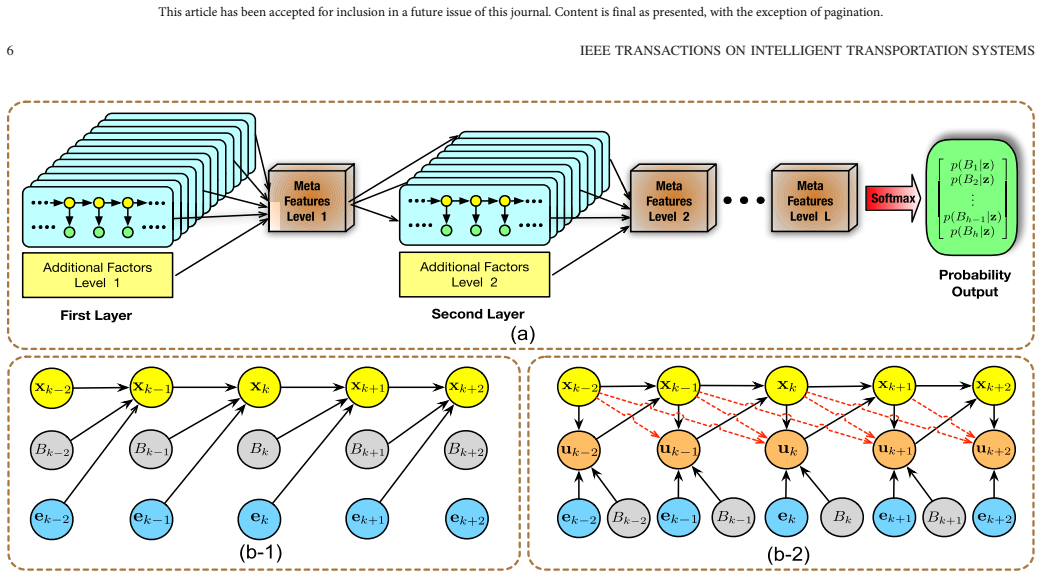
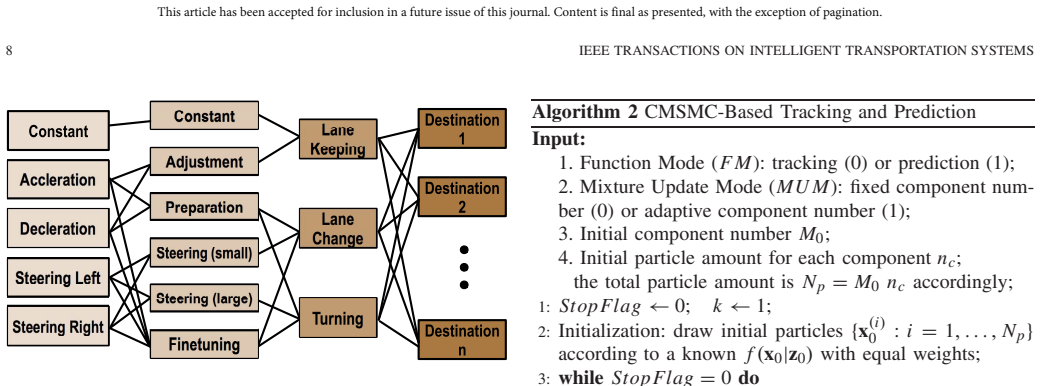
The central object is the constrained mixture sequential Monte Carlo filter, built on a mixture posterior and a self-contained particle state $p_k^{(i)} = [x_k^{(i)}, w_k^{(i)}, \bar{w}_k^{(i)}, c_k^{(i)}, \pi_k^{(i)}, I_k^{(i)}]$, which holds the state vector, normalized and unnormalized weights, the mixture component identity, the component weight, and a feasibility indicator. The recursion samples new particles from an arbitrary proposal distribution (here the HTSPM), computes importance weights from the transition prior and measurement likelihood, updates component weights, reclusters particles, and adaptively adds, removes, or merges components. The HTSPM has two modules: a multi-layer Deep Hidden Markov Model that outputs posterior behavior-class probabilities, and a behavior-conditional evolution module (conditional Gaussian mixture regression, probabilistic MLP, or probabilistic LSTM) that propagates particle states. The component identity is what lets multiple target hypotheses coexist, and the feasibility indicator is what enforces kinematic and rule-based constraints.
What would settle it
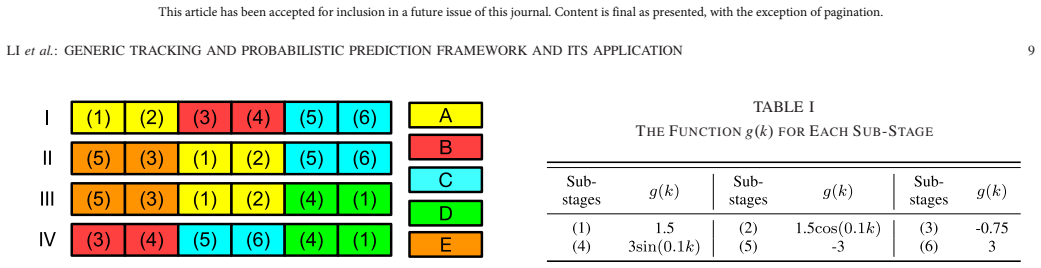
Take a low-dimensional system with known ground-truth dynamics and a fixed measurement model, run CMSMC with a proposal that conditions on current measurements, and compare the particle posterior against an exact grid-based solution for increasing particle counts. If the $\ell^1$ error does not shrink at roughly $1/\sqrt{N_p}$, or if the sample mean of the ratio of the full importance weight to the simplified weight in Eq. (21) differs from 1 beyond Monte Carlo error, the unbiased-Bayesian claim is refuted.
Extended reading notes
Core claim
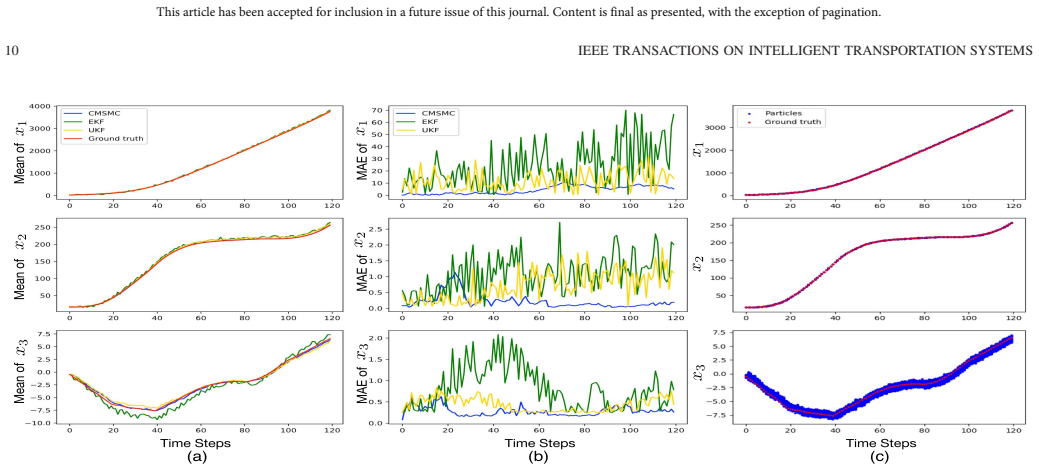
The central claim is that a constrained mixture sequential Monte Carlo framework can maintain a multi-modal posterior over the joint state of several tracked agents and use that same posterior for prediction in one Bayesian recursion. The mixture representation $$f(x_k|z^k)=\sum_{m=1}^{M} \pi_{m,k}\, f_m(x_k|z^k)$$ keeps distinct behavior or target hypotheses alive, so no explicit data association is required: each particle carries a component identity, and component weights are updated from measurement likelihoods. With the HTSPM as the implicit proposal, particles are proposed by first sampling a behavior class from the recognition module and then evolving the state under a behavior-conditional model. The measurement update then reweights particles by likelihood; constraints are enforced by rejecting or resampling infeasible particles; and reclustering with component birth, death, and merge adapts the mixture to changing target counts and occlusions. The paper argues that this inherits the standard sequential Monte Carlo convergence guarantee, at rate $1/\sqrt{N_p}$ per component, and demonstrates improved tracking and prediction accuracy on real highway trajectories compared with extended/unscented Kalman filters, kinematic models, and behavior-unconditional networks.
Load-bearing premise
The load-bearing premise is that the proposal distribution used to propose new particles does not depend on the current measurement, since the particle weights are updated with the simplified formula (21); the recognition module of the prediction model, however, uses current and recent observations, so if that dependence matters, the weights are biased and the filter is not exactly the Bayesian posterior it claims to be.
Editorial extensions
If this is right
- The same code path handles both tracking and prediction: in prediction mode the measurement update is skipped, so occlusion or sensor failure is treated as a missing measurement rather than a separate failure case.
- Any probabilistic or even deterministic predictor that can be sampled can serve as the proposal, so a planner's existing learned motion model can be reused directly inside the tracking filter.
- Multi-modality is preserved over time because mixture components are reweighted rather than collapsed into a single Gaussian; the output is a distribution over joint future trajectories, not one trajectory.
- With component birth, death, and merge, the number of tracked targets can vary over time without requiring explicit target identification or assignment.
- If the convergence argument holds, increasing the particle count improves both tracking and prediction accuracy at the standard Monte Carlo rate, giving a predictable accuracy-versus-compute trade-off.
Reading between the lines
- Because CMSMC is proposal-agnostic, a direct test of the paper's simplification is to rerun the highway experiments with a proposal that uses only past observations and compare tracking error and predictive calibration; if accuracy is unchanged, the simplified weight update is sufficient.
- The mixture recursion is not vehicle-specific: any multi-agent time-series problem with hierarchically separable behaviors, such as pedestrian crossings, robot teammates, or air traffic, can reuse the same filter as long as a measurement likelihood exists.
- The component weights generated by the filter can be read as an online behavior-confidence signal for downstream planning and risk assessment, a use the paper mentions only indirectly.
Signed reviews
Editorial analysis
A structured set of objections, weighed in public.
Referee Report
Summary. The paper proposes a constrained mixture sequential Monte Carlo (CMSMC) framework for multi-target tracking and probabilistic multi-agent prediction, together with a hierarchical time-series prediction model (HTSPM) composed of a deep hidden Markov model recognition module and several candidate state-evolution modules. The CMSMC method represents the posterior as a mixture of particle-filter components, avoids explicit data association, handles occlusions through a measurement-missing assertion, and adaptively adds/removes/merges components. The HTSPM is used as an implicit proposal distribution inside the CMSMC recursion. The framework is evaluated on a synthetic nonlinear case study and on the NGSIM highway dataset for vehicle tracking, behavior recognition, and trajectory prediction, with quantitative and qualitative comparisons against Kalman-filter variants, kinematic models, and behavior-unconditional learning-based models.
Significance. If the Bayesian derivation were correct, the paper would offer a useful unified treatment of multi-target tracking and interactive trajectory prediction, with a modular design that allows arbitrary prediction models to serve as proposals. Strengths of the work include the generic problem formulation, the explicit handling of state constraints, the adaptive mixture mechanism, and a substantial empirical evaluation on held-out NGSIM data with ablations over recognition, evolution model, and interaction effects. The qualitative multi-modal prediction results are plausible and the ablative analysis is informative. However, the central claim that the algorithm performs recursive Bayesian state estimation with standard SMC convergence guarantees is undermined by a load-bearing inconsistency between the implemented proposal distribution and the importance-weight update, as detailed in the major comments. The significance of the paper therefore depends on whether that inconsistency can be repaired within the manuscript's scope.
major comments (3)
- [Section III-D.2, Eq. (21) with Algorithms 1 and 2] The simplified weight update (21) is valid only when the proposal equals the transition prior f_m(x_k | x_{k-1}, e_{k-1}) independent of the current measurement z_k. The manuscript states this proposal is used in all experiments, but the actual implementation described in Algorithm 2 line 4 calls Algorithm 1, whose recognition phase computes f_hat(B_{k-1} | z_k) from the current observation sequence and uses these probabilities to sample behavior, action, and next state. The resulting proposal is measurement-conditioned, so the correct importance weight in (13) must include the proposal density in the denominator. Omitting it biases every particle weight, and using z_k both in the proposal and in the likelihood double-counts the same evidence. Consequently, the particle set does not approximate the posterior f(x_k | z_k) claimed in Section III-B, and the convergence results of Section III-C are invoked for a recursion that is not the one actually implemented.
- [Eq. (24) and Section IV] The state-transition approximation f_hat(x_k | x_{k-1}, e_{k-1}) in Eq. (24) integrates over f_hat(B_{k-1} | z_k), conditioning the transition on the current measurement z_k. In the recursive Bayesian formulation of Eq. (2), the transition density must be independent of the current measurement; otherwise the same measurement is used twice, once in the transition/proposal and once in the likelihood f_m(z_k | x_k). This breaks the filtering interpretation regardless of which importance-weight formula is used. The authors should either condition behavior recognition only on past observations z_{k-1} (or a fixed-lag window ending before k), or introduce the behavior as an explicit latent variable with its own transition and include it in the particle state.
- [Section III-C] The convergence analysis is a sketch rather than a proof. Propositions 1 and 2 are stated for canonical sequential Monte Carlo, and the text asserts that mixture decomposability and the reclustering step do not affect convergence, but no proof is provided. The reclustering step reassigns component memberships, and the adaptive Add/Remove/Merge mechanism changes the number of components; neither operation is part of the standard SMC recursion analyzed in the cited literature. If the convergence claims are retained, the authors need either to prove that these operations leave the approximating measure invariant in the required norm or to explicitly limit the convergence statement to the fixed-component, reclustering-free version of the algorithm.
minor comments (5)
- [Eq. (23)] The effective sample size formula appears garbled: the notation /Sigma1 and μ is undefined and the displayed expression is not the standard approximation N_eff ≈ 1 / sum_i (w_k^(i))^2. Please correct it.
- [Algorithm 2, line 4] The index x_{k-1}^{(i-1)} should presumably be x_{k-1}^{(i)}; as written it refers to a particle index that does not match the loop variable.
- [Algorithm 1, lines 6-7] The loop appends one likelihood per window of length T_l, but the text does not specify how the likelihood sequences from different HMMs are aligned or normalized before concatenation; a brief clarifying sentence would improve reproducibility.
- [Index Terms] The keyword 'bahavior' should be spelled 'behavior'.
- [Eqs. (10)-(11)] The symbol f_hat is used for different objects in Eq. (10) (a trajectory estimate) and Eq. (11) (the empirical marginal measure); distinct notations would avoid confusion.
Circularity Check
No circular derivation: the CMSMC recursion and HTSPM are self-contained against trained inputs and held-out NGSIM data.
full rationale
The paper's central recursion (Eqs. (2)-(8), (12)-(16)) is a standard SMC importance-sampling construction: the proposal distribution appears explicitly in the weight update (13)/(15), and the simplified update (21) is explicitly derived from the choice (20) of the transition prior as proposal. No fitted parameter is renamed as a prediction: the DHMM and evolution models are trained on the NGSIM training split and evaluated on a disjoint test split (Section VII-B), and the numerical case study uses trajectories generated from a known model (27). The self-citations to the authors' prior work, e.g., the CGMR evolution model 'adapted and generalized' from [26], are implementation components with independent published content and do not carry the load of the tracking theorem; the convergence argument is imported from Künsch [37], an external source. The most serious flaw in the paper is not circularity: Section III-D.2 states that proposal (20), independent of z_k, was used in all experiments, but Algorithm 1's recognition phase conditions the sampled behavior and action on the current observation sequence z_k, and Eq. (24) makes that dependence explicit. Under a z_k-dependent proposal the simplified weights (21)/(22) omit the proposal denominator and bias the posterior estimate, so the claimed Bayesian recursion and its convergence guarantees are not matched by the implemented sampler. That is a correctness/implementation gap, not a reduction of the output to the input by construction, and it does not make the empirical comparisons fitted: the experiments remain held-out evaluations. No circular step satisfying the quote-and-reduction standard was found.
Assumptions & free parameters
free parameters (5)
- Mixture component count M =
not reported for NGSIM; M0 initial in Algorithm 2
- DHMM period lengths T_l =
not reported
- Calibration parameters alpha_h =
not reported
- Resampling threshold N_th =
not reported
- History horizon T =
not reported
assumptions (5)
- domain assumption The posterior can be represented as a mixture of M components, and the recursive update (5)-(8) preserves this mixture form.
- ad hoc to paper The reclustering and adaptive component adjustment do not change the estimated posterior, so standard SMC convergence (Propositions 1-2) applies to the full CMSMC algorithm.
- ad hoc to paper The proposal distribution used in tracking is independent of the current measurement z_k, so the weight update (21) is valid.
- domain assumption Exterior information e_{k-1} is independent of the state x_{k-1}.
- domain assumption A fixed window of the most recent T observations is sufficient for behavior recognition.
Cite this review
Pith. "Pith review of Generic Tracking and Probabilistic Prediction Framework and Its Application in Autonomous Driving." pith.science (2026). https://pith.science/paper/L7PTERYU
@misc{pith2026190809031,
  author       = {Pith},
  title        = {Pith review of: Generic Tracking and Probabilistic Prediction Framework and Its Application in Autonomous Driving},
  year         = {2026},
  howpublished = {\url{https://pith.science/paper/L7PTERYU}},
  note         = {Machine review of arXiv:1908.09031}
}
read the original abstract
Accurately tracking and predicting behaviors of surrounding objects are key prerequisites for intelligent systems such as autonomous vehicles to achieve safe and high-quality decision making and motion planning. However, there still remain challenges for multi-target tracking due to object number fluctuation and occlusion. To overcome these challenges, we propose a constrained mixture sequential Monte Carlo (CMSMC) method in which a mixture representation is incorporated in the estimated posterior distribution to maintain multi-modality. Multiple targets can be tracked simultaneously within a unified framework without explicit data association between observations and tracking targets. The framework can incorporate an arbitrary prediction model as the implicit proposal distribution of the CMSMC method. An example in this paper is a learning-based model for hierarchical time-series prediction, which consists of a behavior recognition module and a state evolution module. Both modules in the proposed model are generic and flexible so as to be applied to a class of time-series prediction problems where behaviors can be separated into different levels. Finally, the proposed framework is applied to a numerical case study as well as a task of on-road vehicle tracking, behavior recognition, and prediction in highway scenarios. Instead of only focusing on forecasting trajectory of a single entity, we jointly predict continuous motions for interactive entities simultaneously. The proposed approaches are evaluated from multiple aspects, which demonstrate great potential for intelligent vehicular systems and traffic surveillance systems.
Figures

Figures from the paper (8 more)



Reference graph
Works this paper leans on
-
[1]
S. Sivaraman and M. M. Trivedi, “Looking at vehicles on the road: A survey of vision-based vehicle detection, tracking, and behav- ior analysis,” IEEE Trans. Intell. Transp. Syst. , vol. 14, no. 4, pp. 1773–1795, Dec. 2013
work page 2013
-
[2]
Deep track- ing in the wild: End-to-end tracking u sing recurrent neural networks,
J. Dequaire, P. Ondrúška, D. Rao , D. Wang, and I. Posner, “Deep track- ing in the wild: End-to-end tracking u sing recurrent neural networks,” Int. J. Robot. Res. , vol. 37, nos. 4–5, pp. 492–512, 2018. [ 3 ] S .E .L i et al. , “Kalman filter-based tracking of moving objects using linear ultrasonic sensor array for road vehicles,” Mech. Syst. Signal Proce...
work page 2018
-
[4]
W. Liu, H. He, and F. Sun, “Vehicle state estimation based on min- imum model error criterion combining with extended Kalman filter,” J. Franklin Inst., vol. 353, pp. 834–856, Mar. 2016
work page 2016
-
[5]
Object tracking based on an extended Kalman filter in high dynamic driving situations,
A. Kamann, J. B. Bielmeier, S. Hasirlioglu, U. T. Schwarz, and T. Brandmeier, “Object tracking based on an extended Kalman filter in high dynamic driving situations,” in Proc. 20th Int. Conf. Intell. Transp. Syst., Oct. 2017, pp. 1–6
work page 2017
-
[6]
H. Yu, J. Duan, S. Taheri, H. Cheng, and Z. Qi, “A model predictive control approach combined unscented Kalman filter vehicle state estima- tion in intelligent vehicle trajectory tracking,” Adv. Mech. Eng.,v o l .7 , no. 5, pp. 1–14, 2015
work page 2015
-
[7]
A tutorial on particle filters for online nonlinear/non-Gaussian Bayesian tracking,
M. S. Arulampalam, S. Maskell, N. Gordon, and T. Clapp, “A tutorial on particle filters for online nonlinear/non-Gaussian Bayesian tracking,” IEEE Trans. Signal Process. , vol. 50, no. 2, pp. 174–188, Feb. 2002
work page 2002
-
[8]
Particle filte r theory and practice with positioning applications,
F. Gustafsson, “Particle filte r theory and practice with positioning applications,” IEEE Aerosp. Electron. Syst. Mag. , vol. 25, no. 7, pp. 53–82, Jul. 2010
work page 2010
-
[9]
A particle-filtering approach for vehicular tracking adaptive to occlu- sions,
J. Scharcanski, A. B. de Oliveira, P. G. Cavalcanti, and Y . Yari, “A particle-filtering approach for vehicular tracking adaptive to occlu- sions,”IEEE Trans. Veh. Technol., vol. 60, no. 2, pp. 381–389, Feb. 2011
work page 2011
Show all 45 references
-
[10]
Evidential grid-based tracking and mapping,
G. Tanzmeister and D. Wollherr, “Evidential grid-based tracking and mapping,” IEEE Trans. Intell. Transp. Syst. , vol. 18, no. 6, pp. 1454–1467, Jun. 2017
2017
-
[11]
A Bayesian filter for modeling traffic at stop intersections,
T. Wyder, G. Schildbach, S. Lefèvre, and F. Borrelli, “A Bayesian filter for modeling traffic at stop intersections,” in Proc. IEEE Intell. Veh. Symp., Jun./Jul. 2015, pp. 1252–1257
2015
-
[12]
Interactive scene prediction for automotive applications,
A. Lawitzky, D. Althoff, C. F. Passenberg, G. Tanzmeister, D. Wollherr, and M. Buss, “Interactive scene prediction for automotive applications,” in Proc. IEEE Intell. Veh. Symp. , Jun. 2013, pp. 1028–1033
2013
-
[13]
A survey on motion prediction and risk assessment for intelligent vehicles,
S. Lefevre, D. Vasquez, and C. Laugier, “A survey on motion prediction and risk assessment for intelligent vehicles,” Robomech J.,v o l .1 ,p .1 , Jul. 2014
2014
-
[14]
Model-based probabilistic collision detection in autonomous driving,
M. Althoff, O. Stursberg, and M. Buss, “Model-based probabilistic collision detection in autonomous driving,” IEEE Trans. Intell. Transp. Syst., vol. 10, no. 2, pp. 299–310, Jun. 2009
2009
-
[15]
Generic probabilis- tic interactive situation recognition and prediction: From virtual to real,
J. Li, H. Ma, W. Zhan, and M. Tomizuka, “Generic probabilis- tic interactive situation recognition and prediction: From virtual to real,” in Proc. IEEE 21st Int. Conf. Intell. Transp. Syst. , Nov. 2018, pp. 3218–3224
2018
-
[16]
Safe and feasible motion generation for autonomous driving via constrained policy net,
W. Zhan, J. Li, Y . Hu, and M. Tomizuka, “Safe and feasible motion generation for autonomous driving via constrained policy net,” in Proc. 43rd Annu. Conf. IEEE Ind. Electron. Soc. (IECON) , Oct./Nov. 2017, pp. 4588–4593
2017
-
[17]
Dynamic occupancy grid prediction for urban autonomous driving: A deep learning approach with fully automatic labeling,
S. Hoermann, M. Bach, and K. Di etmayer, “Dynamic occupancy grid prediction for urban autonomous driving: A deep learning approach with fully automatic labeling,” in Proc. IEEE Int. Conf. Robot. Automat. , May 2018, pp. 2056–2063
2018
-
[18]
Kalman filtering with state constraints: A survey of linear and nonlinear algorithms,
D. Simon, “Kalman filtering with state constraints: A survey of linear and nonlinear algorithms,” IET Control Theory Appl. , vol. 4, no. 8, pp. 1303–1318, Aug. 2010
2010
-
[19]
Truncation nonlinear filters for state estimation with nonlinear inequality constraints,
O. Straka, J. Duník, and M. Šim andl, “Truncation nonlinear filters for state estimation with nonlinear inequality constraints,” Autom atica, vol. 48, no. 2, pp. 273–286, 2012
2012
-
[20]
Bayesian estimation via sequential Monte Carlo sampling— Constrained dynamic systems,
L. Lang, W.-S. Chen, B. R. Baks hi, P. K. Goel, and S. Ungarala, “Bayesian estimation via sequential Monte Carlo sampling— Constrained dynamic systems,” Automatica, vol. 43, no. 9, pp. 1615–1622, 2007
2007
-
[21]
Constrained Bayesian state estimation—A comparative study and a new particle filter based approach,
X. Shao, B. Huang, and J. M. Lee, “Constrained Bayesian state estimation—A comparative study and a new particle filter based approach,” J. Process Control, vol. 20, no. 2, pp. 143–157, 2010
2010
-
[22]
Maintaining multimodality through mixture tracking,
J. Vermaak, A. Doucet, and P. Pérez, “Maintaining multimodality through mixture tracking,” in Proc. 9th IEEE Int. Conf. Comput. Vis. , Oct. 2003, pp. 1110–1116
2003
-
[23]
Probabilistic analysis of dynamic scenes and collision risks assessment to improve driving safety,
C. Laugier et al., “Probabilistic analysis of dynamic scenes and collision risks assessment to improve driving safety,” IEEE Intell. Transp. Syst. Mag., vol. 3, no. 4, pp. 4–19, Oct. 2011
2011
-
[24]
Learni ng and inferring a driver’s braking action in car-following scenarios,
W. Wang, J. Xi, and D. Zhao, “Learni ng and inferring a driver’s braking action in car-following scenarios,” IEEE Trans. Veh. Technol., vol. 67, no. 5, pp. 3887–3899, May 2018
2018
-
[25]
A layered HMM for predicting motion of a leader in multi-robot settings,
S. Solaimanpour and P. Doshi, “A layered HMM for predicting motion of a leader in multi-robot settings,” in Proc. Int. Conf. Robot. Automat. , May/Jun. 2017, pp. 788–793
2017
-
[26]
Generic vehicle tracking framework capable of handling occlusions based on modified mixture particle filter,
J. Li, W. Zhan, and M. Tomizuka, “ Generic vehicle tracking framework capable of handling occlusions based on modified mixture particle filter,” in Proc. IEEE Intell. Veh. Symp. , Jun. 2018, pp. 936–942
2018
-
[27]
Towards a fatality- aware benchmark of probabilistic reaction prediction in highly inter- active driving scenarios,
W. Zhan, L. Sun, Y . Hu, J. Li, and M. Tomizuka, “Towards a fatality- aware benchmark of probabilistic reaction prediction in highly inter- active driving scenarios,” in Proc. 21st Int. Conf. Intell. Transp. Syst. , Nov. 2018, pp. 3274–3280
2018
-
[28]
Object-oriented Bayesian networks for detection of lane change maneuvers,
D. Kasper et al. , “Object-oriented Bayesian networks for detection of lane change maneuvers,” IEEE Intell. Transp. Syst. Mag. , vol. 4, no. 3, pp. 19–31, Aug. 2012
2012
-
[29]
Mobile agent trajectory prediction using Bayesian nonpa rametric reachability trees,
G. Aoude, J. Joseph, N. Roy, and J. How, “Mobile agent trajectory prediction using Bayesian nonpa rametric reachability trees,” in Proc. Infotech Aerosp., 2011, p. 1512
2011
-
[30]
DESIRE: Distant future prediction in dynamic scenes with interacting agents,
N. Lee, W. Choi, P. Vernaza, C. B. Choy, P. H. S. Torr, and M. Chandraker, “DESIRE: Distant future prediction in dynamic scenes with interacting agents,” in Proc. IEEE Conf. Comput. Vis. Pattern Recognit., Jul. 2017, pp. 336–345
2017
-
[31]
Wasserstein genera- tive learning with kinematic constraints for probabilistic interactive driving behavior prediction,
H. Ma, J. Li, W. Zhan, and M. To mizuka, “Wasserstein genera- tive learning with kinematic constraints for probabilistic interactive driving behavior prediction,” in Proc. IEEE Intell. Veh. Symp. , 2019, pp. 2241–2247
2019
-
[32]
Interaction-aware multi-agent tracking and probabilistic behavior prediction via adversarial learning,
J. Li, H. Ma, and M. Tomizuka, “Interaction-aware multi-agent tracking and probabilistic behavior prediction via adversarial learning,” in Proc. IEEE Int. Conf. Robot. Autom. , 2019, pp. 6658–6664
2019
-
[33]
Conditional generative neural system for probabilistic trajectory prediction,
J. Li, H. Ma, and M. Tomizuka, “Conditional generative neural system for probabilistic trajectory prediction,” in Proc. IEEE/RSJ Int. Conf. Intell. Robots Syst. , 2019
2019
-
[34]
Coordination and trajectory prediction for vehicle interactions via Bayesian generative modeling,
J. Li, H. Ma, W. Zhan, and M. Tomizuka, “Coordination and trajectory prediction for vehicle interactions via Bayesian generative modeling,” in Proc. IEEE Intell. Veh. Symp. , 2019, pp. 2260–2267
2019
-
[35]
Probabilistic long-term vehicle motion prediction and tracking in large environments,
M. Shan, S. Worrall, and E. Nebot, “Probabilistic long-term vehicle motion prediction and tracking in large environments,” IEEE Trans. Intell. Transp. Syst., vol. 14, no. 2, pp. 539–552, Jun. 2013
2013
-
[36]
Convergence of sequential Monte Carlo meth- ods,
D. Crisan and A. Doucet, “Convergence of sequential Monte Carlo meth- ods,” Signal Process. Group, Dept. Eng. , Univ. Cambridge, Cambridge, U.K., Tech. Rep. CUEDIF-INFENGrrR38, 2000, vol. 1
2000
-
[37]
Recursive Monte Carlo filters: Algorithms and the- oretical analysis,
H. R. Künsch, “Recursive Monte Carlo filters: Algorithms and the- oretical analysis,” A nn. Statist. , vol. 33, no. 5, pp. 1983–2021, 2005
1983
-
[38]
Comparis on of resampling schemes for particle filtering,
R. Douc and O. Cappé, “Comparis on of resampling schemes for particle filtering,” in Proc. 4th Int. Symp. Image Signal Process. Anal., Sep. 2005, pp. 64–69
2005
-
[39]
Hidden Markov models and the Baum–Welch algo- rithm,
L. R. Welch, “Hidden Markov models and the Baum–Welch algo- rithm,” IEEE Inf. Theory Soc. Newslett. , vol. 53, no. 4, pp. 10–13, Dec. 2003
2003
-
[40]
Recognition, tracking, and optimisation,
X. Xie, M. Jones, and G. Tam, “Recognition, tracking, and optimisation,” Int. J. Comput. Vis. , vol. 122, no. 3, pp. 409–410, 2017
2017
-
[41]
Modelling the human lane-change execution behaviour through mul- tilayer perceptrons and convolutional neural networks,
A. Díaz-Álvarez, M. Clavijo, F. Jiménez, E. Talavera, and F. Serradilla, “Modelling the human lane-change execution behaviour through mul- tilayer perceptrons and convolutional neural networks,” Transp. Res. F , Traffic Psychol. Behav., vol. 56, pp. 134–148, Jul. 2018
2018
-
[42]
Long short-term memory,
S. Hochreiter and J. Schmi dhuber, “Long short-term memory,” Neural Comput., vol. 9, no. 8, pp. 1735–1780, 1997
1997
-
[43]
Progressive Bayes: A new framework for nonlinear state estimation,
U. D. Hanebeck, K. Briechle, a nd A. Rauh, “Progressive Bayes: A new framework for nonlinear state estimation,” Proc. SPIE, vol. 5099, pp. 256–268, Apr. 2003
2003
-
[44]
US highway 101 dataset,
J. Colyar and J. Halkias, “US highway 101 dataset,” Federal High- way Admin., Washington, DC, USA, Tech. Rep. FHWA-HRT-07-030, 2007
2007
-
[45]
A critical evaluation of the next generation sim- ulation (NGSIM) vehicle trajectory dataset,
B. Coifman and L. Li, “A critical evaluation of the next generation sim- ulation (NGSIM) vehicle trajectory dataset,” Transp. Res. B, Methodol., vol. 105, pp. 362–377, Nov. 2017
2017
-
[46]
Comparison and evaluation of advanced motion models for vehicle tracking,
R. Schubert, E. Richter, and G. Wani elik, “Comparison and evaluation of advanced motion models for vehicle tracking,” in Proc. 11th Int. Conf. Inf. Fusion, Jun./Jul. 2008, pp. 1–6. This article has been accepted for inclusion in a future issue of this journal. Content is fina...
2013
Reviewed August 14, 2026 · model on record in the stance chip above.
Discussion (0). Continue with ORCID to comment.