REVIEW 1 major objections 5 minor 4 cited by
Understanding Model Calibration -- A gentle introduction and visual exploration of calibration and the expected calibration error (ECE)
T0 review · 1 major / 5 minor · reviewed 2026-08-09 · deepseek-v4-flash
Pith's one-line read The paper argues that the Expected Calibration Error, despite documented weaknesses, remains the default calibration metric, and that multi-class, class-wise, and human-uncertainty calibration are needed alternatives.
desk verdict A clear visual primer on calibration and ECE that deserves a read for teaching, but the printed ECE formula is ill-typed and must be corrected before anyone copies it. read the letter →
The pith
A machine-rendered reading of the paper's core claim, the machinery that carries it, and where it could break.
The reading
What carries the argument
The object that carries the argument is the ECE formula itself, $$\mathrm{ECE}=\sum_{m=1}^{M}\frac{|B_m|}{n}\left|\mathrm{acc}(B_m)-\mathrm{conf}(B_m)\right|,$$ with bins $B_m$ of equal width in confidence. The post's visual step-by-step example makes visible how the formula behaves: only the maximum predicted probability contributes, and the bin count $M$ is arbitrary, so the same data can yield different ECE values and even empty or single-sample bins that dominate the weighting. The alternative calibration definitions replace the scalar 'maximum confidence' target with a richer one—the full vector $\mathbf{q}$ for multi-class calibration, a single per-class coordinate for class-wise calibration, and a per-sample human label distribution for human-uncertainty calibration. These targets in turn require different evaluation measures, such as class-wise ECE, KS-test based checks, and the EntCE, RankCS, and DistCE scores.
What would settle it
Take a set of classifiers trained on a standard 10-class image benchmark. Compute ECE with equal-width bins for $M=5,10,15,20$ and with equal-mass adaptive bins, then check whether the ranking of classifiers by ECE is stable across binning choices. If the rankings are largely stable, the practical force of the binning objection would be weakened; if rankings flip, the paper's warning is confirmed in a concrete setting.
Extended reading notes
Core claim
The central claim is that the most common calibration score, ECE, can give a misleading picture of how well a model's confidences match reality. The author demonstrates this through a worked example with 9 samples and 5 bins, then shows that changing to 10 bins empties several bins and changes the score. The underlying reasons are that ECE only checks the maximum class probability, that its binning scheme is a free choice with no neutral default, and that a degenerate model can achieve zero ECE while being useless. The paper then presents three alternative calibration notions that repair these blind spots: multi-class calibration, which compares against the full prediction vector; class-wise calibration, which checks each class probability in isolation; and human-uncertainty calibration, which matches predictions to distributions of annotator labels. On the paper's view, choosing among these notions should depend on the application, and ECE alone is not a safe summary.
Load-bearing premise
The load-bearing premise is that the cited critiques of ECE—binning sensitivity, the maximum-probability restriction, and the low-ECE pathologies—are accurately characterized and representative, and that the 9-sample toy example illustrates behavior that holds for larger real-world model outputs.
Editorial extensions
If this is right
- If ECE continues to be reported, the bin count and binning scheme should be stated, because different choices produce different values and can change how models compare.
- Reporting accuracy alongside ECE and a proper scoring rule such as Brier score or log-loss would guard against the pathology where low ECE coexists with poor predictions.
- Applications that act on the full probability vector, such as autonomous driving or medical triage, should supplement confidence calibration with class-wise or multi-class calibration checks.
- Datasets with substantial annotator disagreement should be evaluated with human-uncertainty measures such as DistCE rather than against aggregated gold labels.
- Choosing a calibration notion should be driven by the decision context, not by convenience of the ECE computation.
Reading between the lines
- A natural extension the author leaves implicit is a sensitivity diagnostic: plotting ECE against a sweep of bin counts for a fixed model would turn the toy demonstration into a practical tool for judging whether a reported ECE is stable.
- The taxonomy suggests a testable hypothesis: class-wise calibration errors can remain hidden in a confidence-calibrated model because per-class deviations cancel when only maximum probabilities are binned; a benchmark comparing the two notions on real classifiers could show how often this happens.
- The human-uncertainty section implies a data requirement question: how many annotations per item are needed for DistCE to be reliable, since the measure depends on accurate human judgment distributions; this could be studied by subsampling annotation sets.
- One could operationalize the paper's message by proposing a reporting standard that includes a reliability diagram, a binning-sweep curve, and a per-class breakdown alongside any scalar calibration error.
Editorial analysis
A structured set of objections, weighed in public.
Referee Report
Summary. This manuscript is an educational blog post that introduces confidence calibration and the Expected Calibration Error (ECE). After defining confidence calibration, it presents the standard binned ECE formula and walks through a nine-sample, five-bin toy example that yields ECE = 0.10445. It then summarizes three families of criticisms of ECE: calibration pathologies, binning sensitivity, and the restriction to maximum predicted probabilities. The second half introduces multi-class calibration, class-wise calibration, and human-uncertainty calibration, together with evaluation measures such as class-wise ECE, ACE/TACE, KS-test-based checks, EntCE, RankCS, and DistCE. The post explicitly disclaims being an in-depth survey and positions itself as a visual introduction; its central message is that ECE remains widely used despite documented weaknesses and that alternative notions of calibration deserve attention.
Significance. As an educational synthesis, the post's value lies in its clarity and breadth. The toy example is helpful, the figures are clear, and the criticisms and alternative measures are attributed to the primary literature (Naeini et al., 2015; Guo et al., 2017; Kumar et al., 2018; Nixon et al., 2019; Roelofs et al., 2022; Baan et al., 2022, among others). The post does not make new empirical or theoretical claims and provides no code or data, but for a gentle introduction that is acceptable. If the ECE definition is corrected, the post would be a reliable starting point for practitioners who want to understand why ECE should not be used as the sole calibration metric.
major comments (1)
- [Section 2, equations for acc(B_m) and conf(B_m)] The definitions of acc and conf are inconsistent: conf(B_m) = (1/|B_m|) * sum_{i in B_m} p_hat(x_i) averages K-dimensional probability vectors, while acc(B_m) is a scalar, so the expression acc(B_m) - conf(B_m) is ill-typed. The prose and the worked example use only the maximum probability per sample, so the intended definition is conf(B_m) = (1/|B_m|) * sum_{i in B_m} max_k p_hat_k(x_i). As printed, a reader cannot evaluate the central ECE equation or reproduce the reported value ECE = 0.10445. Please correct the formula and introduce a scalar notation for the maximum confidence (e.g., c_i) throughout Section 2.
minor comments (5)
- [Section 1.1] The definition conditions on the event max(p_hat(X)) = c, which has probability zero for continuous predictive distributions; consider noting that this is shorthand for a binned or conditional-expectation formulation.
- [Section 2.1.1 / Figure 9] The statement that 'half the bins now contain no samples' after going from 5 to 10 bins depends on the bin boundaries for the nine-sample example; please show the bin occupancy counts or qualify the wording.
- [Section 3.3.3] In the RankCS formula, the sum runs over n but the indicator uses the index i; fix the index and specify whether argsort is taken in ascending or descending order.
- [Section 3.3.3] The symbol y_i denotes a scalar label in Section 2 but a distribution over classes in Section 3.3.3; use a distinct symbol (e.g., s_i or q_i) for the soft label to avoid ambiguity.
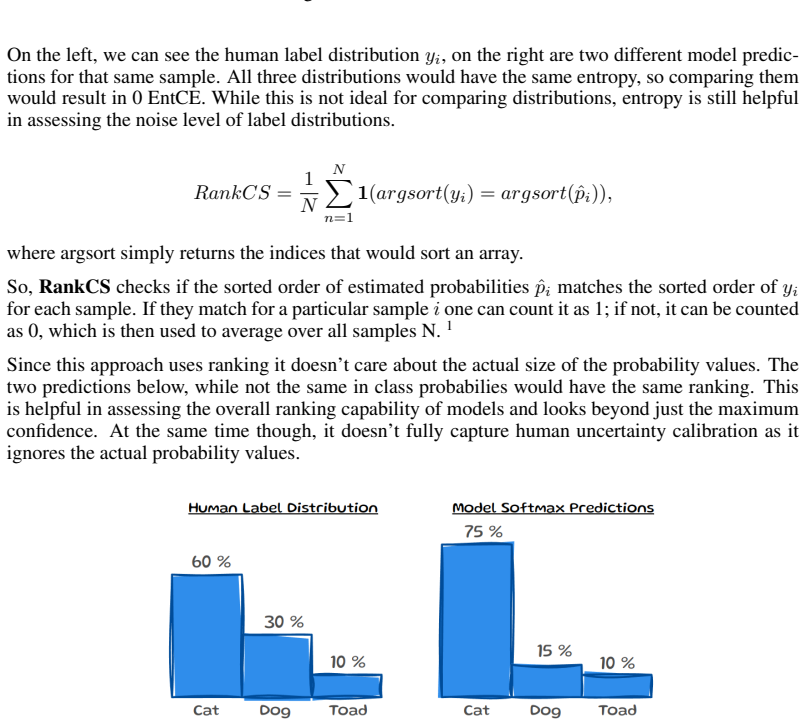
- [Section 3.3.3] The text says EntCE 'captures the agreement' between model and human uncertainty, but the formula is a signed difference; clarify whether the raw difference or the absolute value is the intended error quantity, and align the formula with Baan et al. (2022).
Circularity Check
No significant circularity; the post is an expository survey whose claims are supported by external literature and worked examples.
full rationale
This is a gentle introductory blogpost, not a derivation. It defines calibration notions (confidence, multi-class, class-wise, human-uncertainty) using the standard formalisms from the cited literature, and it evaluates ECE by working through a small example. The central assertion that ECE remains widely used despite known weaknesses is an observation supported by external citations and by the paper's own illustrative binning exercises. No parameter is fitted and no quantity is predicted from a fitted input. There are no self-citations, and no uniqueness theorem or prior result by the author is used to force a conclusion. The one internal inconsistency in Section 2 is that the printed formula for conf(B_m) averages the full probability vector, while the prose correctly states that only maximum probabilities are used in ECE; this is a typographical/correctness flaw in an expository formula, not a circular reduction, because the intended scalar definition is stated in the surrounding text and is used consistently in the worked example. Because every load-bearing statement is either definitional, attributed to external prior work, or demonstrated with an explicit toy computation, the paper is self-contained as a review and does not reduce to its own inputs.
Assumptions & free parameters
assumptions (2)
- domain assumption Ground-truth labels are available for evaluating calibration.
- domain assumption The cited definitions of calibration and ECE are correct and accepted.
Cite this review
Pith. "Pith review of Understanding Model Calibration -- A gentle introduction and visual exploration of calibration and the expected calibration error (ECE)." pith.science (2026). https://pith.science/paper/LH3INP6Z
@misc{pith2026250119047,
  author       = {Pith},
  title        = {Pith review of: Understanding Model Calibration -- A gentle introduction and visual exploration of calibration and the expected calibration error (ECE)},
  year         = {2026},
  howpublished = {\url{https://pith.science/paper/LH3INP6Z}},
  note         = {Machine review of arXiv:2501.19047}
}
read the original abstract
To be considered reliable, a model must be calibrated so that its confidence in each decision closely reflects its true outcome. In this blogpost we'll take a look at the most commonly used definition for calibration and then dive into a frequently used evaluation measure for model calibration. We'll then cover some of the drawbacks of this measure and how these surfaced the need for additional notions of calibration, which require their own new evaluation measures. This post is not intended to be an in-depth dissection of all works on calibration, nor does it focus on how to calibrate models. Instead, it is meant to provide a gentle introduction to the different notions and their evaluation measures as well as to re-highlight some issues with a measure that is still widely used to evaluate calibration.
Figures


Figures from the paper (16 more)



Forward citations
Cited by 4 Pith papers
-
Confidence Calibration in Large Language Models
LLMs show average overconfidence moderated by a strong hard-easy effect, quantified across tasks and via the new LifeEval actuarial-probability benchmark.
-
Wired for Overconfidence: A Mechanistic Perspective on Inflated Verbalized Confidence in LLMs
Inflated verbalized confidence in Qwen2.5-3B and Llama-3.2-3B is driven by a compact, cross-dataset set of middle-to-late-layer MLP blocks and attention heads, and steering or ablating those components at inference ti...
-
Improving Detection of Rare Nodes in Hierarchical Multi-Label Learning
A node-weighted loss combining inverse-frequency weighting and ensemble-uncertainty focal terms improves recall of rare classes in hierarchical multi-label models by up to ~5x.
-
False Fixed Points: Kantian Feedback, Stable Miscalibration, and Representational Compression in LLMs
Confidently wrong LLM answers behave like locally stable fixed points: no fragility gap vs correct answers, and abstention-style self-critique trades coverage for confidence.
Reference graph
Works this paper leans on
-
[6]
doi: 10.18653/v1/2020.emnlp-main.734
Association for Computational Linguis- tics. doi: 10.18653/v1/2020.emnlp-main.734. Jeremy Nixon, Michael W Dusenberry, Linchuan Zhang, Ghassen Jerfel, and Dustin Tran. Measur- ing calibration in deep learning.CVPR workshops, 2(7),
-
[8]
Ambiguous Annotations: When is a Pedestrian not a Pedestrian?
Luisa Schwirten, Jannes Scholz, Daniel Kondermann, and Janis Keuper. Ambiguous annotations: When is a pedestrian not a pedestrian?arXiv preprint arXiv:2405.08794,
-
[10]
doi: 10.18653/v1/2022.findings-emnlp.204
Association for Computational Linguistics. doi: 10.18653/v1/2022.findings-emnlp.204. URLhttps://aclanthology.org/2022. findings-emnlp.204/. Chenglei Si, Zhe Gan, Zhengyuan Yang, Shuohang Wang, Jianfeng Wang, Jordan Lee Boyd-Graber, and Lijuan Wang. Prompting gpt-3 to be reliable. InThe Eleventh International Conference on Learning Representations,
-
[11]
A Confidence Interval for the $\ell_2$ Expected Calibration Error
URLhttps://arxiv.org/abs/2408.08998. Alexandra N Uma, Tommaso Fornaciari, Dirk Hovy, Silviu Paun, Barbara Plank, and Massimo Poesio. Learning from disagreement: A survey.Journal of Artificial Intelligence Research, 72: 1385–1470,
-
[12]
Youliang Yuan, Wenxuan Wang, Qingshuo Guo, Yiming Xiong, Chihao Shen, and Pinjia He. Does chatgpt know that it does not know? evaluating the black-box calibration of chatgpt.Proceedings of the 2024 Joint International Conference on Computational Linguistics, Language Resources and Evaluation (LREC-COLING 2024), pp. 5191–5201,
work page 2024
-
[1983]
Towards a rigorous calibration as- sessment framework: Advancements in metrics, methods, and use
15 ICLR Blogposts 2025 Lorenzo Famiglini, Andrea Campagner, and Federico Cabitza. Towards a rigorous calibration as- sessment framework: Advancements in metrics, methods, and use. InECAI 2023, pp. 645–652. IOS Press,
work page 2025
-
[2008]
ISSN 0891-2017. doi: 10.1162/coli.07-034-R2. Arsenii Ashukha, Alexander Lyzhov, Dmitry Molchanov, and Dmitry Vetrov. Pitfalls of in-domain uncertainty estimation and ensembling in deep learning. InInternational Conference on Learning Representations,
-
[2015]
Yixin Nie, Xiang Zhou, and Mohit Bansal. What can we learn from collective human opinions on natural language inference data? In Bonnie Webber, Trevor Cohn, Yulan He, and Yang Liu (eds.),Proceedings of the 2020 Conference on Empirical Methods in Natural Language Process- ing (EMNLP), pp. 9131–9143, Online, November
work page 2020
Show all 12 references
-
[2019]
Mitigating bias in cali- bration error estimation
16 ICLR Blogposts 2025 Rebecca Roelofs, Nicholas Cain, Jonathon Shlens, and Michael C Mozer. Mitigating bias in cali- bration error estimation. InInternational Conference on Artificial Intelligence and Statistics, pp. 4036–4054. PMLR,
2025
-
[2020]
Joris Baan, Wilker Aziz, Barbara Plank, and Raquel Fernandez
URLhttps://openreview.net/forum?id=BJxI5gHKDr. Joris Baan, Wilker Aziz, Barbara Plank, and Raquel Fernandez. Stop measuring calibration when humans disagree.Proceedings of the 2022 Conference on Empirical Methods in Natural Lan- guage Processing, pp. 1892–1915, December
2022
-
[2022]
Human uncertainty in concept-based ai systems.Proceedings of the 2023 AAAI/ACM Conference on AI, Ethics, and Society, pp
Katherine Maeve Collins, Matthew Barker, Mateo Espinosa Zarlenga, Naveen Raman, Umang Bhatt, Mateja Jamnik, Ilia Sucholutsky, Adrian Weller, and Krishnamurthy Dvijotham. Human uncertainty in concept-based ai systems.Proceedings of the 2023 AAAI/ACM Conference on AI, Ethics, an...
2023
-
[2024]
Re-examining calibration: The case of question answering
Chenglei Si, Chen Zhao, Sewon Min, and Jordan Boyd-Graber. Re-examining calibration: The case of question answering. In Yoav Goldberg, Zornitsa Kozareva, and Yue Zhang (eds.), Findings of the Association for Computational Linguistics: EMNLP 2022, pp. 2814–2829, Abu Dhabi, Unit...
2022
Reviewed August 9, 2026 · model on record in the stance chip above.
Discussion (0). Continue with ORCID to comment.