REVIEW 4 major objections 6 minor 19 references
Synthesizing and Identifying Noise Levels in Autonomous Vehicle Camera Radar Datasets
T0 review · 4 major / 6 minor · reviewed 2026-08-16 · deepseek-v4-flash
Pith's one-line read A synthetic pipeline simulates camera-radar sensor failures with calibrated noise levels, and a lightweight network recognizes the degradation level with 54.4% accuracy.
desk verdict A useful synthetic stress-test pipeline idea undercut by an unvalidated realism claim and a closed-loop evaluation; the arithmetic slip is the least of its problems. read the letter →
The pith
A machine-rendered reading of the paper's core claim, the machinery that carries it, and where it could break.
The reading
What carries the argument
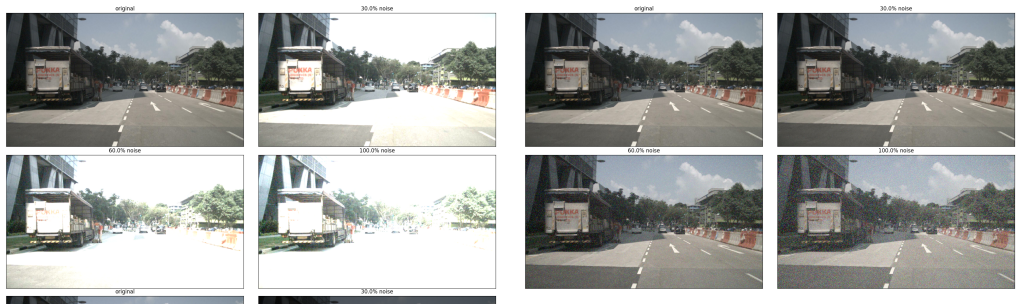
The machinery is two independent noise dials, both called Nlvl, scaled from 0% to 100% so that 100% equals the highest realistic distortion. Camera degradation is produced by Gaussian blur with kernel size $2 \times \text{round}(N_{lvl}) + 1$, a $3 \times 3$ smoothing kernel scaled by $(1 + 3 \times N_{lvl})$ for high/low exposure, and additive Gaussian noise with $\sigma = N_{lvl}$. Radar degradation proceeds in three steps: ghost points drawn from uniform range/angle distributions with a half-Gaussian RCS sample, false negatives removed when the radar-equation coefficient $\sigma/r^4 \times 10^{-N_{lvl}/100}$ falls below the frame minimum, and position/velocity noise scaled by the Cramér-Rao bound $1/\sqrt{\text{SNR}}$. A seven-layer U-Net and a 1D convolutional radar network turn these corrupted samples into eleven noise-level outputs.
What would settle it
Record camera and radar streams while driving through the failure scenarios the paper names—past a power transformer for electromagnetic interference and out of a tunnel for exposure blinding—and compare the real degraded data with the synthetic data at the same nominal noise levels. If the recognizer trained on synthetic data performs at chance on the real degraded frames, or if the real ghost-point and dropped-point statistics diverge from the generative model, the claim that the 100% level represents the highest realistic distortion fails.
Extended reading notes
Core claim
The central claim is that a hand-designed synthesis pipeline reproduces the dominant mechanisms of camera and radar degradation—Gaussian blur, exposure shifts, additive noise, ghost points from multipath, RCS-threshold false negatives, and Cramér-Rao-limited range/Doppler shifts—closely enough that a model trained only on the synthetic data can quantify the degradation level of a given frame. The paper further claims that this quantification is a usable baseline: a lightweight recognizer attains 54.4% accuracy on eleven noise classes across image and radar point-cloud test sets.
Load-bearing premise
The pipeline assumes that its hand-designed degradation models reproduce real sensor failure statistics, with no real-world failure data used to calibrate them.
Editorial extensions
If this is right
- Any camera-radar detection model can be paired with the recognizer to switch strategies or flag unreliable frames at run time.
- The two dials decouple camera and radar degradation, so a vehicle can estimate each sensor's health independently.
- Because the recognizer is trained only on synthetic data, extending the pipeline to new sensor types only requires modeling that sensor's failure modes.
- The stated 54.4% overall accuracy (62.19% camera, 20.79% radar) sets a baseline for future noise-recognition work on multimodal autonomous-vehicle data.
Reading between the lines
- If the calibration claim holds, the pipeline could serve as a stress-test generator: adversarially sweeping noise dials over existing detectors would reveal the degradation level at which each detector fails, a quantity the paper does not measure.
- The radar recognizer's low accuracy (20.79%) suggests either that the synthetic radar noise is harder to classify or that the input representation loses information; comparing recognizer performance on real degraded radar data would separate these explanations.
- The uniform ghost-point placement and half-Gaussian RCS model are plausible but untested against real multipath statistics; a natural next step is collecting ghost-point distributions from urban radar logs and fitting the generative distributions to them.
- A testable extension is to use the predicted noise level as a conditioning input to a detector, then measure whether detection accuracy degrades gracefully as the predicted level rises.
Signed reviews
Editorial analysis
A structured set of objections, weighed in public.
Referee Report
Summary. The paper proposes a synthetic data augmentation pipeline for the nuScenes camera-radar dataset, introducing noise level dials (Nlvl) from 0% to 100%. For cameras it applies Gaussian blur, high/low exposure via kernel scaling, and additive Gaussian noise; for radar it generates ghost points, removes points based on an RCS threshold, and adds Cramér-Rao-based measurement shifts. The authors train a U-Net camera analyzer and a 1D-CNN radar analyzer to predict 11 noise levels, reporting 62.19% camera accuracy, 20.79% radar accuracy, and an aggregate 54.4%. The central claim is that the pipeline accurately simulates real-world sensor failures and that the recognizer can quantify degradation level.
Significance. If the realism claim were supported, the contribution would be a practical plug-and-play augmentation tool for camera-radar AV perception and a lightweight noise-level estimator that could enable degradation-adaptive processing. The paper is clearly structured, the synthesis steps are concrete, and the code release is a strength. However, the significance is contingent on external validation that is absent: the degradations are hand-tuned, the recognizer is evaluated on data produced by the same synthesizer, and the 0% noise level is not actually clean. As it stands, the paper demonstrates only that a network can invert the authors' own augmentation parameters, not that it recognizes real-world sensor degradation.
major comments (4)
- [Section III.A-B] The central claim that the pipeline 'accurately simulates sensor failures' and that 100% Nlvl represents 'the highest realistic distortion' is not supported by any calibration data. The camera degradations in Eqs. (1)-(2) and the additive noise sigma=Nlvl are chosen without reference to measured camera failure statistics, and the radar model uses a uniform ghost-point count, a half-normal RCS draw, beta_min = min(sigma/r^4), and Cramér-Rao-based shifts without fitting to real radar interference or multipath data. Please either provide measured distributions from real sensor faults or substantially soften the realism claim and add a cross-validation on real noisy data.
- [Section IV] The recognizer is trained and tested on data generated by the same Nlvl dials defined in Section III, so the reported 54.4% accuracy measures how well the network inverts the synthesizer's own labels, not how well it identifies real-world degradation levels. A convincing evaluation would include a held-out set of real degraded frames, a physically recorded fault-injection bench, or at least a domain-shift test with different corruption parameters; without this, the accuracy claim is circular.
- [Section III.B] At Nlvl=0%, the pipeline still modifies the radar point cloud: ghost points are drawn with a uniform count between 0 and 4, false-negative removal drops points whenever the noisy alpha falls below beta_min (since w ~ N(0,beta_min) is added even at N=0), and noise-induced shifts are sampled from N(0, acc') with acc' proportional to 10^{0/200}=1. Thus the 0% level is not a clean baseline, and the 11-level classifier is not learning a clean-versus-degraded mapping as the paper implies.
- [Table I] The totals in Table I are inconsistent: 10086 + 2145 = 12231, not 12341, and 6718/12231 = 54.9% while 6718/12341 = 54.4%. The reported overall accuracy of 54.4% appears to use an incorrect denominator; please correct the table and recompute all aggregates.
minor comments (6)
- [Section III.B] The text contains a typo: 'as noise level increases (and SRN decreases)' should read 'SNR' instead of 'SRN'.
- [Figure 5 caption] The caption contains a typo: 'the same point clous' should be 'the same point cloud'.
- [Equation (7)] The notation for Vcomp mixes scalars and vectors: \(\vec{V}_{comp} = (V_r - V_{ego}) \cdot \vec{V}_r\) is dimensionally unclear. Please clarify the projection operation and whether Vcomp is a scalar or a vector.
- [Section IV] Training on only 2-3 scenes from nuScenes mini with validation and test on one scene each likely introduces scene-specific bias; consider reporting confidence intervals or results averaged over multiple scene splits.
- [Abstract] The code link appears as the placeholder '[here]'; please provide the actual repository URL.
- [Section I] The claim that noise-level estimation 'has never been done before' should be supported by a direct citation comparison or softened to 'to the best of our knowledge, we are not aware of prior work on this specific task'.
Circularity Check
No significant circularity: the recognition accuracy is a legitimate closed-loop synthetic benchmark, and the realism claim is an unvalidated assumption rather than a derived result.
full rationale
The paper's derivation chain is self-contained but not circular. Section III defines Nlvl as the independent control parameter of hand-designed camera and radar degradation models (Gaussian blur, exposure scaling, additive Gaussian noise, ghost points, RCS-ruled false negatives, and Cramer-Rao-based shifts). Section IV trains a lightweight classifier to predict the applied Nlvl from data generated by that same pipeline, and the reported 54.4% accuracy directly measures how well the network inverts the authors' own augmentation settings. This is a valid supervised benchmark for the synthetic task, and the accuracy is not statistically forced: the network could fail to invert the synthesizer, so the result is an empirical finding about the recognizer, not a tautology. The paper does not claim that this accuracy validates physical realism. The statements that the degradations are 'realistic' and that 100% Nlvl represents 'the highest realistic distortion in real life scenarios' are asserted assumptions without external sensor-failure measurements; this is a correctness/validation gap, not a circular step, and it is not disguised as a derivation. No load-bearing self-citations, imported uniqueness theorems, or ansatz-by-citation mechanisms appear in the argument. The Table I arithmetic inconsistency (10086+2145=12231, not 12341) is a reproducibility flaw, unrelated to circularity. Overall, no significant circularity is present.
Assumptions & free parameters
free parameters (8)
- Ghost point count upper bound =
4 points per frame
- Ghost point range margin =
10 m
- Half-Gaussian RCS distribution scale =
sigma = 1/3
- Detection uncertainty standard deviation =
beta_min
- Exposure kernel multiplier coefficient =
3
- Additive noise sigma mapping =
sigma = Nlvl
- Blur kernel size coefficient =
2
- SNR reduction factor =
0.1 dB per noise percent
assumptions (8)
- domain assumption Gaussian blur and additive Gaussian noise model camera sensor failures adequately.
- ad hoc to paper Exposure change can be simulated by scaling a 3x3 Gaussian kernel.
- domain assumption Radar received power is proportional to RCS divided by range to the fourth power.
- ad hoc to paper The minimum sigma/r^4 in each frame equals the sensor's detection threshold beta_min.
- domain assumption Measurement accuracy scales with 1/sqrt(SNR) per the Cramer-Rao bound.
- ad hoc to paper Ghost points can be modeled by uniform range/angle draws and half-normal RCS values.
- ad hoc to paper Radar velocity estimation is sampled from current frame because the manufacturer method is unknown.
- domain assumption Night camera data is an unlabeled adverse scenario and can be excluded from training.
Cite this review
Pith. "Pith review of Synthesizing and Identifying Noise Levels in Autonomous Vehicle Camera Radar Datasets." pith.science (2026). https://pith.science/paper/LMYISWWQ
@misc{pith2026250500584,
  author       = {Pith},
  title        = {Pith review of: Synthesizing and Identifying Noise Levels in Autonomous Vehicle Camera Radar Datasets},
  year         = {2026},
  howpublished = {\url{https://pith.science/paper/LMYISWWQ}},
  note         = {Machine review of arXiv:2505.00584}
}
read the original abstract
Detecting and tracking objects is a crucial component of any autonomous navigation method. For the past decades, object detection has yielded promising results using neural networks on various datasets. While many methods focus on performance metrics, few projects focus on improving the robustness of these detection and tracking pipelines, notably to sensor failures. In this paper we attempt to address this issue by creating a realistic synthetic data augmentation pipeline for camera-radar Autonomous Vehicle (AV) datasets. Our goal is to accurately simulate sensor failures and data deterioration due to real-world interferences. We also present our results of a baseline lightweight Noise Recognition neural network trained and tested on our augmented dataset, reaching an overall recognition accuracy of 54.4\% on 11 categories across 10086 images and 2145 radar point-clouds.
Figures


Figures from the paper (4 more)


Reference graph
Works this paper leans on
-
[1]
Radar and camera fusion for object detection and tracking: A comprehensive survey,
K. Shi, S. He, Z. Shi, A. Chen, Z. Xiong, J. Chen, and J. Luo, “Radar and camera fusion for object detection and tracking: A comprehensive survey,” 2024. [Online]. Available: https://arxiv.org/abs/2410.19872 1, 2
arXiv 2024
-
[2]
Detrs with collaborative hybrid assignments training,
Z. Zong, G. Song, and Y . Liu, “Detrs with collaborative hybrid assignments training,” 2023. [Online]. Available: https: //arxiv.org/abs/2211.12860 1
arXiv 2023
-
[3]
Microsoft coco: Common objects in context,
T.-Y . Lin, M. Maire, S. Belongie, L. Bourdev, R. Girshick, J. Hays, P. Perona, D. Ramanan, C. L. Zitnick, and P. Doll ´ar, “Microsoft coco: Common objects in context,” 2015. [Online]. Available: https://arxiv.org/abs/1405.0312 1
arXiv 2015
-
[4]
nuscenes: A multimodal dataset for autonomous driving,
H. Caesar, V . Bankiti, A. H. Lang, S. V ora, V . E. Liong, Q. Xu, A. Krishnan, Y . Pan, G. Baldan, and O. Beijbom, “nuscenes: A multimodal dataset for autonomous driving,” 2019. 1
work page 2019
-
[5]
Sparse4d v3: Advancing end-to-end 3d detection and tracking,
X. Lin, Z. Pei, T. Lin, L. Huang, and Z. Su, “Sparse4d v3: Advancing end-to-end 3d detection and tracking,” 2023. [Online]. Available: https://arxiv.org/abs/2311.11722 1
arXiv 2023
-
[6]
3d multi-object tracking: A baseline and new evaluation metrics,
X. Weng, J. Wang, D. Held, and K. Kitani, “3d multi-object tracking: A baseline and new evaluation metrics,” 2020. 1
work page 2020
-
[7]
Center-based 3d object detection and tracking,
T. Yin, X. Zhou, and P. Kr ¨ahenb¨uhl, “Center-based 3d object detection and tracking,” 2021. [Online]. Available: https://arxiv.org/ abs/2006.11275 1
arXiv 2021
-
[8]
Rcbevdet++: Toward high-accuracy radar-camera fusion 3d perception network,
Z. Lin, Z. Liu, Y . Wang, L. Zhang, and C. Zhu, “Rcbevdet++: Toward high-accuracy radar-camera fusion 3d perception network,”
Show all 19 references
-
[9]
A comprehensive survey of machine learning applied to radar signal processing,
P. Lang, X. Fu, M. Martorella, J. Dong, R. Qin, X. Meng, and M. Xie, “A comprehensive survey of machine learning applied to radar signal processing,” 2020. [Online]. Available: https://arxiv.org/abs/2009.13702 1
2020 arXiv
-
[10]
J. A. S. William L. Melvin, Principles of Modern Radar . Scitech,
-
[11]
Automotive radars: A review of signal processing techniques,
S. M. Patole, M. Torlak, D. Wang, and M. Ali, “Automotive radars: A review of signal processing techniques,” IEEE Signal Processing Magazine, vol. 34, no. 2, pp. 22–35, 2017. 1
2017
-
[12]
Survey on lidar perception in adverse weather conditions,
M. Dreissig, D. Scheuble, F. Piewak, and J. Boedecker, “Survey on lidar perception in adverse weather conditions,” 2023. 1
2023
-
[13]
Radiant: Radar-image association network for 3d object detection,
Y . Long, A. Kumar, D. Morris, X. Liu, M. Castro, and P. Chakravarty, “Radiant: Radar-image association network for 3d object detection,” Proceedings of the AAAI Conference on Artificial Intelligence, vol. 37, pp. 1808–1816, Jun. 2023. [Online]. Available: https://ojs.aaai.org...
2023
-
[14]
Crn: Camera radar net for accurate, robust, efficient 3d perception,
Y . Kim, J. Shin, S. Kim, I.-J. Lee, J. W. Choi, and D. Kum, “Crn: Camera radar net for accurate, robust, efficient 3d perception,” 2023. 1
2023
-
[15]
Radsegnet: A reliable approach to radar camera fusion,
K. Bansal, K. Rungta, and D. Bharadia, “Radsegnet: A reliable approach to radar camera fusion,” 2022. [Online]. Available: https://arxiv.org/abs/2208.03849 2
2022 arXiv
-
[16]
Immfusion: Robust mmwave-rgb fusion for 3d human body reconstruction in all weather conditions,
A. Chen, X. Wang, K. Shi, S. Zhu, B. Fang, Y . Chen, J. Chen, Y . Huo, and Q. Ye, “Immfusion: Robust mmwave-rgb fusion for 3d human body reconstruction in all weather conditions,” in 2023 IEEE International Conference on Robotics and Automation (ICRA). IEEE, May 2023, p. 2752–...
2023
-
[17]
Precision and accuracy in radar measurements,
J. A. H. Mark A. Richards, William L. Melvin, “Precision and accuracy in radar measurements,” in Principles of Modern Radar . Scitech, 2005. 5
2005
-
[18]
U-net: Convolutional networks for biomedical image segmentation,
O. Ronneberger, P. Fischer, and T. Brox, “U-net: Convolutional networks for biomedical image segmentation,” 2015. [Online]. Available: https://arxiv.org/abs/1505.04597 5
2015 arXiv
-
[2024]
Available: https://arxiv.org/abs/2409.04979 1
[Online]. Available: https://arxiv.org/abs/2409.04979 1
Reviewed August 16, 2026 · model on record in the stance chip above.
Discussion (0). Continue with ORCID to comment.