REVIEW 2 major objections 3 minor 41 references
Negative total central charge resolves the curvature singularity of CGHS black holes into flat interior regions while preserving correlated Hawking fluxes that signal unitarity at finite affine distance.
Reviewed by Pith at T0; open to challenge. T0 means a machine referee read the full paper against a public rubric. the ladder, T0–T4 →
T0 review · grok-4.5
2026-07-10 17:40 UTC pith:LOZ2XVT6
load-bearing objection Solid analytic singularity resolution for negative central charge, with explicit purifying fluxes, but the energy-balance gap undercuts the unitarity claim more than the authors admit. the 2 major comments →
Singularity resolution and unitarity in two-dimensional dilaton black holes with negative central charge
The pith
A machine-rendered reading of the paper's core claim, the machinery that carries it, and where it could break.
Core claim
When the total central charge of the one-loop CGHS theory is negative, back-reaction completely removes the classical curvature singularity and replaces it with asymptotically flat regions beyond the horizon; the exterior Hawking flux remains and is correlated with an interior flux containing negative-energy intervals, thereby furnishing a concrete signal that unitary evolution is possible for observers at finite affine distance from the collapse.
What carries the argument
The one-loop effective action that joins the ordinary Polyakov action for the N matter fields, a Polyakov-type term constructed on Strominger’s auxiliary flat metric (so that ghosts and metric fluctuations carry negative central charge but produce no physical Hawking quanta), and the unique local counterterm that keeps the auxiliary metric flat, renders the equations exactly solvable, and forces two-dimensional Minkowski space to remain an exact solution.
Load-bearing premise
The local counterterm must be fixed to the single value that simultaneously restores the classical symmetry, keeps the equations solvable, and makes Minkowski space an exact one-loop solution; any other counterterm would change both the geometry and the flux correlations.
What would settle it
An explicit evaluation of the curvature scalar or of the two-point energy-flux correlators for the chosen counterterm that either finds a remaining singularity or shows that the interior null surfaces reach infinite affine distance would falsify the claim of singularity resolution plus finite-distance unitarity.
If this is right
- The geometric truncation of spacetime that forces non-unitarity is eliminated, so pure-state evolution between past and future null infinity becomes possible in principle.
- Negative-energy flux intervals appear both at left null infinity and inside the horizon, supplying a concrete purification channel for the exterior radiation.
- Cross-horizon energy-energy correlators remain non-vanishing at any finite affine distance and only decay in the strict asymptotic limit.
- Because the event horizon itself survives, a complete energy balance still requires an additional mechanism that couples the left- and right-moving sectors.
- The model supplies an analytically solvable laboratory in which the interplay between singularity resolution and unitarity can be tracked without large-N approximations.
Where Pith is reading between the lines
- Coupling the two chiral sectors through a reflecting boundary condition at the origin, as occurs in spherical reduction, may restore global energy conservation while preserving the singularity-free geometry.
- The brief negative-energy burst inside the horizon is likely the two-dimensional counterpart of the purifying partner modes seen in unitary moving-mirror models.
- The same sign-flip of the central charge that removes the singularity may, once chiral sectors are coupled, also eliminate the event horizon, converting the geometry into a traversable wormhole-like structure.
- If the auxiliary-metric construction can be lifted, analogous singularity resolution should appear in any two-dimensional reduction that admits a negative total central charge.
Editorial analysis
A structured set of objections, weighed in public.
Referee Report
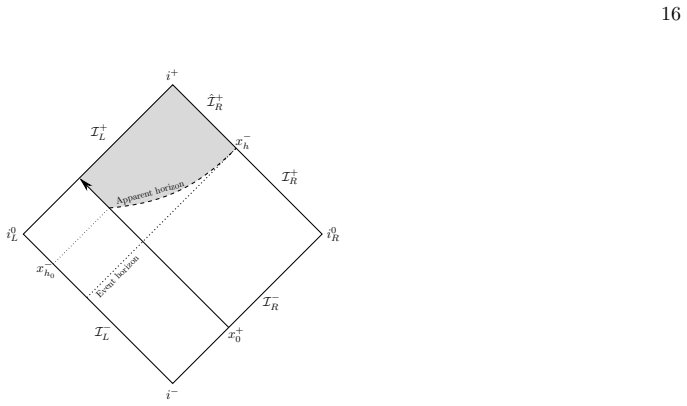
Summary. The paper constructs a one-loop extension of the classical CGHS model whose effective action comprises the Polyakov term for N matter fields, a Strominger-type Polyakov term built from an auxiliary flat metric that decouples Faddeev–Popov ghosts from Hawking radiation, and a local counterterm whose free parameter a is fixed to a0=(C++C−)/(2C+) so that the auxiliary metric remains flat, the equations stay exactly solvable, and two-dimensional Minkowski space remains an exact solution. In the regime of negative total central charge κ=(N−24)/24<0 the classical spacelike singularity is eliminated and replaced by asymptotically flat regions inside the horizon. The exterior Hawking flux retains its classical thermal form and is correlated with an internal flux (containing a short negative-energy interval) supported on null surfaces that approach null infinity from beyond the horizon; these correlations are argued to point toward unitarity provided the surfaces remain at finite affine distance from the collapsing matter. The authors explicitly note that a fully consistent energy balance cannot yet be established and sketch possible remedies.
Significance. If the geometric and correlator results hold, the work supplies a fully analytic, dynamical example of singularity resolution driven by a negative total central charge, extending earlier static analyses and furnishing explicit exterior–interior flux correlations that could purify Hawking radiation. The exact Lambert-W solution, the closed-form asymptotic fluxes, and the two-point correlators computed via Wick contraction constitute genuine technical strengths and make the model a useful laboratory for the information problem in two dimensions. The transparent admission that energy conservation remains open is also a virtue. Realization of the suggested chiral-sector coupling would elevate the construction from a suggestive kinematic mechanism to a more complete unitary model.
major comments (2)
- [V.D, Eqs. (5.45)–(5.47)] Section V.D, Eqs. (5.45)–(5.47): the radiated energy on I^{+}_R diverges as (N/48)λ ln(x^{+}_r/x^{+}_0) while E_L^rad remains finite. Because the event horizon persists (I^{+}_R is complete), the affine parameter on the interior surfaces that carry the purifying correlations becomes ill-defined precisely in the limit where the exterior flux saturates to its thermal value. The “finite affine distance” proviso is therefore essential rather than optional, yet leaves the energy budget open. Correlations alone cannot be promoted from a kinematic feature to evidence of unitary evolution without a consistent energy accounting. The abstract and conclusions should either quantify the correlations at large but finite affine distance relative to the energy mismatch, or more carefully qualify the unitarity claim.
- [V.B–V.C, Figs. 5–6] Section V.B–V.C and Figs. 5–6: the negative-flux interval and the exponential decay of cross-horizon correlators are demonstrated only for one illustrative parameter set (N=23, m/λ=1/48, λx_h^−=−1). While the leading asymptotics are general, the central claim that these features “point to unitarity” would be more robust if the authors showed that the purifying region and the sign-change of the interior flux persist for a broader range of |κ| and mass ratios, or supplied a parameter-independent characterization of that region.
minor comments (3)
- [V.A, Fig. 3] Figure 3 caption and the accompanying text in V.A leave the physical status of a positive x_h0 somewhat ambiguous; a short clarifying sentence would help.
- [II.B.1 and V.B] The notation for the affine parameters ˆσ^± is reused for both finite-x_r rays and the asymptotic limits; a brief remark that the same symbol is retained by continuity would avoid momentary confusion.
- A few typographical inconsistencies appear (e.g., “central rights” in one early heading versus “charge” elsewhere; occasional missing spaces around equation references). A careful proof-reading pass is recommended.
Circularity Check
No load-bearing circularity; singularity resolution and flux correlations follow from the exact κ<0 solution of a counterterm-fixed action, with only minor non-essential self-citation for context.
full rationale
The derivation is self-contained and non-circular. The one-loop action is assembled from the classical CGHS term, the matter Polyakov action Γ+, Strominger’s ghost Polyakov action Γ− built on the auxiliary flat metric, and a one-parameter local counterterm. The free parameter a is fixed uniquely by the independent physical requirement that two-dimensional Minkowski space remain an exact solution (a=a0=(C++C−)/(2C+)), which simultaneously restores the classical free-field equation ∂+∂−( ho−ϕ)=0 and yields exact solvability. The resulting equations are mathematically equivalent to the RST model with N replaced by the total central charge C++C−; when this quantity is negative (κ<0) the explicit shock-wave solution (5.8) has nowhere-vanishing Ω′ and finite curvature R=8e−2 ho ∂+∂− ho everywhere, producing asymptotically flat interior regions. Exterior and interior fluxes are then obtained from the standard Polyakov formula evaluated on affine parameters, and the connected correlators follow from the usual CFT Wick contraction of normal-ordered stress tensors. None of these steps reduces a claimed prediction to a fitted input or to a definitional identity; the energy-balance failure is openly acknowledged rather than hidden. Self-citations (principally to the authors’ prior spherical-reduction analysis [7] and to the related hybrid-state literature [3–5]) supply motivation and comparison but are not required to justify the central geometric or correlator results, which stand on the explicit solution of the present model. Score 1 reflects only the presence of those non-load-bearing self-citations.
Axiom & Free-Parameter Ledger
free parameters (2)
- a (local-counterterm coefficient) =
a0 = (C+ + C−)/(2 C+)
- illustrative plot parameters (N=23, m/λ=1/48, λx_h^−=−1) =
N=23, m/λ=1/48, λx_h^−=−1
axioms (4)
- domain assumption Strominger’s mechanism: Faddeev-Popov ghosts (and the non-propagating ρ,ϕ fluctuations) couple to the auxiliary flat metric ĝ=e^{−2ϕ}g rather than to the physical metric, so they contribute to the central charge but never to physical Hawking radiation.
- domain assumption One-loop effective action obtained by integrating out quadratic fluctuations of matter and ghosts is sufficient to capture the back-reaction that resolves the singularity.
- ad hoc to paper The total central charge C++C− can be negative (N<24) while the theory remains a consistent effective description of gravity plus matter.
- standard math Kruskal gauge ρ=ϕ together with the vacuum choices t±=t̂±=1/(2x±)^{2} correctly encode the Minkowski vacuum before collapse and the Rindler vacuum for the ghost sector.
invented entities (1)
-
Local counterterm S_local[g,ϕ;a] with the specific value a=a0
no independent evidence
read the original abstract
We study a one-loop corrected extension of the classical Callan-Giddings-Harvey-Strominger (CGHS) model of two-dimensional dilaton gravity. The effective action combines the non-local Polyakov action for matter fluctuations, a Polyakov-type term built from an auxiliary flat metric that implements Strominger's mechanism for the Faddeev-Popov reparametrization ghosts, and a local counterterm that simultaneously preserves the flatness of the auxiliary metric, ensures exact solvability, and keeps two-dimensional Minkowski spacetime as an exact solution of the backreacted equations. In the regime of negative total central charge, the classical curvature singularity is resolved and gives way to asymptotically flat regions inside the horizon. The exterior Hawking flux is preserved and turns out to be correlated with an internal radiation flux supported on null surfaces that approach null infinity from beyond the horizon; this internal flux, in particular, presents a short interval of negative values. These correlations point to the preservation of unitarity, provided the relevant null surfaces remain at a finite affine distance from the collapsing matter trajectory. Within the present formulation, however, a fully consistent energy balance cannot yet be established. We discuss possible strategies to overcome this issue.
Figures




Reference graph
Works this paper leans on
-
[1]
One-loop extension of the classical theory 8 IV
Outgoing flux along the null surfacex + =x + r 7 III. One-loop extension of the classical theory 8 IV. The conventional semiclassical largeNlimit 10 A. Outgoing Hawking flux 12 V. Backreacted solutions in the negative central charge regime 14 A. RegimeC − +C + <0 15 B. Fluxes 16 C. Correlations 20
-
[2]
Correlations in the left moving sector 21
-
[3]
Correlations in the right-moving sector 22 D. Energy balance 22 VI. Conclusions and final comments 23 References 24 ∗ cesar.garcia.perez@edu.unige.it † jmarag@ific.uv.es ‡ jnavarro@ific.uv.es § silvia.pla-garcia@tum.de arXiv:2607.07806v1 [gr-qc] 8 Jul 2026 2 I. INTRODUCTION The question of unitary evolution of black holes, first formulated by Hawking near...
work page internal anchor Pith review Pith/arXiv arXiv 2026
-
[4]
We take the limitx + r →+∞at the end of the calculation
Outgoing flux along the null surfacex + =x + r For future purposes, it is convenient to redo the calculation by first evaluating the outgoing flux along the null surfacex + =x + r , wherex + r is a reference point. We take the limitx + r →+∞at the end of the calculation. The flux ⟨T f x−x− ⟩(x−, x+ r ) is given by ⟨T f x−x− ⟩(x−, x+ r ) =− N 12 h (∂−ρ)2 −...
-
[5]
This is a direct consequence of the singularity, which abruptly truncates the spacetime
Correlations are lost: (i) theS-matrix fromI − L toI + R is non-unitary; (ii) theS-matrix fromI − R toI + L is also non-unitary. This is a direct consequence of the singularity, which abruptly truncates the spacetime
-
[6]
Without backreaction, energy conservation cannot be maintained, as already evident from the divergence of Erad. We will see in the following sections how the one-loop extension of the classical theory deals with these issues. III. ONE-LOOP EXTENSION OF THE CLASSICAL THEORY It is useful to consider the quantum theory of our classical model (2.1) in terms o...
-
[7]
Correlations in the left moving sector We now analyze the correlation functionsC ++,++. AtI − L , the energy–energy correlations are given by the standard expression [27] Cin σ+σ+, σ′+σ′+ = N 8 1 (σ+ −σ ′+)4 = N 8 λ4 [log(λx+)−log(λx ′+)]4 .(5.34) Evolving them tox − →0, we obtain Cout ˆσ+ˆσ+,ˆσ′+ˆσ′+ = N 8 λ4 [log(λx+)−log(λx ′+)]4 dσ+ dˆσ+ 2 dσ′+ dˆσ′+ ...
-
[8]
Correlations in the right-moving sector The behavior of the energy-energy correlation function in the right-moving sector follows from the analogous discussion about the outgoing fluxes. Forx + r < x + 0 (i.e., before the shock wave), the correlation functionC −−,−− is given by Cσ−σ−, σ′−σ′− = N 8 1 (σ− −σ ′−)4 = N 8 λ4 [log(−λx−)−log(−λx ′−)]4 ,(5.39) an...
-
[9]
Breakdown of Predictability in Gravitational Collapse,
S. W. Hawking, “Breakdown of Predictability in Gravitational Collapse,” Phys. Rev. D14, 2460-2473 (1976)
work page 1976
-
[10]
C.G. Callan, S. B. Giddings, J.A. Harvey, and A. Strominger. “Evanescent black holes,” Phys. Rev. D,45, R1005 (1992)
work page 1992
-
[11]
Quantum states and their back-reacted geometries in 2d dilaton gravity
Y. Potaux, D. Sarkar and S. N. Solodukhin, “Quantum states and their back-reacted geometries in 2D dilaton gravity,” Phys. Rev. D105, no.2, 025015 (2022) [arXiv:2112.03855 [hep-th]]
work page internal anchor Pith review Pith/arXiv arXiv 2022
-
[12]
Space-time structure, asymptotic radiation and information recovery for a quantum hybrid state
Y. Potaux, D. Sarkar and S. N. Solodukhin, “Spacetime Structure, Asymptotic Radiation, and Information Recovery for a Quantum Hybrid State,” Phys. Rev. Lett.130, no.26, 261501 (2023) [arXiv:2212.13208 [hep-th]]
work page internal anchor Pith review Pith/arXiv arXiv 2023
-
[13]
Hybrid quantum states in 2d dilaton gravity
Y. Potaux, D. Sarkar and S. N. Solodukhin, “Hybrid quantum states in 2D dilaton gravity,” Phys. Rev. D108, no.12, 125012 (2023) [arXiv:2310.18745 [hep-th]]
work page internal anchor Pith review Pith/arXiv arXiv 2023
-
[14]
The Endpoint of Hawking Evaporation
J. G. Russo, L. Susskind and L. Thorlacius, “The Endpoint of Hawking radiation,” Phys. Rev. D46, 3444-3449 (1992) [arXiv:hep-th/9206070 [hep-th]]
work page internal anchor Pith review Pith/arXiv arXiv 1992
-
[15]
Singularity resolution in spherically reduced 2D semiclassical gravity with negative central charge,
A. del R´ ıo, F. J. Mara˜ n´ on-Gonz´ alez and J. Navarro-Salas, “Singularity resolution in spherically reduced 2D semiclassical gravity with negative central charge,” Phys. Rev. D111, 045025 (2025)
work page 2025
-
[16]
Faddeev-Popov ghosts and (1+1)-dimensional black hole evaporation,
A. Strominger, “Faddeev-Popov ghosts and (1+1)-dimensional black hole evaporation,” Phys. Rev. D46, 4396-4401 (1992)
work page 1992
-
[17]
Quantum Geometry of Bosonic Strings,
A. M. Polyakov, “Quantum Geometry of Bosonic Strings,” Phys. Lett. B103, 207-210 (1981)
work page 1981
-
[18]
Information is Not Lost in the Evaporation of 2-dimensional Black Holes,
A. Ashtekar, V. Taveras and M. Varadarajan, “Information is Not Lost in the Evaporation of 2-dimensional Black Holes,” Phys. Rev. Lett.100, 211302 (2008)
work page 2008
-
[19]
Evaporation of 2-Dimensional Black Holes,
A. Ashtekar, F. Pretorius and F. M. Ramazanoglu, “Evaporation of 2-Dimensional Black Holes,” Phys. Rev. D83, 044040 (2011) doi:10.1103/PhysRevD.83.044040
-
[20]
A. Fabbri and J. Navarro-Salas,Modeling black hole evaporation, ICP-World Scientific, London (2005)
work page 2005
-
[21]
M. B. Green, J. H. Schwarz and E. Witten,Superstring theory. IntroductionVol. 1. Cambridge University Press (1987)
work page 1987
-
[22]
D. Tong, “Lectures on String Theory”, University of Cambridge Part III Mathematical Tripos (Chapter 5, Path integrals and ghosts); arXiv:0908.0333 [hep-th]
work page internal anchor Pith review Pith/arXiv arXiv
-
[23]
Quantum Aspects of Black Holes
J. A. Harvey and A. Strominger, “Quantum Aspects of Black Holes”, hep-th/9209055
work page internal anchor Pith review Pith/arXiv arXiv
-
[24]
Les Houches Lectures on Black Holes
A. Strominger, “Les Houches Lectures on Black Holes”, hep-th/9501071
work page internal anchor Pith review Pith/arXiv arXiv
-
[25]
Real decoupling ghost quantization of the CGHS model for two dimensional black holes
S. Liberati, “A Real decoupling ghosts quantization of CGHS model for two-dimensional black holes,” Phys. Rev. D51 (1995), 1710-1715 [arXiv:hep-th/9407002 [hep-th]]
work page internal anchor Pith review Pith/arXiv arXiv 1995
-
[26]
Solvable models for radiating black holes and area preserving diffeomorphisms,
J. Cruz and J. Navarro-Salas, “Solvable models for radiating black holes and area preserving diffeomorphisms,” Phys. Lett. B375, 47-53 (1996)
work page 1996
-
[27]
Islands in Asymptotically Flat 2D Gravity
T. Hartman, E. Shaghoulian and A. Strominger, “Islands in Asymptotically Flat 2D Gravity,” JHEP07, 022 (2020) [arXiv:2004.13857 [hep-th]]
work page internal anchor Pith review Pith/arXiv arXiv 2020
-
[28]
Mass and entropy of asymptotically flat eternal 25 quantum black holes in 2D,
J. Alexandre, E. A. Kontou, D. Pardo Santos, S. Pla and A. Svesko, “Mass and entropy of asymptotically flat eternal 25 quantum black holes in 2D,” JHEP06, 040 (2026) [arXiv:2512.19812 [gr-qc]]
-
[29]
Semiinfinite throat as the end state geometry of two-dimensional black hole evaporation,
S. Bose, L. Parker and Y. Peleg, “Semiinfinite throat as the end state geometry of two-dimensional black hole evaporation,” Phys. Rev. D52, 3512-3517 (1995)
work page 1995
-
[30]
Does the Topology of Space Fluctuate?,
A. Anderson and B. S. DeWitt, “Does the Topology of Space Fluctuate?,” Found. Phys.16, 91-105 (1986)
work page 1986
-
[31]
Conformally invariant boundary conditions for dilaton gravity,
A. Strominger and L. Thorlacius, “Conformally invariant boundary conditions for dilaton gravity,” Phys. Rev. D50, 5177-5187 (1994)
work page 1994
-
[32]
Boundary dynamics in dilaton gravity,
S. R. Das and S. Mukherji, “Boundary dynamics in dilaton gravity,” Mod. Phys. Lett. A9, 3105-3118 (1994)
work page 1994
-
[33]
Dynamical moving mirrors and black holes,
T. D. Chung and H. L. Verlinde, “Dynamical moving mirrors and black holes,” Nucl. Phys. B418, 305-336 (1994)
work page 1994
-
[34]
Hawking radiation and unitary evolution,
S. Bose, L. Parker and Y. Peleg, “Hawking radiation and unitary evolution,” Phys. Rev. Lett.76, 861-864 (1996)
work page 1996
-
[35]
P. Di Francesco, P. Mathieu and D. Senechal,Conformal Field Theory, Springer-Verlag, New York (1997)
work page 1997
-
[36]
Energy conditions in general relativity and quantum field theory
E. A. Kontou and K. Sanders, “Energy conditions in general relativity and quantum field theory,” Class. Quant. Grav.37 (2020) no.19, 193001 [arXiv:2003.01815 [gr-qc]]
work page internal anchor Pith review Pith/arXiv arXiv 2020
-
[37]
Quantum Purity at a Small Price: Easing a Black Hole Paradox
F. Wilczek,Quantum purity at a small price: easing the black hole paradox, arXiv:hep-th/9302096 (1993)
work page internal anchor Pith review Pith/arXiv arXiv 1993
- [38]
-
[39]
Remnant-free Moving Mirror Model for Black Hole Radiation Field
M. R. R. Good, E. V. Linder and F. Wilczek, “Moving mirror model for quasithermal radiation fields,” Phys. Rev. D101, 025012 (2020) [arXiv:1909.01129 [gr-qc]]
work page internal anchor Pith review Pith/arXiv arXiv 2020
-
[40]
Vacuum-purified Hawking radiation from evaporating black holes: Lessons from moving mirrors,
I. Agullo, P. Calizaya Cabrera and B. E. Navascu´ es, “Vacuum-purified Hawking radiation from evaporating black holes: Lessons from moving mirrors,” Phys. Rev. D113, 085010 (2026), [arXiv:2512.18354 [gr-qc]]
-
[41]
Black Hole Evaporation in Loop Quantum Gravity
A. Ashtekar, “Black hole evaporation in loop quantum gravity,” Gen. Rel. Grav.57(2025) no.2, 48 doi:10.1007/s10714- 025-03380-7 [arXiv:2502.04252 [gr-qc]]
work page internal anchor Pith review Pith/arXiv arXiv doi:10.1007/s10714- 2025
discussion (0)
Sign in with ORCID, Apple, or X to comment. Anyone can read and Pith papers without signing in.