REVIEW 3 major objections 6 minor 37 references
MineDraft claims that batch-parallel speculative decoding—keeping two request batches so drafting for one overlaps verification for the other—cuts end-to-end latency by up to 39% and raises throughput by up to 75% over standard SD, at the c
Reviewed by Pith at T0; open to challenge. T0 means a machine referee read the full paper against a public rubric. the ladder, T0–T4 →
MineDraft speeds up speculative decoding by keeping two request batches — drafting one batch while verifying the other — gaining up to ~40% per-GPU throughput at moderate draft lengths.
T0 review reviewed 2026-08-02 challenge →
load-bearing objection A novel batch-parallel speculative decoding framework with honest experiments, but the headline gains are not isolated from the extra GPU, and the theory overstates its case. the 3 major comments →
MineDraft: A Framework for Batch Parallel Speculative Decoding
The pith
A machine-rendered reading of the paper's core claim, the machinery that carries it, and where it could break.
The reading
Core claim
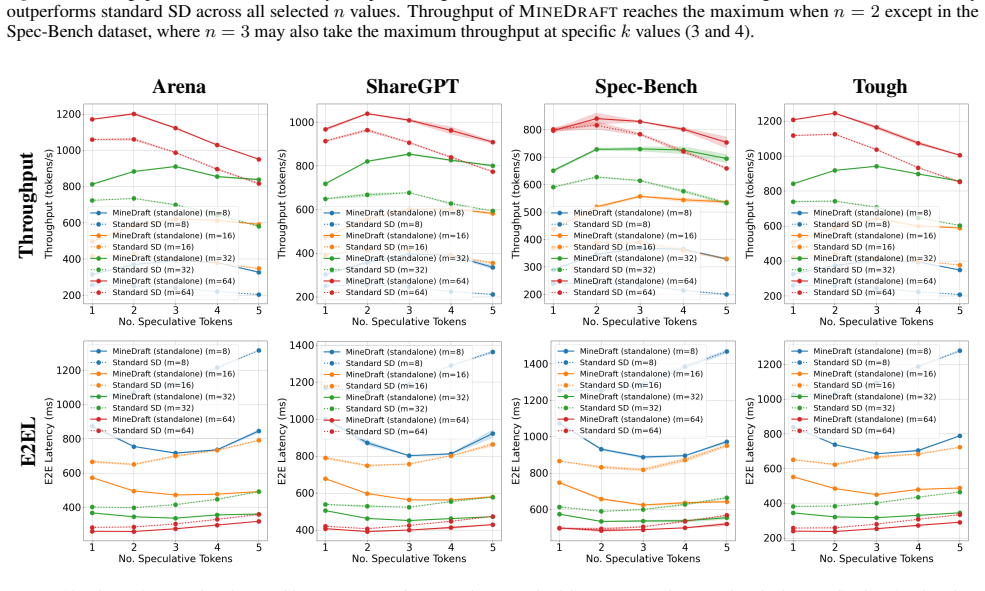
The central claim is that parallelizing drafting and verification via two alternating batches is substantially more efficient than standard speculative decoding. The paper derives Theorem 1: when the draft acceptance rate follows f(t)=1-e^{-αt} and αV≈1.68 (where V is fixed verification time), the standard SD latency is at least 1.59 times the PSD latency, a reduction of more than 37%. Empirically, MineDraft reports average throughput gains of 38.62% to 65.02% over the best baseline and up to 75.68% over standard SD, with end-to-end latency reduced by up to 39.51%, using one additional GPU for the draft model.
What carries the argument
The load-bearing mechanism is the two-batch alternation: the system keeps up to 2m concurrent requests split into Batch 0 and Batch 1, with a Batch Manager tracking balance and assigning new requests to keep the batches roughly equal. At each step, the draft model (on a dedicated GPU) drafts tokens for one batch while the target model (on other GPUs) verifies the previously drafted tokens of the other batch; at the sync point the roles swap. A scheduler patch prevents redundant KV-block allocation for drafts that have not yet been verified. The theoretical backbone is a Pareto-frontier comparison of drafting time t versus verification time V, showing that PSD minimizes R·max(V,t)/f(t) while
Load-bearing premise
The whole gain rests on the assumption that drafting latency can actually be hidden behind verification—that is, the overlap plus the GPU-to-GPU token transfer costs less than the drafting time saved—and that the server always has enough concurrent requests (about 2m) to keep both batches occupied.
What would settle it
Run MineDraft versus standard SD with draft length k=1 on a cluster with a slow interconnect (e.g., PCIe instead of NVLink): if measured end-to-end latency no longer improves, or if throughput falls below standard SD when communication is a majority of step time, the two-batch overlap fails to hide drafting. The paper's own Table 1 indicates that at k=2 communication is already 21–34% of step latency, so this is a direct, checkable boundary.
If this is right
- If the claims hold, production LLM servers can achieve 18–40% per-GPU throughput improvements by pipelining drafting and verification rather than interleaving them.
- The framework is agnostic to how draft tokens are produced, so it can compose with EAGLE, TETRIS, or other drafting strategies to stack gains.
- The extra latency hiding means draft models need not be extremely small; a mid-sized draft model (e.g., Qwen3-1.7B) can strike a better quality-speed balance than either a tiny or a large draft model.
- The theoretical ratio T_SD ≳ 1.59 T_PSD suggests that as long as drafting and verification times are comparable, PSD should beat SD by at least 37% regardless of exact acceptance-rate shape.
- The vLLM plugin implementation indicates the idea can be adopted without modifying the target model or the sampling logic, lowering the barrier to deployment.
Where Pith is reading between the lines
- Because the two-batch scheme needs both batches full to sustain overlap, its benefit is likely to concentrate in steady-state serving with many concurrent requests; latency tail behavior at low load or during tail decay may revert to standard SD performance.
- The measured communication overhead (50–58% of step latency at k=1, 21–34% at k=2) suggests that on slower interconnects or with very short drafts, the parallelism benefit could be eroded; a parameter-free prediction from the paper's model is that the optimal draft length shifts upward as communication cost falls.
- The authors' own normalized results show MineDraft marginally losing to standard SD at k=1–2 on some datasets; an obvious testable extension is a workload-aware draft-length controller that adapts k to the current communication-to-compute ratio.
- If the 50% idealized upper bound is approached, the marginal value of additional GPUs for draft models diminishes; the more interesting next step is whether the same overlap can be achieved without a dedicated GPU by time-slicing the target model's idle phases.
Editorial analysis
A structured set of objections, weighed in public.
Referee Report
Summary. The paper introduces MineDraft, a framework for batch parallel speculative decoding (PSD). It maintains two batches of requests, alternately drafting one batch while verifying the other, using a dedicated draft GPU and direct GPU-to-GPU communication. A theoretical model (§4) claims that PSD yields at least roughly 37% lower latency than standard SD when the acceptance-versus-drafting-time curve is f(t)=1−e^{−αt} and αV≈1.68. Experiments on seven target/draft settings and four datasets report throughput gains up to 75% and latency reductions up to 39% over standard SD; per-GPU normalization reduces these to roughly 18–40% throughput and 0–24% latency, with regressions at small k. The paper also contributes a vLLM plugin and publicly available code.
Significance. If the claims hold, the paper offers a practical systems contribution: a production plugin that yields moderate per-GPU gains in the regime where drafting time is close to verification time, with honest reporting of small-k regressions. Strengths include the breadth of experiments (seven model settings, four datasets, three trials), public code, a dedicated normalized-results section, and Nsight profiling that tests the overlap hypothesis. The main weaknesses are the lack of an isolated ablation separating the parallel design from the effect of a dedicated draft GPU, and an incorrect interpretation of the theorem's regime. These are correctable but currently leave the central attribution and the theoretical claim less solid than the paper presents them.
major comments (3)
- [Sec. 6 and C.1, Figs. 14–15] The experimental design does not isolate the batch-parallel overlap from the effect of a dedicated draft GPU. MineDraft is always run on 5 GPUs (TP=4 plus a dedicated drafter), while standard SD is run on 4 GPUs with the drafter sharing memory and compute with the target. Per-GPU normalization is not a substitute for a controlled ablation: the paper itself reports standard SD OOM in Setting 4 (Fig. 5), and the extra GPU may partly relieve memory pressure or avoid compute contention. Without a 5-GPU sequential-SD baseline (drafter on a dedicated GPU but no batch alternation), the measured gains cannot be attributed to the two-batch parallel design.
- [Sec. 4, Theorem 1] The paragraph after Theorem 1 claims that PSD achieves at least a 37% reduction 'when either the verification time or the curvature of f ... is sufficiently large.' This is not supported by the paper's own derivation. The proof gives T_SD/T_PSD > 1 + ln(αV+1)/(αV), which is strictly decreasing in αV and tends to 1 as αV→∞. Therefore the 37% guarantee does not hold for large αV; it is a narrow-regime statement around αV≈1.68. The theorem itself is conditional, but the interpretation is incorrect and should be corrected or restricted.
- [Sec. 4 and Table 1] The theoretical model assumes zero communication overhead and constant drafting/verification times. Table 1 reports communication is 50.49–57.93% of step latency at k=1 and 20.96–34.18% at k=2 across Settings 1–3, and Fig. 15 shows MineDraft underperforming standard SD at k=1–2. Thus the theoretical guarantee applies outside the regime where the overhead is measured to be largest. This boundary on the theorem's applicability should be stated explicitly in the main text rather than only in the appendix, since it directly affects the claimed scope of the result.
minor comments (6)
- [Abstract and Sec. 1] The headline 'up to 75% throughput and 39% latency' refers to unnormalized 5-GPU vs 4-GPU comparisons. The abstract should also mention the per-GPU normalized figures (roughly 18–40% throughput, 0–24% latency) to avoid overstating the resource-fair advantage.
- [Appendix B, Lemma 1] The lemma is described as 'an upper bound on T_SD' but the statement is actually a lower bound. This is confusing and should be relabeled.
- [Sec. C.5] Normalizing end-to-end latency by multiplying parallel methods' latencies by 1.25 assumes that latency scales linearly with the number of GPUs. This is a strong assumption for distributed inference and should be justified or relaxed.
- [Sec. 4] The choice αV≈1.68 is presented as a threshold, but the paper does not calibrate it to any of the experimental settings. A sentence relating αV to the measured acceptance rates and step times would make the theory more persuasive.
- [Throughout] Several figure captions report aggregate percentages without always stating the number of runs underlying each point; Appendix C gives three runs, but some figures (e.g., Table 1) are single-run. Please state run counts in captions.
- [Abstract] Typo: 'MINEDRAFTrealizes' is missing a space before 'realizes.'
Circularity Check
No significant circularity: Theorem 1 is a conditional analytical bound with no fitted parameters; the TETRIS self-citation is not load-bearing.
full rationale
Sec. 4's Theorem 1 is a conditional analytical bound, not a fitted prediction. It assumes a specific Pareto-frontier form f(t)=1−e^{−αt} and computes the ratio T_SD/T_PSD from the definitions T_SD = min_t R(t+V)/f(t) and T_PSD = min_t R max(V,t)/f(t); the αV≈1.68 threshold is obtained from the Lambert W solution of e^{−αx}=1/(2(αx+1)), not by fitting MineDraft's experimental results. Consequently the theorem does not reduce to an input fit: the 37% figure follows from the stated assumptions and the mathematics, and the paper's own measurements (e.g., Tab. 1 communication overhead, Sec. C.5 normalized losses at small k) are allowed to diverge from the idealized bound. The only author-overlapping citation is TETRIS (Wu et al., 2025), which is used as one combinable drafting strategy and is not the justification for the central batch-parallel design; standalone MineDraft is also evaluated against standard SD. The experimental claim (5 GPUs vs 4 GPUs) is a resource-accounting and attribution concern, not circularity: no fitted parameter is renamed as a prediction, and no self-citation chain forces the result. Thus no circular step is present.
Axiom & Free-Parameter Ledger
free parameters (1)
- α (acceptance-rate curvature)
axioms (6)
- domain assumption Draft model Pareto frontier has the form f(t) = 1 − e^{−αt}
- domain assumption Constant drafting time t per step and constant verification time V per step; zero communication overhead
- domain assumption Time to draft the first batch is negligible in PSD
- domain assumption Sustained workload of at least 2m concurrent requests
- domain assumption A dedicated GPU for the draft model is available
- standard math Standard calculus and Lambert W branch properties
invented entities (1)
-
none
no independent evidence
Cite this review
Pith. "Pith review of MineDraft: A Framework for Batch Parallel Speculative Decoding." pith.science (2026). https://pith.science/paper/LPM5EZ44
@misc{pith2026260318016,
  author       = {Pith},
  title        = {Pith review of: MineDraft: A Framework for Batch Parallel Speculative Decoding},
  year         = {2026},
  howpublished = {\url{https://pith.science/paper/LPM5EZ44}},
  note         = {Machine review of arXiv:2603.18016}
}
read the original abstract
Speculative decoding (SD) accelerates large language model inference by using a smaller draft model to propose draft tokens that are subsequently verified by a larger target model. However, the performance of standard SD is often limited by the strictly sequential execution of these drafting and verification stages. To address this, this paper proposes MineDraft, a batch parallel speculative decoding (PSD) framework designed to effectively hide drafting latency by overlapping it with verification. Our theoretical analysis shows that PSD is substantially more efficient than standard SD. MineDraft realizes the PSD through a novel batch-parallel design that maintains two batches of requests, overlapping drafting for one batch with verification for the other. Our experimental results show significant improvements of MineDraft in both throughput (up to 75%) and end-to-end latency (up to 39%) over standard SD. Furthermore, we have implemented MineDraft as a plugin for vLLM, demonstrating its practicality for production-ready inference systems.
Figures




Reference graph
Works this paper leans on
-
[1]
write newline
" write newline "" before.all 'output.state := FUNCTION n.dashify 't := "" t empty not t #1 #1 substring "-" = t #1 #2 substring "--" = not "--" * t #2 global.max substring 't := t #1 #1 substring "-" = "-" * t #2 global.max substring 't := while if t #1 #1 substring * t #2 global.max substring 't := if while FUNCTION format.date year duplicate empty "emp...
-
[2]
Agrawal, A., Panwar, A., Mohan, J., Kwatra, N., Gulavani, B. S., and Ramjee, R. Sarathi: Efficient llm inference by piggybacking decodes with chunked prefills. arXiv:2308.16369, 2023
Pith/arXiv arXiv 2023
-
[3]
Sharegpt dataset
Anon, a. Sharegpt dataset. https://huggingface.co/datasets/anon8231489123/ShareGPT_Vicuna_unfiltered , 2023
2023
-
[4]
D., Chen, D., and Dao, T
Cai, T., Li, Y., Geng, Z., Peng, H., Lee, J. D., Chen, D., and Dao, T. Medusa: Simple llm inference acceleration framework with multiple decoding heads. In Proc. ICML, pp.\ 5209--5235, 2024
2024
-
[5]
Recurrent drafter for fast speculative decoding in large language models
Cheng, Y., Zhang, A., Zhang, X., Wang, C., and Wang, Y. Recurrent drafter for fast speculative decoding in large language models. arXiv:2403.09919, 2024
Pith/arXiv arXiv 2024
-
[6]
X., Gao, H., Chen, D., Li, J., Zeng, W., Yu, X., Wu, Y., Xie, Z., Li, Y
Dai, D., Deng, C., Zhao, C., Xu, R. X., Gao, H., Chen, D., Li, J., Zeng, W., Yu, X., Wu, Y., Xie, Z., Li, Y. K., Huang, P., Luo, F., Ruan, C., Sui, Z., and Liang, W. Deepseekmoe: Towards ultimate expert specialization in mixture-of-experts language models. arXiv:2401.06066, 2024
Pith/arXiv arXiv 2024
-
[7]
Grattafiori, A., Dubey, A., Jauhri, A., Pandey, A., Kadian, A., Al-Dahle, A., Letman, A., Mathur, A., Schelten, A., Vaughan, A., et al. The llama 3 herd of models. arXiv:2407.21783, 2024
Pith/arXiv arXiv 2024
-
[8]
Hou, Y., Zhang, F., Du, C., Zhang, X., Pan, J., Pang, T., Du, C., Tan, V. Y. F., and Yang, Z. Banditspec: Adaptive speculative decoding via bandit algorithms. In Proc. ICML, 2025
2025
-
[9]
Specserve: Efficient and slo-aware large language model serving with adaptive speculative decoding
Huang, K., Wu, H., Shi, Z., Zou, H., Yu, M., and Shi, Q. Specserve: Efficient and slo-aware large language model serving with adaptive speculative decoding. arXiv:2503.05096, 2025
arXiv 2025
-
[10]
Transformers v4.53.3
Hugging Face . Transformers v4.53.3. https://github.com/huggingface/transformers/releases/tag/v4.53.3 , 2025. Accessed: 2026-01-09
2025
-
[11]
ibnzterrell/meta-llama-3.3-70b-instruct-awq-int4
Ibanez, T. ibnzterrell/meta-llama-3.3-70b-instruct-awq-int4. https://huggingface.co/ibnzterrell/Meta-Llama-3.3-70B-Instruct-AWQ-INT4 , 2024. Accessed: 2026-01-06
2024
-
[12]
H., Gonzalez, J., Zhang, H., and Stoica, I
Kwon, W., Li, Z., Zhuang, S., Sheng, Y., Zheng, L., Yu, C. H., Gonzalez, J., Zhang, H., and Stoica, I. Efficient memory management for large language model serving with pagedattention. In Proc. SOSP, 2023
2023
-
[13]
Fast inference from transformers via speculative decoding
Leviathan, Y., Kalman, M., and Matias, Y. Fast inference from transformers via speculative decoding. In Proc. ICML, pp.\ 19274--19286, 2023
2023
-
[14]
EAGLE : Speculative sampling requires rethinking feature uncertainty
Li, Y., Wei, F., Zhang, C., and Zhang, H. EAGLE : Speculative sampling requires rethinking feature uncertainty. In Proc. ICML, pp.\ 28935--28948, 2024 a
2024
-
[15]
EAGLE -2: Faster inference of language models with dynamic draft trees
Li, Y., Wei, F., Zhang, C., and Zhang, H. EAGLE -2: Faster inference of language models with dynamic draft trees. In Proc. EMNLP, pp.\ 7421--7432, 2024 b
2024
-
[16]
Eagle-3: Scaling up inference acceleration of large language models via training-time test
Li, Y., Wei, F., Zhang, C., and Zhang, H. Eagle-3: Scaling up inference acceleration of large language models via training-time test. arXiv:2503.01840, 2025 a
Pith/arXiv arXiv 2025
-
[17]
Adaserve: Accelerating multi-slo llm serving with slo-customized speculative decoding
Li, Z., Chen, Z., Delacourt, R., Oliaro, G., Wang, Z., Chen, Q., Lin, S., Yang, A., Zhang, Z., Chen, Z., Lai, S., Cheng, X., Miao, X., and Jia, Z. Adaserve: Accelerating multi-slo llm serving with slo-customized speculative decoding. arXiv:2501.12162, 2025 b
Pith/arXiv arXiv 2025
-
[18]
PEARL : Parallel speculative decoding with adaptive draft length
Liu, T., Li, Y., Lv, Q., Liu, K., Zhu, J., Hu, W., and Sun, X. PEARL : Parallel speculative decoding with adaptive draft length. In Proc. ICLR, 2025 a
2025
-
[19]
Turbospec: Closed-loop speculation control system for optimizing llm serving goodput
Liu, X., Park, J., Hu, L., Kwon, W., Li, Z., Zhang, C., Du, K., Mo, X., You, K., Cheung, A., Deng, Z., Stoica, I., and Zhang, H. Turbospec: Closed-loop speculation control system for optimizing llm serving goodput. arXiv:2406.14066, 2025 b
Pith/arXiv arXiv 2025
-
[20]
NVIDIA Nsight Systems 2024.2
NVIDIA. NVIDIA Nsight Systems 2024.2 . https://developer.nvidia.com/nsight-systems , 2024. Accessed: 2026-01-20
2024
-
[21]
Suffixdecoding: Extreme speculative decoding for emerging ai applications
Oliaro, G., Jia, Z., Campos, D., and Qiao, A. Suffixdecoding: Extreme speculative decoding for emerging ai applications. In Proc. NeurIPS, 2025
2025
-
[22]
Pytorch 2.7.0
PyTorch . Pytorch 2.7.0. https://github.com/pytorch/pytorch/releases/tag/v2.7.0 , 2025. Accessed: 2026-01-09
2025
-
[23]
Ryu, H. and Kim, E. Closer look at efficient inference methods: A survey of speculative decoding. arXiv:2411.13157, 2024
Pith/arXiv arXiv 2024
-
[24]
Outrageously large neural networks: The sparsely-gated mixture-of-experts layer
Shazeer, N., Mirhoseini, A., Maziarz, K., Davis, A., Le, Q., Hinton, G., and Dean, J. Outrageously large neural networks: The sparsely-gated mixture-of-experts layer. In Proc. ICLR, 2017
2017
-
[25]
Distributed speculative inference ( DSI ): Speculation parallelism for provably faster lossless language model inference
Timor, N., Mamou, J., Korat, D., Berchansky, M., Pereg, O., Wasserblat, M., Galanti, T., Gordon-Kiwkowitz, M., and Harel, D. Distributed speculative inference ( DSI ): Speculation parallelism for provably faster lossless language model inference. In Proc. ICLR, 2025
2025
-
[26]
[performance]: vllm eagle performance is worse than expected
vLLM . [performance]: vllm eagle performance is worse than expected. https://github.com/vllm-project/vllm/issues/9565, 2024. Accessed: 2026-01-09
2024
-
[27]
vllm v0.9.2
vLLM . vllm v0.9.2. https://github.com/vllm-project/vllm/releases/tag/v0.9.2 , 2025. Accessed: 2026-01-09
2025
-
[28]
OPT -tree: Speculative decoding with adaptive draft tree structure
Wang, J., Su, Y., Li, J., Xia, Q., Ye, Z., Duan, X., Wang, Z., and Zhang, M. OPT -tree: Speculative decoding with adaptive draft tree structure. Transactions of the Association for Computational Linguistics, 13: 0 188--199, 2025
2025
-
[29]
Minions : Accelerating large language model inference with aggregated speculative execution
Wang, S., Yang, H., Wang, X., Liu, T., Wang, P., Liang, X., Ma, K., Feng, T., You, X., Bao, Y., Liu, Y., Luan, Z., and Qian, D. Minions : Accelerating large language model inference with aggregated speculative execution. arXiv:2402.15678, 2024
Pith/arXiv arXiv 2024
-
[30]
Wu, Z., Zhou, Z., Verma, A., Prakash, A., Rus, D., and Low, B. K. H. TETRIS : Optimal draft token selection for batch speculative decoding. In Proc. ACL, pp.\ 33329--33345, 2025
2025
-
[31]
Unlocking efficiency in large language model inference: A comprehensive survey of speculative decoding
Xia, H., Yang, Z., Dong, Q., Wang, P., Li, Y., Ge, T., Liu, T., Li, W., and Sui, Z. Unlocking efficiency in large language model inference: A comprehensive survey of speculative decoding. In Proc. ACL Findings, pp.\ 7655--7671, 2024
2024
-
[32]
Parallelspec: Parallel drafter for efficient speculative decoding
Xiao, Z., Zhang, H., Ge, T., Ouyang, S., Ordonez, V., and Yu, D. Parallelspec: Parallel drafter for efficient speculative decoding. arXiv:2410.05589, 2024
Pith/arXiv arXiv 2024
-
[33]
Yang, A., Li, A., Yang, B., Zhang, B., Hui, B., Zheng, B., Yu, B., Gao, C., Huang, C., Lv, C., et al. Qwen3 technical report. arXiv:2505.09388, 2025
Pith/arXiv arXiv 2025
-
[34]
Llm-tough-questions dataset: A collection of complex questions across 100 domains
YAV-AI. Llm-tough-questions dataset: A collection of complex questions across 100 domains. https://huggingface.co/datasets/YAV-AI/llm-domain-specific-tough-questions , 2024
2024
-
[35]
S., Kim, G.-W., Kim, S., and Chun, B.-G
Yu, G.-I., Jeong, J. S., Kim, G.-W., Kim, S., and Chun, B.-G. Orca: A distributed serving system for \ Transformer-Based \ generative models. In Proc. OSDI, pp.\ 521--538, 2022
2022
-
[36]
Draft & verify: Lossless large language model acceleration via self-speculative decoding
Zhang, J., Wang, J., Li, H., Shou, L., Chen, K., Chen, G., and Mehrotra, S. Draft & verify: Lossless large language model acceleration via self-speculative decoding. In Proc. ACL, pp.\ 11263--11282, 2024
2024
-
[37]
E., and Stoica, I
Zheng, L., Chiang, W.-L., Sheng, Y., Zhuang, S., Wu, Z., Zhuang, Y., Lin, Z., Li, Z., Li, D., Xing, E., Zhang, H., Gonzalez, J. E., and Stoica, I. Judging llm-as-a-judge with mt-bench and chatbot arena. In Proc. NeurIPS (Datasets and Benchmarks Track), pp.\ 46595--46623, 2023
2023
This paper was first reviewed by deepseek-v4-flash on August 2, 2026.
discussion (0)
Sign in with ORCID, Apple, or X to comment. Anyone can read and Pith papers without signing in.