REVIEW 2 major objections 6 minor 106 references
Full-physics nested sampling can finish a typical binary neutron star analysis in under two minutes from a cold prior.
Reviewed by Pith at T0; open to challenge. T0 means a machine referee read the full paper against a public rubric. the ladder, T0–T4 →
T0 review · grok-4.5
2026-07-31 12:49 UTC pith:LQARVD4C
load-bearing objection Solid systems paper: CBC-blocked SwiG on GPUs delivers calibrated ab initio BNS PE at real-time latencies, with the compressed headline depending on a disclosed external reference waveform. the 2 major comments →
Ab Initio Real-Time Gravitational-Wave Parameter Estimation
The pith
A machine-rendered reading of the paper's core claim, the machinery that carries it, and where it could break.
Core claim
Well-calibrated posterior inference on typical 128 s three-detector binary neutron star signals is achievable ab initio with full physical waveforms from an uninformed prior in a median of twelve minutes on one GPU (five minutes across four), and with heterodyning in a median of 89 s—below the segment length—with GW170817 recovered in around two minutes.
What carries the argument
The Slice-within-Gibbs (SwiG) nested-sampling kernel: parameters are partitioned into slow (intrinsic, waveform-regenerating) and fast (extrinsic, cache-reusing) blocks so each constrained slice update mixes on a simpler subspace while the expensive waveform is regenerated only when needed.
Load-bearing premise
The sub-segment compressed timings assume a reference waveform already near the peak likelihood has already been found; locating that reference is not counted in the reported wall time.
What would settle it
Run the same injection catalogue with the heterodyned likelihood but force the reference waveform to be found only from a cold start or a deliberately offset seed; if median wall time then exceeds the 128 s segment or calibration fails, the real-time claim does not hold as stated.
If this is right
- Multi-messenger follow-up can receive full-fidelity posteriors and evidence on the same timescale as skymaps, without waiting for trained networks.
- Next-generation detectors with hour-to-day in-band BNS signals become tractable for exact sampling once the same blocking and GPU sharding are applied.
- Calibration uncertainties and higher-order modes can be added inside the existing fast/slow blocks without redesigning the sampler.
- Unblocked joint-space slice sampling at the same budget fails calibration, so domain-informed blocking is required for these speeds.
Where Pith is reading between the lines
- The same fast-slow caching pattern should transfer to other nested-sampling problems that separate one expensive subspace from many cheap conditionals, not only gravitational waves.
- Seeding the cold sampler with a cheap amortised proposal could close the remaining gap to one-second latencies while retaining exact likelihood diagnostics.
- Automatic discovery of block structure would remove the manual tuning step that currently limits how quickly the method generalises to new waveform families.
Editorial analysis
A structured set of objections, weighed in public.
Referee Report
Summary. The manuscript introduces a GPU-native nested sampling algorithm built on a Slice-within-Gibbs (SwiG) kernel that partitions compact-binary parameters into fast (extrinsic, cached-waveform) and slow (intrinsic, waveform-regenerating) blocks. Coupled to JAX waveform and detector codes, the method targets ab initio gravitational-wave parameter estimation from an uninformed prior with full physical waveforms. On a catalogue of 128 s three-detector BNS injections the authors report well-calibrated posteriors in a median of ~12 minutes on one GPU at full frequency resolution, ~5 minutes when sharded across four GPUs, and a median of 89 s with heterodyned compression—below the segment length. A re-analysis of GW170817 with precessing-spin tidal waveforms completes in around two minutes under the compressed, time-marginalised configuration. Calibration is supported by P–P tests (N=100 main text; N=1000 High-Res stress test), an unblocked nested-slice ablation that collapses coverage, multi-seed stability on GW170817, and explicit wall-time tables that exclude only one-off JIT compilation.
Significance. If the reported timings and calibration hold, the work substantially advances likelihood-based stochastic sampling toward the latencies required for multi-messenger follow-up and provides a concrete algorithmic path for long-duration signals expected in next-generation detectors. Strengths include: (i) extensive, falsifiable calibration (P–P including a 1000-injection stress test with careful discussion of test power); (ii) a clean ablation isolating the fast–slow block structure as essential (Fig. 2c); (iii) multi-seed reproducibility on real data (Fig. 4); (iv) transparent timing breakdowns and waveform-evaluation counts; and (v) an ab initio, training-free complement to amortised pipelines such as DINGO-BNS. The combination of domain-structured MCMC with modern GPU parallelism is a transferable contribution beyond the specific BNS application.
major comments (2)
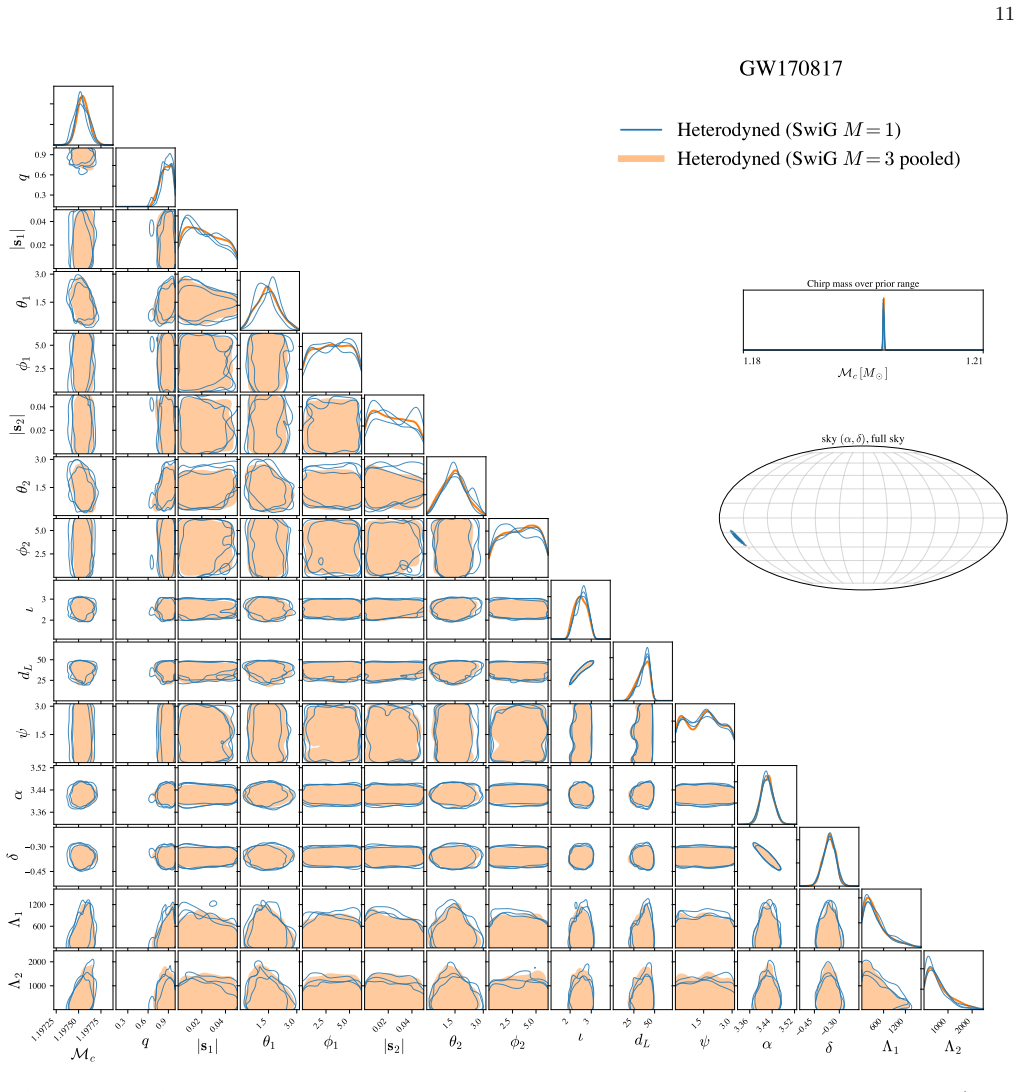
- [§IIID, §VIC, Abstract, Table III] §IIID and §VIC: the headline sub-segment timings (median 89 s; GW170817 ~2 min in the abstract, §V, Table III) are measured after a near-peak reference waveform is already available (injected truth in the campaign; ML-optimised for the real event). Reference location is explicitly excluded from the timed loop and deferred to external routines. For the compressed real-time claim this dependency is load-bearing. Please either (a) fold a concrete, timed reference-finding step into at least one end-to-end wall-time figure/table for the Heterodyned path, or (b) qualify the abstract and conclusions so that “real-time / sub-segment” is clearly conditioned on a pre-existing reference, while leaving the uncompressed and sharded claims (which do not need one) unqualified. A short bound citing the sub-minute optimisers already referenced would suffice.
- [§VA, Fig. 3, Appendix A] §VA and Appendix A: under the distance-marginalised heterodyned likelihood, sampled tc fails calibration (KS p ~ 4e-5) while other parameters remain valid; the fix is to marginalise tc instead. The paper adopts the fixed configuration for GW170817 and validates it (combined p=0.51), but the main-text Heterodyned timing distribution in Fig. 3 appears to be the distance-marginalised (faster) variant. Please state explicitly in §VA/Fig. 3 caption which marginalisation underlies the 89 s median, and report the corresponding median for the time-marginalised setup used on real data (~1.5× premium is mentioned only in passing) so that the production-relevant compressed timing is unambiguous.
minor comments (6)
- [§VA, Fig. 2] Fig. 2a: several individual KS p-values are low (e.g. Λ2 = 0.02, tc = 0.04, δ = 0.06) even though the Fisher-combined p = 0.17 passes. A brief remark on multiple-testing / which parameters drive residual tension would help readers interpret the Baseline vs High-Res comparison.
- [Table III, §VIC] Table III: JIT costs (likelihood + sampler kernel) are comparable to or larger than Heterodyned sampling time on a single event. §VIC correctly calls compilation a technical obstacle; a one-sentence note on amortisation across a night’s triggers or AOT strategies would clarify operational latency.
- [§IIIB] §IIIB footnote 2: inclination is labelled slow because of the ripple implementation rather than physics. Flagging this as an implementation artefact (and a possible future fast-block win) would avoid confusing readers who expect ι to be extrinsic.
- [§VIA] §VIA: the Bilby/pBilby comparison (~11 h on 560 CPU cores) is useful but not like-for-like (calibration uncertainties vs full-sky sampling). The text already notes opposing effects; a short quantitative caveat in the speedup sentences (“up to ~100× / ~300×”) would prevent over-reading.
- [Introduction / Background] Typos / polish: “390gravitational” missing space (p.1); “duringthepast” (p.3); “whenscalinginference” (p.4); “computationallycheaperincomparison” (p.5). A pass for concatenated words would help.
- [Fig. 1] Fig. 1 schematic is helpful; ensuring panel labels (A/B) are referenced consistently in the caption and §I would improve navigation.
Circularity Check
No significant circularity: empirical PE timings and P–P calibration stand on held-out injections and external baselines, not on self-defining fits.
full rationale
This is an engineering/methods paper whose load-bearing claims are measured wall-clock times and posterior calibration on synthetic BNS injections and GW170817, not first-principles predictions derived from fitted constants. Injections are drawn from the recovery prior and coverage is tested against held-out truths via KS/Fisher P–P diagnostics (N=100 and N=1000), with an unblocked NSS ablation and multi-seed GW170817 consistency checks; Bilby/pBilby and DINGO-BNS serve as external comparison points. Self-citations (Nested SwiG, vectorised NS, Jim/ripple) supply reusable infrastructure that is re-specified in Section III and then stress-tested here; they do not force the coverage or timing results by construction. Heterodyning’s reference waveform is an acknowledged external precondition for the compressed path, not a circular derivation step. No equation reduces a claimed prediction to its own fitted input.
Axiom & Free-Parameter Ledger
free parameters (6)
- live points m and deletions k =
m=512, k=64
- inner Gibbs sweeps M =
M=1 (baseline), M=3 (high-res)
- heterodyne bin count Nb =
Nb=5000
- fast-slow block partition and sub-block grouping =
seven sub-blocks as in §IIIB
- nested sampling termination threshold =
ΔlogZ < -3
- spin prior bound χ_max =
0.05
axioms (6)
- domain assumption Detector noise is stationary Gaussian with known PSD; likelihood is the standard matched-filter inner product.
- domain assumption IMRPhenomPv2_NRTidalv2 in ripple is an adequate forward model for the targeted BNS systems (no HOM required for near-equal-mass BNS).
- standard math Slice-within-Gibbs on the constrained prior leaves the nested-sampling target invariant (Metropolis-within-Gibbs correctness).
- domain assumption Intrinsic/extrinsic conditional coupling is mild enough that one (or few) blocked Gibbs sweeps mix at the stated budgets.
- domain assumption Relative-binning/heterodyne likelihood with a nearby reference waveform approximates the full-band likelihood for PE calibration when tc is marginalised.
- standard math Analytic/grid marginalisations over phase, and optionally time or distance, are exact up to grid resolution and may be reconstructed post hoc.
invented entities (1)
-
CBC fast-slow SwiG nested-sampling kernel (blocked constrained slice-within-Gibbs in BlackJAX)
independent evidence
read the original abstract
We present a specialised GPU-native nested sampling kernel targeting rapid parameter estimation for gravitational wave inference problems. Building upon a Slice-within-Gibbs (SwiG) structure for rapid mixing, we investigate how far we can push baseline stochastic sampling techniques on modern GPU hardware. We demonstrate that for typical long-duration binary neutron star signals observed by the LIGO and Virgo detectors, we can achieve well calibrated posterior inference on the full uncompressed data of a three detector network in a median of twelve minutes on a single GPU. This falls to five minutes when sharded across four devices. Utilising heterodyning to compress the data reduces the median wall time across an injection campaign to 89 seconds -- less than the length of the segment itself -- and enables inference with precessing spin, tidal waveforms on GW170817 in around two minutes. This pushes stochastic sampling techniques using full physical waveform calculations, launched from an uninformed prior state, towards real-time gravitational wave parameter estimation.
Figures




Reference graph
Works this paper leans on
-
[1]
B. P. Abbottet al.(LIGO Scientific, Virgo), Phys. Rev. Lett.116, 061102 (2016), arXiv:1602.03837 [gr-qc]
Pith/arXiv arXiv 2016
-
[2]
Abacet al.(LIGO Scientific, VIRGO, KAGRA), (2026), arXiv:2605.27225 [gr-qc]
N. Abacet al.(LIGO Scientific, VIRGO, KAGRA), (2026), arXiv:2605.27225 [gr-qc]
Pith/arXiv arXiv 2026
-
[3]
B. P. Abbottet al.(LIGO Scientific, Virgo), Phys. Rev. Lett.119, 161101 (2017), arXiv:1710.05832 [gr-qc]
Pith/arXiv arXiv 2017
-
[4]
B. P. Abbottet al.(LIGO Scientific, Virgo, Fermi GBM, INTEGRAL, IceCube, AstroSat Cadmium Zinc Tel- luride Imager Team, IPN, Insight-Hxmt, ANTARES, Swift, AGILE Team, 1M2H Team, Dark Energy Camera GW-EM, DES, DLT40, GRAWITA, Fermi-LAT, ATCA, 3 https://github.com/GW-JAX-Team ASKAP, Las Cumbres Observatory Group, OzGrav, DWF (Deeper Wider Faster Program), A...
Pith/arXiv arXiv 2017
-
[5]
B. P. Abbottet al.(LIGO Scientific, Virgo, Fermi- GBM, INTEGRAL), Astrophys. J. Lett.848, L13 (2017), 15 arXiv:1710.05834 [astro-ph.HE]
Pith/arXiv arXiv 2017
-
[6]
A. Goldsteinet al., Astrophys. J. Lett.848, L14 (2017), arXiv:1710.05446 [astro-ph.HE]
Pith/arXiv arXiv 2017
-
[7]
D. A. Coulteret al., Science358, 1556 (2017), arXiv:1710.05452 [astro-ph.HE]
Pith/arXiv arXiv 2017
-
[8]
B. P. Abbottet al.(LIGO Scientific, Virgo), Phys. Rev. X9, 011001 (2019), arXiv:1805.11579 [gr-qc]
Pith/arXiv arXiv 2019
-
[9]
B. P. Abbottet al.(LIGO Scientific, Virgo, 1M2H, Dark Energy Camera GW-E, DES, DLT40, Las Cumbres Observatory, VINROUGE, MASTER), Nature551, 85 (2017), arXiv:1710.05835 [astro-ph.CO]
Pith/arXiv arXiv 2017
-
[10]
M. Pillaset al., Phys. Rev. D112, 083002 (2025), arXiv:2503.15422 [astro-ph.HE]
arXiv 2025
-
[11]
T. Wouters, A. Puecher, P. T. H. Pang, and T. Dietrich, (2025), arXiv:2510.22290 [astro-ph.HE]
arXiv 2025
-
[12]
R. W. Kiendrebeogoet al., Astrophys. J.958, 158 (2023), arXiv:2306.09234 [astro-ph.HE]
Pith/arXiv arXiv 2023
-
[13]
V. G. Shah, G. Narayan, H. M. L. Perkins, R. J. Foley, D. Chatterjee, B. Cousins, and P. Macias, Mon. Not. Roy. Astron. Soc.528, 1109 (2024), arXiv:2310.15240 [astro-ph.HE]
Pith/arXiv arXiv 2024
-
[14]
S. Bhattacharjee, S. Banerjee, V. Bhalerao, P. Beni- amini, S. Bose, K. Hotokezaka, A. Pai, M. Saleem, and G. Waratkar, Mon. Not. Roy. Astron. Soc.528, 4255 (2024), arXiv:2401.13636 [astro-ph.HE]
Pith/arXiv arXiv 2024
-
[15]
R. Kaur, B. O’Connor, A. Palmese, and K. Kunnumkai, Astrophys. J.1000, 74 (2026), arXiv:2410.10579 [astro- ph.HE]
arXiv 2026
-
[16]
L. P. Singer and L. R. Price, Phys. Rev. D93, 024013 (2016), arXiv:1508.03634 [gr-qc]
Pith/arXiv arXiv 2016
-
[17]
S. S. Chaudharyet al., Proc. Nat. Acad. Sci.121, e2316474121 (2024), arXiv:2308.04545 [astro-ph.HE]
Pith/arXiv arXiv 2024
-
[18]
Punturoet al., Class
M. Punturoet al., Class. Quant. Grav.27, 194002 (2010)
2010
-
[19]
Maggioreet al.(ET), JCAP03, 050, arXiv:1912.02622 [astro-ph.CO]
M. Maggioreet al.(ET), JCAP03, 050, arXiv:1912.02622 [astro-ph.CO]
Pith/arXiv arXiv 1912
-
[20]
Branchesiet al., JCAP07, 068, arXiv:2303.15923 [gr-qc]
M. Branchesiet al., JCAP07, 068, arXiv:2303.15923 [gr-qc]
-
[21]
Abacet al.(ET), JCAP03, 081, arXiv:2503.12263 [gr-qc]
A. Abacet al.(ET), JCAP03, 081, arXiv:2503.12263 [gr-qc]
-
[22]
D. Reitzeet al., Bull. Am. Astron. Soc.51, 035 (2019), arXiv:1907.04833 [astro-ph.IM]
Pith/arXiv arXiv 2019
-
[23]
Evanset al., (2021), arXiv:2109.09882 [astro-ph.IM]
M. Evanset al., (2021), arXiv:2109.09882 [astro-ph.IM]
Pith/arXiv arXiv 2021
-
[24]
Couvareset al., (2021), arXiv:2111.06987 [gr-qc]
P. Couvareset al., (2021), arXiv:2111.06987 [gr-qc]
Pith/arXiv arXiv 2021
- [25]
-
[26]
S. Hildet al., Class. Quant. Grav.28, 094013 (2011), arXiv:1012.0908 [gr-qc]
Pith/arXiv arXiv 2011
-
[27]
Skilling, Bayesian Anal.1, 833 (2006)
J. Skilling, Bayesian Anal.1, 833 (2006)
2006
-
[28]
Ashtonet al., Nat
G. Ashtonet al., Nat. Rev. Methods Primers2, 39 (2022)
2022
-
[29]
Veitchet al., Phys
J. Veitchet al., Phys. Rev. D91, 042003 (2015)
2015
-
[30]
G. Ashtonet al., Astrophys. J. Suppl.241, 27 (2019), 1811.02042
Pith/arXiv arXiv 2019
-
[31]
I. M. Romero-Shawet al., Mon. Not. Roy. Astron. Soc. 499, 3295 (2020), arXiv:2006.00714 [astro-ph.IM]
Pith/arXiv arXiv 2020
-
[32]
R. J. E. Smith, G. Ashton, A. Vajpeyi,et al., Mon. Not. Roy. Astron. Soc.498, 4492 (2020), arXiv:1909.11873 [gr-qc]
Pith/arXiv arXiv 2020
-
[33]
N. J. Cornish, (2010), arXiv:1007.4820 [gr-qc]
Pith/arXiv arXiv 2010
-
[34]
B. Zackay, L. Dai, and T. Venumadhav, (2018), arXiv:1806.08792 [astro-ph.IM]
Pith/arXiv arXiv 2018
-
[35]
R. Smith, S. E. Field, K. Blackburn, C.-J. Haster, M. Pürrer, V. Raymond, and P. Schmidt, Phys. Rev. D 94, 044031 (2016), arXiv:1604.08253 [gr-qc]
Pith/arXiv arXiv 2016
-
[36]
S. Morisaki, Phys. Rev. D104, 044062 (2021), arXiv:2104.07813 [gr-qc]
Pith/arXiv arXiv 2021
-
[37]
L. Pathak, A. Reza, and A. S. Sengupta, Phys. Rev. D 108, 064055 (2023), arXiv:2210.02706 [gr-qc]
Pith/arXiv arXiv 2023
-
[38]
L. Pathak, S. Munishwar, A. Reza, and A. S. Sengupta, Phys. Rev. D109, 024053 (2024), arXiv:2309.07012 [gr- qc]
Pith/arXiv arXiv 2024
-
[39]
A. Sharma, L. Pathak, S. Roy, and A. S. Sengupta, (2025), arXiv:2508.04172 [gr-qc]
Pith/arXiv arXiv 2025
-
[40]
M. J. Williams, J. Veitch, and C. Messenger, Phys. Rev. D103, 103006 (2021), arXiv:2102.11056 [gr-qc]
Pith/arXiv arXiv 2021
-
[41]
K. W. k. Wong, M. Gabrié, and D. Foreman-Mackey, J. Open Source Softw.8, 5021 (2023), arXiv:2211.06397 [astro-ph.IM]
Pith/arXiv arXiv 2023
-
[42]
T. Wouters, P. T. H. Pang, T. Dietrich, and C. Van Den Broeck, Phys. Rev. D110, 083033 (2024), arXiv:2404.11397 [astro-ph.IM]
arXiv 2024
- [43]
-
[44]
S. R. Green, C. Simpson, and J. Gair, Phys. Rev. D102, 104057 (2020), arXiv:2002.07656 [astro-ph.IM]
Pith/arXiv arXiv 2020
-
[45]
M. Dax, S. R. Green, J. Gair, J. H. Macke, A. Buonanno, and B. Schölkopf, Phys. Rev. Lett.127, 241103 (2021), arXiv:2106.12594 [gr-qc]
Pith/arXiv arXiv 2021
-
[46]
M. Dax, S. R. Green, J. Gair, N. Gupte, M. Pürrer, V. Raymond, J. Wildberger, J. H. Macke, A. Buo- nanno, and B. Schölkopf, Nature639, 49 (2025), arXiv:2407.09602 [gr-qc]
Pith/arXiv arXiv 2025
-
[47]
D. Yallup, Nested sampling with slice-within-Gibbs: Effi- cient evidence calculation for hierarchical Bayesian mod- els (2026), arXiv:2602.17414
arXiv 2026
-
[48]
D. Yallup, N. Kroupa, and W. Handley, Transactions on Machine Learning Research (2026), arXiv:2601.23252 [stat.CO]
Pith/arXiv arXiv 2026
-
[49]
K. Krishna, A. Vijaykumar, A. Ganguly, C. Talbot, S. Biscoveanu, R. N. George, N. Williams, and A. Zim- merman, (2023), arXiv:2312.06009 [gr-qc]
Pith/arXiv arXiv 2023
-
[50]
P. Canizares, S. E. Field, J. Gair, V. Raymond, R. Smith, and M. Tiglio, Phys. Rev. Lett.114, 071104 (2015), arXiv:1404.6284 [gr-qc]
Pith/arXiv arXiv 2015
-
[51]
S. Morisaki and V. Raymond, Phys. Rev. D102, 104020 (2020), arXiv:2007.09108 [gr-qc]
Pith/arXiv arXiv 2020
-
[52]
S. Morisaki, R. Smith, L. Tsukada, S. Sachdev, S. Steven- son, C. Talbot, and A. Zimmerman, Phys. Rev. D108, 123040 (2023), arXiv:2307.13380 [gr-qc]
Pith/arXiv arXiv 2023
-
[53]
C. García-Quirós, S. Husa, M. Mateu-Lucena, and A. Borchers, Class. Quant. Grav.38, 015006 (2021), arXiv:2001.10897 [gr-qc]
Pith/arXiv arXiv 2021
-
[54]
J. Lange, R. O’Shaughnessy, and M. Rizzo, (2018), arXiv:1805.10457 [gr-qc]
Pith/arXiv arXiv 2018
-
[55]
Aasiet al.(LIGO Scientific), Class
J. Aasiet al.(LIGO Scientific), Class. Quant. Grav.32, 074001 (2015), arXiv:1411.4547 [gr-qc]
Pith/arXiv arXiv 2015
-
[56]
F. Acerneseet al.(VIRGO), Class. Quant. Grav.32, 024001 (2015), arXiv:1408.3978 [gr-qc]
Pith/arXiv arXiv 2015
-
[57]
Akutsuet al.(KAGRA), PTEP2021, 05A101 (2021), arXiv:2005.05574 [physics.ins-det]
T. Akutsuet al.(KAGRA), PTEP2021, 05A101 (2021), arXiv:2005.05574 [physics.ins-det]
arXiv 2021
-
[58]
S. Husa, S. Khan, M. Hannam, M. Pürrer, F. Ohme, X. Jiménez Forteza, and A. Bohé, Phys. Rev. D93, 044006 (2016), arXiv:1508.07250 [gr-qc]
Pith/arXiv arXiv 2016
-
[59]
S. Khan, S. Husa, M. Hannam, F. Ohme, M. Pürrer, X. Jiménez Forteza, and A. Bohé, Phys. Rev. D93, 044007 (2016), arXiv:1508.07253 [gr-qc]
Pith/arXiv arXiv 2016
-
[60]
M. Hannam, P. Schmidt, A. Bohé, L. Haegel, S. Husa, F. Ohme, G. Pratten, and M. Pürrer, Phys. Rev. Lett. 16 113, 151101 (2014), arXiv:1308.3271 [gr-qc]
Pith/arXiv arXiv 2014
-
[61]
T. Dietrich, A. Samajdar, S. Khan, N. K. Johnson- McDaniel, R. Dudi, and W. Tichy, Phys. Rev. D100, 044003 (2019), arXiv:1905.06011 [gr-qc]
Pith/arXiv arXiv 2019
-
[62]
A. M. Baker, P. D. Lasky, E. Thrane, and J. Golomb, Phys. Rev. D112, 102004 (2025), arXiv:2503.04073 [gr- qc]
arXiv 2025
-
[63]
N. Guttman, A. M. Baker, P. D. Lasky, and E. Thrane, (2026), arXiv:2606.14197 [astro-ph.HE]
arXiv 2026
-
[64]
M. Gabrié, G. M. Rotskoff, and E. Vanden-Eijnden, Proc. Nat. Acad. Sci.119, e2109420119 (2022), arXiv:2105.12603 [physics.data-an]
Pith/arXiv arXiv 2022
-
[65]
M. Karamanis, F. Beutler, J. A. Peacock, D. Nabergoj, and U. Seljak, Mon. Not. Roy. Astron. Soc.516, 1644 (2022), arXiv:2207.05652 [astro-ph.IM]
Pith/arXiv arXiv 2022
-
[66]
M. Karamanis, D. Nabergoj, F. Beutler, J. A. Peacock, and U. Seljak, J. Open Source Softw.7, 4634 (2022), arXiv:2207.05660 [astro-ph.IM]
Pith/arXiv arXiv 2022
-
[67]
M. J. Williams, J. Veitch, and C. Messenger, Mach. Learn. Sci. Tech.4, 035011 (2023), arXiv:2302.08526 [astro-ph.IM]
Pith/arXiv arXiv 2023
-
[68]
K. W. K. Wong, M. Isi, and T. D. P. Edwards, Astrophys. J.958, 129 (2023), arXiv:2302.05333 [astro-ph.IM]
Pith/arXiv arXiv 2023
-
[69]
M. Prathaban, H. Bevins, and W. Handley, Mon. Not. Roy. Astron. Soc.541, 200 (2025), arXiv:2411.17663 [astro-ph.IM]
arXiv 2025
-
[70]
L. Negri and A. Samajdar, Mon. Not. Roy. Astron. Soc. 546, staf2145 (2026), arXiv:2509.17606 [astro-ph.HE]
arXiv 2026
-
[71]
M. J. Williams, (2025), arXiv:2511.04218 [hep-ex]
Pith/arXiv arXiv 2025
-
[72]
G. Demasiet al., The Sequential Monte Carlo goes NUTS: Boosting Gravitational-Wave Inference (2026), arXiv:2601.02336 [gr-qc]
Pith/arXiv arXiv 2026
-
[73]
K. Cranmer, J. Brehmer, and G. Louppe, Proc. Nat. Acad. Sci.117, 30055 (2020), arXiv:1911.01429 [stat.ML]
Pith/arXiv arXiv 2020
-
[74]
I. Kobyzev, S. J. D. Prince, and M. A. Brubaker, IEEE Trans. Pattern Anal. Machine Intell.43, 3964 (2021), arXiv:1908.09257 [stat.ML]
Pith/arXiv arXiv 2021
-
[75]
G. Papamakarios, E. Nalisnick, D. J. Rezende, S. Mo- hamed, and B. Lakshminarayanan, J. Machine Learning Res.22, 2617 (2021), arXiv:1912.02762 [stat.ML]
Pith/arXiv arXiv 2021
-
[76]
J. Roulet, M. Crisostomi, L. M. Thomas, and K. Chatzi- ioannou, (2026), arXiv:2604.08897 [gr-qc]
Pith/arXiv arXiv 2026
-
[77]
D. Chatterjeeet al., Mach. Learn. Sci. Tech.5, 045030 (2024), arXiv:2407.19048 [gr-qc]
Pith/arXiv arXiv 2024
-
[78]
E. Marx, D. Chatterjee, M. Desai, R. Kumar, W. Benoit, A. Sasli, L. Singer, M. W. Coughlin, P. Harris, and E. Katsavounidis, Phys. Rev. D113, 063020 (2026), arXiv:2509.22561 [gr-qc]
arXiv 2026
-
[79]
Q. Hu, J. Irwin, Q. Sun, C. Messenger, L. Suleiman, I. S. Heng, and J. Veitch, Astrophys. J. Lett.987, L17 (2025), arXiv:2412.03454 [gr-qc]
Pith/arXiv arXiv 2025
-
[80]
J. Alvey, U. Bhardwaj, V. Domcke, M. Pieroni, and C. Weniger, Phys. Rev. D111, 102006 (2025), arXiv:2408.00832 [gr-qc]
Pith/arXiv arXiv 2025
discussion (0)
Sign in with ORCID, Apple, or X to comment. Anyone can read and Pith papers without signing in.