Ultra-Peripheral Collisions as a Nuclear-Structure Interferometer with Interpretable Multitask Deep Learning
Pith reviewed 2026-06-26 06:31 UTC · model grok-4.3
The pith
An interpretable multitask deep learning model extracts multiple nuclear structure indicators from transverse momentum distributions in ultra-peripheral collisions.
A machine-rendered reading of the paper's core claim, the machinery that carries it, and where it could break.
Core claim
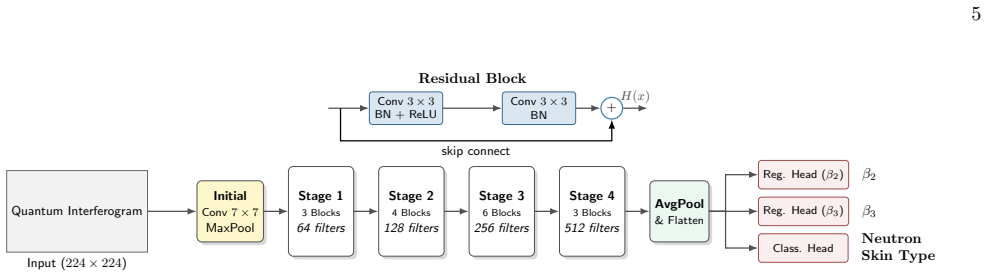
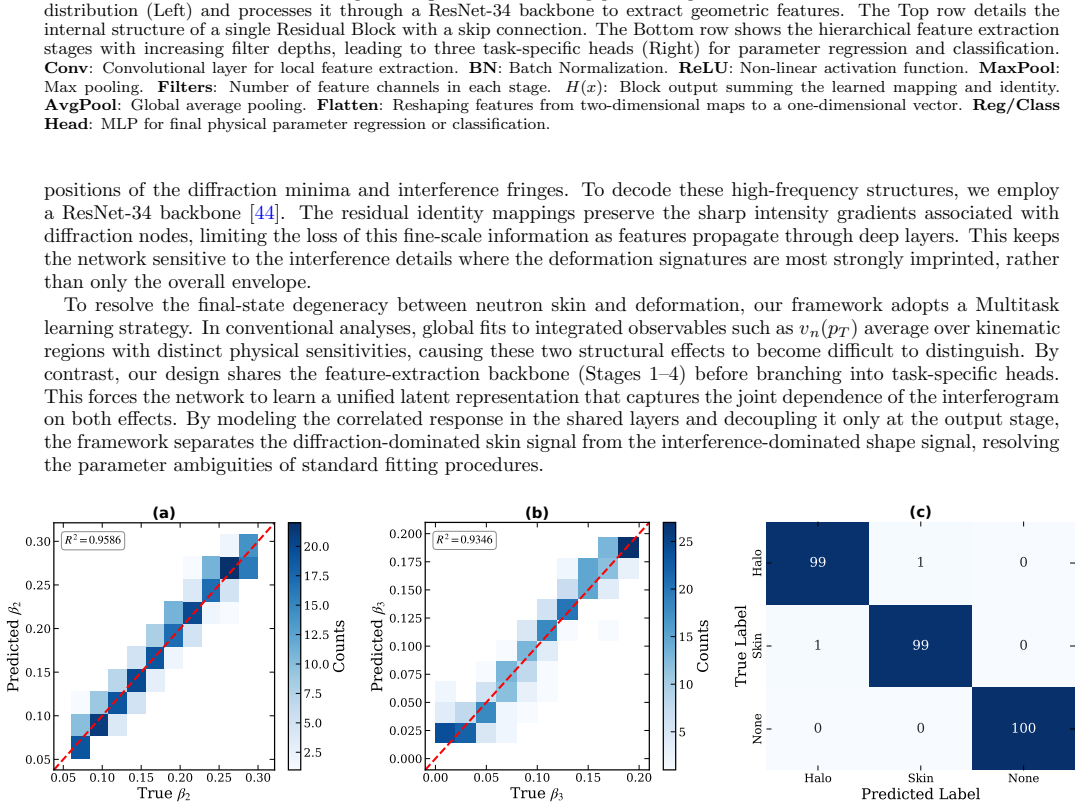
The central claim is that an interpretable multitask deep-learning framework maps transverse momentum distributions from coherent J/ψ photoproduction in ultra-peripheral collisions to multiple nuclear-structure indicators at once, with the learned features separating diffraction-dominated from interference-dominated information and yielding analysis-ready observables.
What carries the argument
The interpretable multitask deep-learning framework that maps transverse momentum distributions to nuclear-structure indicators while identifying driving kinematic regions.
If this is right
- The learned features separate diffraction-dominated and interference-dominated information in the transverse momentum distributions.
- The framework supplies analysis-ready observables suitable for future high-luminosity data sets.
- Multiple nuclear-structure indicators can be constrained simultaneously from the same photoproduction patterns.
- Kinematic regions responsible for each indicator inference become identifiable without manual fitting.
Where Pith is reading between the lines
- The same multitask architecture could be retrained on other vector mesons or nuclear species to test whether separation of diffraction and interference persists across different mass ranges.
- If the model succeeds on real data, traditional one-at-a-time fitting procedures for UPC observables might be replaced by direct extraction of multiple parameters from a single network pass.
- The identified kinematic regions could guide future detector design or trigger strategies to emphasize the interference-dominated regime.
Load-bearing premise
The simulated training data accurately capture all relevant experimental effects including phase smearing, correlated sensitivities to deformation and neutron skin, and backgrounds.
What would settle it
Applying the trained model to real high-luminosity UPC data and finding that the extracted deformation and neutron-skin values disagree with independent measurements from electron scattering or other probes would falsify the claim that the framework generalizes to produce reliable observables.
Figures
read the original abstract
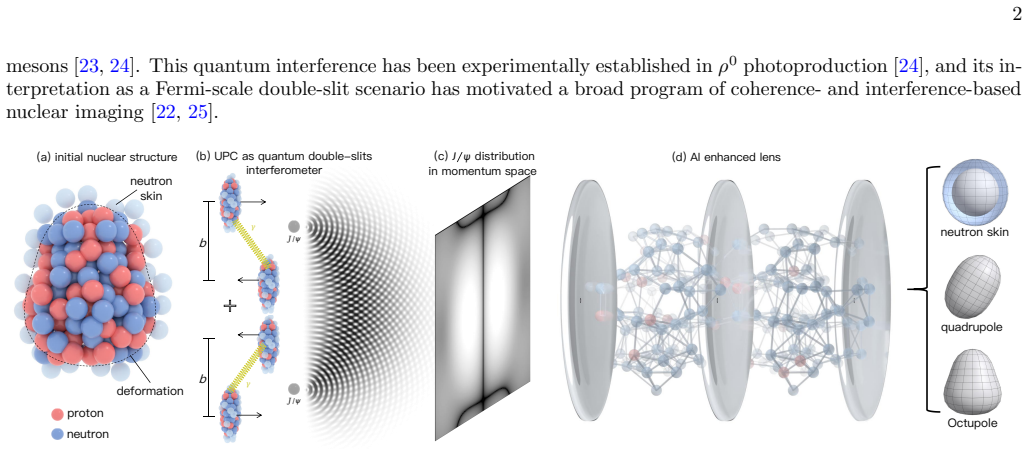
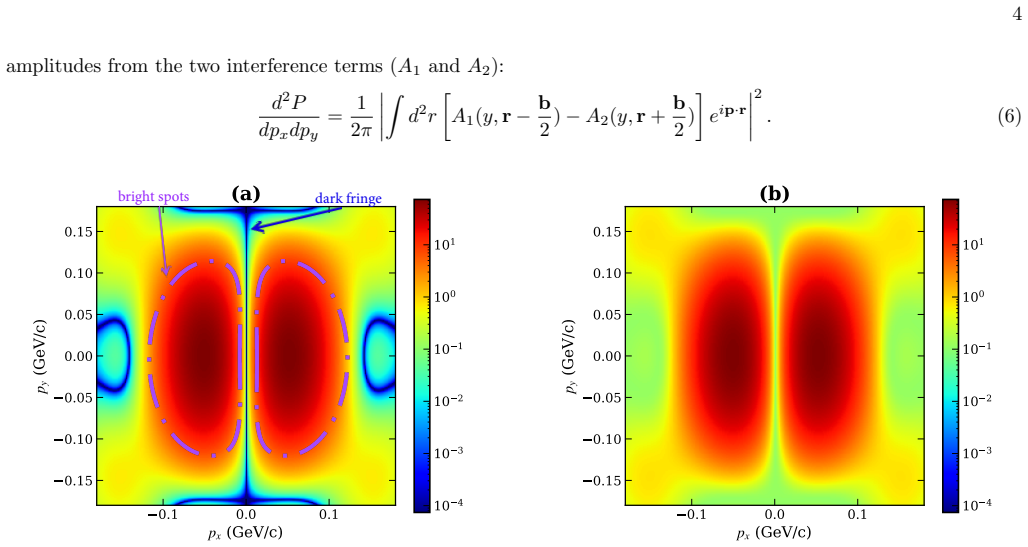
Precise knowledge of nuclear structure is essential across fundamental physics, yet probing these structures is notoriously difficult. To address this challenge, ultra-peripheral collisions (UPCs) provide a femtoscopic tomography for imaging the atomic nucleus. UPCs offer a pristine electromagnetic pathway: coherent vector-meson photoproduction generates patterns of diffraction and two-source interference that directly encode the nuclear spatial density. Turning these patterns into quantitative constraints is, however, a challenging inverse problem, complicated by correlated sensitivities to deformation and neutron skin, phase smearing, and experimental backgrounds. Here we introduce an interpretable Multitask deep-learning framework that maps transverse momentum distributions to multiple nuclear-structure indicators simultaneously and identifies the kinematic regions driving each inference. We demonstrate the approach with coherent $J/\psi$ photoproduction in $^{96}_{40}\text{Zr} + ^{96}_{40}\text{Zr}$ collisions, showing that the learned features separate diffraction-dominated and interference-dominated information and provide analysis-ready observables for future high-luminosity data.
Editorial analysis
A structured set of objections, weighed in public.
Referee Report
Summary. The manuscript introduces an interpretable multitask deep-learning framework that maps transverse momentum distributions from ultra-peripheral collisions to multiple nuclear-structure indicators simultaneously while identifying the driving kinematic regions. It demonstrates the method on simulated coherent J/ψ photoproduction in ^{96}Zr + ^{96}Zr collisions, claiming that the learned features separate diffraction-dominated and interference-dominated information and yield analysis-ready observables.
Significance. If the forward model in simulation faithfully encodes nuclear densities, phase information, and backgrounds, the multitask approach with built-in interpretability offers a practical route to handle correlated sensitivities to deformation and neutron skin in UPC data. The explicit separation of diffraction and interference channels is a concrete strength that could support future high-luminosity analyses.
major comments (1)
- The central claim that the learned features provide analysis-ready observables for real high-luminosity data rests on the untested assumption that the simulated training data captures all relevant experimental effects (phase smearing, correlated sensitivities, backgrounds). No section demonstrates robustness tests, held-out validation metrics, or sensitivity to variations in these inputs, which is load-bearing for generalization.
Simulated Author's Rebuttal
We thank the referee for the constructive and detailed report. The major comment identifies a key limitation in the current scope of validation, which we address directly below and will resolve through manuscript revision.
read point-by-point responses
-
Referee: [—] The central claim that the learned features provide analysis-ready observables for real high-luminosity data rests on the untested assumption that the simulated training data captures all relevant experimental effects (phase smearing, correlated sensitivities, backgrounds). No section demonstrates robustness tests, held-out validation metrics, or sensitivity to variations in these inputs, which is load-bearing for generalization.
Authors: We agree that the manuscript's forward-looking claim regarding analysis-ready observables would be strengthened by explicit robustness demonstrations. The current work is a proof-of-concept demonstration on forward-model simulations that encode nuclear densities, diffraction, and interference; it does not yet incorporate full experimental variations. In the revised version we will add a dedicated subsection reporting held-out validation metrics on parameter-varied simulations, sensitivity scans to phase smearing and background levels, and quantitative assessment of how these affect the extracted nuclear-structure indicators. This will clarify the present scope while supporting the intended application to future data. revision: yes
Circularity Check
No significant circularity detected
full rationale
The paper introduces a multitask deep-learning framework that maps simulated transverse-momentum distributions from coherent J/ψ photoproduction in Zr+Zr UPCs to multiple nuclear-structure indicators. The demonstration relies on the forward simulation faithfully encoding nuclear densities, interference phases, and backgrounds so that learned features remain informative on real data. No equations or steps in the provided abstract and description reduce a claimed prediction to a fitted input by construction, invoke a self-citation as the sole justification for a uniqueness claim, or rename a known empirical pattern as a new derivation. The central claim is an inverse-problem application whose validity rests on external simulation fidelity rather than internal self-reference; the derivation chain is therefore self-contained.
Axiom & Free-Parameter Ledger
Reference graph
Works this paper leans on
-
[1]
Conversely, a halo-type structure is characterized by a larger surface diffuseness for neutrons (a n > a p) with similar radii
while keeping the diffusenessaidentical. Conversely, a halo-type structure is characterized by a larger surface diffuseness for neutrons (a n > a p) with similar radii. The coherent photoproduction amplitude is constructed by convolving the equivalent photon flux [38] with the photon-nucleus scattering amplitude, incorporating nuclear shadowing and cohere...
-
[2]
N. P. Nazirkar, X. Shi, J. Shi, M. N’Gom, and E. Fohtung, Appl. Phys. Rev.11, 021302 (2024)
2024
-
[3]
Ossig, C
C. Ossig, C. Strelow, J. Fl¨ ugge, S. Patjens, J. Garrevoet, K. Spiers, J. L. Barp, J. Hagemann, F. Seiboth, M. De Bastiani, et al., PRX Energy3, 023011 (2024)
2024
-
[4]
J. Miao, P. Charalambous, J. Kirz, and D. Sayre, Nature400, 342 (1999)
1999
-
[5]
Thibault, M
P. Thibault, M. Dierolf, A. Menzel, O. Bunk, C. David, and F. Pfeiffer, Science321, 379 (2008)
2008
-
[6]
Ophus, Microsc
C. Ophus, Microsc. Microanal.25, 563 (2019)
2019
-
[7]
Ozdol, C
V. Ozdol, C. Gammer, X. Jin, P. Ercius, C. Ophus, J. Ciston, and A. Minor, Appl. Phys. Lett.106, 253107 (2015)
2015
-
[8]
A. Yau, W. Cha, M. W. Kanan, G. B. Stephenson, and A. Ulvestad, Science356, 739 (2017)
2017
-
[9]
Robinson and R
I. Robinson and R. Harder, Nature Mater.8, 291 (2009)
2009
-
[10]
C.-C. Chen, C. Zhu, E. R. White, C.-Y. Chiu, M. Scott, B. Regan, L. D. Marks, Y. Huang, and J. Miao, Nature496, 74 (2013)
2013
-
[11]
J. A. Rodriguez, R. Xu, C.-C. Chen, Z. Huang, H. Jiang, A. L. Chen, K. S. Raines, A. Pryor Jr, D. Nam, L. Wiegart, et al., IUCrJ2, 575 (2015)
2015
-
[12]
Hamamoto and B
I. Hamamoto and B. R. Mottelson, Scholarpedia7, 10693 (2011)
2011
-
[13]
Cline, Ann
D. Cline, Ann. Rev. Nucl. Part. Sci.36, 683 (1986)
1986
-
[14]
Ding, D.-Q
M.-Q. Ding, D.-Q. Fang, and Y.-G. Ma, Nucl. Sci. Tech.35, 211 (2024)
2024
-
[15]
F. J. Fattoyev and J. Piekarewicz, Phys. Rev. C86, 015802 (2012)
2012
-
[16]
J. M. Lattimer and M. Prakash, Science304, 536 (2004)
2004
-
[17]
Roca-Maza, M
X. Roca-Maza, M. Centelles, X. Vinas, and M. Warda, Phys. Rev. Lett.106, 252501 (2011)
2011
-
[18]
J. D. Patterson and R. J. Peterson, Nucl. Phys. A717, 235 (2003)
2003
-
[19]
M. I. Abdulhamid et al. (STAR), Nature635, 67 (2024)
2024
-
[20]
Ragoni (ALICE), Acta Phys
S. Ragoni (ALICE), Acta Phys. Polon. Supp.18, 1 (2025)
2025
-
[21]
K. Shen, X. Wu, Z. Tang, and W. Zha, Eur. Phys. J. C84, 1167 (2024)
2024
-
[22]
J. Luo, X. Li, Z. Tang, X. Wu, and W. Zha, Phys. Rev. C108, 054906 (2023)
2023
-
[23]
W. Zha, L. Ruan, Z. Tang, Z. Xu, and S. Yang, Phys. Rev. C99, 061901 (2019)
2019
-
[24]
Lin, J.-Y
S. Lin, J.-Y. Hu, H.-J. Xu, S. Pu, and Q. Wang, Phys. Rev. D111, 074020 (2025)
2025
-
[25]
B. I. Abelev et al. (STAR), Phys. Rev. Lett.102, 112301 (2009)
2009
-
[26]
Ma, Nucl
Y.-G. Ma, Nucl. Sci. Tech.34, 16 (2023)
2023
-
[27]
Aarts, K
G. Aarts, K. Fukushima, T. Hatsuda, A. Ipp, S. Shi, L. Wang, and K. Zhou, Nature Rev. Phys.7, 154 (2025)
2025
-
[28]
M. S. Abdallah et al. (STAR), Phys. Rev. Lett.128, 092301 (2022)
2022
-
[29]
H.-J. Xu, H. Li, X. Wang, C. Shen, and F. Wang, Phys. Lett. B819, 136453 (2021)
2021
-
[30]
J. Jia, G. Giacalone, and C. Zhang, Phys. Rev. Lett.131, 022301 (2023)
2023
-
[31]
Boehnlein et al., Rev
A. Boehnlein et al., Rev. Mod. Phys.94, 031003 (2022). 11
2022
-
[32]
He, Y.-G
W.-B. He, Y.-G. Ma, L.-G. Pang, H.-C. Song, and K. Zhou, Nucl. Sci. Tech.34, 88 (2023)
2023
-
[33]
K. Zhou, L. Wang, L.-G. Pang, and S. Shi, Prog. Part. Nucl. Phys.135, 104084 (2024)
2024
-
[34]
Ma, L.-G
Y.-G. Ma, L.-G. Pang, R. Wang, and K. Zhou, Chin. Phys. Lett.40, 122101 (2023)
2023
-
[35]
Y.-L. Du, D. Pablos, and K. Tywoniuk, Phys. Rev. Lett.128, 012301 (2022)
2022
-
[36]
A. J. Larkoski, Eur. Phys. J. C84, 1117 (2024)
2024
-
[37]
Utama, J
R. Utama, J. Piekarewicz, and H. B. Prosper, Phys. Rev. C93, 014311 (2016)
2016
-
[38]
Cheng, S
Y.-L. Cheng, S. Shi, Y.-G. Ma, H. St¨ ocker, and K. Zhou, Phys. Rev. C107, 064909 (2023)
2023
-
[39]
Krauss, M
F. Krauss, M. Greiner, and G. Soff, Prog. Part. Nucl. Phys.39, 503 (1997)
1997
-
[40]
M. L. Miller, K. Reygers, S. J. Sanders, and P. Steinberg, Ann. Rev. Nucl. Part. Sci.57, 205 (2007)
2007
-
[41]
T. H. Bauer, R. D. Spital, D. R. Yennie, and F. M. Pipkin, Rev. Mod. Phys.50, 261 (1978)
1978
-
[42]
P. Wang, X. Wu, W. Zha, and Z. Tang, Chin. Phys. C46, 074103 (2022)
2022
-
[43]
S. R. Klein, J. Nystrand, J. Seger, Y. Gorbunov, and J. Butterworth, Comput. Phys. Commun.212, 258 (2017)
2017
-
[44]
S. R. Klein and J. Nystrand, Phys. Rev. Lett.84, 2330 (2000)
2000
-
[45]
K. He, X. Zhang, S. Ren, and J. Sun (2015), 1512.03385
Pith/arXiv arXiv 2015
-
[46]
L. M. Zintgraf, T. S. Cohen, T. Adel, and M. Welling (2017), 1702.04595
Pith/arXiv arXiv 2017
-
[47]
Grund (ALICE), Phys
D. Grund (ALICE), Phys. Proc. UPC1, 4 (2024)
2024
-
[48]
L. Massacrier (ALICE), in58th Rencontres de Moriond on QCD and High Energy Interactions(2024), 2407.09707
arXiv 2024
-
[49]
M. I. Abdulhamid et al. (STAR), Phys. Rev. Lett.133, 052301 (2024)
2024
-
[50]
Accardi et al., Eur
A. Accardi et al., Eur. Phys. J. A52, 268 (2016)
2016
-
[51]
J. D. Brandenburg, S. R. Klein, Z. Xu, S. Yang, W. Zha, and J. Zhou, Prog. Part. Nucl. Phys.143, 104174 (2025)
2025
-
[52]
Guzey, E
V. Guzey, E. Kryshen, M. Strikman, and M. Zhalov, Phys. Lett. B726, 290 (2013)
2013
-
[53]
Garcon, Eur
M. Garcon, Eur. Phys. J. A18, 389 (2003)
2003
-
[54]
M¨ antysaari and B
H. M¨ antysaari and B. Schenke, Phys. Rev. Lett.117, 052301 (2016)
2016
-
[55]
D. Y. Shao, H.-Q. Yu, C. Zhang, and J. Zhou (2025), 2511.17670
arXiv 2025
-
[56]
Acharya et al
S. Acharya et al. (ALICE), Phys. Lett. B865, 139466 (2025)
2025
-
[57]
Shatat (ALICE), EPJ Web Conf.296, 07005 (2024)
A. Shatat (ALICE), EPJ Web Conf.296, 07005 (2024)
2024
-
[58]
Pavone, A
A. Pavone, A. Merlo, S. Kwak, and J. Svensson, Plasma Phys. Control. Fusion65, 053001 (2023)
2023
-
[59]
J. E. Bernhard, J. S. Moreland, S. A. Bass, J. Liu, and U. Heinz, Phys. Rev. C94, 024907 (2016)
2016
-
[60]
He, W.-B
J. He, W.-B. He, Y.-G. Ma, and S. Zhang, Phys. Rev. C104, 044902 (2021)
2021
-
[61]
Pratt, E
S. Pratt, E. Sangaline, P. Sorensen, and H. Wang, Phys. Rev. Lett.114, 202301 (2015)
2015
-
[62]
Carleo, I
G. Carleo, I. Cirac, K. Cranmer, L. Daudet, M. Schuld, N. Tishby, L. Vogt-Maranto, and L. Zdeborov´ a, Rev. Mod. Phys. 91, 045002 (2019)
2019
-
[63]
Hufner and B
J. Hufner and B. Z. Kopeliovich, Phys. Lett. B426, 154 (1998). 12 Appendix A: GLAUBER-VMD FRAMEWORK DET AIL J/ψphotoproduction in 96 40Zr+96 40Zr ultra-peripheral collisions is simulated using the Glauber-VMD framework established in Refs. [20–22]. The spatial distribution of nucleons inside the 96 40Zr nucleus is modeled with a deformed Woods–Saxon profi...
1998
-
[64]
Conversely, a halo-type structure is characterized by a larger surface diffuseness for neutrons (a n > a p) with similar radii
while keeping the diffusenessaidentical. Conversely, a halo-type structure is characterized by a larger surface diffuseness for neutrons (a n > a p) with similar radii. The coherent production amplitude is formulated by combining the equivalent photon flux with the nuclear scat- tering amplitude. The spatial photon flux induced by the projectile ion is gi...
discussion (0)
Sign in with ORCID, Apple, or X to comment. Anyone can read and Pith papers without signing in.