REVIEW 3 major objections 6 minor 1 cited by
CLiViS: Unleashing Cognitive Map through Linguistic-Visual Synergy for Embodied Visual Reasoning
T0 review · 3 major / 6 minor · reviewed 2026-08-15 · deepseek-v4-flash
Pith's one-line read The paper claims that a training-free LLM–VLM loop with a dynamic cognitive map reaches state-of-the-art embodied visual reasoning, reporting 49.4% average accuracy across three benchmarks.
desk verdict Useful training-free video-QA pipeline with a genuinely structured cognitive map, but the 'SOTA' claim needs qualifiers and the paper never isolates whether the gains come from new VLM evidence or just iterative LLM reasoning. read the letter →
The pith
A machine-rendered reading of the paper's core claim, the machinery that carries it, and where it could break.
The reading
What carries the argument
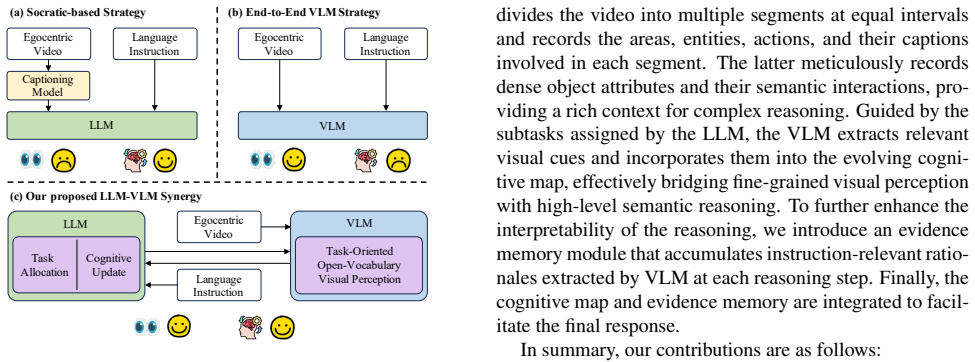
The dynamic Cognitive Map is a graph-based representation of the embodied scene that evolves during inference. It has two components: a navigation graph whose nodes are fixed-length video segments with entities and captions, and a relation graph whose nodes are entities and actions and whose edges are spatial, agent-object, or functional relations. The map is initialized by VLM-generated segmented scene descriptions and refined in each round by new VLM evidence under LLM-generated sub-instructions, with conflict resolution favoring newer observations; an evidence memory stores time-stamped rationales. The map is what bridges low-level perception (VLM) and high-level reasoning (LLM), and ablations show that removing it, or collapsing the iterative loop, costs roughly 10 points on EgoTempo.
What would settle it
Re-run the EgoTempo and OpenEQA evaluations with human raters or an independent judge model (e.g., GPT-4.1) instead of Qwen2.5-Max, and add a dense-caption control in place of the VLM's coarse captions; if the 23.0% and 55.4% scores fall to or below the end-to-end baselines under either change, the claimed synergy gain is a scoring artifact or a caption-impoverishment effect rather than a reasoning improvement.
Extended reading notes
Core claim
The central claim is that embodied visual reasoning should be reformulated as an iterative LLM–VLM synergy rather than a single captioning or end-to-end step: $R = \mathrm{LLM}(M, I \mid M = \bigcup_{T_i \in \mathrm{LLM}(I,M)} \mathrm{VLM}(V, T_i))$, where $M$ is a structured cognitive map initialized from coarse per-segment descriptions and then updated round by round with VLM responses to LLM-generated sub-instructions. The paper presents evidence that this division of labor — LLM as high-level planner, VLM as focused open-vocabulary perceiver — outperforms both static-caption LLM reasoning and monolithic VLM answering, with the largest improvements on videos longer than 30 seconds and on reasoning-intensive question categories such as spatial relations and action sequences. The authors attribute the gains to the map's ability to localize evidence in time (navigation graph) and space (relation graph), plus an evidence memory that accumulates instruction-relevant rationales.
Load-bearing premise
The framework's reported gains rest on the assumption that the LLM's sub-instructions make the VLM extract genuinely new, previously missing visual evidence, and that scoring open-ended answers with the same model family that generates them (Qwen2.5-Max) does not inflate the gains.
Editorial extensions
If this is right
- CLiViS's training-free design means the gains come at inference time, so any improved VLM backbone can be plugged in and still shows average accuracy gains (e.g., +3.6 points over the InternVL3 baseline).
- The performance gap over baselines widens with video duration, implying the framework is suited to long-horizon egocentric tasks such as robotics and autonomous driving.
- Replacing the LLM with a VLM for planning drops EgoTempo accuracy by 12.4 points, indicating a strong text-only reasoner is necessary for complex embodied questions.
- Multi-round interaction is essential: collapsing the loop to a single round drops accuracy by 10.5 points, so the hypothesis-verification cycle, not the map alone, carries much of the benefit.
Reading between the lines
- If the gains come from iterative verification rather than the specific graph structure, a similar cognitive-map loop could transfer to other long-form video tasks such as surveillance review or instructional video QA, where open-vocabulary detail and temporal localization matter.
- The paper's assumption that subtask-guided VLMs recover caption-missing details could be stress-tested by replacing the VLM's coarse captions with human-written dense descriptions; if CLiViS still beats caption-plus-LLM on those, the benefit is architectural rather than an artifact of poor captions.
- Because open-ended answers are judged by the same model family that generates them, the absolute scores may be optimistic; re-running with an independent judge model or human raters would clarify whether the 49.4% average reflects task skill or judge bias.
- The authors observe that reasoning rounds increase with video duration and correlate with accuracy; an explicit round-allocation policy that scales with clip count could turn this correlation into a controllable latency-accuracy trade-off.
Signed reviews
Editorial analysis
A structured set of objections, weighed in public.
Referee Report
Summary. CLiViS is a training-free framework for embodied visual reasoning (episodic-memory EQA) over long egocentric video. It pairs an LLM planner (Qwen2.5-Max by default) with a VLM executor. In stage (1), the video is segmented into 30-second clips; the VLM produces coarse per-clip captions, and the LLM parses them into a two-part 'cognitive map' (a temporal navigation graph and an entity relation graph) together with an instruction-filtered evidence memory. In stage (2), the LLM iteratively issues focused sub-instructions for specific segments, the VLM answers them, and the LLM updates the map and memory (Eqs. 7-10). In stage (3), when the LLM decides the evidence is sufficient or the round limit is reached, it generates the final answer. Experiments on OpenEQA, EgoSchema, and EgoTempo claim consistent state-of-the-art results (55.4%, 69.4%, and 23.0%; average 49.4%), model-agnostic gains over three 7B-8B VLM backbones, component ablations on EgoTempo, and a latency-accuracy analysis on EgoSchema. The supplement adds per-category EgoTempo results, comparisons with GPT-4.1 and Gemini-2.5-flash, and qualitative reasoning traces.
Significance. The paper has real strengths worth crediting: code is released; evaluation uses standard metrics on three external benchmarks; the ablations in Tables 2 and 3 are informative; the latency analysis addresses a practical concern; and the fully traceable reasoning chain (sub-instructions, VLM responses, map updates) is a genuine interpretability asset. If the reported numbers hold, the practical contribution is meaningful: a modular, training-free recipe that consistently lifts several open 7B-8B VLMs, especially on EgoTempo and EgoSchema, and that can also wrap stronger proprietary backbones (Table 6). The significance is, however, bounded by two problems: the headline 'state-of-the-art' claim is contradicted by the paper's own Table 6 (GPT-4.1 alone scores 34.2% on EgoTempo versus 23.0-23.4% for the open-backbone CLiViS variants), and the ablations do not isolate the claimed mechanism of subtask-guided VLM eliciting new visual evidence from the alternative explanation of multi-round LLM reasoning over the initial captions.
major comments (3)
- [Sec. 4.3, Table 1, Table 6] The central 'state-of-the-art' claim is internally inconsistent. Sec. 4.3 asserts state-of-the-art performance with 23.0% on EgoTempo, but Table 6 in the supplement reports that GPT-4.1 alone achieves 34.2% on the same benchmark, which is at least 10.8 points above the best open-backbone CLiViS variant (23.4% for CLiViS with VideoLLaMA3). Likewise, the headline OpenEQA number of 55.4% is for CLiViS with InternVL3, yet the VideoLLaMA3 end-to-end baseline in Table 1 already scores 57.1%; the best CLiViS OpenEQA result is 57.3% (CLiViS with VideoLLaMA3). The authors should either scope the claim precisely (for example, state-of-the-art among open-source 7B-8B VLMs under a fixed LLM) and report the best-performing variant per benchmark, or reconcile the main text with Table 6, which contradicts the unqualified claim in the abstract.
- [Sec. 3.2 (Eq. 7), Table 3] The core premise that LLM-generated sub-instructions elicit genuinely new visual evidence from the VLM is not isolated by the ablations. Table 3's 'w/o multi-round interaction' ablation (-10.5) conflates two factors: the number of LLM reasoning iterations and the presence of additional VLM perception calls. A control that feeds the initial captions and cognitive map back to the LLM for the same number of rounds without any further VLM calls is missing; if that control matches the full model, the claimed 'linguistic-visual synergy' of Eq. (7) is not the load-bearing ingredient and the gains would be attributable to iterative LLM self-questioning over rich captions. The Fig. 4 running example illustrates the risk: the initial caption already states that the refrigerator contains 'a few cornstalks', and the later 'discovery' that corn lies to the left of the hawthorn juice re-describes an already-seen entity. I request this control, and also an explanation of why single-round CLiViS (12.5) performs worse than the plain VLM baseline (17.0).
- [Sec. 4.1] There is a generator-evaluator confound in the open-ended benchmarks. Qwen2.5-Max is used both as the LLM inside CLiViS that produces the final answers and as the scorer that rates all responses on the 5-point Likert scale. Because CLiViS's answers are generated in Qwen2.5-Max's own style, the judge may systematically favor CLiViS (and the Socratic baselines, which share the same LLM) over end-to-end-VLM outputs. Please add a control: re-score a random subset (for example, 100-200 items per benchmark) with an independent judge such as GPT-4o or human annotators and report agreement and the resulting accuracy; at minimum, discuss this limitation explicitly in Sec. 4.1.
minor comments (6)
- [Table 1, Qwen2-VL row] In the EgoTempo columns, the Qwen2-VL row reports 10.3 for <30s and 10.5 for >=30s but 9.6 for 'All'; since the overall accuracy must be a weighted average of the two groups, it cannot lie outside [10.3, 10.5], so this row is internally inconsistent and should be corrected.
- [Table 4, Sec. 4.6] The VideoTree row shows a latency of 7160.0 s with the accuracy entry missing (it should be 60.0 per Table 1), and the text saying 'Although VideoTree is faster' contradicts the printed numbers (7160 s versus 195 s for CLiViS); this is presumably a decimal typo (71.6 s) but must be fixed.
- [Sec. 4.3] The reported 'overall average accuracy of 49.4%' differs from 49.3%, the average of 55.4, 23.0, and 69.4, and also from the value given in Table 2 for the same CLiViS (InternVL3) row.
- [Eq. (4)] The notation M = [sum over T_i in LLM(I,M) of VLM(V, T_i)] is nonstandard and ambiguous because the LLM's output is used as the index set of the summation; please rewrite the reformulation as an explicit composition of functions.
- [Table 5] Several numeric entries run together (for example, the Qwen2.5-VL row shows '12.026.016.0'), and the reported category averages for Qwen2-VL (9.6), CLiViS/Qwen2.5-VL (19.6), and CLiViS/InternVL3 (23.0) do not match the unweighted means of the ten category values (10.4, 19.2, and 22.8), so please either report weighted averages with category sizes or clarify how the overall averages are computed.
- [Fig. 4 and Fig. 7] The time range '00:00:00-00:0:30' in Fig. 4 contains a typo, and the caption of Fig. 7 spells 'Sub-Instrction' instead of 'Sub-Instruction'.
Circularity Check
No significant circularity: CLiViS is a modular, training-free inference framework evaluated on external benchmarks, with no fitted-input prediction loop or load-bearing self-citation chain.
full rationale
CLiViS's core formulation, R = LLM(M,I | M = ∪ VLM(V,T_i)), defines a modular system architecture rather than deriving a result from its own inputs. No parameter is fitted to benchmark data and then reused to predict that same data; all models are fixed pretrained systems and all comparisons share the same evaluation protocol. The cognitive-map updates in Eqs. 7-8 are grounded in VLM outputs over video segments, and Eq. 9 integrates map, memory, and instruction without reducing to the reference answer by construction. Self-citations in Related Works are descriptive and not load-bearing for the central claim. The use of Qwen2.5-Max both inside CLiViS and as the open-ended answer scorer is an evaluation-protocol concern shared by all compared methods, not a derivation-level circularity, and the EgoSchema result is multiple-choice and independent of that judge. The Table 3 'w/o multi-round interaction' ablation is confounded as an experimental comparison, but that is a design limitation rather than an input-output equivalence. Overall, no circular step can be identified from the paper's equations or citations.
Assumptions & free parameters
free parameters (3)
- Video segment length =
30 seconds
- Maximum dialogue rounds =
10
- Frame sampling rate =
0.5 FPS on OpenEQA/EgoSchema, 32 frames capped on EgoTempo
assumptions (3)
- domain assumption Pretrained VLMs provide accurate open-vocabulary perception for focused subtasks.
- domain assumption LLMs can decompose instructions into useful single subtasks and can reliably decide when information is sufficient.
- domain assumption Qwen2.5-Max scoring of open-ended answers is a valid, unbiased measure of correctness.
Cite this review
Pith. "Pith review of CLiViS: Unleashing Cognitive Map through Linguistic-Visual Synergy for Embodied Visual Reasoning." pith.science (2026). https://pith.science/paper/LS3E7LKA
@misc{pith2026250617629,
  author       = {Pith},
  title        = {Pith review of: CLiViS: Unleashing Cognitive Map through Linguistic-Visual Synergy for Embodied Visual Reasoning},
  year         = {2026},
  howpublished = {\url{https://pith.science/paper/LS3E7LKA}},
  note         = {Machine review of arXiv:2506.17629}
}
read the original abstract
Embodied Visual Reasoning (EVR) seeks to follow complex, free-form instructions based on egocentric video, enabling semantic understanding and spatiotemporal reasoning in dynamic environments. Despite its promising potential, EVR encounters significant challenges stemming from the diversity of complex instructions and the intricate spatiotemporal dynamics in long-term egocentric videos. Prior solutions either employ Large Language Models (LLMs) over static video captions, which often omit critical visual details, or rely on end-to-end Vision-Language Models (VLMs) that struggle with stepwise compositional reasoning. Consider the complementary strengths of LLMs in reasoning and VLMs in perception, we propose CLiViS. It is a novel training-free framework that leverages LLMs for high-level task planning and orchestrates VLM-driven open-world visual perception to iteratively update the scene context. Building on this synergy, the core of CLiViS is a dynamic Cognitive Map that evolves throughout the reasoning process. This map constructs a structured representation of the embodied scene, bridging low-level perception and high-level reasoning. Extensive experiments across multiple benchmarks demonstrate the effectiveness and generality of CLiViS, especially in handling long-term visual dependencies. Code is available at https://github.com/Teacher-Tom/CLiViS.
Figures


Figures from the paper (5 more)


Forward citations
Cited by 1 Pith paper
-
The First EgoCross Challenge at EgoVis 2026: Cross-Domain Egocentric Video Question Answering
At CVPR 2026, the EgoCross Challenge evaluated cross-domain egocentric video QA across four specialist domains, with the best system reaching 66.98% accuracy.
Reference graph
Works this paper leans on
-
[1]
Remembr: Building and reasoning over long- horizon spatio-temporal memory for robot navigation
Abrar Anwar, John Welsh, Joydeep Biswas, Soha Pouya, and Yan Chang. Remembr: Building and reasoning over long- horizon spatio-temporal memory for robot navigation. In 2025 IEEE International Conference on Robotics and Au- tomation (ICRA), pages 2838–2845. IEEE, 2025. 3
work page 2025
-
[2]
Jinze Bai, Shuai Bai, Shusheng Yang, Shijie Wang, Sinan Tan, Peng Wang, Junyang Lin, Chang Zhou, and Jingren Zhou. Qwen-vl: A versatile vision-language model for un- derstanding, localization, text reading, and beyond.arXiv preprint arXiv:2308.12966, 2023. 3
arXiv 2023
-
[3]
Shuai Bai, Keqin Chen, Xuejing Liu, Jialin Wang, Wenbin Ge, Sibo Song, Kai Dang, Peng Wang, Shijie Wang, Jun Tang, et al. Qwen2. 5-vl technical report.arXiv preprint arXiv:2502.13923, 2025. 6
arXiv 2025
-
[4]
Tim Br ¨odermann, Christos Sakaridis, Yuqian Fu, and Luc Van Gool. Cafuser: Condition-aware multimodal fusion for robust semantic perception of driving scenes.IEEE Robotics and Automation Letters, 2025. 1
work page 2025
-
[5]
Zhe Chen, Weiyun Wang, Yue Cao, Yangzhou Liu, Zhang- wei Gao, Erfei Cui, Jinguo Zhu, Shenglong Ye, Hao Tian, Zhaoyang Liu, et al. Expanding performance boundaries of open-source multimodal models with model, data, and test- time scaling.arXiv preprint arXiv:2412.05271, 2024. 7
arXiv 2024
-
[6]
Abhishek Das, Samyak Datta, Georgia Gkioxari, Stefan Lee, Devi Parikh, and Dhruv Batra. Embodied question answer- ing. InProceedings of the IEEE conference on computer vision and pattern recognition, pages 1–10, 2018. 1
work page 2018
-
[7]
Danny Driess, Fei Xia, Mehdi S. M. Sajjadi, Corey Lynch, Aakanksha Chowdhery, Brian Ichter, Ayzaan Wahid, Jonathan Tompson, Quan Vuong, Tianhe Yu, Wenlong Huang, Yevgen Chebotar, Pierre Sermanet, Daniel Duck- worth, Sergey Levine, Vincent Vanhoucke, Karol Hausman, Marc Toussaint, Klaus Greff, Andy Zeng, Igor Mordatch, and Pete Florence. Palm-e: an embodie...
2023
-
[8]
Videoagent: A memory-augmented mul- timodal agent for video understanding
Yue Fan, Xiaojian Ma, Rujie Wu, Yuntao Du, Jiaqi Li, Zhi Gao, and Qing Li. Videoagent: A memory-augmented mul- timodal agent for video understanding. InEuropean Confer- ence on Computer Vision, pages 75–92. Springer, 2024. 2, 7
work page 2024
Show all 49 references
-
[9]
Video-r1: Reinforcing video reasoning in mllms.arXiv preprint arXiv:2503.21776, 2025
Kaituo Feng, Kaixiong Gong, Bohao Li, Zonghao Guo, Yib- ing Wang, Tianshuo Peng, Benyou Wang, and Xiangyu Yue. Video-r1: Reinforcing video reasoning in mllms.arXiv preprint arXiv:2503.21776, 2025. 2, 7
2025 arXiv
-
[10]
Objectrelator: Enabling cross-view object rela- tion understanding across ego-centric and exo-centric per- spectives
Yuqian Fu, Runze Wang, Bin Ren, Guolei Sun, Biao Gong, Yanwei Fu, Danda Pani Paudel, Xuanjing Huang, and Luc Van Gool. Objectrelator: Enabling cross-view object rela- tion understanding across ego-centric and exo-centric per- spectives. InICCV, 2025. 2
2025
-
[11]
Ego4d: Around the world in 3,000 hours of egocentric video
Kristen Grauman, Andrew Westbury, Eugene Byrne, Zachary Chavis, Antonino Furnari, Rohit Girdhar, Jackson Hamburger, Hao Jiang, Miao Liu, Xingyu Liu, et al. Ego4d: Around the world in 3,000 hours of egocentric video. In Proceedings of the IEEE/CVF conference on computer vi- sio...
2022
-
[12]
A survey of deep learning techniques for autonomous driving.Journal of field robotics, 37(3):362– 386, 2020
Sorin Grigorescu, Bogdan Trasnea, Tiberiu Cocias, and Gigel Macesanu. A survey of deep learning techniques for autonomous driving.Journal of field robotics, 37(3):362– 386, 2020. 1
2020
-
[13]
Open vocabulary multi- label video classification
Rohit Gupta, Mamshad Nayeem Rizve, Jayakrishnan Un- nikrishnan, Ashish Tawari, Son Tran, Mubarak Shah, Ben- jamin Yao, and Trishul Chilimbi. Open vocabulary multi- label video classification. InEuropean Conference on Com- puter Vision, pages 276–293. Springer, 2024. 1
2024
-
[14]
Sequential multi-object grasping with one dexterous hand
Sicheng He, Zeyu Shangguan, Kuanning Wang, Yongchong Gu, Yuqian Fu, Yanwei Fu, and Daniel Seita. Sequential multi-object grasping with one dexterous hand. InIROS,
-
[15]
Chatdb: Augmenting llms with databases as their symbolic memory.arXiv preprint arXiv:2306.03901, 2023
Chenxu Hu, Jie Fu, Chenzhuang Du, Simian Luo, Junbo Zhao, and Hang Zhao. Chatdb: Augmenting llms with databases as their symbolic memory.arXiv preprint arXiv:2306.03901, 2023. 3
2023 arXiv
-
[16]
Vtimellm: Empower llm to grasp video moments
Bin Huang, Xin Wang, Hong Chen, Zihan Song, and Wenwu Zhu. Vtimellm: Empower llm to grasp video moments. In Proceedings of the IEEE/CVF Conference on Computer Vi- sion and Pattern Recognition, pages 14271–14280, 2024. 3
2024
-
[17]
Egotaskqa: Understanding human tasks in egocentric videos
Baoxiong Jia, Ting Lei, Song-Chun Zhu, and Siyuan Huang. Egotaskqa: Understanding human tasks in egocentric videos. Advances in Neural Information Processing Systems, 35: 3343–3360, 2022. 2
2022
-
[18]
Context-aware planning and environment-aware memory for instruction following em- bodied agents
Byeonghwi Kim, Jinyeon Kim, Yuyeong Kim, Cheolhong Min, and Jonghyun Choi. Context-aware planning and environment-aware memory for instruction following em- bodied agents. InProceedings of the IEEE/CVF Interna- tional Conference on Computer Vision, pages 10936–10946,
-
[19]
Deepseek-v3 technical report
Aixin Liu, Bei Feng, Bing Xue, Bingxuan Wang, Bochao Wu, Chengda Lu, Chenggang Zhao, Chengqi Deng, Chenyu Zhang, Chong Ruan, et al. Deepseek-v3 technical report. arXiv preprint arXiv:2412.19437, 2024. 6
2024 arXiv
-
[20]
Visual instruction tuning.Advances in neural information processing systems, 36:34892–34916, 2023
Haotian Liu, Chunyuan Li, Qingyang Wu, and Yong Jae Lee. Visual instruction tuning.Advances in neural information processing systems, 36:34892–34916, 2023. 3
2023
-
[21]
Aligning cyber space with physical world: A comprehensive survey on embodied ai.IEEE/ASME Transactions on Mechatronics, 2025
Yang Liu, Weixing Chen, Yongjie Bai, Xiaodan Liang, Guanbin Li, Wen Gao, and Liang Lin. Aligning cyber space with physical world: A comprehensive survey on embodied ai.IEEE/ASME Transactions on Mechatronics, 2025. 2
2025
-
[22]
A survey on vision-language-action models for embodied ai.arXiv preprint arXiv:2405.14093, 2024
Yueen Ma, Zixing Song, Yuzheng Zhuang, Jianye Hao, and Irwin King. A survey on vision-language-action models for embodied ai.arXiv preprint arXiv:2405.14093, 2024. 1
2024 arXiv
-
[23]
Openeqa: Embodied question answering in the era of foun- dation models
Arjun Majumdar, Anurag Ajay, Xiaohan Zhang, Pranav Putta, Sriram Yenamandra, Mikael Henaff, Sneha Silwal, 9 Paul Mcvay, Oleksandr Maksymets, Sergio Arnaud, et al. Openeqa: Embodied question answering in the era of foun- dation models. InProceedings of the IEEE/CVF conference o...
2024
-
[24]
Egoschema: A diagnostic benchmark for very long- form video language understanding.Advances in Neural In- formation Processing Systems, 36:46212–46244, 2023
Karttikeya Mangalam, Raiymbek Akshulakov, and Jitendra Malik. Egoschema: A diagnostic benchmark for very long- form video language understanding.Advances in Neural In- formation Processing Systems, 36:46212–46244, 2023. 2, 6
2023
-
[25]
Patil, Ion Stoica, and Joseph E
Charles Packer, Sarah Wooders, Kevin Lin, Vivian Fang, Shishir G. Patil, Ion Stoica, and Joseph E. Gonzalez. MemGPT: Towards llms as operating systems.arXiv preprint arXiv:2310.08560, 2023. 3
2023 arXiv
-
[26]
V2-sam: Mar- rying sam2 with multi-prompt experts for cross-view object correspondence.CVPR, 2026
Jiancheng Pan, Runze Wang, Tianwen Qian, Mohammad Mahdi, Yanwei Fu, Xiangyang Xue, Xiaomeng Huang, Luc Van Gool, Danda Pani Paudel, and Yuqian Fu. V2-sam: Mar- rying sam2 with multi-prompt experts for cross-view object correspondence.CVPR, 2026. 2
2026
-
[27]
Jongwoo Park, Kanchana Ranasinghe, Kumara Kahatapitiya, Wonjeong Ryoo, Donghyun Kim, and Michael S. Ryoo. Too many frames, not all useful: Efficient strategies for long- form video qa.Advances in Neural Information Processing Systems, 2024. 7
2024
-
[28]
Position: Episodic memory is the missing piece for long-term llm agents.arXiv preprint arXiv:2502.06975, 2025
Mathis Pink, Qinyuan Wu, Vy Ai V o, Javier Turek, Jianing Mu, Alexander Huth, and Mariya Toneva. Position: Episodic memory is the missing piece for long-term llm agents.arXiv preprint arXiv:2502.06975, 2025. 3
2025 arXiv
-
[29]
Omnia de egotempo: Benchmarking temporal understanding of multi-modal llms in egocentric videos
Chiara Plizzari, Alessio Tonioni, Yongqin Xian, Achin Kul- shrestha, and Federico Tombari. Omnia de egotempo: Benchmarking temporal understanding of multi-modal llms in egocentric videos. InProceedings of the IEEE/CVF Con- ference on Computer Vision and Pattern Recognition, 2025. 6
2025
-
[30]
Improving language understanding by gen- erative pre-training
Alec Radford, Karthik Narasimhan, Tim Salimans, Ilya Sutskever, et al. Improving language understanding by gen- erative pre-training. 2018. 3
2018
-
[31]
Character-llm: A trainable agent for role-playing
Yunfan Shao, Linyang Li, Junqi Dai, and Xipeng Qiu. Character-llm: A trainable agent for role-playing. InPro- ceedings of the 2023 Conference on Empirical Methods in Natural Language Processing, pages 13153–13187, 2023. 3
2023
-
[32]
Moviechat: From dense token to sparse memory for long video understanding
Enxin Song, Wenhao Chai, Guanhong Wang, Yucheng Zhang, Haoyang Zhou, Feiyang Wu, Haozhe Chi, Xun Guo, Tian Ye, Yanting Zhang, et al. Moviechat: From dense token to sparse memory for long video understanding. InProceed- ings of the IEEE/CVF Conference on Computer Vision and Pat...
2024
-
[33]
Part, Ioannis Papaioannou, Arash Eshghi, Ioannis Konstas, and Oliver Lemon
Alessandro Suglia, Claudio Greco, Katie Baker, Jose L. Part, Ioannis Papaioannou, Arash Eshghi, Ioannis Konstas, and Oliver Lemon. AlanaVLM: A multimodal embodied AI foundation model for egocentric video understanding. In Findings of the Association for Computational Linguisti...
2024
-
[34]
Mac: a meta-learning approach for fea- ture learning and recombination.Pattern Analysis and Ap- plications, 27(2):63, 2024
Sambhavi Tiwari, Manas Gogoi, Shekhar Verma, and Kr- ishna Pratap Singh. Mac: a meta-learning approach for fea- ture learning and recombination.Pattern Analysis and Ap- plications, 27(2):63, 2024. 3
2024
-
[35]
Llama: Open and efficient foundation language models
Hugo Touvron, Thibaut Lavril, Gautier Izacard, Xavier Martinet, Marie-Anne Lachaux, Timoth´ee Lacroix, Baptiste Rozi`ere, Naman Goyal, Eric Hambro, Faisal Azhar, et al. Llama: Open and efficient foundation language models. arXiv preprint arXiv:2302.13971, 2023. 3
2023 arXiv
-
[36]
Ocra: Object-centric learning with 3d and tactile priors for human-to-robot action transfer.arXiv preprint arXiv:2603.14401, 2026
Kuanning Wang, Ke Fan, Yuqian Fu, Siyu Lin, Hu Luo, Daniel Seita, Yanwei Fu, Yu-Gang Jiang, and Xiangyang Xue. Ocra: Object-centric learning with 3d and tactile priors for human-to-robot action transfer.arXiv preprint arXiv:2603.14401, 2026. 1
2026
-
[37]
Qwen2-vl: Enhancing vision-language model’s perception of the world at any resolution.arXiv preprint arXiv:2409.12191, 2024
Peng Wang, Shuai Bai, Sinan Tan, Shijie Wang, Zhihao Fan, Jinze Bai, Keqin Chen, Xuejing Liu, Jialin Wang, Wenbin Ge, Yang Fan, Kai Dang, Mengfei Du, Xuancheng Ren, Rui Men, Dayiheng Liu, Chang Zhou, Jingren Zhou, and Jun- yang Lin. Qwen2-vl: Enhancing vision-language model’s ...
2024 arXiv
-
[38]
Videotree: Adaptive tree-based video representation for llm reasoning on long videos
Ziyang Wang, Shoubin Yu, Elias Stengel-Eskin, Jaehong Yoon, Feng Cheng, Gedas Bertasius, and Mohit Bansal. Videotree: Adaptive tree-based video representation for llm reasoning on long videos. InProceedings of the IEEE/CVF conference on computer vision and pattern recognition,
-
[39]
Lighttrack: Finding lightweight neural net- works for object tracking via one-shot architecture search
Bin Yan, Houwen Peng, Kan Wu, Dong Wang, Jianlong Fu, and Huchuan Lu. Lighttrack: Finding lightweight neural net- works for object tracking via one-shot architecture search. InProceedings of the IEEE/CVF conference on computer vi- sion and pattern recognition, pages 15180–1518...
2021
-
[40]
An Yang, Baosong Yang, Beichen Zhang, Binyuan Hui, Bo Zheng, Bowen Yu, Chengyuan Li, Dayiheng Liu, Fei Huang, Haoran Wei, et al. Qwen2. 5 technical report.arXiv preprint arXiv:2412.15115, 2024. 6
2024 arXiv
-
[41]
So- cratic models: Composing zero-shot multimodal reasoning with language
Andy Zeng, Maria Attarian, Brian Ichter, Krzysztof Choro- manski, Adrian Wong, Stefan Welker, Federico Tombari, Aveek Purohit, Michael Ryoo, Vikas Sindhwani, et al. So- cratic models: Composing zero-shot multimodal reasoning with language. InThe Eleventh International Conferen...
2023
-
[42]
Videollama 3: Frontier multi- modal foundation models for image and video understand- ing.arXiv preprint arXiv:2501.13106, 2025
Boqiang Zhang, Kehan Li, Zesen Cheng, Zhiqiang Hu, Yuqian Yuan, Guanzheng Chen, Sicong Leng, Yuming Jiang, Hang Zhang, Xin Li, et al. Videollama 3: Frontier multi- modal foundation models for image and video understand- ing.arXiv preprint arXiv:2501.13106, 2025. 6
2025 arXiv
-
[43]
Video-LLaMA: An instruction-tuned audio-visual language model for video un- derstanding
Hang Zhang, Xin Li, and Lidong Bing. Video-LLaMA: An instruction-tuned audio-visual language model for video un- derstanding. InProceedings of the 2023 Conference on Em- pirical Methods in Natural Language Processing: System Demonstrations, pages 543–553, 2023. 3
2023
-
[44]
Internvl3: Exploring advanced training and test-time recipes for open-source multimodal models.arXiv preprint arXiv:2504.10479, 2025
Jinguo Zhu, Weiyun Wang, Zhe Chen, Zhaoyang Liu, Shen- glong Ye, Lixin Gu, Yuchen Duan, Hao Tian, Weijie Su, Jie Shao, et al. Internvl3: Exploring advanced training and test-time recipes for open-source multimodal models.arXiv preprint arXiv:2504.10479, 2025. 6 10 CLiViS: Unle...
2025 arXiv
-
[45]
Considering hardware limitations and ef- ficiency, we preprocess videos by sampling frames at 0.5 FPS on OpenEQA and EgoSchema, while limiting frame count to 32 for EgoTempo
More Implementation Details Additional Experimental Parameters.During evalua- tion, we set the temperature to0.5and top p= 0.9for LLM components, while VLMs use a temperature of0.3 and top p= 0.9. Considering hardware limitations and ef- ficiency, we preprocess videos by sampl...
-
[46]
Supplementary Results To further understand how different methods handle diverse instructions, we conduct a fine-grained evaluation on the EgoTempo dataset. The questions in EgoTempo are catego- rizes into 10 distinct types, including Action-Specific Ob- jects (AO), Locating O...
-
[47]
The results are presented in Table 6
Comparison with Frontier Multimodal Models We have conducted additional experiments using GPT-4.1 and Gemini-2.5-flash on the EgoTempo benchmark to eval- uate performance. The results are presented in Table 6. As shown in the table, CLiViS delivers superior accu- racy compared...
-
[48]
Reasoning Dynamics Figure 5 illustrates a multivariate bubble chart, where the horizontal axis represents video duration, the vertical axis indicates the number of inference rounds performed by CLiViS, bubble color represents the accuracy (darker is bet- ter) and bubble size r...
-
[49]
We highlight relevant infor- mation throughout the reasoning trace, marking correct de- tails in green and erroneous ones in red
More Qualitative Results To illustrate CLiViS’s reasoning process and interpretabil- ity, we present a qualitative case from the EgoSchema dataset in Figure 6 to Figure 8, that traces every step from cognitive initialization to sub-instruction generation and ex- ecution and co...
Reviewed August 15, 2026 · model on record in the stance chip above.
Discussion (0). Continue with ORCID to comment.