REVIEW 4 major objections 6 minor 14 references
Rapid Deployment of Domain-specific Hyperspectral Image Processors with Application to Autonomous Driving
T0 review · 4 major / 6 minor · reviewed 2026-08-12 · deepseek-v4-flash
Pith's one-line read A customized post-training quantization pipeline lets a hyperspectral road-segmentation FCN run on a low-cost FPGA module with only a 0.18% drop in global IoU.
desk verdict Solid engineering deployment of hyperspectral segmentation on a low-cost FPGA SOM; the headline quantization loss is real but conflates quantization with clipping/retraining. read the letter →
The pith
A machine-rendered reading of the paper's core claim, the machinery that carries it, and where it could break.
The reading
What carries the argument
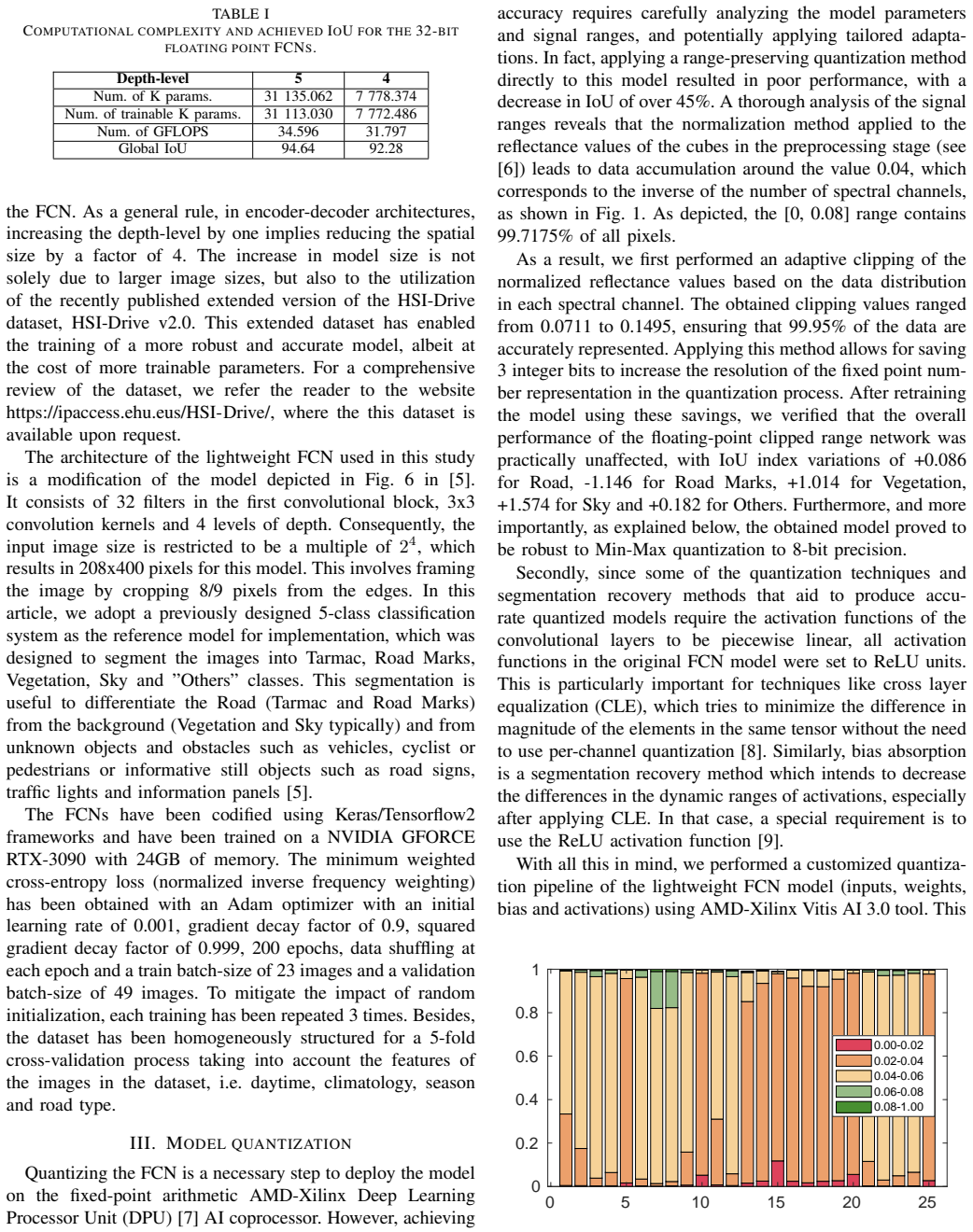
The load-bearing mechanism is input-range clipping driven by the spectral data's distribution. Because normalized reflectance values concentrate near 0.04, the inverse of the 25 spectral channels, with 99.7175% of pixels in the range [0, 0.08], the authors clip each channel to its own adaptive maximum, saving three integer bits that are reinvested as fractional bits to raise fixed-point resolution. On top of this, the pipeline applies symmetric per-tensor quantization for weights with zero-point zero, asymmetric quantization for activations, min-max for inputs and biases, min-MSE for weights and activations, cross-layer equalization, and batch-normalization folding, all within the restrictions of the AMD-Xilinx DPU coprocessor, which requires homogeneous uniform bit-widths and power-of-two scale factors.
What would settle it
Run the deployed 8-bit model on hyperspectral cubes whose per-channel normalized reflectance distribution has been deliberately shifted, for example by fog, night-time artificial illumination, or a camera spectral-response change, and measure per-class IoU; if global IoU drops materially below the reported 92.10%, the clipping thresholds are not domain-stable.
Extended reading notes
Core claim
The central discovery is that a lightweight fully convolutional network trained on HSI-Drive v2.0, with four depth levels and about 7.8 million parameters, survives 8-bit fixed-point conversion almost intact. Using adaptive per-channel clipping of the normalized reflectance input, with clamping thresholds between 0.0711 and 0.1495 that cover 99.95% of the data, ReLU activation replacement, min-max quantization for inputs and biases, min-MSE quantization for weights and activations, cross-layer equalization, and batch-normalization folding, the authors obtain an integer model whose global IoU falls from 92.28% to 92.10% and weighted IoU from 80.55% to 80.31% when executed on the Kria KV260's DPU. The quantized system processes consecutive cubes at up to 14.14 FPS with a measured average power of 7.635 W and 0.540 J per image, outperforming the compared Jetson Nano implementation on energy per image.
Load-bearing premise
The clipping thresholds, computed from the HSI-Drive v2.0 training distribution, are assumed to remain valid for every scene the vehicle will encounter; if new lighting or weather shifts the reflectance distribution away from its 0.04 concentration, the three saved bits will discard spectral information the classifier still needs.
Editorial extensions
If this is right
- The same post-training quantization recipe should transfer to other Xilinx DPU-equipped boards, since it is tied to the DPU's fixed-point constraints rather than to the specific Kria board.
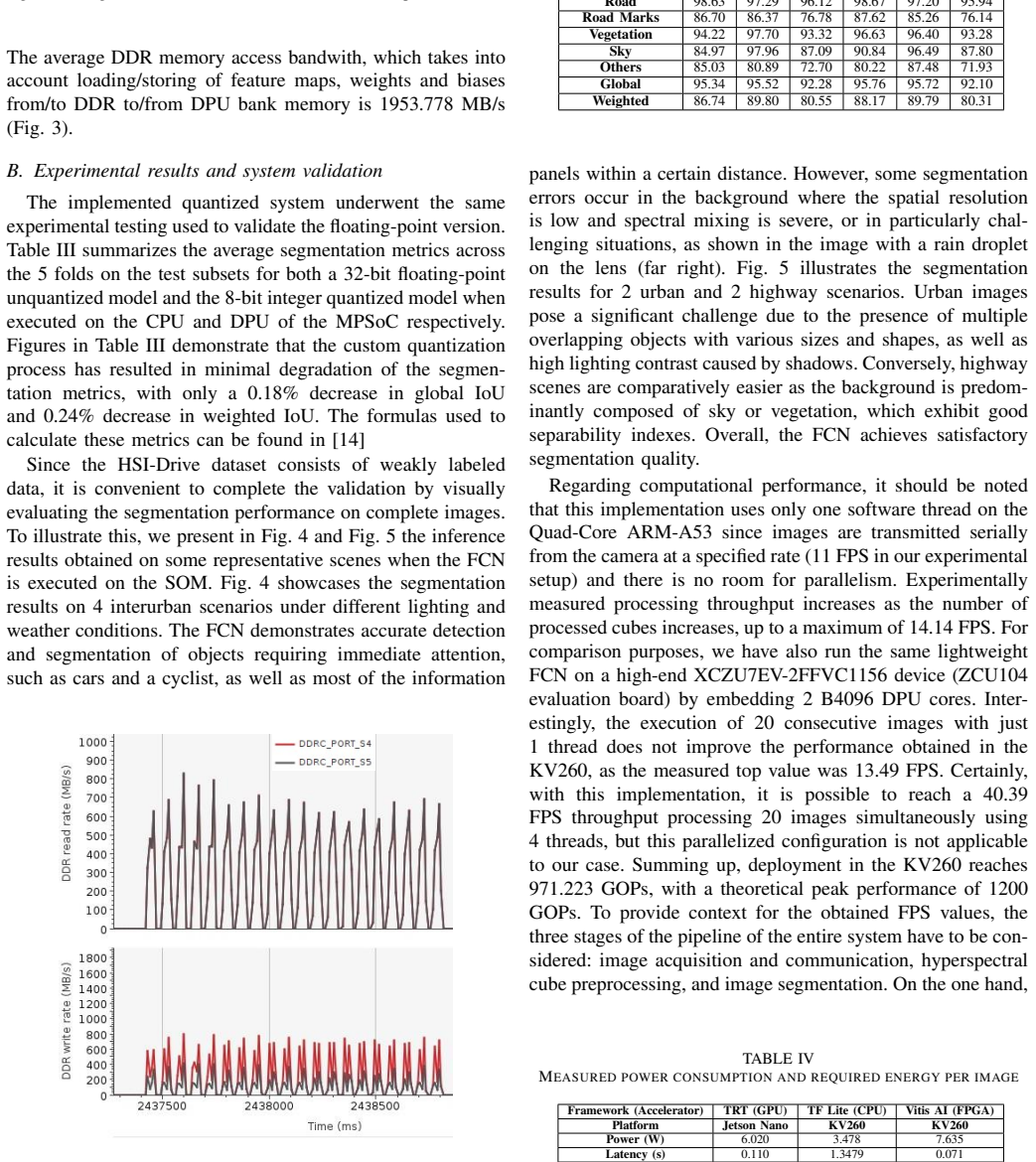
- The 14.14 FPS measured throughput exceeds the 11 FPS camera capture rate in the test setup, so the whole acquisition-preprocessing-segmentation chain can run in real time on one ARM core thread.
- At 0.540 J per image the FPGA deployment is more energy-efficient per frame than the compared GPU implementation, which matters for battery-powered vehicles.
- Shrinking the model from five depth levels to four cuts parameter count roughly fourfold, from about 31 million to 7.8 million, while keeping global IoU above 92%, and the 8-bit version occupies only 7.407 MB.
- Quantization artifacts are small enough that per-class IoU changes stay within roughly 1.5 percentage points, with Sky even improving by 0.71 points.
Reading between the lines
- If the clipping thresholds are computed on the full dataset rather than per training fold, the reported accuracy retention could partly reflect information leakage; re-estimating thresholds inside each cross-validation fold would test this.
- The same adaptive-clipping idea is likely applicable to other hyperspectral segmentation tasks where reflectance normalization creates a sharp low-value peak, provided the spectral channel count and normalization scheme are comparable.
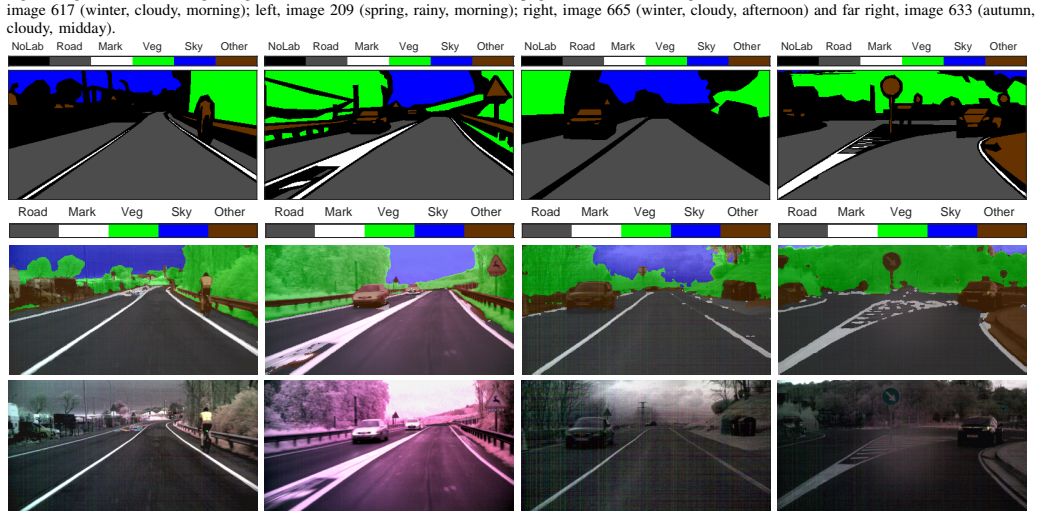
- One test image with a rain droplet on the lens suggests robustness is visual, not metric-based; quantifying IoU over such degraded frames would reveal whether the three-bit savings survive lens artifacts.
- Since the DPU reaches 40.39 FPS only with four threads and parallel image batches, a multi-camera or multi-cube ADS pipeline could exploit that parallelism even though single-camera use cannot.
Editorial analysis
A structured set of objections, weighed in public.
Referee Report
Summary. This paper presents a post-training quantization pipeline for deploying a lightweight fully convolutional network (FCN) for hyperspectral road-scene segmentation on an AMD-Xilinx Kria KV260 SOM with a DPU. The pipeline includes adaptive input clipping, ReLU activation replacement, cross-layer equalization, bias absorption, batch-normalization folding, and Min-Max/Min-MSE quantization. The authors report that the INT8 model incurs only a 0.18% global IoU and 0.24% weighted IoU degradation relative to an FP32 model, while achieving up to 14.14 FPS and 7.635 W power consumption on the KV260 SOM. The paper also compares latency, power, and energy per image with a Jetson Nano implementation and a CPU-only implementation on the same SOM.
Significance. If the accuracy-retention claim is properly isolated, the paper makes a useful engineering contribution: it demonstrates a domain-specific quantization flow for a low-cost SOM, provides credible measured hardware metrics (throughput, power, energy), and offers a practical comparison with an embedded GPU. Strengths include the detailed description of DPU-imposed constraints, the model complexity tables, and the validation on a real driving dataset with diverse conditions. However, the central accuracy claim is currently confounded by an ambiguous baseline, the lack of per-fold variance undermines the quantitative precision of the headline numbers, and a safety-relevant class-specific drop is left unexplained.
major comments (4)
- [§IV-B, Table III] The reported deltas of 0.18% global IoU and 0.24% weighted IoU are presented as the cost of the 'custom quantization process,' but the FP32 baseline is ambiguous. The FP32 column in Table III reports a global IoU of 92.28, which matches the depth-4 model in Table I, suggesting it is the original unmodified model rather than the model after the clipping, retraining, and ReLU replacement described in Section III. Because the INT8 model incorporates all of those modifications plus quantization, the comparison does not isolate the quantization loss. Please state explicitly which model is used as the FP32 baseline, and report the intermediate FP32 model after clipping/retraining and ReLU replacement so that the reader can separate the effect of quantization from the other pipeline changes.
- [§IV-B, Table III] No measure of variance is reported for the 5-fold cross-validation results in Table III. The deltas claimed as minimal (0.18% global IoU, 0.24% weighted IoU) are small, and without standard deviations or per-fold results, the conclusion that accuracy is preserved is not quantitatively supported. Please provide per-fold results or standard deviations for both the FP32 and INT8 models.
- [§III, Table III] The 'Others' class recall drops from 85.03 to 80.22 between the FP32 and INT8 columns, a 4.8-point decrease, with no discussion in the text. This class includes vehicles, pedestrians, and other obstacles that are safety-critical in autonomous driving. Please analyze whether this drop arises from the clipping/retraining step, the ReLU replacement, or the quantization itself, and discuss the implications for the target application.
- [§III] The adaptive clipping thresholds are described as computed 'based on the data distribution in each spectral channel,' but the paper does not state whether these thresholds are derived per training fold using only training data or on the full dataset. If the latter, this would constitute data leakage and bias the reported test accuracy. Please specify the exact procedure used to obtain the clipping values (0.0711 to 0.1495) for each fold.
minor comments (6)
- [§II] The sentence 'where the this dataset is available upon request' contains a typo and should read 'where this dataset is available upon request.'
- [§IV-A] The text 'which is was 300MHz' should read 'which was 300MHz,' and '533GHz' should be '533MHz' for the Cortex-R5F processor frequency.
- [§IV-A] The word 'bandwith' is misspelled; it should be 'bandwidth.'
- [§IV-B] In the text after Table IV, the sentence 'Table III summarizes measured values' should refer to Table IV, as the comparison of power, latency, and energy is presented in Table IV.
- [§III] The statement that adaptive clipping 'allows for saving 3 integer bits' is not explained. Please clarify how reducing the input range translates into a 3-bit savings in the fixed-point representation on the DPU.
- [§III] The paper should discuss the domain-shift risk of the clipping thresholds. Because they are derived from the HSI-Drive v2.0 data distribution, if the concentration of normalized reflectance near 0.04 does not hold under unseen lighting or weather conditions, the 3-bit savings could discard discriminative spectral information and break the accuracy-retention claim.
Circularity Check
No significant circularity: the deployment metrics are measured outcomes, not quantities forced by the quantization inputs.
full rationale
The paper's derivation chain is empirical rather than deductive. The starting FCN and HSI-Drive v2.0 dataset are taken from the authors' prior work ([5], [6]), but the paper's contribution—8-bit post-training quantization with adaptive clipping, ReLU replacement, CLE/BN folding, and deployment on a Kria KV260 DPU—is implemented and measured independently of those citations. The clipping thresholds are fitted to the input reflectance distribution, yet the reported accuracy retention (0.18% global IoU loss) is a measured consequence of running the quantized model on test folds, not a quantity that is mathematically equal to the thresholds by construction; no equation in Section III defines the IoU delta in terms of the clipping values. Table III is a hardware execution result, and the latency and power figures are direct measurements. The legitimate concerns are experimental: the paper does not state whether clipping thresholds are computed per training fold or on the full dataset, and it does not identify whether the FP32 baseline in Table III is the original model or the clipped/retrained model, so part of the 0.18% delta may include retraining effects rather than quantization alone. These are leakage and confound risks, not circular derivation, and they do not make the central claim equivalent to its inputs. Accordingly, no circular step is exhibited.
Assumptions & free parameters
free parameters (3)
- per-channel input clipping thresholds =
0.0711 to 0.1495 (per spectral channel)
- clipping coverage target =
99.95%
- per-tensor quantization scale factors =
Computed per tensor from data (not listed)
assumptions (4)
- domain assumption Normalized reflectance values of HSI cubes concentrate near the inverse of the number of spectral channels (0.04 for 25 channels).
- ad hoc to paper A homogeneous, uniform, power-of-two-scale quantization scheme, as required by the DPU, can preserve FCN segmentation accuracy.
- ad hoc to paper Replacing all activation functions with ReLU does not reduce the FCN's ability to segment after retraining.
- domain assumption The HSI-Drive v2.0 dataset, with its 5-fold split stratified by daytime, climatology, season, and road type, is representative of real autonomous driving conditions.
Cite this review
Pith. "Pith review of Rapid Deployment of Domain-specific Hyperspectral Image Processors with Application to Autonomous Driving." pith.science (2026). https://pith.science/paper/LYFQAUI3
@misc{pith2026241117543,
  author       = {Pith},
  title        = {Pith review of: Rapid Deployment of Domain-specific Hyperspectral Image Processors with Application to Autonomous Driving},
  year         = {2026},
  howpublished = {\url{https://pith.science/paper/LYFQAUI3}},
  note         = {Machine review of arXiv:2411.17543}
}
read the original abstract
The article discusses the use of low cost System-On-Module (SOM) platforms for the implementation of efficient hyperspectral imaging (HSI) processors for application in autonomous driving. The work addresses the challenges of shaping and deploying multiple layer fully convolutional networks (FCN) for low-latency, on-board image semantic segmentation using resource- and power-constrained processing devices. The paper describes in detail the steps followed to redesign and customize a successfully trained HSI segmentation lightweight FCN that was previously tested on a high-end heterogeneous multiprocessing system-on-chip (MPSoC) to accommodate it to the constraints imposed by a low-cost SOM. This SOM features a lower-end but much cheaper MPSoC suitable for the deployment of automatic driving systems (ADS). In particular the article reports the data- and hardware-specific quantization techniques utilized to fit the FCN into a commercial fixed-point programmable AI coprocessor IP, and proposes a full customized post-training quantization scheme to reduce computation and storage costs without compromising segmentation accuracy.
Figures

Figures from the paper (1 more)
Reference graph
Works this paper leans on
-
[1]
G. A. Fricker, J. D. Ventura, J. A. Wolf, M. P. North, F. W. Davis, and J. Franklin, “A convolutional neural network classifier identifies tree species in mixed-conifer forest from hyperspectral imagery,” Remote Sensing, vol. 11, no. 19, p. 2326, 2019
work page 2019
-
[2]
M. Taghizadeh, A. A. Gowen, and C. P. O’Donnell, “Comparison of hyperspectral imaging with conventional rgb imaging for quality evaluation of agaricus bisporus mushrooms,” Biosystems engineering , vol. 108, no. 2, pp. 191–194, 2011
work page 2011
-
[3]
Ro- bust deep learning-based semantic organ segmentation in hyperspectral images,
S. Seidlitz, J. Sellner, J. Odenthal, B. ¨Ozdemir, A. Studier-Fischer, S. Kn ¨odler, L. Ayala, T. J. Adler, H. G. Kenngott, M. Tizabi et al., “Ro- bust deep learning-based semantic organ segmentation in hyperspectral images,” Medical Image Analysis , p. 102488, 2022
work page 2022
-
[4]
Potentials of combined visible light and near infrared imaging for driving automation,
K. Weikl, D. Schroeder, and W. Stechele, “Potentials of combined visible light and near infrared imaging for driving automation,” in Electronic Imaging Conference, 2022
work page 2022
-
[5]
J. Guti ´errez-Zaballa, K. Basterretxea, J. Echanobe, M. V . Mart ´ınez, U. Martinez-Corral, ´O. Mata-Carballeira, and I. del Campo, “On-chip hyperspectral image segmentation with fully convolutional networks for scene understanding in autonomous driving,” Journal of Systems Architecture, p. 102878, 2023
work page 2023
-
[6]
J. Guti ´errez-Zaballa, K. Basterretxea, J. Echanobe, M. V . Mart´ınez, and I. del Campo, “HSI-Drive v2.0: Expanded Dataset and New Classifica- tion Challenges for Hyperspectral Scene Understanding in Autonomous Driving,” in (Unpublished), 2023
work page 2023
-
[7]
DPUCZDX8G for Zynq UltraScale+ MPSoCs product guide (PG338),
Xilinx, “DPUCZDX8G for Zynq UltraScale+ MPSoCs product guide (PG338),” https://docs.xilinx.com/r/en-US/pg338-dpu?tocId= Bd4R4bhnWgMYE6wUISXDLw, 2022
work page 2022
-
[8]
Data- free quantization through weight equalization and bias correction,
M. Nagel, M. v. Baalen, T. Blankevoort, and M. Welling, “Data- free quantization through weight equalization and bias correction,” in Proceedings of the IEEE/CVF International Conference on Computer Vision, 2019, pp. 1325–1334
work page 2019
Show all 14 references
-
[9]
A white paper on neural network quantization,
M. Nagel, M. Fournarakis, R. A. Amjad, Y . Bondarenko, M. Van Baalen, and T. Blankevoort, “A white paper on neural network quantization,” arXiv preprint arXiv:2106.08295 , 2021
2021 arXiv
-
[10]
Quantization and training of neural networks for efficient integer-arithmetic-only inference,
B. Jacob, S. Kligys, B. Chen, M. Zhu, M. Tang, A. Howard, H. Adam, and D. Kalenichenko, “Quantization and training of neural networks for efficient integer-arithmetic-only inference,” in Proceedings of the IEEE conference on computer vision and pattern recognition , 2018, pp. ...
2018
-
[11]
Batch normalization: Accelerating deep network training by reducing internal covariate shift,
S. Ioffe and C. Szegedy, “Batch normalization: Accelerating deep network training by reducing internal covariate shift,” in International conference on machine learning . pmlr, 2015, pp. 448–456
2015
-
[12]
Kria K26 SOM: The ideal platform for vision AI at the edge,
AMD-Xilinx, “Kria K26 SOM: The ideal platform for vision AI at the edge,” 2021
2021
-
[13]
Deep learning with int8 optimization on xilinx devices,
Y . Fu, E. Wu, A. Sirasao, S. Attia, K. Khan, and R. Wittig, “Deep learning with int8 optimization on xilinx devices,” White Paper, 2016
2016
-
[14]
Exploring fully convolutional networks for the segmentation of hyperspectral imaging applied to advanced driver assistance systems,
J. Guti ´errez-Zaballa, K. Basterretxea, J. Echanobe, M. V . Mart ´ınez, and I. del Campo, “Exploring fully convolutional networks for the segmentation of hyperspectral imaging applied to advanced driver assistance systems,” in Design and Architecture for Signal and Image Proc...
2022 doi
Reviewed August 12, 2026 · model on record in the stance chip above.
Discussion (0). Continue with ORCID to comment.