REVIEW 4 major objections 6 minor 42 references
A hybrid QGAN can learn and store the byte distribution of a post-quantum signature scheme.
Reviewed by Pith at T0; open to challenge. T0 means a machine referee read the full paper against a public rubric. the ladder, T0–T4 →
T0 review · deepseek-v4-flash
2026-08-02 03:54 UTC pith:M7SBHGPE
load-bearing objection A clean but overclaimed QGAN demonstration on a likely-uniform target distribution; the capability conclusion is not supported. the 4 major comments →
Towards quantum machine learning for assessing the resilience of post-quantum cryptography
The pith
A machine-rendered reading of the paper's core claim, the machinery that carries it, and where it could break.
Core claim
The paper's central claim is that a QGAN with a quantum circuit as generator and a classical neural network as discriminator can be trained to approximate the distribution of nibble pairs encoding the first byte of SPHINCS+ signatures, and that the resulting parameterized circuit acts as a quantum memory that stores the empirical distribution. The authors report convergence of the loss functions and quantify the approximation quality with KL divergence; the hardware-efficient ansatz gives the closest match, while the real-amplitudes ansatz performs surprisingly well despite fewer parameters. The authors conclude that these results confirm the generalization capability of QGANs needed to repr
What carries the argument
The central mechanism is the hybrid QGAN: a parameterized quantum circuit (the generator) produces an n-qubit state whose measurement probabilities are meant to match the target empirical distribution, while a classical neural network (the discriminator) tries to separate real samples from generator samples; the two are trained adversarially with binary cross-entropy loss. The target data are the first byte of each SPHINCS+ signature, split into two four-bit nibbles, giving a 2D 16×16 histogram. Three ansatze — N-local, real-amplitudes, and hardware-efficient — serve as generator circuits, and the paper evaluates the learned distribution via the Kullback-Leibler divergence. The trained gener
Load-bearing premise
The paper's central claim depends on the assumption that the empirical distribution of the first byte of SPHINCS+ signatures, sampled from 2^13 signatures of a single plaintext, is non-trivial and representative enough that approximating it demonstrates a capability relevant to cryptanalysis; if those bytes are nearly uniform, the task reduces to trivial state preparation.
What would settle it
Sample a large number of SPHINCS+ signatures and compute the KL divergence (or chi-square statistic) between the empirical first-byte distribution and the uniform distribution on 256 values. If the divergence is within sampling noise of zero — for instance, a chi-square test with p-value above 0.01 — then the first byte carries no distinguishing structure, and the QGAN's success would not demonstrate an ability to reproduce a cryptographically meaningful distribution. Alternatively, run the same QGAN pipeline on genuinely uniform random bytes; if the KL curves are statistically indistinguishab
If this is right
- If a QGAN can load real post-quantum signature data into a quantum state, then a quantum computer can subsequently apply variational or sampling algorithms to that encoded distribution with only polynomially many gates.
- The comparison of ansatze suggests that circuit expressibility is not always the decisive factor for learning quality; simple real-amplitude circuits can match or beat more expressive ones, which guides circuit selection for future quantum-machine-learning attacks.
- The result implies a concrete, implementable first stage in a future pipeline for quantum-assisted cryptanalysis: from raw post-quantum outputs to quantum-resident probability distributions.
- The authors' success on the benchmark normal mixture shows the method works as a generic distribution-loading tool, strengthening the case that the post-quantum-specific result is not idiosyncratic to the setup.
Where Pith is reading between the lines
- A direct follow-up test would be to measure the KL divergence between the SPHINCS+ first-byte distribution and the uniform distribution; if the byte values are nearly uniform, the successful loading reflects trivial state preparation, and the paper's stronger claim about reproducing 'complex' post-quantum distributions would need re-benchmarking on a genuinely non-uniform distribution.
- The approach could be extended beyond bytes to the full signature structure or to other post-quantum families (lattice-based, code-based); the nibble-pair encoding suggests a natural path to higher-dimensional distributions at the cost of more qubits and parameters.
- If the loaded distribution is faithful, one could use the quantum state as a prior in an amplitude-amplification-style search for high-probability signatures, potentially changing the query complexity of offline forgery attempts — though this is speculative and not claimed by the paper.
- Because the paper's experiments are simulated, a near-term hardware run of the same circuits would test whether noise at the current NISQ level preserves the learned distribution; the authors themselves list noise as a limitation.
Editorial analysis
A structured set of objections, weighed in public.
Referee Report
Summary. The paper proposes a hybrid quantum-classical QGAN framework for learning and loading the probability distribution of the first byte of SPHINCS+ signatures into a quantum state. The generator is implemented with three Qiskit ansatze (N-local, real-amplitudes, hardware-efficient) on a 16-qubit register, trained with a classical discriminator and ADAM. Results are reported as loss curves and KL divergences versus epoch for each ansatz. The abstract and conclusions claim that near-term hybrid quantum-classical methods 'possess capabilities required' for reproducing 'complex probability distribution generated by post-quantum cryptography schemes,' and that this is a first step toward cryptanalytic workflows.
Significance. If fully supported, the paper would provide a modest but concrete demonstration of loading a PQC-related distribution into a quantum state with a near-term-compatible circuit, potentially motivating further work on QML-assisted cryptanalysis. The paper clearly describes the circuit architectures, data encoding, and training setup, and it makes an honest comparison of three ansatze. However, the central claim is not established by the presented evidence: there is no classical baseline, no statistical characterization of the target distribution, no train/test separation, and the reported KL values are high. The significance of the work therefore remains prospective rather than demonstrated.
major comments (4)
- [§3.2, Fig. 4(a), Abstract] The target distribution is the first byte of SPHINCS+ signatures. For a hash-based signature scheme, the leading bytes are expected to be statistically uniform (the randomizer is chosen uniformly). The paper provides no uniformity test, no justification that this byte is representative of a 'complex probability distribution,' and no comparison against a uniform baseline. With only 2^13 samples, the histogram in Fig. 4(a) may be sampling noise around 1/256. If the distribution is near-uniform, the learning task is trivial state preparation and the abstract's central claim is vacuous. The authors should add a chi-square or KL-vs-uniform test, compare against a fixed uniform state and a classical histogram, and ideally use a genuinely non-uniform, multi-byte or multi-plaintext distribution.
- [§5 and §4 (evaluation methodology)] The conclusion that QGANs 'possess generalization capabilities required to reproduce complex probability distribution' is unsupported because the model is trained and evaluated on the same empirical distribution. There is no train/test split, no held-out sample, and no cross-validation. The reported KL divergence measures similarity to the training set, not predictive generalization. A valid generalization claim requires evaluating the trained generator on data not seen during training, e.g., signatures generated with different plaintexts or from a held-out portion of the signature stream.
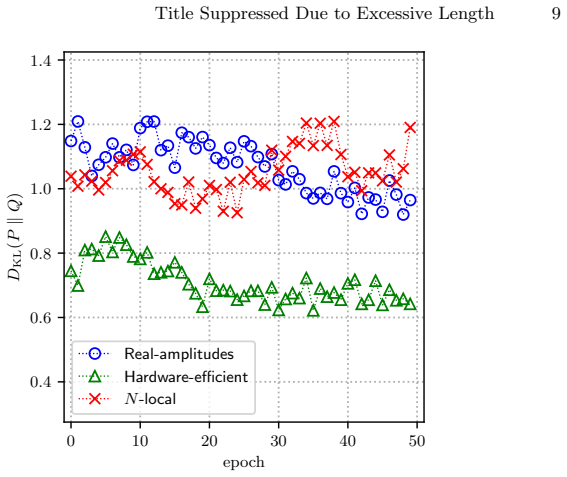
- [§4, Figs. 5–7] All experimental curves appear to be single runs with no error bars, no random seed reporting, and no statistical significance testing. Moreover, no classical baseline is provided. The KL values of 0.4–1.4 (Fig. 6) are high for a 256-bin distribution and cannot be interpreted without knowing the KL of a trivial uniform distribution or a classical histogram (which would be near zero). The authors should report mean ± standard deviation over multiple independent trainings and compare against at least (i) the empirical-vs-uniform KL and (ii) a classical GAN or histogram baseline.
- [§4, parameter counts] There is an internal inconsistency in the number of N-local ansatz parameters: the experimental setup states 98 parameters, but the discussion in the following paragraph says 96 trainable parameters. This discrepancy should be corrected, as it affects the comparison of ansatz expressibility.
minor comments (6)
- [Abstract] Typo: 'posses' should be 'possess'.
- [Throughout] The word 'ansatz' is repeatedly misspelled as 'anzatz' (e.g., Figs. 2, 5 and text).
- [Fig. 1] Typo: 'meeasurement' should be 'measurement'.
- [Acknowledgments] Typo: 'constrictive remarks' should be 'constructive remarks'.
- [Eq. (2)] The binary cross-entropy loss is written with x_j and y_j, but the roles of predictions and labels are ambiguous; the standard convention is y log(p) + (1-y) log(1-p), where p is the predicted probability. Please clarify the notation.
- [§4, benchmark description] The text says 'From the results in Fig. 4(b) one can note...' but Fig. 4(b) shows the raw data, not the learning curves; the intended reference is likely Fig. 7.
Circularity Check
Central 'generalization' claim rests on a training-set fit: the DKL metric is evaluated against the same empirical distribution used to define the target state, with no held-out data.
specific steps
-
fitted input called prediction
[Section 5 (Conclusions), with Eq. (1) in Section 3.1 and Eq. (3)/Fig. 6 in Section 4]
"The presented results confirm that Quantum Generative Adversarial Networks posses generalization capabilities required to reproduce complex probability distribution generated by the post-quantum cryptography schemes."
The only PQC 'complex probability distribution' is the empirical histogram of the first byte of SPHINCS+ signatures (Section 3.2, Fig. 4a). Equation (1) defines the target state directly from the training-data probabilities p_j, and Eq. (3)/Fig. 6 evaluate DKL(P||Q) with P being the same empirical p_j. There is no held-out split or independent test distribution. Therefore the reported low DKL measures how well the generator fits its own training target; calling this 'generalization capabilities' is a training-set fit renamed as a prediction. The capability conclusion is self-referential rather than evidence of generalization to unseen signature data.
full rationale
No self-citation chain is load-bearing: the paper cites external libraries and prior QGAN work [4,36,41], not the author's own results. The numerical pipeline is otherwise a standard QGAN training loop with a classical discriminator and Qiskit ansatze, and the KL curves are honestly reported as training progress. The circularity is concentrated in the interpretation: Section 3.1 builds the target state from empirical p_j, Section 4 evaluates DKL against the same empirical distribution, and Section 5 converts this into a claim about 'generalization capabilities.' Since no train/test split or out-of-sample evaluation is provided, the central capability claim is supported only by a fit to its own ground truth. A further correctness risk, not itself circularity, is that the chosen target (first byte of SPHINCS+ signatures) may be near-uniform by construction, which would make the 'complex distribution' claim vacuous; but that is an external validity concern, not a derivation-chain circularity.
Axiom & Free-Parameter Ledger
free parameters (5)
- Ansatz choices and layer count =
N-local, real-amplitudes, hardware-efficient; six layers
- Optimizer hyperparameters =
lr=0.01, beta1=0.7, beta2=0.999
- Number of qubits =
16
- Training sample size =
2^13 signatures, single plaintext
- Data representation =
first byte as two 4-bit words
axioms (5)
- standard math Quantum state evolution is unitary and measurement follows the Born rule.
- standard math The target distribution can be represented via amplitude encoding |ψ⟩ = Σ√p_j|j⟩.
- ad hoc to paper The empirical first-byte distribution from 2^13 SPHINCS+ signatures for a single plaintext is representative of the signature scheme's output.
- domain assumption Trained parameters generalize to unseen data.
- domain assumption Noiseless simulation results transfer to near-term NISQ hardware.
read the original abstract
The potential capabilities of quantum computers motivated the development of cryptographic protocols suitable for securing communication against adversaries with access to large fault-tolerant quantum computers. However, even though current quantum computers are limited in terms of size and precision, they can still be useful for finding loopholes and weaknesses in the post-quantum cryptographic protocols. In this work, we present an attempt to utilize the capabilities of Quantum Generative Adversarial Networks (QGANs), one of the promising architectures used in quantum machine learning, for this purpose. We describe an example application of QGAN architecture for the purpose of loading the probability distribution of the hash-based digital signatures into the memory of a quantum computer. Our results confirm that near-term hybrid quantum-classical methods possess capabilities required for this purpose. The presented approach can be used as a first step in the workflow, enabling the utilization of quantum computing for attacking post-quantum cryptographic primitives.
Figures



Reference graph
Works this paper leans on
-
[1]
Release Notes (Apr 2025), https://www.openssh.com/txt/ release-10.0
OpenSSH 10. Release Notes (Apr 2025), https://www.openssh.com/txt/ release-10.0
2025
-
[2]
Post-quantum cryptography standardization (May 2025), https://csrc.nist.gov/ pqc-standardization
2025
-
[3]
pqcrypto (v.0.3.4): Post-quantum cryptography for Python (Jul 2025), https: //pypi.org/project/pqcrypto/
2025
-
[4]
Qiskit machine learning (2025), https://github.com/qiskit-community/ qiskit-machine-learning
2025
-
[5]
Reference Implementation of version 24 of the Java SE Platform (Mar 2025), https://openjdk.org/projects/jdk/24/
2025
-
[6]
Reference Implementation of version 26 of the Java SE Platform (Mar 2026), https://openjdk.org/projects/jdk/26/
2026
-
[7]
Nature574(7779), 505–510 (Oct 2019)
Arute, F., et al.: Quantum supremacy using a programmable superconducting processor. Nature574(7779), 505–510 (Oct 2019). https://doi.org/10.1038/ s41586-019-1666-5
2019
-
[8]
IEEE Access11, 54175–54187 (2023)
Baksi, A., Breier, J., Dasu, V.A., Hou, X., Kim, H., Seo, H.: New results on machine learning-based distinguishers. IEEE Access11, 54175–54187 (2023). https: //doi.org/10.1109/access.2023.3270396
arXiv 2023
-
[9]
https: //doi.org/10.48550/ARXIV.2502.08721
Benedetti, M., Buhrman, H., Weggemans, J.: Complement sampling: Provable, verifiable and nisqable quantum advantage in sample complexity (2025). https: //doi.org/10.48550/ARXIV.2502.08721
-
[10]
New Journal of Physics21(4), 043023 (Apr 2019).https://doi.org/10.1088/1367-2630/ab14b5
Benedetti, M., Grant, E., Wossnig, L., Severini, S.: Adversarial quantum circuit learning for pure state approximation. New Journal of Physics21(4), 043023 (Apr 2019).https://doi.org/10.1088/1367-2630/ab14b5
-
[11]
(eds.): Post-Quantum Cryptography
Bernstein, D.J., Buchmann, J., Dahmen, E. (eds.): Post-Quantum Cryptography. Springer Berlin Heidelberg, Berlin, Heidelberg (2009)
2009
-
[12]
Nature549(7671), 188–194 (Sep 2017).https://doi.org/10.1038/nature23461
Bernstein, D.J., Lange, T.: Post-quantum cryptography. Nature549(7671), 188–194 (Sep 2017).https://doi.org/10.1038/nature23461
-
[13]
Nature Reviews Physics3(9), 625–644 (Aug 2021)
Cerezo, M., Arrasmith, A., Babbush, R., Benjamin, S.C., Endo, S., Fujii, K., McClean, J.R., Mitarai, K., Yuan, X., Cincio, L., Coles, P.J.: Variational quantum algorithms. Nature Reviews Physics3(9), 625–644 (Aug 2021). https://doi.org/ 10.1038/s42254-021-00348-9
-
[14]
International Conference on Research in Security Standardisation, pp
Chen, L.: Standardisation of and Migration to Post-Quantum Cryptography, vol. International Conference on Research in Security Standardisation, pp. 3–13. Springer Nature (2025).https://doi.org/10.1007/978-3-031-87541-0_1
-
[15]
Physical Review A98(1), 012324 (Jul 2018)
Dallaire-Demers, P.L., Killoran, N.: Quantum generative adversarial networks. Physical Review A98(1), 012324 (Jul 2018). https://doi.org/10.1103/physreva. 98.012324 Title Suppressed Due to Excessive Length 13
doi:10.1103/physreva 2018
-
[16]
In: Proceedings of the 10th ACM Asia Public-Key Cryptography Workshop
Dubrova, E., Ngo, K., G¨ artner, J., Wang, R.: Breaking a fifth-order masked imple- mentation of crystals-kyber by copy-paste. In: Proceedings of the 10th ACM Asia Public-Key Cryptography Workshop. pp. 10–20. ASIA CCS ’23, ACM (Jul 2023). https://doi.org/10.1145/3591866.3593072
arXiv 2023
-
[17]
Goodfellow, I.J., Pouget-Abadie, J., Mirza, M., Xu, B., Warde-Farley, D., Ozair, S., Courville, A., Bengio, Y.: Generative adversarial networks (2014). https://doi. org/10.48550/arXiv.1406.2661
- [18]
-
[19]
Physica Scripta99(8), 086002 (Jul 2024)
Hariharasitaraman, S., Mishra, N., Vishnuvardhanan, D.: QHopNN: investigating quantum advantage in cryptanalysis using a quantum hopfield neural network. Physica Scripta99(8), 086002 (Jul 2024). https://doi.org/10.1088/1402-4896/ ad5ed1
-
[20]
Nature 567(7747), 209–212 (Mar 2019).https://doi.org/10.1038/s41586-019-0980-2
Havl ´ ıˇ cek, V., C´ orcoles, A.D., Temme, K., Harrow, A.W., Kandala, A., Chow, J.M., Gambetta, J.M.: Supervised learning with quantum-enhanced feature spaces. Nature 567(7747), 209–212 (Mar 2019).https://doi.org/10.1038/s41586-019-0980-2
-
[21]
Science376(6598), 1182–1186 (Jun 2022)
Huang, H.Y., Broughton, M., Cotler, J., Chen, S., Li, J., Mohseni, M., Neven, H., Babbush, R., Kueng, R., Preskill, J., McClean, J.R.: Quantum advantage in learning from experiments. Science376(6598), 1182–1186 (Jun 2022). https: //doi.org/10.1126/science.abn7293
-
[22]
Nature Communications 12(1) (May 2021).https://doi.org/10.1038/s41467-021-22539-9
Huang, H.Y., Broughton, M., Mohseni, M., Babbush, R., Boixo, S., Neven, H., McClean, J.R.: Power of data in quantum machine learning. Nature Communications 12(1) (May 2021).https://doi.org/10.1038/s41467-021-22539-9
-
[23]
https: //doi.org/10.48550/arXiv.2506.18002
Islam, M., Turkeli, S., Ozaydin, F.: A survey of quantum generative adversarial networks: Architectures, use cases, and real-world implementations (2025). https: //doi.org/10.48550/arXiv.2506.18002
-
[24]
In: IEEE European Symposium on Security and Privacy, EuroS&P 2022 - Workshops, Genoa, Italy, June 6-10,
Kannwischer, M.J., Schwabe, P., Stebila, D., Wiggers, T.: Improving software quality in cryptography standardization projects. In: IEEE European Symposium on Security and Privacy, EuroS&P 2022 - Workshops, Genoa, Italy, June 6-10,
2022
-
[25]
Cryptology ePrint Archive (2023), https: //ia.cr/2023/004
Kim, H., Lim, S., Baksi, A., Kim, D., Yoon, S., Jang, K., Seo, H.: Quantum artificial intelligence on cryptanalysis. Cryptology ePrint Archive (2023), https: //ia.cr/2023/004
2023
-
[26]
In: International conference on learning representations (ICLR)
Kinga, D., Adam, J.B., et al.: A method for stochastic optimization. In: International conference on learning representations (ICLR). vol. 5. San Diego, California (2015), https://arxiv.org/abs/1412.6980
Pith/arXiv arXiv 2015
-
[27]
American Institute of Aeronautics and Astronautics (Jan 2025)
Mohammad, K.: Cyber Shield: Advances in Detection, Isolation, and Con- tainment Mechanisms. American Institute of Aeronautics and Astronautics (Jan 2025). https://doi.org/10.2514/6.2025-2724, https://arc.aiaa.org/ doi/abs/10.2514/6.2025-2724
-
[28]
Mosca, M.: Cybersecurity in an era with quantum computers: Will we be ready? IEEE Security & Privacy16(5), 38–41 (Sep 2018). https://doi.org/10.1109/msp. 2018.3761723,https://ia.cr/2015/1075
arXiv 2018
-
[29]
Electronics12(4) (2023)
Ngo, T.A., Nguyen, T., Thang, T.C.: A survey of recent advances in quantum generative adversarial networks. Electronics12(4) (2023). https://doi.org/10. 3390/electronics12040856
2023
-
[30]
Nguyen, V.L., Nguyen, L.H., Hwang, R.H., Canberk, B., Duong, T.Q.: Quantum machine learning for 6G network intelligence and adversarial threats. IEEE Commu- 14 Jaroslaw A. Miszczak nications Standards Magazine9(Sep 2025). https://doi.org/10.1109/MCOMSTD. 2025.3575261
arXiv 2025
-
[31]
Nokhwal, S., Nokhwal, S., Pahune, S., Chaudhary, A.: Quantum generative adver- sarial networks: Bridging classical and quantum realms. In: 2024 8th International Conference on Intelligent Systems, Metaheuristics & Swarm Intelligence (ISMSI). pp. 105–109. ISMSI 2024, ACM (Apr 2024). https://doi.org/10.1145/3665065. 3665082
-
[32]
Mathematics12(23), 3852 (2024)
Pajuhanfard, M., Kiani, R., Sheng, V.S.: Survey of quantum generative adversarial networks (qgan) to generate images. Mathematics12(23), 3852 (2024). https: //doi.org/10.3390/math12233852
-
[33]
River Publishers (May 2025)
Prasad, R., Koren, A.: Safeguarding 6G: Security and Privacy for the Next Genera- tion. River Publishers (May 2025)
2025
-
[34]
Red Hat Inc.: 4 key steps to prepare for post-quantum cryp- tography (May 2025), https://www.redhat.com/en/resources/ 4-steps-for-postquantum-cryptography-checklist
2025
-
[35]
https: //doi.org/10.48550/arXiv.1901.00848
Romero, J., Aspuru-Guzik, A.: Variational quantum generators: Generative ad- versarial quantum machine learning for continuous distributions (2019). https: //doi.org/10.48550/arXiv.1901.00848
-
[36]
Sahin, M.E., Altamura, E., Wallis, O., Wood, S.P., Dekusar, A., Millar, D.A., Imamichi, T., Matsuo, A., Mensa, S.: Qiskit machine learning: an open-source library for quantum machine learning tasks at scale on quantum hardware and classical simulators (May 2025),https://arXiv.org/abs/2505.17756
Pith/arXiv arXiv 2025
-
[37]
SIAM Review41(2), 303–332 (Jan 1999)
Shor, P.W.: Polynomial-time algorithms for prime factorization and discrete logarithms on a quantum computer. SIAM Review41(2), 303–332 (Jan 1999). https://doi.org/10.1137/s0036144598347011
-
[38]
Advanced Quantum Technologies2(12), 1900070 (2019)
Sim, S., Johnson, P.D., Aspuru-Guzik, A.: Expressibility and entangling capability of parameterized quantum circuits for hybrid quantum-classical algorithms. Advanced Quantum Technologies2(12), 1900070 (2019)
2019
-
[39]
https://doi.org/10.48550/arXiv
Ueda, K., Matsuo, A.: Optimizing ansatz design in quantum generative adversarial networks using large language models (2025). https://doi.org/10.48550/arXiv. 2503.12884
-
[40]
https://doi.org/10.48550/arXiv.2310.10315
Zaman, K., Marchisio, A., Hanif, M.A., Shafique, M.: A survey on quantum machine learning: Current trends, challenges, opportunities, and the road ahead (2023). https://doi.org/10.48550/arXiv.2310.10315
-
[41]
npj Quantum Information5(1) (Nov 2019).https://doi.org/10.1038/s41534-019-0223-2
Zoufal, C., Lucchi, A., Woerner, S.: Quantum generative adversarial networks for learning and loading random distributions. npj Quantum Information5(1) (Nov 2019).https://doi.org/10.1038/s41534-019-0223-2
-
[2022]
pp. 19–30. IEEE Computer Society, Los Alamitos, CA, USA (2022). https: //doi.org/10.1109/EuroSPW55150.2022.00010
arXiv 2022
discussion (0)
Sign in with ORCID, Apple, or X to comment. Anyone can read and Pith papers without signing in.