Bar-induced deflection of open cluster tidal tails
Pith reviewed 2026-06-28 00:34 UTC · model grok-4.3
The pith
The Galactic bar deflects open cluster tidal tails in a pattern-speed-dependent way that observations of NGC 2632 and the Hyades use to disfavour moderate speeds.
A machine-rendered reading of the paper's core claim, the machinery that carries it, and where it could break.
Core claim
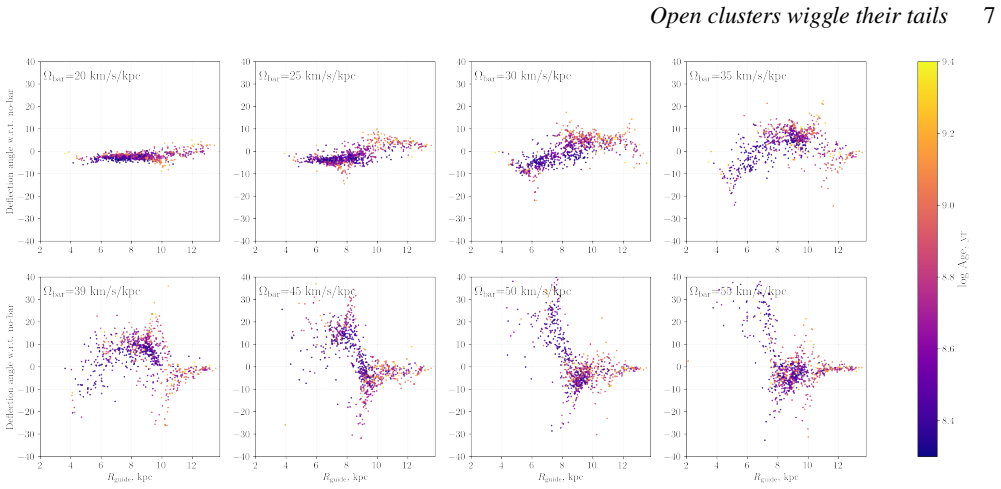
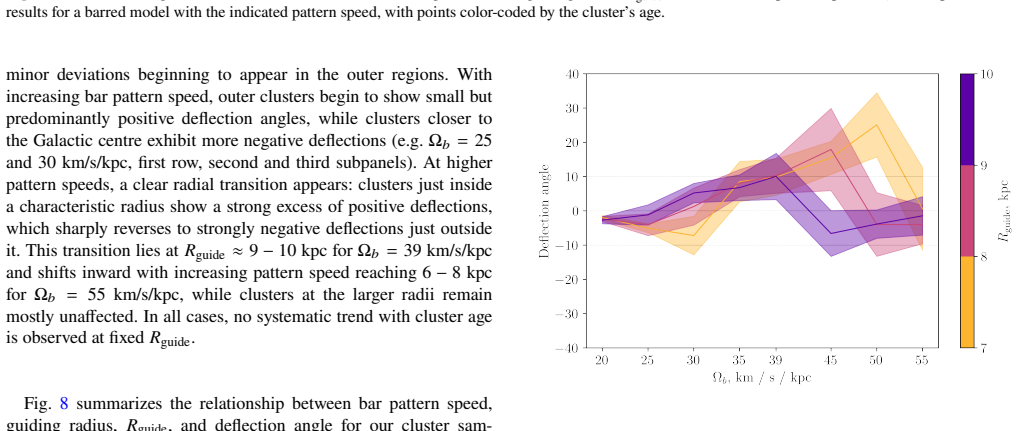
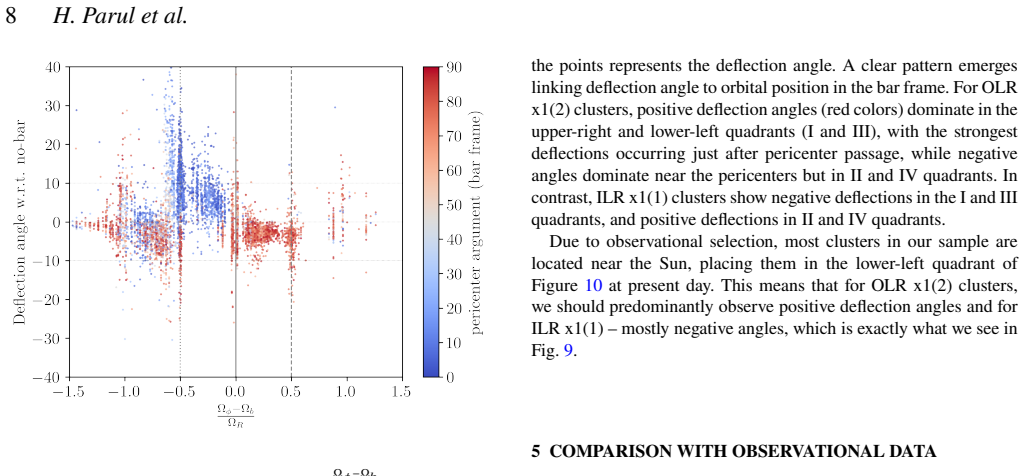
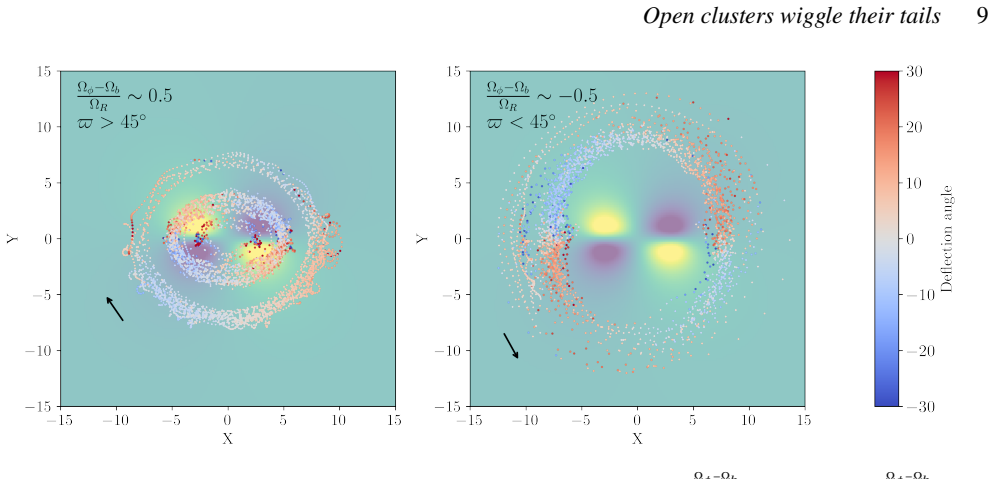
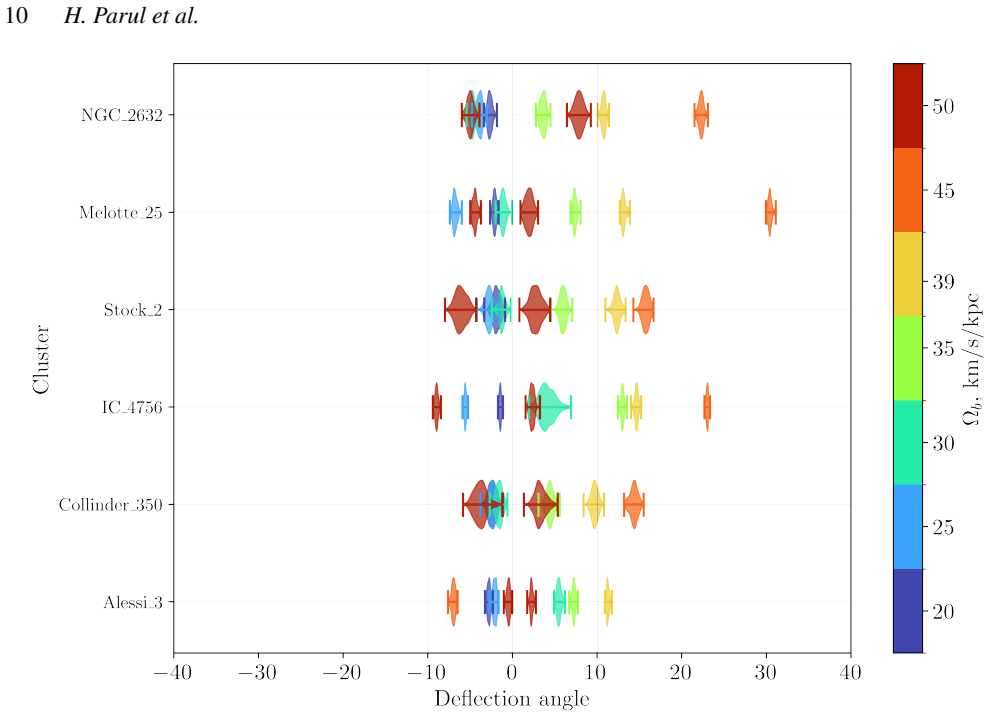
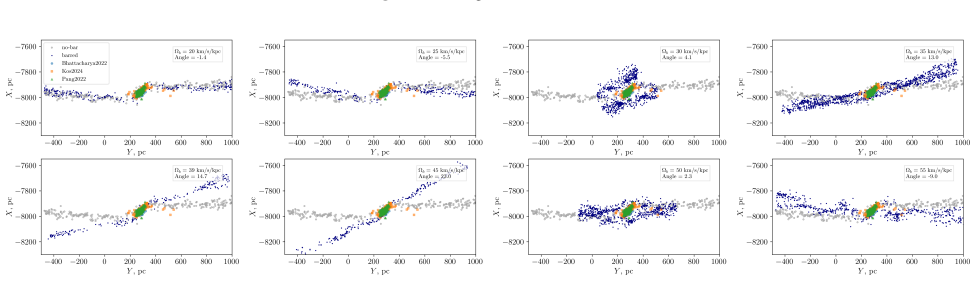
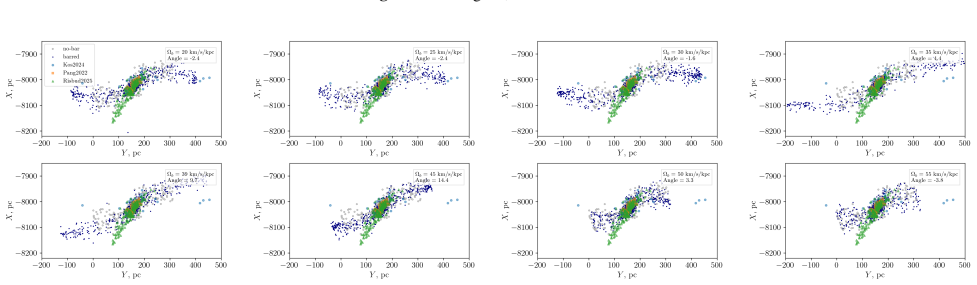
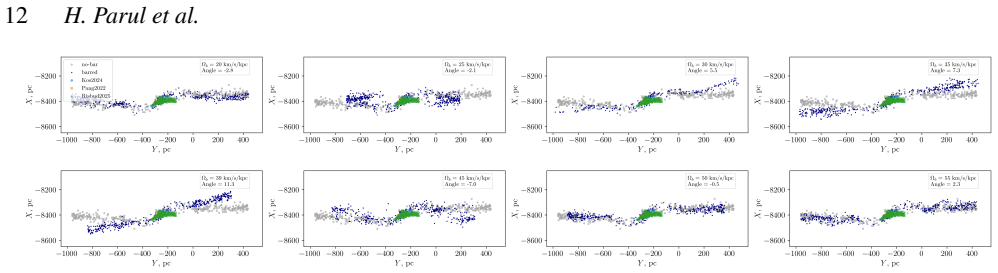
The paper claims that the bar induces a measurable deflection in tidal-tail orientation whose magnitude and sign depend on pattern speed and guiding radius, with peak effect near the outer Lindblad resonance, and that the observed tails of NGC 2632 and the Hyades are incompatible with moderate values of the bar pattern speed.
What carries the argument
The deflection angle, defined as the rotation of the tail orientation produced by a barred potential relative to the axisymmetric reference case.
If this is right
- The deflection angle varies systematically with bar pattern speed and cluster guiding radius.
- The largest deflections occur for clusters near the outer Lindblad resonance.
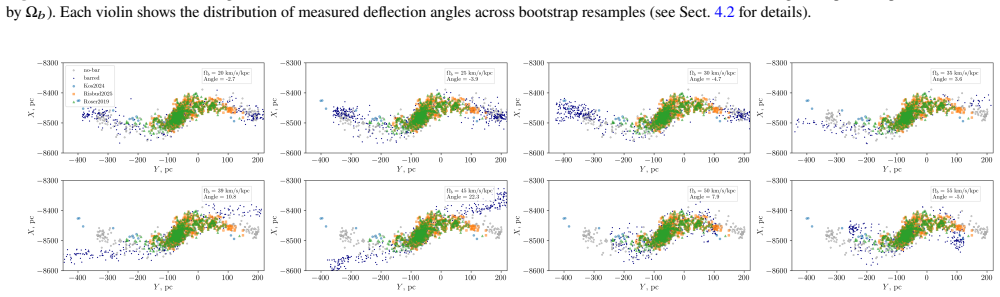
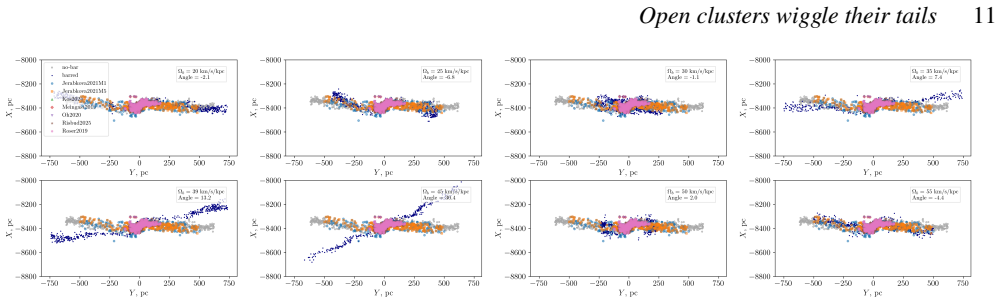
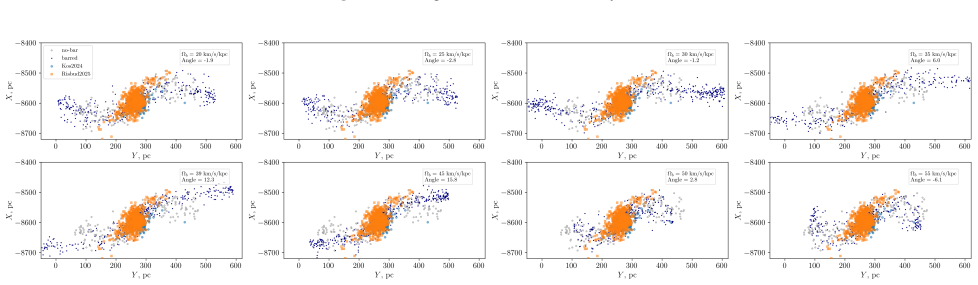
- Observed tails of NGC 2632 and the Hyades disfavour moderate pattern speeds.
- A catalogue of deflection angles, minimal tail extents, and bar-sensitivity flags is supplied to guide future observations.
Where Pith is reading between the lines
- Additional clusters with well-measured extended tails could further restrict the allowed range of bar pattern speeds.
- The same comparison method could be reapplied once improved cluster positions and velocities become available.
Load-bearing premise
The test-particle simulations in the chosen barred potentials accurately reproduce the real tail orientations without significant contributions from other perturbers, non-axisymmetric features beyond the bar, or errors in the input cluster positions and velocities.
What would settle it
A precise measurement showing that the tail orientation of NGC 2632 or the Hyades matches the deflection predicted for a moderate pattern speed (near 30-40 km/s/kpc) would falsify the claim that those speeds are disfavoured.
Figures
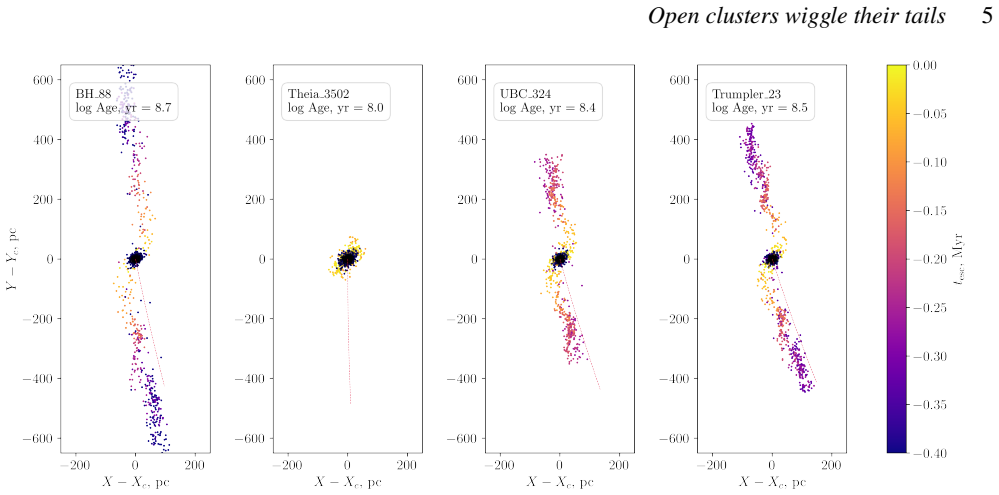
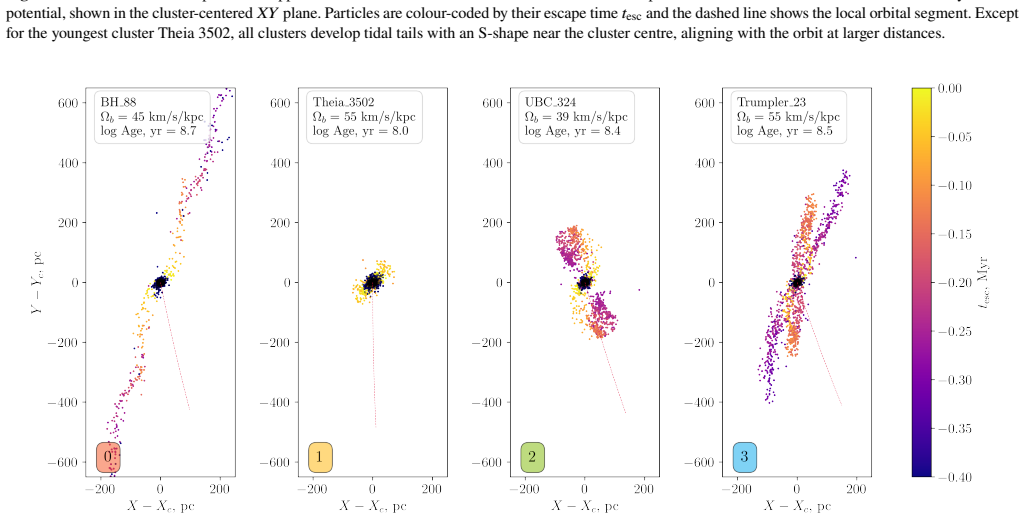
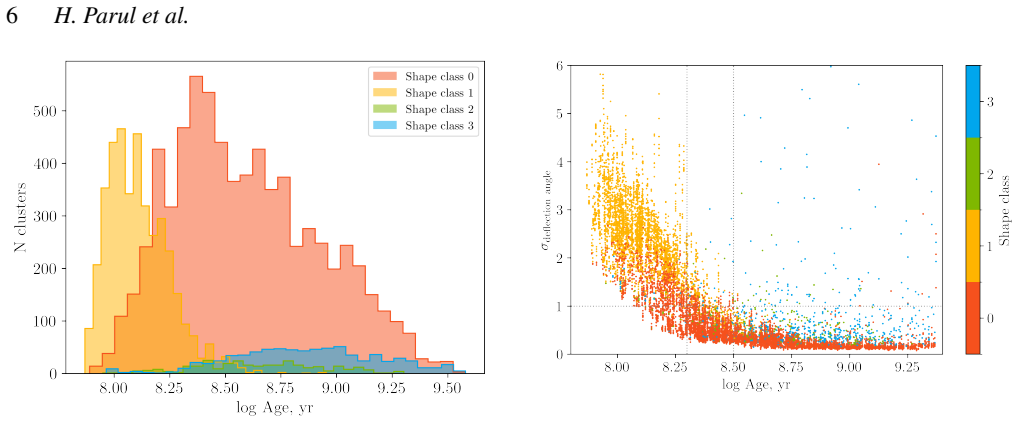
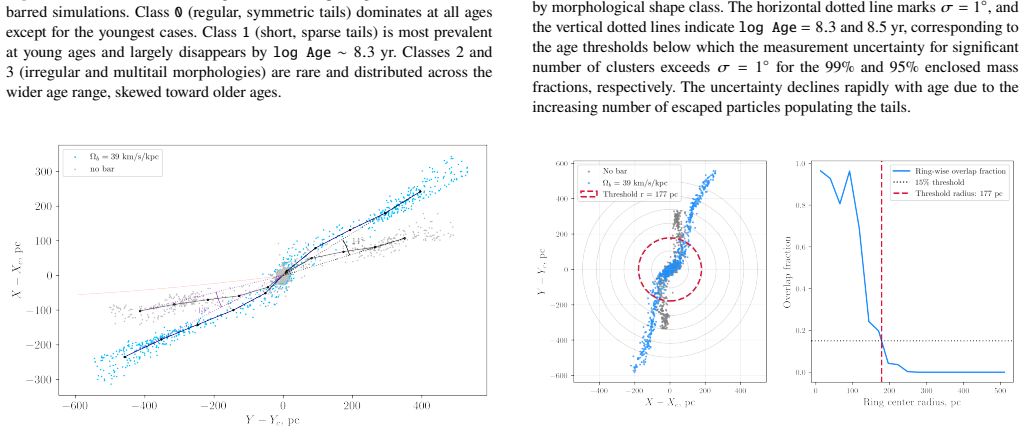
read the original abstract
We present a systematic study of how the Galactic bar affects the orientation of tidal tails of open clusters and assess the power of tail morphology to constrain the bar's pattern speed. Using test-particle simulations, we follow the evolution of $\sim 1450$ observed open clusters from the Hunt & Reffert (2024) catalogue in an axisymmetric reference potential and in eight barred potentials with pattern speeds ranging from $\Omega_b = 20$ km/s/kpc to $\Omega_b = 55$ km/s/kpc. We quantify the bar effect through the deflection angle -- the rotation of the tail orientation in the barred model relative to the axisymmetric case. The deflection angle varies systematically with bar pattern speed and cluster guiding radius. The largest deflections occur for clusters near the outer Lindblad resonance (OLR), with the sign of the angle set by the orientation of the orbit's pericentre relative to the bar's major axis. For each cluster we measure the distance from the centre beyond which different bar models produce distinguishable tail orientations, and classify each cluster as bar-sensitive or bar-insensitive based on its maximum absolute deflection across the bar models. Comparing with observed tidal tails from the literature, we find that the extended tails of NGC 2632 and the Hyades disfavour moderate pattern speeds. We provide a catalogue of deflection angles, minimal tail extents, and bar-sensitivity flags to guide future observational searches and the re-assessment of existing tidal tail catalogues.
Editorial analysis
A structured set of objections, weighed in public.
Referee Report
Summary. The manuscript uses test-particle simulations to evolve ~1450 open clusters from the Hunt & Reffert (2024) catalogue in an axisymmetric potential and in eight barred potentials with pattern speeds Ω_b ranging from 20 to 55 km s^{-1} kpc^{-1}. It defines a deflection angle measuring the rotation of tidal tail orientation relative to the axisymmetric case, shows that this angle varies systematically with Ω_b and guiding radius (largest near the OLR), classifies clusters as bar-sensitive or insensitive, and concludes that the observed tails of NGC 2632 and the Hyades disfavour moderate pattern speeds. A catalogue of deflection angles, minimal tail extents, and sensitivity flags is provided.
Significance. If the central assumptions hold, the work supplies an independent, observationally accessible constraint on the Galactic bar pattern speed via tail morphology, complementing other dynamical probes. The systematic exploration across a large cluster sample and the release of a reusable catalogue are concrete strengths that would enable follow-up even if the disfavouring result is later refined.
major comments (2)
- [Abstract and §3] Abstract and §3 (simulation description): the claim that moderate Ω_b are disfavoured rests on simulated deflection angles matching the observed tail orientations of NGC 2632 and the Hyades. No validation, error budget, or sensitivity test is presented for the assumption that test-particle motion in the chosen barred potentials dominates over spiral arms, GMCs, or 6D phase-space uncertainties from the Hunt & Reffert catalogue. This assumption is load-bearing for the central claim.
- [§4] §4 (comparison to observations): the disfavouring conclusion is drawn from only two clusters. The manuscript should report the measured deflection angles (with uncertainties) for NGC 2632 and the Hyades across the full Ω_b grid, together with the observed tail angles and their measurement errors, so that the statistical weight of the disfavouring can be assessed directly.
minor comments (2)
- [Abstract] The abstract states '~1450' clusters; replace with the exact count used in the runs.
- [Methods] Clarify in the methods whether the bar models are otherwise identical (same mass, scale lengths, etc.) or whether additional parameters were varied; this affects interpretation of the deflection-angle trends.
Simulated Author's Rebuttal
We thank the referee for their thoughtful and constructive comments on our manuscript. We respond to each major comment below.
read point-by-point responses
-
Referee: [Abstract and §3] Abstract and §3 (simulation description): the claim that moderate Ω_b are disfavoured rests on simulated deflection angles matching the observed tail orientations of NGC 2632 and the Hyades. No validation, error budget, or sensitivity test is presented for the assumption that test-particle motion in the chosen barred potentials dominates over spiral arms, GMCs, or 6D phase-space uncertainties from the Hunt & Reffert catalogue. This assumption is load-bearing for the central claim.
Authors: We acknowledge the validity of this point. Our study employs the test-particle approximation to isolate the effect of the bar, but we recognize that other Galactic components and observational uncertainties may affect the results. A comprehensive sensitivity analysis incorporating these factors is beyond the scope of this work. In the revised manuscript, we will add a paragraph in §3 discussing these assumptions and their potential limitations. We maintain that the systematic trends with pattern speed provide a useful baseline for future, more complex simulations. revision: partial
-
Referee: [§4] §4 (comparison to observations): the disfavouring conclusion is drawn from only two clusters. The manuscript should report the measured deflection angles (with uncertainties) for NGC 2632 and the Hyades across the full Ω_b grid, together with the observed tail angles and their measurement errors, so that the statistical weight of the disfavouring can be assessed directly.
Authors: We agree that including these quantitative details will strengthen the presentation. We will revise the manuscript to include a new table in §4 that reports the deflection angles for NGC 2632 and the Hyades for each pattern speed in our grid. We will also list the observed tail angles and their measurement uncertainties as reported in the literature. This will enable readers to evaluate the statistical significance of the disfavouring directly. revision: yes
Circularity Check
No significant circularity; derivation is simulation-driven and externally benchmarked
full rationale
The paper varies bar pattern speeds as explicit inputs across a grid (20-55 km/s/kpc), computes deflection angles as the difference between barred and axisymmetric test-particle runs, and compares the resulting tail orientations to independent literature observations of NGC 2632 and the Hyades. No step reduces a claimed prediction to a fitted quantity by construction, no self-citation is invoked as a uniqueness theorem or load-bearing premise, and the central disfavoring of moderate pattern speeds rests on external data rather than internal redefinition. The derivation chain is therefore self-contained against external benchmarks.
Axiom & Free-Parameter Ledger
free parameters (1)
- bar pattern speed grid
axioms (2)
- domain assumption Test-particle approximation suffices to capture tail orientation evolution
- domain assumption The axisymmetric reference potential is an appropriate baseline
Reference graph
Works this paper leans on
-
[1]
Improving the open cluster census. III. Using cluster masses, radii, and dynamics to create a cleaned open cluster catalogue. , keywords =. doi:10.1051/0004-6361/202348662 , archivePrefix =. 2403.05143 , primaryClass =
-
[2]
Three-Dimensional Models for the Distribution of Mass in Galaxies. , keywords =. doi:10.1093/pasj/27.4.533 , adsurl =
-
[3]
A non-axisymmetric potential for the Milky Way disk. , keywords =. doi:10.1051/0004-6361/202453077 , archivePrefix =. 2411.12800 , primaryClass =
-
[4]
Shepherding Tidal Debris with the Galactic Bar: The Ophiuchus Stream
Shepherding tidal debris with the Galactic bar: the Ophiuchus stream. , keywords =. doi:10.1093/mnras/stw1006 , archivePrefix =. 1512.04536 , primaryClass =
work page internal anchor Pith review Pith/arXiv arXiv doi:10.1093/mnras/stw1006
-
[5]
A Milky Way with a massive, centrally concentrated thick disc: new Galactic mass models for orbit computations. , keywords =. doi:10.1051/0004-6361/201527346 , archivePrefix =. 1611.07979 , primaryClass =
work page internal anchor Pith review Pith/arXiv arXiv doi:10.1051/0004-6361/201527346
-
[6]
STREAMFINDER I: A New Algorithm for detecting Stellar Streams
STREAMFINDER - I. A new algorithm for detecting stellar streams. , keywords =. doi:10.1093/mnras/sty912 , archivePrefix =. 1804.11338 , primaryClass =
work page internal anchor Pith review Pith/arXiv arXiv doi:10.1093/mnras/sty912
-
[7]
Stellar Streams Discovered in the Dark Energy Survey
Stellar Streams Discovered in the Dark Energy Survey. , keywords =. doi:10.3847/1538-4357/aacdab , archivePrefix =. 1801.03097 , primaryClass =
work page internal anchor Pith review Pith/arXiv arXiv doi:10.3847/1538-4357/aacdab
-
[8]
Detection of a 63 Degree Cold Stellar Stream in the Sloan Digital Sky Survey
Detection of a 63 Cold Stellar Stream in the Sloan Digital Sky Survey. , keywords =. doi:10.1086/505111 , archivePrefix =. astro-ph/0604332 , primaryClass =
work page internal anchor Pith review Pith/arXiv arXiv doi:10.1086/505111
-
[9]
Gaia Data Release 2. Summary of the contents and survey properties
Gaia Data Release 2. Summary of the contents and survey properties. , keywords =. doi:10.1051/0004-6361/201833051 , archivePrefix =. 1804.09365 , primaryClass =
work page internal anchor Pith review Pith/arXiv arXiv doi:10.1051/0004-6361/201833051
-
[10]
Detection of massive tidal tails around the globular cluster Pal 5 with SDSS commissioning data
Detection of Massive Tidal Tails around the Globular Cluster Palomar 5 with Sloan Digital Sky Survey Commissioning Data. , keywords =. doi:10.1086/319095 , archivePrefix =. astro-ph/0012311 , primaryClass =
work page internal anchor Pith review Pith/arXiv arXiv doi:10.1086/319095
-
[11]
Dynamical evolution of star clusters in tidal fields. , keywords =. doi:10.1046/j.1365-8711.2003.06286.x , archivePrefix =. astro-ph/0211471 , primaryClass =
-
[12]
A comprehensive set of simulations studying the influence of gas expulsion on star cluster evolution. , keywords =. doi:10.1111/j.1365-2966.2007.12209.x , archivePrefix =. 0707.1944 , primaryClass =
-
[13]
Riding the kinematic waves in the Milky Way disk with Gaia
Riding the kinematic waves in the Milky Way disk with Gaia. , keywords =. doi:10.1051/0004-6361/201833494 , archivePrefix =. 1805.09790 , primaryClass =
work page internal anchor Pith review Pith/arXiv arXiv doi:10.1051/0004-6361/201833494
-
[14]
Star Clusters Across Cosmic Time. , keywords =. doi:10.1146/annurev-astro-091918-104430 , archivePrefix =. 1812.01615 , primaryClass =
-
[15]
Milky Way dynamics in light of Gaia. , keywords =. doi:10.1016/j.newar.2024.101721 , archivePrefix =. 2501.04075 , primaryClass =
-
[16]
Disentangling the Galaxy's Gordian knot: evidence from APOGEE─Gaia for a knotted and slower bar in the Milky Way. , keywords =. doi:10.1093/mnras/staf348 , archivePrefix =. 2402.07986 , primaryClass =
-
[17]
Evidence for the strong effect of gas removal on the internal dynamics of young stellar clusters. , keywords =. doi:10.1111/j.1745-3933.2006.00162.x , archivePrefix =. astro-ph/0602465 , primaryClass =
-
[18]
Disentangling the independently controllable factors of variation by interacting with the world
Embedded Clusters in Molecular Clouds. , keywords =. doi:10.1146/annurev.astro.41.011802.094844 , archivePrefix =. astro-ph/0301540 , primaryClass =
work page internal anchor Pith review Pith/arXiv arXiv doi:10.1146/annurev.astro.41.011802.094844
-
[19]
How many stars form in compact clusters in the local Milky Way?. , keywords =. doi:10.1051/0004-6361/202556366 , archivePrefix =. 2508.12788 , primaryClass =
-
[20]
, keywords =
An improved model of the galactic mass distribution for orbit computations. , keywords =
-
[21]
Analytical Potentials for Barred Galaxies. , keywords =. doi:10.1086/171764 , adsurl =
-
[22]
Galactic Dynamics: Second Edition
-
[23]
Trigonometric Parallaxes of High Mass Star Forming Regions: The Structure and Kinematics of the Milky Way. , keywords =. doi:10.1088/0004-637X/783/2/130 , archivePrefix =. 1401.5377 , primaryClass =
work page internal anchor Pith review Pith/arXiv arXiv doi:10.1088/0004-637x/783/2/130
-
[24]
Stellar Population Studies with the SDSS. I. The Vertical Distribution of Stars in the Milky Way. , keywords =. doi:10.1086/320647 , adsurl =
-
[25]
Local kinematics and the local standard of rest. , keywords =. doi:10.1111/j.1365-2966.2010.16253.x , archivePrefix =. 0912.3693 , primaryClass =
-
[26]
galpy: A Python Library for Galactic Dynamics
galpy: A python Library for Galactic Dynamics. , keywords =. doi:10.1088/0067-0049/216/2/29 , archivePrefix =. 1412.3451 , primaryClass =
work page internal anchor Pith review Pith/arXiv arXiv doi:10.1088/0067-0049/216/2/29
-
[27]
Tidal tails of star clusters. , keywords =. doi:10.1111/j.1365-2966.2009.15690.x , archivePrefix =. 0909.2619 , primaryClass =
-
[28]
Quantitative analysis of clumps in the tidal tails of star clusters. , keywords =. doi:10.1111/j.1365-2966.2008.14099.x , archivePrefix =. 0808.3293 , primaryClass =
-
[29]
On the structure of tidal tails. , keywords =. doi:10.1111/j.1365-2966.2008.13323.x , archivePrefix =. 0804.2476 , primaryClass =
-
[30]
More on the structure of tidal tails. , keywords =. doi:10.1111/j.1365-2966.2011.20242.x , archivePrefix =. 1111.5013 , primaryClass =
-
[31]
Orbits in barred galaxies. , keywords =. doi:10.1007/BF00873080 , adsurl =
-
[32]
Robust and Scalable Learning of Complex Intrinsic Dataset Geometry via ElPiGraph. Entropy , keywords =. doi:10.3390/e22030296 , archivePrefix =. 1804.07580 , primaryClass =
-
[33]
Structural parameters of 389 local open clusters. , keywords =. doi:10.1051/0004-6361/202142186 , archivePrefix =. 2111.05291 , primaryClass =
-
[34]
Constraining the Galactic Bar and Spiral Pattern Speeds with the Hyades Tidal Stream. , keywords =. doi:10.3847/1538-4357/ae5959 , adsurl =
-
[35]
Clusters in the solar neighbourhood: how are they destroyed?
Clusters in the solar neighbourhood: how are they destroyed?. , keywords =. doi:10.1051/0004-6361:20065567 , archivePrefix =. astro-ph/0606749 , primaryClass =
work page internal anchor Pith review Pith/arXiv arXiv doi:10.1051/0004-6361:20065567
-
[36]
doi:10.1111/j.1365-2966.2006.11277.x , eprint =
Star cluster disruption by giant molecular clouds. , keywords =. doi:10.1111/j.1365-2966.2006.10711.x , archivePrefix =. astro-ph/0606451 , primaryClass =
-
[37]
arXiv e-prints , keywords =
Constraining the Galactic bar using the M92 stellar stream. arXiv e-prints , keywords =
-
[38]
Discovery of Tidal Tails in Disrupting Open Clusters: Coma Berenices and a Neighbor Stellar Group
Discovery of Tidal Tails in Disrupting Open Clusters: Coma Berenices and a Neighbor Stellar Group. , keywords =. doi:10.3847/1538-4357/ab13b0 , archivePrefix =. 1902.01404 , primaryClass =
work page internal anchor Pith review Pith/arXiv arXiv doi:10.3847/1538-4357/ab13b0 1902
-
[39]
The Milky Way bar pattern speed using Hercules and Gaia DR3. , keywords =. doi:10.1093/mnrasl/slae024 , archivePrefix =. 2305.04981 , primaryClass =
-
[40]
Life in the fast lane: a direct view of the dynamics, formation, and evolution of the Milky Way's bar. , keywords =. doi:10.1093/mnras/stz2891 , archivePrefix =. 1905.11404 , primaryClass =
-
[41]
The 4:1 outer Lindblad resonance of a long-slow bar as an explanation for the Hercules stream. , keywords =. doi:10.1093/mnras/sty921 , archivePrefix =. 1803.02358 , primaryClass =
work page internal anchor Pith review Pith/arXiv arXiv doi:10.1093/mnras/sty921
-
[42]
effects of bar, spiral arms and giant molecular clouds
Dynamics of tidal tails of open clusters: I. effects of bar, spiral arms and giant molecular clouds. arXiv e-prints , keywords =
-
[43]
Diagnosing the Stellar Population and Tidal Structure of the Blanco 1 Star Cluster. , keywords =. doi:10.3847/1538-4357/ab63d4 , archivePrefix =. 1912.06657 , primaryClass =
-
[44]
3D Morphology of Open Clusters in the Solar Neighborhood with Gaia EDR 3. II. Hierarchical Star Formation Revealed by Spatial and Kinematic Substructures. , keywords =. doi:10.3847/1538-4357/ac674e , archivePrefix =. 2204.06000 , primaryClass =
-
[45]
A review of simulated properties and the reliability of observational catalogues
Tidal tails of nearby open clusters: II. A review of simulated properties and the reliability of observational catalogues. , keywords =. doi:10.1051/0004-6361/202555858 , archivePrefix =. 2508.15056 , primaryClass =
-
[46]
Tidal tails of open clusters. , keywords =. doi:10.1051/0004-6361/202449828 , archivePrefix =. 2406.18767 , primaryClass =
-
[47]
Open Star Clusters and Their Asymmetrical Tidal Tails. , keywords =. doi:10.3847/1538-4357/ad4c66 , archivePrefix =. 2405.09609 , primaryClass =
-
[48]
Dynamical traceback simulations using Gaia DR3
Finding the dispersing siblings of young open clusters. Dynamical traceback simulations using Gaia DR3. , keywords =. doi:10.1051/0004-6361/202346877 , archivePrefix =. 2310.02441 , primaryClass =
-
[49]
Tidal tails of nearby open clusters: I. Mapping with Gaia DR3. , keywords =. doi:10.1051/0004-6361/202453302 , archivePrefix =. 2501.17225 , primaryClass =
-
[50]
Gaps in stellar streams as a result of globular cluster flybys: The case of Palomar 5. , keywords =. doi:10.1051/0004-6361/202553923 , archivePrefix =. 2502.03941 , primaryClass =
-
[51]
Modeling the extra-tidal features generated by Galactic globular clusters
The e-TidalGCs project. Modeling the extra-tidal features generated by Galactic globular clusters. , keywords =. doi:10.1051/0004-6361/202244141 , archivePrefix =. 2301.05166 , primaryClass =
-
[52]
The case of the tidal stream of the Hyades
Impact of the Galactic bar on tidal streams within the Galactic disc. The case of the tidal stream of the Hyades. , keywords =. doi:10.1051/0004-6361/202346650 , archivePrefix =. 2309.05733 , primaryClass =
-
[53]
Tidal tails in open clusters: Morphology, binary fraction, dynamics, and rotation. , keywords =. doi:10.1051/0004-6361/202555711 , archivePrefix =. 2508.19457 , primaryClass =
-
[54]
A Gaia EDR3 search for tidal tails in disintegrating open clusters. , keywords =. doi:10.1093/mnras/stac2906 , archivePrefix =. 2209.08259 , primaryClass =
-
[55]
A tale of caution: the tails of NGC 752 are much longer than claimed. , keywords =. doi:10.1093/mnras/stac1567 , archivePrefix =. 2205.11949 , primaryClass =
-
[56]
Possible discovery of candidate epicyclic overdensities from an open star cluster
The 800 pc long tidal tails of the Hyades star cluster. Possible discovery of candidate epicyclic overdensities from an open star cluster. , keywords =. doi:10.1051/0004-6361/202039949 , archivePrefix =. 2103.12080 , primaryClass =
-
[57]
Evidence for a Catastrophically Disrupted Open Cluster. , keywords =. doi:10.3847/1538-4357/adceb8 , archivePrefix =. 2504.19343 , primaryClass =
-
[58]
Milky Way Mass Models for Orbit Calculations
Milky Way mass models for orbit calculations. , keywords =. doi:10.1051/0004-6361/201220540 , archivePrefix =. 1211.4353 , primaryClass =
work page internal anchor Pith review Pith/arXiv arXiv doi:10.1051/0004-6361/201220540
-
[59]
Understanding the Origin and Dynamical Evolution of the Unique Open Star Cluster Berkeley 20 Using FIRE Simulations. , keywords =. doi:10.3847/2041-8213/ae21bf , archivePrefix =. 2511.14958 , primaryClass =
-
[60]
Extended stellar systems in the solar neighborhood. I. The tidal tails of the Hyades. , keywords =. doi:10.1051/0004-6361/201834622 , archivePrefix =. 1811.04931 , primaryClass =
work page internal anchor Pith review Pith/arXiv arXiv doi:10.1051/0004-6361/201834622
-
[61]
Extended stellar systems in the solar neighborhood. V. Discovery of coronae of nearby star clusters. , keywords =. doi:10.1051/0004-6361/202038610 , archivePrefix =. 2010.06591 , primaryClass =
-
[62]
Kinematic modelling of clusters with Gaia: the death throes of the Hyades. , keywords =. doi:10.1093/mnras/staa2381 , archivePrefix =. 2007.02969 , primaryClass =
-
[63]
Astronomy Letters , keywords =
Analysis of the structure and dynamics of the stellar tails of open star clusters. Astronomy Letters , keywords =. doi:10.1134/S1063773706030030 , adsurl =
-
[64]
Tidal tails of open star clusters as probes of early gas expulsion. I. A semi-analytic model. , keywords =. doi:10.1051/0004-6361/201936570 , archivePrefix =. 2006.14087 , primaryClass =
-
[65]
Detection of tidal tails around the open cluster M 67 using principal component analysis. , keywords =. doi:10.1093/pasj/psaa031 , adsurl =
-
[66]
Discovery of Tidal Tails around the Old Open Cluster NGC 2506. , keywords =. doi:10.3847/1538-4357/ab8560 , adsurl =
-
[67]
Praesepe (NGC 2632) and its tidal tails
Praesepe (NGC 2632) and its tidal tails. , keywords =. doi:10.1051/0004-6361/201935502 , archivePrefix =. 1903.08610 , primaryClass =
work page internal anchor Pith review Pith/arXiv arXiv doi:10.1051/0004-6361/201935502 1903
-
[68]
The Hyades tidal tails revealed by Gaia DR2
Hyades tidal tails revealed by Gaia DR2. , keywords =. doi:10.1051/0004-6361/201834608 , archivePrefix =. 1811.03845 , primaryClass =
work page internal anchor Pith review Pith/arXiv arXiv doi:10.1051/0004-6361/201834608
-
[69]
ApJ , fjournal=
Fournier, Paul , title=. ApJ , fjournal=
-
[70]
An important paper , journal=
-
[71]
Another Unreal Paper , journal=
-
[72]
A Last Unreal Paper , journal=
-
[73]
The Gravitational Million-Body Problem: A Multidisciplinary Approach to Star Cluster Dynamics
-
[74]
A catalogue of Galactic GEMS: Globular cluster Extra-tidal Mock Stars. , keywords =. doi:10.1093/mnras/stae203 , archivePrefix =. 2310.09331 , primaryClass =
-
[75]
Charting the Galactic Acceleration Field. II. A Global Mass Model of the Milky Way from the STREAMFINDER Atlas of Stellar Streams Detected in Gaia DR3. , keywords =. doi:10.3847/1538-4357/ad382d , archivePrefix =. 2311.17202 , primaryClass =
-
[76]
Tidal tails around globular clusters. Are they a good tracer of cluster orbits?
Tidal Tails around Globular Clusters: Are They a Good Tracer of Cluster Orbits?. , keywords =. doi:10.1086/512114 , archivePrefix =. astro-ph/0611204 , primaryClass =
work page internal anchor Pith review Pith/arXiv arXiv doi:10.1086/512114
-
[77]
Clumpy streams in a smooth dark halo: the case of Palomar 5
Clumpy streams in a smooth dark halo: the case of Palomar 5. , keywords =. doi:10.1051/0004-6361/201219563 , archivePrefix =. 1209.0466 , primaryClass =
work page internal anchor Pith review Pith/arXiv arXiv doi:10.1051/0004-6361/201219563
-
[78]
Stellar streams in the Gaia era. , keywords =. doi:10.1016/j.newar.2024.101713 , archivePrefix =. 2405.19410 , primaryClass =
-
[79]
Modeling the disruption of the globular cluster Pal5 by Galactic tides
Modeling the Disruption of the Globular Cluster Palomar 5 by Galactic Tides. , keywords =. doi:10.1086/383214 , archivePrefix =. astro-ph/0401422 , primaryClass =
work page internal anchor Pith review Pith/arXiv arXiv doi:10.1086/383214
-
[80]
How Gaia sheds light on the Milky Way star cluster population. , keywords =. doi:10.1016/j.newar.2024.101696 , archivePrefix =. 2406.03308 , primaryClass =
discussion (0)
Sign in with ORCID, Apple, or X to comment. Anyone can read and Pith papers without signing in.