Black Bounce via Gravitational Tension Screening Acting as an Analogue of Schwinger Corrections
Pith reviewed 2026-06-28 13:15 UTC · model grok-4.3
The pith
Gravitational tension screening produces regular black bounces by capping tension at a finite value instead of letting it diverge.
A machine-rendered reading of the paper's core claim, the machinery that carries it, and where it could break.
Core claim
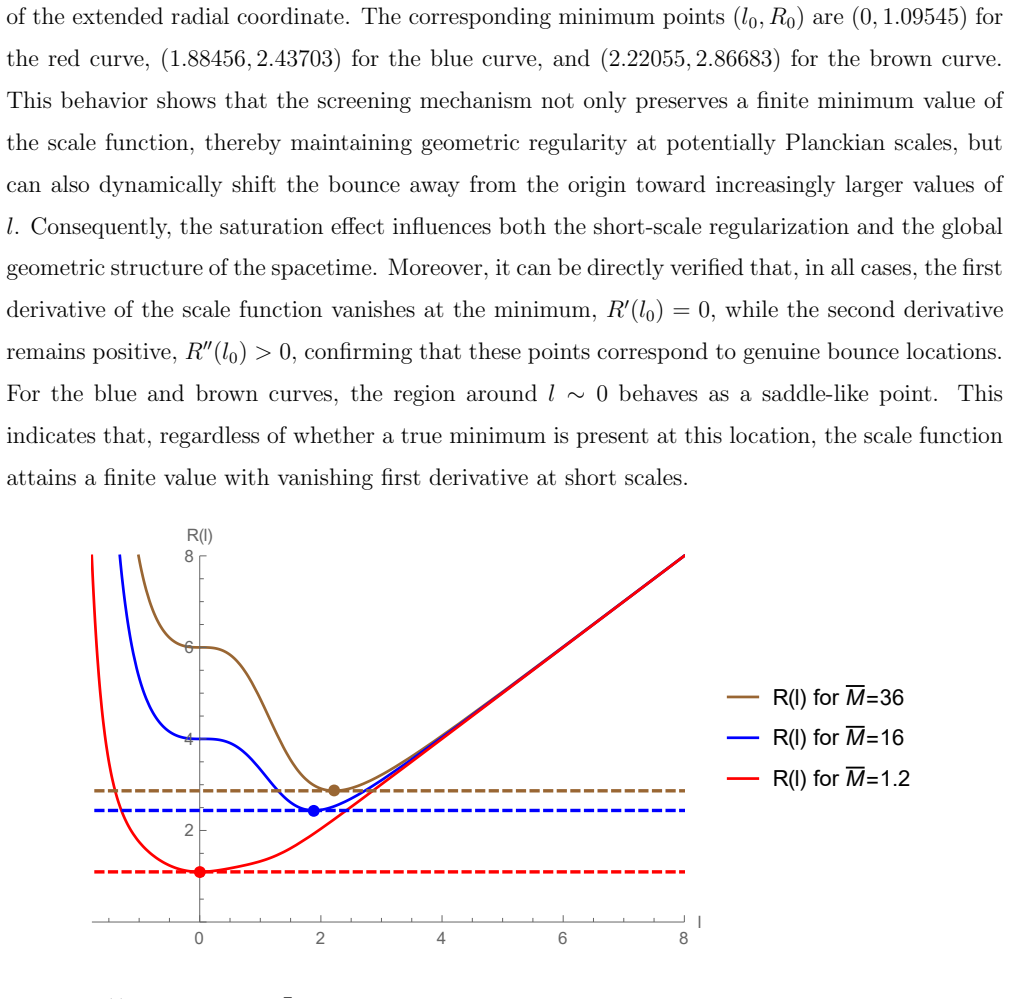
The scale function acquires tension dependent corrections, giving rise to a regular bounce structure without introducing ad hoc regular cores. The bounce location emerges dynamically from the interplay between gravitational tension and geometric screening. Depending on the regime, the bounce may remain associated with short distance scales or be displaced toward larger finite scale regions, indicating that saturation effects can modify not only the inner structure of compact objects at short scales but also their global geometry.
What carries the argument
Tension-dependent corrections to the scale function that screen gravitational tension at high curvatures and thereby enforce a finite minimum radius.
If this is right
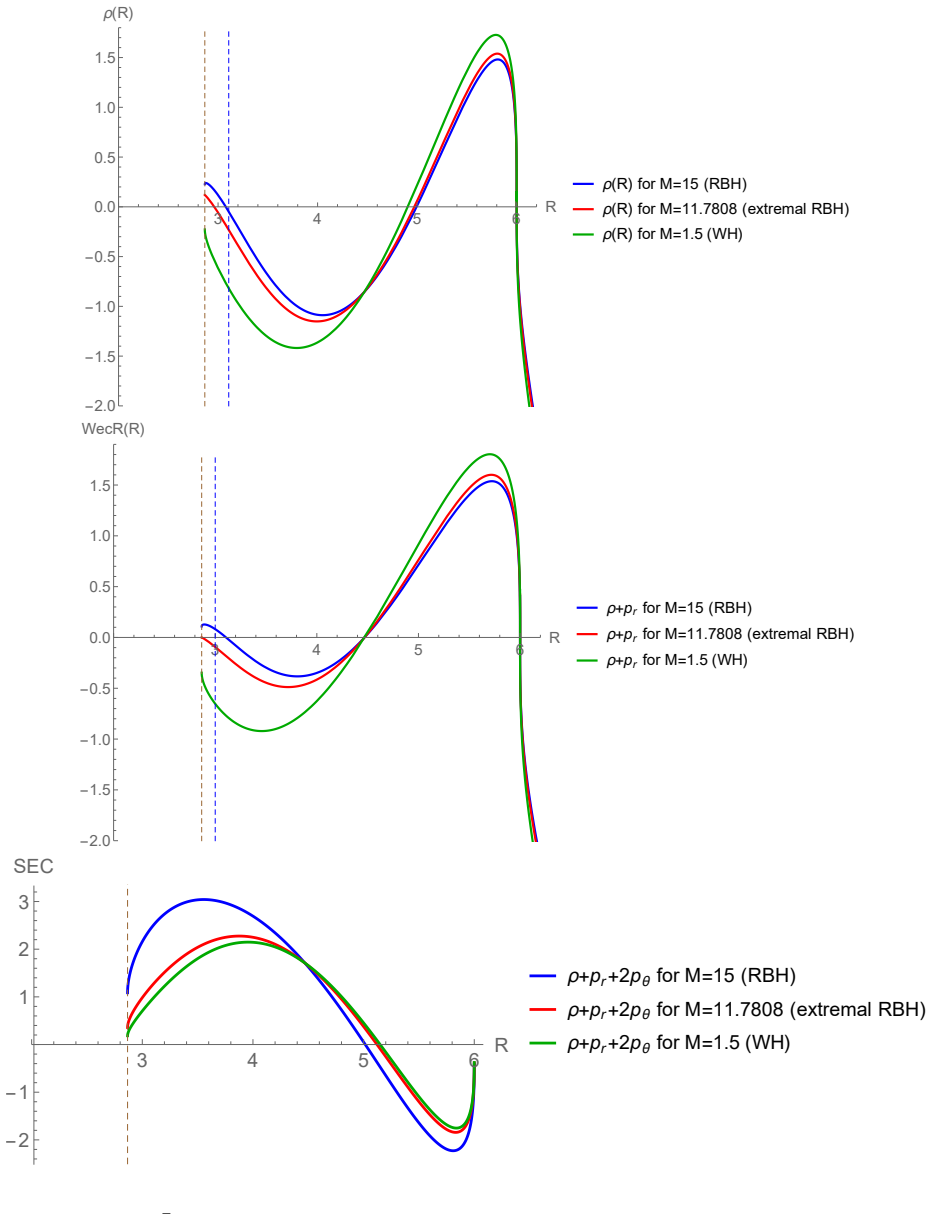
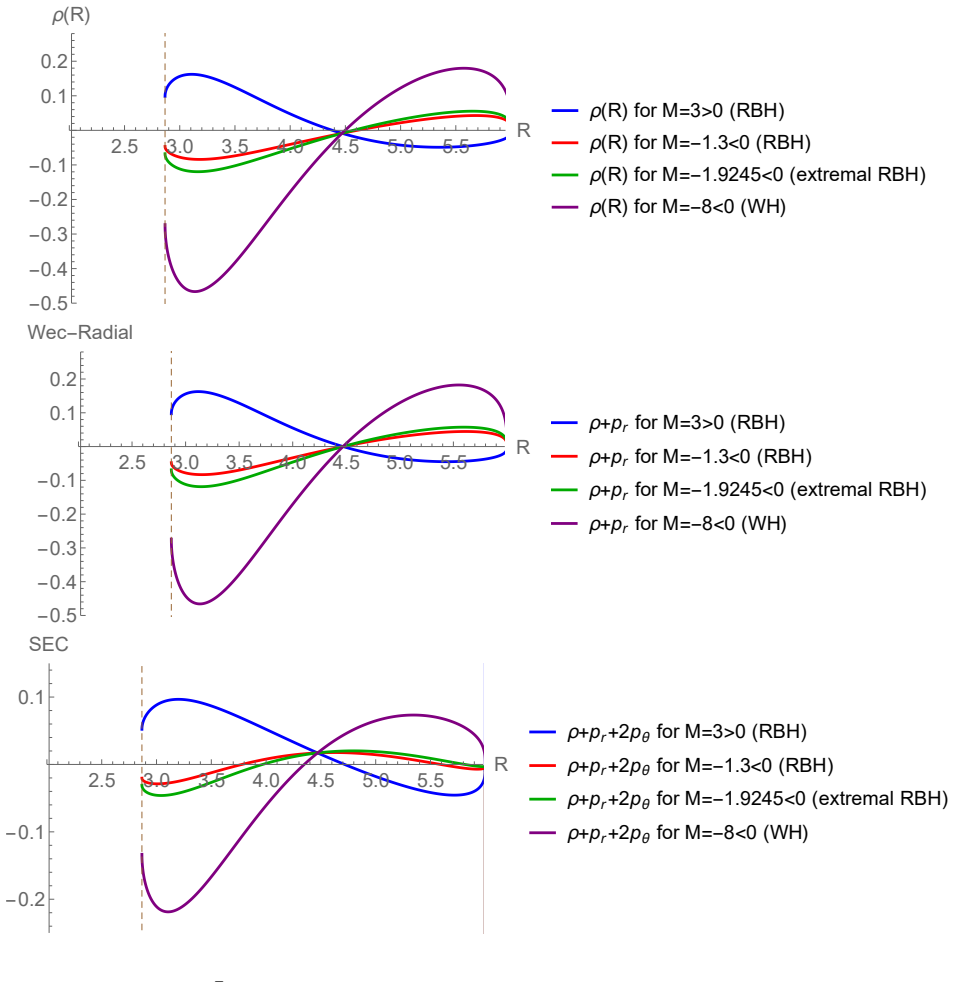
- Regular black holes, extremal regular black holes, and traversable wormholes arise for spherical, planar, and hyperbolic transverse sections.
- The bounce location can shift from short-distance scales to larger finite regions according to the saturation parameters.
- Hyperbolic and planar regular black holes can satisfy the standard energy conditions near the bounce.
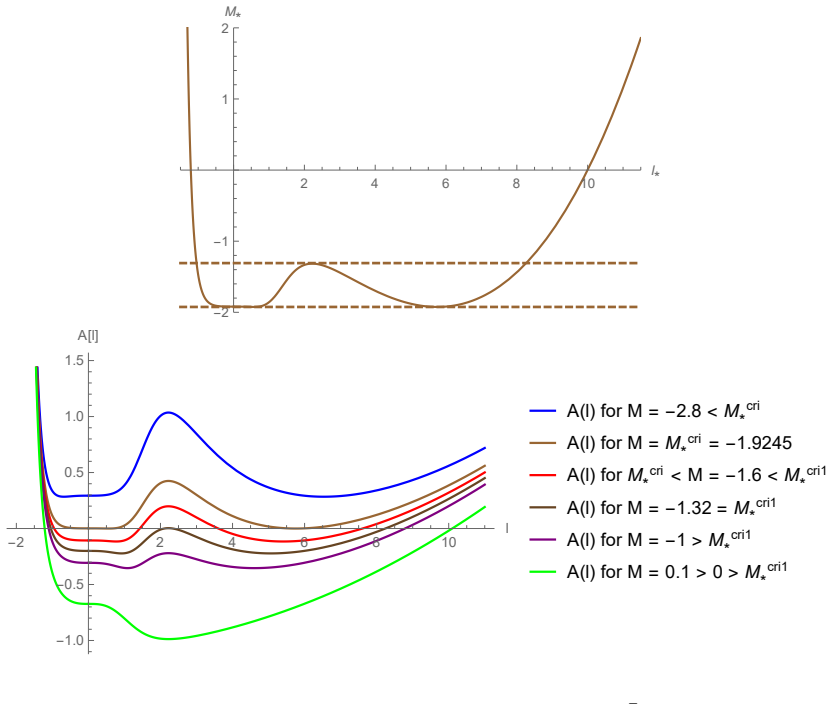
- Hyperbolic geometries admit regular negative-mass configurations whose energy-condition behavior depends strongly on the parameters.
Where Pith is reading between the lines
- The same saturation rule could be applied to other curvature singularities to test whether it produces regular centers without manual adjustment.
- Observations of near-horizon geometry or shadows might distinguish tension-screened bounces from other regularization schemes if the bounce radius moves outward.
- Planar and hyperbolic cases could serve as simplified models for studying energy-condition compliance in modified gravity without spherical symmetry.
Load-bearing premise
The gravitational tension associated with the vacuum geometry does not grow indefinitely in high curvature and short scales regimes, but dynamically approaches a finite critical value.
What would settle it
A derivation in which the tension continues to increase without bound as curvature rises, preventing the scale function from developing a minimum radius, would falsify the mechanism.
Figures
read the original abstract
We provide a novel geometric regularization mechanism for black bounce spacetimes based on an effective gravitational tension screening inspired by Schwinger like saturation effects. The construction assumes that the gravitational tension associated with the vacuum geometry does not grow indefinitely in high curvature and short scales regimes, but dynamically approaches a finite critical value. As a result, the scale function acquires tension dependent corrections, giving rise to a regular bounce structure without introducing ad hoc regular cores. The mechanism generates regular geometries with spherical, planar, and hyperbolic transverse sections, describing regular black holes (RBHs), extremal RBHs, and traversable wormholes. A key result is that the bounce location emerges dynamically from the interplay between gravitational tension and geometric screening. Depending on the regime, the bounce may remain associated with short distance scales or be displaced toward larger finite scale regions, indicating that saturation effects can modify not only the inner structure of compact objects at short scales but also their global geometry. Hiperbolic and planar RBHs may satisfy the standard energy conditions near the bounce. Moreover, the hyperbolic geometry exhibits distinctive features, including regular negative mass configurations and a strong dependence of the energy conditions on the system parameters. In contrast, the matter sources supporting wormhole geometries, as expected, violate the energy conditions near the throat.
Editorial analysis
A structured set of objections, weighed in public.
Referee Report
Summary. The manuscript proposes a geometric regularization for black-bounce spacetimes via an effective gravitational-tension screening mechanism modeled on Schwinger-like saturation. It assumes that the gravitational tension associated with the vacuum geometry saturates at a finite critical value rather than diverging at high curvature, inducing tension-dependent corrections to the scale function that produce regular bounce structures. The construction is claimed to generate regular black holes, extremal regular black holes, and traversable wormholes for spherical, planar, and hyperbolic transverse sections, with the bounce location emerging dynamically from the tension-geometry interplay; energy-condition behavior is discussed for each case.
Significance. If a consistent dynamical mechanism for tension saturation were derived from the field equations and shown to be independent of the bounce ansatz, the approach could supply a new, non-ad-hoc route to singularity resolution that also modifies global geometry. At present the significance cannot be assessed because the explicit metric functions, the tension-screening Lagrangian or field equations, and any verification against the Einstein equations or energy conditions are not supplied.
major comments (1)
- The central claim that a regular bounce arises without ad-hoc cores rests entirely on the postulate that gravitational tension saturates at a finite value. Without the explicit field equations or derivation showing how this saturation is enforced dynamically (rather than imposed by hand), it is impossible to determine whether the bounce location or the energy-condition statements are independent predictions or direct consequences of the saturation assumption itself.
minor comments (1)
- The abstract contains the typographical error "Hiperbolic" (should be "Hyperbolic").
Simulated Author's Rebuttal
We thank the referee for their careful reading of the manuscript and for highlighting the foundational role of the tension saturation assumption. We address the major comment below, clarifying the effective nature of the proposed mechanism.
read point-by-point responses
-
Referee: The central claim that a regular bounce arises without ad-hoc cores rests entirely on the postulate that gravitational tension saturates at a finite value. Without the explicit field equations or derivation showing how this saturation is enforced dynamically (rather than imposed by hand), it is impossible to determine whether the bounce location or the energy-condition statements are independent predictions or direct consequences of the saturation assumption itself.
Authors: The saturation of gravitational tension at a finite critical value is introduced as an effective postulate, directly analogous to the Schwinger effect in which vacuum polarization prevents indefinite growth of the electric field. The manuscript does not derive this saturation from the Einstein equations or from an explicit modified-gravity Lagrangian; it takes the saturation as the defining assumption of the model and then examines its geometric consequences. Within this framework the bounce location is fixed by the condition that the tension reaches its critical value, so both the bounce radius and the energy-condition behavior are direct consequences of the assumption rather than independent predictions. We therefore do not claim a first-principles dynamical derivation in the present work, but rather explore the regularization that follows once saturation is imposed. A microscopic derivation from field equations would constitute a natural extension, but lies outside the scope of the current geometric construction. revision: no
Circularity Check
No circularity identified; derivation relies on explicit assumption without self-referential reduction
full rationale
The provided abstract states an assumption that gravitational tension saturates at a finite value, from which tension-dependent corrections to the scale function are said to follow, producing a bounce. No equations, self-citations, fitted parameters, or uniqueness theorems are supplied in the text excerpt. Without explicit derivation steps or quotes showing that the bounce location or energy conditions reduce by construction to the saturation assumption itself, no load-bearing circular step matching the enumerated patterns can be exhibited. The paper presents the saturation as an input assumption rather than a derived output, and the resulting geometries are described as consequences rather than tautological redefinitions. This is consistent with a non-circular modeling choice.
Axiom & Free-Parameter Ledger
free parameters (1)
- critical tension value
axioms (1)
- ad hoc to paper Gravitational tension does not grow indefinitely but dynamically approaches a finite critical value in high-curvature regimes.
invented entities (1)
-
gravitational tension screening
no independent evidence
Reference graph
Works this paper leans on
-
[1]
In these models, the causal structure does not terminate at a physical singularity, but instead extends toward a future causal region of the universe
have attracted considerable attention due to their ability to smoothly interpolate between RBHs and traversable wormholes. In these models, the causal structure does not terminate at a physical singularity, but instead extends toward a future causal region of the universe. Depending on the parameter space, these geometries may describe one-way or two-way ...
-
[2]
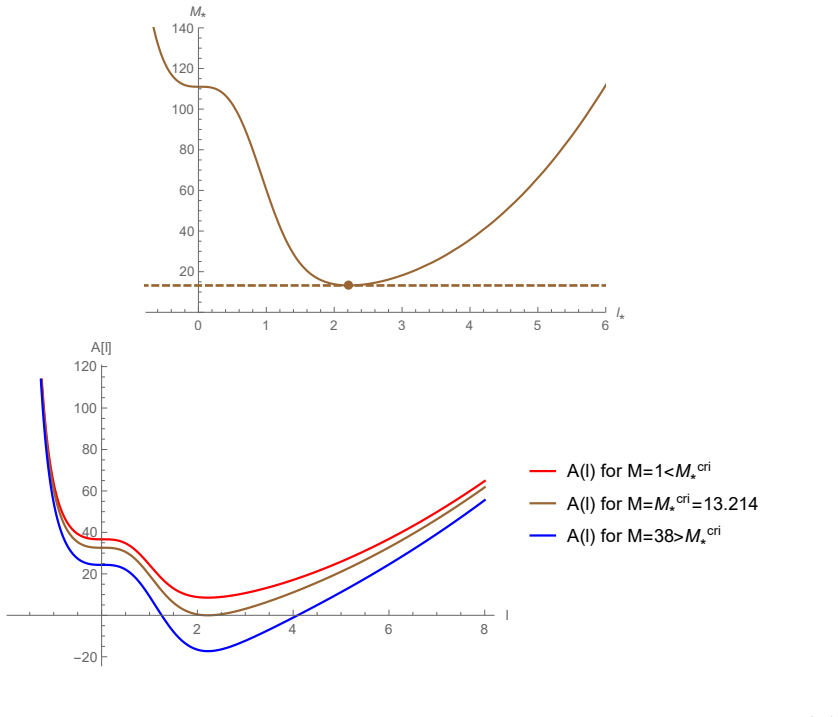
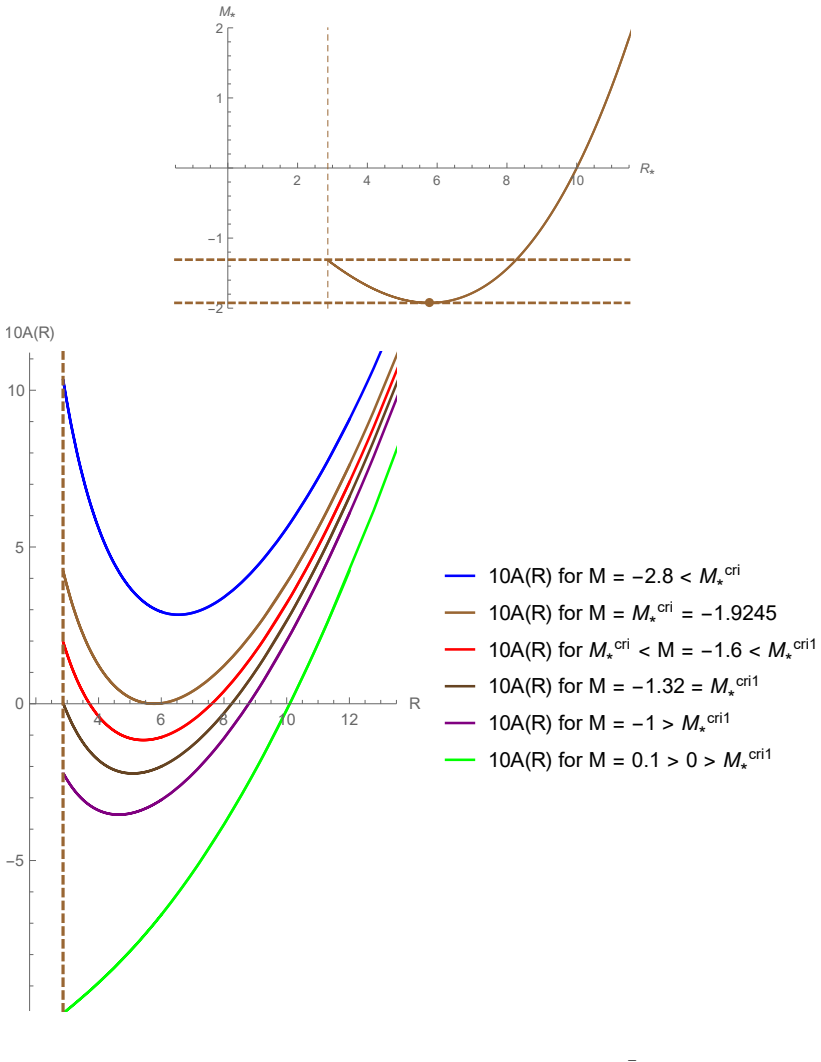
The minimum point is given by the ordered pair (R (cri) ∗ , M(cri) ∗ ) = (2.8668,13.2142). Second panel: The functionA(R) is displayed forM < M (cri) ∗ ,M=M (cri) ∗ , andM > M (cri) ∗ in red, brown, and blue, respectively, representing a traversable wormhole, an extremal RBH, and an RBH.a= 1, ¯M= 36, L= 1, k= 1. The horizon associated with the blue curve ...
-
[3]
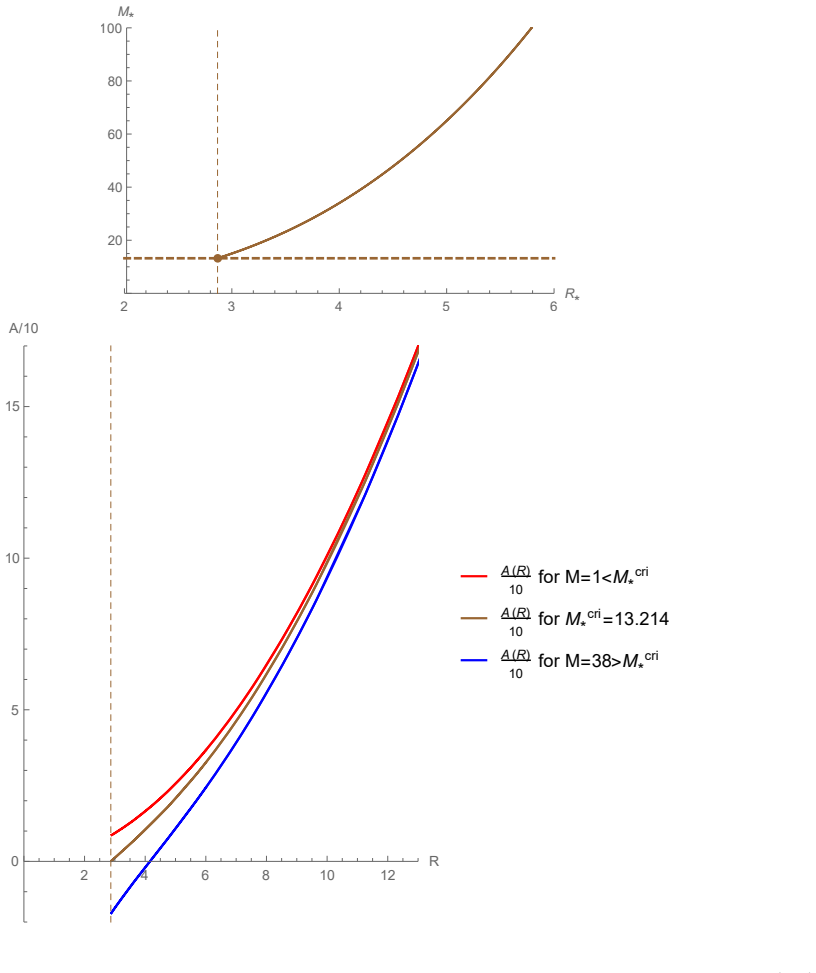
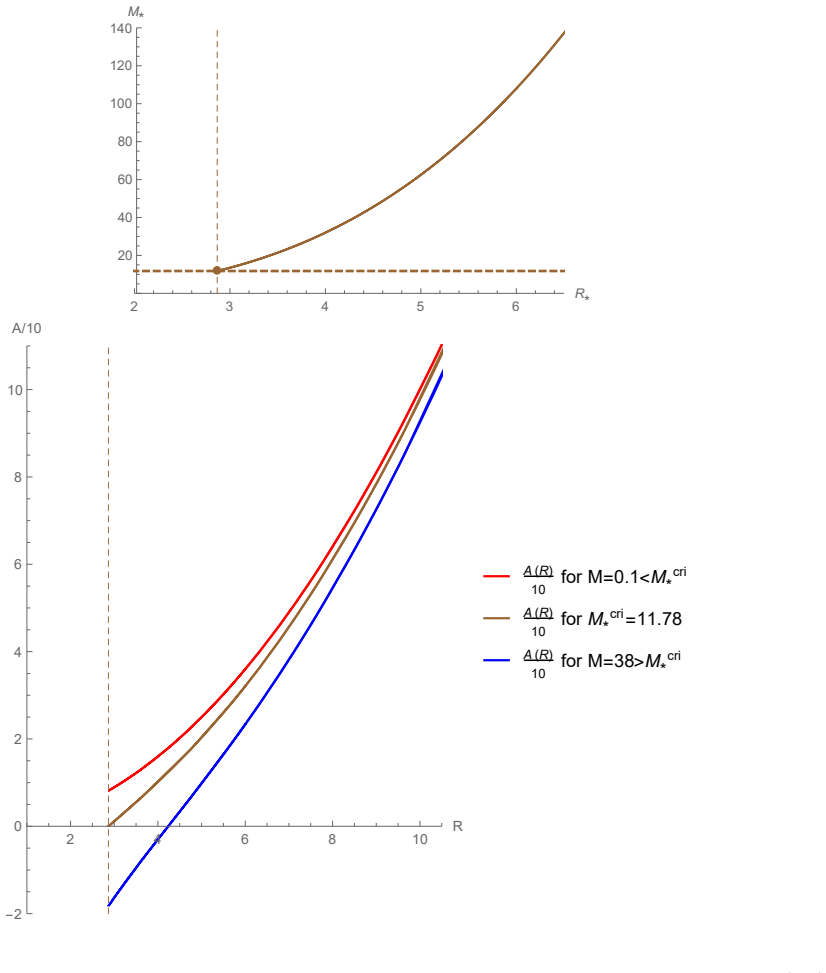
The minimum point is given by the ordered pair (R (cri) ∗ , M(cri) ∗ ) = (2.8668,11.7808). Second panel: The functionA(R) is displayed forM < M (cri) ∗ ,M=M (cri) ∗ , andM > M (cri) ∗ in red, brown, and blue, respectively, representing a traversable wormhole, an extremal RBH, and an RBH. The parameter values used area= 1, ¯M= 36, L= 1, k= 0. The horizon a...
-
[4]
Observation of Gravitational Waves from a Binary Black Hole Merger
B. P. Abbottet al.(LIGO Scientific, Virgo), “Observation of Gravitational Waves from a Binary Black Hole Merger,” Phys. Rev. Lett.116, 061102 (2016), arXiv:1602.03837 [gr-qc]
work page internal anchor Pith review Pith/arXiv arXiv 2016
-
[5]
First M87 Event Horizon Telescope Results. I. The Shadow of the Supermassive Black Hole
Kazunori Akiyamaet al.(Event Horizon Telescope), “First M87 Event Horizon Telescope Results. I. The Shadow of the Supermassive Black Hole,” Astrophys. J. Lett.875, L1 (2019), arXiv:1906.11238 24 [astro-ph.GA]
work page internal anchor Pith review Pith/arXiv arXiv 2019
-
[6]
First M87 Event Horizon Telescope Results. VI. The Shadow and Mass of the Central Black Hole
Kazunori Akiyamaet al.(Event Horizon Telescope), “First M87 Event Horizon Telescope Re- sults. VI. The Shadow and Mass of the Central Black Hole,” Astrophys. J. Lett.875, L6 (2019), arXiv:1906.11243 [astro-ph.GA]
work page internal anchor Pith review Pith/arXiv arXiv 2019
-
[7]
Delaying the Inevitable: Tidal Disruption in Microstate Geometries,
Iosif Bena, Anthony Houppe, and Nicholas P. Warner, “Delaying the Inevitable: Tidal Disruption in Microstate Geometries,” JHEP02, 103 (2021), arXiv:2006.13939 [hep-th]
-
[8]
Dymnikova GUP-corrected black holes,
G. Alencar, Milko Estrada, C. R. Muniz, and Gonzalo J. Olmo, “Dymnikova GUP-corrected black holes,” JCAP11, 100 (2023), arXiv:2309.03920 [gr-qc]
-
[9]
Regular black holes from semi-classical down to Planckian size
Euro Spallucci and Anais Smailagic, “Regular black holes from semi-classical down to Planckian size,” Int. J. Mod. Phys. D26, 1730013 (2017), arXiv:1701.04592 [hep-th]
work page internal anchor Pith review Pith/arXiv arXiv 2017
-
[10]
Vacuum nonsingular black hole,
I. Dymnikova, “Vacuum nonsingular black hole,” Gen. Rel. Grav.24, 235–242 (1992)
1992
-
[11]
Comment on “Regular evaporating black holes with stable cores
Ra´ ul Carballo-Rubio, Francesco Di Filippo, Stefano Liberati, Costantino Pacilio, and Matt Visser, “Comment on “Regular evaporating black holes with stable cores”,” Phys. Rev. D108, 128501 (2023), arXiv:2212.07458 [gr-qc]
-
[12]
De sitter-schwarzschild black hole: Its particlelike core and thermodynamical properties,
I.G. DYMNIKOVA, “De sitter-schwarzschild black hole: Its particlelike core and thermodynamical properties,” International Journal of Modern Physics D05, 529–540 (1996)
1996
-
[13]
Stefano Ansoldi, “Spherical black holes with regular center: A Review of existing models including a recent realization with Gaussian sources,” inConference on Black Holes and Naked Singularities (2008) arXiv:0802.0330 [gr-qc]
work page internal anchor Pith review Pith/arXiv arXiv 2008
-
[14]
Dymnikova-Schwinger traversable wormholes,
Milko Estrada and Celio R. Muniz, “Dymnikova-Schwinger traversable wormholes,” JCAP03, 055 (2023), arXiv:2301.05037 [gr-qc]
-
[15]
Pure Lovelock gravity regular black holes,
Milko Estrada and Rodrigo Aros, “Pure Lovelock gravity regular black holes,” JCAP01, 032 (2025), arXiv:2409.09559 [gr-qc]
-
[16]
Quantum corrections to Dymnikova-Schwinger black holes in Einstein-Gauss-Bonnet gravity,
A. Errehymy, Y. Khedif, M. Daoud, K. Myrzakulov, B. Turimov, and T. Myrzakul, “Quantum corrections to Dymnikova-Schwinger black holes in Einstein-Gauss-Bonnet gravity,” Phys. Lett. B 870, 139915 (2025), arXiv:2509.17630 [gr-qc]
-
[17]
A. Errehymy, Y. Khedif, M. Daoud, B. Turimov, M. A. Khan, and S. Usanov, “Dymnikova-Schwinger quantum-corrected slowly rotating wormholes: Photon and spinning particle dynamics,” (2026), arXiv:2604.03864 [gr-qc]
work page internal anchor Pith review Pith/arXiv arXiv 2026
-
[18]
Gravitational Pair Production and Black Hole Evaporation,
Michael F. Wondrak, Walter D. van Suijlekom, and Heino Falcke, “Gravitational Pair Production and Black Hole Evaporation,” Phys. Rev. Lett.130, 221502 (2023), arXiv:2305.18521 [gr-qc]. 25
-
[19]
On conformal anomaly and pair production,
M. N. Chernodub, “On conformal anomaly and pair production,” Int. J. Mod. Phys. A40, 2540008 (2025), arXiv:2306.03892 [hep-th]
-
[20]
Black-bounce to traversable wormhole
Alex Simpson and Matt Visser, “Black-bounce to traversable wormhole,” JCAP02, 042 (2019), arXiv:1812.07114 [gr-qc]
work page internal anchor Pith review Pith/arXiv arXiv 2019
-
[21]
Gravitational lensing in black- bounce spacetimes,
J. R. Nascimento, A. Yu. Petrov, P. J. Porfirio, and A. R. Soares, “Gravitational lensing in black- bounce spacetimes,” Phys. Rev. D102, 044021 (2020), arXiv:2005.13096 [gr-qc]
-
[22]
Echoes of novel black-bounce spacetimes,
Yi Yang, Dong Liu, Zhaoyi Xu, Yujia Xing, Shurui Wu, and Zheng-Wen Long, “Echoes of novel black-bounce spacetimes,” Phys. Rev. D104, 104021 (2021), arXiv:2107.06554 [gr-qc]
-
[23]
Thin accretion disk in the Simpson-Visser black-bounce and wormhole spacetimes,
Parth Bambhaniya, Saurabh K, Kimet Jusufi, and Pankaj S. Joshi, “Thin accretion disk in the Simpson-Visser black-bounce and wormhole spacetimes,” Phys. Rev. D105, 023021 (2022), arXiv:2109.15054 [gr-qc]
-
[24]
Tidal forces in the Simpson–Visser black-bounce and wormhole spacetimes,
Dhruv Arora, Parth Bambhaniya, Dipanjan Dey, and Pankaj S. Joshi, “Tidal forces in the Simpson–Visser black-bounce and wormhole spacetimes,” Phys. Dark Univ.44, 101487 (2024), arXiv:2305.08082 [gr-qc]
-
[25]
Shadow structure of generalizedk−nblack-bounce metrics,
Jose R. Nascimento, Ana R. M. Oliveira, Albert Yu. Petrov, Paulo J. Porf´ ırio, and Amilcar R. Queiroz, “Shadow structure of generalizedk−nblack-bounce metrics,” Gen. Rel. Grav.58, 26 (2026), arXiv:2510.23748 [gr-qc]
-
[26]
Big bounce and black bounce in quasi-topological gravity,
Yi Ling and Zhangping Yu, “Big bounce and black bounce in quasi-topological gravity,” JCAP03, 004 (2026), arXiv:2509.00137 [gr-qc]
-
[27]
Anderson Bragado and Gonzalo J. Olmo, “Periodic equatorial orbits in a black bounce scenario,” Class. Quant. Grav.42, 185004 (2025), arXiv:2506.15600 [gr-qc]
-
[28]
Echoes and quasinormal modes of asymmetric black bounces
Alana C. L. Santos, Leandro A. Lessa, Roberto V. Maluf, and Gonzalo J. Olmo, “Echoes and quasinormal modes of asymmetric black bounces,” (2025), arXiv:2508.11096 [gr-qc]
work page internal anchor Pith review Pith/arXiv arXiv 2025
-
[29]
On the structure of black bounces sourced by anisotropic fluids,
L. A. Lessa and G. J. Olmo, “On the structure of black bounces sourced by anisotropic fluids,” JCAP 03, 019 (2025), arXiv:2412.05378 [gr-qc]
-
[30]
Braneworld black bounce to transversable wormhole,
Tiago M. Crispim, Milko Estrada, C. R. Muniz, and G. Alencar, “Braneworld black bounce to transversable wormhole,” JCAP10, 063 (2024), arXiv:2405.08048 [hep-th]
-
[31]
Possibility of hyperbolic tunneling
Francisco S. N. Lobo and Jose P. Mimoso, “Possibility of hyperbolic tunneling,” Phys. Rev. D82, 044034 (2010), arXiv:0907.3811 [gr-qc]
work page internal anchor Pith review Pith/arXiv arXiv 2010
-
[32]
Hyperbolic Casimir-like wormhole,
Roberto Avalos, Daniel Brito, Ernesto Fuenmayor, and Ernesto Contreras, “Hyperbolic Casimir-like wormhole,” Eur. Phys. J. C85, 793 (2025), arXiv:2507.17906 [gr-qc]. 26
-
[33]
Marco Calz´ a, Massimiliano Rinaldi, and Sergio Zerbini, “Topological regular black holes without a Cauchy horizon,” Phys. Rev. D112, 024024 (2025), arXiv:2505.04427 [gr-qc]
-
[34]
Complexity growth for topological black holes by holographic method,
Koichi Nagasaki, “Complexity growth for topological black holes by holographic method,” Int. J. Mod. Phys. A35, 2050152 (2020), arXiv:1912.03567 [hep-th]
-
[35]
Analytic solutions of neutral hyperbolic black holes with scalar hair,
Jie Ren, “Analytic solutions of neutral hyperbolic black holes with scalar hair,” Phys. Rev. D106, 086023 (2022), arXiv:1910.06344 [hep-th]
-
[36]
Horizon curvature and spacetime structure influences on black hole scalarization,
Hong Guo, Xiao-Mei Kuang, Eleftherios Papantonopoulos, and Bin Wang, “Horizon curvature and spacetime structure influences on black hole scalarization,” Eur. Phys. J. C81, 842 (2021), arXiv:2012.11844 [gr-qc]
-
[37]
Joule-Thomson expansion of hyperscaling violating black holes with spherical and hyperbolic horizons,
J. Sadeghi and R. Toorandaz, “Joule-Thomson expansion of hyperscaling violating black holes with spherical and hyperbolic horizons,” Nucl. Phys. B951, 114902 (2020)
2020
-
[38]
Robert B. Mann, “Black holes of negative mass,” Class. Quant. Grav.14, 2927–2930 (1997), arXiv:gr- qc/9705007
-
[39]
Topological Black Holes -- Outside Looking In
Robert B. Mann, “Topological black holes: Outside looking in,” Annals Israel Phys. Soc.13, 311 (1997), arXiv:gr-qc/9709039
work page internal anchor Pith review Pith/arXiv arXiv 1997
-
[40]
Novel topological black holes from thermodynamics and deforming horizons,
Jinbo Yang, “Novel topological black holes from thermodynamics and deforming horizons,” Phys. Rev. D109, 084032 (2024), arXiv:2301.01709 [gr-qc]
-
[41]
Rodrigo Aros and Milko Estrada, “Study about black hole solutions with nonconstant transver- sal curvature and its conserved charges in Lovelock gravity,” Phys. Rev. D109, 104044 (2024), arXiv:2309.04871 [gr-qc]
-
[42]
Thermodynamics of exotic black holes in Lovelock gravity,
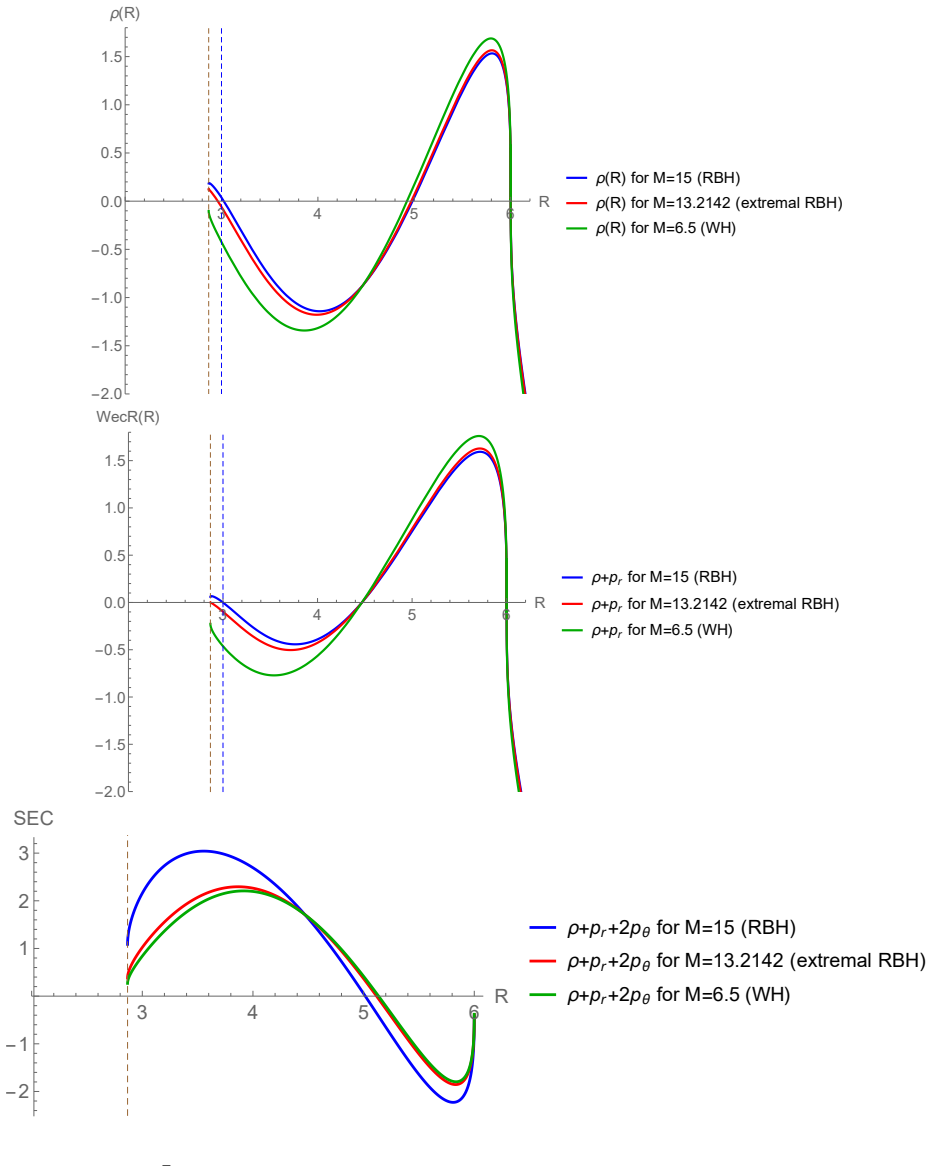
Brayden R. Hull and Robert B. Mann, “Thermodynamics of exotic black holes in Lovelock gravity,” Phys. Rev. D104, 084032 (2021), arXiv:2102.05282 [gr-qc]. 27 3 4 5 6 R -2.0 -1.5 -1.0 -0.5 0.0 0.5 1.0 1.5 ρ(R) ρ(R)for M=15(RBH) ρ(R)for M=11.7808(extremal RBH) ρ(R)for M=1.5(WH) 3 4 5 6 R -2.0 -1.5 -1.0 -0.5 0.0 0.5 1.0 1.5 WecR(R) ρ+pr for M=15(RBH) ρ+pr for...
discussion (0)
Sign in with ORCID, Apple, or X to comment. Anyone can read and Pith papers without signing in.