REVIEW 3 major objections 4 minor 48 references
PDFBench: A Benchmark for De novo Protein Design from Function
T0 review · 3 major / 4 minor · reviewed 2026-08-07 · deepseek-v4-flash
Pith's one-line read PDFBench is the first comprehensive benchmark for function-guided de novo protein design, running eight models through sixteen metrics across two input settings and mapping how the metrics interrelate.
desk verdict A useful benchmark with real insights, but the keyword-guided rankings compare different test subsets and need a common-subset evaluation before the results can be trusted. read the letter →
The pith
A machine-rendered reading of the paper's core claim, the machinery that carries it, and where it could break.
The reading
What carries the argument
The load-bearing machinery is PDFBench's metric suite itself: sixteen scores organized into six dimensions — plausibility (three perplexity scores, Rep-2, Rep-5, and a new biologically motivated Repeat metric), foldability (ESMFold-based pLDDT and PAE), language alignment (ProTrek Score, EvoLlama Score, IPR Recovery, GO Recovery, Retrieval Accuracy), similarity (GT-Identity, ESM Score, GT-TMscore), novelty, and diversity — applied to two controlled test sets, MolinstTest and the cutoff-dated SwissTest. The device that turns raw scores into benchmark-level conclusions is the correlation analysis among metrics, including the Pearson correlations among perplexity, pLDDT, and PAE, the Repeat threshold near 10, and soft, random, and hard variants of Retrieval Accuracy that quantify how much negative-sample choice moves results.
What would settle it
Re-run the keyword-guided comparison with every model evaluated on the identical intersection of supported keywords under one fixed GO ancestor-substitution rule, and check whether the Table 3 rankings persist; if the per-model subsets show different natural-protein reference scores, or the intersection-based rankings shift, the fairness premise fails.
Extended reading notes
Core claim
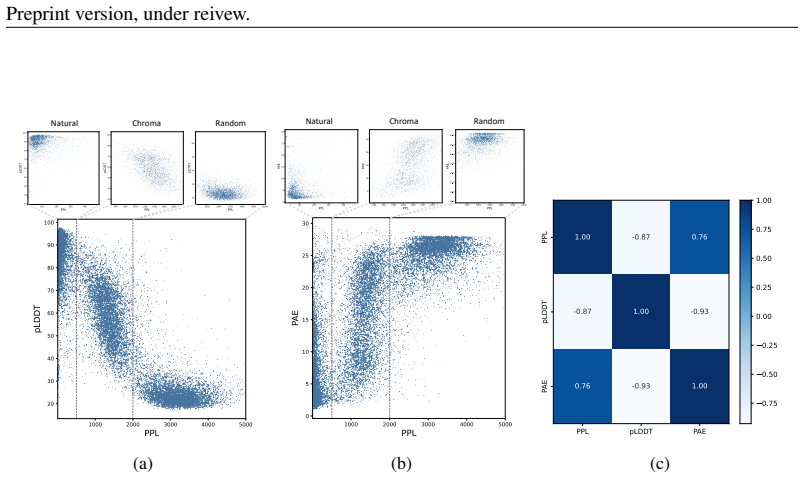
The central claim is that a unified, multi-metric evaluation can make function-guided de novo protein design comparable across methods and can reveal which evaluation metrics carry real information. PDFBench evaluates eight models — ProDVa, Pinal, ProteinDT, Chroma, PAAG, ESM3, CFP-Gen, and ProteoGAN — on 16 metrics spanning six dimensions. For description-guided design it repurposes the Mol-Instructions test split as MolinstTest (5,876 proteins), and for keyword-guided design it builds SwissTest (1,057 proteins, 1,297 InterPro entries, 380 GO terms) from SwissProt entries created between January 1 and August 25, 2025, so the training sets of the baselines cannot contain the test answers. The empirical findings include: perplexity correlates 0.76 with pLDDT and -0.87 with PAE; Repeat values above 10 are associated with lower structural plausibility; ProTrek and EvoLlama scores agree closely, with suggested alignment thresholds of 15 and 50; and Retrieval Accuracy depends heavily on the retrieval strategy, with the soft-versus-hard gap reaching 66.31 percentage points even for natural proteins. On the models themselves, the paper finds that ProDVa and Pinal lead in plausibility, foldability, and language alignment while sacrificing novelty and diversity, whereas CFP-Gen is the strongest keyword-guided model.
Load-bearing premise
The load-bearing premise is that testing each keyword-guided model only on the keyword subset it supports still yields scores that can be compared directly across models, since if one model's supported keywords are systematically easier, the aggregate rankings in Table 3 would reflect test-set selection rather than model capability.
Editorial extensions
If this is right
- Models in this area can now be compared on a common 16-metric grid, so a gain on one dimension can be weighed against its cost on novelty, diversity, or structural plausibility.
- Cheap sequence-level scores can substitute for expensive structure prediction in initial screening, since low perplexity and low Repeat scores consistently indicate well-folded proteins.
- Retrieval-based alignment results should be reported together with the retrieval strategy, because soft versus hard negative selection moves Retrieval Accuracy by up to 66.31 percentage points even for natural proteins.
- Keyword-guided results should be separated by input type, since InterPro guidance consistently yields stronger plausibility, foldability, and alignment than GO guidance.
- Scores above 15 on ProTrek and above 50 on EvoLlama give a concrete rule for flagging designs that faithfully match their functional description.
Reading between the lines
- A direct test suggested by the paper's own setup: re-run all keyword-guided models on the single intersection of the keywords they all support; if the Table 3 aggregate rankings shift, the head-to-head scores partly measure subset difficulty rather than model quality.
- The reported correlations imply a cheap two-stage screening pipeline for future designs — filter by perplexity and Repeat thresholds before spending compute on structure prediction and alignment scoring.
- The soft-overlap protocol (reporting results with and without functionally similar training-set neighbors) could become a standard fairness disclosure for other generative benchmarks.
- The SwissTest recipe — reviewed SwissProt entries inside a date window — transfers directly to contamination-safe evaluation sets in neighboring generation tasks such as antibody or small-molecule design.
Editorial analysis
A structured set of objections, weighed in public.
Referee Report
Summary. PDFBench proposes a benchmark for de novo protein design from function. It evaluates eight models (ProteoGAN, ESM3, CFP-Gen, Chroma, ProteinDT, PAAG, Pinal, ProDVa) across 16 metrics in two settings: description-guided design using a repurposed Mol-Instructions test set (MolinstTest) and keyword-guided design using a newly curated SwissTest set with a 2025 datetime cutoff. The paper reports aggregate leaderboards, analyzes metric correlations (e.g., PPL vs. pLDDT/PAE, Repeat vs. foldability, ProTrek vs. EvoLlama agreement, retrieval-strategy sensitivity), and claims to be the first comprehensive benchmark that enables more reliable model comparisons.
Significance. If the comparisons are trustworthy, PDFBench would be a useful community resource: it assembles a broad metric suite, includes a contamination-controlled keyword test set, and provides a quantitative fairness analysis for the description-guided setting. The soft-overlap analysis in Appendix B.3 and the retrieval-strategy sensitivity study in Section 4.3 are genuinely informative contributions. However, the benchmark's central promise of reliable model comparison is not yet established because the keyword-guided leaderboard mixes different test subsets and one of the main alignment metrics is trained by the same group that contributes a headline baseline. The empirical correlations in Section 4 also rest on thresholds that are stated inconsistently. These issues are fixable, but they affect the interpretation of the headline results.
major comments (3)
- [Appendix E.1 / Table 3] The keyword-guided leaderboard is not computed on a common test set. Appendix E.1 states that unsupported InterPro entries are skipped for ESM3 and CFP-Gen and that unsupported GO terms are replaced by ancestors or skipped for ProteoGAN and CFP-Gen. Together with Table 1, this means the GO-guided rows evaluate ProteoGAN on 41 of 380 terms and CFP-Gen on 92 of 380 terms, while the other models are evaluated on all 380 terms; the IPR-guided rows evaluate ESM3 on 1,197 of 1,297 entries and CFP-Gen on 170 of 1,297 entries, while the other models see all 1,297 entries. Aggregate scores and the ranking claim in Section 3.2, finding (3), that "CFP-Gen shows great performance among the keyword-guided baselines" therefore compare models on different test inputs, and a model with a smaller or easier subset can appear better than one tested on a larger or harder set. The fairness analysis in Appendix B.3 addresses data contamination, not this subset skew, and Appendix F's limitation statement mentions only the 1,057-protein size. The paper should report a common-subset evaluation (e.g., scores on the intersection of supported keywords for each model pair) or otherwise justify why the differing subsets do not affect the aggregate ranking.
- [Appendix C.2 / Section 2.3] The EvoLlama Score introduces a circularity concern for the benchmark's conclusions. As stated in Appendix C.2, EvoLlama is "randomly initialized and trained from scratch using the SwissMolinst dataset described in Liu et al. (2025a)", i.e., the same group's ProDVa paper, and ProDVa is one of the headline baselines in Tables 2 and 3. Using this scorer in the main EvoLlama Score column means that ProDVa's ranking can partly reflect its own authors' training distribution, rather than an independent judge of function-sequence alignment. The paper should either use a publicly available, independently trained oracle, report EvoLlama Score only as a secondary or clearly labeled same-group metric, or provide an analysis showing that EvoLlama Score does not systematically favor EvoLlama-trained models over the other baselines.
- [Section 4.1 / Figure 3] The PPL-range definitions are internally inconsistent. The text defines "low PPL range (values above 500), medium PPL range (values between 500 and 2,000), and high PPL range (values above 2,000)", while the Figure 3 caption says values below 500 are low, 500–2,000 are medium, and above 2,000 are high. Moreover, the actual PPL values in Table 2 (e.g., natural proteins have PPL-ProGen2 = 5.99 and random sequences have 21.71) are inconsistent with any reading in which natural proteins fall in the range labeled "low" if that range is above 500. Takeaway I and the correlation claims in Section 4.1 therefore need a corrected, clearly specified threshold scheme with a distribution-based justification.
minor comments (4)
- [Abstract and page headers] There are multiple typos: "de novoprotein" in the abstract and "under reivew" in the page headers; these should be corrected.
- [Section 2.3] The sentence "we prompt the P with The function of the protein is" is grammatically unclear; it should be reworded to state that the designed protein is prompted through EvoLlama.
- [Section 3.2, finding (3)] The text reports "GO Recovery up to 21.05", but Table 10 shows GO Recovery values of 18.98 (GO-guided) and 23.31 (IPR&GO-guided) for CFP-Gen; the numbers should be aligned.
- [Tables 2 and 3 / Appendix E.1] The main tables report point estimates without standard deviations, despite Appendix E.1 stating that results are averaged over three seeds; including confidence intervals or a reference to the complete tables with uncertainty would help readers assess the stability of the rankings.
Circularity Check
No derivation reduces to its inputs; the only circularity burden is a same-group evaluator (EvoLlama) trained on the ProDVa dataset, which is minor and independently corroborated.
-
other
[Section 2.3 (Language Alignment) and Appendix C.2 (EvoLlama Score); Table 2]
"In addition, EvoLlama (Liu et al., 2024), fine-tuned on our dataset, is employed to derive the EvoLlama Score ... The model is randomly initialized and trained from scratch using the SwissMolinst dataset described in Liu et al. (2025a)."
EvoLlama is from the same author group and was trained from scratch on SwissMolinst, the dataset introduced in the authors' own ProDVa paper; ProDVa is one of the baselines PDFBench evaluates. Consequently, the EvoLlama Score reported for ProDVa is generated by an evaluator that shares ProDVa's training distribution, so the language-alignment numbers (e.g., 51.19 for ProDVa) are not fully independent. This is a self-citation/fitted-evaluator concern rather than a formal equation-level reduction: ProTrek and Retrieval Accuracy, which are external, yield the same qualitative ranking, so the central claims retain independent support.
full rationale
PDFBench's main metric derivations are self-contained: MolinstTest is an external dataset, SwissTest is curated independently with a date cutoff, and metrics like pLDDT, PAE, TM-score, ProTrek, MMseqs2, and Foldseek are external oracles. The correlation analyses in Section 4 are empirical, not definitional. The one salient self-reference is the EvoLlama Score (Appendix C.2): EvoLlama is the authors' own model trained on the SwissMolinst dataset from the same group's ProDVa paper, and ProDVa is a benchmarked baseline. This makes that score partly same-source, but it is a minor self-citation rather than a load-bearing circularity because ProTrek and Retrieval Accuracy independently support the same findings. The keyword-guided subset-skew issue (Appendix E.1) is a genuine comparability threat but is a fairness/correctness problem, not a circularity: models are scored on different supported-keyword subsets, yet no score is defined in terms of another score. Overall, no derivation reduces by construction to its inputs; the circularity burden is limited to the same-group evaluator/baseline pair.
Assumptions & free parameters
free parameters (3)
- PPL range thresholds =
<500 (low), 500-2000 (medium), >2000 (high)
- Repeat threshold =
10
- Soft overlap similarity threshold =
0.5 (50% functional identity) for the 0.24% claim; thresholds 0.1-0.7 explored in Appendix B.3
assumptions (5)
- domain assumption ESMFold-predicted pLDDT and PAE are valid proxies for protein foldability.
- domain assumption ProTrek embeddings capture functional relatedness between protein sequences and text descriptions.
- domain assumption Sequence similarity to UniProtKB (MMseqs2) and structural similarity to AlphaFoldDB/SwissProt (Foldseek) are valid novelty and diversity measures.
- domain assumption Querying SwissProt with date_created between 2025-01-01 and 2025-08-25 yields 'unseen' proteins for all baselines.
- domain assumption The soft-overlap analysis based on ProTrek function embeddings with threshold 0.5 is sufficient to establish evaluation fairness.
Cite this review
Pith. "Pith review of PDFBench: A Benchmark for De novo Protein Design from Function." pith.science (2026). https://pith.science/paper/MDZAUC5B
@misc{pith2026250520346,
  author       = {Pith},
  title        = {Pith review of: PDFBench: A Benchmark for De novo Protein Design from Function},
  year         = {2026},
  howpublished = {\url{https://pith.science/paper/MDZAUC5B}},
  note         = {Machine review of arXiv:2505.20346}
}
read the original abstract
Function-guided protein design is a crucial task with significant applications in drug discovery and enzyme engineering. However, the field lacks a unified and comprehensive evaluation framework. Current models are assessed using inconsistent and limited subsets of metrics, which prevents fair comparison and a clear understanding of the relationships between different evaluation criteria. To address this gap, we introduce PDFBench, the first comprehensive benchmark for function-guided denovo protein design. Our benchmark systematically evaluates eight state-of-the-art models on 16 metrics across two key settings: description-guided design, for which we repurpose the Mol-Instructions dataset, originally lacking quantitative benchmarking, and keyword-guided design, for which we introduce a new test set, SwissTest, created with a strict datetime cutoff to ensure data integrity. By benchmarking across a wide array of metrics and analyzing their correlations, PDFBench enables more reliable model comparisons and provides key insights to guide future research.
Figures


Figures from the paper (3 more)


Reference graph
Works this paper leans on
-
[1]
The coming of age of de novo protein design
Po-Ssu Huang, Scott E Boyken, and David Baker. The coming of age of de novo protein design. Nature , 537(7620):320--327, 2016
work page 2016
-
[2]
Katherine I Albanese, Sophie Barbe, Shunsuke Tagami, Derek N Woolfson, and Thomas Schiex. Computational protein design. Nature Reviews Methods Primers , 5(1):13, 2025
work page 2025
-
[3]
Computational design of enzymes for biotechnological applications
Joan Planas-Iglesias, S \'e rgio M Marques, Gaspar P Pinto, Milos Musil, Jan Stourac, Jiri Damborsky, and David Bednar. Computational design of enzymes for biotechnological applications. Biotechnology Advances , 47:107696, 2021
work page 2021
-
[4]
De novo enzymes by computational design
Hajo Kries, Rebecca Blomberg, and Donald Hilvert. De novo enzymes by computational design. Current opinion in chemical biology , 17(2):221--228, 2013
work page 2013
-
[5]
Computational design of enzymes
Reinhard Sterner, Rainer Merkl, and Frank M Raushel. Computational design of enzymes. Chemistry & biology , 15(5):421--423, 2008
work page 2008
-
[6]
Computational approaches for drug discovery
Che-Lun Hung and Chi-Chun Chen. Computational approaches for drug discovery. Drug development research , 75(6):412--418, 2014
work page 2014
-
[7]
Computational approaches in drug designing
Anshul Tiwari and Sakshi Singh. Computational approaches in drug designing. In Bioinformatics , pages 207--217. Elsevier, 2022
work page 2022
-
[8]
Protgpt2 is a deep unsupervised language model for protein design
Noelia Ferruz, Steffen Schmidt, and Birte H \"o cker. Protgpt2 is a deep unsupervised language model for protein design. Nature communications , 13(1):4348, 2022
work page 2022
Show all 48 references
-
[9]
Generating novel, designable, and diverse protein structures by equivariantly diffusing oriented residue clouds
Yeqing Lin and Mohammed AlQuraishi. Generating novel, designable, and diverse protein structures by equivariantly diffusing oriented residue clouds. arXiv preprint arXiv:2301.12485 , 2023
2023 arXiv
-
[10]
De novo design of protein structure and function with rfdiffusion
Joseph L Watson, David Juergens, Nathaniel R Bennett, Brian L Trippe, Jason Yim, Helen E Eisenach, Woody Ahern, Andrew J Borst, Robert J Ragotte, Lukas F Milles, et al. De novo design of protein structure and function with rfdiffusion. Nature , 620(7976):1089--1100, 2023
2023
-
[11]
Large language models generate functional protein sequences across diverse families
Ali Madani, Ben Krause, Eric R Greene, Subu Subramanian, Benjamin P Mohr, James M Holton, Jose Luis Olmos Jr, Caiming Xiong, Zachary Z Sun, Richard Socher, et al. Large language models generate functional protein sequences across diverse families. Nature biotechnology , 41(8):...
2023
-
[12]
Robust optimization in protein fitness landscapes using reinforcement learning in latent space
Minji Lee, Luiz Felipe Vecchietti, Hyunkyu Jung, Hyun Joo Ro, Meeyoung Cha, and Ho Min Kim. Robust optimization in protein fitness landscapes using reinforcement learning in latent space. arXiv preprint arXiv:2405.18986 , 2024
2024 arXiv
-
[13]
A text-guided protein design framework
Shengchao Liu, Yanjing Li, Zhuoxinran Li, Anthony Gitter, Yutao Zhu, Jiarui Lu, Zhao Xu, Weili Nie, Arvind Ramanathan, Chaowei Xiao, et al. A text-guided protein design framework. Nature Machine Intelligence , pages 1--12, 2025
2025
-
[14]
Toward de novo protein design from natural language
Fengyuan Dai, Shiyang You, Chentong Wang, Yuliang Fan, Jin Su, Chenchen Han, Xibin Zhou, Jianming Liu, Hui Qian, Shunzhi Wang, et al. Toward de novo protein design from natural language. bioRxiv , pages 2024--08, 2024
2024
-
[15]
Annotation-guided protein design with multi-level domain alignment
Chaohao Yuan, Songyou Li, Geyan Ye, Yikun Zhang, Long-Kai Huang, Wenbing Huang, Wei Liu, Jianhua Yao, and Yu Rong. Annotation-guided protein design with multi-level domain alignment. arXiv preprint arXiv:2404.16866 , 2024
2024 arXiv
-
[16]
Mol-instructions: A large-scale biomolecular instruction dataset for large language models
Yin Fang, Xiaozhuan Liang, Ningyu Zhang, Kangwei Liu, Rui Huang, Zhuo Chen, Xiaohui Fan, and Huajun Chen. Mol-instructions: A large-scale biomolecular instruction dataset for large language models. arXiv preprint arXiv:2306.08018 , 2023
2023 arXiv
-
[17]
Continuous automated model evaluation (cameo) complementing the critical assessment of structure prediction in casp12
J \"u rgen Haas, Alessandro Barbato, Dario Behringer, Gabriel Studer, Steven Roth, Martino Bertoni, Khaled Mostaguir, Rafal Gumienny, and Torsten Schwede. Continuous automated model evaluation (cameo) complementing the critical assessment of structure prediction in casp12. Pro...
2018
-
[18]
Interpro in 2022
Typhaine Paysan-Lafosse, Matthias Blum, Sara Chuguransky, Tiago Grego, Beatriz L \'a zaro Pinto, Gustavo A Salazar, Maxwell L Bileschi, Peer Bork, Alan Bridge, Lucy Colwell, et al. Interpro in 2022. Nucleic acids research , 51(D1):D418--D427, 2023
2022
-
[19]
Rita: a study on scaling up generative protein sequence models
Daniel Hesslow, Niccol \'o Zanichelli, Pascal Notin, Iacopo Poli, and Debora Marks. Rita: a study on scaling up generative protein sequence models. arXiv preprint arXiv:2205.05789 , 2022
2022 arXiv
-
[20]
Protein generation with evolutionary diffusion: sequence is all you need
Sarah Alamdari, Nitya Thakkar, Rianne van den Berg, Neil Tenenholtz, Bob Strome, Alan Moses, Alex Xijie Lu, Nicolo Fusi, Ava Pardis Amini, and Kevin K Yang. Protein generation with evolutionary diffusion: sequence is all you need. BioRxiv , pages 2023--09, 2023
2023
-
[21]
Diffusion language models are versatile protein learners
Xinyou Wang, Zaixiang Zheng, Fei Ye, Dongyu Xue, Shujian Huang, and Quanquan Gu. Diffusion language models are versatile protein learners. In International Conference on Machine Learning , 2024
2024
-
[22]
Deep sharpening of topological features for de novo protein design
Zander Harteveld, Joshua Southern, Micha \"e l Defferrard, Andreas Loukas, Pierre Vandergheynst, Micheal Bronstein, and Bruno Correia. Deep sharpening of topological features for de novo protein design. In ICLR2022 Machine Learning for Drug Discovery , 2022
2022
-
[23]
Robust deep learning--based protein sequence design using proteinmpnn
Justas Dauparas, Ivan Anishchenko, Nathaniel Bennett, Hua Bai, Robert J Ragotte, Lukas F Milles, Basile IM Wicky, Alexis Courbet, Rob J de Haas, Neville Bethel, et al. Robust deep learning--based protein sequence design using proteinmpnn. Science , 378(6615):49--56, 2022
2022
-
[24]
Learning inverse folding from millions of predicted structures
Chloe Hsu, Robert Verkuil, Jason Liu, Zeming Lin, Brian Hie, Tom Sercu, Adam Lerer, and Alexander Rives. Learning inverse folding from millions of predicted structures. In International conference on machine learning , pages 8946--8970. PMLR, 2022
2022
-
[25]
Pifold: Toward effective and efficient protein inverse folding
Zhangyang Gao, Cheng Tan, Pablo Chac \'o n, and Stan Z Li. Pifold: Toward effective and efficient protein inverse folding. arXiv preprint arXiv:2209.12643 , 2022
2022 arXiv
-
[26]
Secondary structure-guided novel protein sequence generation with latent graph diffusion
Yutong Hu, Yang Tan, Andi Han, Lirong Zheng, Liang Hong, and Bingxin Zhou. Secondary structure-guided novel protein sequence generation with latent graph diffusion. In 2024 IEEE International Conference on Bioinformatics and Biomedicine (BIBM) , pages 31--41. IEEE, 2024
2024
-
[27]
Ppi-llama2: De novo generation of binding proteins conditioned on target sequence alone
Yinuo Zhang, Phil He, Ashley Hsu, Sophia Vincoff, and Pranam Chatterjee. Ppi-llama2: De novo generation of binding proteins conditioned on target sequence alone. In ICLR 2024 Workshop on Generative and Experimental Perspectives for Biomolecular Design
2024
-
[28]
Progen2: exploring the boundaries of protein language models
Erik Nijkamp, Jeffrey A Ruffolo, Eli N Weinstein, Nikhil Naik, and Ali Madani. Progen2: exploring the boundaries of protein language models. Cell systems , 14(11):968--978, 2023
2023
-
[29]
Illuminating protein space with a programmable generative model
John B Ingraham, Max Baranov, Zak Costello, Karl W Barber, Wujie Wang, Ahmed Ismail, Vincent Frappier, Dana M Lord, Christopher Ng-Thow-Hing, Erik R Van Vlack, et al. Illuminating protein space with a programmable generative model. Nature , 623(7989):1070--1078, 2023
2023
-
[30]
Simulating 500 million years of evolution with a language model
Thomas Hayes, Roshan Rao, Halil Akin, Nicholas J Sofroniew, Deniz Oktay, Zeming Lin, Robert Verkuil, Vincent Q Tran, Jonathan Deaton, Marius Wiggert, et al. Simulating 500 million years of evolution with a language model. Science , page eads0018, 2025
2025
-
[31]
De novo protein design using geometric vector field networks
Weian Mao, Muzhi Zhu, Zheng Sun, Shuaike Shen, Lin Yuanbo Wu, Hao Chen, and Chunhua Shen. De novo protein design using geometric vector field networks. In The Twelfth International Conference on Learning Representations , 2024
2024
-
[32]
Proteus: exploring protein structure generation for enhanced designability and efficiency
Chentong Wang, Yannan Qu, Zhangzhi Peng, Yukai Wang, Hongli Zhu, Dachuan Chen, and Longxing Cao. Proteus: exploring protein structure generation for enhanced designability and efficiency. bioRxiv , pages 2024--02, 2024
2024
-
[33]
Carbonnovo: Joint design of protein structure and sequence using a unified energy-based model
Milong Ren, Tian Zhu, and Haicang Zhang. Carbonnovo: Joint design of protein structure and sequence using a unified energy-based model. In Forty-first International Conference on Machine Learning , 2024
2024
-
[34]
Dplm-2: A multimodal diffusion protein language model
Xinyou Wang, Zaixiang Zheng, Fei Ye, Dongyu Xue, Shujian Huang, and Quanquan Gu. Dplm-2: A multimodal diffusion protein language model. arXiv preprint arXiv:2410.13782 , 2024
2024 arXiv
-
[35]
Uniprot: the universal protein knowledgebase
The UniProt Consortium. Uniprot: the universal protein knowledgebase. Nucleic acids research , 46(5):2699--2699, 2018
2018
-
[36]
Uniprotkb/swiss-prot: the manually annotated section of the uniprot knowledgebase
Emmanuel Boutet, Damien Lieberherr, Michael Tognolli, Michel Schneider, and Amos Bairoch. Uniprotkb/swiss-prot: the manually annotated section of the uniprot knowledgebase. In Plant bioinformatics: methods and protocols , pages 89--112. Springer, 2007
2007
-
[37]
Neural text generation with unlikelihood training, 2019
Sean Welleck, Ilia Kulikov, Stephen Roller, Emily Dinan, Kyunghyun Cho, and Jason Weston. Neural text generation with unlikelihood training, 2019
2019
-
[38]
Weinberger, and Yoav Artzi
Tianyi Zhang*, Varsha Kishore*, Felix Wu*, Kilian Q. Weinberger, and Yoav Artzi. Bertscore: Evaluating text generation with bert. In International Conference on Learning Representations , 2020
2020
-
[39]
Gpu-accelerated homology search with mmseqs2
Felix Kallenborn, Alejandro Chacon, Christian Hundt, Hassan Sirelkhatim, Kieran Didi, Sooyoung Cha, Christian Dallago, Milot Mirdita, Bertil Schmidt, and Martin Steinegger. Gpu-accelerated homology search with mmseqs2. bioRxiv , pages 2024--11, 2024
2024
-
[40]
Language models of protein sequences at the scale of evolution enable accurate structure prediction
Zeming Lin, Halil Akin, Roshan Rao, Brian Hie, Zhongkai Zhu, Wenting Lu, Nikita Smetanin, Allan dos Santos Costa, Maryam Fazel-Zarandi, Tom Sercu, Sal Candido, et al. Language models of protein sequences at the scale of evolution enable accurate structure prediction. bioRxiv , 2022
2022
-
[41]
Highly accurate protein structure prediction with alphafold
John Jumper, Richard Evans, Alexander Pritzel, Tim Green, Michael Figurnov, Olaf Ronneberger, Kathryn Tunyasuvunakool, Russ Bates, Augustin Z \' dek, Anna Potapenko, et al. Highly accurate protein structure prediction with alphafold. nature , 596(7873):583--589, 2021
2021
-
[42]
u rgen J \
Mehmet Akdel, Douglas EV Pires, Eduard Porta Pardo, J \"u rgen J \"a nes, Arthur O Zalevsky, B \'a lint M \'e sz \'a ros, Patrick Bryant, Lydia L Good, Roman A Laskowski, Gabriele Pozzati, et al. A structural biology community assessment of alphafold2 applications. Nature Stru...
2022
-
[43]
Alphafold protein structure database: massively expanding the structural coverage of protein-sequence space with high-accuracy models
Mihaly Varadi, Stephen Anyango, Mandar Deshpande, Sreenath Nair, Cindy Natassia, Galabina Yordanova, David Yuan, Oana Stroe, Gemma Wood, Agata Laydon, et al. Alphafold protein structure database: massively expanding the structural coverage of protein-sequence space with high-a...
2022
-
[44]
Scoring function for automated assessment of protein structure template quality
Yang Zhang and Jeffrey Skolnick. Scoring function for automated assessment of protein structure template quality. Proteins: Structure, Function, and Bioinformatics , 57(4):702--710, 2004
2004
-
[45]
Protrek: Navigating the protein universe through tri-modal contrastive learning
Jin Su, Xibin Zhou, Xuting Zhang, and Fajie Yuan. Protrek: Navigating the protein universe through tri-modal contrastive learning. bioRxiv , pages 2024--05, 2024
2024
-
[46]
Evollama: Enhancing llms' understanding of proteins via multimodal structure and sequence representations
Nuowei Liu, Changzhi Sun, Tao Ji, Junfeng Tian, Jianxin Tang, Yuanbin Wu, and Man Lan. Evollama: Enhancing llms' understanding of proteins via multimodal structure and sequence representations. arXiv preprint arXiv:2412.11618 , 2024
2024 arXiv
-
[47]
Pearson correlation coefficient
Israel Cohen, Yiteng Huang, Jingdong Chen, Jacob Benesty, Jacob Benesty, Jingdong Chen, Yiteng Huang, and Israel Cohen. Pearson correlation coefficient. Noise reduction in speech processing , pages 1--4, 2009
2009
-
[48]
Domain-specific language model pretraining for biomedical natural language processing
Yu Gu, Robert Tinn, Hao Cheng, Michael Lucas, Naoto Usuyama, Xiaodong Liu, Tristan Naumann, Jianfeng Gao, and Hoifung Poon. Domain-specific language model pretraining for biomedical natural language processing. ACM Transactions on Computing for Healthcare (HEALTH) , 3(1):1--23, 2021
2021
Reviewed August 7, 2026 · model on record in the stance chip above.
Discussion (0). Continue with ORCID to comment.