Regularized Compton double scattering via unitarity
Pith reviewed 2026-07-01 01:28 UTC · model grok-4.3
The pith
Unitarity at tree level regularizes area divergences in the density matrix for double Compton scattering of entangled photons by solving a no-scattering probability polynomial.
A machine-rendered reading of the paper's core claim, the machinery that carries it, and where it could break.
Core claim
When two initially entangled photons each undergo Compton scattering, the scattered electrons become correlated yet the final reduced density matrix of one scattered pair remains uninfluenced by the other because of unitarity. Keeping unitarity up to tree level and expressing the initial four-particle state as a superposition of two states with relative phase produces two area divergences in the final density matrix. These are regularized by solving for the roots of a polynomial that represents the probability for no scattering; the procedure suggests a novel definition of the scattering cross-section. Vieta's formulas relate the divergences to finite cross-sections. For an initial pure stat
What carries the argument
Root-solving of the no-scattering probability polynomial obtained from tree-level unitarity constraints on the density matrix of the phase-superposed initial state.
If this is right
- The final reduced density matrix of one scattered pair remains independent of the other pair because of unitarity.
- Explicit formulas for the density matrix and electron-polarization correlations are obtained for any initial pure state.
- The polarization correlations take the functional form required by the Young's diffraction analogy.
- The regularization supplies a novel definition of the scattering cross-section via the roots of the no-scattering polynomial.
Where Pith is reading between the lines
- The same root-solving step could be applied to other entangled multi-particle scattering processes to remove divergences internally.
- Varying the relative phase in the initial superposition would produce tunable interference patterns in the measured electron polarizations.
- The diffraction analogy raises the possibility that optical interference techniques could be adapted to test predictions for polarization correlations in scattering experiments.
Load-bearing premise
Unitarity maintained up to tree level alone is sufficient to regularize the area divergences in the final density matrix without external input.
What would settle it
An explicit evaluation of the final density-matrix elements after substituting the polynomial roots that enforce the no-scattering probability, checking whether the area divergences cancel and produce the predicted finite cross-sections.
Figures
read the original abstract
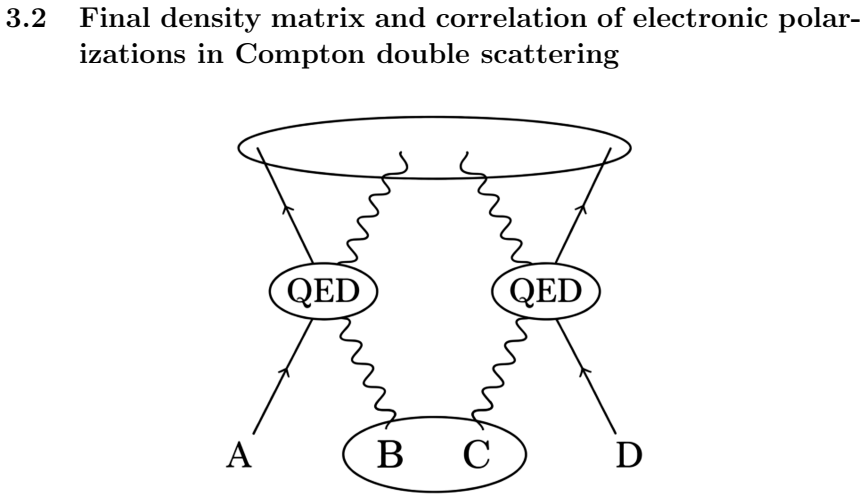
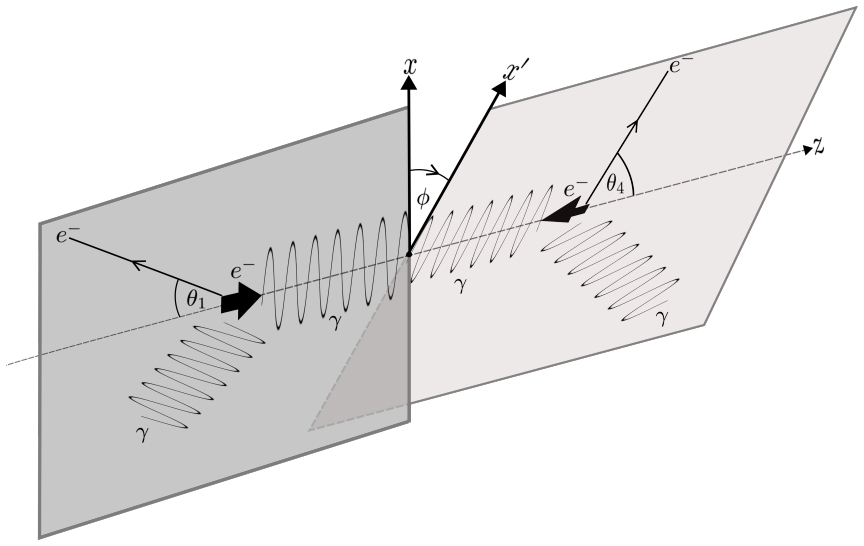
When two initially entangled photons each undergo Compton scattering, the scattered electrons become correlated. However, the final reduced density matrix of one scattered pair is not influenced by the other scattered pair due to unitarity. Herein, we keep unitarity up to tree level for Compton double scattering and obtain different results than recent literature. The initial four particles, where the initial photons are entangled, are written as a superposition of two states with a relative phase. The final density matrix has two area divergences that are regularized with unitarity. The regularization procedure, i.e. solving for the roots of a polynomial that represents the probability for no scattering, suggests a novel definition of the scattering cross-section. Vieta's formulas relate these divergences to finite cross-sections. For an initial pure state, the formulas for the final density matrix and the correlation of final electronic polarizations are given. The correlation implies double scattering is analogous to Young's diffraction experiment. The two initial superposed states are the circular apertures while the Feynman amplitudes are the interfering complex light fields.
Editorial analysis
A structured set of objections, weighed in public.
Referee Report
Summary. The manuscript claims that enforcing tree-level unitarity in Compton double scattering of two initially entangled photons allows regularization of two area divergences in the final reduced density matrix. The initial four-particle state is written as a superposition of two states with relative phase; the no-scattering probability is expressed as a polynomial whose roots, via Vieta's formulas, convert the divergences into finite cross-sections. This yields a novel definition of the scattering cross-section, produces results different from recent literature, and implies that the final electronic polarization correlations are analogous to Young's diffraction experiment, with the superposed states playing the role of circular apertures and the Feynman amplitudes the interfering fields.
Significance. If the polynomial representation of the no-scattering probability follows directly from the tree-level S-matrix elements without auxiliary modeling choices or circularity, the approach would supply a unitarity-based regularization of position-space area divergences in entangled multi-particle states. This could offer a parameter-free route to finite cross-sections in density-matrix calculations for QED processes and a new perspective on quantum correlations in scattering.
Simulated Author's Rebuttal
We thank the referee for their careful summary of the manuscript and for noting the potential significance of a unitarity-based regularization approach, conditional on the polynomial representation following directly from the tree-level S-matrix. No explicit major comments were listed in the report, so we offer no point-by-point responses below. We remain available to address any specific questions or to demonstrate that the no-scattering probability polynomial is obtained directly from the S-matrix elements with no auxiliary modeling.
Circularity Check
Novel cross-section definition reduces to roots of a no-scattering probability polynomial built from the same amplitudes
specific steps
-
self definitional
[Abstract]
"The regularization procedure, i.e. solving for the roots of a polynomial that represents the probability for no scattering, suggests a novel definition of the scattering cross-section. Vieta's formulas relate these divergences to finite cross-sections."
The polynomial encodes the no-scattering probability constructed from the same tree-level S-matrix elements whose squared moduli define the cross-section. Solving for its roots and relabeling them as the cross-section therefore equates the output definition to an algebraic function of the input amplitudes by construction.
full rationale
The paper's central regularization step constructs a polynomial whose roots (via Vieta) are asserted to supply a new definition of the scattering cross-section that cancels the area divergences. Because the no-scattering probability is formed from the tree-level Compton amplitudes for the entangled initial state, the algebraic rearrangement that extracts the cross-section from those same amplitudes is self-definitional; the output is forced by the input quantities rather than independently constrained by unitarity. This matches the self-definitional pattern and accounts for the reported difference from recent literature.
Axiom & Free-Parameter Ledger
axioms (1)
- domain assumption Unitarity is maintained up to tree level in Compton double scattering calculations
Reference graph
Works this paper leans on
-
[1]
S. Shivashankara and H. Sprague, ``Unitarity constrains the quantum information metrics for particle interactions,'' Nucl. Phys. B 1018, 116989 (2025), arXiv:2412.12585 [hep-th] https://arxiv.org/abs/2412.12585
- [2]
-
[3]
Shivashankara, ``Entanglement Entropy of Compton Scattering with a Witness,'' Can
S. Shivashankara, ``Entanglement Entropy of Compton Scattering with a Witness,'' Can. J. Phys. 101, 757-766 (2023), arXiv:2305.10027 [hep-th] https://arxiv.org/abs/2305.10027
-
[4]
S. Shivashankara, P. Rizzo and N. Cafe, ``Entanglement Entropy Distributions of a Muon Decay,'' LHEP 2024 (2024) 531, arXiv:2312.05712 [hep-th] https://arxiv.org/abs/2312.05712
-
[5]
S. Shivashankara and G. Gogliettino, ``Regularized Entanglement Entropy of Electron-Positron Scattering with a Witness Photon,'' Phys. Rev. D 110, 096004 (2024), https://arxiv.org/abs/2405.11799 arXiv:2405.11799 [hep-th]
-
[6]
K. Kowalska and E. M. Sessolo, ``Entanglement in flavored scalar scattering,'' JHEP 07, 156 (2024) doi:10.1007/JHEP07(2024)156 arXiv:2404.13743 [hep-ph] https://arxiv.org/abs/2404.13743
-
[7]
Qubit entanglement from forward scattering
K. Kowalska and E. M. Sessolo, ``Qubit entanglement from forward scattering,'' JHEP 04, 014 (2026) doi:10.1007/JHEP04(2026)014 arXiv:2510.04200 [hep-ph] https://arxiv.org/abs/2510.04200
work page internal anchor Pith review Pith/arXiv arXiv doi:10.1007/jhep04(2026)014 2026
-
[8]
M. E. Peskin, D. V. Schroeder, An Introduction to Quantum Field Theory (Westview Press, Boulder, CO, 1995)
1995
-
[9]
Hecht, Optics (Addison-Wesley, Reading, MA, 2001) comment
E. Hecht, Optics (Addison-Wesley, Reading, MA, 2001) comment
2001
-
[10]
Entanglement Entropy of Scattering Particles
R. Peschanski and S. Seki,``Entanglement Entropy of Scattering Particles,'' Phys. Lett. B 758, 89-92 (2016), arXiv:1602.00720 [hep-th] https://arxiv.org/abs/1602.00720
work page internal anchor Pith review Pith/arXiv arXiv 2016
-
[11]
R. Peschanski and S. Seki, ``Evaluation of Entanglement Entropy in High Energy Elastic Scattering,'' Phys. Rev. D 100, no.7, 076012 (2019), arXiv:1906.09696 [hep-th] https://arxiv.org/abs/1906.09696
-
[12]
S. Seki, I. Y. Park and S. J. Sin, ``Variation of Entanglement Entropy in Scattering Process,'' Phys. Lett. B 743, 147-153 (2015), arXiv:1412.7894 [hep-th] https://arxiv.org/abs/1412.7894
work page internal anchor Pith review Pith/arXiv arXiv 2015
-
[13]
Relativistic effect of entanglement in fermion-fermion scattering
J. Fan and X. Li, ``Relativistic effect of entanglement in fermion-fermion scattering,'' Phys. Rev. D 97, no.1, 016011 (2018), arXiv:1712.06237 [hep-th] https://arxiv.org/abs/1712.06237
work page internal anchor Pith review Pith/arXiv arXiv 2018
-
[14]
J. Fan, Y. Deng and Y. C. Huang, ``Variation of entanglement entropy and mutual information in fermion-fermion scattering,'' Phys. Rev. D 95, no.6, 065017 (2017), arXiv:1703.07911 [hep-th] https://arxiv.org/abs/1703.07911
work page internal anchor Pith review Pith/arXiv arXiv 2017
-
[15]
S. Fedida and A. Serafini, ``Tree-level entanglement in quantum electrodynamics,'' Phys. Rev. D 107, no.11, 116007 (2023), arXiv:2209.01405 [quant-ph] https://arxiv.org/abs/2209.01405
- [16]
-
[17]
J. D. Fonseca, B. Hiller, J. B. Araujo, I. G. da Paz and M. Sampaio, ``Entanglement and scattering in quantum electrodynamics: S matrix information from an entangled spectator particle,'' Phys. Rev. D 106, no.5, 056015 (2022), arXiv:2112.01300 [quant-ph] https://arxiv.org/abs/2112.01300
-
[18]
M. Blasone, G. Lambiase and B. Micciola, ``Entanglement distribution in Bhabha scattering with an entangled spectator particle,'' Phys. Rev. D 109, no.9, 096022 (2024) doi:10.1103/PhysRevD.109.096022 [arXiv:2401.10715 [quant-ph]]
-
[19]
Entanglement entropy in particle decay
L. Lello, D. Boyanovsky and R. Holman, JHEP 11, 116 (2013) arXiv:1304.6110 [hep-th] https://arxiv.org/abs/1304.6110
work page internal anchor Pith review Pith/arXiv arXiv 2013
-
[20]
J. Lykken, ``Quantum Information for Particle Theorists,'' PoS TASI2020, 010 (2021) arXiv:2010.02931 [quant-ph] https://arxiv.org/abs/2010.02931
-
[21]
L. D. Landau, E. M. Lifshitz, Quantum Mechanics Non-relativistic Theory (Addison-Wesley, Reading, MA, 1958)
1958
-
[22]
M. Ghodrati, ``String amplitudes and mutual information in confining backgrounds : the partonic behavior,'' https://arxiv.org/abs/2307.13454 https://arxiv.org/abs/2307.13454
-
[23]
Quigg, Gauge Theories of the Strong, Weak, and Electromagnetic Interactions (Princeton, NJ : Princeton University Press, 2013)
C. Quigg, Gauge Theories of the Strong, Weak, and Electromagnetic Interactions (Princeton, NJ : Princeton University Press, 2013)
2013
-
[24]
Toumbas and A
N. Toumbas and A. Irakleous, Scattering, IR dynamics and entanglement, PoS (CORFU2022), 152 (2023) https://inspirehep.net/files/dae454147926381289dc4e4fe7cd5333 https://inspirehep.net/files/dae454147926381289dc4e4fe7cd5333
2023
-
[25]
G. Aad et al. [ATLAS], Observation of quantum entanglement in top-quark pairs using the ATLAS detector, https://arxiv.org/abs/2311.07288 https://arxiv.org/abs/2311.07288
-
[26]
Quantum SMEFT tomography: Top quark pair production at the LHC,
R. Aoude, E. Madge, F. Maltoni and L. Mantani, Phys. Rev. D 106, no.5, 055007 (2022) https://arxiv.org/abs/2203.05619 https://arxiv.org/abs/2203.05619
-
[27]
Tiesinga, D.B
E. Tiesinga, D.B. Newell, P.J. Mohr, and B.N. Taylor, NIST SP961 (May 2019), https://pdg.lbl.gov/2023/reviews/rpp2022-rev-phys-constants.pdf https://pdg.lbl.gov/2023/reviews/rpp2022-rev-phys-constants.pdf
2019
-
[28]
R. L. Workman et al. [Particle Data Group], PTEP 2022, 083C01 (2022), https://pdg.lbl.gov/2023/ https://pdg.lbl.gov/2023/listings/contents_listings.html. comment
2022
discussion (0)
Sign in with ORCID, Apple, or X to comment. Anyone can read and Pith papers without signing in.