REVIEW 3 major objections 5 minor 12 references
This paper tries to establish that, in a very strong magnetic background, the lowest Landau level dominates the QCD pressure both at finite temperature and in cold dense matter, so the two-loop correction is small and quark-magnetar masses
Reviewed by Pith at T0; open to challenge. T0 means a machine referee read the full paper against a public rubric. the ladder, T0–T4 →
Two-loop lowest-Landau-level perturbative QCD with an adopted running scale roughly matches lattice data at high temperature and predicts slightly smaller maximum masses for quark magnetars than the simple bag model.
T0 review reviewed 2026-08-05 challenge →
load-bearing objection A competent proceedings recap of the authors' own LLL pQCD program; the one new comparison is useful, but the scale ansatz is load-bearing and the abstract overstates novelty. the 3 major comments →
Hot and dense pQCD in a very strong magnetic background
The pith
A machine-rendered reading of the paper's core claim, the machinery that carries it, and where it could break.
The reading
Core claim
On the paper's own terms, the central discovery is that once the field is strong enough that only the lowest Landau level matters (m_s << T << sqrt(eB)), the full two-loop pressure is well represented by the free LLL pressure evaluated with a running coupling and a running strange mass. The exchange term, which carries the leading interaction correction, contributes only a small fraction to the ratio P_exch/P_free for the temperatures and chemical potentials considered, with the scale choice Λ = sqrt((2πT)^2 + eB) giving the best behavior. Consequently the condensate and strange susceptibility can be matched to lattice results in the limited overlapping temperature range, and the cold dense
What carries the argument
The lowest Landau level (LLL) approximation: at very high magnetic fields, eB >> T^2 and m_s << T, transverse quark motion is frozen to the lowest Landau level, reducing the fermion phase space to one-dimensional integrals with B-dependent prefactors qB/(2π). The paper's explicit integrals for the free pressure (Eq. 1) and the two-loop exchange pressure (Eq. 2), together with the scale ansatz Λ = sqrt((2πT)^2 + eB) for the running strong coupling and strange quark mass, are the load-bearing elements: they turn the full QCD pressure into a compact semi-analytic expression that can be evaluated for physical quark masses. The same structure carries over to the cold dense limit through Eqs. (3)
Load-bearing premise
The result depends on the assumed energy scale Λ = sqrt((2πT)^2 + eB) for the running coupling and strange quark mass; this choice is not derived, and other plausible choices shift the curves substantially, so the claimed lattice agreement and magnetar bounds rest on it.
What would settle it
Compute the full two-loop pressure with all Landau levels, not just the LLL, at eB = 9 GeV^2 and T around 0.1–0.2 GeV; if the exchange-to-free ratio is not small, the LLL truncation is invalid. Alternatively, new lattice data for the strange susceptibility or condensate at eB = 9 GeV^2 and T ≈ 0.12–0.15 GeV that fall outside the paper's factor-of-two scale band would refute the comparison.
If this is right
- In the LLL window, the two-loop exchange term can be dropped from practical calculations: at eB = 9 GeV^2 the exchange/free pressure ratio stays small over the studied temperature range, so the equation of state is effectively one-loop with running parameters.
- The same simplification survives at zero temperature: the cold dense pressure is given by an analytic function of chemical potential and magnetic field, making the quark-matter equation of state straightforward to use in astrophysical modeling.
- Quark-magnetar maximum masses saturate below the bag-model curve, and increasing the magnetic field steeply lowers the maximum mass, giving a stronger upper bound than the B = 0 perturbative equation of state.
- The condensate and strange susceptibility track lattice data within the overlapping temperature window, so perturbative LLL results can be used as a cross-check and complement to lattice computations in strong magnetic fields.
Where Pith is reading between the lines
- We infer that the same LLL-dominance argument should apply to higher-order baryon-number Taylor coefficients, with the quadratic and quartic baryon susceptibilities nearly linear in the magnetic field within the LLL window.
- We infer a testable extension: if the LLL truncation is valid, transport coefficients such as shear and bulk viscosities should inherit the anisotropic B-scaling of the LLL density of states, a prediction that could be probed in heavy-ion phenomenology.
- We infer that the scale ansatz Λ = sqrt((2πT)^2 + eB) effectively absorbs the magnetic contribution into the running couplings; if so, the same ansatz should work for other flavor channels and for nonzero isospin chemical potentials, extending the results without new parameters.
Editorial analysis
A structured set of objections, weighed in public.
Referee Report
Summary. The manuscript computes the perturbative QCD pressure, chiral condensate, and strange quark number susceptibility in the lowest Landau level (LLL) approximation at high magnetic field and finite temperature, up to two-loop order and with physical quark masses. It then passes to the cold-and-dense limit and applies the resulting equation of state to quark magnetars, comparing the maximum mass with the simple bag model. The central quantitative claims are: (i) the two-loop exchange contribution to the pressure is small, suggesting good convergence of LLL pQCD; (ii) the computed condensate and strange susceptibility are “in the same ballpark” as lattice QCD for temperatures around 0.10–0.15 GeV at eB = 9 GeV^2; and (iii) quark magnetar maximum masses are slightly smaller than those of the bag model. The calculations are built on the authors’ earlier papers [5,6,8], with the new elements here being the lattice comparison and the magnetar application.
Significance. If the results hold, the paper would support the practical usefulness of LLL perturbation theory in a strong magnetic background: a two-loop LLL expansion with a running strange mass and coupling would reproduce lattice data in a controlled window and would provide a simple analytic EoS for quark magnetars. The manuscript is honest about the limitations of the comparison, and it makes explicit that the central scale is a chosen ansatz rather than a derived quantity. Credit is due for using external lattice data as a benchmark, for displaying alternative coupling prescriptions, and for showing factor-of-2 scale bands in Fig. 2. However, the significance is limited by the narrow temperature window, the marginal validity of the LLL mass hierarchy at the lowest temperatures shown, and the absence of a stationarity or sensitivity test for the renormalization-scale ansatz that drives all quantitative results.
major comments (3)
- [§2, Eqs. (1)–(2), Fig. 2] The comparison with lattice data and the claimed “same ballpark” agreement rely on the renormalization-scale ansatz Λ = sqrt((2πT)^2 + eB) for the running coupling and strange quark mass. This ansatz is imported from Ref. [6] without a derivation or an error budget beyond factor-of-2 bands. Since both αs and ms(Λ) enter nonlinearly in the pressure, condensate, and susceptibility, the central curves could shift substantially under a different, equally plausible scale choice. The paper does not provide a stationarity check, e.g., an evaluation of dP/d ln Λ or a systematic scan of Λ around the adopted value. Please add such a scale-sensitivity analysis and display the resulting spread against the lattice points. If the spread is comparable to the band widths already shown, the “same ballpark” conclusion should be correspondingly weakened.
- [§2, Eq. (2), Fig. 2] The derivation of Eq. (2) is stated to hold for ms ≪ T ≪ sqrt(eB). The temperature range in Fig. 2 extends down to T ≈ 0.10 GeV, where the physical strange quark mass (ms ≈ 0.095 GeV) is comparable to T, so the condition ms ≪ T is only marginally satisfied at the lowest shown points. Consequently the two-loop LLL expression is being used at the edge of its controlled regime for the low-temperature part of the condensate and susceptibility comparison. This weakens the low-T agreement claim. Please either restrict the comparison to T values where ms/T is small, or provide an estimate of the size of the omitted ms/T corrections and show that they do not affect the conclusions.
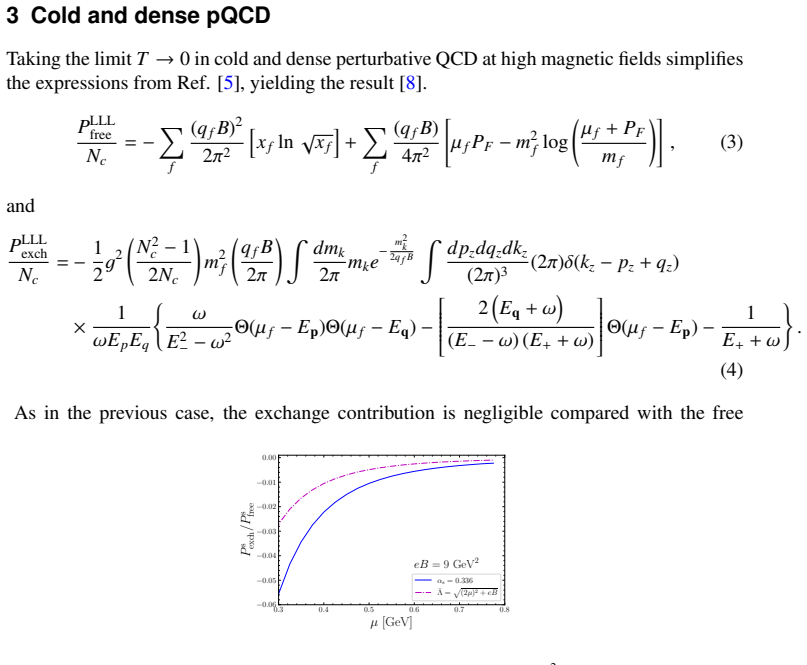
- [§3.1, Eqs. (3)–(4), Figs. 3–4] The cold-and-dense application to quark magnetars inherits the same scale-ansatz sensitivity. In Fig. 3 the ratio Ps_exch/Ps_free is shown for Λ = sqrt((2μ)^2 + eB) (with, as plotted, αs = 0.336), but no justification or sensitivity test for this scale is given. The resulting pressure, after adding the bag constant and the thermodynamic-consistency function W, determines the maximum masses in Fig. 4. Because the key claim is that pQCD predicts “slightly smaller” maximum masses than the bag model, a plausible change in the cold-dense scale could alter the ordering or the size of the difference. Please show how M_max varies under the same factor-of-2 scale variation used in the hot case, or otherwise quantify the scale uncertainty of the magnetar bound.
minor comments (5)
- [Fig. 2] The lattice data points from Ref. [7] are shown without error bars. Please include error bars or provide the numerical values in a table; this is important because the agreement claim is judged against the size of the lattice uncertainties.
- [§2, text] The text says the results are “in the same ballpark as the lattice at higher values of temperature,” but the plotted temperature interval is only 0.10–0.15 GeV. If higher-T lattice data are available in Ref. [7], please extend the comparison; otherwise rephrase to avoid overstating the range.
- [§3.1, Eqs. (3)–(4), Fig. 4] The symbol B is used both for the magnetic field strength (e.g., B = 10^19 G in Fig. 4) and for the bag constant (e.g., B^{1/4} = 145 MeV and the bag-model pressure formula). This ambiguity is confusing. Please use separate symbols, such as B_mag and B_bag or B_0.
- [Throughout] Minor typographical issues: the affiliation line has an extra space in “Letícia F .Palhares”; Eq. (1) has an unusual typesetting of “ln√x_f”; and the manuscript should be checked for consistent use of overlines and subscripts in the scale/coupling notation.
- [References] Ref. [9] is cited as “(2025)” without a journal or arXiv number and appears to be a preprint; please update the reference or mark it clearly as a preprint.
Circularity Check
No significant circularity: central results are direct evaluations of previously derived LLL expressions against an external lattice benchmark, with the only nontrivial input being a disclosed renormalization-scale ansatz.
full rationale
The paper's derivation chain is not circular. The LLL free and exchange pressures, Eqs. (1)-(4), are taken from the authors' earlier peer-reviewed calculations ([5], [6], [8]), which are analytic first-principles expressions within the stated LLL regime, not fitted to the lattice data used here. The lattice results of Ref. [7] serve as an external benchmark, and no parameter is adjusted to reproduce them; the comparison is an honest test of the adopted scale choice. The renormalization-scale ansatz Λ = sqrt((2πT)^2 + eB) is an assumption imported from Ref. [6], but it is stated explicitly in the text, shown in the figures, and probed with factor-2 variation bands in Fig. 2, so it is not a hidden fit or a prediction forced by construction. The conclusion that the exchange contribution is small is robust across the several coupling prescriptions displayed in Fig. 1, not only for the preferred scale. The cold-dense and magnetar section uses the same free-LLL pressure with running mass and the thermodynamic-consistency function W from Ref. [12]; W is a defined function, not an output that has been renamed as an input. The comparison with the bag model in Fig. 4 is a benchmark, not an input. The self-citations are abundant, but they supply previously derived analytic expressions and a consistency function, and they are not used to forbid alternatives or to define the target result into existence. The main scientific weakness — sensitivity of the lattice comparison and magnetar bounds to the untested scale ansatz — is a correctness/robustness concern, not circularity. Under the hard rule that circularity requires exhibiting a reduction of a prediction to its own fitted or definitional input, no such step is present.
Axiom & Free-Parameter Ledger
free parameters (4)
- Renormalization scale ansatz Lambda = sqrt((2*pi*T)^2 + eB) =
eB = 9 GeV^2; central scale with factor-2 variation bands
- Fixed coupling alpha_s = 0.336 =
0.336
- Bag constant B for the magnetar EoS =
B^{1/4} = 145 MeV for one curve; B = 0 for another
- Thermodynamic-consistency function W =
not specified
axioms (4)
- domain assumption Only the lowest Landau level contributes for m_s << T << sqrt(eB)
- domain assumption Two-loop perturbative expansion of the QCD pressure is convergent at the adopted scales
- domain assumption Vacuum two-loop running of alpha_s and m_s applies at finite T and B through the scale Lambda
- ad hoc to paper Magnetar matter is described by the LLL free pressure plus bag constant and the W function
Cite this review
Pith. "Pith review of Hot and dense pQCD in a very strong magnetic background." pith.science (2026). https://pith.science/paper/MHNVJFRT
@misc{pith2026250904626,
  author       = {Pith},
  title        = {Pith review of: Hot and dense pQCD in a very strong magnetic background},
  year         = {2026},
  howpublished = {\url{https://pith.science/paper/MHNVJFRT}},
  note         = {Machine review of arXiv:2509.04626}
}
read the original abstract
We compute the pressure, chiral condensate and strange quark number susceptibility from perturbative QCD up to two-loop order at finite temperature and very high magnetic fields with physical quark masses. We also discuss the case of cold and dense quark matter in the presence of a very strong magnetic field and constraints for quark magnetars.
Figures



Reference graph
Works this paper leans on
-
[1]
V .M. Kaspi, A. Beloborodov, Magnetars, Ann. Rev. Astron. Astrophys.55, 261 (2017), 1703.00068. 10.1146/annurev-astro-081915-023329
Pith/arXiv arXiv 2017
-
[2]
D.E. Kharzeev, L.D. McLerran, H.J. Warringa, The Effects of topological charge change in heavy ion collisions: ’Event by event P and CP violation’, Nucl. Phys. A 803, 227 (2008), 0711.0950. 10.1016/j.nuclphysa.2008.02.298
Pith/arXiv arXiv 2008
-
[3]
Vachaspati, Magnetic fields from cosmological phase transitions, Phys
T. Vachaspati, Magnetic fields from cosmological phase transitions, Phys. Lett. B 265, 258 (1991). 10.1016/0370-2693(91)90051-Q
-
[4]
G.S. Bali, F. Bruckmann, G. Endr ˝odi, F. Gruber, A. Schaefer, Magnetic field-induced gluonic (inverse) catalysis and pressure (an)isotropy in QCD, JHEP 04, 130 (2013), 1303.1328. 10.1007/JHEP04(2013)130
Pith/arXiv arXiv 2013
-
[5]
Effect of quark masses on the QCD presssure in a strong magnetic background
J.P. Blaizot, E.S. Fraga, L.F. Palhares, E ffect of quark masses on the QCD pres- sure in a strong magnetic background, Phys. Lett. B 722, 167 (2013), 1211.6412. 10.1016/j.physletb.2013.04.004
work page internal anchor Pith review Pith/arXiv arXiv 2013
-
[6]
Hot perturbative QCD in a very strong magnetic background
E.S. Fraga, L.F. Palhares, T.E. Restrepo, Hot perturbative QCD in a very strong mag- netic background, Phys. Rev. D 108, 034026 (2023), 2303.12140. 10.1103 /Phys- RevD.108.034026
work page internal anchor Pith review Pith/arXiv arXiv 2023
-
[7]
M. D’Elia, L. Maio, F. Sanfilippo, A. Stanzione, Phase diagram of QCD in a mag- netic background, Phys. Rev. D 105, 034511 (2022), 2111.11237. 10.1103 /Phys- RevD.105.034511
Pith/arXiv arXiv 2022
-
[8]
Cold and dense perturbative QCD in a very strong magnetic background
E.S. Fraga, L.F. Palhares, T.E. Restrepo, Cold and dense perturbative QCD in a very strong magnetic background, Phys. Rev. D 109, 054033 (2024), 2312.13952. 10.1103/PhysRevD.109.054033
work page internal anchor Pith review Pith/arXiv arXiv 2024
-
[9]
E.S. Fraga, L.F. Palhares, T.E. Restrepo, Susceptibilities and Taylor coefficients of mag- netic QCD from perturbation theory (2025), 2507.14360
-
[10]
N. Astrakhantsev, V .V . Braguta, A.Y . Kotov, A.A. Roenko, QCD equation of state at nonzero baryon density in an external magnetic field, Phys. Rev. D109, 094511 (2024), 2403.07783. 10.1103/PhysRevD.109.094511
Pith/arXiv arXiv 2024
-
[11]
A. Ayala, C.A. Dominguez, S. Hernandez-Ortiz, L.A. Hernandez, M. Loewe, D.M. Paret, R. Zamora, Thermomagnetic evolution of the QCD strong coupling, Phys. Rev. D 98, 031501(R) (2018), 1805.08198. 10.1103/PhysRevD.98.031501
Pith/arXiv arXiv 2018
-
[12]
T.E. Restrepo, C. Providência, M.B. Pinto, Nonstrange quark stars within resummed QCD, Phys. Rev. D107, 114015 (2023), 2212.11184. 10.1103/PhysRevD.107.114015
Pith/arXiv arXiv 2023
This paper was first reviewed by deepseek-v4-flash on August 5, 2026.
discussion (0)
Sign in with ORCID, Apple, or X to comment. Anyone can read and Pith papers without signing in.