REVIEW 2 major objections 7 minor 34 references
Krylov Complexity for Time-Dependent Hamiltonians
T0 review · 2 major / 7 minor · reviewed 2026-08-02 · deepseek-v4-flash
Pith's one-line read This paper establishes that Krylov spread complexity for explicitly time-dependent Hamiltonians is computable through Floquet–Magnus approximations, and that a piecewise Magnus expansion remains reliable when the global expansion loses accu
desk verdict A solid methods paper with a genuinely new dressed-frame Floquet-Magnus term and a clean C_K = 1/2|ν|^2 relation; the piecewise-Magnus reliability claim is the weak spot and needs referee attention. read the letter →
The pith
A machine-rendered reading of the paper's core claim, the machinery that carries it, and where it could break.
The reading
What carries the argument
The central object is the Magnus expansion, which represents the time-ordered evolution as U=exp(Ω1+Ω2+…), with Ωn built from nested commutators of H(t) at different times; this turns time ordering into a series of commutator corrections. Over one driving period it becomes the Floquet–Magnus expansion and produces an effective time-independent Floquet Hamiltonian. The paper's piecewise variant splits the time axis and applies the same local expansion on each segment, giving an ordered product of local exponentials. For the oscillator, each local exponential is a quadratic symplectic generator; the resulting Bogoliubov coefficient ν(t) then directly yields Krylov complexity through C_K=1/2|ν|
What would settle it
For the soft-quench oscillator with ω0=1, ω1=2 and an intermediate duration such as τ=10, compute the exact Krylov complexity by high-precision numerical integration of the oscillator's symplectic propagator, then compare with the piecewise Magnus result for successively smaller Δ. If the difference does not decrease as O(t Δ^m) and instead saturates or grows with the number of steps, the linear-error-accumulation assumption is false and the method is not reliable in the regime where the paper claims it.
Extended reading notes
Core claim
On its own terms, the paper establishes that the time-ordering obstruction to Krylov complexity for time-dependent Hamiltonians can be bypassed with Magnus exponentials. In the periodic case, a Magnus expansion over one driving period yields an approximate Floquet Hamiltonian; for the linearly polarized two-level drive this produces a high-frequency stroboscopic complexity written in terms of Bessel and Struve functions. In the non-periodic case, the paper introduces the piecewise Magnus expansion: partition the interval, exponentiate a local effective Hamiltonian on each piece, and multiply the local propagators in time order. Applied to a time-dependent oscillator, the method gives C_K(t)=
Load-bearing premise
The load-bearing premise, stated as an assumption in Section 5.3, is that errors made on each small time slice accumulate at most linearly with the number of slices; the paper does not prove this for the ordered product of local exponentials, and if the errors compound faster, the O(t Δ^m) accuracy claim and the method's reliability conclusion collapse.
Editorial extensions
If this is right
- For periodically driven two-level systems, stroboscopic Krylov complexity can be written analytically: the circular drive gives Rabi-like sin² oscillations, and the high-frequency linear drive gives Bessel- and Struve-function expressions.
- For a time-dependent oscillator, Krylov spread complexity is exactly the squeezed-vacuum measure C_K(t)=1/2 sinh² r(t)=1/2|ν(t)|², so complexity growth is nothing but squeezing.
- The piecewise Magnus method only needs the local convergence condition δ h_max Δ<1 on each slice, so it applies when the global condition δ h_max t<1 fails.
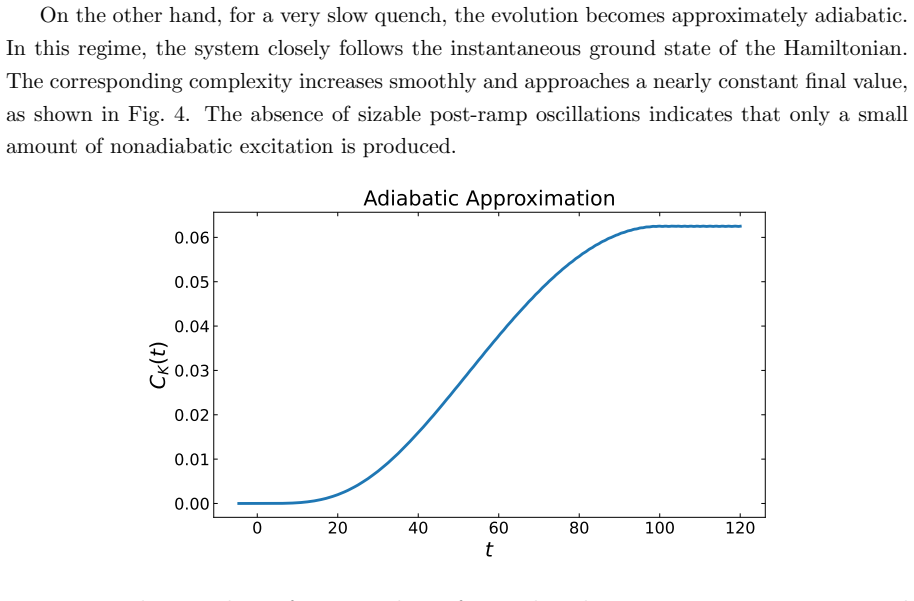
- The method reproduces the sudden-quench result and the adiabatic limit, and smooth finite-time quenches show bounded post-ramp oscillations.
- The framework is not restricted to periodic drives; it offers a practical route to spread complexity for a broad class of time-dependent quantum systems.
Reading between the lines
- Beyond the paper: the linear-error-accumulation assumption can be tested directly with an intermediate-duration quench (e.g., ω0=1, ω1=2, τ≈10), comparing piecewise Magnus against high-precision numerical integration; the promised O(t Δ^m) scaling is checkable.
- Beyond the paper: because C_K equals half the squared Bogoliubov coefficient for Gaussian evolution, measuring an oscillator mode's squeezing in the lab would directly measure its Krylov complexity, connecting an abstract complexity measure to quadrature statistics.
- Beyond the paper: the same piecewise strategy should extend to multi-mode quadratic systems and to operator complexity, where local Magnus generators and Bogoliubov transformations play the same role.
- Beyond the paper: accuracy could be improved without changing the structure by including higher local Magnus orders or replacing each step with a higher-order symplectic integrator.
Editorial analysis
A structured set of objections, weighed in public.
Referee Report
Summary. This paper studies Krylov (spread) complexity for states evolving under explicitly time-dependent Hamiltonians. For periodically driven two-level systems, the authors use Floquet theory and the Magnus/Floquet–Magnus expansion to obtain approximate stroboscopic complexity, including closed-form expressions in terms of Bessel and Struve functions. For non-periodic driving, they propose a piecewise Magnus expansion: the interval is split into small segments, each segment is approximated by a local effective Hamiltonian, and the evolution is composed from the local exponentials. For a harmonic oscillator with time-dependent frequency, the Krylov complexity is related to the Bogoliubov coefficient via C_K = (1/2) |ν(t)|^2, and the piecewise method is tested numerically on smooth frequency quenches. The central claim is that the piecewise Magnus expansion provides a reliable method when a global Magnus expansion loses convergence or accuracy.
Significance. If fully established, the paper offers a practical tool for computing Krylov complexity in time-dependent systems without the need for an exact Floquet Hamiltonian. The analytical results for the two-level systems—especially the dressed-frame Floquet–Magnus derivation and the Bessel/Struve expressions—are useful and internally consistent. The exact relation C_K = (1/2)|ν(t)|^2 for the squeezed-vacuum Krylov chain is derived in Appendix C without free parameters fitted to the predicted quantity; h_x and h_z are computed from the Magnus integrals, and the complexity is read off afterward. The abrupt-quench limit and the adiabatic limit serve as honest consistency checks. However, the paper's main new contribution—the claim that the piecewise Magnus expansion is reliable in regimes where the global expansion fails—is not yet supported by the numerical evidence or by a rigorous error-accumulation argument.
major comments (2)
- [§5.3, Eq. (101)] The central claim that the piecewise Magnus expansion 'provides a reliable method' rests on the total-error estimate O(N Δ^{m+1}) = O(t Δ^m) stated after Eq. (101). This estimate follows from the sentence 'Assuming that these local errors accumulate at most linearly, up to stability constants.' For an ordered product of local exponentials S_{N-1} ⋯ S_0, the linear-accumulation premise is not a trivial consequence of the local error bound; it requires a stability argument for the error propagation through the composition map. No such proof is given, and no numerical test of the Δ-dependence of the global error is provided. Because the reliability claim is the main new contribution, this is a load-bearing gap. Please either supply a stability/convergence proof for the composition of local Magnus exponentials, or provide a numerical convergence study that measures the global error as a func
- [§5.4, Figs. 2–4] The numerical validation covers only two asymptotic regimes: τ = 0.1 against the sudden-quench formula Eq. (89), and τ = 100 against the adiabatic expectation. The intermediate regime τ = 10, which is precisely the regime where a global Magnus expansion may lose accuracy and where the piecewise method is claimed to be useful, is shown in Fig. 2 with no comparison to an exact or high-accuracy solution. No error-versus-Δ curve is presented, and the statements 'agrees well' and 'approaches a nearly constant final value' are not quantified. The abstract and §6 claim reliability when the global expansion 'loses convergence or accuracy'; the current evidence does not support that claim in the intermediate regime. Please add an intermediate-time benchmark (e.g., a direct high-accuracy integration of the time-dependent Schrödinger equation) and a Δ-scaling error plot.
minor comments (7)
- [Eq. (16)] The second term is written as 'Ω(t)' but should be 'Ω_2(t)'.
- [Fig. 1] The vertical-axis label appears garbled: 'ln( (t) (N)(t) )' should be ln ||Ω(t)−Ω^{(N)}(t)|| or similar.
- [Fig. 3] The caption 'Sudden Approximation' is vague; please state the parameters and specify what the plotted curve is compared against.
- [§5.4] The phrase 'agrees well with the exact analytical expression' is not quantified. Please state the maximum deviation or show an error plot.
- [General] The manuscript contains numerical results but no code/data availability statement. For reproducibility, please provide the code or a sufficiently detailed description of the numerical implementation and partition choices.
- [Ref. [31]] Reference [31] is listed as 'Unpublished'. If it is not publicly available, consider removing it or citing a preprint/arXiv version.
- [§5.1] Please clarify explicitly how the even-Fock basis |K_n⟩=|2n⟩ arises as the Lanczos basis for the piecewise product of local effective Hamiltonians, connecting it to the general construction in Appendix A. The basis is natural for each local effective Hamiltonian, but the product of different local generators deserves a sentence of justification.
Circularity Check
No significant circularity: h_z/h_x come from Magnus integrals and C_K is read off from the derived effective generator; the only self-citations are peripheral. Flagged limitations (unproved linear error-accumulation, limits-only validation) are correctness risks, not circularity.
full rationale
Walking the derivation chain, no step reduces a 'prediction' to an input by construction, and no parameter is fitted to the quantity being predicted. For the two-level systems (§4), h_z and h_x are obtained by evaluating Magnus integrals — the dressed-frame average (Eq. 48) and the second-order commutator term (Eqs. 50–51) — and C_K(nT) then follows from the exact static two-level formula (33), a closed function of ω0, ω, and Ω0 only; no target complexity value is used to set any coefficient, and the CDT-zero comment in §4.3 is an explicit caveat that higher-order corrections matter there, reinforcing that the leading-order result is not being asserted by construction. For the quadratic oscillator (§5), the local effective generators (97–99) are interval averages and commutator integrals of M(s); the approximate symplectic propagator (101) yields ν(t), and the sudden-quench benchmark (89) is derived independently from the exact propagator (87). In §5.4 the τ→0 numerical curve is compared with that exact benchmark rather than tuned to it, and the τ→100 limit is checked against the independent adiabatic expectation. The squeezed-vacuum relation C_K = ½|ν|² (Eq. 79) is derived in Appendix C from the occupation probabilities and the standard generating function (C.7); it is a genuine derivation, not a definitional rewrite or a renaming of a known pattern. The only self-citations, [8] and [32] (both including author Faraji Astaneh), appear in a background literature bracket in the Introduction ([3–11]) and in a future-directions sentence in §6; neither is load-bearing, no uniqueness theorem is imported, and no ansatz is smuggled in via these self-citations. Per the manuscript's own limitation passages, which I flag explicitly: §5.3's central total-error estimate O(N Δ^{m+1}) = O(t Δ^m) rests on an explicit unproved hypothesis ('Assuming that these local errors accumulate at most linearly, up to stability constants'), and §5.4/§6 validate the piecewise method only in the sudden (τ=0.1) and adiabatic (τ=100) limits, with no intermediate-regime benchmark or Δ-scaling convergence test. These gaps bear on whether the Abstract's 'reliable method' claim is actually supported where the global Magnus expansion fails — an evidence/correctness problem, not a circularity problem: the method's outputs do not feed back into its inputs, and a wrong error bound or a failed intermediate test would make the method inaccurate, not circular. Score 2 reflects the presence of minor,
Assumptions & free parameters
free parameters (2)
- piecewise partition width Δ_j =
unspecified
- local Magnus truncation order m =
2
assumptions (4)
- standard math Magnus series convergence condition δξ hmax t<1 and truncation bound (60) hold as stated from [17].
- domain assumption For a squeezed vacuum evolving from the reference vacuum, the even-Fock chain |K_n>=|2n> is the Krylov basis and C_K=1/2|ν(t)|^2.
- domain assumption Floquet-gauge choices and identity terms (micromotion, h0 I) do not affect stroboscopic spread complexity.
- standard math Bessel and Struve function identities, including Σ J_{2ℓ+1}/(2ℓ+1)=π H0/4, from DLMF [35].
Cite this review
Pith. "Pith review of Krylov Complexity for Time-Dependent Hamiltonians." pith.science (2026). https://pith.science/paper/MIBYWFYV
@misc{pith2026260710454,
  author       = {Pith},
  title        = {Pith review of: Krylov Complexity for Time-Dependent Hamiltonians},
  year         = {2026},
  howpublished = {\url{https://pith.science/paper/MIBYWFYV}},
  note         = {Machine review of arXiv:2607.10454}
}
read the original abstract
We investigate Krylov spread complexity for states evolving under time-dependent Hamiltonians. For periodically driven systems, we formulate the problem within Floquet theory and show how the Magnus expansion provides a systematic approximation when the Floquet Hamiltonian is not available in closed form. We then extend this framework beyond periodic driving and demonstrate that, in addition to the globally truncated Magnus expansion, a piecewise Magnus expansion provides a reliable method when the global expansion loses convergence or accuracy. Our results provide practical tools for analyzing complexity growth in a broad class of time-dependent quantum systems.
Figures


Reference graph
Works this paper leans on
-
[31]
Alishahiha and K
M. Alishahiha and K. Papadodimas. Unpublished. 2026
2026
-
[1]
Nandy, A
P. Nandy, A. S. Matsoukas-Roubeas, P. Mart ´ ınez-Azcona, A. Dymarsky, and A. del Campo. Quantum dynamics in krylov space: Methods and applications.Physics Reports, 1125:1–82, 2025
2025
-
[2]
Krylov com- plexity, 2025
Eliezer Rabinovici, Adri´ an S´ anchez-Garrido, Ruth Shir, and Julian Sonner. Krylov com- plexity, 2025. 25
2025
-
[3]
J. L. F. Barbon, E. Rabinovici, R. Shir, and R. Sinha. On the evolution of operator complexity beyond scrambling.Journal of High Energy Physics, 10:264, 2019
2019
-
[4]
Dymarsky and M
A. Dymarsky and M. Smolkin. Krylov complexity in conformal field theory.Physical Review D, 104:L081702, 2021
2021
-
[5]
Krylov complexity under hamiltonian deformations and toda flows.Physical Review B, 113(14), April 2026
Kazutaka Takahashi, Pratik Nandy, and Adolfo del Campo. Krylov complexity under hamiltonian deformations and toda flows.Physical Review B, 113(14), April 2026
2026
-
[6]
Caputa, J
P. Caputa, J. M. Magan, D. Patramanis, and E. Tonni. Krylov complexity of modular hamiltonian evolution.Physical Review D, 109:086004, 2024
2024
-
[7]
Caputa, J
P. Caputa, J. M. Magan, and D. Patramanis. Geometry of krylov complexity.Physical Review Research, 4:013041, 2022
2022
Show all 34 references
-
[8]
Faraji Astaneh and N
A. Faraji Astaneh and N. Vardian. Average spread complexity and the higher-order level spacing.Journal of High Energy Physics, 12:128, 2025
2025
-
[9]
On quantum complexity.Phys
Mohsen Alishahiha. On quantum complexity.Phys. Lett. B, 842:137979, 2023
2023
-
[10]
Imani, Komeil Babaei Velni, and M
Hamid R. Imani, Komeil Babaei Velni, and M. Reza Mohammadi Mozaffar. Krylov com- plexity in Lifshitz-type Dirac field theories.Eur. Phys. J. C, 85(9):958, 2025
2025
-
[11]
Florent Baume, Atakan C ¸ avu¸ so˘ glu, Vivek Chakrabhavi, and Jonathan J. Heckman. Con- trolled Chaos in 4D SCFTs. 6 2026
2026
-
[12]
Sato and T
M. Sato and T. N. Ikeda. Floquet theory and applications in open quantum and classical systems.Journal of the Physical Society of Japan, 94:111007, 2025
2025
-
[13]
Bukov, L
M. Bukov, L. D’Alessio, and A. Polkovnikov. Universal high-frequency behavior of peri- odically driven systems: from dynamical stabilization to Floquet engineering.Advances in Physics, 64:139–226, 2015
2015
-
[14]
On the exponential solution of differential equations for a linear operator
Wilhelm Magnus. On the exponential solution of differential equations for a linear operator. Commun. Pure Appl. Math., 7:649–673, 1954
1954
-
[15]
Blanes, F
S. Blanes, F. Casas, J. A. Oteo, and J. Ros. The magnus expansion and some of its applications.Physics Reports, 470:151–238, 2009
2009
-
[16]
Convergence of the magnus series.Foundations of Computational Mathematics, 8(3):291–301, November 2007
Per Christian Moan and Jitse Niesen. Convergence of the magnus series.Foundations of Computational Mathematics, 8(3):291–301, November 2007
2007
-
[17]
H. Apel, T. Cubitt, and E. Onorati. A sharper magnus expansion bound woven in binary branches, 2025
2025
-
[18]
Ashhab, J
S. Ashhab, J. R. Johansson, A. M. Zagoskin, and F. Nori. Two-level systems driven by large-amplitude fields.Physical Review A, 75:063414, 2007
2007
-
[19]
Cerf, Timothy C
Christian Weedbrook, Stefano Pirandola, Ra´ ul Garc ´ ıa-Patr´ on, Nicolas J. Cerf, Timothy C. Ralph, Jeffrey H. Shapiro, and Seth Lloyd. Gaussian quantum information.Reviews of Modern Physics, 84(2):621–669, May 2012. 26
2012
-
[20]
Horace P. Yuen. Two-photon coherent states of the radiation field.Phys. Rev. A, 13:2226– 2243, Jun 1976
1976
-
[21]
Colloquium: Nonequilibrium dynamics of closed interacting quantum systems.Rev
Anatoli Polkovnikov, Krishnendu Sengupta, Alessandro Silva, and Mukund Vengalattore. Colloquium: Nonequilibrium dynamics of closed interacting quantum systems.Rev. Mod. Phys., 83:863–883, Aug 2011
2011
-
[22]
W. H. Zurek, U. Dorner, and P. Zoller. Dynamics of a quantum phase transition.Phys. Rev. Lett., 95:105701, 2005
2005
-
[23]
Universal model of floquet operator krylov space.Phys- ical Review B, 110(15), October 2024
Hsiu-Chung Yeh and Aditi Mitra. Universal model of floquet operator krylov space.Phys- ical Review B, 110(15), October 2024
2024
-
[24]
Yates and Aditi Mitra
Daniel J. Yates and Aditi Mitra. Strong and almost strong modes of floquet spin chains in krylov subspaces.Physical Review B, 104(19):195121, 2021
2021
-
[25]
Nizami and Ankit W
Amin A. Nizami and Ankit W. Shrestha. Krylov complexity in periodically driven quantum systems.Physical Review E, 108(5):054222, 2023
2023
-
[26]
Nizami and Ankit W
Amin A. Nizami and Ankit W. Shrestha. Spread complexity and quantum chaos for peri- odically driven spin chains.Physical Review E, 110(3):034201, 2024
2024
-
[27]
Takahashi and A
K. Takahashi and A. del Campo. Krylov subspace methods for quantum dynamics with time-dependent generators.Physical Review Letters, 134(3):030401, 2025
2025
-
[28]
Universal growth of krylov complexity across a quantum phase transition, 2026
Andr´ as Grabarits and Adolfo del Campo. Universal growth of krylov complexity across a quantum phase transition, 2026
2026
-
[29]
del Campo and W
A. del Campo and W. H. Zurek. Universality of phase transition dynamics: Topological defects from symmetry breaking.Int. J. Mod. Phys. A, 29:1430018, 2014
2014
-
[30]
Medina-Guerra, and Adolfo del Campo
Andr´ as Grabarits, E. Medina-Guerra, and Adolfo del Campo. Krylov Dynamics and Op- erator Growth in Time-Dependent Systems via Lie Algebras. 5 2026
2026
-
[32]
Faraji Astaneh and N
A. Faraji Astaneh and N. Vardian. Generalized krylov complexity.Physical Review D, 113(2):026004, 2026
2026
-
[33]
D. E. Parker, X. Cao, A. Avdoshkin, T. Scaffidi, and E. Altman. A universal operator growth hypothesis.Physical Review X, 9:041017, 2019
2019
-
[34]
Balasubramanian, P
V. Balasubramanian, P. Caputa, J. M. Magan, and Q. Wu. Quantum chaos and the complexity of spread of states.Physical Review D, 106:046007, 2022. [35]NIST Digital Library of Mathematical Functions.https://dlmf.nist.gov/, Release 1.2.7 of 2026-06-15. F. W. J. Olver, A. B. Olde D...
2022
Reviewed August 2, 2026 · model on record in the stance chip above.
Discussion (0). Continue with ORCID to comment.