REVIEW 4 minor 113 references
In the fractal phase of generalized Rosenzweig–Porter models, level counting statistics around the Thouless energy collapse to one universal scaling function shared by all the variants studied.
Reviewed by Pith at T0; open to challenge. T0 means a machine referee read the full paper against a public rubric. the ladder, T0–T4 →
T0 review · grok-4.5
2026-07-13 02:57 UTC pith:MOD7PG3Y
load-bearing objection Solid extension of the RP full-counting-statistics calculation to free and Wigner classes, with clean numerics and a useful QREM contrast.
Level statistics in the fractal phase of generalized Rosenzweig--Porter models
The pith
A machine-rendered reading of the paper's core claim, the machinery that carries it, and where it could break.
Core claim
In the fractal phase 1<γ<2 the cumulant generating function of the number of eigenvalues lying in an interval of width of order the Thouless energy ET takes the universal scaling form F(s)=pa(0)ET G(s,E/ET)+O(σ^{2}), where the function G is independent of the distributions of the diagonal matrix A and of the off-diagonal matrix M (provided M is either orthogonally invariant or a finite-variance Wigner matrix).
What carries the argument
The replica path-integral representation of the cumulant generating function, reduced by free-probability (HCIZ) techniques or by direct averaging over independent entries, to a saddle-point action that at leading order in the Thouless scale depends only on the second free (or ordinary) cumulant of M.
Load-bearing premise
The calculation keeps only the second cumulant of the off-diagonal matrix and discards higher-order terms; this is controlled only when the energy window is of order the Thouless energy and the matrix entries have finite variance.
What would settle it
Compute the level compressibility of a generalized RP matrix whose off-diagonal entries have infinite variance (or of a model with strongly correlated diagonal entries) at the Thouless scale and check whether it still collapses onto the same analytic curve χT(y).
Editorial analysis
A structured set of objections, weighed in public.
Referee Report
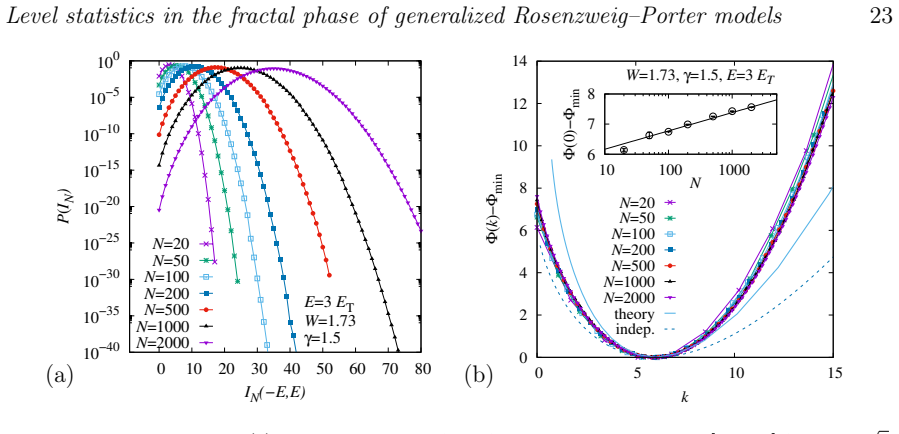
Summary. The paper studies the full counting statistics of eigenvalues in generalized Rosenzweig–Porter ensembles H = A + √σ M, where A is diagonal with i.i.d. entries and M is either orthogonally invariant (mutually free with A) or a finite-variance Wigner matrix. In the fractal phase 1 < γ < 2, a replica path-integral calculation combined with free-probability tools shows that the cumulant generating function of the number of eigenvalues in an interval of width E ∼ E_T takes the universal scaling form F[−E,E](s) = p_a(0) E_T G(s, E/E_T) + O(σ²), with G given explicitly by Eq. (78). The associated level compressibility χ_T(y) (Eq. 85) is likewise universal. The analytic predictions are checked by exact diagonalization (N up to 3·10^4) across several ensembles and by large-deviation sampling of the rate function down to probabilities ∼10^{-40}. A numerical contrast with the quantum random energy model shows a different, broader crossover, attributed to multifractality of the QREM eigenstates.
Significance. The work supplies a controlled analytic derivation of a previously conjectured universal scaling function for the level compressibility and full counting statistics of RP-type models. The derivation unifies the GOE, Wishart and finite-variance Wigner cases under a single saddle-point action that retains only the second free (or ordinary) cumulant of M, and recovers earlier results as special cases. High-quality numerical support—including large-deviation sampling to 10^{-40}—and a clear negative result for the QREM strengthen the claim that the universality class is tied to simple fractal (rather than multifractal) eigenstates. The result is a useful benchmark for random-matrix models of the integrability-to-chaos crossover.
minor comments (4)
- In §5.1 the finite-size drift of Φ(0) is left open (logarithmic growth versus possible saturation). A short remark clarifying that the analytic prediction Φ(k)∼2/k as k→0 is expected only for N→∞, and that the observed slow drift is consistent with the independent-level benchmark of Appendix B, would help the reader.
- Eq. (48) defines E_T with the second cumulant of M; it would be useful to state explicitly in the caption of Fig. 3 how this prefactor is fixed for each ensemble (especially the sparse-Gaussian and tent cases) so that the collapse is fully reproducible.
- The discussion of Lévy matrices in §5.4 notes that they empirically obey the same χ_T even though the finite-variance assumption is violated. A one-sentence pointer to the density–density correlator of Ref. [59] would make the connection sharper.
- Typographical: the arXiv date stamp “13 July 2026” and a few missing spaces around inline math (e.g. “1<γ<2”) should be cleaned before final production.
Circularity Check
No significant circularity: the universal CGF scaling is obtained from a controlled saddle-point evaluation of the replica action, recovering prior special cases rather than assuming them.
full rationale
The central claim is the universal form of the cumulant generating function F[−E,E](s)=pa(0)ET G(s,E/ET)+O(σ²) with G given by Eq. (78) for both orthogonally invariant and finite-variance Wigner matrices in the fractal phase. Sections 3.1–3.2 construct the replica path-integral actions for the two classes and show they coincide at O(σ) once only the second free (or ordinary) cumulant of M is retained; the subsequent saddle-point evaluation in §4.1 then produces a scaling function independent of pa and of all higher cumulants of M. The O(σ²) truncation is self-consistently justified for E∼ET≪1. Prior results of overlapping authors (the GOE case of Ref. [1] and the Wishart case of Ref. [66]) are recovered as special cases of the same calculation rather than used as load-bearing premises. The Thouless energy is the standard definition already present in the RP literature; it is not fitted to the data being predicted. Numerical validation (exact diagonalization at N=3·10⁴ and large-deviation sampling to 10^{-40}) is independent of the analytic derivation. The QREM contrast is presented as a negative result outside the claimed class. The only mild self-reference is the recovery of earlier special cases, which does not force the general result. Hence the derivation is self-contained against its own inputs.
Axiom & Free-Parameter Ledger
free parameters (3)
- γ (RP exponent)
- ν (overall scale of M)
- effective fractal dimension D (QREM only)
axioms (4)
- standard math Low-rank HCIZ integral approximation for orthogonally invariant matrices (Eq. 23)
- domain assumption Replica-symmetric saddle point for the auxiliary matrix Q
- domain assumption Analytic continuation n±→±is/π of the replica partition function
- domain assumption Finite second cumulant of the entries of M (κ₂^{(ζ)} or κ₂^{(free)})
read the original abstract
The Rosenzweig--Porter (RP) random matrix ensemble has emerged as a minimal model for the integrability-to-chaos crossover in quantum many-body systems. Its phase diagram features a region with fractal eigenstates, exhibiting intermediate spectral and localization properties between the fully localized and fully delocalized regimes. In this work, we explore several generalizations of the RP model and determine their level statistics at the scale of the Thouless energy $E_T$, which characterizes the crossover. Using tools from free probability theory and the replica method, we compute the full counting statistics in the limit of large system size, and show that it takes a simple, universal scaling form around $E_T$, shared across all variations of the model. We validate our analytical predictions using exact numerical diagonalization of large samples, and large-deviation algorithms that resolve the full counting statistics down to probabilities as low as $10^{-40}$. We also contrast our predictions with measurements on the quantum random energy model, which is the simplest model displaying many-body localization.
Figures



Reference graph
Works this paper leans on
-
[1]
Venturelli D, Cugliandolo L F, Schehr G and Tarzia M 2023SciPost Phys.14110 URL https://scipost.org/10.21468/SciPostPhys.14.5.110
-
[2]
Gornyi I V, Mirlin A D and Polyakov D G 2005Phys. Rev. Lett.95(20) 206603 URLhttps: //link.aps.org/doi/10.1103/PhysRevLett.95.206603 Level statistics in the fractal phase of generalized Rosenzweig–Porter models41
-
[3]
Phys.3211126–1205 URLhttps: //doi.org/10.1016/j.aop.2005.11.014
Basko D M, Aleiner I L and Altshuler B L 2006Ann. Phys.3211126–1205 URLhttps: //doi.org/10.1016/j.aop.2005.11.014
-
[4]
Altman E and Vosk R 2015Annu. Rev. Condens. Matter Phys.6383–409 ISSN 1947-5462 URL http://dx.doi.org/10.1146/annurev-conmatphys-031214-014701
-
[5]
Nandkishore R and Huse D A 2015Annu. Rev. Condens. Matter Phys.615–38 ISSN 1947-5462 URLhttp://dx.doi.org/10.1146/annurev-conmatphys-031214-014726
-
[6]
Abanin D A and Papić Z 2017Ann. Phys. Berlin529ISSN 1521-3889 URLhttp://dx.doi. org/10.1002/andp.201700169
-
[7]
Alet F and Laflorencie N 2018C. R. Phys.19498–525 ISSN 1631-0705 URLhttp://dx.doi. org/10.1016/j.crhy.2018.03.003
-
[8]
Abanin D A, Altman E, Bloch I and Serbyn M 2019Rev. Mod. Phys.91(2) 021001 URL https://link.aps.org/doi/10.1103/RevModPhys.91.021001
-
[9]
Sierant P, Lewenstein M, Scardicchio A, Vidmar L and Zakrzewski J 2025Rep. Prog. Phys.88 026502 URLhttp://dx.doi.org/10.1088/1361-6633/ad9756
-
[10]
Cugliandolo L F and Müller M 2023 Quantum glasses - a reviewSpin Glass Theory and Far Beyond - Replica Symmetry Breaking after 40 yearsed Charbonneau P, Marinari E, Mézard M, Parisi G, Ricci-Tersenghi F, Sicuro G and Zamponi F (World Scientific) p 353–374 URL https://www.worldscientific.com/doi/abs/10.1142/9789811273926_0018
-
[11]
Srednicki M 1994Phys. Rev. E50(2) 888–901 URLhttps://link.aps.org/doi/10.1103/ PhysRevE.50.888
-
[12]
Rigol M, Dunjko V and Olshanii M 2008Nature452854–858 URLhttps://doi.org/10.1038/ nature06838
-
[13]
Livan G, Novaes M and Vivo P 2018Introduction to Random Matrices(Springer International Publishing) URLhttps://doi.org/10.1007/978-3-319-70885-0
-
[14]
Potters M and Bouchaud J P 2020A First Course in Random Matrix Theory: For Physicists, Engineers and Data Scientists(CambridgeUniversityPress)URLhttps://doi.org/10.1017/ 9781108768900
-
[15]
Mingo J A and Speicher R 2017Free Probability and Random Matrices(Heidelberg: Springer) URLhttps://doi.org/10.1007/978-1-4939-6942-5
-
[16]
CrapsB,ClerckMD,EvninOandPavlovM2026Randommatrixtheoryofintegrability-to-chaos transition (Preprint2604.03669) URLhttps://arxiv.org/abs/2604.03669
-
[17]
Mirlin A D, Fyodorov Y V, Dittes F M, Quezada J and Seligman T H 1996Phys. Rev. E54(4) 3221–3230 URLhttps://link.aps.org/doi/10.1103/PhysRevE.54.3221
-
[18]
Fyodorov Y V, Ossipov A and Rodriguez A 2009J. Stat. Mech.2009L12001 URLhttps: //doi.org/10.1088/1742-5468/2009/12/L12001
-
[19]
Roy S, Khaymovich I M, Das A and Moessner R 2018SciPost Phys.4025 URLhttps: //scipost.org/10.21468/SciPostPhys.4.5.025
-
[20]
Wang J, Liu X J, Xianlong G and Hu H 2016Phys. Rev. B93(10) 104504 URLhttps: //link.aps.org/doi/10.1103/PhysRevB.93.104504
-
[21]
Nosov P A, Khaymovich I M and Kravtsov V E 2019Phys. Rev. B99(10) 104203 URL https://link.aps.org/doi/10.1103/PhysRevB.99.104203
-
[22]
Duthie A, Roy S and Logan D E 2022Phys. Rev. B106(2) L020201 URLhttps://link.aps. org/doi/10.1103/PhysRevB.106.L020201
-
[23]
21468/SciPostPhys.11.6.101
Kutlin A G and Khaymovich I M 2021SciPost Phys.11101 URLhttps://scipost.org/10. 21468/SciPostPhys.11.6.101
-
[24]
Motamarri V R, Gorsky A S and Khaymovich I M 2022SciPost Phys.13117 URLhttps: //scipost.org/10.21468/SciPostPhys.13.5.117
-
[25]
Tang W and Khaymovich I M 2022Quantum6733 URLhttps://doi.org/10.22331/ q-2022-06-09-733
2022
-
[26]
Tarzia M 2022Phys. Rev. B105(17) 174201 URLhttps://link.aps.org/doi/10.1103/ PhysRevB.105.174201 Level statistics in the fractal phase of generalized Rosenzweig–Porter models42
-
[27]
Skvortsov M A, Amini M and Kravtsov V E 2022Phys. Rev. B106(5) 054208 URLhttps: //link.aps.org/doi/10.1103/PhysRevB.106.054208
-
[28]
Cai X, Lang L J, Chen S and Wang Y 2013Phys. Rev. Lett.110(17) 176403 URLhttps: //link.aps.org/doi/10.1103/PhysRevLett.110.176403
-
[29]
DeGottardi W, Sen D and Vishveshwara S 2013Phys. Rev. Lett.110(14) 146404 URLhttps: //link.aps.org/doi/10.1103/PhysRevLett.110.146404
-
[30]
Liu F, Ghosh S and Chong Y D 2015Phys. Rev. B91(1) 014108 URLhttps://link.aps.org/ doi/10.1103/PhysRevB.91.014108
-
[31]
Das A K and Ghosh A 2022Phys. Rev. E105(5) 054121 URLhttps://link.aps.org/doi/10. 1103/PhysRevE.105.054121
-
[32]
Ahmed A, Ramachandran A, Khaymovich I M and Sharma A 2022Phys. Rev. B106(20) 205119 URLhttps://link.aps.org/doi/10.1103/PhysRevB.106.205119
-
[33]
Lee S, Andreanov A and Flach S 2023Phys. Rev. B107(1) 014204 URLhttps://link.aps. org/doi/10.1103/PhysRevB.107.014204
-
[34]
Das A K and Ghosh A 2023J. Phys. A: Math. Theor.56495003 ISSN 1751-8121 URL http://dx.doi.org/10.1088/1751-8121/ad0b5a
-
[35]
Le Doussal P 2025J. Phys. A: Math. Theor.ISSN 1751-8121 URLhttp://dx.doi.org/10. 1088/1751-8121/adf835
-
[36]
Baron J W 2025EPL15121002 ISSN 1286-4854 URLhttp://dx.doi.org/10.1209/ 0295-5075/adf2dc
-
[37]
Šuntajs J and Vidmar L 2022Phys. Rev. Lett.129(6) 060602 URLhttps://link.aps.org/doi/ 10.1103/PhysRevLett.129.060602
-
[38]
Phys.17122002 URL https://doi.org/10.1088/1367-2630/17/12/122002
Kravtsov V E, Khaymovich I M, Cuevas E and Amini M 2015New J. Phys.17122002 URL https://doi.org/10.1088/1367-2630/17/12/122002
-
[39]
von Soosten P and Warzel S 2019Lett. Math. Phys.109905–922 ISSN 1573-0530 URL https://doi.org/10.1007/s11005-018-1131-7
-
[40]
Lett.11547003 URLhttps://doi.org/10
Facoetti D, Vivo P and Biroli G 2016Europhys. Lett.11547003 URLhttps://doi.org/10. 1209/0295-5075/115/47003
-
[41]
Lett.11637002 URLhttps://doi.org/10.1209/ 0295-5075/116/37002
Truong K and Ossipov A 2016Europhys. Lett.11637002 URLhttps://doi.org/10.1209/ 0295-5075/116/37002
-
[42]
Bogomolny E and Sieber M 2018Phys. Rev. E98(3) 032139 URLhttps://link.aps.org/doi/ 10.1103/PhysRevE.98.032139
-
[43]
Tomasi G D, Amini M, Bera S, Khaymovich I M and Kravtsov V E 2019SciPost Phys.6(1) 14 URLhttps://scipost.org/10.21468/SciPostPhys.6.1.014
-
[44]
Lett.11730003 URLhttps://doi.org/10.1209/0295-5075/117/ 30003
Amini M 2017Europhys. Lett.11730003 URLhttps://doi.org/10.1209/0295-5075/117/ 30003
-
[45]
Pino M, Tabanera J and Serna P 2019J. Phys. A: Math. Theor.52475101 URLhttps: //doi.org/10.1088/1751-8121/ab4b76
-
[46]
Berkovits R 2020Phys. Rev. B102(16) 165140 URLhttps://link.aps.org/doi/10.1103/ PhysRevB.102.165140
-
[47]
Kravtsov V E, Khaymovich I M, Altshuler B L and Ioffe L B 2020preprint(Preprint2002.02979) URLhttps://doi.org/10.48550/arXiv.2002.02979
-
[48]
Khaymovich I M, Kravtsov V E, Altshuler B L and Ioffe L B 2020Phys. Rev. Res.2(4) 043346 URLhttps://link.aps.org/doi/10.1103/PhysRevResearch.2.043346
-
[49]
Monthus C 2017J. Phys. A: Math. Theor.50295101 URLhttps://iopscience.iop.org/ article/10.1088/1751-8121/aa77e1
-
[50]
Biroli G and Tarzia M 2021Phys. Rev. B103(10) 104205 URLhttps://link.aps.org/doi/ 10.1103/PhysRevB.103.104205
-
[51]
Buijsman W and Lev Y B 2022SciPost Phys.12082 URLhttps://scipost.org/10.21468/ SciPostPhys.12.3.082
-
[52]
Level statistics in the fractal phase of generalized Rosenzweig–Porter models43 21468/SciPostPhys.11.2.045
Khaymovich I M and Kravtsov V E 2021SciPost Phys.11045 URLhttps://scipost.org/10. Level statistics in the fractal phase of generalized Rosenzweig–Porter models43 21468/SciPostPhys.11.2.045
-
[53]
Sarkar M, Ghosh R and Khaymovich I M 2023Phys. Rev. B108(6) L060203 URLhttps: //link.aps.org/doi/10.1103/PhysRevB.108.L060203
-
[54]
Buijsman W 2024Phys. Rev. B109(2) 024205 URLhttps://link.aps.org/doi/10.1103/ PhysRevB.109.024205
-
[55]
Phys.26083018 ISSN 1367-2630 URLhttp://dx.doi.org/10.1088/1367-2630/ad5d86
Čadež T, Kumar Nandy D, Rosa D, Andreanov A and Dietz B 2024New J. Phys.26083018 ISSN 1367-2630 URLhttp://dx.doi.org/10.1088/1367-2630/ad5d86
-
[56]
Jahnke V, Nandy P, Pal K, Camargo H A and Kim K Y 2025 Free probability approach to spectral and operator statistics in Rosenzweig-Porter random matrix ensembles (Preprint2506.04520) URLhttps://arxiv.org/abs/2506.04520
arXiv 2025
-
[57]
Ghosh R, Sarkar M and Khaymovich I M 2025Phys. Rev. B111(22) L220102 URLhttps: //link.aps.org/doi/10.1103/k957-fcmh
-
[58]
Lunkin A and Tikhonov K 2025SciPost Phys.19015 URLhttps://scipost.org/10.21468/ SciPostPhys.19.1.015
-
[59]
org/10.21468/SciPostPhys.20.1.003
Safonova E, Lunkin A and Feigel’man M 2026SciPost Phys.20003 URLhttps://scipost. org/10.21468/SciPostPhys.20.1.003
-
[60]
Świętek R, Kliczkowski M, Hopjan M and Vidmar L 2026 Fading ergodicity and quantum dynamics in random matrix ensembles (Preprint2603.23616) URLhttps://arxiv.org/abs/ 2603.23616
arXiv 2026
-
[61]
21468/SciPostPhys.16.1.008
Kutlin A and Khaymovich I M 2024SciPost Phys.16008 URLhttps://scipost.org/10. 21468/SciPostPhys.16.1.008
-
[62]
Rev.120(5) 1698–1714 URLhttps://link.aps.org/ doi/10.1103/PhysRev.120.1698
Rosenzweig N and Porter C E 1960Phys. Rev.120(5) 1698–1714 URLhttps://link.aps.org/ doi/10.1103/PhysRev.120.1698
-
[63]
Atas Y Y, Bogomolny E, Giraud O and Roux G 2013Phys. Rev. Lett.110(8) 084101 URL https://link.aps.org/doi/10.1103/PhysRevLett.110.084101
-
[64]
Rep.326259–382 ISSN 0370-1573 URLhttps://www.sciencedirect
Mirlin A D 2000Phys. Rep.326259–382 ISSN 0370-1573 URLhttps://www.sciencedirect. com/science/article/pii/S0370157399000915
-
[65]
Phys.456169300 ISSN 0003-4916 URLhttps://www
Altshuler B and Kravtsov V 2023Ann. Phys.456169300 ISSN 0003-4916 URLhttps://www. sciencedirect.com/science/article/pii/S0003491623000854
-
[66]
Delapalme V, Cugliandolo L F, Schehr G, Tarzia M and Venturelli D 2026J. Stat. Mech.2026 013301 ISSN 1742-5468 URLhttp://dx.doi.org/10.1088/1742-5468/ae29f6
-
[67]
Cipolloni G, Erdős L and Henheik J 2026 On a Rosenzweig-Porter-type model (Preprint 2607.02446) URLhttps://arxiv.org/abs/2607.02446
Pith/arXiv arXiv 2026
-
[68]
Voiculescu D V, Dykema K J and Nica A 1992Free random variablesCRM Monograph Series (American Mathematical Soc.) ISBN 9780821869703 URLhttps://doi.org/10.1090/crmm/ 001
-
[69]
Vallini E, Foini L and Pappalardi S 2025 Refinements of the eigenstate thermalization hypothesis under local rotational invariance via free probability (Preprint2511.23217) URLhttps: //arxiv.org/abs/2511.23217
Pith/arXiv arXiv 2025
-
[70]
Camargo H A, Fu Y, Jahnke V, Pal K and Kim K Y 2025 Quantum signatures of chaos from free probability (Preprint2503.20338) URLhttps://arxiv.org/abs/2503.20338
arXiv 2025
-
[71]
WishartJ1928Biometrika20A32ISSN0006-3444URLhttp://dx.doi.org/10.2307/2331939
-
[72]
Phys.456169300 URLhttps://www.sciencedirect
Altshuler B and Kravtsov V 2023Ann. Phys.456169300 URLhttps://www.sciencedirect. com/science/article/pii/S0003491623000854
-
[73]
Cohen D, Yukalov V I and Ziegler K 2016Phys. Rev. A93042101 URLhttps://doi.org/10. 1103/PhysRevA.93.042101
-
[74]
Adler D, Wei D, Will M, Srakaew K, Agrawal S, Weckesser P, Moessner R, Pollmann F, Bloch I and Zeiher J 2024Nature63680 URLhttps://doi.org/10.1038/s41586-024-08188-0
-
[75]
Phys.8172 URL https://doi.org/10.1038/s42005-025-02039-8
Jeyaretnam J, Bhore T, Osborne J J, Halimeh J C and Papić Z 2025Commun. Phys.8172 URL https://doi.org/10.1038/s42005-025-02039-8
-
[76]
Faoro L, Feigel’man M V and Ioffe L 2019Ann. Phys.409167916 ISSN 0003-4916 URL Level statistics in the fractal phase of generalized Rosenzweig–Porter models44 https://www.sciencedirect.com/science/article/pii/S000349161930171X
-
[77]
Baldwin C L and Laumann C R 2018Phys. Rev. B97(22) 224201 URLhttps://link.aps. org/doi/10.1103/PhysRevB.97.224201
-
[78]
Parolini T and Mossi G 2020preprint(Preprint2007.00315) URLhttps://doi.org/10.48550/ arXiv.2007.00315
Pith/arXiv arXiv 2007
-
[79]
Biroli G, Facoetti D, Schiró M, Tarzia M and Vivo P 2021Phys. Rev. B103(1) 014204 URL https://link.aps.org/doi/10.1103/PhysRevB.103.014204
-
[80]
KechedzhiK,SmelyanskiyV,McCleanJR,DenchevVS,MohseniM,IsakovS,BoixoS,Altshuler B and Neven H 2018Leibniz Int. Proc. Inf.1119:1–9:16 URLhttps://drops.dagstuhl.de/ storage/00lipics/lipics-vol111-tqc2018/LIPIcs.TQC.2018.9/LIPIcs.TQC.2018.9.pdf
2018
discussion (0)
Sign in with ORCID, Apple, or X to comment. Anyone can read and Pith papers without signing in.