REVIEW 2 major objections 4 minor 1 cited by
Level-spacing statistics between integrability and chaos are controlled by the distribution of the perturbation's matrix elements alone.
Reviewed by Pith at T0; open to challenge. T0 means a machine referee read the full paper against a public rubric. the ladder, T0–T4 →
T0 review · grok-4.5
2026-07-13 12:34 UTC
load-bearing objection Clean, predictive RMT construction for intermediate level statistics that actually works on two many-body systems and beats the usual baselines. the 2 major comments →
Random matrix theory of integrability-to-chaos transition
The pith
A machine-rendered reading of the paper's core claim, the machinery that carries it, and where it could break.
Core claim
The unfolded nearest-neighbor level-spacing distribution of a Hamiltonian H = H0 + γ H1 (H0 integrable, H1 chaotic) is accurately reproduced, at large Hilbert-space dimension, by the eigenvalues of the random ensemble H = D + γ' M, where the diagonal entries of D are i.i.d. draws from the spectrum of H0 and the off-diagonal entries of M are i.i.d. draws from the single unordered sample of ⟨n|H1|m⟩. Matching the average r-ratio between the physical and random spectra identifies the corresponding values of γ and γ'.
What carries the argument
The random-matrix ensemble H = D + γ' M constructed from the spectral density of the integrable part and the empirical distribution of the perturbation matrix elements; once the overall scale is fixed by the average r-ratio, this ensemble carries the full level-spacing statistics of the physical crossover.
Load-bearing premise
That all correlations among the perturbation matrix elements, and any dependence on their precise locations inside the matrix, become irrelevant for level spacings once only the unordered sample of their values is retained.
What would settle it
Construct any concrete H0 + γ H1 of Hilbert-space dimension a few times 10^4, extract the empirical distributions of its eigenvalues and off-diagonal matrix elements, build the corresponding random ensemble, match the average r-ratio, and check whether the unfolded spacing histograms of the physical and random spectra disagree systematically beyond sampling fluctuations.
If this is right
- Spectroscopic data alone can constrain the statistics of the chaotic part of an unknown Hamiltonian.
- The intermediate spacing curve is no longer an arbitrary fitting function; it is predicted once the matrix-element distribution is known.
- Power-law tails in off-diagonal matrix elements become a new universal signature of integrability-to-chaos crossovers across widely different degrees of freedom.
- Existing phenomenological fits (Brody, Rosenzweig-Porter) are systematically outperformed by a construction that uses only the physical matrix-element sample.
Where Pith is reading between the lines
- The same matrix-element distributions that control level spacings may also govern the onset of eigenstate thermalization, offering a quantitative link between spectral statistics and ETH deviations.
- Analytic methods already developed for diagonal-plus-random ensembles could now be applied to extract closed-form spacing distributions for power-law P_M, turning the numerical construction into an asymptotic theory.
- If the power-law regime of P_M is truly universal, its exponent may serve as a single-parameter classifier of how a given system approaches chaos.
Editorial analysis
A structured set of objections, weighed in public.
Referee Report
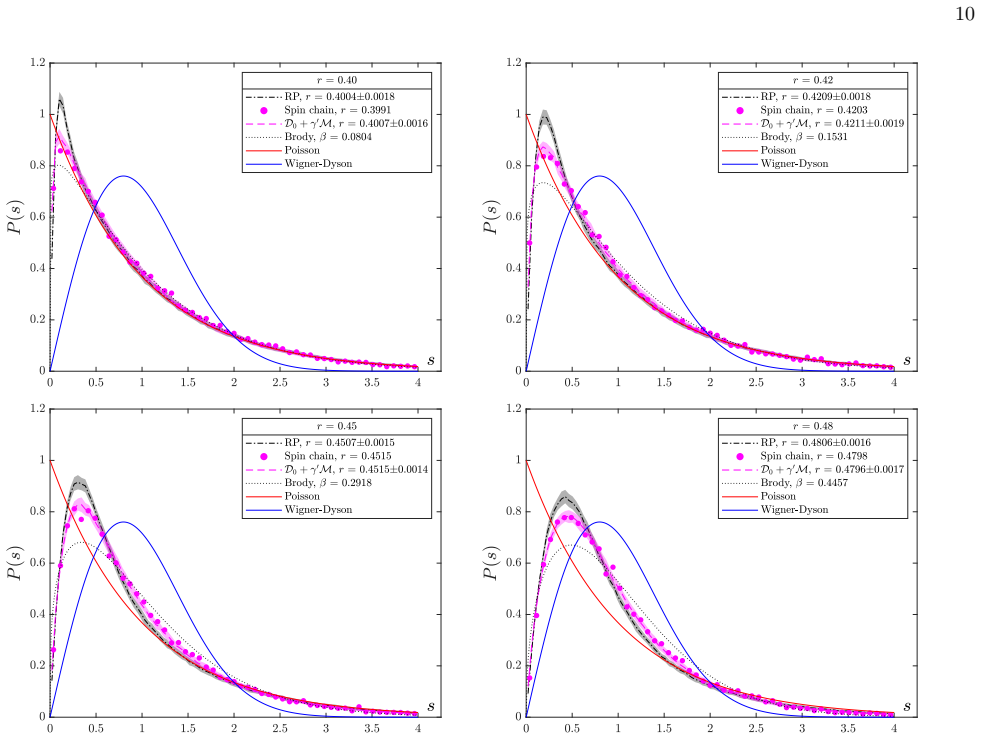
Summary. The paper proposes that the unfolded nearest-neighbor level-spacing distribution of a Hamiltonian H = H0 + γ H1 (integrable H0 plus chaotic perturbation H1) is controlled, at large Hilbert-space dimension D, by the unordered sample of off-diagonal matrix elements of H1 in the eigenbasis of H0. This is encoded in the random-matrix ensemble H = D + γ' M (Eq. 6), where the diagonal entries of D are drawn i.i.d. from the spectrum of H0 and the off-diagonal entries of M are drawn i.i.d. from the empirical distribution PM of those matrix elements. The single free parameter γ' is fixed by matching the average r-ratio of the physical and ensemble spectra. The construction is validated by direct numerical comparison on an open-boundary transverse-field Ising chain (L = 16, D ≈ 3.3 imes 10^4) and a quantum resonant system ((N, M) = (37, 37), D ≈ 2.2 imes 10^4) at four intermediate values of the average r-ratio; the ensemble histograms match the physical data and outperform both the Rosenzweig–Porter model and the Brody distribution (Figs. 1–2, Appendix D). In addition, the authors report that PM itself is dominated by a power-law regime over many orders of magnitude in these and two further systems (billiard, perturbed oscillator).
Significance. If the central claim holds, the long-standing problem of intermediate (neither Poisson nor Wigner–Dyson) level statistics is reduced to a concrete, falsifiable random-matrix ensemble whose only non-universal input is an empirically accessible distribution of matrix elements. The numerical evidence is strong for the reported system sizes: two distinct many-body models, fifty ensemble realizations, 2σ error belts, public codes, and clear out-performance of the standard baselines. The power-law observation for PM is an independent, potentially far-reaching empirical finding that links the construction to ETH-type matrix-element statistics. Analytic control of the ensemble remains open, but the numerical and conceptual advance is already substantial for the field.
major comments (2)
- The load-bearing premise (Sec. III) that correlations among the matrix elements of H1 and their precise locations inside the matrix become irrelevant once the unordered sample is fixed is tested only by the success of the i.i.d. ensemble (6) against the physical spectra. While the match in Figs. 1–2 and the 2σ belts of Appendix D are persuasive at D ∼ 2–3 imes 10^4, a single controlled counter-example (or a finite-size scaling of residual discrepancy) would strengthen the claim that the premise survives into the large-D limit. The present evidence does not invalidate the claim for the systems studied, but the assumption remains the softest point of the argument.
- The power-law regime of PM (Fig. 3 and Appendix E) is reported for four systems, yet the exponents differ (p ∈ [0, 1] for the many-body models versus p = 3/2 for the billiard). The manuscript does not clarify whether the level-spacing statistics remain insensitive to the precise value of p inside the claimed range, nor whether the same ensemble construction continues to work for the billiard and oscillator once their PM is inserted. A short additional panel or statement would make the universality claim more precise.
minor comments (4)
- The protocol for extracting PD and PM (Appendix B) relies on inverse-transform sampling from histograms of log10 |H1,nm|. A one-sentence statement of the binning resolution and of how exact numerical zeros are treated would improve reproducibility.
- Figs. 1 and 2 would benefit from a brief note in the caption that the physical histograms are obtained from a single realization of H1 (as stated in the text), while the ensemble curves average 50 draws.
- The analytic derivation of the billiard power law (Appendix E, Eq. E5) is elegant; a short remark on whether an analogous continuum limit exists for the many-body models would be welcome.
- A few typographical inconsistencies appear (e.g., “Lévy” vs. “Lévy-RP”, occasional missing spaces around “γ'”). These are easily cleaned.
Circularity Check
No significant circularity: PD/PM extracted once from physical H0/H1, ensemble sampled independently, and full P(s) compared after matching only the scalar average r-ratio.
full rationale
The central claim is that the i.i.d. ensemble (6) with entries drawn from the empirical unordered samples PD (spectrum of H0) and PM (off-diagonal matrix elements of H1 in the H0 eigenbasis) reproduces the unfolded level-spacing histograms of the physical H = H0 + γ H1 once the single free parameter γ' is fixed by matching the average r-ratio (an independent spectral observable that does not require unfolding). This is not self-definitional: the spacing distribution P(s) is never used as an input to construct the ensemble or to set γ'; the match of the full curves in Figs. 1–2 (and the error belts of Appendix D) is therefore a genuine numerical test, not a tautology. The same construction is repeated for two unrelated families (spin chains and QRS) and outperforms both the RP model (different PM) and the Brody fit. The power-law observation on PM is purely empirical and is not fed back into the spacing prediction. Self-citations (prior QRS papers) supply only the integrable H0 examples, not any uniqueness theorem or load-bearing ansatz that forces the result. The sole modeling assumption (irrelevance of entry positions/correlations once the unordered sample is fixed) is stated explicitly and is precisely what the numerical agreement tests; it does not reduce the claimed prediction to its inputs by construction. Score 1 reflects only the ordinary, non-load-bearing use of author-related models as test beds.
Axiom & Free-Parameter Ledger
free parameters (1)
- γ′ (or equivalently average r)
axioms (3)
- ad hoc to paper At large Hilbert-space dimension the level-spacing distribution of H0 + γ H1 depends only on the unordered sample of off-diagonal matrix elements of H1 in the H0 eigenbasis (correlations and positions become irrelevant).
- domain assumption Spectral unfolding via local mesoscopic windows of width ∼√D yields a universal mean density of 1 that can be compared across systems.
- domain assumption The average r-ratio is a faithful one-parameter proxy for the stage of the Poisson-to-Wigner crossover.
invented entities (1)
-
Random-matrix ensemble H = D + γ′ M with PD and PM extracted from physical H0 and H1
no independent evidence
read the original abstract
The statistics of gaps between quantum energy levels is a hallmark criterion in quantum chaos and quantum integrability studies. The relevant distributions corresponding to exactly integrable vs. fully chaotic systems are universal and described by the Poisson vs. Wigner-Dyson curves. In the transitional regime between integrability and chaos, the distributions are much less universal and have not been understood quantitatively until now. We point out that the relevant statistics that controls these distributions is that of the matrix elements of the nonintegrable perturbation Hamiltonian in the energy eigenbasis of the unperturbed integrable system. With this insight, we formulate a simple random matrix ensemble that correctly reproduces the level spacing distributions in a variety of test systems. For the distribution of matrix elements appearing in our construction, we furthermore discover surprising universal features: across a variety of physical systems with diverse degrees of freedom, these distributions are dominated by simple power laws.
Figures




Forward citations
Cited by 1 Pith paper
-
Level statistics in the fractal phase of generalized Rosenzweig--Porter models
Full counting statistics of generalized Rosenzweig-Porter models collapse onto a universal scaling function of E/E_T in the fractal phase, confirmed by free-probability/replica analytics and large-deviation numerics, ...
Reference graph
Works this paper leans on
-
[1]
and its classical limit is Lax-integrable [46]. We per- turbH 0 with a single random QRS realization, where the coefficientsC nmkl in (12) are drawn from a uniform distribution over the interval [0,1], while respecting the symmetriesC nmkl =C mnkl =C klnm. This choice de- finesH 1. With these definitions in hand, we repeat the numeri- cal experiment of th...
-
[2]
An impor- tant property of this probability distribution is that it is invariant under orthogonal transformations, reflecting the independence of the choice of basis
for the offdiagonal elements. An impor- tant property of this probability distribution is that it is invariant under orthogonal transformations, reflecting the independence of the choice of basis. Furthermore, the Wigner surmise is analytically derived for 2×2 GOE matrices, and it matches the numerical results for large GOE matrices very well. The RP mode...
-
[3]
Babelon, D
O. Babelon, D. Bernard and M. Talon,Introduction to classical integrable systems(Cambridge University Press, 2003)
2003
-
[4]
J. S. Caux and J. Mossel,Remarks on the notion of quantum integrability,J. Stat. Mech.1102(2011) P02023, arXiv:1012.3587 [cond-mat.str-el]
Pith/arXiv arXiv 2011
-
[5]
L. D’Alessio, Y. Kafri, A. Polkovnikov and M. Rigol, From quantum chaos and eigenstate thermalization to statistical mechanics and thermodynamics, Adv. Phys. 65(2016) 239, arXiv:1509.06411 [cond-mat.stat-mech]. 13
Pith/arXiv arXiv 2016
-
[6]
M. V. Berry and M. Tabor,Level clustering in the reg- ular spectrum, Proc. Roy. Soc. A356(1977) 375
1977
-
[7]
Bohigas, M.-J
O. Bohigas, M.-J. Giannoni and C. Schmit,Character- ization of chaotic quantum spectra and universality of level fluctuation laws,Phys. Rev. Lett.52(1984) 1
1984
-
[8]
T. A. Brody, J. Flores, J. B. French, P. A. Mello, A. Pandey and S. S. M. Wong,Random-matrix physics: spectrum and strength fluctuations,Rev. Mod. Phys.53 (1981) 385
1981
-
[9]
Haller, H
E. Haller, H. K¨ oppel and L. S. Cederbaum,On the statistical behaviour of molecular vibronic energy levels, Chem. Phys. Lett.101(1983) 215
1983
-
[10]
G. Akemann, M. Kieburg, A. Mielke and T. Prosen, Universal signature from integrability to chaos in dis- sipative open quantum systems,Phys. Rev. Lett.123 (2019) 254101, arXiv:1910.03520 [cond-mat.stat-mech]
Pith/arXiv arXiv 2019
-
[11]
L. S´ a, P. Ribeiro and T. Prosen,Complex spacing ratios: a signature of dissipative quantum chaos,Phys. Rev. X10(2020) 021019, arXiv:1910.12784 [cond-mat.stat- mech]
Pith/arXiv arXiv 2020
-
[12]
Grobe, F
R. Grobe, F. Haake and H.-J. Sommers,Quantum dis- tinction of regular and chaotic dissipative motion,Phys. Rev. Lett.61(1988) 1899
1988
-
[13]
Woldet al.,Experimental detection of dissipative quantum chaos,arXiv:2506.04325
K. Woldet al.,Experimental detection of dissipative quantum chaos,arXiv:2506.04325
-
[14]
T. A. Brody,A statistical measure for the repulsion of energy levels,Lett. Nuovo Cim.7(1973) 482
1973
-
[15]
Rosenzweig and C
N. Rosenzweig and C. E. Porter,Repulsion of energy levels in complex atomic spectra,Phys. Rev.120(1960) 1698
1960
-
[16]
J. R. Armstrong, S. ˚Aberg, S. M. Reimann and V. G. Zelevinsky,Complexity of quantum states in the two-dimensional pairing model,Phys. Rev. E86(2012) 066204
2012
-
[17]
Feingold, D
M. Feingold, D. M. Leitner and M. Wilkinson,Spec- tral statistics in semiclassical random-matrix ensembles, Phys. Rev. Lett.66(1991) 986
1991
-
[18]
Prosen,Berry-Robnik level statistics in a smooth bil- liard system,J
T. Prosen,Berry-Robnik level statistics in a smooth bil- liard system,J. Phys. A31(1998) 7023, arXiv:cond- mat/9803341
arXiv 1998
-
[19]
M. Robnik and T. Prosen,Comment on energy level statistics in the mixed regime,J. Phys. A30(1997) 8787, arXiv:chao-dyn/9706023
Pith/arXiv arXiv 1997
-
[20]
M. Serbyn and J. E. Moore,Spectral statistics across the many-body localization transition,Phys. Rev. B,93 (2016) 041424, arXiv:1508.07293 [cond-mat.dis-nn]
Pith/arXiv arXiv 2016
-
[21]
V. E. Kravtsov, I. M. Khaymovich, E. Cuevas and M. Amini,A random matrix model with localization and ergodic transitions,New J. Phys.17(2015) 122002, arXiv:1508.01714[cond-mat.dis-nn]
Pith/arXiv arXiv 2015
-
[22]
P. Sierant and J. Zakrzewski,Level statistics across the many-body localization transition,Phys. Rev. B 99 (2019) 104205, arXiv:1808.02795 [cond-mat.dis-nn]
Pith/arXiv arXiv 2019
-
[23]
I. C. Percival,Regular and irregular spectra,J. Phys. B 6(1973) L229
1973
-
[24]
J. Zakrzewski, K. Dupret and D. Delande,Statistical properties of energy levels of chaotic systems: Wigner or non-Wigner?,Phys. Rev. Lett.74(1995) 522, arXiv:chao-dyn/9501016
Pith/arXiv arXiv 1995
-
[25]
M. V. Berry and M. Robnik,Semiclassical level spacings when regular and chaotic orbits coexist,J. Phys. A17 (1984) 2413
1984
-
[26]
Prosen and M
T. Prosen and M. Robnik,Semiclassical energy level statistics in the transition region between integrability and chaos: transition from Brody-like to Berry-Robnik behaviour,J. Phys. A27(1994) 8059
1994
-
[27]
B. De, P. Sierant and J. Zakrzewski,On intermedi- ate statistics across many-body localization transition, J. Phys. A55(2022) 014001, arXiv:2108.11654 [cond- mat.dis-nn]
Pith/arXiv arXiv 2022
-
[28]
Leyvraz and T
F. Leyvraz and T. H. Seligman,Self-consistent pertur- bation theory for random matrix ensembles,J. Phys. A 23(1990) 1555
1990
-
[29]
D. Venturelli, L. F. Cugliandolo, G. Schehr, and M. Tarzia,Replica approach to the generalized Rosenzweig-Porter model,SciPost Phys.14(2023) 110, arXiv:2209.11732 [cond-mat.dis-nn]
Pith/arXiv arXiv 2023
-
[30]
Zakrzewski,Quantum chaos and level dynamics,En- tropy25(2023) 491
J. Zakrzewski,Quantum chaos and level dynamics,En- tropy25(2023) 491
2023
-
[31]
V. Oganesyan and D. A. Huse,Localization of inter- acting fermions at high temperature,Phys. Rev. B75 (2007) 155111, arXiv:cond-mat/0610854 [cond-mat.str- el]
Pith/arXiv arXiv 2007
-
[32]
Y. Y. Atas, E. Bogomolny, O. Giraud and G. Roux, Distribution of the ratio of consecutive level spacings in random matrix ensembles,Phys. Rev. Lett.110(2013) 084101, arXiv:1212.5611 [math-ph]
Pith/arXiv arXiv 2013
-
[33]
O. Evnin and W. Piensuk,Quantum resonant systems, integrable and chaotic,J. Phys. A52(2019) 025102, arXiv:1808.09173 [math-ph]
Pith/arXiv arXiv 2019
-
[34]
Lenz and F
G. Lenz and F. Haake,Reliability of small matrices for large spectra with nonuniversal fluctuations,Phys. Rev. Lett.67(1991) 1
1991
-
[35]
T. Guhr, A. M¨ uller–Groeling and H. A. Weidenm¨ uller, Random-matrix theories in quantum physics: com- mon concepts,Phys. Rep.299(1998) 189, arXiv:cond- mat/9707301
arXiv 1998
-
[36]
D. A. Rabson, B. N. Narozhny, and A. J. Millis, Crossover from Poisson to Wigner-Dyson level statistics in spin chains with integrability breaking,Phys. Rev. B, 69(2004) 054403, arXiv:cond-mat/0308089
Pith/arXiv arXiv 2004
-
[37]
A. Gubin and L. F. Santos,Quantum chaos: An intro- duction via chains of interacting spins 1/2,Am. J. Phys. 80(2012) 246, arXiv:1106.5557 [cond-mat.stat-mech]
Pith/arXiv arXiv 2012
-
[38]
D. Sz´ asz-Schagrin, B. Pozsgay and G. Tak´ acs,Weak in- tegrability breaking and level spacing distribution,Sci- Post Phys.11(2021) 037, arXiv:2103.06308 [cond- mat.stat-mech]
Pith/arXiv arXiv 2021
-
[39]
D. Kundu, S. Kumar and S. S. Gupta,Spectral crossovers and universality in quantum spin chains cou- pled to random fields,Phys. Rev. B105(2022) 014205, arXiv:2309.14076 [cond-mat.stat-mech]
Pith/arXiv arXiv 2022
-
[40]
W. Buijsman, V. Cheianov and V. Gritsev,Ran- dom matrix ensemble for the level statistics of many- body localization,Phys. Rev. Lett.122(2019) 180601, arXiv:1807.05075 [cond-mat.dis-nn]
Pith/arXiv arXiv 2019
-
[41]
A. Sol´ orzano, L. F. Santos and E. J. Torres-Herrera, Multifractality and self-averaging at the many-body lo- calization transition,Phys. Rev. Res.3(2021) L032030, arXiv:2102.02824 [cond-mat.dis-nn]
Pith/arXiv arXiv 2021
-
[42]
Zenodo 19412167 (2026)
2026
-
[43]
Evnin,Resonant Hamiltonian systems and weakly nonlinear dynamics in AdS spacetimes,Class
O. Evnin,Resonant Hamiltonian systems and weakly nonlinear dynamics in AdS spacetimes,Class. Quant. Grav.38(2021) 203001, arXiv:2104.09797 [gr-qc]
Pith/arXiv arXiv 2021
-
[44]
A. Biasi, P. Bizo´ n and O. Evnin,Solvable cubic res- onant systems, Comm. Math. Phys.369(2019) 433, arXiv:1805.03634 [nlin.SI]
Pith/arXiv arXiv 2019
-
[45]
M. De Clerck and O. Evnin,Time-periodic quantum states of weakly interacting bosons in a harmonic trap, Phys. Lett. A384(2020) 126930, arXiv:2003.03684 14 [cond-mat.quant-gas]
Pith/arXiv arXiv 2020
-
[46]
B. Craps, M. De Clerck and O. Evnin,Time- periodicities in holographic CFTs,JHEP09(2021) 030, arXiv:2103.12798 [hep-th]
Pith/arXiv arXiv 2021
-
[47]
M. De Clerck and O. Evnin,A superintegrable quantum field theory,arXiv:2511.03373 [nlin.SI]
-
[48]
A. Biasi and O. Evnin,Turbulent cascades in a trun- cation of the cubic Szeg˝ o equation and related systems, Anal. PDE15(2022) 217, arXiv:2002.07785 [math.AP]
Pith/arXiv arXiv 2022
-
[49]
B. Craps, M. De Clerck, O. Evnin, P. Hacker and M. Pavlov,Bounds on quantum evolution complexity via lattice cryptography,SciPost Phys.13(2022) 090, arXiv:2202.13924 [quant-ph]
Pith/arXiv arXiv 2022
-
[50]
Cizeau and J
P. Cizeau and J. P. Bouchaud,Theory of L´ evy matrices, Phys. Rev. E50(1994) 1810
1994
-
[51]
Z. Burda, R. A. Janik, J. Jurkiewicz, M. A. Nowak, G. Papp and I. Zahed,Free random L´ evy matrices,Phys. Rev. E65(2002) 021106, arXiv:cond-mat/0011451
Pith/arXiv arXiv 2002
-
[52]
E. Tarquini, G. Biroli and M. Tarzia,Level statis- tics and localization transitions of L´ evy matrices,Phys. Rev. Lett.116(2016) 010601, arXiv:1507.00296 [cond- mat.dis-nn]
Pith/arXiv arXiv 2016
-
[53]
G. Biroli and M. Tarzia,The L´ evy-Rosenzweig-Porter random matrix ensemble,Phys. Rev. B103(2021) 104205, arXiv:2012.12841 [cond-mat.dis-nn]
Pith/arXiv arXiv 2021
-
[54]
S. Roy, I. M. Khaymovich, A. Das and R. Moess- ner,Multifractality without fine-tuning in a Floquet quasiperiodic chain,SciPost Phys.4(2018) 025, arXiv:1706.05012 [cond-mat.dis-nn]
Pith/arXiv arXiv 2018
-
[55]
Tarzia,The many-body localization transition in the Hilbert space,Phys
M. Tarzia,The many-body localization transition in the Hilbert space,Phys. Rev. B102(2020) 014208, arXiv:2003.11847 [cond-mat.stat-mech]
Pith/arXiv arXiv 2020
-
[56]
Ph. J. D. Crowley and A. Chandran,A constructive theory of the numerically accessible many-body local- ized to thermal crossover,SciPost Phys.12(2022) 201, arXiv:2012.14393 [cond-mat.dis-nn]
Pith/arXiv arXiv 2022
-
[57]
F. H. L. Essler and A. J. J. M. de Klerk,Statistics of matrix elements of local operators in integrable models, Phys. Rev. X14(2024) 031048, arXiv:2307.12410 [cond- mat.stat-mech]
Pith/arXiv arXiv 2024
-
[58]
F. Rottoli and V. Alba,Eigenstate thermalization hypothesis for off-diagonal matrix elements in inte- grable spin chains,Phys. Rev. B113(2026) 054308, arXiv:2505.23602 [cond-mat.stat-mech]
arXiv 2026
-
[59]
A. D. Mirlin and Y. V. Fyodorov,Universality of level correlation function of sparse random matrices,J. Phys. A24(1991) 2273
1991
-
[60]
A. Frisch, M. Mark, K. Aikawa, F. Ferlaino, J. L. Bohn, C. Makrides, A. Petrov and S. Kotochigova,Quan- tum chaos in ultracold collisions of gas-phase erbium atoms,Nature507(2014) 475, arXiv:1312.1972 [cond- mat.quant-gas]
Pith/arXiv arXiv 2014
-
[61]
H. Donget al.,Measuring the spectral form factor in many-body chaotic and localized phases of quan- tum processors,Phys. Rev. Lett.134(2025) 010402, arXiv:2403.16935 [quant-ph]
Pith/arXiv arXiv 2025
-
[62]
Maieret al.,Emergence of chaotic scattering in ul- tracold Er and Dy,Phys
T. Maieret al.,Emergence of chaotic scattering in ul- tracold Er and Dy,Phys. Rev. X5(2015) 041029, arXiv:1506.05221 [cond-mat.quant-gas]
Pith/arXiv arXiv 2015
-
[63]
M. Moritaet al.,Magnetic Feshbach resonances in Ba++Li collisions due to strong spin-orbit coupling, arXiv:2507.12936 [physics.atom-ph]
-
[64]
S. Olver and A. Townsend,Fast inverse transform sampling in one and two dimensions,arXiv:1307.1223 [math.NA]
discussion (0)
Sign in with ORCID, Apple, or X to comment. Anyone can read and Pith papers without signing in.