REVIEW 4 major objections 5 minor 2 cited by
This paper proposes a per-query, latency- and token-aware framework that jointly selects an inference-time scaling strategy and its compute budget, and shows it beats fixed strategies on reasoning benchmarks.
Reviewed by Pith at T0; open to challenge. T0 means a machine referee read the full paper against a public rubric. the ladder, T0–T4 →
T0 review · deepseek-v4-flash
2026-08-04 18:33 UTC pith:MW47OT4J
load-bearing objection Useful, incremental systems paper on latency-aware adaptive test-time compute, but the missing train/test split for its accuracy probe makes the headline result unverifiable as written. the 4 major comments →
Latency and Token-Aware Test-Time Compute
The pith
A machine-rendered reading of the paper's core claim, the machinery that carries it, and where it could break.
Core claim
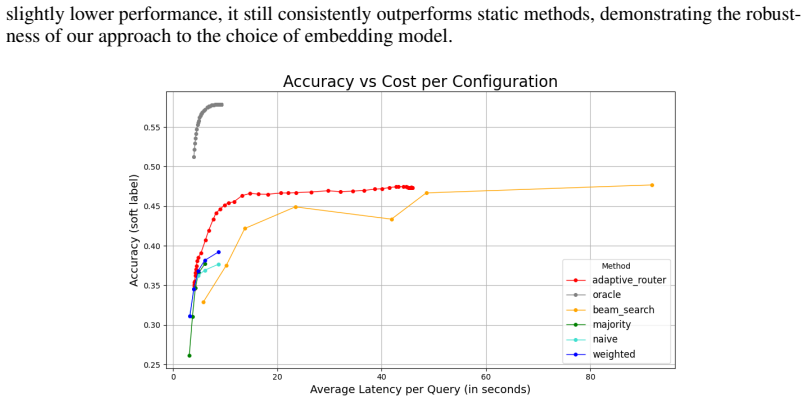
The central claim is that inference-time scaling should be framed as a per-query utility maximization problem: for each query, pick the decoding strategy s that maximizes U_s(x) = a_s(x) - λ_T T_s(x) - λ_L L_s(x), where a is accuracy, T is token cost, and L is wall-clock latency. The paper shows that this adaptive framework, using a trained accuracy probe and precomputed mean costs, consistently outperforms static strategies on reasoning benchmarks. It also finds that penalty weights naturally shift selection across methods: low penalties favor high-accuracy, compute-heavy beam search; higher penalties route queries to lighter sampling methods.
What carries the argument
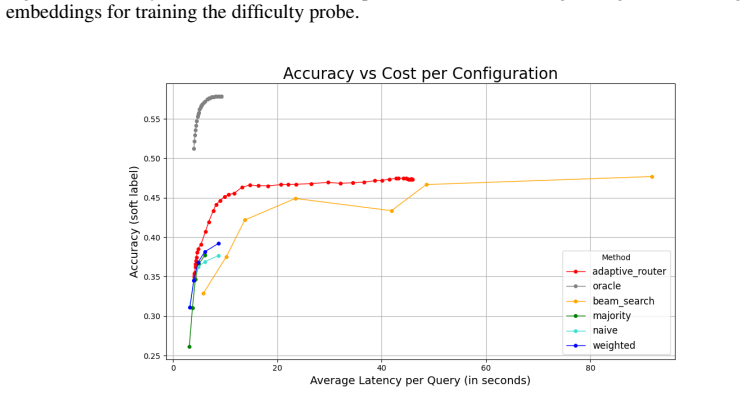
The core mechanism is the utility function in Eq. (1), which converts accuracy, token cost, and latency into a single scalar per query. Accuracy is estimated by a two-layer MLP probe trained on soft labels from repeated sampling, using query embeddings (Qwen or BERT) plus strategy descriptors; token and latency costs are predicted as precomputed strategy-level means. The router then selects the strategy with maximum estimated utility.
Load-bearing premise
The entire approach rests on the accuracy probe predicting, for each query and each candidate strategy, the true probability of a correct answer well enough that the argmax of estimated utility matches the oracle's choice most of the time.
What would settle it
Run the adaptive router on a held-out set while replacing the probe's accuracy predictions with random values (or with predictions from a deliberately miscalibrated model); if the resulting accuracy–cost curve still beats static strategies, then the probe is not load-bearing. Conversely, comparing per-query selections against the oracle (which knows true accuracy) would reveal how often the router makes a worse choice than the oracle; if that disagreement is large where utilities are close, the dominance claim weakens.
If this is right
- If the utility-based router works as claimed, fixed inference-time scaling budgets become unnecessary: the same model can allocate cheap strategies to easy queries and expensive ones to hard queries automatically.
- Including latency as a utility term enables deployment in interactive and agentic settings where wall-clock time matters, not just token counts.
- The framework generalizes beyond the tested methods, so new strategies (e.g., tree-of-thought, reflexion) can be added as additional strategy tuples without changing the router.
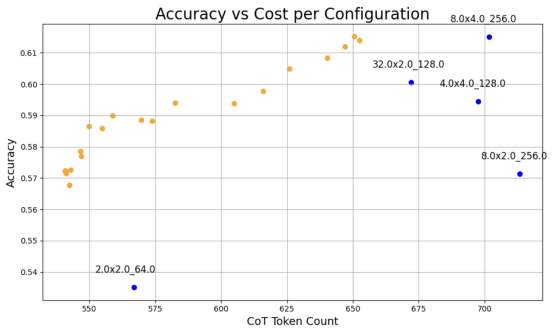
- Even within a single method, utility-based hyperparameter selection (e.g., beam width and depth) beats fixed configurations, suggesting the same principle applies at a finer granularity.
- The accuracy probe, despite being lightweight, is calibrated enough to make the adaptive strategy consistently beat static baselines across a range of penalty weights.
Where Pith is reading between the lines
- The paper's strongest hidden assumption is that the accuracy probe's per-query rankings are reliable; if the probe is miscalibrated on hard or out-of-distribution queries, the adaptive strategy could silently degrade to static-like behavior, since cost estimates are already near-oracle.
- A direct extension would be to test whether the same utility formulation transfers to coding or open-ended tasks, where accuracy is not exact match but pass@k or reward-model scores—this would require redefining a_s but the framework's structure would remain unchanged.
- The mean-cost approximation suggests an interesting asymmetry: token and latency costs are dominated by strategy choice, not query, so the main remaining room for improvement is in predicting accuracy, not costs.
- One could construct a practical diagnostic: measure per-query regret against the oracle (which uses true accuracy). If regret is concentrated on queries where candidate utilities are close, then small probe errors are acceptable; if it is spread uniformly, probe quality becomes the bottleneck.
Editorial analysis
A structured set of objections, weighed in public.
Referee Report
Summary. The paper proposes a per-query, latency- and token-aware framework for test-time compute. For each query x, a utility U_s(x)=a_s(x)-lambda_T T_s(x)-lambda_L L_s(x) (Eq. 1) is maximized over a set of decoding strategies, where accuracy is predicted by a learned probe and costs by per-strategy means. Experiments on NuminaMath-CoT with Qwen2.5-1.5B-Instruct and a PRM are used to show that adaptive selection dominates static strategies in accuracy-cost and accuracy-latency trade-offs. The paper also reports calibration for the accuracy probe, a BERT-embedding variant, a comparison of predicted vs. oracle costs, and an adaptive beam-search hyperparameter experiment on Math-500.
Significance. If the empirical claims hold, the framework is a useful extension of adaptive test-time compute: it goes beyond best-of-N by including beam search, explicitly models latency in addition to token count, and provides a practical per-query routing procedure. The paper has several strengths: a clear utility formulation, a calibration check for the learned accuracy model, and ablations for the choice of embeddings and for predicted-vs-oracle costs. However, the evidence is currently insufficient to support the strong claim that the approach 'consistently outperforms' static strategies. The central routing mechanism is validated on only one dataset, one generator, and one reward model, with no error bars, no documented train/calibration/test split for the accuracy probe, and no comparison against prior adaptive methods. These gaps leave the main contribution plausible but not yet established.
major comments (4)
- [Section 2.4 and Appendix A.1] The accuracy probe is the only learned component that makes the utility in Eq. (1) computable before generation, and the argmax selection is sensitive to probe errors near ties. The manuscript does not state the train/calibration/test split for the probe, nor the number of repeated samples used to create the soft labels. If the same queries used to fit or calibrate the probe are also used to evaluate the selection policy, the reported dominance in Fig. 1 could be an in-sample artifact. Please report exact split sizes, the repeated-sampling count, and the number of seeds, and show held-out calibration and per-query prediction error. This is required to establish that the probe generalizes to unseen queries.
- [Section 3, Figs. 1-2] Accuracy is measured by 'soft-label correctness', but no variance or confidence intervals are reported. Many parts of the trade-off curves in Fig. 1 appear close, especially near the plateau, and the abstract claims the adaptive strategy 'consistently outperforms' static strategies—a strong quantifier. Without error bars over test queries or sampling seeds, the reader cannot assess whether the apparent advantage is within noise. Please report standard errors or confidence intervals and state the number of evaluation queries used to construct each point.
- [Section 3 and Related Work] The comparison is limited to static strategies from the same method set. The paper motivates itself as an improvement over prior adaptive allocation work (Snell et al., 2024; Damani et al., 2024; Ding et al., 2025), but it does not compare against any adaptive baseline, not even a simple difficulty-threshold heuristic. Since the proposed approach is itself an adaptive method, this omission makes it difficult to judge the incremental contribution of the latency/token-aware selection over existing adaptive allocation. Please add such a comparison or explicitly narrow the claim to static baselines and leave the comparison to prior adaptive methods for future work.
- [Section 3] All experiments use a single generator (Qwen2.5-1.5B-Instruct), a single PRM (Qwen2.5-Math-PRM-7B), and a single benchmark (NuminaMath-CoT; Math-500 only for the beam-search study). The abstract and Section 4 claim consistent superiority and discuss broader applicability to coding and agentic workflows. With one reasoning benchmark, the empirical claim is not established beyond that specific setting. At minimum, report results on at least one additional benchmark or soften the claims to reflect the scope of the experiments.
minor comments (5)
- [Fig. 1 caption] The phrase 'soft-label correctness' should be defined precisely. It currently conflates exact-match accuracy with an empirical accuracy estimated by repeated sampling; please specify how the reported accuracy is computed.
- [Section 2.1] For best-of-N, the 'Weighted' aggregation over identical responses is not formally defined. Please provide the aggregation rule or a reference.
- [Appendix A.5] The term 'chunk size' appears in the beam-search experiment but is not defined in Section 2.1. Please define it or use consistent terminology.
- [Appendix A.1] Training details state early stopping with patience=1, but no data size, number of strategies, or number of queries per strategy is given. Reporting these numbers would help reproducibility.
- [Full text] There is a typo in the author block: 'Y ousef' should be 'Yousef'.
Circularity Check
No significant circularity: the fitted accuracy probe is used for selection, while evaluation is measured against ground-truth soft labels; self-citations are not load-bearing.
full rationale
The central claim is that per-query maximization of estimated utility (Eq. 1) over a set of decoding strategies yields better accuracy--cost--latency trade-offs than any fixed strategy. The derivation chain is: define utility (Eq. 1), replace unobservable quantities with trained predictors (Section 2.4), and then compare the resulting adaptive policy against static strategies on reasoning benchmarks. The accuracy probe (Appendix A.1) is a fitted two-layer MLP trained on soft labels obtained by repeated sampling against ground truth. However, the reported accuracy in Figure 1 is also measured as soft-label correctness from actual generated outputs, not by the probe's own predictions. Thus the evaluation metric is external to the fitted probe: the probe influences which strategy is selected, but the accuracy credited to that selection is measured by running the strategy and checking outputs against ground truth. Similarly, the cost model uses precomputed average token counts and latencies; Figures 7 and 8 explicitly compare the adaptive policy with predicted versus true costs, showing that the predicted costs are not being passed off as the evaluation target. It is mathematically true that an oracle selector choosing the best static strategy per query would dominate any single static strategy, but the paper's empirical claim is that the learned probe approximates that oracle on unseen evaluation queries. That is an empirical transfer claim, not a definitional identity. The self-citations (Damani et al. 2024, Astudillo et al. 2025, Tsiourvas et al. 2025) are background context or extension pointers and are not load-bearing; no uniqueness theorem or ansatz is imported from prior work of the same authors. The paper does not clearly state the train/calibration/test split for the accuracy probe and provides no error bars, which is a reproducibility and correctness-risk concern, but not evidence of circularity: the claimed dominance could in principle be an in-sample artifact only if the probe were evaluated on its own training queries, and the paper does not exhibit that identity. No step in the derivation reduces by construction to its own inputs.
Axiom & Free-Parameter Ledger
free parameters (3)
- lambda_T, lambda_L =
swept over grids (Fig. 1)
- accuracy probe weights and Platt scaling =
learned on soft labels from training subset
- repeated sampling count for soft labels =
not reported
axioms (4)
- domain assumption Utility is a linear weighted sum of accuracy, token cost, and latency (Eq. 1).
- domain assumption Strategy accuracy on a query is predictable from query embeddings and strategy hyperparameters.
- domain assumption Per-strategy mean token and latency costs from the training set are adequate predictions for individual queries.
- domain assumption Soft-label exact-match accuracy on math answers is the right deployment objective.
Cite this review
Pith. "Pith review of Latency and Token-Aware Test-Time Compute." pith.science (2026). https://pith.science/paper/MW47OT4J
@misc{pith2026250909864,
  author       = {Pith},
  title        = {Pith review of: Latency and Token-Aware Test-Time Compute},
  year         = {2026},
  howpublished = {\url{https://pith.science/paper/MW47OT4J}},
  note         = {Machine review of arXiv:2509.09864}
}
read the original abstract
Inference-time scaling has emerged as a powerful way to improve large language model (LLM) performance by generating multiple candidate responses and selecting among them. However, existing work on dynamic allocation for test-time compute typically considers only parallel generation methods such as best-of-N, overlooking incremental decoding methods like beam search, and has largely ignored latency, focusing only on token usage. We formulate inference-time scaling as a problem of dynamic compute allocation and method selection, where the system must decide which strategy to apply and how much compute to allocate on a per-query basis. Our framework explicitly incorporates both token cost and wall-clock latency, the latter being critical for user experience and particularly for agentic workflows where models must issue multiple queries efficiently. Experiments on reasoning benchmarks show that our approach consistently outperforms static strategies, achieving favorable accuracy-cost trade-offs while remaining practical for deployment.
Figures




Forward citations
Cited by 2 Pith papers
-
On Time, Within Budget: Constraint-Driven Online Resource Allocation for Agentic Workflows
MCPP is a Monte Carlo simulation-based online planner that improves the probability of agentic workflows completing successfully under explicit budget and deadline constraints compared to baselines on CodeFlow and Pro...
-
On Time, Within Budget: Constraint-Driven Online Resource Allocation for Agentic Workflows
MCPP uses Monte Carlo simulations of workflow executions to dynamically allocate resources and replan, raising constrained completion probability over baselines on CodeFlow and ProofFlow.
Reference graph
Works this paper leans on
-
[1]
Optimal policy minimum bayesian risk.arXiv preprint arXiv:2505.17242,
Ramón Fernandez Astudillo, Md Arafat Sultan, Aashka Trivedi, Yousef El-Kurdi, Tahira Naseem, Radu Florian, and Salim Roukos. Optimal policy minimum bayesian risk.arXiv preprint arXiv:2505.17242,
-
[4]
Best-route: Adaptive llm routing with test-time optimal compute.arXiv preprint arXiv:2506.22716,
Dujian Ding, Ankur Mallick, Shaokun Zhang, Chi Wang, Daniel Madrigal, Mirian Del Car- men Hipolito Garcia, Menglin Xia, Laks VS Lakshmanan, Qingyun Wu, and Victor Rühle. Best-route: Adaptive llm routing with test-time optimal compute.arXiv preprint arXiv:2506.22716,
-
[5]
Daya Guo, Dejian Yang, Haowei Zhang, Junxiao Song, Ruoyu Zhang, Runxin Xu, Qihao Zhu, Shirong Ma, Peiyi Wang, Xiao Bi, et al. Deepseek-r1: Incentivizing reasoning capability in llms via reinforcement learning.arXiv preprint arXiv:2501.12948,
-
[6]
Routerbench: A benchmark for multi-llm routing system.arXiv preprint arXiv:2403.12031,
Qitian Jason Hu, Jacob Bieker, Xiuyu Li, Nan Jiang, Benjamin Keigwin, Gaurav Ranganath, Kurt Keutzer, and Shriyash Kaustubh Upadhyay. Routerbench: A benchmark for multi-llm routing system.arXiv preprint arXiv:2403.12031,
-
[7]
NuminaMath contains over 860k math problem–solution pairs with CoT. Isaac Ong, Amjad Almahairi, Vincent Wu, Wei-Lin Chiang, Tianhao Wu, Joseph E Gonzalez, M Waleed Kadous, and Ion Stoica. Routellm: Learning to route llms with preference data.arXiv preprint arXiv:2406.18665,
-
[8]
The openai o1 system card.arXiv preprint arXiv:2412.16720,
OpenAI. The openai o1 system card.arXiv preprint arXiv:2412.16720,
-
[10]
Reflexion: Language agents with verbal reinforcement learning, 2023.URL https://arxiv
Noah Shinn, Federico Cassano, Beck Labash, Ashwin Gopinath, Karthik Narasimhan, and Shunyu Yao. Reflexion: Language agents with verbal reinforcement learning, 2023.URL https://arxiv. org/abs/2303.11366, 1,
Pith/arXiv arXiv 2023
-
[12]
Asterios Tsiourvas, Wei Sun, and Georgia Perakis. Causal llm routing: End-to-end regret minimiza- tion from observational data.arXiv preprint arXiv:2505.16037,
-
[13]
When more is less: Understanding chain-of-thought length in llms.arXiv preprint arXiv:2502.07266,
Yuyang Wu, Yifei Wang, Ziyu Ye, Tianqi Du, Stefanie Jegelka, and Yisen Wang. When more is less: Understanding chain-of-thought length in llms.arXiv preprint arXiv:2502.07266,
-
[14]
Scaling llm inference with optimized sample compute allocation.arXiv preprint arXiv:2410.22480,
Kexun Zhang, Shang Zhou, Danqing Wang, William Yang Wang, and Lei Li. Scaling llm inference with optimized sample compute allocation.arXiv preprint arXiv:2410.22480,
-
[2022]
Abon: Adaptive best-of-n alignment.arXiv preprint arXiv:2505.12050,
Vinod Raman, Hilal Asi, and Satyen Kale. Abon: Adaptive best-of-n alignment.arXiv preprint arXiv:2505.12050,
-
[2023]
Charlie Snell, Jaehoon Lee, Kelvin Xu, and Aviral Kumar. Scaling llm test-time compute optimally can be more effective than scaling model parameters.arXiv preprint arXiv:2408.03314,
-
[2024]
Mehul Damani, Idan Shenfeld, Andi Peng, Andreea Bobu, and Jacob Andreas. Learning how hard to think: Input-adaptive allocation of lm computation.arXiv preprint arXiv:2410.04707,
-
[2025]
Large language monkeys: Scaling inference compute with repeated sampling
Bradley Brown, Jordan Juravsky, Ryan Ehrlich, Ronald Clark, Quoc V Le, Christopher Ré, and Azalia Mirhoseini. Large language monkeys: Scaling inference compute with repeated sampling. arXiv preprint arXiv:2407.21787,
discussion (0)
Sign in with ORCID, Apple, or X to comment. Anyone can read and Pith papers without signing in.