REVIEW 4 major objections 5 minor 30 references
Diffusion Suction Grasping with Large-Scale Parcel Dataset
T0 review · 4 major / 5 minor · reviewed 2026-08-08 · deepseek-v4-flash
Pith's one-line read Diffusion model sets a new suction-grasping record on a 25,000-scene parcel benchmark.
desk verdict A useful parcel dataset and a sensible diffusion decoder, but the flagship Parcel benchmark is self-scored, so the SOTA gap is likely overstated until the analytic labels are validated. read the letter →
The pith
A machine-rendered reading of the paper's core claim, the machinery that carries it, and where it could break.
The reading
What carries the argument
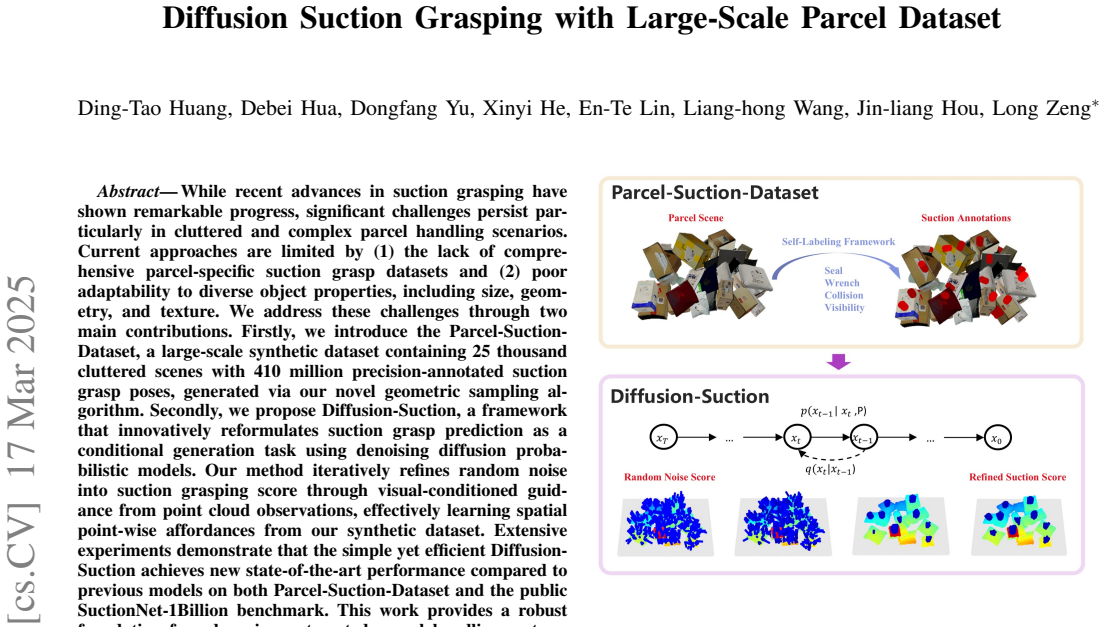
The central mechanism is the diffusion denoising process operating in the space of suction-grasp confidence scores. The paper defines suction poses as a position and approach normal, reduces the problem to predicting a point-wise score, and models the reverse diffusion $p_\theta(x_{t-1}|x_t,P)$ conditioned on the scene point cloud $P$. The architecture is split into a PointNet++ encoder, run once, and a lightweight Pointcloud Conditioned Denoising Block (PCDB) that combines the noisy score map, timestamp embedding, and visual features, applies channel-spatial attention (CBAM), and uses residual connections. A second key component is the Self-Parcel-Suction-Labeling pipeline, which generates annotations from the product $S = S_{\text{seal}} \times S_{\text{wrench}} \times S_{\text{collision}} \times S_{\text{visibility}}$, where the visibility term measures pixel-level occlusion and a gravity-angle correction adjusts the wrench score for side grasps.
What would settle it
Run a physical suction trial on a set of parcel objects with varying flatness, side-grasp angles, and occlusion levels, record the analytic score of each predicted grasp before attempting it, and check whether the analytic score ordering matches actual grasp success; if many top-scoring predictions fail in exactly the cases where the visibility term or the gravity-angle correction is active, the annotation protocol is the weak link.
Extended reading notes
Core claim
Diffusion-Suction reformulates suction-grasp prediction as an iterative denoising process rather than a one-shot discriminative prediction. Given a scene point cloud, a point encoder extracts visual features once; a lightweight denoising decoder then repeatedly refines a Gaussian noise map into a per-point suction score map, using a cosine noise schedule and DDIM sampling. The paper argues that this generative formulation, trained on the new synthetic Parcel-Suction-Dataset, yields state-of-the-art results: Top-50 AP 94.42 and Top-1 AP 98.00 on Parcel-Suction-Dataset, and consistent improvements over prior methods on SuctionNet-1Billion across seen, similar, and novel scenes. The authors also report real-robot grasp success rates of 78.69% to 100% across rectangular, planar, cylindrical, and mixed parcel types in scattered and stacked scenes.
Load-bearing premise
The dataset's ground-truth labels are generated by an analytic formula for seal, wrench, collision, and visibility, and the benchmark then scores predictions against those same self-generated labels, so if that formula does not reflect physical suction success, the benchmark gains may not transfer to real grasping even though a small robot experiment suggests they do.
Editorial extensions
If this is right
- If the reported results hold, diffusion-based score-map generation becomes a strong alternative to discriminative suction-grasp networks, potentially improving bin-picking and parcel-handling systems in logistics.
- The Parcel-Suction-Dataset, if released, would give the community a large, diverse synthetic benchmark specifically for flat and occluded parcel objects, filling a gap left by existing cluttered-scene datasets.
- The method's split of a once-run point encoder and a lightweight iterative decoder suggests that diffusion-based affordance prediction can be made computationally practical for real-time robotic picking.
- The visibility and gravity-angle terms in the annotation pipeline could generalize to other suction-grasping benchmarks, providing a recipe for automatically labeling hard-to-measure grasp outcomes.
Reading between the lines
- The paper's framing implies that any dense affordance-prediction task, such as parallel-jaw grasping, pushing, or tool-use point selection, could be reformulated as a diffusion denoising problem with a similar encoder plus lightweight denoising decoder structure; this is an editorial extension, not a claim the paper tests.
- The success of the visibility term suggests that occlusion-aware labels are a major driver of performance in heavily stacked scenes; one could test this directly by ablating the visibility term on other suction datasets with real occlusion statistics.
- A concrete testable extension would be to train Diffusion-Suction on Parcel-Suction-Dataset and evaluate on a real parcel-picking benchmark with a substantially different parcel distribution, to see whether the synthetic-to-real transfer shown in the paper's small robot experiment holds at scale.
Signed reviews
Editorial analysis
A structured set of objections, weighed in public.
Referee Report
Summary. The paper proposes a large-scale synthetic suction-grasping dataset for parcel scenes, Parcel-Suction-Dataset (25k cluttered scenes, 410M annotated poses), generated by a Self-Parcel-Suction-Labeling (SPSL) pipeline with seal, wrench, collision, and visibility scores. It also proposes Diffusion-Suction, a diffusion-based model that denoises random noise into suction-grasp score maps conditioned on PointNet++ point-cloud features. Experiments report state-of-the-art results on both Parcel-Suction-Dataset (Top-50 AP 94.42 vs. 62.81 for Cao et al.) and SuctionNet-1Billion, plus ablations and a real-robot grasping study with success rates between 78% and 100%.
Significance. If the claims hold, the paper would provide a large parcel-specific synthetic benchmark and a novel generative formulation for suction-grasp prediction, both potentially useful for logistics automation. The SuctionNet-1Billion improvements are concrete and the ablation study gives some insight into the design choices. The stated intent to release code and dataset is a further strength. However, the validity of the central benchmark claim depends on the annotation protocol being a faithful proxy for physical suction success, and the current evidence for that is weak.
major comments (4)
- [§III-B, §V-A] The Parcel-Suction-Dataset ground-truth labels, the diffusion training target, and the online evaluation criterion are all produced by the same analytic scoring model S = S_seal × S_wrench × S_collision × S_visibility. Section V-A states that online evaluation computes seal and wrench scores for correctness and, for Parcel scenes, also computes visibility scores. Thus the reported AP on this benchmark primarily measures how well a model regresses the authors' own annotation function, not physical suction success. No independent validation of S_seal, S_wrench, or S_visibility against real suction outcomes is given. The large Top-50 AP gap (94.42 vs. 62.81) is consistent with Diffusion-Suction fitting this synthetic scoring function better than the baselines, but it does not by itself establish a physical grasping advantage. Please add a hold-out validation of the annotation model against physical grasp outcomes, or clearly reframe the benchmark result as performance on the synthetic scoring model.
- [Table II, §V-B] The paper does not state whether the comparator methods (Normal STD, DexNet3.0, Cao et al.) were retrained on the Parcel-Suction-Dataset training split or evaluated with their original weights. Since Diffusion-Suction is trained on Parcel labels, a zero-shot or differently-trained baseline comparison would not be controlled. Please specify the exact training and evaluation protocol for every method in Table II and, if the baselines were not retrained on the same split, provide retrained results.
- [Table I, §V-C] The paper does not state whether Diffusion-Suction was trained or fine-tuned on SuctionNet-1Billion or only on Parcel-Suction-Dataset. This distinction is essential for interpreting the SuctionNet results: an improvement over Cao et al. could be an in-dataset comparison or a cross-dataset generalization result, which have very different implications. Please state the training data, fine-tuning protocol, and any hyperparameter changes used for the SuctionNet experiments.
- [Table V, §V-E] The real-robot experiment has no baseline comparator, no trial counts, and no confidence intervals, and the stopping rule ('terminated if the robot failed to grasp any object in three consecutive attempts') can bias reported success rates by ending runs after difficult sub-sequences. With R_grasp values between 78% and 100% across conditions and no uncertainty quantification, the experiment cannot by itself bridge the gap between the synthetic benchmark and physical grasping. Please add per-condition trial counts, standard errors or confidence intervals, and at least one baseline method evaluated under identical conditions.
minor comments (5)
- [§III-B, Eq. (3)] The wrench score formula has unbalanced parentheses and uses |τ_e| where τ_e is defined as a vector in Eq. (2); please clarify the intended norm and correct the typesetting.
- [Algorithm 1, Algorithm 2] The variable x0 is used inconsistently: in Algorithm 1 it denotes the score map, while in Algorithm 2 it is passed to PointNet++ as if it were the input point cloud. Please rename one of the variables to avoid confusion.
- [Table IV, §V-D] The AP values for training step 20 with inference steps 15 (10.06) and 5 (28.10) versus inference step 10 (81.95) are strongly non-monotonic; please verify these numbers or discuss the cause, as this may indicate numerical instability or a typographical error.
- [§V-A] The evaluation description says the product of seal and wrench scores is thresholded for correctness and that for Parcel scenes visibility scores are also calculated, but it does not specify how the visibility score enters the correctness criterion. Please define the exact online evaluation rule for the Parcel benchmark.
- [§V-B] The sentence 'an improvement of +32% on average precision the in the top-50 metric' contains a typo and should be rephrased.
Circularity Check
Parcel-Suction-Dataset SOTA is partly self-referential: the same analytic score S generates the training targets and the online evaluation metric, so the benchmark primarily measures fit to the authors' own scoring function; SuctionNet and real-robot results provide independent support.
-
self definitional
[Section III-B (score definition S = Sseal × Swrench × Scollision × Svisibility), Section IV-C Algorithm 1 (training target), Section V-A (online evaluation metric)]
"the higher the score is, the easier it will be to perform suction grasping in real-world scenes. ... We define the final metric as the product of the sub-evaluation scores S = Sseal × Swrench × Scollision × Svisibility. ... We add Gaussian noise to the ground-truth suction grasping score according to Equation (5). ... When evaluating the Parcel-Suction-Dataset, we calculate visibility scores for online evaluation."
Parcel labels are generated by the SPSL analytic model S; Algorithm 1 trains the diffusion head to regress that same ground-truth score x0; and the online AP criterion is the product of seal, wrench, and visibility scores, the same S. Hence a model that outputs S is correct by construction, and the 94.42 AP primarily measures fit to the authors' own scoring function, not an independent physical grasp measurement. This makes the Parcel benchmark claim self-referential. SuctionNet-1Billion uses externally fixed labels and the real-robot test is an independent (though small, baseline-free) check, so circularity is partial.
full rationale
The paper is primarily an empirical contribution, not a formal derivation, so there is no Eq-X-equals-Eq-Y chain in the diffusion formulation; the DDPM/DDIM mechanics follow standard published models. The only circularity-adjacent step is that the Parcel-Suction-Dataset benchmark uses the same analytic scoring function S to create ground-truth labels, to supervise the diffusion head, and to judge prediction correctness, which makes the Parcel SOTA a self-consistency result. This concern is mitigated by the independent SuctionNet-1Billion benchmark and by the real-robot experiments, though the robot test has no baseline comparator and no confidence intervals. No load-bearing self-citations or imported uniqueness theorems appear. Overall score 3 reflects one partial self-reference while the central claim retains independent empirical content.
Assumptions & free parameters
free parameters (2)
- signal scaling factor scale =
0.5
- diffusion training/inference step T =
20
assumptions (5)
- domain assumption The analytic suction contact model from Cao et al. (seal and wrench scores) accurately predicts real suction grasp success.
- domain assumption Bullet-simulated stacking with randomized friction and poses faithfully represents real cluttered parcel piles.
- domain assumption TRELLIS-generated 3D parcel assets from multi-view images are sufficient proxies for real parcels.
- ad hoc to paper The composite score S = S_seal * S_wrench * S_collision * S_visibility is a valid scalar objective for ranking suction grasps.
- ad hoc to paper The visibility score, defined as the ratio of occluded to unobstructed pixel areas, correctly penalizes grasps that disturb other parcels.
Cite this review
Pith. "Pith review of Diffusion Suction Grasping with Large-Scale Parcel Dataset." pith.science (2026). https://pith.science/paper/N4KWLBYX
@misc{pith2026250207238,
  author       = {Pith},
  title        = {Pith review of: Diffusion Suction Grasping with Large-Scale Parcel Dataset},
  year         = {2026},
  howpublished = {\url{https://pith.science/paper/N4KWLBYX}},
  note         = {Machine review of arXiv:2502.07238}
}
read the original abstract
While recent advances in object suction grasping have shown remarkable progress, significant challenges persist particularly in cluttered and complex parcel handling scenarios. Two fundamental limitations hinder current approaches: (1) the lack of a comprehensive suction grasp dataset tailored for parcel manipulation tasks, and (2) insufficient adaptability to diverse object characteristics including size variations, geometric complexity, and textural diversity. To address these challenges, we present Parcel-Suction-Dataset, a large-scale synthetic dataset containing 25 thousand cluttered scenes with 410 million precision-annotated suction grasp poses. This dataset is generated through our novel geometric sampling algorithm that enables efficient generation of optimal suction grasps incorporating both physical constraints and material properties. We further propose Diffusion-Suction, an innovative framework that reformulates suction grasp prediction as a conditional generation task through denoising diffusion probabilistic models. Our method iteratively refines random noise into suction grasp score maps through visual-conditioned guidance from point cloud observations, effectively learning spatial point-wise affordances from our synthetic dataset. Extensive experiments demonstrate that the simple yet efficient Diffusion-Suction achieves new state-of-the-art performance compared to previous models on both Parcel-Suction-Dataset and the public SuctionNet-1Billion benchmark.
Figures


Figures from the paper (3 more)


Reference graph
Works this paper leans on
-
[1]
Visual sorting of express parcels based on multi-task deep learning,
S. Han, X. Liu, X. Han, G. Wang, and S. Wu, “Visual sorting of express parcels based on multi-task deep learning,” Sensors, vol. 20, no. 23, p. 6785, 2020
work page 2020
-
[2]
Robotic system for post office package handling,
O. Vismanis, J. Arents, K. Freivalds, V . Ahluwalia, and K. Ozols, “Robotic system for post office package handling,” Applied Sciences, vol. 13, no. 13, p. 7643, 2023
work page 2023
-
[3]
Suctionnet-1billion: A large- scale benchmark for suction grasping,
H. Cao, H.-S. Fang, W. Liu, and C. Lu, “Suctionnet-1billion: A large- scale benchmark for suction grasping,” IEEE Robotics and Automation Letters, vol. 6, no. 4, pp. 8718–8725, 2021
work page 2021
-
[4]
A. Zeng, S. Song, K.-T. Yu, E. Donlon, F. R. Hogan, M. Bauza, D. Ma, O. Taylor, M. Liu, E. Romo, et al., “Robotic pick-and-place of novel objects in clutter with multi-affordance grasping and cross-domain image matching,” The International Journal of Robotics Research , vol. 41, no. 7, pp. 690–705, 2022
work page 2022
-
[5]
Coas-net: Context-aware suction network with a large-scale domain randomized synthetic dataset,
Y . G. Son, T. H. Bui, J. Hong, Y . H. Kim, S. J. Moon, C. S. Kim, I. Rhee, H. Kang, and H. R. Choi, “Coas-net: Context-aware suction network with a large-scale domain randomized synthetic dataset,” IEEE Robotics and Automation Letters , vol. 9, no. 1, pp. 827–834, 2023
work page 2023
-
[6]
Team delft’s robot winner of the amazon picking challenge 2016,
C. Hernandez, M. Bharatheesha, W. Ko, H. Gaiser, J. Tan, K. van Deurzen, M. de Vries, B. Van Mil, J. van Egmond, R. Burger, et al., “Team delft’s robot winner of the amazon picking challenge 2016,” in RoboCup 2016: Robot World Cup XX 20 . Springer, 2017, pp. 613–624
work page 2016
-
[7]
PVN3D: A deep point-wise 3d keypoints voting network for 6dof pose estimation,
Y . He, W. Sun, H. Huang, J. Liu, H. Fan, and J. Sun, “PVN3D: A deep point-wise 3d keypoints voting network for 6dof pose estimation,” in Proceedings of the IEEE/CVF conference on computer vision and pattern recognition, 2020, pp. 11 632–11 641
work page 2020
-
[8]
D.-T. Huang, E.-T. Lin, L. Chen, L.-F. Liu, and L. Zeng, “Sd- net: Symmetric-aware keypoint prediction and domain adaptation for 6d pose estimation in bin-picking scenarios,” arXiv preprint arXiv:2403.09317, 2024
work page Pith review arXiv 2024
Show all 30 references
-
[9]
Uncertainty-aware suction grasping for cluttered scenes,
R. Cao, B. Yang, Y . Li, C.-W. Fu, P.-A. Heng, and Y .-H. Liu, “Uncertainty-aware suction grasping for cluttered scenes,” IEEE Robotics and Automation Letters , 2024
2024
-
[10]
Denoising diffusion implicit models,
J. Song, C. Meng, and S. Ermon, “Denoising diffusion implicit models,” arXiv preprint arXiv:2010.02502 , 2020
2010 arXiv
-
[11]
Suction grasp region prediction using self-supervised learning for object picking in dense clutter,
Q. Shao, J. Hu, W. Wang, Y . Fang, W. Liu, J. Qi, and J. Ma, “Suction grasp region prediction using self-supervised learning for object picking in dense clutter,” in 2019 IEEE 5th International Conference on Mechatronics System and Robots (ICMSR) . IEEE, 2019, pp. 7–12
2019
-
[12]
Sim-suction: Learning a suction grasp policy for cluttered environments using a synthetic benchmark,
J. Li and D. J. Cappelleri, “Sim-suction: Learning a suction grasp policy for cluttered environments using a synthetic benchmark,” IEEE Transactions on Robotics , 2023
2023
-
[13]
PPR- Net: point-wise pose regression network for instance segmentation and 6d pose estimation in bin-picking scenarios,
Z. Dong, S. Liu, T. Zhou, H. Cheng, L. Zeng, X. Yu, and H. Liu, “PPR- Net: point-wise pose regression network for instance segmentation and 6d pose estimation in bin-picking scenarios,” in 2019 IEEE/RSJ International Conference on Intelligent Robots and Systems (IROS) . IEEE, ...
2019
-
[14]
PPR-Net++: accurate 6-d pose estimation in stacked scenarios,
L. Zeng, W. J. Lv, Z. K. Dong, and Y . J. Liu, “PPR-Net++: accurate 6-d pose estimation in stacked scenarios,” IEEE Transactions on Automation Science and Engineering , vol. 19, no. 4, pp. 3139–3151, 2021
2021
-
[15]
Parametricnet: 6dof pose estimation network for parametric shapes in stacked scenarios,
L. Zeng, W. J. Lv, X. Y . Zhang, and Y . J. Liu, “Parametricnet: 6dof pose estimation network for parametric shapes in stacked scenarios,” in 2021 IEEE International Conference on Robotics and Automation (ICRA). IEEE, 2021, pp. 772–778
2021
-
[16]
Robot suction region prediction method from knowledge to learning in disordered manufacturing scenarios,
T. Zhang, C. Zhang, S. Ji, and T. Hu, “Robot suction region prediction method from knowledge to learning in disordered manufacturing scenarios,” Engineering Applications of Artificial Intelligence , vol. 120, p. 105928, 2023
2023
-
[17]
Denoising diffusion probabilistic models,
J. Ho, A. Jain, and P. Abbeel, “Denoising diffusion probabilistic models,” Advances in neural information processing systems , vol. 33, pp. 6840–6851, 2020
2020
-
[18]
Generative adversarial nets,
I. Goodfellow, J. Pouget-Abadie, M. Mirza, B. Xu, D. Warde-Farley, S. Ozair, A. Courville, and Y . Bengio, “Generative adversarial nets,” Advances in neural information processing systems , vol. 27, 2014
2014
-
[19]
Auto-encoding variational bayes,
D. P. Kingma, “Auto-encoding variational bayes,” arXiv preprint arXiv:1312.6114, 2013
2013 arXiv
-
[20]
Structured 3d latents for scalable and versatile 3d generation,
J. Xiang, Z. Lv, S. Xu, Y . Deng, R. Wang, B. Zhang, D. Chen, X. Tong, and J. Yang, “Structured 3d latents for scalable and versatile 3d generation,” arXiv preprint arXiv:2412.01506 , 2024
2024 arXiv
-
[21]
Generative modeling by estimating gradients of the data distribution,
Y . Song and S. Ermon, “Generative modeling by estimating gradients of the data distribution,” Advances in neural information processing systems, vol. 32, 2019
2019
-
[22]
Pointnet++: Deep hierarchical feature learning on point sets in a metric space,
C. R. Qi, L. Yi, H. Su, and L. J. Guibas, “Pointnet++: Deep hierarchical feature learning on point sets in a metric space,” Advances in neural information processing systems , vol. 30, 2017
2017
-
[23]
Dynamic graph cnn for learning on point clouds,
Y . Wang, Y . Sun, Z. Liu, S. E. Sarma, M. M. Bronstein, and J. M. Solomon, “Dynamic graph cnn for learning on point clouds,” ACM Transactions on Graphics (tog) , vol. 38, no. 5, pp. 1–12, 2019
2019
-
[24]
Pointnet: Deep learning on point sets for 3d classification and segmentation,
C. R. Qi, H. Su, K. Mo, and L. J. Guibas, “Pointnet: Deep learning on point sets for 3d classification and segmentation,” in Proceedings of the IEEE conference on computer vision and pattern recognition , 2017, pp. 652–660
2017
-
[25]
4d spatio-temporal convnets: Minkowski convolutional neural networks,
C. Choy, J. Gwak, and S. Savarese, “4d spatio-temporal convnets: Minkowski convolutional neural networks,” in Proceedings of the IEEE/CVF conference on computer vision and pattern recognition , 2019, pp. 3075–3084
2019
-
[26]
Open3d: A modern library for 3d data processing,
Q.-Y . Zhou, J. Park, and V . Koltun, “Open3d: A modern library for 3d data processing,” arXiv preprint arXiv:1801.09847 , 2018
2018 arXiv
-
[27]
Cbam: Convolutional block attention module,
S. Woo, J. Park, J.-Y . Lee, and I. S. Kweon, “Cbam: Convolutional block attention module,” in Proceedings of the European conference on computer vision (ECCV) , 2018, pp. 3–19
2018
-
[28]
Deep residual learning for image recognition,
K. He, X. Zhang, S. Ren, and J. Sun, “Deep residual learning for image recognition,” in Proceedings of the IEEE conference on computer vision and pattern recognition , 2016, pp. 770–778
2016
-
[29]
A generalist framework for panoptic segmentation of images and videos,
T. Chen, L. Li, S. Saxena, G. Hinton, and D. J. Fleet, “A generalist framework for panoptic segmentation of images and videos,” in Proceedings of the IEEE/CVF international conference on computer vision, 2023, pp. 909–919
2023
-
[30]
Dex- net 3.0: Computing robust vacuum suction grasp targets in point clouds using a new analytic model and deep learning,
J. Mahler, M. Matl, X. Liu, A. Li, D. Gealy, and K. Goldberg, “Dex- net 3.0: Computing robust vacuum suction grasp targets in point clouds using a new analytic model and deep learning,” in 2018 IEEE International Conference on robotics and automation (ICRA) . IEEE, 2018, pp. 5620–5627
2018
Reviewed August 8, 2026 · model on record in the stance chip above.
Discussion (0). Continue with ORCID to comment.