Identical Bosons, large occupation numbers and classical field description
Pith reviewed 2026-06-27 16:05 UTC · model grok-4.3
The pith
Large occupation numbers alone do not ensure classical field behavior for identical bosons; proximity to a coherent state is required.
A machine-rendered reading of the paper's core claim, the machinery that carries it, and where it could break.
Core claim
An arbitrary quantum state of identical bosons with large occupation numbers does not necessarily behave classically under the criterion 2 σ_φ < |<φ>|. Coherent states exhibit quasi-classical behavior, and the analysis demonstrates that deviations from a large-occupation coherent state can violate the classicality condition. Thus, it is the proximity of the state to a large-occupation coherent state, rather than the occupation number itself, that ensures the validity of the classical field description.
What carries the argument
The criterion 2 σ_φ < |<φ>|, which checks whether phase uncertainty is smaller than the mean field amplitude, applied to test classicality of arbitrary quantum states of identical bosons.
If this is right
- Classical field equations for ultra-light dark matter apply only when the state remains close to a large-occupation coherent state.
- Arbitrary states with large occupation numbers but significant phase variance require full quantum treatment.
- Restrictions placed on state vectors can restore classical behavior even for boson systems.
- Deviation from coherence spoils the classical description at any occupation number.
Where Pith is reading between the lines
- Similar checks on state proximity to coherence may be needed when modeling other many-boson systems such as condensates.
- Experimental preparation of controlled deviations from coherent states could map the boundary between classical and quantum regimes.
- Simulations of boson dynamics should incorporate state classification rather than occupation number alone.
Load-bearing premise
The criterion 2 σ_φ < |<φ>| is a sufficient and appropriate test for classical field behaviour that can be applied to arbitrary quantum states of identical bosons.
What would settle it
A concrete calculation or simulation of a quantum state with large occupation number that satisfies 2 σ_φ < |<φ>| yet produces observable non-classical effects such as interference or squeezing would falsify the criterion.
Figures
read the original abstract
For a system with a large number of identical Bosons, it is common to claim, often without any additional justifications, that, when the mean occupation number in a single particle state is sufficiently large, classical field description will be applicable. This is why e.g. for ultra-light dark matter, the classical field equations are used to compute its dynamics. In this work, we test the validity and robustness of this assumption based on the criterion $2 \sigma_\varphi < |\langle \varphi \rangle| $ for classical field behaviour and applying it to aribtrary quantum states. We find that an arbitrary state with large occupation number doesn't behave classically while imposing some restrictions on the state vectors can improve the classical behavior. Since coherent states are known to have quasi-classical behaviour, we also ask how much deviation from coherent state can spoil the classical behaviour. Based on this analysis, we find that it is the proximity of the state to a large occupation coherent state rather than large occupation number itself which ensures validity of classical description. Implications of this for ultra light dark matter are discussed.
Editorial analysis
A structured set of objections, weighed in public.
Referee Report
Summary. The manuscript claims that for identical bosons, a large mean occupation number in a single-particle state is insufficient by itself to justify a classical field description; instead, the quantum state must be sufficiently close to a large-occupation coherent state. This is tested by applying the inequality 2 σ_φ < |<φ>| as a criterion for classical behavior to arbitrary quantum states, showing that generic large-N states fail the test while states near coherent states succeed, with implications discussed for ultra-light dark matter modeling.
Significance. If the central distinction holds under a justified criterion, the result would require revisions to common practice in bosonic systems (e.g., ultra-light dark matter simulations) where large occupation number alone is taken to license classical field equations. The work correctly identifies that coherent states are known to be quasi-classical, but the quantitative mapping from state proximity to classical dynamics remains to be established.
major comments (2)
- [Criterion definition and application (abstract and main text sections presenting the test)] The inequality 2 σ_φ < |<φ>| is introduced and applied as the diagnostic for classical field behaviour on arbitrary states, yet no derivation is supplied showing why field-amplitude fluctuation (with prefactor 2) is the appropriate and sufficient proxy for reduction to classical equations such as the Gross-Pitaevskii equation. This is load-bearing for the central claim, as the distinction between “large N” and “near-coherent” collapses if the criterion is ad hoc or limited to a restricted class of states.
- [Sections applying the criterion to example states and discussing deviations from coherence] The manuscript concludes that arbitrary large-occupation states fail the classicality test while restrictions on state vectors improve it, but the specific families of states examined and the quantitative measure of “proximity to a coherent state” are not shown to be representative or free of post-hoc selection; without this, the generality of the result for arbitrary bosonic states cannot be assessed.
minor comments (2)
- [Abstract] Abstract contains the typo “aribtrary” (should be “arbitrary”).
- [Abstract and corresponding discussion section] The phrasing “how much deviation from coherent state can spoil the classical behaviour” is vague; a quantitative metric (e.g., overlap or distance in Fock space) should be defined when this is introduced.
Simulated Author's Rebuttal
We thank the referee for the careful reading of our manuscript and the constructive comments. We respond to each major comment below, indicating where revisions will be incorporated.
read point-by-point responses
-
Referee: [Criterion definition and application (abstract and main text sections presenting the test)] The inequality 2 σ_φ < |<φ>| is introduced and applied as the diagnostic for classical field behaviour on arbitrary states, yet no derivation is supplied showing why field-amplitude fluctuation (with prefactor 2) is the appropriate and sufficient proxy for reduction to classical equations such as the Gross-Pitaevskii equation. This is load-bearing for the central claim, as the distinction between “large N” and “near-coherent” collapses if the criterion is ad hoc or limited to a restricted class of states.
Authors: The criterion is motivated by the physical requirement that the relative fluctuation in the field amplitude must be small enough for the expectation value to provide a reliable classical description, with the prefactor 2 corresponding to a threshold where fluctuations remain sub-dominant (σ_φ / |<φ>| < 1/2). This is consistent with standard treatments in quantum optics where coherent states satisfy equality at this scale. We agree, however, that an explicit link to the suppression of quantum corrections in the Gross-Pitaevskii dynamics would strengthen the presentation. In the revised version we will add a short derivation showing how the inequality ensures that higher-order correlation functions do not contribute appreciably to the equations of motion. revision: yes
-
Referee: [Sections applying the criterion to example states and discussing deviations from coherence] The manuscript concludes that arbitrary large-occupation states fail the classicality test while restrictions on state vectors improve it, but the specific families of states examined and the quantitative measure of “proximity to a coherent state” are not shown to be representative or free of post-hoc selection; without this, the generality of the result for arbitrary bosonic states cannot be assessed.
Authors: The families considered (Fock states, thermal states, and coherent states with controlled deviations) are chosen because they are analytically tractable and span the range of possible fluctuation behaviors for fixed large occupation number. The failure of generic large-N states follows directly from the fact that any state not centered on a coherent-state displacement operator necessarily possesses larger variance in the field operator. While the examples are illustrative rather than exhaustive, the underlying argument is general: the classicality condition is satisfied if and only if the state is sufficiently close to a coherent state of the same mean occupation. We will revise the text to make this general argument more prominent and to clarify that the quantitative threshold on proximity is set by the same inequality used throughout. revision: partial
Circularity Check
No significant circularity detected
full rationale
The paper applies the stated criterion 2 σ_φ < |<φ>| as an input test for classical field behavior across arbitrary bosonic states and concludes that proximity to a large-occupation coherent state (rather than occupation number alone) is required. No equations, parameters, or predictions within the provided abstract or description reduce by construction to fitted inputs, self-definitions, or self-citation chains; the criterion is used to evaluate states rather than being redefined or forced by the result itself. The derivation chain remains self-contained.
Axiom & Free-Parameter Ledger
axioms (1)
- domain assumption The inequality 2 σ_φ < |<φ>| is a valid and sufficient indicator of classical field behaviour for bosonic systems.
Reference graph
Works this paper leans on
-
[1]
for a discussion). Let us begin by recalling that mean occupation num- ber is defined to be the ratio of the number density of 3 particles in phase space to the number density of quan- tum states in phase space. In many situations of interest only one or a few modes are such that their occupation numbers are large - this is obviously relevant in the con- ...
-
[2]
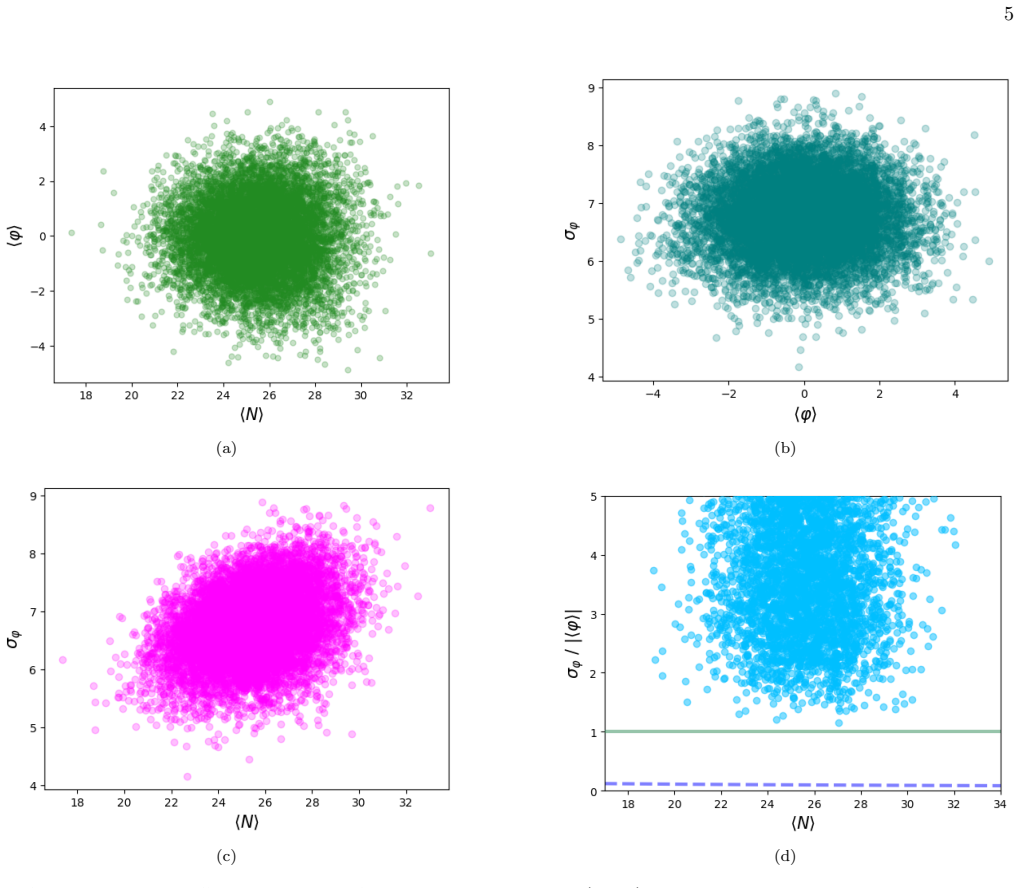
Case I Let us first examine the case in which allc ns are uni- formly distributed pseudo-random numbers within the interval (−1,1). Once a pseudo random vector is ob- tained, we normalise it and apply the expressions given above to compute the quantities⟨N⟩,⟨φ⟩,σ φ,σ φ/⟨φ⟩ etc for each state vector in our sample. For the case withN dim = 50 andN sample = ...
-
[3]
Similarly, changing the number of vectors in the sample from 10 4 to 10 5 doesn’t change these results i.e
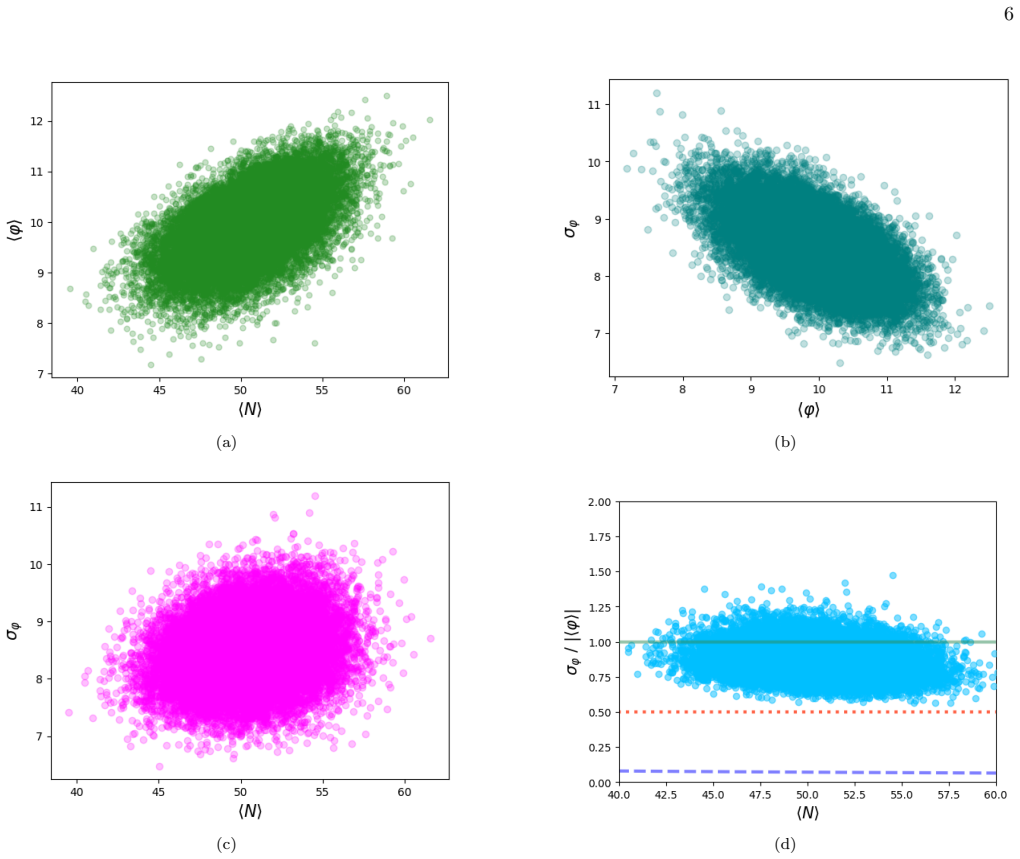
Case II Could our results for the last case be sensitive to the value ofN dim? Could increasing the value of the number of vectors in the sample i.e.N sample change anything substantial? We verified that increasingN dim from 50 to 100 will give similar results, though the typical⟨N⟩of the vectors in the sample will now be around 50. Similarly, changing th...
-
[4]
The results for this case are shown in fig (2) forN dim = 100 andN sample = 25000
Case III Let us now examine the case in whichc ns are all posi- tive, in particular, suppose they are uniformly distributed pseudo-random numbers within the interval (0,2). The results for this case are shown in fig (2) forN dim = 100 andN sample = 25000. We see that merely insisting that all the coefficientsc n be positive introduces correlations between...
-
[5]
We thus con- sider vectors whose expansion coefficients are normally distributed pseudo random numbers aroundc n values for coherent state
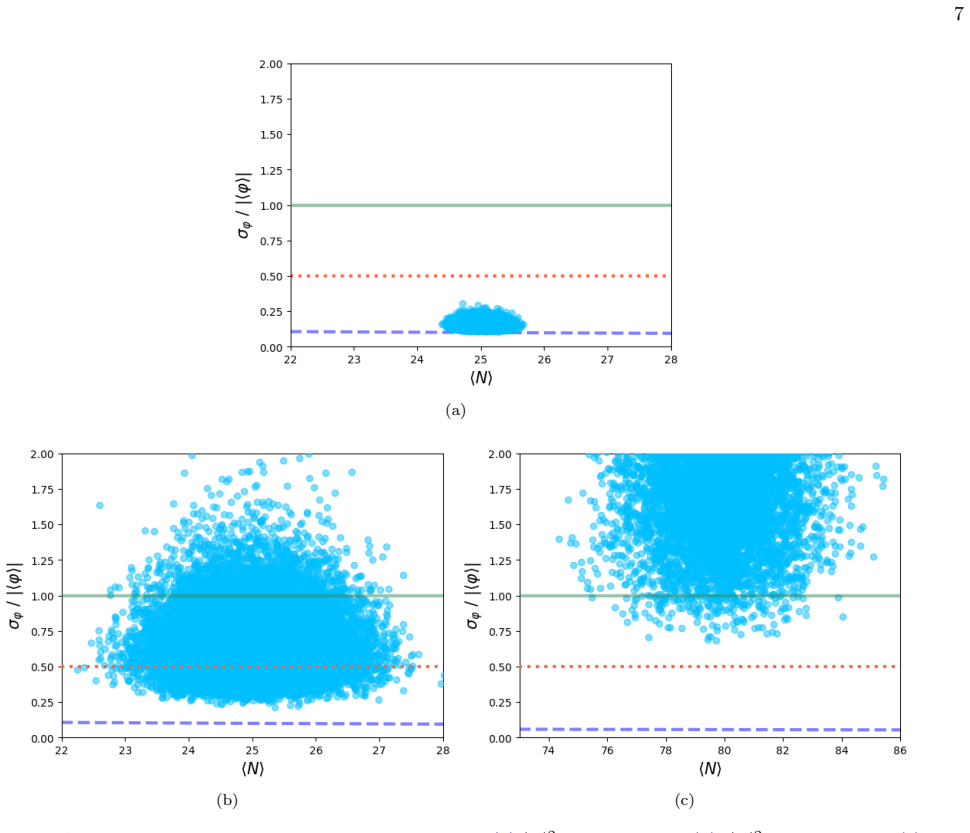
Case IV Given this, it make sense to look at the vectors whose coefficients are similar to coherent states. We thus con- sider vectors whose expansion coefficients are normally distributed pseudo random numbers aroundc n values for coherent state. For eachn, we will have a normal distri- bution with mean given by the expression in Eq (5) and standard devi...
2022
-
[6]
M. Cirelli, A. Strumia and J. Zupan, “Dark Matter,” SciPost Phys. Rev. 1 (2026) [arXiv:2406.01705 [hep-ph]]
Pith/arXiv arXiv 2026
-
[7]
L. Hui, “Wave Dark Matter,” Ann. Rev. Astron. As- trophys.59, 247-289 (2021) doi:10.1146/annurev-astro- 120920-010024 [arXiv:2101.11735 [astro-ph.CO]]
-
[8]
Ultralight fuzzy dark matter review,
A. Eberhardt and E. G. M. Ferreira, “Ultralight fuzzy dark matter review,” [arXiv:2507.00705 [astro-ph.CO]]
-
[9]
H. Y. Schive, “Fuzzy dark matter simulations,” Liv. Rev. Comput. Astrophys.12, no.1, 1 (2026) doi:10.1007/s41115-026-00027-5 [arXiv:2509.23231 [astro-ph.CO]]
work page internal anchor Pith review Pith/arXiv arXiv doi:10.1007/s41115-026-00027-5 2026
-
[10]
M. Indjin, N. Keepfer, I. K. Liu, N. P. Proukakis and G. Rigopoulos,“Fuzzy dark matter haloes with repulsive self-interactions: coherent soliton and halo vortex network with moderate self-coupling,” Mon. Not. Roy. Astron. Soc.545, no.3, staf2046 (2025) doi:10.1093/mnras/staf2046 [arXiv:2507.00293 [astro- ph.CO]]
-
[11]
Heating and scattering of stellar distributions by ultralight dark matter,
A. Eberhardt, M. Gosenca and L. Hui, “Heating and scattering of stellar distributions by ultralight dark matter,” Phys. Rev. D113, no.8, 083535 (2026) doi:10.1103/zngx-f8pz [arXiv:2510.17079 [astro-ph.CO]]
-
[12]
Cosmology of axion dark matter,
C. A. J. O’Hare, “Cosmology of axion dark matter,” PoSCOSMICWISPers, 040 (2024) doi:10.22323/1.454.0040 [arXiv:2403.17697 [hep-ph]]
-
[13]
Quantum description of wave dark matter,
D. Y. Cheong, N. L. Rodd and L. T. Wang, “Quantum description of wave dark matter,” Phys. Rev. D111, no.1, 015028 (2025) doi:10.1103/PhysRevD.111.015028 [arXiv:2408.04696 [hep-ph]]
-
[14]
Advanced Quantum Mechanics
J. J. Sakurai, “Advanced Quantum Mechanics”, Addison-Wesley Publishing Company, 1967, ISBN 978- 0201067101
1967
-
[15]
Quantum Electrodynamics (Volume 4 of the Course of Theoretical Physics)
V. B. Berestetskii, E. M. Lifshitz, and L. P. Pitaevskii, “Quantum Electrodynamics (Volume 4 of the Course of Theoretical Physics)”, Pergamon Press, 1982, ISBN 978- 0-7506-3371-0
1982
-
[16]
Classical Limit of Quantum Elec- trodynamics,
I. Bialynicki-Birula, “Classical Limit of Quantum Elec- trodynamics,” Acta Phys. Austriaca Suppl.18, 111-151 (1977)
1977
-
[17]
Introduction to Quantum Op- tics,
C. Navarrete-Benlloch, “Introduction to Quantum Op- tics,” [arXiv:2203.13206 [quant-ph]]
-
[18]
Duration of classicality in highly degenerate interacting Bosonic systems
P. Sikivie and E. M. Todarello, “Duration of clas- sicality in highly degenerate interacting Bosonic systems,” Phys. Lett. B770, 331-334 (2017) doi:10.1016/j.physletb.2017.04.069 [arXiv:1607.00949 [hep-ph]]
work page internal anchor Pith review Pith/arXiv arXiv doi:10.1016/j.physletb.2017.04.069 2017
-
[19]
Quantum and Classical Behavior in Interacting Bosonic Systems
M. P. Hertzberg, “Quantum and Classical Behavior in Interacting Bosonic Systems,” JCAP11, 037 (2016) doi:10.1088/1475-7516/2016/11/037 [arXiv:1609.01342 [hep-ph]]
work page internal anchor Pith review Pith/arXiv arXiv doi:10.1088/1475-7516/2016/11/037 2016
-
[20]
Classicality and Quantum Break-Time for Cosmic Axions
G. Dvali and S. Zell, “Classicality and Quantum Break-Time for Cosmic Axions,” JCAP07, 064 (2018) doi:10.1088/1475-7516/2018/07/064 [arXiv:1710.00835 [hep-ph]]
work page internal anchor Pith review Pith/arXiv arXiv doi:10.1088/1475-7516/2018/07/064 2018
-
[21]
A. Arza, S. S. Chakrabarty, S. Enomoto, Y. Han and E. Todarello, “Duration of Classicality of an inho- mogeneous quantum field with repulsive contact self- interactions,” Phys. Rev. D100, no.12, 125010 (2019) doi:10.1103/PhysRevD.100.125010 [arXiv:1907.04941 [hep-th]]
-
[22]
A. Eberhardt, A. Zamora, M. Kopp and T. Abel, “Classical field approximation of ultralight dark matter: Quantum break times, corrections, and de- coherence,” Phys. Rev. D109, no.8, 083527 (2024) doi:10.1103/PhysRevD.109.083527 [arXiv:2310.07119 [astro-ph.CO]]
-
[23]
N. P. Proukakis, G. Rigopoulos and A. Soto, “Hy- brid model of condensate and particle dark mat- ter: Linear perturbations in the hydrodynamic limit,” Phys. Rev. D110, no.2, 023504 (2024) doi:10.1103/PhysRevD.110.023504 [arXiv:2311.05280 [astro-ph.CO]]
-
[24]
Quantum liquids: Bose condensation and Cooper pairing in condensed-matter systems
A. J. Leggett, “Quantum liquids: Bose condensation and Cooper pairing in condensed-matter systems” Ox- ford University Press, (2006). 9780198526438.001.0001
2006
-
[25]
Statistical Mechanics,
R. K. Pathria, “Statistical Mechanics,” Butterworth- Heinemann, 1996, ISBN 978-0-08-054171-6
1996
-
[26]
Quantum Mechanics, Volume 1: Basic Concepts, Tools, and Applications
Claude Cohen-Tannoudji, Bernard Diu, Franck Lalo¨ e 9 “Quantum Mechanics, Volume 1: Basic Concepts, Tools, and Applications” Wiley-VCH, 2019, 978-3527345533
2019
-
[27]
M. Schlosshauer, “Quantum decoherence,” Phys. Rept. 831, 1-57 (2019) doi:10.1016/j.physrep.2019.10.001 [arXiv:1911.06282 [quant-ph]]
-
[28]
Coherent states via decoherence,
W. H. Zurek, S. Habib and J. P. Paz, “Coherent states via decoherence,” Phys. Rev. Lett.70, 1187-1190 (1993) doi:10.1103/PhysRevLett.70.1187
-
[29]
Introduction to quantum effects in gravity,
V. Mukhanov and S. Winitzki, “Introduction to quantum effects in gravity,” Cambridge University Press, 2007, ISBN 978-0-521-86834-1, 978-1-139-78594-5
2007
-
[30]
A. Lagu¨ e, B. Schwabe, R. Hloˇ zek, D. J. E. Marsh and K. K. Rogers, “Cosmological simulations of mixed ultralight dark matter,” Phys. Rev. D109, no.4, 043507 (2024) doi:10.1103/PhysRevD.109.043507 [arXiv:2310.20000 [astro-ph.CO]]
-
[31]
We note that, since, classical field equations are used in simulating wave DM halos, their validity is more general than the validity of other criteria such as Penrose Onsager criterion for spatial coherence [5], which are tested for solutions of classical field equations
discussion (0)
Sign in with ORCID, Apple, or X to comment. Anyone can read and Pith papers without signing in.