REVIEW 3 major objections 6 minor 38 references
When the teacher wants to say 'Wait' but the student wants to continue, reasoning has gone wrong; Relay-OPD detects that moment, lets the teacher correct it, and lifts distilled math accuracy by 5.7 points.
Reviewed by Pith at T0; open to challenge. T0 means a machine referee read the full paper against a public rubric. the ladder, T0–T4 →
T0 review · deepseek-v4-flash
2026-08-01 00:42 UTC pith:NKOALLLD
load-bearing objection A practical, well-executed distillation method with a genuinely new trigger signal; the core mechanism is plausible but not directly validated, and the evaluation needs more seeds and a cleaner tuning story. the 3 major comments →
Pass the Baton: Trajectory-Relayed On-Policy Distillation
The pith
A machine-rendered reading of the paper's core claim, the machinery that carries it, and where it could break.
Core claim
The central claim: prefix failure—the moment a student commits to a wrong reasoning direction—is visibly marked by a teacher–student asymmetry: the teacher's top token is a reflection word (Wait, But, …) while the student's top-K contains none. This is observable online, with no label or verifier, and marks where reasoning went wrong. Relay-OPD uses it as a handoff trigger: the teacher briefly takes over (one reflection token plus L paragraphs, at most M times), then the student resumes. Training on these relay trajectories with a reverse-KL objective beats standard OPD by +5.73% (1.7B student) and +3.01% (0.6B) across eight math benchmarks, and cuts training trajectory length by more than h
What carries the argument
The handoff trigger φ(h)=1[a_T(h)∈R]·1[K_S(h)∩R=∅], where R is a fixed list of reflection tokens, a_T is the teacher's argmax token, and K_S is the student's top-K support. It turns the observation 'teacher redirects, student continues' into an online, label-free failure detector. Around it, Relay-OPD builds relay trajectories: the teacher writes one reflection token plus L paragraphs at up to M triggers, then the student resumes; a reverse-KL single-sample objective (Eq. 9) trains on the relay tokens. A single speculative-decoding engine makes the alternation exact and cheap, reusing teacher logits for both verification and trigger detection.
Load-bearing premise
The load-bearing premise is that 'the teacher wants to say a reflection word while the student's top choices contain none' reliably marks the point where reasoning has actually gone wrong; if that correlation is weak, the trigger fires on noise and the reported gains may come mostly from shorter trajectories rather than from genuine correction.
What would settle it
Annotate a few hundred student rollouts by locating the first point at which the final answer becomes unrecoverable (using a verifier or human judgment), then measure the handoff criterion's precision and recall at those points against random prefixes. If the trigger is not significantly better than chance, or if replacing each teacher leg with an equally short random sentence at the same detected positions preserves the accuracy gain, then the asymmetry is not a failure marker and the method's benefit is largely early termination.
If this is right
- Prefix failure in on-policy distillation can be corrected online without external verifiers, reward models, or process labels.
- Training becomes cheaper: average rollout length drops by over 50% (50.7% for the 1.7B student, 63.9% for 0.6B) and the best checkpoint is reached earlier.
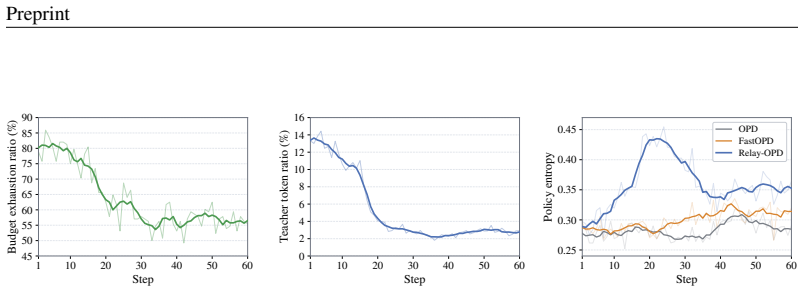
- A very small amount of teacher writing—around 0.35% of tokens in the intervention study, settling at 2–3% during training—is enough to produce most of the correction.
- The gains hold across eight benchmarks and both student scales, with best or second-best results everywhere; pass@k also improves.
- The value of teacher takeover is front-loaded: shifting intervention from early to late triggers cuts accuracy sharply, so early positions are where correction matters.
Where Pith is reading between the lines
- The handoff criterion is effectively a cheap, online error detector for long reasoning chains; a natural extension is to use it at inference time to decide when a small model should yield to a larger one, not just during training.
- The paper's evidence that the trigger marks genuine failures is indirect (one detailed case, budget-exhaustion curves, final accuracy); a direct precision/recall study against labeled failure points would separate real correction from the benefit of stopping early.
- Because later takeovers are far less effective, a training schedule that shrinks the relay budget as the student improves—matching the observed drop in budget exhaustion—could preserve the gains with even fewer teacher tokens.
- The reflection-token vocabulary is model-family-specific, as the paper itself notes; transferring the method to a model whose correction style avoids Wait/But would require re-deriving the set, and that is likely where the method would break first.
Editorial analysis
A structured set of objections, weighed in public.
Referee Report
Summary. The paper proposes Relay-OPD, an on-policy distillation method that detects 'prefix failure' through a teacher–student continuation asymmetry: when the teacher's top-1 next token is a reflection word (Wait, But, ...) while the student's top-K contains no reflection token, the teacher takes over for a short leg (L paragraphs, up to M takeovers) before the student resumes. The student is optimized on the resulting relay trajectory with a clipped reverse-KL-style advantage. On eight math benchmarks with Qwen3-4B teacher and 0.6B/1.7B students, the method reports average improvements over standard OPD (+5.73% for 1.7B) and over FastOPD (+1.49%), with over 50% shorter training trajectories. The method is implemented in a single speculative-decoding engine.
Significance. The central idea—using an online, label-free teacher-student divergence as a handoff trigger for local correction—is interesting and potentially practical. If the trigger is a valid failure detector, the paper provides a strong empirical demonstration: the ablations (teacher-leg vs. trigger-stop, objective choice, sensitivity to M/L/K) are informative, and the reported training-length reduction is substantial. The paper is honest about limitations (reflection-token transfer, teacher-gap assumption, budget tuning on 1.7B). Strengths include the clear problem framing, the explicit speculative-decoding implementation, the rich ablation suite, and the availability of code via a GitHub link. The main weaknesses are the unvalidated Eq. (6) trigger and the lack of uncertainty quantification in the headline comparisons.
major comments (3)
- [§3.2, Eq. (6); Appendix A.1; Table 2] The paper's central claim is that the handoff criterion in Eq. (6) is a label-free indicator of where the student's reasoning has gone wrong. This claim is not directly tested. The only direct illustration is one case (Appendix E.1); the rest of the evidence is indirect (final accuracy, teacher-token ratio, and Table 2). The Trigger-Stop ablation (M=1, no teacher leg, average 43.48) is worse than FastOPD's fixed 4,096-token truncation (45.47, Table 7), so stopping at Eq. (6) is not shown to be a better failure detector than a fixed cutoff. The reflection-token set in Appendix A.1 is asserted to transfer to Qwen3 with no false-positive measurement on correct reasoning. Because Eq. (6) is load-bearing, please report precision/recall (or trigger-rate vs. final correctness) on a labeled/held-out sample, and measure false-positive rates of R on correct prefixes.
- [Tables 1, 6, 7; §4.5] The headline comparisons rest on a single training run for each configuration, with no error bars or significance tests. Hyperparameters (M, L, K in §4.5) and the FastOPD truncation length (Table 7) were selected on the same eight evaluation benchmarks, and the best checkpoint is chosen on those benchmarks (Table 1 subscripts). This creates selection bias: the reported +5.73%/+1.49% averages are maxima over the swept configurations, not typical performance. At minimum, provide multiple seeds (or bootstrap CIs) for the main comparison and a held-out validation set for checkpoint/hyperparameter selection, or clearly state that the reported numbers are tuned on the test set.
- [§3.3, Eqs. (10)–(12)] The efficiency claim that 'teacher logits computed during verification simultaneously provide a_T and the trigger criterion at no additional cost' appears inconsistent with the state-dependent target. In student legs, π_tgt = π_barθ, so speculative verification does not compute teacher logits; yet Eq. (6) requires teacher logits on every student-leg prefix. The paper does not explain how teacher logits are obtained there without an extra teacher forward pass. This matters because the single-engine speculative-decoding implementation is presented as a contribution. Please clarify the implementation or qualify the 'no additional cost' statement, and ideally report wall-clock training time.
minor comments (6)
- [Figure 1 and text after abstract] There are garbled token-probability snippets ('So 50.6% - 16.4% Now 21.1% But 74.4% Wait 7.8% So 10.1%...') between the abstract and introduction. Ensure the figure/caption and surrounding text are legible and the numbers match Table 8.
- [§3.2, Eq. (7)–(9)] The term 'reverse-KL-style' for Eq. (7)–(9) is imprecise: the objective is a clipped importance-weighted policy-gradient surrogate, not a reverse-KL divergence. Consider renaming or explaining the relationship.
- [§3.2, §3.3] The notation h^z_t is used with different index conventions in Eq. (10) and Algorithm 1. Define it once before first use and keep the indexing consistent.
- [Table 1 caption] The caption should define the subscripts in the Avg column (training step of the best checkpoint) and explicitly state that values are single runs with no error bars.
- [Figure 2(a)] The metric 'mean@4' is used without definition; clarify whether it is the same 4-sample mean used in the evaluation protocol.
- [Eq. (11)–(12)] The subscript on π_tgt is dropped in Eq. (12); use consistent notation for readability.
Circularity Check
No significant circularity: the derivation chain is self-contained and externally benchmarked.
full rationale
Relay-OPD's derivation does not reduce to its own inputs at any equation-level step. The handoff trigger (Eq. 6) is an operational condition on teacher and student token distributions; it is not defined in terms of final accuracy or the benchmark outcomes it is used to predict. Its usefulness is established by external intervention experiments and downstream benchmark results, which are independent of the trigger's definition. The relay objective (Eq. 7) is the same single-sample RKL-style advantage as standard OPD applied to the actually generated relay tokens; it contains no fitted term that is renamed as a prediction. The only hyperparameters (K, M, L) are selected via the reported sensitivity analysis on the same evaluation benchmarks, which is a form of test-set selection and a limitation, but it is not a constructional identity: the reported gains could in principle fail under other settings, and the paper shows neighboring settings with lower accuracy. The reflection-token set is borrowed from external sources (Guo et al.; Muennighoff et al.) and its transfer to Qwen3 is asserted rather than measured, a validity concern, but not circularity. No load-bearing self-citation appears: cited foundations (speculative decoding, OPD, SKD, FastOPD) are external prior work. The paper's own limitations section notes the budget was tuned on the 1.7B student and reused for 0.6B, which again is an experimental-design caveat, not a derivation that equates an output to an input. Therefore no specific reduction of the kind required by the circularity pass is present.
Axiom & Free-Parameter Ledger
free parameters (3)
- K (handoff top-K) =
5
- M (max teacher takeovers) =
2
- L (teacher leg paragraphs) =
3
axioms (4)
- ad hoc to paper The reflection-token set R (Wait, But, Hmm, ... and variants) reliably indicates teacher redirect intent, and its absence from student top-K marks a reasoning failure worth correcting.
- domain assumption Teacher-leg tokens can be optimized with the same reverse-KL-style single-sample objective as student-leg tokens, without explicit off-policy correction.
- standard math Speculative decoding with the student as draft model and teacher as target model exactly reproduces the relay process described in §3.2.
- domain assumption The DAPO-Math-17K training distribution and the eight evaluation benchmarks are representative and uncontaminated for measuring transfer to math reasoning.
read the original abstract
On-policy distillation (OPD) grounds token-level supervision in the student's own trajectory, yet suffers from prefix failure: once the student commits to a wrong reasoning direction, all subsequent generation builds on this deviation, producing misdirected continuations that elicit unreliable supervision and waste compute. We identify a teacher-student continuation asymmetry on failed prefixes, where the teacher tends to redirect while the student continues along the original direction, and convert it into a label-free handoff trigger in Relay On-Policy Distillation (Relay-OPD). During training, Relay-OPD constructs relay trajectories by letting the teacher briefly take over at detected trigger points to produce a teacher leg, after which the student resumes and is optimized on the resulting trajectory. A limited relay budget concentrates intervention on critical early positions while limiting departure from the student policy. With a Qwen3-4B-Instruct-2507 teacher and Qwen3-0.6B/1.7B-Non-Thinking students on eight mathematical reasoning benchmarks, Relay-OPD achieves the best or second-best results on every benchmark, outperforming standard OPD by +5.73% and the strongest baseline FastOPD by +1.49% on average for 1.7B, with consistent gains at 0.6B. Training trajectory length is reduced by over 50%.
Figures



Reference graph
Works this paper leans on
-
[1]
On-policy distillation of language models: Learning from self-generated mistakes
Rishabh Agarwal, Nino Vieillard, Yongchao Zhou, Piotr Stanczyk, Sabela Ramos Garea, Matthieu Geist, and Olivier Bachem. On-policy distillation of language models: Learning from self-generated mistakes. In International Conference on Learning Representations, volume 2024, pp.\ 21246--21263, 2024
2024
-
[2]
Aime 2024
AI-MO. Aime 2024. https://huggingface.co/datasets/AI-MO/aimo-validation-aime, 2024 a
2024
-
[3]
Amc 2023
AI-MO. Amc 2023. https://huggingface.co/datasets/AI-MO/aimo-validation-amc, 2024 b
2023
-
[4]
Matharena: Evaluating llms on uncontaminated math competitions, February 2025
Mislav Balunović, Jasper Dekoninck, Ivo Petrov, Nikola Jovanović, and Martin Vechev. Matharena: Evaluating llms on uncontaminated math competitions, February 2025. URL https://matharena.ai/
2025
-
[5]
Accelerating large language model decoding with speculative sampling
Charlie Chen, Sebastian Borgeaud, Geoffrey Irving, Jean-Baptiste Lespiau, Laurent Sifre, and John Jumper. Accelerating large language model decoding with speculative sampling. arXiv preprint arXiv:2302.01318, 2023
Pith/arXiv arXiv 2023
-
[6]
Revisiting on-policy distillation: Empirical failure modes and simple fixes
Yuqian Fu, Haohuan Huang, Kaiwen Jiang, Jiacai Liu, Zhuo Jiang, Yuanheng Zhu, and Dongbin Zhao. Revisiting on-policy distillation: Empirical failure modes and simple fixes. arXiv preprint arXiv:2603.25562, 2026
Pith/arXiv arXiv 2026
-
[7]
Minillm: Knowledge distillation of large language models
Yuxian Gu, Li Dong, Furu Wei, and Minlie Huang. Minillm: Knowledge distillation of large language models. In International Conference on Learning Representations, volume 2024, pp.\ 32694--32717, 2024
2024
-
[8]
Deepseek-r1: Incentivizing reasoning capability in llms via reinforcement learning
Daya Guo, Dejian Yang, Haowei Zhang, Junxiao Song, Peiyi Wang, Qihao Zhu, Runxin Xu, Ruoyu Zhang, Shirong Ma, Xiao Bi, et al. Deepseek-r1: Incentivizing reasoning capability in llms via reinforcement learning. arXiv preprint arXiv:2501.12948, 2025
Pith/arXiv arXiv 2025
-
[9]
Olympiadbench: A challenging benchmark for promoting agi with olympiad-level bilingual multimodal scientific problems
Chaoqun He, Renjie Luo, Yuzhuo Bai, Shengding Hu, Zhen Thai, Junhao Shen, Jinyi Hu, Xu Han, Yujie Huang, Yuxiang Zhang, et al. Olympiadbench: A challenging benchmark for promoting agi with olympiad-level bilingual multimodal scientific problems. In Proceedings of the 62nd Annual Meeting of the Association for Computational Linguistics (Volume 1: Long Pape...
2024
-
[10]
Measuring mathematical problem solving with the math dataset
Dan Hendrycks, Collin Burns, Saurav Kadavath, Akul Arora, Steven Basart, Eric Tang, Dawn Song, and Jacob Steinhardt. Measuring mathematical problem solving with the math dataset. arXiv preprint arXiv:2103.03874, 2021
Pith/arXiv arXiv 2021
-
[11]
Distilling the knowledge in a neural network
Geoffrey Hinton, Oriol Vinyals, and Jeff Dean. Distilling the knowledge in a neural network. arXiv preprint arXiv:1503.02531, 2015
Pith/arXiv arXiv 2015
-
[12]
Jonas H \"u botter, Frederike L \"u beck, Lejs Behric, Anton Baumann, Marco Bagatella, Daniel Marta, Ido Hakimi, Idan Shenfeld, Thomas Kleine Buening, Carlos Guestrin, et al. Reinforcement learning via self-distillation. arXiv preprint arXiv:2601.20802, 2026
Pith/arXiv arXiv 2026
-
[13]
Aaron Jaech, Adam Kalai, Adam Lerer, Adam Richardson, Ahmed El-Kishky, Aiden Low, Alec Helyar, Aleksander Madry, Alex Beutel, Alex Carney, et al. Openai o1 system card. arXiv preprint arXiv:2412.16720, 2024
Pith/arXiv arXiv 2024
-
[14]
Trajectory-refined distillation
Li Jiang, Haoran Xu, Yichuan Ding, and Amy Zhang. Trajectory-refined distillation. arXiv preprint arXiv:2606.08432, 2026
Pith/arXiv arXiv 2026
-
[15]
Sequence-level knowledge distillation
Yoon Kim and Alexander M Rush. Sequence-level knowledge distillation. In Proceedings of the 2016 conference on empirical methods in natural language processing, pp.\ 1317--1327, 2016
2016
-
[16]
Efficient memory management for large language model serving with pagedattention
Woosuk Kwon, Zhuohan Li, Siyuan Zhuang, Ying Sheng, Lianmin Zheng, Cody Hao Yu, Joseph Gonzalez, Hao Zhang, and Ion Stoica. Efficient memory management for large language model serving with pagedattention. In Proceedings of the 29th symposium on operating systems principles, pp.\ 611--626, 2023
2023
-
[17]
Fast inference from transformers via speculative decoding
Yaniv Leviathan, Matan Kalman, and Yossi Matias. Fast inference from transformers via speculative decoding. In International Conference on Machine Learning, pp.\ 19274--19286. PMLR, 2023
2023
-
[18]
Rethinking on-policy distillation of large language models: Phenomenology, mechanism, and recipe
Yaxuan Li, Yuxin Zuo, Bingxiang He, Jinqian Zhang, Chaojun Xiao, Cheng Qian, Tianyu Yu, Huan-ang Gao, Wenkai Yang, Zhiyuan Liu, et al. Rethinking on-policy distillation of large language models: Phenomenology, mechanism, and recipe. arXiv preprint arXiv:2604.13016, 2026
Pith/arXiv arXiv 2026
-
[19]
Let's verify step by step
Hunter Lightman, Vineet Kosaraju, Yuri Burda, Harrison Edwards, Bowen Baker, Teddy Lee, Jan Leike, John Schulman, Ilya Sutskever, and Karl Cobbe. Let's verify step by step. In International Conference on Learning Representations, volume 2024, pp.\ 39578--39601, 2024
2024
-
[20]
Kevin Lu and Thinking Machines Lab. On-policy distillation. Thinking Machines Lab: Connectionism, 2025. doi:10.64434/tml.20251026. https://thinkingmachines.ai/blog/on-policy-distillation
-
[21]
s1: Simple test-time scaling
Niklas Muennighoff, Zitong Yang, Weijia Shi, Xiang Lisa Li, Li Fei-Fei, Hannaneh Hajishirzi, Luke Zettlemoyer, Percy Liang, Emmanuel Cand \`e s, and Tatsunori B Hashimoto. s1: Simple test-time scaling. In Proceedings of the 2025 Conference on Empirical Methods in Natural Language Processing, pp.\ 20286--20332, 2025
2025
-
[22]
Unlocking on-policy distillation for any model family
Carlos Miguel Patiño, Kashif Rasul, Quentin Gallouédec, Ben Burtenshaw, Sergio Paniego, Vaibhav Srivastav, Thibaud Frere, Ed Beeching, Lewis Tunstall, Leandro von Werra, and Thomas Wolf. Unlocking on-policy distillation for any model family. https://huggingface.co/spaces/HuggingFaceH4/on-policy-distillation, 2025
2025
-
[23]
Privileged information distillation for language models
Emiliano Penaloza, Dheeraj Vattikonda, Nicolas Gontier, Alexandre Lacoste, Laurent Charlin, and Massimo Caccia. Privileged information distillation for language models. arXiv preprint arXiv:2602.04942, 2026
Pith/arXiv arXiv 2026
-
[24]
Deepseekmath: Pushing the limits of mathematical reasoning in open language models
Zhihong Shao, Peiyi Wang, Qihao Zhu, Runxin Xu, Junxiao Song, Xiao Bi, Haowei Zhang, Mingchuan Zhang, YK Li, Yang Wu, et al. Deepseekmath: Pushing the limits of mathematical reasoning in open language models. arXiv preprint arXiv:2402.03300, 2024
Pith/arXiv arXiv 2024
-
[25]
Self-distillation enables continual learning
Idan Shenfeld, Mehul Damani, Jonas H \"u botter, and Pulkit Agrawal. Self-distillation enables continual learning. arXiv preprint arXiv:2601.19897, 2026
Pith/arXiv arXiv 2026
-
[26]
Hybridflow: A flexible and efficient rlhf framework
Guangming Sheng, Chi Zhang, Zilingfeng Ye, Xibin Wu, Wang Zhang, Ru Zhang, Yanghua Peng, Haibin Lin, and Chuan Wu. Hybridflow: A flexible and efficient rlhf framework. In Proceedings of the Twentieth European Conference on Computer Systems, pp.\ 1279--1297, 2025
2025
-
[27]
Mimo-v2-flash technical report
Bangjun Xiao, Bingquan Xia, Bo Yang, Bofei Gao, Bowen Shen, Chen Zhang, Chenhong He, Chiheng Lou, Fuli Luo, Gang Wang, et al. Mimo-v2-flash technical report. arXiv preprint arXiv:2601.02780, 2026
Pith/arXiv arXiv 2026
-
[28]
On the position bias of on-policy distillation
Yan Xie, Sijie Zhu, Tiansheng Wen, Bo Chen, and Yifei Wang. On the position bias of on-policy distillation. arXiv preprint arXiv:2606.22600, 2026
Pith/arXiv arXiv 2026
-
[29]
Deepseek-v4: Towards highly efficient million-token context intelligence
Anyi Xu, Bangcai Lin, Bing Xue, Bingxuan Wang, Bingzheng Xu, Bochao Wu, Bowei Zhang, Chaofan Lin, Chen Dong, Chenchen Ling, et al. Deepseek-v4: Towards highly efficient million-token context intelligence. arXiv preprint arXiv:2606.19348, 2026
arXiv 2026
-
[30]
Speculative knowledge distillation: Bridging the teacher-student gap through interleaved sampling
Wenda Xu, Rujun Han, Zifeng Wang, Long Le, Dhruv Madeka, Lei Li, William Wang, Rishabh Agarwal, Chen-Yu Lee, and Tomas Pfister. Speculative knowledge distillation: Bridging the teacher-student gap through interleaved sampling. In International Conference on Learning Representations, volume 2025, pp.\ 64616--64646, 2025
2025
-
[31]
An Yang, Anfeng Li, Baosong Yang, Beichen Zhang, Binyuan Hui, Bo Zheng, Bowen Yu, Chang Gao, Chengen Huang, Chenxu Lv, et al. Qwen3 technical report. arXiv preprint arXiv:2505.09388, 2025 a
Pith/arXiv arXiv 2025
-
[32]
Distilling rule-based knowledge into large language models
Wenkai Yang, Yankai Lin, Jie Zhou, and Ji-Rong Wen. Distilling rule-based knowledge into large language models. In Proceedings of the 31st International Conference on Computational Linguistics, pp.\ 913--932, 2025 b
2025
-
[33]
Black-box on-policy distillation of large language models
Tianzhu Ye, Li Dong, Zewen Chi, Xun Wu, Shaohan Huang, and Furu Wei. Black-box on-policy distillation of large language models. arXiv preprint arXiv:2511.10643, 2025
arXiv 2025
-
[34]
Dapo: An open-source llm reinforcement learning system at scale
Qiying Yu, Zheng Zhang, Ruofei Zhu, Yufeng Yuan, Xiaochen Zuo, Yu Yue, Weinan Dai, Tiantian Fan, Gaohong Liu, Lingjun Liu, et al. Dapo: An open-source llm reinforcement learning system at scale. Advances in Neural Information Processing Systems, 38: 0 113222--113244, 2026
2026
-
[35]
Glm-5: from vibe coding to agentic engineering
Aohan Zeng, Xin Lv, Zhenyu Hou, Zhengxiao Du, Qinkai Zheng, Bin Chen, Da Yin, Chendi Ge, Chenghua Huang, Chengxing Xie, et al. Glm-5: from vibe coding to agentic engineering. arXiv preprint arXiv:2602.15763, 2026
Pith/arXiv arXiv 2026
-
[36]
Fast and effective on-policy distillation from reasoning prefixes
Dongxu Zhang, Zhichao Yang, Sepehr Janghorbani, Jun Han, Andrew Ressler II, Qian Qian, Gregory D Lyng, Sanjit Singh Batra, and Robert E Tillman. Fast and effective on-policy distillation from reasoning prefixes. In Findings of the Association for Computational Linguistics: ACL 2026, pp.\ 25553--25569, 2026
2026
-
[37]
Self-distilled reasoner: On-policy self-distillation for large language models
Siyan Zhao, Zhihui Xie, Mengchen Liu, Jing Huang, Guan Pang, Feiyu Chen, and Aditya Grover. Self-distilled reasoner: On-policy self-distillation for large language models. arXiv preprint arXiv:2601.18734, 2026
Pith/arXiv arXiv 2026
-
[38]
Less is more: Early stopping rollout for on-policy distillation
Zhou Ziheng, Jiaqi Li, Huacong Tang, Ying Nian Wu, and Demetri Terzopoulos. Less is more: Early stopping rollout for on-policy distillation. arXiv preprint arXiv:2605.27028, 2026
Pith/arXiv arXiv 2026
discussion (0)
Sign in with ORCID, Apple, or X to comment. Anyone can read and Pith papers without signing in.