REVIEW 2 major objections 2 minor 1 cited by
Brownian motion near a rigid wall has separable added-mass and history inertial forces distinguished by frequency scaling.
Reviewed by Pith at T0; open to challenge. T0 means a machine referee read the full paper against a public rubric. the ladder, T0–T4 →
T0 review · grok-4.3
2026-06-27 14:56 UTC pith:NM34MSH4
load-bearing objection The paper separates added-mass and history forces for confined thermal particles via frequency scaling in spectra, but separability under lubrication needs checking for cross-terms. the 2 major comments →
Quantitative measurement of fluid inertial effects in confined Brownian motion
The pith
A machine-rendered reading of the paper's core claim, the machinery that carries it, and where it could break.
Core claim
The behaviours of the two distinct inertial contributions are quantitatively investigated in the vicinity of a flat, rigid wall. The separation of the added-mass and history-force contributions is achieved through their different frequency-scaling signatures within the measured high-resolution thermal spectra.
What carries the argument
Separation of added-mass and history-force contributions via their distinct frequency-scaling signatures in thermal spectra.
Load-bearing premise
The added-mass and history-force contributions remain separable through their distinct frequency-scaling signatures even under strong confinement and thermal driving without significant cross-talk.
What would settle it
Observing thermal spectra where the added-mass and history contributions cannot be disentangled due to overlapping frequency signatures or model mismatch would disprove the separability.
If this is right
- The inertial contributions remain separable even under strong confinement and thermal fluctuations.
- A complete picture of Brownian motion at interfaces in the lubrication regime is established.
- Results apply directly to nanofluidics and interfacial biophysics.
Where Pith is reading between the lines
- Similar separation techniques could be tested in other confined geometries like channels or porous media.
- Extensions to non-rigid walls or different fluid viscosities might reveal additional coupling effects.
Editorial analysis
A structured set of objections, weighed in public.
Referee Report
Summary. The paper claims to quantitatively separate the added-mass (~ω²) and history-force (~ω^{1/2}) contributions to fluid inertia in Brownian motion near a rigid wall in the lubrication regime. This is achieved by fitting distinct frequency-scaling signatures in high-resolution thermal velocity power spectra obtained from colloidal-probe AFM experiments, validated against independent numerical simulations and theory. The work aims to provide a complete description of confined Brownian dynamics with direct relevance to nanofluidics.
Significance. If the separation holds without significant bias from confinement-induced cross-terms, the results would fill a noted gap in understanding inertial effects under strong hydrodynamic confinement and thermal driving, extending beyond bulk or weakly confined cases. The multi-method approach (experiment + simulation + theory) and focus on measurable spectra are strengths that could make the findings useful for modeling interfacial transport.
major comments (2)
- [Theory and Results sections (separation procedure)] The central claim of clean separability rests on the assumption that added-mass and history contributions remain distinguishable by frequency scaling even at small gap distances (lubrication regime). However, the manuscript does not provide an explicit check (e.g., via deterministic forcing at matched gaps or decomposition of the full unsteady mobility tensor) that hydrodynamic cross-terms do not introduce additional frequency-dependent corrections that would bias the two-term spectral fit. This directly affects the quantitative extraction of coefficients reported in the results.
- [Numerical simulations and comparison to experiment] The abstract and introduction state that the behaviors 'remain scarcely addressed, unclear and often entangled,' yet the validation against simulations appears to assume the same two-term model used for fitting experimental spectra. An independent test of model mismatch (e.g., residual analysis or comparison to full unsteady Stokes solution at the experimental gaps) is needed to confirm the extracted parameters are not artifacts of the assumed functional form.
minor comments (2)
- [Theory] Notation for the frequency-dependent mobility or memory kernel should be clarified with explicit definitions, especially when transitioning between bulk and confined expressions.
- [Figures] Figure captions for the spectral data should include the precise gap distances (in units of particle radius) and the frequency range over which the power-law fits are performed.
Simulated Author's Rebuttal
We thank the referee for their careful reading of the manuscript and for the constructive comments. We address the major comments point by point below.
read point-by-point responses
-
Referee: [Theory and Results sections (separation procedure)] The central claim of clean separability rests on the assumption that added-mass and history contributions remain distinguishable by frequency scaling even at small gap distances (lubrication regime). However, the manuscript does not provide an explicit check (e.g., via deterministic forcing at matched gaps or decomposition of the full unsteady mobility tensor) that hydrodynamic cross-terms do not introduce additional frequency-dependent corrections that would bias the two-term spectral fit. This directly affects the quantitative extraction of coefficients reported in the results.
Authors: The referee correctly notes that the current manuscript lacks an explicit verification that confinement-induced cross-terms do not bias the two-term fit. Our lubrication-theory analysis shows that the leading unsteady mobility separates into multiplicative corrections that preserve the distinct ω² and ω^{1/2} scalings without introducing new frequency dependencies. To strengthen the claim, we will add in the revised manuscript an explicit decomposition of the full unsteady mobility tensor evaluated at the experimental gaps, together with a quantitative assessment of any residual cross-term contributions to the fitted coefficients. revision: yes
-
Referee: [Numerical simulations and comparison to experiment] The abstract and introduction state that the behaviors 'remain scarcely addressed, unclear and often entangled,' yet the validation against simulations appears to assume the same two-term model used for fitting experimental spectra. An independent test of model mismatch (e.g., residual analysis or comparison to full unsteady Stokes solution at the experimental gaps) is needed to confirm the extracted parameters are not artifacts of the assumed functional form.
Authors: The numerical simulations solve the complete unsteady Stokes equations in the confined geometry and do not presuppose the two-term model; the two-term functional form is applied only after the spectra are obtained, for the purpose of parameter extraction and comparison with experiment. We agree that an explicit test of model adequacy is valuable. In the revision we will include residual analysis of the two-term fit to the full simulation spectra and a direct comparison of the extracted coefficients against the full unsteady Stokes solution evaluated at the experimental gap distances. revision: yes
Circularity Check
No significant circularity; separation via frequency signatures is a methodological application of established hydrodynamics
full rationale
The paper combines broad-range thermal colloidal-probe AFM experiments, numerical simulations, and theory to quantify added-mass and history-force contributions under confinement. Separation is performed by exploiting their distinct frequency scalings (ω² vs ω^{1/2}) in the measured velocity power spectra, which is a direct consequence of the underlying unsteady Stokes hydrodynamics rather than a quantity defined by the fit itself or renamed from the input data. No self-citations are invoked as load-bearing uniqueness theorems, no fitted parameters are relabeled as independent predictions, and the central claims rest on cross-validation across independent experimental, numerical, and theoretical channels. The derivation chain is therefore self-contained against external benchmarks.
Axiom & Free-Parameter Ledger
read the original abstract
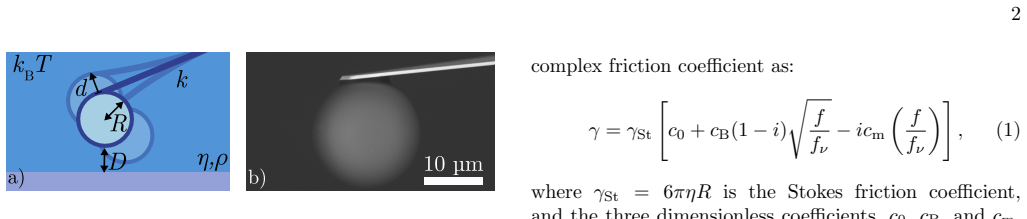
The hydrodynamic response of Brownian particles in liquids is fundamentally altered by inertial forces arising from unsteady momentum transport in the surrounding fluid. These forces are of two distinct types\,: the added mass and the history effect. While both are well understood in bulk and weakly-confined geometries, under deterministic driving, their respective behaviours under strong confinement and thermal fluctuations remain scarcely addressed, unclear and often entangled together. The goal of the present study is thus to fill this fundamental gap. The behaviours of the two distinct inertial contributions are quantitatively investigated in the vicinity of a flat, rigid wall, using a combination of broadrange thermal colloidal-probe atomic-force-microscopy experiments, advanced numerical simulations and theory. The separation of the added-mass and history-force contributions is achieved through their different frequency-scaling signatures within the measured high-resolution thermal spectra. Our results establish a complete picture of Brownian motion at interfaces, in the lubrication regime, with direct relevance to nanofluidics and interfacial biophysics.
Figures


Forward citations
Cited by 1 Pith paper
-
Broadband molecular dynamics simulation of fluid inertial effects in confined Brownian motion
Simulations show confinement near a wall enhances effective added mass of Brownian particles at short times via modified velocity autocorrelation.
Reference graph
Works this paper leans on
-
[1]
A. Einstein, ¨Uber die von der molekularkinetischen The- orie der W¨ arme geforderte Bewegung von in ruhen- den Fl¨ ussigkeiten suspendierten Teilchen., Annalen der Physik 17, 549 (1905)
1905
-
[2]
von Smoluchowski, Zur kinetischen theorie der brown- schen molekularbewegung und der suspensionen, An- nalen der Physik 326, 756 (1906)
M. von Smoluchowski, Zur kinetischen theorie der brown- schen molekularbewegung und der suspensionen, An- nalen der Physik 326, 756 (1906)
1906
-
[3]
Langevin, Sur la th´ eorie du mouvement Brown- ien, Comptes rendus hebdomadaires des s´ eances de l’Acad´ emie des sciences146, 530 (1908)
P. Langevin, Sur la th´ eorie du mouvement Brown- ien, Comptes rendus hebdomadaires des s´ eances de l’Acad´ emie des sciences146, 530 (1908)
1908
-
[4]
J. Boussinesq, Sur la r´ esistance qu’oppose un liquide ind´ efini en repos, sans pesanteur, au mouvement vari´ e d’une sph` ere solide qu’il mouille sur toute sa surface, quand les vitesses restent bien continues et assez faibles pour que leurs carr´ es et, produits soient n´ egligeables., Comptes-rendus de l’Acad´ emie des Sciences 100, 975 (1885)
-
[5]
A. B. Basset, A Treatise On Hydrodynamics With Nu- merous Examples Vol Ii (Deighton, Bell And Company, 1888)
-
[6]
J. Mo, A. Simha, S. Kheifets, and M. G. Raizen, Test- ing the Maxwell-Boltzmann distribution using Brownian particles, Optics Express 23, 1888 (2015)
2015
-
[7]
Ohbayashi, T
K. Ohbayashi, T. Kohno, and H. Utiyama, Photon corre- lation spectroscopy of the non-Markovian Brownian mo- tion of spherical particles, Physical Review A 27, 2632 (1983). 6
1983
-
[8]
Berg-Sørensen and H
K. Berg-Sørensen and H. Flyvbjerg, Power spectrum analysis for optical tweezers, Review of Scientific Instru- ments 75, 594 (2004)
2004
-
[9]
Berg-Sørensen and H
K. Berg-Sørensen and H. Flyvbjerg, The colour of ther- mal noise in classical Brownian motion: A feasibility study of direct experimental observation, New Journal of Physics 7, 38 (2005)
2005
-
[10]
Franosch, M
T. Franosch, M. Grimm, M. Belushkin, F. M. Mor, G. Foffi, L. Forr´ o, and S. Jeney, Resonances arising from hydrodynamic memory in Brownian motion, Nature478, 85 (2011)
2011
-
[11]
Kheifets, A
S. Kheifets, A. Simha, K. Melin, T. Li, and M. G. Raizen, Observation of Brownian Motion in Liquids at Short Times: Instantaneous Velocity and Memory Loss, Sci- ence 343, 1493 (2014)
2014
-
[12]
B. R. Dasgupta and D. A. Weitz, Microrheology of cross- linked polyacrylamide networks, Physical Review E 71, 021504 (2005)
2005
-
[13]
S. M. Block, Kinesin Motor Mechanics: Binding, Step- ping, Tracking, Gating, and Limping, Biophysical Jour- nal 92, 2986 (2007)
2007
-
[14]
Hwang and M
W. Hwang and M. Karplus, Structural basis for power stroke vs. Brownian ratchet mechanisms of motor pro- teins, Proceedings of the National Academy of Sciences 116, 19777 (2019)
2019
-
[15]
Brenner, The slow motion of a sphere through a vis- cous fluid towards a plane surface, Chemical Engineering Science 16, 242 (1961)
H. Brenner, The slow motion of a sphere through a vis- cous fluid towards a plane surface, Chemical Engineering Science 16, 242 (1961)
1961
-
[16]
L. P. Faucheux and A. J. Libchaber, Confined brownian motion, Physical Review E 49, 5158 (1994)
1994
-
[18]
E. R. Dufresne, D. Altman, and D. G. Grier, Brownian dynamics of a sphere between parallel walls, Europhysics Letters 53, 264 (2001)
2001
-
[19]
Matse, M
M. Matse, M. V. Chubynsky, and J. Bechhoefer, Test of the diffusing-diffusivity mechanism using near-wall col- loidal dynamics, Physical Review E 96, 042604 (2017)
2017
-
[20]
Lavaud, T
M. Lavaud, T. Salez, Y. Louyer, and Y. Amarouch- ene, Stochastic inference of surface-induced effects using brownian motion, Physical Review Research 3, L032011 (2021)
2021
-
[21]
Alexandre, M
A. Alexandre, M. Lavaud, N. Fares, E. Millan, Y. Louyer, T. Salez, Y. Amarouchene, T. Gu´ erin, and D. S. Dean, Non-gaussian diffusion near surfaces, Physical Review Letters 130, 077101 (2023)
2023
-
[22]
Gotoh and Y
T. Gotoh and Y. Kaneda, Effect of an infinite plane wall on the motion of a spherical Brownian particle, The Jour- nal of Chemical Physics 76, 3193 (1982)
1982
-
[23]
R. J. Clarke, S. M. Cox, P. Williams, and O. Jensen, The drag on a microcantilever oscillating near a wall, Journal of Fluid Mechanics 545, 397 (2005)
2005
-
[24]
R. J. Clarke, O. Jensen, J. Billingham, and P. Williams, Three-dimensional flow due to a microcantilever oscillat- ing near a wall: an unsteady slender-body analysis, Pro- ceedings of the Royal Society A: Mathematical, Physical and Engineering Sciences 462, 913 (2006)
2006
-
[25]
Basak, A
S. Basak, A. Raman, and S. V. Garimella, Hydrodynamic loading of microcantilevers vibrating in viscous fluids, Journal of applied physics 99 (2006)
2006
-
[26]
Jeney, B
S. Jeney, B. Luki´ c, J. A. Kraus, T. Franosch, and L. Forr´ o, Anisotropic Memory Effects in Confined Col- loidal Diffusion, Physical Review Letters 100, 240604 (2008)
2008
-
[27]
Simha, J
A. Simha, J. Mo, and P. J. Morrison, Unsteady Stokes flow near boundaries: The point-particle approximation and the method of reflections, Journal of Fluid Mechanics 841, 883 (2018)
2018
-
[28]
R. J. Clarke, O. E. Jensen, J. Billingham, A. P. Pearson, and P. M. Williams, Stochastic elastohydrodynamics of a microcantilever oscillating near a wall, Phys. Rev. Lett. 96, 050801 (2006)
2006
-
[29]
J. Mo, A. Simha, and M. G. Raizen, Broadband bound- ary effects on Brownian motion, Physical Review E 92, 062106 (2015)
2015
-
[30]
Huang and I
K. Huang and I. Szlufarska, Effect of interfaces on the nearby brownian motion, Nature communications6, 8558 (2015)
2015
-
[31]
R. S. Chadwick and Z. Liao, High-Frequency Oscillations of a Sphere in a Viscous Fluid near a Rigid Plane, SIAM Review 10.1137/06067763X (2008)
-
[32]
F.-L. Yang, A formula for the wall-amplified added mass coefficient for a solid sphere in normal approach to a wall and its application for such motion at low Reynolds num- ber, Physics of Fluids 22, 123303 (2010)
2010
-
[33]
Bigan, M
N. Bigan, M. Liz´ ee, M. Pascual, A. Nigu` es, L. Bocquet, and A. Siria, Long range signature of liquid’s inertia in nanoscale drainage flows, Soft Matter 20, 8804 (2024)
2024
-
[34]
Benmouna and D
F. Benmouna and D. Johannsmann, Hydrodynamic in- teraction of afm cantilevers with solid walls: An investi- gation based on afm noise analysis, The European Phys- ical Journal E 9, 435 (2002)
2002
-
[35]
Zhang, V
Z. Zhang, V. Bertin, M. H. Essink, H. Zhang, N. Fares, Z. Shen, T. Bickel, T. Salez, and A. Maali, Unsteady drag force on an immersed sphere oscillating near a wall, Journal of Fluid Mechanics 977, A21 (2023)
2023
-
[36]
R. P. Pel´ aez, P. Ib´ a˜ nez-Freire, P. Palacios-Alonso, A. Donev, and R. Delgado-Buscalioni, Universally adapt- able multiscale molecular dynamics (uammd). a native- GPU software ecosystem for complex fluids, soft matter, and beyond, Computer Physics Communications 306, 109363 (2025)
2025
-
[37]
R. P. Pel´ aez, P. Palacios-Alonso, and R. Delgado- Buscalioni, Spectral solver for the oscillatory Stokes frequency-based equation in doubly periodic confined do- mains, Journal of Fluid Mechanics 1010, A57 (2025)
2025
-
[38]
Palacios-Alonso, R
P. Palacios-Alonso, R. P. Pel´ aez, and R. Delgado- Buscalioni, Fast spectral solver for viscoelastic structures under oscillatory flow in free space or wall-bounded do- mains: Applications to quartz crystal microbalance and force spectroscopy, The Journal of Chemical Physics163, 194109 (2025)
2025
-
[39]
N. F. Bonet, P. P. Alonso, M. V´ elez, and R. Delgado- Buscalioni, Quantitative description of protein config- uration and viscoelasticity using first-principles hydro- dynamics applied to quartz crystal microbalance exper- iments, The Journal of Chemical Physics 164, 145103 (2026)
2026
-
[40]
Bedeaux and P
D. Bedeaux and P. Mazur, Brownian motion and fluctu- ating hydrodynamics, Physica 76, 247 (1974)
1974
-
[41]
L. D. Landau and E. M. Lifshitz, Fluid Mechanics: Vol- ume 6 (Elsevier, 2013)
2013
-
[42]
IEEE Transactions on Audio and Electroacoustics
-
[43]
M. A. Bevan and D. C. Prieve, Hindered diffusion of col- loidal particles very near to a wall: Revisited, The Jour- nal of Chemical Physics 113, 1228 (2000)
2000
-
[44]
Huang and I
K. Huang and I. Szlufarska, Effect of interfaces on the nearby Brownian motion, Nature Communications 6, 8558 (2015). 7
2015
-
[45]
Lamb, Hydrodynamics (New York,: Dover publica- tions, 1945)
H. Lamb, Hydrodynamics (New York,: Dover publica- tions, 1945)
1945
-
[46]
Milne Thomson L.N., Theoretical Hydrodynamics Fourth Edition (The Macmillan And Company, 1962)
1962
-
[47]
Fouxon and A
I. Fouxon and A. Leshansky, Fundamental solution of un- steady Stokes equations and force on an oscillating sphere near a wall, Physical Review E 98, 063108 (2018)
2018
-
[48]
Indei, J
T. Indei, J. D. Schieber, A. C´ ordoba, and E. Pilyugina, Treating inertia in passive microbead rheology, Physical Review E 85, 021504 (2012)
2012
-
[49]
Makris, Impulse response function for Brownian mo- tion, Soft Matter 17, 5410 (2021)
N. Makris, Impulse response function for Brownian mo- tion, Soft Matter 17, 5410 (2021)
2021
-
[50]
Zhang, Z
H. Zhang, Z. Zhang, E. Hart´ e, F. Argoul, and A. Maali, Contactless measurements of the elastic modulus of liv- ing cells using thermal fluctuations of atomic force mi- croscope cantilever, Physics of Fluids 37, 032002 (2025)
2025
-
[51]
Marbach, D
S. Marbach, D. S. Dean, and L. Bocquet, Transport and dispersion across wiggling nanopores, Nature Physics 14, 1108 (2018)
2018
-
[52]
Fares, M
N. Fares, M. Lavaud, Z. Zhang, A. Jha, Y. Amarouchene, and T. Salez, Observation of Brownian elastohydrody- namic forces acting on confined soft colloids, Proceedings of the National Academy of Sciences 121, e2411956121 (2024)
2024
-
[53]
Y. Ye, Y. Amarouchene, R. Sarfati, D. S. Dean, and T. Salez, Brownian motion near a soft surface, Comptes Rendus. Physique 26, 619 (2025)
2025
-
[54]
Kestin, M
J. Kestin, M. Sokolov, and W. A. Wakeham, Viscosity of liquid water in the range -8 ◦C to 150 ◦C, Journal of Physical and Chemical Reference Data 7, 941 (1978)
1978
-
[55]
C. Ma, A. Nikiforov, D. Hegemann, N. De Geyter, R. Morent, and K. K. Ostrikov, Plasma-controlled sur- face wettability: Recent advances and future applica- tions, International Materials Reviews 68, 82 (2023)
2023
-
[56]
Bhattacharya, A
S. Bhattacharya, A. Datta, J. Berg, and S. Gangopad- hyay, Studies on surface wettability of poly(dimethyl) siloxane (PDMS) and glass under oxygen-plasma treat- ment and correlation with bond strength, Journal of Mi- croelectromechanical Systems 14, 590 (2005)
2005
discussion (0)
Sign in with ORCID, Apple, or X to comment. Anyone can read and Pith papers without signing in.