REVIEW 5 major objections 7 minor 7 cited by
Dens3R: A Foundation Model for 3D Geometry Prediction
T0 review · 5 major / 7 minor · reviewed 2026-08-06 · deepseek-v4-flash
Pith's one-line read Dens3R claims that building normals into the pointmap makes pointmaps, depth, normals, and matches jointly accurate and consistent from unposed images.
desk verdict Solid extension of the DUSt3R line with a real two-stage idea, but the load-bearing claim that normal supervision improves the pointmap itself is asserted rather than measured. read the letter →
The pith
A machine-rendered reading of the paper's core claim, the machinery that carries it, and where it could break.
The reading
What carries the argument
The central object is the intrinsic-invariant pointmap, a pointmap whose per-pixel representation is concatenated with the view-space surface normal so the same 3D structure carries consistent normal information across viewpoints. The two-stage training curriculum is the mechanism that makes it work: Stage 1 learns a scale-invariant pointmap under local and global 3D regression losses plus the MASt3R pixel matching (infoNCE) loss; Stage 2 fine-tunes that foundation with a normal prediction head and a normal loss $L_n$ under one-to-one supervision. A second supporting mechanism is position-interpolated rotary positional encoding, which re-encodes position $m$ at the original frequency for a longer sequence by $R'(x,m)=R(x, mL/L')$, so high-resolution inputs are interpolated rather than extrapolated. Together these pieces are what the paper credits for simultaneous accuracy on pointmaps, depth, normals, and matches.
What would settle it
A concrete check: train Dens3R with the intrinsic-invariant normal stage and with that stage ablated, and compare pointmap and depth errors, not only normal angle, on NYUv2 and ScanNet; if depth and pointmap errors stay flat while only normal metrics improve, the paper's unified-representation claim would be contradicted.
Extended reading notes
Core claim
The paper's discovery is that surface normals are the missing coupling term in pointmap-based 3D regression. Earlier DUSt3R-style models predict pointmaps with cross-view losses but ignore normals, and the paper finds that normals derived from such scale-invariant pointmaps are inaccurate. Dens3R's second stage concatenates the normal into the pointmap, defining an intrinsic-invariant pointmap $P_i^n = P_i \oplus n$, and switches from many-to-one to one-to-one supervision so each viewpoint's normal is optimized independently. With this representation and a shared encoder-decoder transformer, Dens3R reports lower angular errors than regression- and diffusion-based normal estimators, higher matching AUC on ZEB, ScanNet-1500, and MegaDepth-1500 than MASt3R and VGGT, competitive or better depth errors than MoGe and VGGT, and lower reprojection error on the Map-free pose benchmark.
Load-bearing premise
The argument depends on the premise that feeding surface normals into the pointmap makes pointmaps and depth more accurate, not just the normal head; if normal supervision only sharpens normals, the unified-representation thesis reduces to a multi-head model.
Editorial extensions
If this is right
- A single unposed image pair yields internally consistent depth, normals, pointmaps, and matches, so downstream systems no longer need to align outputs from separately trained geometric models.
- Monocular normal estimation becomes less ambiguous: the paper reports the lowest mean angular error among compared normal estimators on NYUv2, ScanNet, IBims-1, Sintel, and DIODE-outdoor.
- The same pointmap backbone supports camera pose estimation from one pair of unposed images, with lower reprojection error and higher pose AUC than DUSt3R, MASt3R, and VGGT on the Map-free benchmark.
- High-resolution and multi-resolution inputs remain usable because position-interpolated RoPE avoids the extrapolation failure that makes prior pointmap models produce overlapping or inconsistent geometry at 2K.
- Because the backbone is frozen and only new heads are trained, the representation transfers to segmentation and to surface reconstruction via normal supervision, pointing to a common geometry backbone for many tasks.
Reading between the lines
- The intrinsic-invariant idea need not stop at normals: if the pattern holds, other per-view intrinsic maps with weak cross-view ambiguity, such as albedo or material properties, could be concatenated into the same pointmap using the same two-stage curriculum.
- A decisive test the paper leaves open is whether normal supervision improves pointmap and depth error, not just normal angle; the ablations in Table 4 report only normal metrics, so the cross-task benefit that motivates the unified representation is asserted rather than measured.
- The two-stage schedule suggests a general principle for multi-output 3D regression: learn cross-view geometry first and add per-view intrinsic constraints later, because coupling them from the start is unstable; this ordering could guide other joint-prediction architectures.
- The position-interpolated RoPE is a resolution-extension technique that should transfer to any dense prediction transformer whose training resolution bounds its operating range, such as optical flow or stereo networks.
Editorial analysis
A structured set of objections, weighed in public.
Referee Report
Summary. The paper proposes Dens3R, a feed-forward dense 3D foundation model that takes unposed single images or image pairs as input and jointly predicts pointmaps, depth maps, surface normals, camera parameters, and dense matching features. The architecture is a shared encoder-decoder dense visual transformer with position-interpolated rotary positional encoding to support high-resolution inputs. Training proceeds in two stages: Stage 1 learns a scale-invariant pointmap with MASt3R-style losses (local/global 3D regression, pointmap normal loss, pixel matching loss), and Stage 2 adds explicit normal-head supervision to form an 'intrinsic-invariant pointmap,' followed by a coarse-to-fine schedule from 512 to 1024 pixels. Task-specific heads are then fine-tuned with the backbone frozen, and a verbally described post-processing pipeline is used for multi-view inference. Experiments report strong results in normal estimation (NYUv2, ScanNet, IBims, Sintel, DIODE), dense matching (ZEB, ScanNet-1500, MegaDepth-1500), and camera pose estimation (Map-free), plus competitive but not uniformly best monocular depth results (e.g., NYUv2 REL 0.042 versus 0.035 for MoGe).
Significance. The strengths of the paper are real: the headline results are held-out benchmark numbers rather than quantities derived from the model's own equations, so the main empirical claims are not circular; the normal-estimation gains (NYUv2 mean 16.1 versus 17.5 for Lotus-G; IBims 16.0 versus 17.2 for StableNormal) and dense matching gains (ZEB mean 64.5 versus 59.9 for MASt3R) are consistent and sizeable; the dataset curation table (Tab. 5) is unusually detailed; and the demonstration of segmentation and surface-reconstruction uses of the frozen backbone strengthens the foundation-model framing. If the two-stage design genuinely makes normal supervision improve the pointmap and downstream geometric outputs, this would be a useful advance over single-task regression systems. However, the central cross-task coupling claim is currently supported only by normal-metric ablations (Sec. 4.3, Tab. 4 and Tab. 7) and qualitative figures, not by quantitative pointmap or depth ablations; the multi-view pipeline is likewise not quantitatively evaluated; and no code or weights are available. The paper is substantial but needs targeted evidence before the headline claim can be taken as established.
major comments (5)
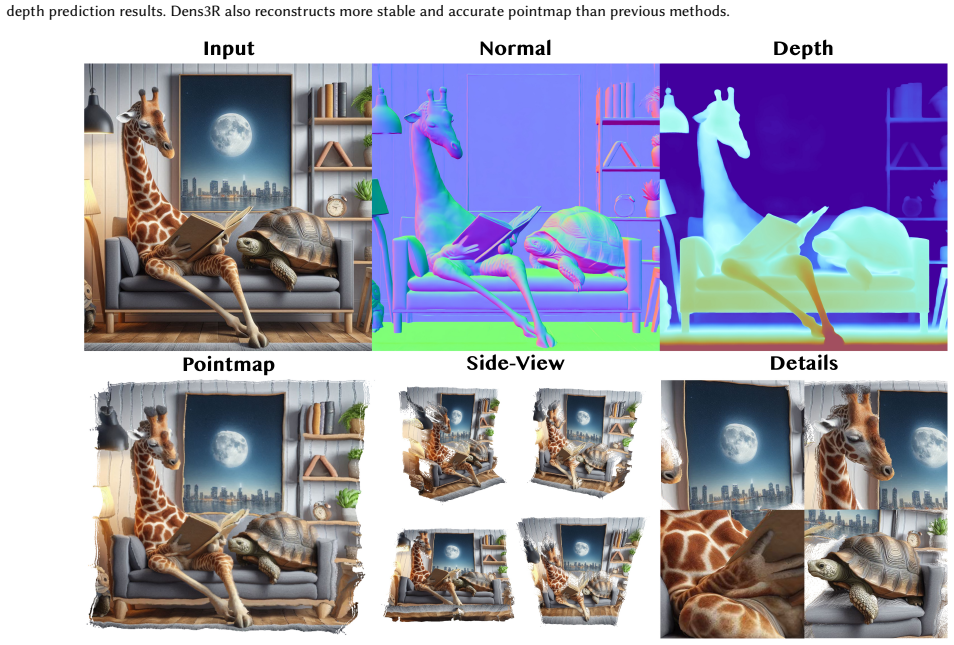
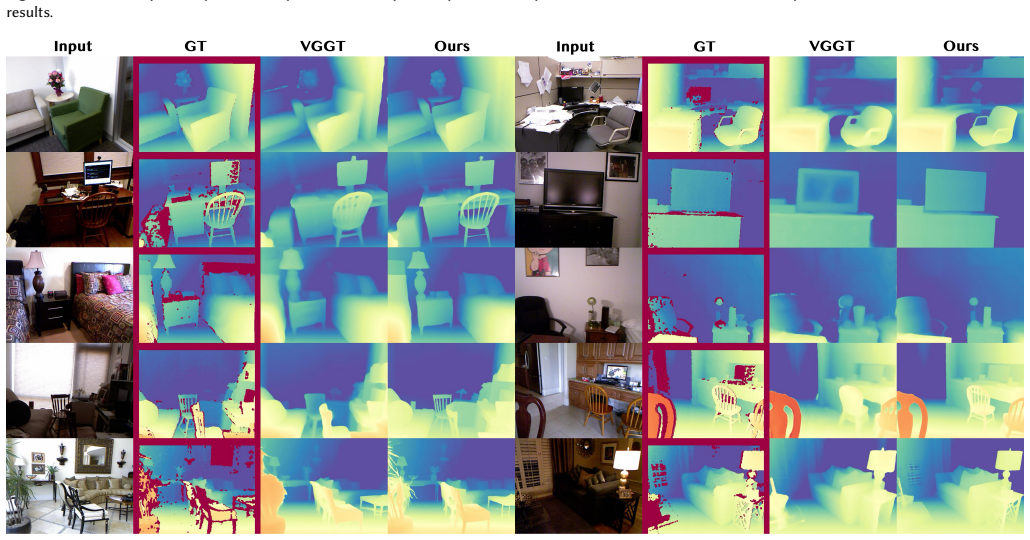
- [Sec. 4.3, Tab. 4 and Tab. 7] The central claim, stated in Sec. 1 ('introducing normal information during geometric prediction can significantly improve the accuracy of point maps') and embodied in the Stage-2 design (Sec. 3.2, Eq. 11), is that normal-based intrinsic-invariant training improves the pointmap representation itself. However, the only quantitative ablation of the intrinsic-invariant training reports normal metrics (mean, median, delta-11.25 degree) exclusively; no pointmap accuracy or depth accuracy is reported for the w/o IIT variant versus Ours. The depth comparison in Tab. 3 is also mixed: Dens3R's NYUv2 REL is 0.042 versus 0.038 for VGGT and 0.035 for MoGe. The current evidence is therefore consistent with the weaker interpretation that Stage 2 improves only the normal head, leaving the pointmap essentially at the Stage-1 level. Please add quantitative pointmap and depth metrics, such as depth REL/RMSE and a pointmap chamfer or F-score measure on NYUv2 and DIODE, for the w/o IIT, w/o C2F, and Ours variants.
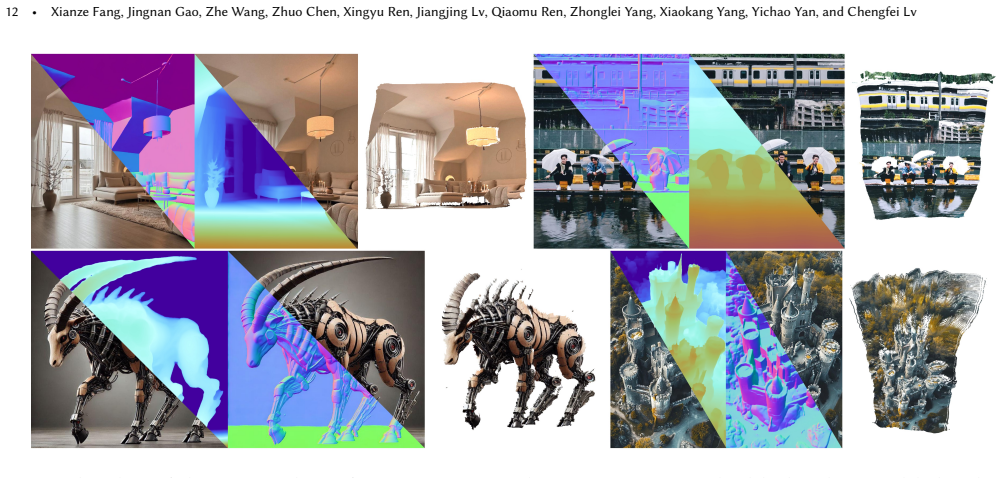
- [Sec. 4.2 and contribution list] The first listed contribution is pointmap reconstruction, and the title emphasizes 3D geometry prediction, yet pointmap quality is only ever shown qualitatively (Figs. 5-7 and 23); no quantitative pointmap metric is reported against DUSt3R, MASt3R, MoGe, or VGGT. Please add a quantitative pointmap evaluation (e.g., chamfer distance, F-score, or accuracy at thresholds) on a held-out set or an existing benchmark, paired with the same baselines used in Tab. 3.
- [Sec. 3.3 multi-view inputs] The multi-view input pipeline is described only verbally: 'establish geometric mappings between different viewpoints by constructing and optimizing a dense correspondence network across views.' No equations, pseudocode, optimization objective, or hyperparameters are given, and the only evidence is qualitative (Fig. 23). Since multi-view geometric consistency is claimed as an outcome and the post-processing is a stated contribution, please specify the algorithm and include a quantitative evaluation showing that multi-view inputs improve consistency and accuracy relative to single-pair inference.
- [Sec. 4.3 and Fig. 8a] The position-interpolated rotary positional encoding is a stated contribution (Sec. 3.1, Eq. 2), but Tab. 4 contains no row for w/o position interpolation, and Fig. 8a and Fig. 22 are qualitative. Please report a quantitative comparison with and without the position-interpolated RoPE at resolutions 512 and 1024 (for example, normal or matching metrics), and, if the claim that interpolation is more stable than direct extrapolation is retained, support it with a comparison against explicit extrapolation.
- [Sec. 3.2, Eq. 9] The core 'intrinsic-invariant pointmap' is never formally defined. Section 3.2 describes a change from a 'one-to-many' mapping to a 'one-to-one' mapping and defines P^n_i = P_i + n (Eq. 9), but it is not specified what n is, what the concatenation produces, or what invariance the pointmap satisfies after Stage 2. In addition, Stage 1 already includes the Pointmap Normal Loss L_pts_n (Eq. 6 and Eq. 8), which is in tension with the narrative that normals enter only in Stage 2, and the assertion in Sec. 4.3 that jointly training pointmap and normal from the start is unstable is made without any supporting experiment. Please formalize the representation, disambiguate the roles of L_pts_n and L_n, and provide evidence (training curves or an ablation with the normal loss included from Stage 1) for the instability claim.
minor comments (7)
- [Tab. 1 and Tab. 6] The DSINE row reports identical values for NYUv2 and ScanNet (Mean 18.6, Med 9.9, delta-11.25 degree 56.1) in both Tab. 1 and Tab. 6; please verify these entries.
- [Tab. 2] Several cells in Tab. 2 are run together (e.g., the SIFT row contains '14.733.4 7.6'); please reformat the table for readability.
- [Eq. 3 and Eq. 4] The normalization factors z_v and bar z_v are defined through garbled superscript notation in the text; the intended definition (average distance of valid points to the origin) should be written explicitly.
- [Eq. 11] The pixel matching loss L_match present in Eq. 8 is absent from Eq. 11 without comment; please state whether the matching head is frozen in Stage 2 and why L_match is dropped.
- [Tab. 3 footnote] The footnote reads 'we utilize Lotu-G disparity model'; this should be 'Lotus-G', and the asterisk footnotes in Tab. 1 and Tab. 3 should be defined consistently.
- [References] MegaDepth is cited twice, as [Li and Snavely 2018a] and [Li and Snavely 2018b], with identical titles; please merge into one entry.
- [Availability] The manuscript is silent on code and model weight availability; for a foundation-model paper, please add a statement, as this materially affects reproducibility.
Circularity Check
No significant circularity: Dens3R's headline results are external benchmark evaluations, and no predicted quantity reduces to a fitted parameter or self-citation by construction.
full rationale
The paper's central claims are empirical: Dens3R is trained with the losses in Eqs. 4-11 and evaluated on external benchmarks (NYUv2, ScanNet, ZEB, MegaDepth-1500, Map-free, etc.). None of the reported metrics is defined as a fitted constant or as the model's own training target in disguised form. The two-stage intrinsic-invariant training is a design choice; the ablation in Sec. 4.3/Tab. 4/Tab. 7 reports only normal metrics, so the claim that normal supervision improves pointmap accuracy is under-supported, but that is a missing-evidence/correctness issue, not a circular derivation: Eq. 11 does not force the pointmap improvement to hold by construction, and the claim remains externally testable. The position-interpolated RoPE (Eq. 2) is adapted from external LLM context-extensions work (Chen et al. 2023), not from the authors' own prior results, and its benefit is shown through comparison with DUSt3R/VGGT at high resolution. The paper cites prior DUSt3R-family methods as baselines and building blocks, but those citations are external works and are not used to forbid alternatives or to import a uniqueness theorem. The Appendix I limitation about thin structures is an honest limitation statement and does not indicate circularity. Overall, the derivation chain is self-contained in the sense that the reported predictions are benchmark-measured outputs of a learned model, not analytical consequences of its own definitions.
Assumptions & free parameters
free parameters (6)
- Stage-1 loss weights =
Set to 1.0, 0.1, and 0.075 for eta1, eta2, and eta3 in the paper.
- Stage-2 loss weights =
Set to 1.0, 0.1, and 1.0 for lambda1, lambda2, and lambda3 in the paper.
- Matching loss temperature =
Not reported in the paper.
- Training resolutions =
Set to 512 pixels for the coarse stage and 1024 pixels for the fine stage.
- Position interpolation factor =
Not reported in the paper.
- Dataset mixing ratios =
Listed in Table 5 with percentages such as 6.77 and 13.53.
assumptions (6)
- standard math RoPE interpolation formula and its smoothness assumptions (Eq. 2).
- domain assumption Geometric quantities are inherently interconvertible and joint regression improves accuracy.
- domain assumption Surface normals provide intrinsic invariance that simplifies training.
- ad hoc to paper Jointly training pointmaps and normals from stage 1 causes instability.
- domain assumption Pairwise camera poses used to transform normals in Eq. (6) are accurate enough.
- domain assumption Confidence loss in prior works causes models to ignore complex scenes.
invented entities (1)
-
Intrinsic-invariant pointmap
Cite this review
Pith. "Pith review of Dens3R: A Foundation Model for 3D Geometry Prediction." pith.science (2026). https://pith.science/paper/NO3SX6V3
@misc{pith2026250716290,
  author       = {Pith},
  title        = {Pith review of: Dens3R: A Foundation Model for 3D Geometry Prediction},
  year         = {2026},
  howpublished = {\url{https://pith.science/paper/NO3SX6V3}},
  note         = {Machine review of arXiv:2507.16290}
}
read the original abstract
Recent advances in dense 3D reconstruction have led to significant progress, yet achieving accurate unified geometric prediction remains a major challenge. Most existing methods are limited to predicting a single geometry quantity from input images. However, geometric quantities such as depth, surface normals, and point maps are inherently correlated, and estimating them in isolation often fails to ensure consistency, thereby limiting both accuracy and practical applicability. This motivates us to explore a unified framework that explicitly models the structural coupling among different geometric properties to enable joint regression. In this paper, we present Dens3R, a 3D foundation model designed for joint geometric dense prediction and adaptable to a wide range of downstream tasks. Dens3R adopts a two-stage training framework to progressively build a pointmap representation that is both generalizable and intrinsically invariant. Specifically, we design a lightweight shared encoder-decoder backbone and introduce position-interpolated rotary positional encoding to maintain expressive power while enhancing robustness to high-resolution inputs. By integrating image-pair matching features with intrinsic invariance modeling, Dens3R accurately regresses multiple geometric quantities such as surface normals and depth, achieving consistent geometry perception from single-view to multi-view inputs. Additionally, we propose a post-processing pipeline that supports geometrically consistent multi-view inference. Extensive experiments demonstrate the superior performance of Dens3R across various dense 3D prediction tasks and highlight its potential for broader applications.
Figures


Figures from the paper (21 more)






Forward citations
Cited by 7 Pith papers
-
FoundationGeo: Learning Spatial Pixel-Wise Fields for Monocular Metric Geometry
Pixel-wise scale and ray-direction fields plus focal-diverse synthetic data convert a strong relative geometry backbone into the best average zero-shot monocular metric depth across seven benchmarks.
-
Towards Consistent Video Geometry Estimation
ViGeo is a feed-forward transformer for video geometry that introduces dynamic chunking attention and a completion-based data refinement framework to achieve SOTA on depth, normals, and point map estimation.
-
4DVGGT-D: 4D Visual Geometry Transformer with Improved Dynamic Depth Estimation
A training-free two-pass adaptation of VGGT, with attention-based motion masking and inverse-variance depth fusion, improves dynamic-scene point-cloud reconstruction on DyCheck.
-
2K Retrofit: Entropy-Guided Efficient Sparse Refinement for High-Resolution 3D Geometry Prediction
Entropy-guided sparse refinement upgrades frozen low-resolution geometric foundation models to accurate 2K depth and pointmap outputs at a fraction of full-resolution cost.
-
GPOcc++: Unified Sparse Gaussian Occupancy Prediction with Visual Geometry Priors
A unified framework converts surface geometry priors into sparse Gaussian occupancy predictions and extends it to multi-view and temporal inputs.
-
MoWorld: A Flash World Model
MoWorld achieves up to 50 FPS real-time interactive world simulation on NPUs by combining a 3D-native data engine, curriculum cross-frame pretraining, autoregressive distillation, and mixed-precision parallel inference.
-
WorldMirror: Universal 3D World Reconstruction with Any-Prior Prompting
A unified feed-forward network that ingests optional geometric priors and jointly predicts point maps, depth, camera poses, normals, and 3D Gaussians, reporting state-of-the-art results on multiple 3D benchmarks.
Reference graph
Works this paper leans on
-
[4]
Wonder3D: Single Image to 3D Using Cross-Domain Diffusion. InCVPR. 9970–9980. Tao Lu, Mulin Yu, Linning Xu, Yuanbo Xiangli, Limin Wang, Dahua Lin, and Bo Dai
-
[5]
Ricardo Martin-Brualla, Noha Radwan, Mehdi S
Scaffold-GS: Structured 3D Gaussians for View-Adaptive Rendering.CVPR (2024). Ricardo Martin-Brualla, Noha Radwan, Mehdi S. M. Sajjadi, Jonathan T. Barron, Alexey Dosovitskiy, and Daniel Duckworth. 2021. NeRF in the Wild: Neural Radiance Fields for Unconstrained Photo Collections. InCVPR. 7210–7219. Lukas Mehl, Jenny Schmalfuss, Azin Jahedi, Yaroslava Nal...
work page 2024
-
[6]
Spring: A High-Resolution High-Detail Dataset and Benchmark for Scene Flow, Optical Flow and Stereo. InCVPR. 4981–4991. Iaroslav Melekhov, Aleksei Tiulpin, Torsten Sattler, Marc Pollefeys, Esa Rahtu, and Juho Kannala. 2019. DGC-Net: Dense Geometric Correspondence Network. InW ACV. 1034–1042. Ben Mildenhall, Pratul P. Srinivasan, Matthew Tancik, Jonathan T...
arXiv 2019
-
[7]
Towards Robust Monocular Depth Estimation: Mixing Datasets for Zero- Shot Cross-Dataset Transfer.IEEE Trans. Pattern Anal. Mach. Intell.44, 3 (2022), 1623–1637. Jeremy Reizenstein, Roman Shapovalov, Philipp Henzler, Luca Sbordone, Patrick La- batut, and David Novotny. 2021. Common Objects in 3D: Large-Scale Learning and Evaluation of Real-Life 3D Category...
work page 2022
-
[10]
DUSt3R: Geometric 3D Vision Made Easy. InCVPR. 20697–20709. Wenshan Wang, Delong Zhu, Xiangwei Wang, Yaoyu Hu, Yuheng Qiu, Chen Wang, Yafei Hu, Ashish Kapoor, and Sebastian Scherer. 2020b. TartanAir: A Dataset to Push the Limits of Visual SLAM. (2020), 4909–4916. Xiaolong Wang, David F. Fouhey, and Abhinav Gupta. 2015. Designing deep networks for surface ...
work page 2020
-
[11]
Input-level Inductive Biases for 3D Reconstruction. InCVPR. 6166–6176. Wei Yin, Chi Zhang, Hao Chen, Zhipeng Cai, Gang Yu, Kaixuan Wang, Xiaozhi Chen, and Chunhua Shen. 2023. Metric3D: Towards Zero-shot Metric 3D Prediction from A Single Image. InICCV. 9009–9019. Zehao Yu, Anpei Chen, Binbin Huang, Torsten Sattler, and Andreas Geiger. 2024. Mip- Splatting...
work page 2024
-
[2016]
The SYNTHIA Dataset: A Large Collection of Synthetic Images for Semantic Segmentation of Urban Scenes. InCVPR. 3234–3243. Paul-Edouard Sarlin, Daniel DeTone, Tomasz Malisiewicz, and Andrew Rabinovich
-
[2020]
SuperGlue: Learning Feature Matching With Graph Neural Networks. In CVPR. 4937–4946. Manolis Savva, Abhishek Kadian, Oleksandr Maksymets, Yili Zhao, Erik Wijmans, Bhavana Jain, Julian Straub, Jia Liu, Vladlen Koltun, Jitendra Malik, Devi Parikh, and Dhruv Batra. 2019. Habitat: A Platform for Embodied AI Research. InICCV. 9338–9346. Philipp Schröppel, Jan ...
arXiv 2024
Show all 11 references
-
[2022]
In ECCV, Vol
Map-free Visual Relocalization: Metric Pose Relative to a Single Image. In ECCV, Vol. 13661. 690–708. Gwangbin Bae and Andrew J. Davison. 2024. Rethinking Inductive Biases for Surface Normal Estimation. InCVPR. 9535–9545. Aayush Bansal, Bryan C. Russell, and Abhinav Gupta. 201...
2024
-
[2023]
Zip-NeRF: Anti-Aliased Grid-Based Neural Radiance Fields. InICCV. 19697– 19705. Gilad Baruch, Zhuoyuan Chen, Afshin Dehghan, Tal Dimry, Yuri Feigin, Peter Fu, Thomas Gebauer, Brandon Joffe, Daniel Kurz, Arik Schwartz, and Elad Shulman. 2021. ARKitScenes - A Diverse Real-World ...
2023 arXiv
-
[2024]
RoMa: Robust Dense Feature Matching. InCVPR. 19790–19800. Ufuk Efe, Kutalmis Gokalp Ince, and A. Aydin Alatan. 2021. DFM: A Performance Baseline for Deep Feature Matching. InCVPRW. 4284–4293. Ainaz Eftekhar, Alexander Sax, Jitendra Malik, and Amir Zamir. 2021. Omnidata: A Scal...
2024 arXiv
Reviewed August 6, 2026 · model on record in the stance chip above.
Discussion (0). Continue with ORCID to comment.