REVIEW 3 major objections 5 minor 28 references
Probabilistic Multimodal Modeling for Human-Robot Interaction Tasks
T0 review · 3 major / 5 minor · reviewed 2026-08-14 · deepseek-v4-flash
Pith's one-line read The paper claims that reformulating interaction primitives with an ensemble Kalman filter yields more accurate, more robust, and faster inference than standard Interaction Primitives in multimodal human-robot interaction.
desk verdict eBIP is a solid empirical combination of BIP and EnKF with real robot results; its high-dimensional ensemble claims need sensitivity analysis before generalizing. read the letter →
The pith
A machine-rendered reading of the paper's core claim, the machinery that carries it, and where it could break.
The reading
What carries the argument
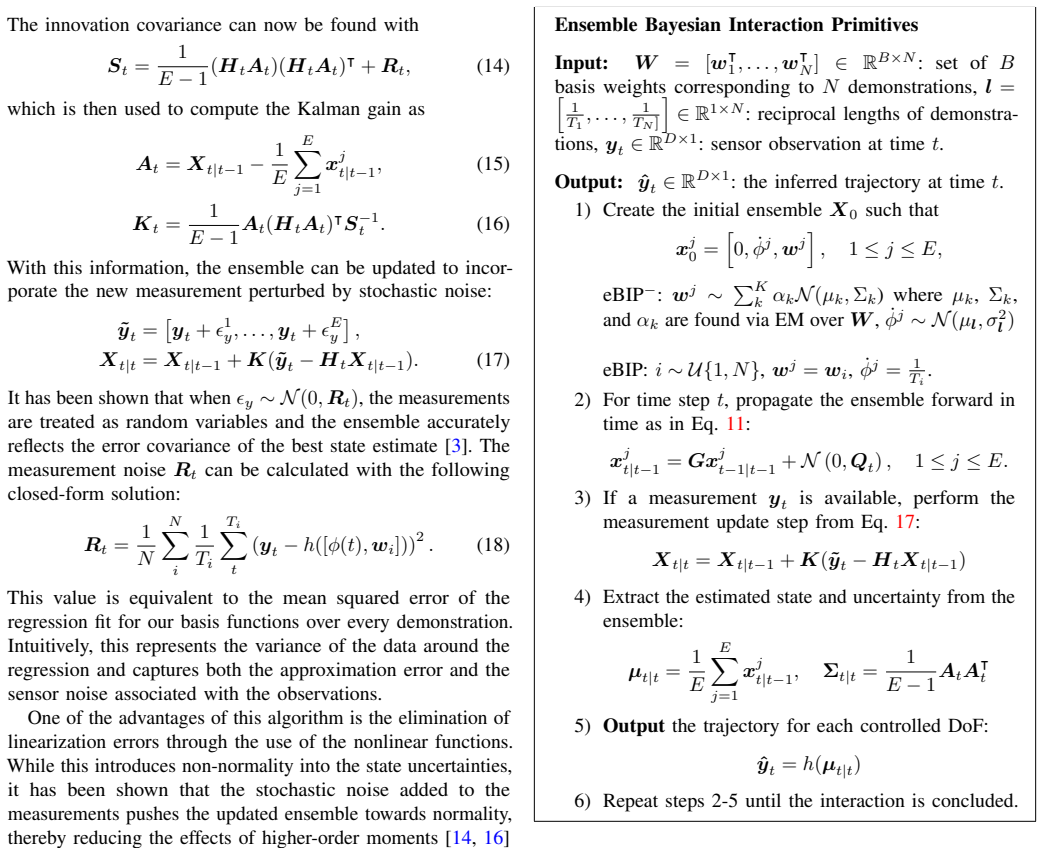
The central object is the ensemble of latent-state samples, where each sample is a set of basis-function weights plus phase and phase velocity, updated by an ensemble Kalman filter. Each demonstration is compressed into weights $w$ through basis functions of a phase variable $\varphi$, and the training set itself becomes the non-Gaussian prior. The filter propagates every ensemble member through the state dynamics, maps all members through the nonlinear observation function $h$, and updates them with a Kalman gain built from the ensemble's sample covariance, so no explicit covariance matrix, no linearized observation matrix, and no hand-built measurement model are required. Measurement noise $R_t$ is computed in closed form as the mean squared error of the regression fit over demonstrations. This machinery converts interaction-primitive inference from a cubic-cost extended Kalman filter into an $O(E^2 n)$ ensemble update, and it is what lets the method keep 559-dimensional state inference fast while avoiding Taylor linearization errors.
What would settle it
Take the same throwing demonstrations and add a sensor modality with strongly non-Gaussian noise, for example a depth camera with frequent outlier spikes, and rerun the comparison; if eBIP's joint mean-squared error no longer beats particle filtering and BIP under that noise, the claim that it gracefully handles the nonlinearities and non-Gaussian uncertainties inherent to multimodal inference is falsified.
Extended reading notes
Core claim
The central claim is that an interaction primitive can be reformulated so that probabilistic inference over a high-dimensional, multimodal latent state is done by an ensemble rather than by an explicit covariance matrix and a linearized measurement model. The paper argues that this removes three sources of error that degrade standard Interaction Primitives as modalities are added: approximation error from assuming a Gaussian prior, linearization error from Taylor-expanding the observation function, and computational cost from cubic covariance updates. In eBIP, the latent representation is the set of basis-function weights from demonstrations, and the prior is the empirical distribution of those weights, used directly as an ensemble. Each ensemble member is propagated with a constant-velocity phase model and updated with the ensemble Kalman filter, with perturbed measurements whose noise covariance is the closed-form mean squared error of the demonstration regression. The paper claims this yields more accurate and more robust inference than standard BIP, particle filtering, and a Gaussian-mixture variant, while scaling as $O(E^2 n)$ rather than roughly $O(n^3)$.
Load-bearing premise
The load-bearing premise is that an ensemble of 80 to 198 samples can adequately represent the posterior uncertainty of a 559-dimensional latent state without localization or covariance inflation; if the sample covariance is a poor surrogate, the claimed accuracy and robustness would not transfer to other tasks or sensor sets.
Editorial extensions
If this is right
- Because the ensemble replaces the explicit covariance matrix, filtering cost scales as $O(E^2 n)$ instead of roughly $O(n^3)$, so tasks with hundreds or thousands of degrees of freedom can be filtered in real time with a modest ensemble.
- New sensor modalities can be added without hand-designing a measurement model: the measurement noise covariance is estimated directly from the regression residuals of the demonstrations.
- Demonstration data that is not Gaussian, including multiple distinct throwing styles, can be used as the prior as-is, which the paper shows avoids the catastrophic errors that a Gaussian prior produces on this task.
- Before the ball is visible, the multimodal ensemble already predicts the interception point to within about 60 cm; with all modalities at 82% of the trajectory the prediction narrows to about 23 cm, which the paper reports is sufficient for the robot to catch the ball in most live trials.
- Ensemble size provides an explicit accuracy-versus-speed dial; in the live experiments, 80 members balanced computation time and catch performance.
Reading between the lines
- A natural extension the paper leaves implicit is to use the ensemble's innovation statistics to select or weight modalities online; the paper's finding that adding the head sensor increased error suggests a context-dependent sensor gating rule could improve both accuracy and interpretability.
- The nonparametric prior predicts that eBIP's advantage over Gaussian-prior BIP grows as demonstrations become more clustered or multimodal; this could be tested on the same throwing data by intentionally seeding distinct throw styles in the training set.
- Because the complexity is $O(E^2 n)$ with fixed $E$, a stress test with state dimension in the thousands, for example whole-body motion with many sensors, should remain computationally feasible for eBIP but not for BIP; whether the ensemble covariance stays well-conditioned at that scale is an open empirical question.
Signed reviews
Editorial analysis
A structured set of objections, weighed in public.
Referee Report
Summary. The paper proposes ensemble Bayesian Interaction Primitives (eBIP), a reformulation of interaction primitives for multimodal human-robot interaction. Instead of the Gaussian prior and extended Kalman filter used in standard Bayesian Interaction Primitives (BIP), eBIP represents the prior distribution directly as an ensemble of demonstration-derived samples and performs ensemble Kalman filtering, avoiding explicit covariance matrices and linearization of the observation model. The method is evaluated on a ball-catching task with a UR5 robot using 221 kinesthetic demonstrations and multimodal sensor streams; the authors report lower joint and ball prediction errors than BIP, particle filtering, and a Gaussian-mixture variant (eBIP−) in 10-fold cross-validation, as well as real-time catching performance including a blindfolded condition with a 60% success rate. The central claim is that eBIP is more accurate, more robust, and faster than standard Interaction Primitives and other common methods in challenging HRI scenarios.
Significance. If the claims hold, eBIP is a useful practical contribution: it replaces a Gaussian prior with a non-parametric ensemble, removes linearization errors in the observation update, eliminates the explicit covariance matrix, and reduces per-step complexity from roughly O(n^3) to O(E^2 n), which matters for high-dimensional multimodal HRI. The paper is explicit about the algorithm, provides code and video, and evaluates on held-out demonstrations via 10-fold cross-validation with Mann-Whitney U tests. The ablation against BIP, particle filtering, and the mixture-prior variant is informative, and the real-time catching experiment demonstrates feasibility in a physical system. The main weakness is that the central accuracy/robustness claim depends on an ensemble Kalman update in a 559-dimensional state with at most 198 ensemble members, and the paper does not provide the ensemble diagnostics or scaling analysis needed to show that the EnKF approximation is reliable in this regime.
major comments (3)
- [§IV, Eqs. (11)-(17), and §V] The central accuracy-and-robustness claim rests on an ensemble Kalman update in a 559-dimensional latent state with at most 198 ensemble members, yet the paper provides no localization, no covariance inflation, no ensemble-size scaling in this regime, and no rank or calibration diagnostics. The sample covariance used in Eqs. (14)-(16) has rank at most E−1, so observation innovations outside the span of the ensemble perturbations cannot be assimilated, and spurious long-range correlations can produce overconfident updates. As written, the Table I results could be specific to the span of the demonstration set rather than evidence of generally reliable high-dimensional ensemble inference. Please add an ensemble-size study in the 559-dimensional setting, a rank/calibration diagnostic, or an explicit and quantitative argument for why E=80–198 gives a faithful posterior approximation here.
- [§IV, Eq. (11) and Fig. 3 step 2] The propagation step perturbs each ensemble member with N(0,Q_t), but Q_t is never specified for eBIP. For BIP, Q_t is the block-diagonal process-noise matrix in Eq. (4); if eBIP uses a similar or scaled Q_t, that choice is a free parameter that materially affects filter accuracy and stability. Without reporting how Q_t is set, the experimental comparison cannot be reproduced, and it is not possible to rule out that the observed differences are driven by process-noise tuning rather than by the ensemble formulation itself.
- [Table I and §V-B] The statistical support for the superiority claim is incomplete. Standard errors are reported only for eBIP, no confidence intervals are given for the PF, BIP, or eBIP− errors, and the blindfolded success rate (12/20) is reported without an interval. In addition, baseline hyperparameters are not fully specified: the particle count and resampling details for PF beyond the effective-size threshold, the BIP noise parameters, and the BIC-selected basis-function counts per modality are missing. Please report the full configuration for every method and per-method variability so the Mann-Whitney U comparisons can be independently assessed.
minor comments (5)
- [Fig. 3, step 4] Step 4 of the algorithm extracts the posterior mean and covariance using x^j_{t|t-1}, but after step 3 the updated ensemble is X_{t|t}; this appears to be a typo and should use x^j_{t|t} to match Eq. (17).
- [§V-A, sensor list] The text says observations come from 5 modalities but then lists six types: hand/feet positions, IMU, foot pressure, head orientation, ball position, and robot joint positions. Please clarify the modality count or revise the list.
- [§V-B, eBIP− description] The sentence stating that EM 'regularly produced non-positive semi-definite covariance matrices (using 1 component as determined by BIC)' is unclear: a single-component Gaussian should be positive semidefinite by construction, so the failure mode needs a more precise explanation.
- [Eq. (13)] The notation for H_t A_t, defined as a difference between the transformed ensemble and a repeated row vector of sample means, is dimensionally ambiguous; writing the subtraction with an explicit E-column matrix would make the computation clearer.
- [§V-A and Table I] The basis-function selection via BIC is mentioned but the resulting number of basis functions per modality and the exact basis set (Polynomial, Gaussian, Sigmoid) are not reported, which makes the 559-dimensional state difficult to reproduce.
Circularity Check
No significant circularity: the accuracy/robustness claims are evaluated on held-out demonstrations, and the self-citation to the authors' BIP paper is not load-bearing.
full rationale
The paper's central contribution is an ensemble reformulation of Bayesian Interaction Primitives. The claimed advantages are supported by holdout evaluation, not by fitting test data: 'Errors are computed via 10-fold cross validation over the randomly shuffled set of demonstrations, which also limits the maximum number of ensemble members used in both the eBIP and PF models to 198.' Thus the target quantities (joint MSE and ball MAE) are measured on held-out demonstrations, and the ensemble size is a training/evaluation choice rather than a parameter tuned to the test outputs. The self-citation to the authors' prior BIP paper [5] supplies the baseline formulation and notation, but eBIP's ensemble update follows standard ensemble Kalman filter results [10, 18]; the BIP citation is not used as evidence for eBIP's accuracy. The eBIP- variant's failure due to non-positive semi-definite covariance matrices is reported as an empirical observation, not as a definitional equivalence. No load-bearing step in the derivation chain reduces an output to an input by construction, and no fitted parameter is renamed as a prediction. The paper is self-contained with respect to its empirical claims, so the circularity burden is minimal.
Assumptions & free parameters
free parameters (4)
- Ensemble size E =
80 (real-time), 198 (cross-validation)
- Process noise covariance Q_t
- Measurement noise R_t =
Computed via Eq. 18 from training demonstrations
- Basis function selection per dimension =
Per-dimension B selected by BIC from polynomial, Gaussian, and sigmoid candidates
assumptions (4)
- domain assumption Each demonstrated trajectory can be represented as a weighted linear combination of time-dependent basis functions with i.i.d. Gaussian noise.
- domain assumption As E increases, the ensemble mean and covariance approximate the Kalman filter state, and perturbed observations push the analysis ensemble toward Gaussianity.
- domain assumption The latent weights are static and the phase evolves with a linear constant-velocity model.
- ad hoc to paper Measurement noise R_t is constant over time and equals the mean squared error of the basis regression over all demonstrations.
Cite this review
Pith. "Pith review of Probabilistic Multimodal Modeling for Human-Robot Interaction Tasks." pith.science (2026). https://pith.science/paper/NT36TX63
@misc{pith2026190804955,
  author       = {Pith},
  title        = {Pith review of: Probabilistic Multimodal Modeling for Human-Robot Interaction Tasks},
  year         = {2026},
  howpublished = {\url{https://pith.science/paper/NT36TX63}},
  note         = {Machine review of arXiv:1908.04955}
}
read the original abstract
Human-robot interaction benefits greatly from multimodal sensor inputs as they enable increased robustness and generalization accuracy. Despite this observation, few HRI methods are capable of efficiently performing inference for multimodal systems. In this work, we introduce a reformulation of Interaction Primitives which allows for learning from demonstration of interaction tasks, while also gracefully handling nonlinearities inherent to multimodal inference in such scenarios. We also empirically show that our method results in more accurate, more robust, and faster inference than standard Interaction Primitives and other common methods in challenging HRI scenarios.
Figures


Figures from the paper (3 more)


Reference graph
Works this paper leans on
-
[1]
Interaction primitives for human-robot cooperation tasks
Heni Ben Amor, Gerhard Neumann, Sanket Kamthe, Oliver Kroemer, and Jan Peters. Interaction primitives for human-robot cooperation tasks. In Robotics and Automation (ICRA), 2014 IEEE International Conference on, pages 2831–2837. IEEE, 2014
work page 2014
-
[2]
Pattern recognition and machine learning
Christopher M Bishop. Pattern recognition and machine learning. 2006
work page 2006
-
[3]
Analysis scheme in the ensemble kalman filter
Gerrit Burgers, Peter Jan van Leeuwen, and Geir Evensen. Analysis scheme in the ensemble kalman filter. Monthly weather review, 126(6):1719–1724, 1998
work page 1998
-
[4]
A framework inte- grating statistical and social cues to teach a humanoid robot new skills
Sylvain Calinon and Aude Billard. A framework inte- grating statistical and social cues to teach a humanoid robot new skills. In Proc. IEEE Intl Conf. on Robotics and Automation (ICRA), Workshop on Social Interaction with Intelligent Indoor Robots , May 2008
work page 2008
-
[5]
Bayesian in- teraction primitives: A slam approach to human-robot interaction
Joseph Campbell and Heni Ben Amor. Bayesian in- teraction primitives: A slam approach to human-robot interaction. In Conference on Robot Learning , pages 379–387, 2017
work page 2017
-
[6]
L. Chen, H. Wu, S. Duan, Y . Guan, and J. Rojas. Learning human-robot collaboration insights through the integration of muscle activity in interaction motion models. In 2017 IEEE-RAS 17th International Conference on Humanoid Robotics (Humanoids), pages 491–496, Nov 2017
work page 2017
-
[7]
Michael H. Coen. Multimodal integration: A biological view. In Proceedings of the 17th International Joint Conference on Artificial Intelligence - Volume 2, IJCAI’01, pages 1417–1424, San Francisco, CA, USA, 2001. Mor- gan Kaufmann Publishers Inc
work page 2001
-
[8]
Yunduan Cui, James Poon, Jaime Valls Miro, Kimitoshi Yamazaki, Kenji Sugimoto, and Takamitsu Matsubara. Environment-adaptive interaction primitives through vi- sual context for human–robot motor skill learning. Au- tonomous Robots, Aug 2018
work page 2018
Show all 28 references
-
[9]
Multi-modal intention prediction with probabilistic move- ment primitives
Oriane Dermy, François Charpillet, and Serena Ivaldi. Multi-modal intention prediction with probabilistic move- ment primitives. In Human Friendly Robotics , pages 181–196. Springer, 2019
2019
-
[10]
The ensemble kalman filter: Theoretical formulation and practical implementation
Geir Evensen. The ensemble kalman filter: Theoretical formulation and practical implementation. Ocean dynam- ics, 53(4):343–367, 2003
2003
-
[11]
Learning multiple collaborative tasks with a mixture of interaction primitives
Marco Ewerton, Gerhard Neumann, Rudolf Lioutikov, Heni Ben Amor, Jan Peters, and Guilherme Maeda. Learning multiple collaborative tasks with a mixture of interaction primitives. In 2015 IEEE International Conference on Robotics and Automation (ICRA) , pages 1535–1542, May 2015...
2015
-
[12]
Critical evaluation of extended kalman filtering and moving- horizon estimation
Eric L Haseltine and James B Rawlings. Critical evaluation of extended kalman filtering and moving- horizon estimation. Industrial & engineering chemistry research, 44(8):2451–2460, 2005
2005
-
[13]
Human-robot teaming: Approaches from joint action and dynamical systems
Tariq Iqbal and Laurel D Riek. Human-robot teaming: Approaches from joint action and dynamical systems. Humanoid Robotics: A Reference , pages 2293–2312, 2019
2019
-
[14]
Implications of stochastic and deterministic filters as ensemble-based data assimilation methods in varying regimes of error growth
W Gregory Lawson and James A Hansen. Implications of stochastic and deterministic filters as ensemble-based data assimilation methods in varying regimes of error growth. Monthly weather review , 132(8):1966–1981, 2004
1966
-
[15]
Mimesis model from partial observations for a humanoid robot
Dongheui Lee and Yoshihiko Nakamura. Mimesis model from partial observations for a humanoid robot. The International Journal of Robotics Research , 29(1):60–80, 2010
2010
-
[16]
Comparison of ensemble kalman filters under non-gaussianity
Jing Lei, Peter Bickel, and Chris Snyder. Comparison of ensemble kalman filters under non-gaussianity. Monthly Weather Review, 138(4):1293–1306, 2010
2010
-
[17]
Statistical Sensor Fusion: Exercises
Christian Lundquist, Zoran Sjanic, and Fredrik Gustafsson. Statistical Sensor Fusion: Exercises . Studentlitteratur AB, Sweden, 2015
2015
-
[18]
Efficient implementation of the ensemble Kalman filter
Jan Mandel. Efficient implementation of the ensemble Kalman filter . University of Colorado at Denver and Health Sciences Center, Center for Computational Math- ematics, 2006
2006
-
[19]
Advanced data assimilation in strongly nonlinear dynam- ical systems
Robert N Miller, Michael Ghil, and Francois Gauthiez. Advanced data assimilation in strongly nonlinear dynam- ical systems. Journal of the atmospheric sciences , 51(8): 1037–1056, 1994
1994
-
[20]
Multimodal integration learning of robot behavior using deep neural networks
Kuniaki Noda, Hiroaki Arie, Yuki Suga, and Tetsuya Ogata. Multimodal integration learning of robot behavior using deep neural networks. Robotics and Autonomous Systems, 62(6):721–736, 2014
2014
-
[21]
Oguz, Zhehua Zhou, and Dirk Wollherr
Ozgur S. Oguz, Zhehua Zhou, and Dirk Wollherr. A hybrid framework for understanding and predicting human reaching motions. Frontiers in Robotics and AI , 5:27, 2018
2018
-
[22]
The Child’s Construction of Reality
Jean Piaget. The Child’s Construction of Reality . Rout- ledge & Paul, 1955
1955
-
[23]
L. R. Rabiner. A tutorial on hidden markov models and selected applications in speech recognition. Proceedings of the IEEE , 77(2):257–286, Feb 1989
1989
-
[24]
Multimodal learning and inference from visual and remotely sensed data
Dushyant Rao, Mark De Deuge, Navid Nourani-Vatani, Stefan B Williams, and Oscar Pizarro. Multimodal learning and inference from visual and remotely sensed data. The International Journal of Robotics Research , 36 (1):24–43, 2017
2017
-
[25]
UR5 Robot Arm
Universal Robots. UR5 Robot Arm. https://www. universal-robots.com/products/ur5-robot/. [Online; ac- cessed May 15, 2019]
2019
-
[26]
Caldwell
Leonel Rozo, Joao Silvério, Sylvain Calinon, and Dar- win G. Caldwell. Learning controllers for reactive and proactive behaviors in human-robot collaboration. Frontiers in Robotics and AI , 3(30):1–11, June 2016. Specialty Section Robotic Control Systems
2016
-
[27]
Computational human-robot interaction
Andrea Thomaz, Guy Hoffman, Maya Cakmak, et al. Computational human-robot interaction. Foundations and Trends R© in Robotics, 4(2-3):105–223, 2016
2016
-
[28]
Probabilistic robotics
Sebastian Thrun, Wolfram Burgard, and Dieter Fox. Probabilistic robotics. MIT press, 2005
2005
Reviewed August 14, 2026 · model on record in the stance chip above.
Discussion (0). Continue with ORCID to comment.