REVIEW 3 major objections 3 minor 114 references
Boundary phases and thermodynamics of the Kondo spin-$s$ chain: from overscreened Kondo to boundary-bound states
T0 review · 3 major / 3 minor · reviewed 2026-08-16 · deepseek-v4-flash
Pith's one-line read This paper shows that a spin-1/2 impurity on a spin-s Takhtajan–Babujian chain is exactly solvable and has five boundary phases, with impurity-bound states reorganizing the spectrum into excitation towers.
desk verdict A solid, referee-worthy generalization of tower TBA to spin-s Kondo chains, with one unproved degeneracy claim that should be fixed before acceptance. read the letter →
The pith
A machine-rendered reading of the paper's core claim, the machinery that carries it, and where it could break.
The reading
What carries the argument
The load-bearing machinery is the tower decomposition of the Bethe ansatz spectrum. Bulk $n$-strings describe delocalized spin-wave excitations, while impurity-dependent purely imaginary roots describe modes localized at the boundary. For each tower $k\in\{T^{\rm str}, T^{\rm BS}, T^{\rm hBS}\}$, only the driving term $f_n^{(k)}(\lambda)$ in the density equations changes; the $\eta$-system $\ln\eta_n = \delta_{n,2s}\,D(\lambda) + G \ast \ln[(1+\eta_{n-1})(1+\eta_{n+1})]$ is identical across towers. The Takahashi identity then separates each tower's impurity free energy, and the boundary gap $E_\gamma$ sets which base state dominates at zero temperature. This one-universal-$\eta$-system, many-drivings structure is what makes the multi-tower thermodynamics tractable.
What would settle it
Exact-diagonalize the finite-size Hamiltonian (1) for small chains with s=1 and s=3/2, enumerate all eigenstates, and compare their energies and degeneracies with the Bethe-ansatz predictions, including the boundary-string towers; any eigenstate not assigned to T^str, T^BS, or T^hBS, or a spectral threshold appearing at a frequency different from |E_gamma|, would falsify the tower-complete phase diagram.
Extended reading notes
Core claim
The paper establishes that the Bethe ansatz equations acquire purely imaginary impurity-dependent roots, the fundamental boundary string $\mu_\gamma = i(\gamma-1/2)$ for $\gamma>1/2$ and higher-order boundary strings for $\gamma>1$, and that each such root serves as the base state of its own excitation tower. The impurity partition function becomes a statistical sum over three towers, $e^{-\beta F_{\rm imp}} = \sum_k e^{-\beta F_{\rm imp}^{(k)}}$, where the tower-specific free energies differ only in their driving terms while sharing one universal TBA $\eta$-system. Solving this multi-tower TBA gives a residual impurity entropy $\ln[2\cos(\pi/(2s+2))]$ throughout the antiferromagnetic regime, $\ln 2$ in the ferromagnetic regime, a boundary gap $E_\gamma = -2\pi g/\cos(\pi(\gamma-s))$ that lifts one tower in the AF3 and F2 phases, and nonmonotonic impurity entropy wherever boundary-bound modes form. The paper also shows that the zero-temperature impurity spectral function develops a threshold peak at $\omega \approx |E_\gamma|$ exactly in the gapped phases, and that the entropy curves agree quantitatively with matrix-product-operator simulations for $s=1$ and $s=3/2$.
Load-bearing premise
The argument assumes that every eigenstate of the open chain is captured by the classification into bulk n-string configurations plus the allowed boundary-string roots, so a single additional class of roots would mix the towers and change the phase diagram.
Editorial extensions
If this is right
- In the weak antiferromagnetic phase the impurity specific heat scales as $C_{\rm imp}\propto (T/T_K)^{2/(1+s)}$, with $T_K\propto\exp(-2\pi\sqrt{g/J})$ at small coupling, so the Kondo crossover is controlled by the bulk marginal coupling.
- The residual impurity entropy remains $\ln[2\cos(\pi/(2s+2))]$ across all antiferromagnetic phases, even where the screening mechanism changes from an extended Kondo cloud to localized bound modes.
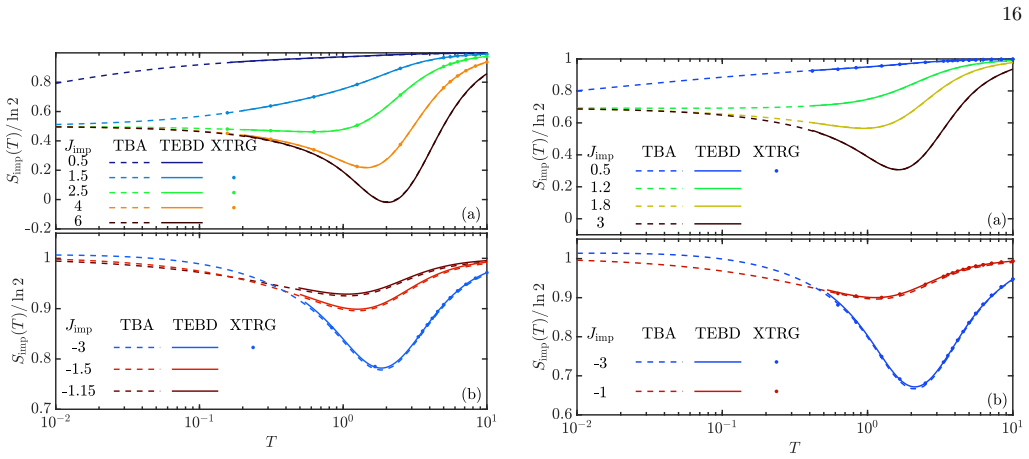
- Once boundary-bound states form, the impurity entropy is nonmonotonic in temperature, giving a sharp thermodynamic fingerprint that distinguishes the new phases from the conventional Kondo phase.
- In the AF3 and F2 phases the impurity spectral function develops a threshold peak near $|E_\gamma|$, providing a frequency-resolved probe of which excitation tower becomes kinematically accessible.
- At high temperature every tower contributes equally and $S_{\rm imp}(\infty)=\ln 2$, confirming that the three towers together account for the full spin-$1/2$ impurity Hilbert space.
Reading between the lines
- If the tower completeness assumed here holds, the same multi-tower TBA pipeline should apply to other integrable boundary systems, such as open XXZ chains or Gross–Neveu-type impurities; a testable extension is a similar nonmonotonic impurity entropy whenever a boundary string crosses the threshold $\gamma=1/2$.
- The sum rule $\sum_k e^{S_k(\infty)}=2$ checks the total count of towers but does not prove that every eigenstate is captured; a stronger test is an exact diagonalization of the finite-size Hamiltonian (1) at small $N$ and $s=1$, comparing the full level count and energies with the Bethe-ansatz predictions including boundary strings.
- The paper's preliminary suggestion that quasi-towers survive weak integrability breaking implies that the qualitative phenomenology, including nonmonotonic impurity entropy and spectral thresholds, may persist in realistic materials, but the exact residual entropies and phase boundaries would shift; measuring the temperature of the entropy dip as a function of boundary coupling could locate the ap
Signed reviews
Editorial analysis
A structured set of objections, weighed in public.
Referee Report
Summary. The paper studies a spin-1/2 impurity coupled to the boundary of an integrable spin-s Takhtajan–Babujian chain. Using boundary quantum inverse scattering, the authors construct the Bethe ansatz solution, map out a five-phase boundary phase diagram, and develop a multi-tower thermodynamic Bethe ansatz in which the Hilbert space is decomposed into towers built on different boundary configurations. The central claims are that the residual impurity entropy is ln[2cos(pi/(2s+2))] throughout the antiferromagnetic regime, that the impurity entropy becomes nonmonotonic when boundary-bound states form, and that the impurity spectral function shows thresholds at |E_gamma| in the gapped phases. These predictions are benchmarked against finite-temperature MPO simulations for s=1 and s=3/2 and against the BCFT Affleck–Ludwig g-function in the overscreened regime.
Significance. If correct, the paper provides a rare exact, nonperturbative description of the crossover from overscreened Kondo physics to boundary-bound-state formation in a strongly correlated spin chain, including thermodynamics across all coupling regimes. The main strengths are the explicit integrability construction in Appendix A, the independent BCFT check on the residual entropy in AF1, the multi-tower TBA framework, and the quantitative MPO and spectral-function benchmarks. The tower decomposition and the three-tower degeneracy are, however, central inputs whose derivation is incomplete, and one of the appendix formulas used to support the residual entropy is internally inconsistent. The paper's conceptual framework is compelling, but the missing technical support for the tower base-energy degeneracy must be supplied before the central claims can be considered established.
major comments (3)
- [Appendix B, text after Eqs. (B13), (B20), (B24); Sec. IV.B.1] The T=0 degeneracy of the three towers in AF2'' (gamma in (1,s)) and F1 (gamma>s+1) is a load-bearing assumption that is asserted but not derived. The text states 'E_BS = E_str for gamma<s or gamma>s+1' and says that a 'compact G*Y expression' exists for E_hBS, but no cancellation is shown. If, for example, E_hBS differs from E_str in AF2'', then the T=0 partition function is dominated by a single tower and the residual entropy would be S_hBS(0), not ln[2cos(pi/(2s+2))]. The MPO benchmarks in Sec. V do not reach T=0 in AF2'' (for s=3/2, J=1.8, data stop near T=0.4), so this central input has no independent numerical verification. I request either an explicit derivation of the equalities E_str=E_BS=E_hBS in these phases or a small-N exact-diagonalization check of the tower base energies for a representative coupling in AF2'' and F1.
- [Appendix B, Eq. (B17)] Equation (B17) is algebraically inconsistent with the zero-temperature eta solution in Eq. (B16). From (B16), 1+eta_n = [sin(pi(n+1)/(2s+2))/sin(pi/(2s+2))]^2, so the ratio (1+eta_{n+1})/(1+eta_n) is the square of the displayed trigonometric ratio, not the ratio itself. For s=1, gamma=0.8, the appendix formula gives S_str(0)=ln(1/2)=-0.693, whereas the correct tower entropy obtained from Eq. (69) is -0.347. A reader following the appendix would find that e^{S_str}+e^{S_BS}=1.207, not sqrt(2), and the claimed residual entropy ln sqrt(2) would fail. The appendix must be corrected (likely a missing factor 1/2) and brought into agreement with the main-text formulas in Sec. IV.C, which are the correct ones.
- [Sec. IV.B, Eqs. (63)-(67)] The total partition function is written as a sum over three tower free energies, which presumes that every Bethe root configuration is either a pure bulk n-string configuration or one containing the fundamental/higher-order boundary strings, with no other non-string roots mixing the towers. The check sum_k e^{S_k(infty)}=2 verifies the total impurity Hilbert-space dimension at infinite temperature but is not sufficient to exclude additional non-string solutions that could alter the low-temperature sum. This completeness assumption should be stated explicitly in the main text, and the authors should provide a counting argument or a numerical classification of Bethe roots for moderate N in at least one representative coupling in AF2'' and F1.
minor comments (3)
- [Sec. IV.C, S_hBS formula] The displayed formula for S_hBS(0) uses the index floor(2|gamma-1|) and lacks the numerator sin^2(pi/(2s+2)); for gamma in (1,1.5) and s=3/2 this gives a division by zero. The correct expression is Eq. (B25), which uses floor(2gamma).
- [Eq. (72) and Fig. 4] The sign and monotonicity of E_gamma should be clarified: in AF3, E_gamma is negative and 'growing' means increasing toward zero as J/g increases, while in F2 it is positive. The caption of Fig. 4 and the text around Eq. (72) should state this convention explicitly.
- [Sec. V] The sentence in the s=1 discussion stating that the MPO data see lim_{T->0} S_imp = 0.5 log 2 refers specifically to s=1; this should be stated explicitly so it is not confused with the s=3/2 result, whose residual value is ln(2 cos(pi/5)) not (1/2) ln 2.
Circularity Check
No significant circularity: the Bethe-Ansatz/TBA derivation is self-contained and externally benchmarked.
full rationale
The paper's central predictions are not circular. The Bethe Ansatz equations (20) and energy (21) are derived from the transfer-matrix construction in Appendix A, and the impurity parameter gamma is a reparameterization of J/g via Eq. (22), not a fitted quantity. The AF1 residual entropy (42) is obtained by solving the standard Takahashi eta-system (39)-(41) and is independently checked against the Affleck-Ludwig BCFT result (19); the BCFT value is not used as an input to the Bethe-Ansatz calculation. The multi-tower decomposition (66)-(67) is presented as an ansatz over Bethe-Ansatz solution classes and is re-derived for the spin-s model in Appendix B, with tower-dependent driving terms (64) and free energies (69)-(74) obtained from the BAE rather than imported wholesale from the authors' prior work. The finite-temperature entropy curves are benchmarked against parameter-free MPO/TEBD/XTRG simulations (Figs. 5-6), and the spectral thresholds are compared with the analytically derived boundary gap E_gamma (72) without a fitted offset. The unproved base-energy degeneracy E_BS = E_str in the AF2''/F1 phases is a derivation gap and a correctness risk, not a circular reduction: the equality is claimed as a consequence of the root-energy sums, not imposed as an input. Self-citations to Ref. [24] supply nomenclature and motivation, but the load-bearing derivation is self-contained in the present manuscript.
Assumptions & free parameters
assumptions (4)
- domain assumption String hypothesis for the open spin-s Takhtajan-Babujian chain with boundary impurity: all eigenstates are captured by bulk n-strings plus boundary strings.
- domain assumption Completeness of the three-tower decomposition: the total partition function is a simple sum over tower impurity free energies, e^{-beta F_imp} = sum_k e^{-beta F_imp^(k)}.
- standard math Takahashi identity and analytic continuation of shifted kernels (Eq. (34) and Eq. (B12)) are valid for complex impurity shifts gamma.
- standard math Boundary CFT fusion rule: the infrared fixed point for antiferromagnetic coupling is the fusion of a spin-1/2 primary with the SU(2)_k boundary condition, giving residual entropy ln(2 cos(pi/(2s+2))).
Cite this review
Pith. "Pith review of Boundary phases and thermodynamics of the Kondo spin-$s$ chain: from overscreened Kondo to boundary-bound states." pith.science (2026). https://pith.science/paper/NWLOR7PW
@misc{pith2026260812453,
  author       = {Pith},
  title        = {Pith review of: Boundary phases and thermodynamics of the Kondo spin-$s$ chain: from overscreened Kondo to boundary-bound states},
  year         = {2026},
  howpublished = {\url{https://pith.science/paper/NWLOR7PW}},
  note         = {Machine review of arXiv:2608.12453}
}
abstract
We study a spin-$\frac12$ impurity coupled to the boundary of a strongly correlated spin-$s$ Takhtajan--Babujian chain, an integrable model whose low-energy physics is described by a perturbed $SU(2)_{2s}$ Wess--Zumino--Witten conformal field theory. While boundary conformal field theory determines the low-energy universality class of the weak-coupling regime, exact Bethe Ansatz methods reveal a sequence of boundary quantum phase transitions in which impurity-bound states emerge and reorganize the Hilbert space into multiple excitation towers built on distinct boundary configurations. This tower restructuring provides the organizing principle for a rich boundary phase diagram extending beyond the conventional Kondo regime. Weak antiferromagnetic coupling realizes the overscreened $2s$-channel Kondo universality class, whereas stronger couplings generate localized boundary modes and qualitatively new screening mechanisms. To describe the resulting thermodynamics, we develop a generalized thermodynamic Bethe Ansatz framework that captures the multi-tower structure across all regimes. The impurity entropy reproduces the boundary conformal field theory prediction in the overscreened Kondo regime but develops pronounced nonmonotonic temperature dependence once boundary-bound states appear, in quantitative agreement with large-scale finite-temperature matrix-product-operator simulations. Complementary dynamical calculations reveal sharp threshold features in the impurity spectral function that directly track the underlying tower structure. Together, boundary conformal field theory, exact Bethe Ansatz, generalized thermodynamic Bethe Ansatz, and tensor-network simulations provide a unified description of impurity screening, boundary-bound-state formation, and excitation-tower reconstruction in a correlated spin-$s$ chain.
Figures


Figures from the paper (6 more)


Reference graph
Works this paper leans on
-
[1]
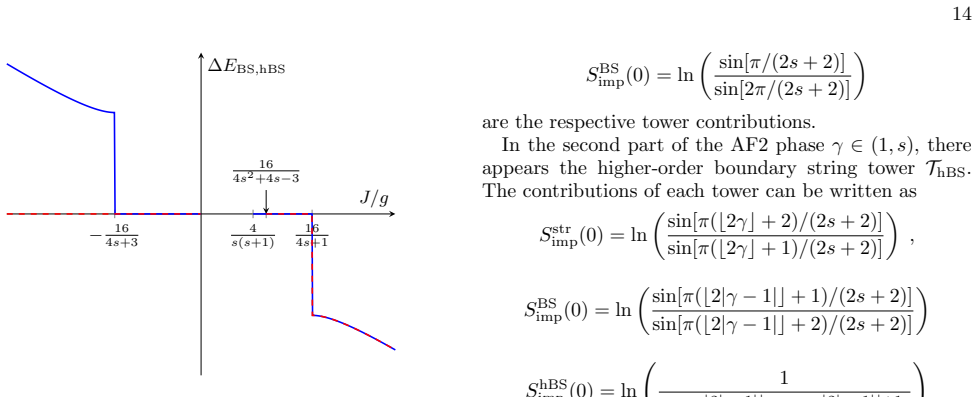
Phase AF2 For intermediate antiferromagnetic impurity coupling strengthJ/g∈( 4 s(s+1), 16 4s+1), the corresponding impu- rity parameter is within the rangeγ∈(1/2,s). For γ >1/2, in addition to the string towerT str, the BAE (20) allows for the boundary-string towerT BS; and for γ >1, on top of the two, there appears the higher-order boundary string towerT...
-
[2]
Phase AF3 The strong antiferromagnetic phase AF3 corresponds to the couplings ratioJ/g > 16 4s+1 and the impurity pa- rameterγ∈(s,s+ 1/2). In this phase, the spin chain prefers to form the bound modes with the impurity – both boundary string and higher-order boundary string base states become the ground state, and the string tower carrying (s+ 1)/(2s+ 1) ...
-
[3]
Phase F2 When the impurity parameter crosses the valueγ=s+ 1 2, the system enters the strong ferromagnetic phase F2 γ∈(s+ 1 2,s+ 1) with the couplings ratioJ/g <− 16 4s+3. In this phase, because of the ferromagnetic nature of the impurity coupling with the spin chain, it is energetically unfavorable for the system to form a bound singlet with the impurity...
-
[4]
Similar to the AF2” phase, all three towers start from the same energy, and the free energy expressions follow (73) withγ∈(s+ 1,∞)
Phase F1 The last in the list is the weak ferromagnetic phase J/g∈(− 16 4s+3,0). Similar to the AF2” phase, all three towers start from the same energy, and the free energy expressions follow (73) withγ∈(s+ 1,∞). The closed form of the free energy contributions of each of the towers in terms of the ratiosη n together with the limit values of these ratios ...
-
[5]
The Kondo problem to heavy fermions
Alexander Cyril Hewson. The Kondo problem to heavy fermions. Number 2. Cambridge university press, 1997
1997
-
[6]
The physics of dilute magnetic alloys
Jun Kondo. The physics of dilute magnetic alloys. Cam- bridge University Press, 2012
2012
-
[7]
Solu- tion of the kondo problem
Natan Andrei, K Furuya, and JH Lowenstein. Solu- tion of the kondo problem. Reviews of modern physics, 55(2):331, 1983
1983
-
[8]
Solution of the n-channel kondo problem (scaling and integrability)
AM Tsvelick and PB Wiegmann. Solution of the n-channel kondo problem (scaling and integrability). Zeitschrift f¨ urPhysik B Condensed Matter, 54(3):201– 206, 1984
1984
Show all 114 references
-
[9]
Scales and scaling in the kondo model
N Andrei and JH Lowenstein. Scales and scaling in the kondo model. Physical review letters, 46(5):356, 1981
1981
-
[10]
Pasnoori, J
Pradip Kattel, Parameshwar R. Pasnoori, J. H. Pix- ley, Patrick Azaria, and Natan Andrei. Kondo effect in the isotropic heisenberg spin chain. Phys. Rev. B, 109:174416, May 2024
2024
-
[11]
Pasnoori, J
Pradip Kattel, Parameshwar R. Pasnoori, J. H. Pixley, and Natan Andrei. Edge modes and boundary impurities in the anisotropic heisenberg spin chain. Phys. Rev. B, 111:174430, May 2025
2025
-
[12]
The one-dimensional ising model with a transverse field
Pierre Pfeuty. The one-dimensional ising model with a transverse field. ANNALS of Physics, 57(1):79–90, 1970
1970
-
[13]
Critical prop- erties of s= 1/2 antiferromagnetic xxz chain with next- nearest-neighbour interactions
Kiyohide Nomura and Kiyomi Okamoto. Critical prop- erties of s= 1/2 antiferromagnetic xxz chain with next- nearest-neighbour interactions. Journal of Physics A: Mathematical and General, 27(17):5773–5788, 1994
1994
-
[14]
Anoma- lous transport from hot quasiparticles in interacting spin chains
Sarang Gopalakrishnan and Romain Vasseur. Anoma- lous transport from hot quasiparticles in interacting spin chains. Reports on Progress in Physics, 86(3):036502, 2023. 20
2023
-
[15]
Kinetic theory of spin diffusion and superdiffusion in xxz spin chains
Sarang Gopalakrishnan and Romain Vasseur. Kinetic theory of spin diffusion and superdiffusion in xxz spin chains. Physical review letters, 122(12):127202, 2019
2019
-
[16]
Kardar-parisi-zhang physics in the quantum heisenberg magnet
Marko Ljubotina, Marko ˇZnidariˇ c, and Tomaˇ z Prosen. Kardar-parisi-zhang physics in the quantum heisenberg magnet. Physical review letters, 122(21):210602, 2019
2019
-
[17]
Detection of kardar–parisi–zhang hydrodynamics in a quantum heisenberg spin-1/2 chain
Allen Scheie, NE Sherman, M Dupont, SE Nagler, MB Stone, GE Granroth, JE Moore, and DA Tennant. Detection of kardar–parisi–zhang hydrodynamics in a quantum heisenberg spin-1/2 chain. Nature Physics, 17(6):726–730, 2021
2021
-
[18]
Quantum physics in one dimension, volume 121
Thierry Giamarchi. Quantum physics in one dimension, volume 121. Clarendon press, 2003
2003
-
[19]
Continuum dynamics of the 1-d heisenberg antiferromagnet: Identification with the o (3) nonlinear sigma model
F Duncan M Haldane. Continuum dynamics of the 1-d heisenberg antiferromagnet: Identification with the o (3) nonlinear sigma model. Physics letters a, 93(9):464–468, 1983
1983
-
[20]
Field theory methods and quantum critical phenomena
Ian K Affleck. Field theory methods and quantum critical phenomena. Technical report, PRE-31353, 1988
1988
-
[21]
Scaling of entanglement close to a quan- tum phase transition
Andreas Osterloh, Luigi Amico, Giuseppe Falci, and Rosario Fazio. Scaling of entanglement close to a quan- tum phase transition. Nature, 416(6881):608–610, 2002
2002
-
[22]
The kondo effect in spin chains
Nicolas Laflorencie, Erik S Sørensen, and Ian Affleck. The kondo effect in spin chains. Journal of Statistical Mechanics: Theory and Experiment, 2008(02):P02007, 2008
2008
-
[23]
Entanglement in many-body systems
Luigi Amico, Rosario Fazio, Andreas Osterloh, and Vlatko Vedral. Entanglement in many-body systems. Reviews of modern physics, 80(2):517–576, 2008
2008
-
[24]
Heisenberg chain with impurities (an integrable model)
Natan Andrei and Henrik Johannesson. Heisenberg chain with impurities (an integrable model). Physics Letters A, 100(2):108–112, 1984
1984
-
[25]
Exact solution of the open heisen- berg chain with two impurities
Yupeng Wang. Exact solution of the open heisen- berg chain with two impurities. Physical Review B, 56(21):14045, 1997
1997
-
[26]
The open spin chain with impurity: an exact solution
Holger Frahm and Andrei A Zvyagin. The open spin chain with impurity: an exact solution. Journal of Physics: Condensed Matter, 9(45):9939, 1997
1997
-
[27]
Spin- chain multichannel kondo model via image impurity boundary condition
Jordan Gaines, Guangjie Li, and Jukka V¨ ayrynen. Spin- chain multichannel kondo model via image impurity boundary condition. arXiv preprint arXiv:2506.02399, 2025
2025
-
[28]
Ther- modynamics in a split hilbert space: Quantum impu- rity at the edge of the heisenberg chain
Abay Zhakenov, Pradip Kattel, and Natan Andrei. Ther- modynamics in a split hilbert space: Quantum impu- rity at the edge of the heisenberg chain. arXiv preprint arXiv:2508.19334, 2025
2025 arXiv
-
[29]
Entanglement probe of two- impurity kondo physics in a spin chain
Abolfazl Bayat, Sougato Bose, Pasquale Sodano, and Henrik Johannesson. Entanglement probe of two- impurity kondo physics in a spin chain. Physical Review Letters, 109(6):066403, 2012
2012
-
[30]
An introduction to integrable techniques for one-dimensional quantum systems, volume
Fabio Franchini et al. An introduction to integrable techniques for one-dimensional quantum systems, volume
-
[31]
Bosonization and strongly correlated systems
Alexander O Gogolin, Alexander A Nersesyan, and Alexei M Tsvelik. Bosonization and strongly correlated systems. Cambridge university press, 2004
2004
-
[32]
Bosonization for beginners—refermionization for experts
Jan Von Delft and Herbert Schoeller. Bosonization for beginners—refermionization for experts. Annalen der Physik, 510(4):225–305, 1998
1998
-
[33]
Ian Affleck and F. D. M. Haldane. Critical theory of quantum spin chains. Phys. Rev. B, 36:5291–5300, Oct 1987
1987
-
[34]
Low energy effective hamiltonian for the xxz spin chain
Sergei Lukyanov. Low energy effective hamiltonian for the xxz spin chain. Nuclear Physics B, 522(3):533–549, 1998
1998
-
[35]
Field-theoretical meth- ods in quantum magnetism
Daniel C Cabra and Pierre Pujol. Field-theoretical meth- ods in quantum magnetism. In Quantum Magnetism, pages 253–305. Springer, 2008
2008
-
[36]
Eigenwerte und eigenfunktionen der linearen atomkette
HA Bethe and I Zur Theorie der Metalle. Eigenwerte und eigenfunktionen der linearen atomkette. Z. Phys, 71(205):13, 1931
1931
-
[37]
One-dimensional chain of anisotropic spin-spin interactions
Chen-Ning Yang and Chen-Ping Yang. One-dimensional chain of anisotropic spin-spin interactions. i. proof of bethe’s hypothesis for ground state in a finite system. Physical Review, 150(1):321, 1966
1966
-
[38]
One-dimensional chain of anisotropic spin-spin interactions
Chen-Ning Yang and Chen-Ping Yang. One-dimensional chain of anisotropic spin-spin interactions. ii. properties of the ground-state energy per lattice site for an infinite system. Physical Review, 150(1):327, 1966
1966
-
[39]
One-dimensional chain of anisotropic spin-spin interactions
Chen-Ning Yang and Chen-Ping Yang. One-dimensional chain of anisotropic spin-spin interactions. iii. applica- tions. Physical Review, 151(1):258, 1966
1966
-
[40]
Exactly solved models in statistical mechanics
Rodney J Baxter. Exactly solved models in statistical mechanics. Elsevier, 2016
2016
-
[41]
Thermodynamics of one- dimensional solvable models
Minoru Takahashi et al. Thermodynamics of one- dimensional solvable models. 1999
1999
-
[42]
Dynamical structure factor of the anisotropic heisen- berg chain in a transverse field
Jean-S´ ebastien Caux, Fabian HL Essler, and Ute L¨ ow. Dynamical structure factor of the anisotropic heisen- berg chain in a transverse field. Physical Review B, 68(13):134431, 2003
2003
-
[43]
Computation of dynamical correlation func- tions of heisenberg chains: the gaplessanisotropic regime
Jean-S´ ebastien Caux, Rob Hagemans, and Jean Michel Maillet. Computation of dynamical correlation func- tions of heisenberg chains: the gaplessanisotropic regime. Journal of Statistical Mechanics: Theory and Experiment, 2005(09):P09003, 2005
2005
-
[44]
In- tegrable spin chain with hilbert space fragmentation and solvable real-time dynamics
Bal´ azs Pozsgay, Tam´ as Gombor, Arthur Hutsalyuk, Yun- feng Jiang, Levente Pristy´ ak, and Eric Vernier. In- tegrable spin chain with hilbert space fragmentation and solvable real-time dynamics. Physical Review E, 104(4):044106, 2021
2021
-
[45]
Quantum wake dynamics in heisen- berg antiferromagnetic chains
Allen Scheie, Pontus Laurell, Bella Lake, Stephen E Nagler, Matthew B Stone, Jean-Sebastian Caux, and D Alan Tennant. Quantum wake dynamics in heisen- berg antiferromagnetic chains. Nature Communications, 13(1):5796, 2022
2022
-
[46]
Experimental observation of bethe strings
Zhe Wang, Jianda Wu, Wang Yang, Anup Kumar Bera, Dmytro Kamenskyi, ATM Nazmul Islam, Shenglong Xu, Joseph Matthew Law, Bella Lake, Congjun Wu, et al. Experimental observation of bethe strings. Nature, 554(7691):219–223, 2018
2018
-
[47]
Theoretical and experimental studies on one-dimensional magnetic sys- tems
M Steiner, J Villain, and CG Windsor. Theoretical and experimental studies on one-dimensional magnetic sys- tems. Advances in Physics, 25(2):87–209, 1976
1976
-
[48]
Spin dynamics in the quantum antiferro- magnetic chain compound kcuf 3
SE Nagler, DA Tennant, RA Cowley, TG Perring, and SK Satija. Spin dynamics in the quantum antiferro- magnetic chain compound kcuf 3. Physical Review B, 44(22):12361, 1991
1991
-
[49]
Far-from-equilibrium spin transport in heisenberg quantum magnets
Sebastian Hild, Takeshi Fukuhara, Peter Schauß, Jo- hannes Zeiher, Michael Knap, Eugene Demler, Immanuel Bloch, and Christian Gross. Far-from-equilibrium spin transport in heisenberg quantum magnets. Physical review letters, 113(14):147205, 2014
2014
-
[50]
Spin-1 haldane phase in a chain of rydberg atoms
J M¨ ogerle, K Brechtelsbauer, AT Gea-Caballero, J Prior, G Emperauger, G Bornet, C Chen, Thierry Lahaye, A Browaeys, and HP B¨ uchler. Spin-1 haldane phase in a chain of rydberg atoms. PRX Quantum, 6(2):020332, 21 2025
2025
-
[51]
Quasi-local edge mode in xxx spin chain/circuit with interaction boundary defect
Tomaˇ z Prosen. Quasi-local edge mode in xxx spin chain/circuit with interaction boundary defect. arXiv preprint arXiv:2603.17835, 2026
2026 arXiv
-
[52]
Takhtajan
L.A. Takhtajan. The picture of low-lying excitations in the isotropic heisenberg chain of arbitrary spins. Physics Letters A, 87(9):479–482, 1982
1982
-
[53]
Babujian
H.M. Babujian. Exact solution of the one-dimensional isotropic heisenberg chain with arbitrary spins s. Physics Letters A, 90(9):479–482, 1982
1982
-
[54]
Babujian
H.M. Babujian. Exact solution of the isotropic heisen- berg chain with arbitrary spins: Thermodynamics of the model. Nuclear Physics B, 215(3):317–336, 1983
1983
-
[55]
This happens due to the choice of the interaction terms written in this paper in terms of spin operators while in [24] the Hamiltonian was in terms of the Pauli matrices
Settings= 1/2 gives the different impurity coupling from the one in [24]:J Heisenberg =J/4. This happens due to the choice of the interaction terms written in this paper in terms of spin operators while in [24] the Hamiltonian was in terms of the Pauli matrices
-
[56]
This choice was motivated by more convenient forms of the interaction for spinss= 1/2,1
The Babujian polynomial used in this paper comes with an additional factor of 4 when compared with the orig- inal paper [50]:Q 2s(x) = 4Q original 2s (x). This choice was motivated by more convenient forms of the interaction for spinss= 1/2,1
-
[57]
Impurity-induced critical behaviour in antiferromagnetic heisenberg chains
P Schlottmann. Impurity-induced critical behaviour in antiferromagnetic heisenberg chains. Journal of Physics: Condensed Matter, 3(34):6617, aug 1991
1991
-
[58]
Jianhui Dai, Yupeng Wang, and U. Eckern. Ghost spins and quantum critical behavior in a spin chain with lo- cal bond deformation. Phys. Rev. B, 60:6594–6600, Sep 1999
1999
-
[59]
Wess-zumino-witten models
Lorenz Eberhardt. Wess-zumino-witten models. YRISW PhD School in Vienna, 2, 2019
2019
-
[60]
Non-abelian bosonization in two di- mensions
Edward Witten. Non-abelian bosonization in two di- mensions. Communications in Mathematical Physics, 92(4):455–472, 1984
1984
-
[61]
A field theory of currents
Hirotaka Sugawara. A field theory of currents. Physical Review, 170(5):1659, 1968
1968
-
[62]
Conformal field theory approach to the kondo effect
Ian Affleck. Conformal field theory approach to the kondo effect. arXiv preprint cond-mat/9512099, 1995
1995 arXiv
-
[63]
Overscreened multichannel su (n) kondo model: Large-n solution and conformal field the- ory
Olivier Parcollet, Antoine Georges, Gabriel Kotliar, and Anirvan Sengupta. Overscreened multichannel su (n) kondo model: Large-n solution and conformal field the- ory. Physical Review B, 58(7):3794, 1998
1998
-
[64]
Solution of the multichannel kondo problem
Natan Andrei and C Destri. Solution of the multichannel kondo problem. Physical review letters, 52(5):364, 1984
1984
-
[65]
Multichannel kondo problem and some applications
P Schlottmann and PD Sacramento. Multichannel kondo problem and some applications. Advances in Physics, 42(6):641–682, 1993
1993
-
[66]
Boundary conformal field theory
John Cardy. Boundary conformal field theory. arXiv preprint hep-th/0411189, 2004
2004 arXiv
-
[67]
ground-state degeneracy
Ian Affleck and Andreas WW Ludwig. Universal nonin- teger “ground-state degeneracy”in critical quantum sys- tems. Physical Review Letters, 67(2):161, 1991
1991
-
[68]
In the Bethe-Ansatz/TBA calculation below, that con- tribution is present in both the impurity and impurity- free systems and therefore cancels in the difference defin- ingS imp
In a microscopic open spin chain, there is also an ordinary open-boundary contribution to the totalO(1) entropy. In the Bethe-Ansatz/TBA calculation below, that con- tribution is present in both the impurity and impurity- free systems and therefore cancels in the difference de...
-
[69]
Thermodynam- ics of a one-dimensional system of bosons with repul- sive delta-function interaction
Chen-Ning Yang, Cheng P Yang, et al. Thermodynam- ics of a one-dimensional system of bosons with repul- sive delta-function interaction. Journal of Mathematical Physics, 10(7):1115, 1969
1969
-
[70]
Due to open-boundary conditions,µ j and−µ j corre- spond to the same excitation
-
[71]
Ono(1) contributions to the free energy in bethe ansatz systems: the exact g-function
Bal´ azs Pozsgay. Ono(1) contributions to the free energy in bethe ansatz systems: the exact g-function. Journal of High Energy Physics, 2010(8):1–30, 2010
2010
-
[72]
Exact g-function without strings
Yi-Jun He and Yunfeng Jiang. Exact g-function without strings. arXiv preprint arXiv:2412.12869, 2024
2024 arXiv
-
[73]
The thermodynamics in this work is formulated in the open-channel picture, where the tower decomposition emerges naturally from the Bethe-Ansatz spectrum of the open chain. It would be interesting to understand how the same tower structure is encoded in the corresponding close...
-
[74]
ground-state degeneracy
Ian Affleck and Andreas W. W. Ludwig. Universal nonin- teger “ground-state degeneracy” in critical quantum sys- tems. Phys. Rev. Lett., 67:161–164, Jul 1991
1991
-
[75]
Integrable models in condensed matter physics
Natan Andrei. Integrable models in condensed matter physics. In Low-Dimensional Quantum Field Theories for Condensed Matter Physicists, page 457–551. WORLD SCIENTIFIC, February 1995
1995
-
[76]
The kondo effect in the quantum xx spin chain
Pradip Kattel, Yicheng Tang, J H Pixley, and Natan An- drei. The kondo effect in the quantum xx spin chain. Journal of Physics A: Mathematical and Theoretical, 57(26):265004, jun 2024
2024
-
[77]
Off-diagonal Bethe ansatz for exactly solvable models
Yupeng Wang, Wen-Li Yang, Junpeng Cao, and Kangjie Shi. Off-diagonal Bethe ansatz for exactly solvable models. Springer, 2015
2015
-
[78]
Non-Abelian symmetries in ten- sor networks: A quantum symmetry space approach
Andreas Weichselbaum. Non-Abelian symmetries in ten- sor networks: A quantum symmetry space approach. Annals of Physics, 327(12):2972–3047, 2012
2012
-
[79]
X-symbols for non-Abelian sym- metries in tensor networks
Andreas Weichselbaum. X-symbols for non-Abelian sym- metries in tensor networks. Physical Review Research, 2(2):023385, 2020
2020
-
[80]
QSpace – an open-source tensor library for Abelian and non-Abelian symmetries
Andreas Weichselbaum. QSpace – an open-source tensor library for Abelian and non-Abelian symmetries. SciPost Physics Codebases, 40, 2024
2024
-
[81]
Garc´ ıa-Ripoll, and J
Frank Verstraete, Juan J. Garc´ ıa-Ripoll, and J. Ignacio Cirac. Matrix product density operators: Simulation of finite-temperature and dissipative systems. Physical Review Letters, 93(20):207204, 2004
2004
-
[82]
Mixed-state dy- namics in one-dimensional quantum lattice systems: A time-dependent superoperator renormalization algo- rithm
Michael Zwolak and Guifr´ e Vidal. Mixed-state dy- namics in one-dimensional quantum lattice systems: A time-dependent superoperator renormalization algo- rithm. Physical Review Letters, 93(20):207205, 2004
2004
-
[83]
Feiguin and Steven R
Adrian E. Feiguin and Steven R. White. Finite- temperature density matrix renormalization using an en- larged hilbert space. Physical Review B, 72(22):220401, 2005
2005
-
[84]
Efficient simulation of one-dimensional quantum many-body systems
Guifr´ e Vidal. Efficient simulation of one-dimensional quantum many-body systems. Physical Review Letters, 93(4):040502, 2004
2004
-
[85]
Exponential thermal tensor network ap- proach for quantum lattice models
Bin-Bin Chen, Lei Chen, Ziyu Chen, Wei Li, and Andreas Weichselbaum. Exponential thermal tensor network ap- proach for quantum lattice models. Physical Review X, 8(3):031082, 2018
2018
-
[86]
Steven R. White. Density matrix formulation for quan- tum renormalization groups. Phys. Rev. Lett., 69:2863– 2866, Nov 1992
1992
-
[87]
Schollw¨ ock
U. Schollw¨ ock. The density-matrix renormalization group. Rev. Mod. Phys., 77:259–315, Apr 2005
2005
-
[88]
The density-matrix renormalization group in the age of matrix product states
Ulrich Schollw¨ ock. The density-matrix renormalization group in the age of matrix product states. Annals of 22 Physics, 326(1):96–192, 2011. January 2011 Special Issue
2011
-
[89]
Con- trolled bond expansion for density matrix renormaliza- tion group ground state search at single-site costs
Andreas Gleis, Jheng-Wei Li, and Jan von Delft. Con- trolled bond expansion for density matrix renormaliza- tion group ground state search at single-site costs. Phys. Rev. Lett., 130:246402, Jun 2023
2023
-
[90]
Time- dependent variational principle with controlled bond ex- pansion for matrix product states
Jheng-Wei Li, Andreas Gleis, and Jan von Delft. Time- dependent variational principle with controlled bond ex- pansion for matrix product states. Phys. Rev. Lett., 133:026401, Jul 2024
2024
-
[91]
Pro- jector formalism for kept and discarded spaces of matrix product states
Andreas Gleis, Jheng-Wei Li, and Jan von Delft. Pro- jector formalism for kept and discarded spaces of matrix product states. Phys. Rev. B, 106:195138, Nov 2022
2022
-
[92]
Hubig, I
C. Hubig, I. P. McCulloch, U. Schollw¨ ock, and F. A. Wolf. Strictly single-site dmrg algorithm with subspace expansion. Phys. Rev. B, 91:155115, Apr 2015
2015
-
[93]
Re- ply to comment on ”controlled bond expansion for den- sity matrix renormalization group ground state search at single-site costs”, 2025
Andreas Gleis, Jheng-Wei Li, and Jan von Delft. Re- ply to comment on ”controlled bond expansion for den- sity matrix renormalization group ground state search at single-site costs”, 2025
2025
-
[94]
Tangent space Krylov computation of real-frequency spectral functions: Influence of density-assisted hopping on 2D Mott physics
Oleksandra Kovalska, Jan von Delft, and Andreas Gleis. Tangent space Krylov computation of real-frequency spectral functions: Influence of density-assisted hopping on 2D Mott physics. 2510.07279 [cond-mat.str-el], 2025
2025
-
[95]
Ther- modynamics in a split hilbert space: Quantum impurity at the edge of a one-dimensional superconductor
Pradip Kattel, Abay Zhakenov, and Natan Andrei. Ther- modynamics in a split hilbert space: Quantum impurity at the edge of a one-dimensional superconductor. arXiv preprint arXiv:2508.19330, 2025
2025 arXiv
-
[96]
Kondo overscreening in the presence of superconductiv- ity
Pradip Kattel, Abay Zhakenov, and Natan Andrei. Kondo overscreening in the presence of superconductiv- ity. Phys. Rev. B, 112:085103, Aug 2025
2025
-
[97]
Mul- tichannel kondo effect in one-dimensional superconduct- ing leads
Pradip Kattel, Abay Zhakenov, and Natan Andrei. Mul- tichannel kondo effect in one-dimensional superconduct- ing leads. Phys. Rev. B, 113:165130, Apr 2026
2026
-
[98]
Com- peting color superconductivity and color kondo effect in quark matter
Pradip Kattel, Abay Zhakenov, and Natan Andrei. Com- peting color superconductivity and color kondo effect in quark matter. Phys. Rev. D, 112:094012, Nov 2025
2025
-
[99]
Exact spectrum of the spin-s heisenberg chain with generic non-diagonal boundaries
Junpeng Cao, Shuai Cui, Wen-Li Yang, Kangjie Shi, and Yupeng Wang. Exact spectrum of the spin-s heisenberg chain with generic non-diagonal boundaries. Journal of High Energy Physics, 2015(2), February 2015. Appendix A: Integrability, Bethe equations, and energy formula This ap...
2015
-
[100]
Double-row monodromy and transfer matrix The chain consists ofNbulk spin-ssites 1,...,Nand a spin- 1 2 impurity at site 0, attached to the left edge. Open boundaries are implemented by the double-row (Sklyanin-type) monodromy with auxiliary spins, Ua s (u) =T a s (u)bTa s (u),...
-
[101]
Regularity is what makest s(u) generate a local Hamiltonian
From the transfer matrix to the Hamiltonian Regularity.Settingu= 0 in (A4) givesf ℓ(0) =η 2s(2s)! (−1)2s−ℓ, hence Rkl s (0) =c 2sX ℓ=0 (−1)2s−ℓPℓ kl =cP kl, c≡η 2s(2s)!,(A18) whereP kl is the permutation operator on the two spin-ssitesk,l(its spectral decomposition ons⊗sis exa...
-
[102]
The Babujian polynomialQ 2s(x) The bulk interaction in (A28) is the degree-2spolynomial (A24) in theSU(2) scalarx= ⃗Si·⃗Si+1. Three equivalent representations are useful, Q2s(x) = 4 2sX ℓ=1 HℓPℓ,(A29) = 4 2sX ℓ=1 Hℓ 2sY m=0 m̸=ℓ x−x m xℓ−xm ,(A30) = 2sX p=0 qpxp,(A31) the last...
-
[103]
A 8, the power form for numerics
Projector form: Q2(x) = 4H1P 1 + 4H2P 2 = 4P 1 + 6P2,(A34) power form: Q2(x) = 6 +x−x 2.(A35) Example:s= 3 2.Here 2s= 3,x 0 =− 15 4 ,x 1 =− 11 4 ,x 2 =− 3 4,x 3 = 9 4, andH 1 = 1,H 2 = 3 2,H 3 = 11 6 , giving Q3(x) = 4P 1 + 6P2 + 22 3P 3 = 4 27x3 + 2 27x2− 1 4x+ 35 6 .(A36) 26...
-
[104]
We sketch the proof in three steps, following the standard Sklyanin argument adapted to the impurity monodromy (A14)–(A15)
Commutativity of the transfer matrices Integrability follows from [t j(u),tk(v)] = 0 for arbitrary auxiliary spinsj,k, since expandingt(u) in powers ofu then yields a commuting family of charges containingH. We sketch the proof in three steps, following the standard Sklyanin a...
-
[105]
and then relate its eigenvalues to those oft s by fusion
-
[106]
wanted”) lines yield the eigenvalue; the remaining (“unwanted
Algebraic Bethe ansatz with spin- 1 2 auxiliary space Operator entries.Write the double-row monodromy with spin- 1 2 auxiliary space as Ua σ(u) = A(u)B(u) C(u)D(u) ! a ,(A43) 27 and the single row asT a σ (u) = A(u)B(u) C(u)D(u) ! . The crossing identityσ y a Rai(u) ta σy a =−...
-
[107]
Rather than repeating the ABA for a spin-sauxiliary space, we use fusion [95]
Fusion and the hierarchy relation The Hamiltonian is generated byt s(u), not byt σ(u), so we still need the eigenvalues of the former. Rather than repeating the ABA for a spin-sauxiliary space, we use fusion [95]. FusedR-matrices.For two auxiliary spin- 1 2 spaces at spectral ...
-
[108]
Energy function The cases= 1.Fors= 1 the bulk auxiliary spin coincides with the fused spin 1, so (A75) is all we need. The Hamiltonian (A28) reads Hs=1 =J⃗ s0·⃗S1 +g N−1X k=1 6 +⃗Sk·⃗Sk+1− ⃗Sk·⃗Sk+1 2 =J⃗ s0·⃗S1 +g N−1X k=1 4P 1 k,k+1 + 6P2 k,k+1 ,(A76) and E= d du ln Λ1(u) u=...
-
[109]
limu→0ud (s)(u−η/2) =−lim u→0ua (s)(u−η/2) =− η3 2 s2N 1 4−γ 2 . 31 Hence lim u→0 u[···] = h lim u→0 ua (s) u− η 2 i a(s)η 2 ,(A78) while d du{u[···]} u=0 = d dua(s) u+ η 2 0 h limua (s) i + d du n ua (s) u− η 2 o 0 a(s)η 2 | {z } {λ}-independent + h limua (s) i a(s)η 2 d du Q...
-
[110]
IV C FIG
Preliminaries The BAE for rapidities{µ j}, derived in the Section A 6, read µj−is µj +is 2N µj− i 2−iγ µj + i 2−iγ µj− i 2 +iγ µj + i 2 +iγ = MY ℓ=1 ℓ̸=j (µj−µℓ−i)(µj +µℓ−i) (µj−µℓ +i)(µj +µℓ +i) .(B1) Introduce the standard phase functions Θn(x) = 2 arctan 2x n , K n(x) = 1 2...
-
[111]
String tower (no boundary strings) Applying the string hypothesis,n-string centers{λ (n) j }obey the log-BAE 2NX n,2s(λ(n) j )+Θn(λ(n) j )+Θn(λ(n) j −iγ)+Θ n(λ(n) j +iγ) = 2πJ (n) j + X m≥1 ζmX i=1 Θnm(λ(n) j −λ (m) i )+Θnm(λ(n) j +λ (m) i ) , (B5) with integersJ (n) j . Diffe...
-
[112]
Fundamental boundary-string tower (γ >1/2) Forγ > 1 2 the BAE admit the impurity-dependent rootµ γ =i(γ− 1
-
[113]
(fundamental boundary string). Including it shifts the driving term in (B6): σh n(µ) =f BS n (µ)− X m≥1 Anmσm(µ), f BS n (µ) = 2NY n,2s(µ) +Kn(µ)− X v=± Kn µ+iv(γ−1) .(B19) Thus the impurity free energy becomes Fimp BS (T) =−4πK 2s i(γ− 1 2) + T 2 X n≥1 Z dλ X v=± Kn λ+iv(γ−1)...
-
[114]
2 mX k=1 X v=± Kn µ+iv(γ−k) + X v=± Kn µ+iv(γ−m−1) # ,(B23) 36 leading to the impurity free energy Fimp hBS(T) =−4π mX k=0 K2s i γ− 1 2−k + T 2 X n≥1 Z dλ X v=±
Higher-order boundary-string tower (γ >1) Forγ >1 there exist higher-order boundary stringsµ (m) γ,l =i(γ− 1 2−l), l= 0,...,m, m=⌊γ+ 1 2⌋[73]. Including these roots changes the driving term to fhBS n (µ) = 2NY n,2s(µ) +Kn(µ)− " 2 mX k=1 X v=± Kn µ+iv(γ−k) + X v=± Kn µ+iv(γ−m−1...
Reviewed August 16, 2026 · model on record in the stance chip above.
Discussion (0). Continue with ORCID to comment.