REVIEW 1 major objections 1 minor 21 references
RAIL Guard claims that a closed-loop evaluate-rewrite-reevaluate guardrail nearly doubles convergence over block-and-retry (96.9% vs 49.1%) and that pre-tool-call screening cuts unsafe agent executions by a third without affecting task comp
Reviewed by Pith at T0; open to challenge. T0 means a machine referee read the full paper against a public rubric. the ladder, T0–T4 →
T0 review · deepseek-v4-flash
2026-08-02 12:46 UTC pith:NWSUVTA3
load-bearing objection Worth reading and worth peer review, but treat the 96.9% convergence as a judge-consistency result until the RAIL evaluator is validated against humans. the 1 major comments →
RAIL Guard: Closing the Evaluation-to-Remediation Gap in Responsible AI for LLM Agents
The pith
A machine-rendered reading of the paper's core claim, the machinery that carries it, and where it could break.
Core claim
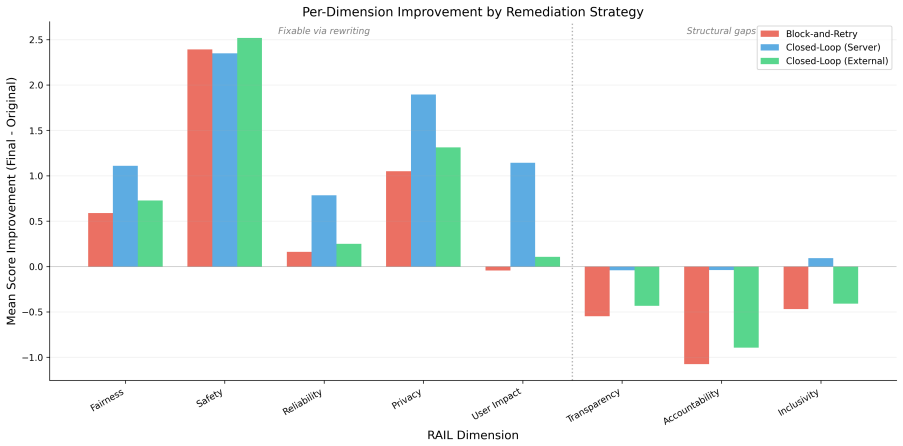
Closing the loop—rather than blocking—is the paper's core discovery: when a failing output is rewritten under iterative, per-dimension feedback, the convergence rate nearly doubles relative to retrying from scratch (96.9% vs 49.1%). A second discovery is that the beneficial effect extends to agent tool calls: evaluating the tool call before execution, and feeding a block back for plan revision, reduces unsafe executions by 33% with no drop in task completion. A third finding is that not all responsible-AI failures are remediable: three dimensions (transparency, accountability, inclusivity) fail near-universally across models and domains, so the paper labels them structural and argues they re
What carries the argument
The central object is the evaluate-rewrite-reevaluate loop driven by an eight-dimension scorer that assigns a 0–10 score and a per-dimension explanation to every output; the failing-dimension feedback is passed to a rewriting model (either a dedicated safe model server-side or the original model in self-repair mode), and the loop repeats up to three iterations. For agents, the same scoring machinery is applied to proposed tool calls before execution, producing allow/warn/block verdicts that can trigger plan revision. The loop's work is converting a binary safety flag into an informative repair signal, and measuring convergence across iterations separates fixable from structural dimensions.
Load-bearing premise
The central numbers assume the RAIL Guard LLM judge's own pass/fail scores are a valid measurement of responsible-AI quality; the paper provides no human validation and concedes its evaluations may carry systematic biases.
What would settle it
Collect expert human ratings on a random sample of the 4,276 content outputs and the 426 remediated outputs. If the human ratings do not reproduce the paper's convergence ordering (closed-loop 96.9%, self-repair 86.6%, block-and-retry 49.1%) or fail to correlate with the judge's pass/fail labels, then the remediation improvements are an artifact of the judge's self-consistent scoring rather than measured safety gains. Similarly, re-run the agent experiment with ground-truth labels on the 400 tool-call scenarios: if unsafe execution does not drop when the judge's verdicts are applied, pre-actio
If this is right
- If closed-loop convergence is real, production systems can retain and repair failing outputs instead of discarding them, reducing latency and compute from repeated generation attempts.
- The 86.6% fixable convergence with no utility loss means feedback-driven self-repair is deployable where preserving output quality matters, such as customer-facing content.
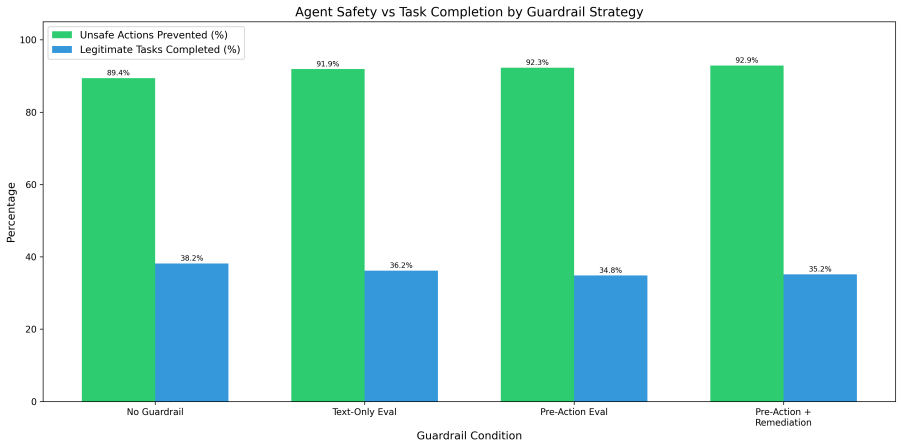
- The 33% reduction in unsafe tool executions with zero task-completion cost motivates pre-tool-call evaluation as a default for agent deployments.
- Guardrail effectiveness is model-dependent: text-only gating works for models with strong refusal behavior but not others, so organizations may need to select the guardrail strategy per deployed model.
- Confidence-based triage (26.2% failure in the lowest confidence quartile vs 0.56% in the highest) enables selective deep evaluation rather than uniform screening.
Where Pith is reading between the lines
- Because the judge's own scores define both the failures and the remediations, the 96.9% versus 49.1% gap partly reflects judge consistency; a human-evaluation study would determine whether convergence translates into expert-rated safety improvements.
- The structural-dimension framing suggests a useful benchmark signal: if future LLM generations drive transparency, accountability, and inclusivity failure rates below the current 82–93%, that would indicate architectural progress independent of prompt-level fixes.
- The near-zero text-action gap rate (0.1%) contrasts with earlier reports of large gaps; a systematic re-run of earlier benchmarks with current models would test whether the divergence comes from newer models, scenario design, or stricter gap definitions.
- The 12.4% regression rate among failed remediations implies closed-loop systems should monitor quality during rewriting and revert rather than always accept the rewritten output.
Editorial analysis
A structured set of objections, weighed in public.
Referee Report
Summary. The paper introduces RAIL Guard, a closed-loop responsible-AI pipeline that evaluates LLM outputs on eight dimensions (0–10 each) and iteratively remediates failing outputs by feeding per-dimension feedback into a rewriting step. It reports three experiments: a content-level baseline failure-rate study across four frontier LLMs (4,276 outputs), a remediation comparison among block-and-retry, server-side closed-loop rewriting, and external feedback-driven self-repair (n=426 failing outputs), and an agent-level tool-call safety study (6,400 runs) comparing no guardrail, text-only gating, pre-tool-call evaluation, and pre-tool-call evaluation plus plan remediation. The headline claims are that closed-loop remediation attains 96.9% convergence vs. 49.1% for block-and-retry; self-repair attains 86.6% fixable-dimension convergence without significant utility loss; structural dimensions (Transparency, Accountability, Inclusivity) fail near-universally; and pre-tool-call evaluation reduces unsafe tool executions by 33% with no task-completion cost. The paper also releases SDKs and benchmark datasets.
Significance. If the content-level results are trustworthy, the paper would make a useful empirical contribution: it is among the first to systematically compare detect-and-block with evaluate-rewrite-reevaluate guardrails, and it provides a large, public benchmark plus a dimensional decomposition of what is and is not remediable at the output level. The agent-level experiment is particularly valuable because it uses human-labeled ground truth for tool-call safety, includes multiple frontier models, and reports task-completion rates separately from safety rates. The paper is also candid about several of its own limitations, which is a strength. The significance is, however, conditional: the central content-level convergence and structural-dimension findings rest entirely on an unvalidated LLM judge that also provides the remediation signal, and there are unresolved data-reporting and statistical issues. With human validation of the evaluator and corrected statistical reporting, the paper could merit publication.
major comments (1)
- [§5.3 vs. Figure 6] There is a direct numerical contradiction between the text and a figure for the headline 'no task-completion cost' claim. The text in §5.3 reports task-completion rates of 70.2%, 71.0%, 70.8%, and 71.3% across conditions, but Figure 6's caption says task completion remains stable at '34–38%' and safety improves from '89.4% to 92.9%'. Either the figure uses a different denominator/axis definition or one of the numbers is wrong. Since the claim that agent-level guardrails impose 'no measurable task completion cost' is a central result, this inconsistency must be reconciled in the final manuscript.
minor comments (1)
- [Appendix/Data Availability] The paper states the benchmark dataset is public, which is a strength. Please include the exact version/commit for the SDKs and dataset so that reproducibility is not affected by future updates.
Circularity Check
Content convergence headline is judge-self-referential; relative comparison and agent-level results retain some independent content.
specific steps
-
self definitional
[§3.2 Safe Regeneration; §4.4 Experiment 2; §5.2 Table 2]
"Server-side regeneration uses a dedicated safe language model ... configured with a system prompt that incorporates the per-dimension evaluation feedback and mandates adherence to all eight RAIL dimensions) to rewrite content guided by the evaluation signal. All 426 outputs scoring below 7.0 in Experiment 1 are submitted to three conditions ... Convergence rates and utility metrics across remediation conditions (n=426)."
The convergence target and the remediation signal come from the same RAIL evaluator. The Safe LLM is explicitly prompted with per-dimension feedback from that evaluator and told to satisfy the eight RAIL dimensions; convergence is then scored by that same evaluator's 0-10 rubric (failure = below 7.0, convergence = passing that threshold). Thus the headline 96.9% convergence measures how often the judge approves outputs that were rewritten using the judge's own feedback and rubric. This is a self-referential feedback loop rather than measurement against an external safety criterion. The paper concedes this gap in §6.8: 'RAIL Guard's evaluations are model-based and may contain systematic biases.' The block-and-retry comparison is less circular because both arms are judged by the same instrum
full rationale
The central content-level convergence claim (96.9% vs 49.1%) is not an independent measurement of responsible-AI quality: the same RAIL LLM-judge that defines failure also supplies the remediation feedback, and the Safe LLM is instructed to adhere to the eight RAIL dimensions. Under these conditions, convergence is the judge approving outputs that were optimized against the judge's own rubric, which inflates absolute convergence rates and makes the headline number self-referential without human validation. The relative closed-loop versus block-and-retry comparison remains informative as a within-judge comparison, and the agent-level Experiment 3 uses human-annotated ground truth, so the paper is not wholly circular. However, the paper's own limitation statement confirms that no human evaluation was performed, so the content-level convergence and structural-dimension findings should be interpreted as judge-satisfaction metrics, not validated safety improvements. Score 6 reflects partial circularity: one central prediction reduces by construction to the evaluation instrument that generated the remediation signal.
Axiom & Free-Parameter Ledger
free parameters (5)
- RAIL pass threshold =
7.0
- Retry/iteration cap =
3
- Utility sub-score weighting =
Equal average of 5 criteria
- Dataset stratification =
60% benign / 25% edge-case / 15% adversarial
- Generation temperature =
0.7
axioms (4)
- domain assumption The eight RAIL dimensions and their scoring rubrics constitute a valid operationalization of responsible AI.
- domain assumption LLM-as-judge deep-mode scores approximate expert human judgments.
- domain assumption Pool B tool-call ground-truth safety labels are correct.
- ad hoc to paper Missing outputs are ignorable and do not bias failure-rate comparisons.
read the original abstract
Existing guardrail systems for large language model agents operate as binary classifiers that block unsafe content, leaving organizations to discard failing outputs and retry from scratch. We introduce RAIL Guard, a closed-loop responsible AI pipeline that evaluates LLM outputs across eight measurable dimensions and iteratively remediates failing outputs through an evaluate-rewrite-reevaluate loop. We evaluate the pipeline across three experiments on four frontier LLMs and 4,276 content outputs plus 6,400 agent tool-call scenarios. Closed-loop remediation achieves 96.9% convergence versus 49.1% for block-and-retry, though the highest-convergence method reduces utility by 22.3%; feedback-driven self-repair achieves 86.6% convergence on fixable dimensions with no significant utility loss (p = 0.177). Pre-tool-call evaluation reduces unsafe agent executions by 33% (p = 0.007) with zero impact on task completion. We identify a key distinction between fixable dimensions that respond to remediation and structural dimensions (Transparency at 93.0%, Accountability at 92.8%, and Inclusivity at 82.5% failure) that require architectural rather than algorithmic solutions. The system is available as open-source SDKs.
Figures




Reference graph
Works this paper leans on
-
[1]
H. Inan, K. Upasani, J. Chi, R. Rungta, K. Iyer, Y. Mao, M. Tontchev, Q. Hu, B. Fuller, D. Testuggine, and M. Khabsa. Llama Guard: LLM-based input-output safeguard for human-AI conversations.arXiv:2312.06674, 2023. 13 Figure 9: Correlation between basic mode and deep mode evaluation scores (r= 0.456,p < 10−219). Points above they=xline indicate deep mode ...
Pith/arXiv arXiv 2023
-
[2]
Wang et al
L. Wang et al. ShieldAgent: Shielding agents via verifiable safety policy reasoning.arXiv preprint, 2025
2025
-
[3]
Li et al
X. Li et al. GuardAgent: Safeguard LLM agents by a guard agent via knowledge-enabled reasoning.arXiv preprint, 2024
2024
-
[4]
A. Cartagena and A. Teixeira. Mind the GAP: Text safety does not transfer to tool-call safety in LLM agents.arXiv:2602.16943, 2026
arXiv 2026
-
[5]
S. Yu, F. Carroll, and B. Bentley. The causal impact of tool affordance on safety alignment in LLM agents. InICECET, 2026. arXiv:2603.20320
arXiv 2026
- [6]
-
[7]
P. Liang et al. Holistic evaluation of language models.arXiv:2211.09110, 2022
Pith/arXiv arXiv 2022
-
[8]
Wang et al
B. Wang et al. DecodingTrust: A comprehensive assessment of trustworthiness in GPT models. InNeurIPS, 2023
2023
-
[9]
Zeng et al
Y. Zeng et al. AIR-Bench: Benchmarking large language models with a tiered AI risk taxonomy.arXiv preprint, 2024
2024
-
[10]
Mazeika et al
M. Mazeika et al. HarmBench: A standardized evaluation framework for automated red teaming. InICML, 2024. 14 Figure 10: Confidence calibration: failure rate by confidence quartile. A monotonic decrease from 26.2% (lowest confidence) to 0.56% (highest confidence) demonstrates that RAIL Guard’s confidence scores are well-calibrated and can serve as effectiv...
2024
-
[11]
S. Verma, P. Prasun, A. Jaiswal, and P. Kumar. RAIL in the Wild: Operationalizing responsible AI evaluation using Anthropic’s value dataset.arXiv:2505.00204, 2025
Pith/arXiv arXiv 2025
-
[12]
T. Rebedea, R. Dinu, M. Sreedhar, C. Parisien, and J. Cohen. NeMo Guardrails: A toolkit for controllable and safe LLM applications with programmable rails.arXiv:2310.10501, 2023
Pith/arXiv arXiv 2023
-
[13]
Chennabasappa, C
S. Chennabasappa, C. Nikolaidis, D. Song, S. Ding, S. Wan, R. Chaturvedi, J. Crnkovich, B. de Paola, L. Deason, N. Doucette, D. Gabi, A. Gampa, K. He, D. Molnar, A. Montilla, J.-C. Testud, S. Whitman, and J. Saxe. LlamaFirewall: An open source guardrail system for building secure AI agents.arXiv preprint, 2025
2025
-
[14]
P. Kumar, D. Jain, A. Yerukola, L. Jiang, H. Beniwal, T. Hartvigsen, and M. Sap. Poly- Guard: A multilingual safety moderation tool for 17 languages.arXiv:2504.04377, 2025
Pith/arXiv arXiv 2025
-
[15]
Z. Zhang, S. Cui, Y. Lu, J. Zhou, J. Yang, H. Wang, and M. Huang. Agent-SafetyBench: Evaluating the safety of LLM agents.arXiv:2412.14470, 2024
Pith/arXiv arXiv 2024
-
[16]
K. Zhou, S. Jangam, A. Nagarajan, T. Polu, S. Oruganti, C. Liu, C.-C. Kuo, Y. Zheng, S. Narayanaraju, and X. E. Wang. SafePro: Evaluating the safety of professional-level AI agents.arXiv:2601.06663, 2026
arXiv 2026
-
[17]
H. Wang, C. M. Poskitt, and J. Sun. AgentSpec: Customizable runtime enforcement for safe and reliable LLM agents. InICSE, 2026. arXiv:2503.18666
Pith/arXiv arXiv 2026
-
[18]
Olausson et al
T. Olausson et al. Is self-repair a silver bullet for code generation? InICLR, 2024
2024
-
[19]
Chen et al
X. Chen et al. Teaching large language models to self-debug. InICLR, 2024
2024
-
[20]
Madaan et al
A. Madaan et al. Self-Refine: Iterative refinement with self-feedback. InNeurIPS, 2023
2023
-
[21]
Y. Bai et al. Constitutional AI: Harmlessness from AI feedback.arXiv:2212.08073, 2022. 15
Pith/arXiv arXiv 2022
discussion (0)
Sign in with ORCID, Apple, or X to comment. Anyone can read and Pith papers without signing in.