REVIEW 2 major objections 5 minor 50 references
A single phase-space function still generates finite-time evolution once dissipation and nonlocal forces are included via doubled variables.
Reviewed by Pith at T0; open to challenge. T0 means a machine referee read the full paper against a public rubric. the ladder, T0–T4 →
T0 review · grok-4.5
2026-07-31 17:48 UTC pith:OFMHZ43W
load-bearing objection Clean, incremental extension of the Magnusian to Galley-doubled dissipative dynamics, with an explicit 2.5PN cycle map that checks out against known Peters fluxes. the 2 major comments →
The Magnusian generator for dissipative systems and application to leading 2.5PN radiation-reaction dynamics
The pith
A machine-rendered reading of the paper's core claim, the machinery that carries it, and where it could break.
Core claim
To first order in a perturbing force, the Magnusian on the doubled phase space is χ⁽¹⁾ = −Q⁻_B ∫ ds F^A[X⁽⁰(s)] M^A_B, and this function continues to generate the finite-time evolution of physical observables by nested Poisson brackets. For Newtonian bound motion plus the leading 2.5PN radiation-reaction force, the explicit one-period Magnusian defines a discrete map from one radial cycle to the next that reproduces the secular evolution seen in numerical solutions of the same equations.
What carries the argument
The first-order doubled-phase-space Magnusian χ⁽¹⁾(Q₊, Q₋, s_f, s_i) = −Q⁻_B ∫_{s_i}^{s_f} F^A[X⁽⁰_{s,s_i}(Q₊)] M^A_B(s, s_i; Q₊) ds. It packages the force along the unperturbed flow into a single generator whose Poisson-bracket exponential advances any physical observable over a finite interval.
Load-bearing premise
That keeping only the first-order Magnusian and a few nested brackets of it, while dropping independent higher-order Magnus terms, still captures the cumulative dissipative map over many orbits for the cases shown.
What would settle it
Iterate the reported one-period Magnusian map for the same initial data (e.g. ν=1/4, e=0.3, h=20) over thousands of orbits and compare energy and angular frequency against a high-accuracy numerical integration of the 2.5PN ODEs; systematic drift that grows faster than the truncated nested-bracket residual would falsify the claim that χ⁽¹⁾ alone suffices on that timescale.
If this is right
- One-period Magnusians supply discrete inspiral maps that advance observables cycle by cycle without reintegrating the ODEs every orbit.
- The same construction applies to nonlocal hereditary forces after perturbative order reduction, so 4PN tail terms can be folded into a Magnusian.
- A scattering Magnusian from past to future asymptotics is defined by the same integral, opening a direct link between bound-cycle and unbound generators.
- Near resonances the finite-time Magnusian integrals remain nonsingular, unlike angle-averaging near-identity transformations that divide by vanishing frequency combinations.
- After regularization of worldline n-point functions, a self-force Magnusian can encode both conservative and dissipative mass-ratio corrections in one generator.
Where Pith is reading between the lines
- If the bound and scattering Magnusians are analytic continuations of one function, existing scattering-amplitude data could seed cycle maps for eccentric inspirals without a separate bound-state calculation.
- Comparing wall-clock cost of iterated Magnusian maps against existing averaging schemes on resonant EMRI trajectories would quantify whether the Poisson-bracket organization is cheaper near resonances.
- Because the Magnusian is linear in the difference variables, gauge-invariant relational observables (redshift, periastron advance) may be read off by single derivatives once the generator is known, even when the motion is non-integrable.
Editorial analysis
A structured set of objections, weighed in public.
Referee Report
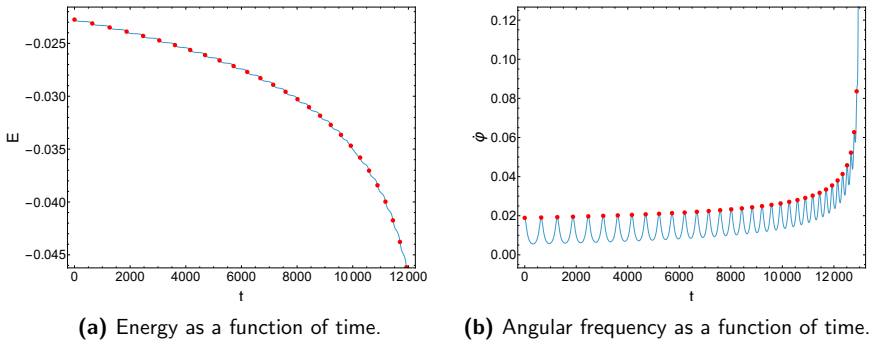
Summary. The paper extends the Magnusian — a phase-space function whose exponentiated Poisson-bracket action generates finite-time evolution — to dissipative and nonlocal-in-time dynamics using the classical in-in (Galley/Schwinger-Keldysh) formalism. After reviewing the doubled phase space, the ± basis, and the closure of linear-in-Q₋ generators under the doubled bracket (§2), the author constructs a classical interaction picture and derives the Magnusian–Hamiltonian relation via the Magnus series (§3). The main result is Eq. (3.40): the first-order dissipative Magnusian is the force evaluated along the unperturbed flow, transported back to the initial point by the Jacobi propagator, and contracted with Q₋. As an application (§4), the one-period Magnusian for Newtonian motion perturbed by the 2.5PN radiation-reaction force is computed in Delaunay variables, with explicit closed-form coefficients (4.21), defining a discrete cycle-to-cycle map that is compared with numerical integrations of the same ODEs (Figs. 1–2). Section 5 identifies the one-period Magnusian with the effective Hamiltonian of a canonical near-identity transformation and contrasts it with NITs used in self-force theory, notably the absence of resonant denominators. Appendices A–B treat integrating out a scalar field and perturbative order reduction of nonlocal forces.
Significance. If the construction holds, it gives the first canonical phase-space generator for finite-time dissipative two-body evolution, with direct relevance to inspiral self-force and PN radiation-reaction problems where relational/cycle-to-cycle observables are the gauge-invariant currency. Notable strengths: the derivation is parameter-free (the 2.5PN force is an external input from the literature, not fitted); the one-period generator is obtained in closed form (Eqs. 4.21) and its content is independently verified against known physics — chi_g and chi_l reproduce the Peters-averaged dJ/dt and dE/dt including the (1+7e^2/8) and (1+73e^2/24+37e^4/96) eccentricity enhancements, and chi_G=0 correctly encodes the absence of periastron advance at 2.5PN; the closure result (§2.4) guarantees the physical limit needs no extra prescription; and Appendices A-B give a concrete, reusable treatment of nonlocal self-force-type interactions. These are real assets for the record.
major comments (2)
- [§4.3, Figs. 1-2] The comparison validating the cycle map (Figs. 1-2) is shown only as a qualitative overlay of two curves. The evolution uses exp of chi^(1) truncated at three nested brackets, while chi^(2) (Eq. 3.41) is written down but never evaluated or bounded. I agree the omission is parametrically controlled at the plotted parameters (F_2.5/F_Newt ~ nu/q^3 ~ 3e-5 at h=20, so chi^(2) contributes ~1e-4 or less over the ~20 cycles shown, and it is formally the same order as the already-omitted 5PN EOM terms, so the truncation is internally consistent with the stated 'leading dissipative order' scope). Nonetheless, the claim in the abstract that the map 'describes the evolution ... in agreement with numerical solutions' deserves quantitative support: please add a residual/error curve (numerical minus Magnusian) for E and phi-dot, state the truncation error of the three-bracket exponential, and either估算
- [§5.3, after Eq. (5.23)] The text states that 'the finite-time integrals defining the Magnusian do not face this problem and therefore remain finite at resonances.' The one-cycle integrals in Eqs. (4.20) are indeed finite where the NIT Fourier denominators (k.Y) vanish, and this is a genuine formal advantage. However, near a resonance the accuracy of an iterated single-cycle map can still degrade through slow resonant-phase accumulation, which the present construction does not address. Since the outlook (§6, final paragraph) already calls for a comparison with NIT-based inspiral schemes near resonances, I recommend softening or qualifying this sentence to claim finiteness of the generator, not robustness of the long-time evolution.
minor comments (5)
- [App. A, App. B, §4.3] Typos: 'achives' (App. A.1, below Eq. A.3), 'swith' (App. A.1, first line), 'time independent If the order-reduced flow' (capital I mid-sentence, after Eq. B.9), 'apoastron' (§4.3) — 'apoapsis' is the standard term for a generic central mass.
- [Figs. 1-2 and captions] State the integrator, tolerance, and number of cycles used for the numerical solution; the phi-dot axis label renders as a missing glyph in both figures. A brief note on how the one-cycle map is iterated (whether the orbital period and endpoint times are recomputed at each step as L evolves, and how the f=pi/2 strobing of Fig. 2 is implemented) would make the construction reproducible.
- [Eqs. (4.21a) vs (4.21c)] chi_l and chi_L differ in the e^4 coefficient (37 vs 36) and overall normalization; a one-sentence remark tracing this to the Jacobi-propagator term -3(t-t_i)F_l/L^4 in Eq. (4.17) would save the reader a check.
- [Eq. (5.16)] The identification H' = -chi/T picks a logarithm of the finite map; the phrase 'perturbative branch continuously connected to the identity' is doing real work here, and one sentence spelling out that the branch is fixed order by order in epsilon would help, particularly since the map is not symplectic on the physical (Q+) subspace.
- [References, Eq. (3.40)] Ref. [41] contains duplicated journal-field text ('Lynch, Philip. "Efficient Trajectory..."'). Also check index-placement conventions for M^A_B between Eqs. (2.24) and (3.22)/(3.40) — consistent as written, but a defining sentence would prevent misreading.
Circularity Check
No significant circularity: Magnusian is derived from doubled Hamiltonian + Magnus series; 2.5PN force and Peters fluxes are external inputs; numerics are a consistency check of the same ODEs.
full rationale
The load-bearing formula (Eq. 3.40) follows from the classical in-in doubled action (Sec. 2), the interaction-picture Hamiltonian linear in Q− (Eq. 3.22), and the standard Magnus inversion (Eqs. 3.35–3.39). None of these steps define the generator in terms of the claimed finite-time map; the map is obtained by exponentiating the derived χ. The 2.5PN force (Eq. 4.2) is taken from the PN literature, not fitted. The explicit one-period coefficients (Eqs. 4.21) independently reproduce the known Peters-averaged dE/dt and dJ/dt (including eccentricity factors), which is external corroboration rather than a renamed fit. Comparison to numerical integration of Eqs. (4.1) is a truncation/implementation consistency check of the same input force, not a statistically forced “prediction.” Prior Magnusian citations (Kim et al.) supply the conservative foundation and are extended, not used as a uniqueness theorem that forces the dissipative result. No self-definitional loop, fitted-input-as-prediction, or load-bearing self-citation chain appears.
Axiom & Free-Parameter Ledger
axioms (6)
- standard math Classical Hamiltonian evolution and Poisson brackets on ordinary and doubled phase space, including the ± symplectic structure {q₊,p₋}={q₋,p₊}=1.
- domain assumption Galley/in-in (Schwinger–Keldysh) doubling with physical limit Q₋→0 correctly embeds dissipative and retarded nonlocal forces as Hamiltonian flow on the doubled space.
- standard math Magnus expansion relates a time-dependent interaction Hamiltonian to a finite-time generator χ via Bernoulli numbers / nested brackets (Eqs. 3.35–3.41).
- standard math Functions linear in Q₋ are closed under the doubled Poisson bracket and act as vector fields on physical observables independent of Q₋ after bracketing (§2.4).
- domain assumption Nonlocal-in-time forces may be perturbatively order-reduced to local forces along the iterative background flow X, yielding an equivalent local doubled Hamiltonian for the physical vector field (App. B).
- domain assumption Leading dissipative dynamics may be treated as Newtonian conservative motion plus the harmonic-gauge 2.5PN radiation-reaction force in the adiabatic regime (Eqs. 4.1–4.2).
invented entities (1)
-
Dissipative (doubled) Magnusian χ(Q₊,Q₋,s_f,s_i)
independent evidence
read the original abstract
The Magnusian is a phase-space function that generates finite-time evolution through nested Poisson brackets. It is related to several familiar generators of classical dynamics, including the radial action, the eikonal phase and related quantities. In this work, we extend the Magnusian framework to systems with dissipation and nonlocal-in-time interactions using the in-in formalism, also known as the Schwinger-Keldysh or Galley formalism. This framework is particularly natural for binary dynamics, where integrating out the mediating gravitational field can produce both dissipative radiation-reaction effects and hereditary, nonlocal-in-time interactions. We derive the generalized Magnusian and show that it continues to generate finite-time evolution. As an application, we construct the Magnusian for Newtonian bound motion subject to the leading 2.5PN radiation-reaction force. The resulting generator defines a discrete evolution map from one cycle to the next and describes the evolution of the system in agreement with numerical solutions.
Figures

Reference graph
Works this paper leans on
-
[4]
Amaro-Seoane et al.,Laser Interferometer Space Antenna,1702.00786
P. Amaro-Seoane et al.,Laser Interferometer Space Antenna,1702.00786
-
[5]
L. Blanchet,Gravitational Radiation from Post-Newtonian Sources and Inspiralling Compact Binaries,Living Rev. Rel.17(2014) 2 [1310.1528]
Pith/arXiv arXiv 2014
-
[6]
E. Poisson and C.M. Will,Gravity: Newtonian, Post-Newtonian, Relativistic, Cambridge University Press (2014), 10.1017/CBO9781139507486
-
[7]
Goldberger and I.Z
W.D. Goldberger and I.Z. Rothstein,Effective field theory of gravity for extended objects,Physical Review D73(2006)
2006
-
[8]
Porto,The effective field theorist’s approach to gravitational dynamics,Phys
R.A. Porto,The effective field theorist’s approach to gravitational dynamics,Phys. Rept.633(2016) 1 [1601.04914]
Pith/arXiv arXiv 2016
-
[9]
Levi,Effective Field Theories of Post-Newtonian Gravity: A comprehensive review,Rept
M. Levi,Effective Field Theories of Post-Newtonian Gravity: A comprehensive review,Rept. Prog. Phys.83(2020) 075901 [1807.01699]
Pith/arXiv arXiv 2020
-
[10]
Damour,Gravitational scattering, post-Minkowskian approximation and Effective One-Body theory,Phys
T. Damour,Gravitational scattering, post-Minkowskian approximation and Effective One-Body theory,Phys. Rev. D94(2016) 104015 [1609.00354]
Pith/arXiv arXiv 2016
-
[11]
Cheung, I.Z
C. Cheung, I.Z. Rothstein and M.P. Solon,From scattering amplitudes to classical potentials in the post-minkowskian expansion,Phys. Rev. Lett.121(2018) 251101. – 28 –
2018
-
[12]
Kosower, B
D.A. Kosower, B. Maybee and D. O’Connell,Amplitudes, observables, and classical scattering,Journal of High Energy Physics2019(2019)
2019
-
[13]
Z. Bern, C. Cheung, R. Roiban, C.-H. Shen, M.P. Solon and M. Zeng,Scattering amplitudes and the conservative hamiltonian for binary systems at third post-minkowskian order,Physical Review Letters122(2019)
2019
-
[14]
Z. Bern, J. Parra-Martinez, R. Roiban, M.S. Ruf, C.-H. Shen, M.P. Solon et al., Scattering Amplitudes and Conservative Binary Dynamics atO(G 4),Phys. Rev. Lett.126(2021) 171601 [2101.07254]
Pith/arXiv arXiv 2021
-
[15]
E. Poisson, A. Pound and I. Vega,The Motion of point particles in curved spacetime,Living Rev. Rel.14(2011) 7 [1102.0529]
Pith/arXiv arXiv 2011
-
[16]
Barack et al.,Black holes, gravitational waves and fundamental physics: a roadmap,Class
L. Barack et al.,Black holes, gravitational waves and fundamental physics: a roadmap,Class. Quant. Grav.36(2019) 143001 [1806.05195]
Pith/arXiv arXiv 2019
-
[17]
L. Barack and A. Pound,Self-force and radiation reaction in general relativity,Rept. Prog. Phys.82(2019) 016904 [1805.10385]
Pith/arXiv arXiv 2019
-
[18]
A. Pound and J. Miller,Practical, covariant puncture for second-order self-force calculations,Phys. Rev. D89(2014) 104020 [1403.1843]
Pith/arXiv arXiv 2014
-
[19]
Buonanno and T
A. Buonanno and T. Damour,Effective one-body approach to general relativistic two-body dynamics,Phys. Rev. D59(1999) 084006
1999
-
[20]
Damour,The General Relativistic Two Body Problem and the Effective One Body Formalism,Fundam
T. Damour,The General Relativistic Two Body Problem and the Effective One Body Formalism,Fundam. Theor. Phys.177(2014) 111 [1212.3169]
Pith/arXiv arXiv 2014
-
[21]
A. Taracchini et al.,Effective-one-body model for black-hole binaries with generic mass ratios and spins,Phys. Rev. D89(2014) 061502 [1311.2544]
Pith/arXiv arXiv 2014
-
[22]
Gonzo, J
R. Gonzo, J. Lewis and A. Pound,First law of binary black hole scattering,Phys. Rev. Lett.135(2025) 131401
2025
-
[23]
Detweiler,Consequence of the gravitational self-force for circular orbits of the schwarzschild geometry,Physical Review D77(2008)
S. Detweiler,Consequence of the gravitational self-force for circular orbits of the schwarzschild geometry,Physical Review D77(2008)
2008
-
[24]
A. Le Tiec, L. Blanchet and B.F. Whiting,The First Law of Binary Black Hole Mechanics in General Relativity and Post-Newtonian Theory,Phys. Rev. D85 (2012) 064039 [1111.5378]
Pith/arXiv arXiv 2012
-
[25]
Le Tiec,First law of mechanics for compact binaries on eccentric orbits,Physical Review D92(2015)
A. Le Tiec,First law of mechanics for compact binaries on eccentric orbits,Physical Review D92(2015)
2015
-
[26]
Blanchet and A
L. Blanchet and A. Le Tiec,First law of compact binary mechanics with gravitational-wave tails,Classical and Quantum Gravity34(2017) 164001
2017
-
[27]
Kim, J.-W
J.-H. Kim, J.-W. Kim and S. Lee,Massive twistor worldline in electromagnetic fields,Journal of High Energy Physics2024(2024)
2024
-
[28]
J.-H. Kim, J.-W. Kim, S. Kim and S. Lee,Classical eikonal from Magnus expansion, JHEP01(2025) 111 [2410.22988]. – 29 –
Pith/arXiv arXiv 2025
-
[29]
Kim,Radiation eikonal for post-Minkowskian observables,Phys
J.-W. Kim,Radiation eikonal for post-Minkowskian observables,Phys. Rev. D111 (2025) L121702 [2501.07372]
Pith/arXiv arXiv 2025
-
[30]
J.-W. Kim, R. Patil, T. Scheopner and J. Steinhoff,Magnusian: relating the eikonal phase, the on-shell action, and the scattering generator,JHEP03(2026) 241 [2511.05649]
arXiv 2026
-
[31]
Galley,Classical mechanics of nonconservative systems,Phys
C.R. Galley,Classical mechanics of nonconservative systems,Phys. Rev. Lett.110 (2013) 174301
2013
-
[32]
C.R. Galley, D. Tsang and L.C. Stein,The principle of stationary nonconservative action for classical mechanics and field theories,1412.3082
-
[33]
Schwinger,Brownian motion of a quantum oscillator,J
J.S. Schwinger,Brownian motion of a quantum oscillator,J. Math. Phys.2(1961) 407
1961
-
[34]
Keldysh,Diagram Technique for Nonequilibrium Processes,Sov
L.V. Keldysh,Diagram Technique for Nonequilibrium Processes,Sov. Phys. JETP 20(1965) 1018
1965
-
[35]
Jordan,Effective field equations for expectation values,Phys
R.D. Jordan,Effective field equations for expectation values,Phys. Rev. D33(1986) 444
1986
-
[36]
Magnus,On the exponential solution of differential equations for a linear operator,Communications on Pure and Applied Mathematics7(1954) 649
W. Magnus,On the exponential solution of differential equations for a linear operator,Communications on Pure and Applied Mathematics7(1954) 649
1954
-
[37]
S. Kim, H. Lee and S. Lee,Classical eikonal in relativistic scattering, 2025
2025
-
[38]
T. Damour, P. Jaranowski and G. Sch¨ afer,Fourth post-Newtonian effective one-body dynamics,Phys. Rev. D91(2015) 084024 [1502.07245]
Pith/arXiv arXiv 2015
-
[39]
van de Meent and N
M. van de Meent and N. Warburton,Fast self-forced inspirals,Classical and Quantum Gravity35(2018) 144003
2018
-
[40]
Lynch, M
P. Lynch, M. van de Meent and N. Warburton,Eccentric self-forced inspirals into a rotating black hole,Classical and Quantum Gravity39(2022) 145004
2022
-
[41]
Efficient Trajectory Calculations for Extreme Mass-Ratio Inspirals Using near-Identity (Averaging) Transformations
P. Lynch,Efficient trajectory calculations for extreme mass-ratio inspirals using near-identity (averaging),Lynch, Philip.“Efficient Trajectory Calculations for Extreme Mass-Ratio Inspirals Using near-Identity (Averaging) Transformations.” University College Dublin. School of Mathematics and Statistics, 2022.(2022)
2022
-
[42]
K¨ alin and R.A
G. K¨ alin and R.A. Porto,From boundary data to bound states,Journal of High Energy Physics2020(2020)
2020
-
[43]
K¨ alin and R.A
G. K¨ alin and R.A. Porto,From boundary data to bound states. part ii. scattering angle to dynamical invariants (with twist),Journal of High Energy Physics2020 (2020)
2020
-
[44]
G. Cho, G. K¨ alin and R.A. Porto,From boundary data to bound states. part iii. radiative effects,Journal of High Energy Physics2022(2022)
2022
-
[45]
A.I. Harte, F.M. Blanco and E.E. Flanagan,Nonlinearly Self-Interacting Extended Bodies Move as Test Bodies in Effective External Fields,Phys. Rev. Lett.135 (2025) 151401 [2504.11912]. – 30 –
Pith/arXiv arXiv 2025
-
[46]
S.L. Detweiler and B.F. Whiting,Selfforce via a Green ’s function decomposition, Phys. Rev. D67(2003) 024025 [gr-qc/0202086]
Pith/arXiv arXiv 2003
-
[47]
F.M. Blanco, E.E. Flanagan and A.I. Harte,Conservative and dissipative sectors in a nonlinear scalar model for the gravitational self-force problem,2605.14958
-
[48]
T. Damour, P. Jaranowski and G. Sch¨ afer,Nonlocal-in-time action for the fourth post-Newtonian conservative dynamics of two-body systems,Phys. Rev. D89(2014) 064058 [1401.4548]
Pith/arXiv arXiv 2014
-
[49]
C. Dlapa, G. K¨ alin, Z. Liu and R.A. Porto,Dynamics of binary systems to fourth post-minkowskian order from the effective field theory approach,Phys. Lett. B831 (2022) 137203 [2106.08276]
Pith/arXiv arXiv 2022
-
[50]
C. Dlapa, G. K¨ alin, Z. Liu and R.A. Porto,Conservative dynamics of binary systems at fourth post-minkowskian order in the large-eccentricity expansion,Phys. Rev. Lett. 128(2022) 161104 [2112.11296]
Pith/arXiv arXiv 2022
-
[51]
Z. Bern, J. Parra-Martinez, R. Roiban, M.S. Ruf, C.-H. Shen, M.P. Solon et al., Scattering amplitudes, the tail effect, and conservative binary dynamics atO(G 4), Phys. Rev. Lett.128(2022) 161103 [2112.10750]
Pith/arXiv arXiv 2022
-
[52]
Z. Bern, J. Parra-Martinez, R. Roiban, M.S. Ruf, C.-H. Shen, M.P. Solon et al., Scattering amplitudes and conservative dynamics at the fourth post-Minkowskian order,PoSLL2022(2022) 051
2022
-
[53]
Blanco,Local hamiltonian dynamics from nonlocal action principles and applications to binary systems in general relativity,Phys
F.M. Blanco,Local hamiltonian dynamics from nonlocal action principles and applications to binary systems in general relativity,Phys. Rev. D110(2024) 024061. A Integrating out a scalar field: A Self-Force Example In this appendix, we illustrate the procedure described in Subsection 2.3 by explicitly constructing the effective action obtained after integra...
2024
discussion (0)
Sign in with ORCID, Apple, or X to comment. Anyone can read and Pith papers without signing in.