REVIEW 2 major objections 4 minor 40 references
Deterministic policies make continuous-time extended mean-field control learnable without stochastic kernels or known action dependence.
Reviewed by Pith at T0; open to challenge. T0 means a machine referee read the full paper against a public rubric. the ladder, T0–T4 →
T0 review · grok-4.5
2026-07-14 07:42 UTC pith:OT7L34OL
load-bearing objection Solid, usable model-free DPG for continuous-time extended MFC via deterministic policies; the classical C^{1,2} regularity is the only real soft spot and is typical of the subfield. the 2 major comments →
Actor-Critic Learning for Extended Mean Field Control with Deterministic Policies
The pith
A machine-rendered reading of the paper's core claim, the machinery that carries it, and where it could break.
Core claim
Under natural regularity, the gradient of the value with respect to a deterministic-policy parameter equals the integral of the derivative of a local advantage-rate function that depends on state, action and the joint state–action law; this identity supplies a martingale characterization that can be learned model-free and yields a practical continuous-time deep DPG algorithm for extended mean-field control.
What carries the argument
The deterministic policy-gradient formula (Theorems 3.1–3.2): the policy gradient is expressed via both the ordinary action derivative and an L-derivative with respect to the control marginal of a local advantage-rate function that is identified by a martingale condition along observed trajectories.
Load-bearing premise
The lifted value function is assumed already to be a classical C1,2 solution on the Wasserstein space for every policy parameter, rather than being proved from the coefficients.
What would settle it
Run the CT-DDPG algorithm on the linear-quadratic Cucker–Smale or liquidation problem with known closed-form optimum; if the learned return systematically fails to approach the analytic optimum as particle number and episode count increase, the claimed gradient and martingale characterizations are false.
Editorial analysis
A structured set of objections, weighed in public.
Referee Report
Summary. The paper develops a model-free continuous-time actor-critic framework for extended mean-field control (MFC), in which both dynamics and rewards may depend on the joint law of states and controls. Deterministic feedback policies are used so that the state-action measure is the push-forward of the state law, avoiding optimization over stochastic kernels. A model-free sensitivity formula for parameterized McKean-Vlasov dynamics (Theorems 2.1-2.3) yields a deterministic policy-gradient identity on the Wasserstein space (Theorem 3.1). This is refined via local value and advantage-rate functions of (state, action, joint law), producing a gradient that contains both ordinary action derivatives and L-derivatives with respect to the control marginal (Theorem 3.2). The local objects are characterized by a martingale condition that is turned into a continuous-time deep DPG algorithm (CT-DDPG, Algorithm 1) with particle approximations, measure-dependent networks, TD learning, and action- or parameter-space exploration. Numerical experiments on stochastic Cucker-Smale consensus and optimal liquidation with trade crowding illustrate efficiency and robustness, including settings with explicit control-distribution dependence.
Significance. If the regularity assumptions hold, the work supplies a clean, first-principles policy-gradient theory for continuous-time extended MFC that removes the separable-structure and known-control-dependence restrictions of earlier exploratory-policy methods. The local martingale characterization (3.20) and the resulting CT-DDPG algorithm are practically useful and are supported by consistent numerical evidence on both LQ and non-LQ problems. The deterministic-policy route is a genuine conceptual contribution relative to the stochastic-policy literature, and the paper is careful to state the classical-solution hypotheses under which the identities are derived.
major comments (2)
- Assumption 2.2 (and the induced Assumption 3.1) postulates that the lifted value V(·,·,θ) already belongs to C^{1,2}([0,T]×P_2(R^n)) for every policy parameter θ and that the advantage-rate map A[w] is continuously differentiable in θ. This classical regularity is used both for the sensitivity formula (Theorem 2.1) and for the martingale characterization that drives learning (Theorem 3.2 / (3.20)). The paper does not derive it from the coefficients; a short discussion of sufficient conditions (or a pointer to existing viscosity/regularity results for McKean-Vlasov HJB equations) would make the scope of the claims clearer.
- Section 3.3 constructs candidate local functions V_D^θ and q_D via a decoupled dynamics and the integrated Hamiltonian (3.27). While this shows existence under extra smoothness, the uniqueness claim in Theorem 3.2 is only for the integrated objects V̂ and q̂. The algorithm learns the local networks V^φ and q^ψ; a brief remark on whether different local representatives can produce the same integrated gradient (and therefore the same policy update) would strengthen the link between theory and practice.
minor comments (4)
- In (3.18) and (3.22) the independent copy is written eξ / eX; a single consistent notation (e.g., ξ̃) would improve readability.
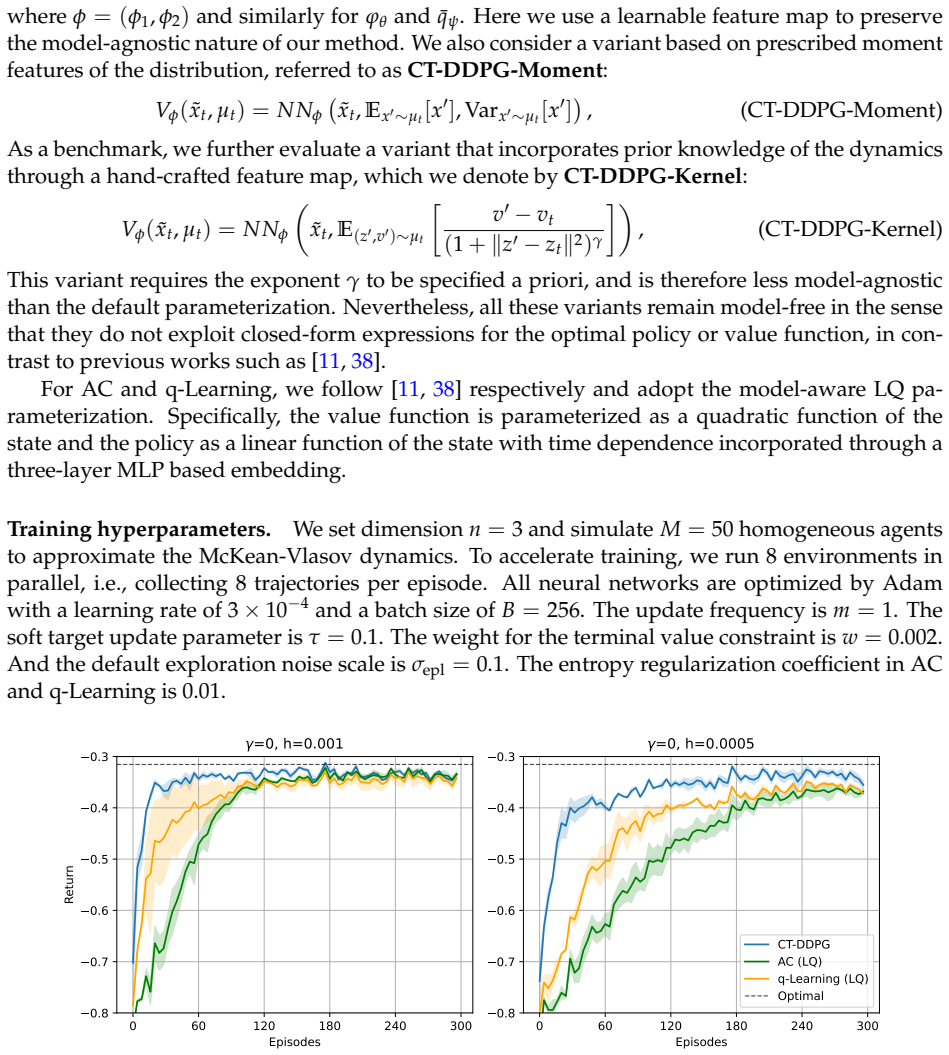
- Figure 1 caption states that AC and q-Learning exploit the LQ structure while CT-DDPG does not; the main text already makes this clear, but the caption could briefly note that the comparison is therefore not fully model-agnostic.
- The terminal-penalty weight w=0.002 and soft-update τ=0.1 appear only in the experimental section; a short sensitivity remark (or a default recommendation) would help reproducibility.
- A few typographical inconsistencies remain (e.g., “T echnical” in the section heading of 6.1, occasional missing spaces after commas in displayed equations).
Circularity Check
No significant circularity: policy-gradient identities and martingale characterizations are derived from performance-difference + Itô under postulated classical regularity, without fitting the target or load-bearing self-citation chains.
full rationale
The core claims (Theorems 2.1–2.3, 3.1–3.2) follow from a performance-difference identity (Proposition 6.2, extending classical control lemmas via Itô on the flow of measures) plus the linear PDE satisfied by the lifted value (Lemma 6.1) and a chain-rule expansion of the push-forward (3.18). The advantage-rate A[w] is defined from the generator (2.5–2.6) and then shown to recover the parameter gradient by direct differentiation under the integral; the local representations VD, qD are constructed explicitly as the decoupled value and integrated Hamiltonian (3.23–3.27) and verified to satisfy the martingale condition (3.20). Regularity (Assumptions 2.2/3.1) is postulated rather than proved, but that is an existence gap, not a circular reduction of the claimed identities to their inputs. Self-citations ([7], [11], [27], etc.) supply related continuous-time or discrete-time analogues; none is invoked as a uniqueness theorem that forces the present formulae. Numerical experiments validate the resulting CT-DDPG algorithm on independent benchmarks and do not enter the theoretical statements. The derivation is therefore self-contained against its own equations.
Axiom & Free-Parameter Ledger
free parameters (4)
- learning rate η =
3×10^{-4}
- exploration noise σ_epl =
0.1 (default)
- particle count M =
50
- soft-update τ and terminal weight w =
τ=0.1, w=0.002
axioms (3)
- domain assumption Coefficients b,σ,r,g satisfy local Lipschitz continuity in (x,μ) and linear growth uniformly in the policy parameter (Assumption 2.1 / 3.1).
- ad hoc to paper For every policy parameter θ the lifted value function V(·,·,θ) belongs to C^{1,2}([0,T]×P_2(R^n)) and the advantage-rate map A[w] is continuously differentiable in θ (Assumption 2.2).
- ad hoc to paper Local value and advantage-rate functions admit continuous L-derivatives with respect to the control marginal and satisfy the chain rule (Assumption 3.2).
invented entities (1)
-
local advantage-rate function q_D(t,x,a,Γ)
no independent evidence
read the original abstract
This paper develops a model-free reinforcement learning framework for continuous--time extended mean field control problems, where both the dynamics and reward may depend on the joint distribution of states and controls. We adopt deterministic feedback policies, under which the state--action distribution is induced directly as a push--forward of the state law. This avoids optimization over stochastic kernels and bypasses key limitations of existing approaches in extended mean field settings. We first establish a model--free sensitivity formula for parameterized McKean--Vlasov dynamics and use it to derive a deterministic policy gradient formula expressed through an advantage--rate function on the Wasserstein space. We then refine this formula by introducing local value and advantage--rate representations that depend on the state, action, and joint state--action distribution, yielding a policy gradient that includes both action derivatives and measure--derivative terms with respect to the control distribution. These characterizations lead to a martingale--based learning principle and motivate a continuous--time deep deterministic policy gradient algorithm combining particle approximations, measure--dependent neural networks, temporal--difference learning, and exploration in either action or parameter space. Numerical experiments on stochastic Cucker--Smale consensus control and optimal liquidation with trade crowding demonstrate the efficiency, stability, and robustness of the proposed method, including problems with explicit dependence on the control distribution.
Figures


Reference graph
Works this paper leans on
-
[1]
Acciaio, J
B. Acciaio, J. Backhoff-Veraguas, and R. Carmona. Extended mean field control problems: stochastic maximum principle and transport perspective.SIAM journal on Control and Opti- mization, 57(6):3666–3693, 2019
2019
-
[2]
Bayraktar, N
E. Bayraktar, N. B ¨auerle, and A. D. Kara. Finite approximations for mean-field type multi- agent control and their near optimality.Applied Mathematics & Optimization, 92(1):7, 2025
2025
-
[3]
E. Bayraktar, M. Hernandez, Q. Yan, and Y. Zhu. Policy gradient for continuous-time mean- field control.arXiv preprint arXiv:2605.20718, 2026. 24
Pith/arXiv arXiv 2026
-
[4]
Buckdahn, J
R. Buckdahn, J. Li, S. Peng, and C. Rainer. Mean-field stochastic differential equations and associated pdes.Annals of Probability: An official journal of the Institute of Mathematical Statistics, 45(2):824–878, 2017
2017
-
[5]
Carmona and F
R. Carmona and F. Delarue.Probabilistic Theory of Mean Field Games with Applications I: Mean Field FBSDEs, Control, and Games, volume 83. Springer, 2018
2018
-
[6]
Carmona, M
R. Carmona, M. Lauri `ere, and Z. Tan. Model-free mean-field reinforcement learning: mean- field MDP and mean-field Q-learning.The Annals of Applied Probability, 33(6B):5334–5381, 2023
2023
- [7]
-
[8]
Cosso, F
A. Cosso, F. Gozzi, I. Kharroubi, H. Pham, and M. Rosestolato. Optimal control of path- dependent McKean–Vlasov SDEs in infinite-dimension.The Annals of Applied Probability, 33(4):2863–2918, 2023
2023
-
[9]
Cucker and S
F. Cucker and S. Smale. Emergent behavior in flocks.IEEE Transactions on automatic control, 52(5):852–862, 2007
2007
-
[10]
Foerster, I
J. Foerster, I. A. Assael, N. De Freitas, and S. Whiteson. Learning to communicate with deep multi-agent reinforcement learning.Advances in neural information processing systems, 29, 2016
2016
-
[11]
Frikha, M
N. Frikha, M. Germain, M. Lauri `ere, H. Pham, and X. Song. Actor-critic learning for mean- field control in continuous time.Journal of Machine Learning Research, 26(127):1–42, 2025
2025
-
[12]
Germain, M
M. Germain, M. Lauri `ere, H. Pham, and X. Warin. Deepsets and their derivative networks for solving symmetric PDEs.Journal of Scientific Computing, 91(2):63, 2022
2022
-
[13]
H. Gu, X. Guo, X. Wei, and R. Xu. Dynamic programming principles for mean-field controls with learning.Operations Research, 71(4):1040–1054, 2023
2023
-
[14]
H. Gu, X. Guo, X. Wei, and R. Xu. Mean-field multiagent reinforcement learning: A decen- tralized network approach.Mathematics of Operations Research, 50(1):506–536, 2025
2025
-
[15]
X. Guo, Y. Huang, and X. Yu. Deterministic policy gradient for learning equilibrium in time- inconsistent control problems.arXiv preprint arXiv:2606.11798, 2026
Pith/arXiv arXiv 2026
-
[16]
Haarnoja, A
T. Haarnoja, A. Zhou, P . Abbeel, and S. Levine. Soft actor-critic: Off-policy maximum entropy deep reinforcement learning with a stochastic actor. InInternational Conference on Machine Learning, pages 1861–1870. Pmlr, 2018
2018
-
[17]
Y. Jia, D. Ouyang, and Y. Zhang. Accuracy of discretely sampled stochastic policies in continuous-time reinforcement learning.SIAM Journal on Control and Optimization, 64(3):1889–1929, 2026
1929
-
[18]
Jia and X
Y. Jia and X. Y. Zhou. Policy gradient and actor-critic learning in continuous time and space: Theory and algorithms.Journal of Machine Learning Research, 23(275):1–50, 2022
2022
-
[19]
Jia and X
Y. Jia and X. Y. Zhou. q-learning in continuous time.Journal of Machine Learning Research, 24(161):1–61, 2023. 25
2023
-
[20]
T. P . Lillicrap, J. J. Hunt, A. Pritzel, N. Heess, T. Erez, Y. Tassa, D. Silver, and D. Wierstra. Continuous control with deep reinforcement learning.arXiv preprint arXiv:1509.02971, 2015
Pith/arXiv arXiv 2015
-
[21]
R. Lowe, Y. I. Wu, A. Tamar, J. Harb, O. Pieter Abbeel, and I. Mordatch. Multi-agent actor- critic for mixed cooperative-competitive environments.Advances in neural information process- ing systems, 30, 2017
2017
-
[22]
Ma and Z
J. Ma and Z. Liu. Continuous dependence for McKean-Vlasov SDEs under distribution- dependent Lyapunov conditions.Discrete and Continuous Dynamical Systems-S, 18(11):3282– 3301, 2025
2025
-
[23]
S. Mekkaoui, H. Pham, and X. Warin. Learning operators on labelled conditional distribu- tions with applications to mean field control of non exchangeable systems.arXiv preprint arXiv:2603.21683, 2026
arXiv 2026
-
[24]
M. Meunier, H. Pham, and C. Reisinger. Model-free policy gradient for discrete-time mean- field control.arXiv preprint arXiv:2601.11217, 2026
arXiv 2026
-
[25]
Motte and H
M. Motte and H. Pham. Mean-field markov decision processes with common noise and open- loop controls.The Annals of Applied Probability, 32(2):1421–1458, 2022
2022
-
[26]
Nourian, P
M. Nourian, P . E. Caines, and R. P . Malham ´e. Mean field analysis of controlled cucker- smale type flocking: Linear analysis and perturbation equations.IFAC Proceedings Volumes, 44(1):4471–4476, 2011
2011
-
[27]
Pham and X
H. Pham and X. Warin. Actor-critic learning algorithms for mean-field control with moment neural networks.Methodology and Computing in Applied Probability, 27(1):13, 2025
2025
-
[28]
Pham and X
H. Pham and X. Wei. Bellman equation and viscosity solutions for mean-field stochastic control problem.ESAIM: Control, Optimisation and Calculus of Variations, 24(1):437–461, 2018
2018
-
[29]
A. Picarelli, M. Scaratti, and J. Tam. Extended mean field control: a global numerical solution via finite-dimensional approximation.arXiv preprint arXiv:2503.20510, 2025
arXiv 2025
-
[30]
M. Plappert, R. Houthooft, P . Dhariwal, S. Sidor, R. Y. Chen, X. Chen, T. Asfour, P . Abbeel, and M. Andrychowicz. Parameter space noise for exploration.arXiv preprint arXiv:1706.01905, 2017
Pith/arXiv arXiv 2017
-
[31]
C. Reisinger, W. Stockinger, M. O. Tsianni, and Y. Zhang. Convergence rates of time dis- cretization in extended mean field control.arXiv preprint arXiv:2509.00904, 2025
Pith/arXiv arXiv 2025
-
[32]
Reisinger, W
C. Reisinger, W. Stockinger, and Y. Zhang. A fast iterative pde-based algorithm for feedback controls of nonsmooth mean-field control problems.SIAM Journal on Scientific Computing, 46(4):A2737–A2773, 2024
2024
-
[33]
Z. Ren, X. Wei, X. Yu, and X. Y. Zhou. Continuous-time q-learning for mean-field control with common noise, part-i: Theoretical foundations.arXiv preprint arXiv:2604.27372, 2026
Pith/arXiv arXiv 2026
-
[34]
Z. Ren, X. Wei, X. Yu, and X. Y. Zhou. Continuous-time q-learning for mean-field control with common noise, part-ii: q-learning algorithms.arXiv preprint arXiv:2604.27378, 2026
Pith/arXiv arXiv 2026
-
[35]
Sethi, D
D. Sethi, D. ˇSiˇska, and Y. Zhang. Entropy annealing for policy mirror descent in continuous time and space.SIAM Journal on Control and Optimization, 63(4):3006–3041, 2025. 26
2025
-
[36]
H. M. Soner, J. Teichmann, and Q. Yan. Learning algorithms for mean field optimal control. arXiv preprint arXiv:2503.17869, 2025
Pith/arXiv arXiv 2025
-
[37]
Szpruch, T
L. Szpruch, T. Treetanthiploet, and Y. Zhang. Optimal scheduling of entropy regularizer for continuous-time linear-quadratic reinforcement learning.SIAM Journal on Control and Optimization, 62(1):135–166, 2024
2024
-
[38]
Wei and X
X. Wei and X. Yu. Continuous time q-learning for mean-field control problems.Applied Mathematics & Optimization, 91(1):10, 2025
2025
-
[39]
X. Wei, X. Yu, and F. Yuan. Unified continuous-time q-learning for mean-field game and mean-field control problems.arXiv preprint arXiv:2407.04521, 2024
Pith/arXiv arXiv 2024
-
[40]
J. Yong. Linear-quadratic optimal control problems for mean-field stochastic differen- tial equations—time-consistent solutions.Transactions of the American Mathematical Society, 369(8):5467–5523, 2017. 27
2017
discussion (0)
Sign in with ORCID, Apple, or X to comment. Anyone can read and Pith papers without signing in.