Steering Optimisation Trajectories in Diffusion Representation Learning
Reviewed by Pith T0 review T1 audit T2 compute T3 formal T4 kernel 2026-07-07 17:39 UTCglm-5.2pith:P54DC26Rrecord.jsonopen to challenge →
The pith
Two training tricks steer diffusion autoencoders toward disentangled representations
A machine-rendered reading of the paper's core claim, the machinery that carries it, and where it could break.
Core claim
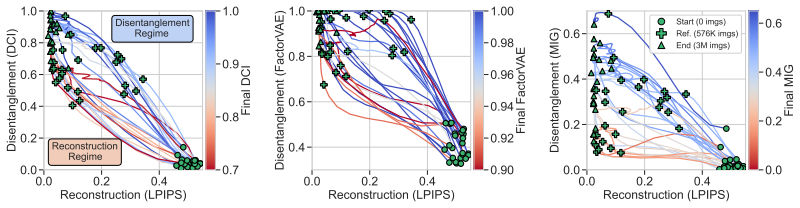
The central object is the optimization trajectory: a curve of reconstruction quality plotted against representation quality during training. The authors show these trajectories bifurcate into two regimes determined early, and that the regime can be steered by two concrete interventions. The first replaces U-Net skip connections with gated residuals initialized near zero, forcing the decoder to rely on semantic tokens rather than a high-bandwidth pixel bypass. The second is a log SNR curriculum that restricts the noise-level band at the start of training and linearly widens it, controlling when the model encounters reconstruction-favorable noise levels. Together these shift trajectories fromt
What carries the argument
Gated residual U-Net blocks with near-zero-initialized gates replacing skip connections; log SNR curriculum that linearly widens the sampled noise-level band from an initial range to the full training range over a fixed number of steps, with an importance correction to maintain the correct loss weighting.
If this is right
- Diffusion autoencoders with identical objectives and architectures can converge to substantially different latent structures depending on early training dynamics, suggesting that random seed sensitivity in representation learning is partly a trajectory-selection problem rather than purely a capacity or data issue.
- The log SNR curriculum is a lightweight intervention that can be applied to existing diffusion training pipelines without architectural changes, potentially improving representation quality in any diffusion model that uses a U-Net with skip connections.
- The finding that skip connections act as reconstruction shortcuts that bypass semantic conditioning suggests that architectural choices in diffusion U-Nets have representation-learning consequences that are invisible when only measuring image fidelity.
- The regime structure, if it generalizes to transformer-based diffusion architectures where skip pathways are already constrained, may interact differently with the curriculum and could require modified interventions.
Load-bearing premise
The two-regime structure and its causal mechanisms are identified and validated primarily in a 3M-parameter U-Net with an undertrained VQ-VAE checkpoint, where regime separation is most visible. The authors note that larger models mask these patterns and that better VQ-VAE training reduces regime separation. The extrapolation that the same mechanisms operate in the larger models used for main results rests on performance improvements rather than direct trajectory evidence at
What would settle it
If the gated residual and curriculum interventions improve disentanglement in larger models through a mechanism unrelated to the two-regime structure (for example, by regularizing the loss landscape or changing gradient noise), then the paper's causal story about skip shortcuts and noise-level exposure steering regime selection would not hold, even though the practical improvements would remain.
Figures


read the original abstract
We study why diffusion autoencoders can achieve similar image quality while learning substantially different latent structures. We trace this behaviour to optimisation dynamics; we analyse curves of image reconstruction against latent representation quality, revealing trajectories that organise around two distinct regimes early in training. Models in the reconstruction regime prioritise image fidelity early, whereas those in the disentanglement regime improve reconstruction and disentanglement more gradually. We hypothesise that this behaviour can be influenced by targeting shortcut pathways in the diffusion U-Net and controlling early noise-level exposure, thereby shaping the reconstruction-disentanglement trade-off during training. To steer optimisation toward stronger representations, we introduce SteeringDRL, combining gated residual U-Nets with a simple noise-level exposure curriculum for training. Across disentanglement benchmarks, SteeringDRL improves representation quality and reduces seed sensitivity. Our method further extends to spatial disentanglement in object-centric learning, improving segmentation quality on synthetic and real-world datasets.
Editorial analysis
A structured set of objections, weighed in public.
Referee Report
Summary. The paper studies optimisation dynamics in diffusion autoencoders for unsupervised representation learning, observing that training trajectories organise around two regimes (reconstruction vs. disentanglement) that are determined early in training. Two mechanisms are proposed: (1) gated residual U-Net blocks replacing skip connections to suppress reconstruction shortcuts (H1), and (2) a log SNR curriculum that gradually widens the noise-level band during training (H2). The combined method, SteeringDRL, is evaluated on attribute disentanglement (Shapes3D, Cars3D, MPI3D) and spatial disentanglement (ClevrTex, PascalVOC), showing improvements over EncDiff and SlotDiffusion baselines with reduced seed variance. The paper provides extensive ablations (Tables 1, 6–11) and trajectory visualisations (Figures 1, 3, 4, 12) to support the regime hypothesis and the individual contributions of each component.
Significance. The paper tackles a genuine question: why diffusion autoencoders with identical objectives and architectures can yield substantially different latent structures. The observation of two optimisation regimes is interesting and the proposed interventions (gated residuals, log SNR curriculum) are simple and well-motivated. The ablation study in Table 1 is thorough, testing each component independently and in combination across 10 seeds. The extension to spatial disentanglement with object-centric learning on both synthetic and real-world data (Tables 3, 4) demonstrates generality beyond the initial setting. The trajectory visualisations provide qualitative support for the regime hypothesis. The method is falsifiable: Figure 4 shows that different curricula produce different trajectories, and Table 11 ablates curriculum hyperparameters. The code release commitment would strengthen reproducibility.
major comments (3)
- Section 6.1 and Section E.5: The central causal claim—that two optimisation regimes exist and are driven by skip-connection shortcuts (H1) and early noise-level exposure (H2)—is validated only in a 3M-parameter U-Net with an undertrained 30K-step VQ-VAE checkpoint, where regime separation is 'most visible.' The authors acknowledge that 'larger models mask these patterns' (Section 4) and that the baseline 'no longer exhibits regime separation' at the scale used for main results (Section 6.1). This creates a gap between the explanatory framework (regime dynamics) and the models where improvements are reported. The improvements in larger models could potentially be explained by standard regularisation effects of gated residuals and curriculum learning without invoking regime dynamics. The paper should either (a) provide direct trajectory evidence of regime separation at the scale of the Enc
- Table 1: The component-wise ablation reveals that the gated residual U-Net alone does not improve DCI (0.832→0.826) and the curriculum alone applied to the standard U-Net hurts DCI (0.932→0.853). The improvement only appears when all three components (gated residual + sigmoid(−λ) weighting + curriculum) are combined (DCI 0.926). This three-way interaction is load-bearing for the claim that H1 and H2 are the operative mechanisms, yet the paper does not analyse why the components are individually ineffective or counterproductive but jointly beneficial. An alternative explanation is that the gated residual changes the optimisation landscape in a way that makes the curriculum effective for reasons unrelated to regime steering. The paper should discuss this interaction more carefully, ideally with trajectory plots for each two-component combination (gated+weighting, gated+curriculum, standard
- Section 6.1, Figure 3: The claim that SteeringDRL 'steers trajectories toward the disentanglement regime' in larger models is supported by trajectory plots, but the baseline in this setting 'no longer exhibits regime separation and instead follows the reconstruction regime' (Section 6.1). If there is no regime separation at this scale, it is unclear what 'toward the disentanglement regime' means operationally. The paper should clarify whether the trajectory shift in Figure 3 reflects the same regime dynamics observed in Figure 1, or whether it is simply an improvement in disentanglement metrics that is post-hoc labelled as regime steering. A more precise definition of what constitutes evidence of regime steering (as opposed to generic improvement) would strengthen the causal claim.
minor comments (8)
- Table 2: For MPI3D-toy at N=20, SteeringDRL achieves FactorVAE 0.870, which is lower than EncDiff (0.899) and DyGA (0.930). The text states the method 'remains competitive,' but the gap on FactorVAE is notable. This should be acknowledged more directly.
- Table 5: The curriculum hyperparameters (initial band, widening steps) vary substantially across datasets ([0,10] with 32K steps for attribute disentanglement vs. [−2,2] with 200K steps for OCL). The paper does not explain how these are selected. A brief note on the selection criterion would improve reproducibility.
- Section E.5: The VQ-VAE checkpoint choice (30K vs 150K steps) affects regime visibility, with the 30K checkpoint making regimes 'most visible.' Since the main results use the EncDiff setup (which appears to use a more trained VQ-VAE), the relationship between the analysis checkpoint and the main-results checkpoint should be stated more explicitly.
- Figure 4 caption: 'C5 beats C2 in disentanglement' — the DCI values in Table 11 show C2 (initial band [−5,0]) achieves DCI 0.914 while C5 (initial band [0,10], 32K) achieves 0.926, so the claim is correct but the margin is within one standard deviation. This should be noted.
- Section 3.3, Eq. (6): The derivative dλ/dt appears without explicit derivation. A brief note pointing to the noise schedule definition in Section A.1 would help readers.
- Table 3: The STEERINGDRL rows with 50-step DDIM and 200-step DDPM share the same segmentation metrics (indicated by quotation marks). A footnote or merged rows would be clearer.
- The paper would benefit from a brief discussion of computational overhead introduced by the gated residual U-Net and curriculum, particularly for the 138M-parameter PascalVOC model.
- Section C.1: The FiLM-based amortised encoder is described as reducing parameters by approximately O(N) relative to the split-MLP. A quantitative comparison of parameter counts would be informative, especially since Table 1 shows it matches the split-MLP baseline.
Simulated Author's Rebuttal
We thank the referee for a careful and constructive report. The core concern—the gap between the scale at which regime dynamics are most visible and the scale at which we report main results—is well-taken, and we agree the manuscript must do more to bridge it. Below we address each major comment in turn.
read point-by-point responses
-
Referee: Section 6.1 and Section E.5: The central causal claim—that two optimisation regimes exist and are driven by skip-connection shortcuts (H1) and early noise-level exposure (H2)—is validated only in a 3M-parameter U-Net with an undertrained 30K-step VQ-VAE checkpoint, where regime separation is 'most visible.' The authors acknowledge that 'larger models mask these patterns' (Section 4) and that the baseline 'no longer exhibits regime separation' at the scale used for main results (Section 6.1). This creates a gap between the explanatory framework (regime dynamics) and the models where improvements are reported. The improvements in larger models could potentially be explained by standard regularisation effects of gated residuals and curriculum learning without invoking regime dynamics. The paper should either (a) provide direct trajectory evidence of regime separation at the scale of the Enc
Authors: The referee correctly identifies a genuine gap in the manuscript: the regime phenomenon is most clearly visible in a low-capacity setting, while the main results use larger models where the baseline no longer exhibits clear two-regime separation. We agree this gap must be addressed more carefully, and we will revise the manuscript accordingly (revision_made = 'partial'). Here is our honest assessment of what we can and cannot do. First, we acknowledge that we cannot fully close the gap with the experiments currently in the paper. We do not have trajectory evidence showing clean two-regime separation at the scale of the EncDiff U-Net used in Table 1. At that scale, the baseline trajectories cluster in what we label the 'reconstruction regime' rather than separating into two distinct regimes. This is a limitation we will state more explicitly. Second, we can partially bridge the gap with evidence already in the paper but not sufficiently highlighted. Figure 4 (and the extended version in Figure 13) shows that, with the gated residual architecture fixed, different curricula produce qualitatively different trajectory shapes—some prioritise early reconstruction, others maintain gradual disentanglement improvement. This is direct evidence that the curriculum steers optimisation dynamics at the larger scale, even though the baseline does not exhibit two-regime separation. The zeroed-skip ablation in Table 6 and Figure 12 provides analogous evidence for H1 at the larger scale: removing skip connections shifts trajectories toward the disentanglement regime, and adding the curriculum on top shifts them further. Third, we agree that an alternative explanation—standard regularisation effects of gated residuals and curriculum—cannot be ruled out with the current evidence. We will re revision: no
-
Referee: Table 1: The component-wise ablation reveals that the gated residual U-Net alone does not improve DCI (0.832→0.826) and the curriculum alone applied to the standard U-Net hurts DCI (0.932→0.853). The improvement only appears when all three components (gated residual + sigmoid(−λ) weighting + curriculum) are combined (DCI 0.926). This three-way interaction is load-bearing for the claim that H1 and H2 are the operative mechanisms, yet the paper does not analyse why the components are individually ineffective or counterproductive but jointly beneficial. An alternative explanation is that the gated residual changes the optimisation landscape in a way that makes the curriculum effective for reasons unrelated to regime steering. The paper should discuss this interaction more carefully, ideally with trajectory plots for each two-component combination (gated+weighting, gated+curriculum, standard
Authors: The referee is correct that the three-way interaction in Table 1 is load-bearing and under-analysed. We will revise the manuscript to discuss this interaction explicitly and add trajectory plots for the two-component combinations (revision_made = 'yes'). Our current understanding of the interaction is as follows. The curriculum alone applied to the standard U-Net hurts DCI (0.932→0.853) because, when skip connections are present, restricting early noise-level exposure delays reconstruction without redirecting the optimisation away from the reconstruction shortcut. The skip pathway allows the decoder to reconstruct from encoder features without relying on the semantic tokens, so the curriculum's effect on noise-level exposure does not translate into improved representation—it simply slows reconstruction. The gated residual alone does not improve DCI (0.832→0.826) because, while it suppresses the skip shortcut, the model still sees the full noise-level band from the start. Without curriculum control, early exposure to reconstruction-favouring noise levels can still bias the model toward the reconstruction regime, even with a weaker shortcut pathway. The combination works because the gated residual removes the high-bandwidth bypass that would otherwise absorb the curriculum's effect, while the curriculum controls the noise-level exposure that drives regime selection. This is consistent with the regime-steering explanation, but the referee is right that it is also consistent with an alternative: the gated residual changes the optimisation landscape in a way that makes the curriculum effective for reasons unrelated to regime dynamics. We cannot fully distinguish between these explanations with the current evidence. However, the zeroed-skip + curriculum ablation in Table 6 is revision: no
-
Referee: Section 6.1, Figure 3: The claim that SteeringDRL 'steers trajectories toward the disentanglement regime' in larger models is supported by trajectory plots, but the baseline in this setting 'no longer exhibits regime separation and instead follows the reconstruction regime' (Section 6.1). If there is no regime separation at this scale, it is unclear what 'toward the disentanglement regime' means operationally. The paper should clarify whether the trajectory shift in Figure 3 reflects the same regime dynamics observed in Figure 1, or whether it is simply an improvement in disentanglement metrics that is post-hoc labelled as regime steering. A more precise definition of what constitutes evidence of regime steering (as opposed to generic improvement) would strengthen the causal claim.
Authors: The referee raises a valid conceptual point: if there is no two-regime separation at the larger scale, the phrase 'toward the disentanglement regime' is not well-defined. We will revise the manuscript to clarify this (revision_made = 'yes'). Our intended meaning is the following. In the low-capacity setting (Figure 1), the disentanglement regime is characterised by two properties: (1) reconstruction improves more gradually, and (2) disentanglement improves progressively throughout training rather than being deferred. In the larger-scale setting (Figure 3), the baseline follows what we call the reconstruction regime—fast early reconstruction with slower disentanglement improvement. SteeringDRL shifts the trajectory so that reconstruction is slower and disentanglement improves more progressively, which is qualitatively consistent with the disentanglement regime pattern from Figure 1. However, we agree that without two-regime separation at the larger scale, calling this 'regime steering' rather than 'trajectory improvement' involves an extrapolation from the low-capacity setting. We will make this explicit in the revision: the trajectory shift in Figure 3 is qualitatively consistent with the regime dynamics observed in Figure 1, but we cannot confirm it is the same phenomenon. We will also provide a more precise operational definition: evidence of regime steering (as opposed to generic improvement) requires that the trajectory shape changes in a way that matches the regime characteristics—specifically, delayed reconstruction with progressive disentanglement improvement, rather than uniform improvement on both axes. By this definition, Figure 3 shows trajectory shapes consistent with regime steering, but the causal link to the low-capacity regime dynamics remains an infer revision: no
Circularity Check
No significant circularity; one minor non-load-bearing self-citation
full rationale
The paper's derivation chain is self-contained. The two-regime observation (Section 4) is an empirical finding about trajectory shapes, not a definition that tautologically implies its own conclusion. Hypotheses H1 and H2 are tested via independent ablations (Tables 6–9): zeroing skip connections changes disentanglement/reconstruction tradeoffs, and restricting noise-level bands changes optimization trajectories. These are genuine experiments, not fitted-input-as-prediction. The method components (gated residuals from [29], sigmoid(-λ) weighting from [42], cross-attention from [88]) are drawn from external prior work, not from a self-citation chain. The one shared co-author citation is [66] (Ribeiro, Glocker et al.), a tutorial on VDM++ used for background formulation; it does not carry the central argument and is not invoked as a uniqueness theorem. Curriculum parameters are empirically ablated (Table 11) and tuned per-dataset (Table 5), not claimed as first-principles predictions. The fact that individual components sometimes fail in isolation (Table 1) while the combination succeeds raises correctness/generalization questions, but these are not circularity: the ablations are independent experiments with independent measurements. No step in the derivation reduces to its inputs by construction.
Axiom & Free-Parameter Ledger
free parameters (5)
- Initial curriculum band [λL(0), λU(0)] =
[0,10] for attribute disentanglement; [-2,2] for OCL
- Widening steps mmax =
32K for attribute; 200K for OCL
- Gate initialization ξ =
Initialized such that Softplus(ξ) ≈ 0
- Full log SNR band [λmin, λmax] =
[-5,12] for attribute; [-8.5,6.5] for ClevrTex; [-15,15] for PascalVOC
- Number of tokens/slots N =
10 or 20 for attribute; 11 for ClevrTex; 6 for PascalVOC
axioms (5)
- standard math The VDM++ framework (variance-preserving diffusion in log SNR space) is a valid generative objective for representation learning.
- domain assumption Cross-attention between semantic tokens and U-Net features induces disentanglement without additional regularisation.
- domain assumption Skip connections in U-Nets provide a high-bandwidth bypass around the semantic conditioning pathway.
- domain assumption High noise levels in diffusion correspond to coarse semantic information; low noise levels correspond to fine-grained details.
- domain assumption The cosine noise schedule is appropriate for all experiments.
Reference graph
Works this paper leans on
-
[1]
Rezero is all you need: Fast convergence at large depth
Thomas Bachlechner, Bodhisattwa Prasad Majumder, Henry Mao, Gary Cottrell, and Julian McAuley. Rezero is all you need: Fast convergence at large depth. In Uncertainty in artificial intelligence, pages 1352–1361. PMLR, 2021
work page 2021
-
[2]
Representation learning: A review and new perspectives
Yoshua Bengio, Aaron Courville, and Pascal Vincent. Representation learning: A review and new perspectives. IEEE transactions on pattern analysis and machine intelligence, 35(8): 1798–1828, 2013
work page 2013
-
[3]
Zimmermann, Yash Sharma, Bernhard Schölkopf, Julius V on Kügelgen, and Wieland Brendel
Jack Brady, Roland S. Zimmermann, Yash Sharma, Bernhard Schölkopf, Julius V on Kügelgen, and Wieland Brendel. Provably learning object-centric representations. In Andreas Krause, Emma Brunskill, Kyunghyun Cho, Barbara Engelhardt, Sivan Sabato, and Jonathan Scarlett, editors, Proceedings of the 40th International Conference on Machine Learning, volume 202 ...
work page 2023
-
[4]
Interaction Asymmetry: A General Principle for Learning Composable Abstractions
Jack Brady, Julius von Kügelgen, Sébastien Lachapelle, Simon Buchholz, Thomas Kipf, and Wieland Brendel. Interaction asymmetry: A general principle for learning composable abstrac- tions. arXiv preprint arXiv:2411.07784, 2024
work page internal anchor Pith review Pith/arXiv arXiv 2024
-
[5]
Understanding disentangling in $\beta$-VAE
Christopher P Burgess, Irina Higgins, Arka Pal, Loic Matthey, Nick Watters, Guillaume Desjardins, and Alexander Lerchner. Understanding disentangling in β-vae. arXiv preprint arXiv:1804.03599, 2018
work page internal anchor Pith review Pith/arXiv arXiv 2018
-
[6]
MONet: Unsupervised Scene Decomposition and Representation
Christopher P Burgess, Loic Matthey, Nicholas Watters, Rishabh Kabra, Irina Higgins, Matt Botvinick, and Alexander Lerchner. Monet: Unsupervised scene decomposition and representa- tion. arXiv preprint arXiv:1901.11390, 2019
work page internal anchor Pith review Pith/arXiv arXiv 1901
-
[7]
RoentGen: Vision-Language Foundation Model for Chest X-ray Generation
Pierre Chambon, Christian Bluethgen, Jean-Benoit Delbrouck, Rogier Van der Sluijs, Mał- gorzata Połacin, Juan Manuel Zambrano Chaves, Tanishq Mathew Abraham, Shivanshu Purohit, Curtis P Langlotz, and Akshay Chaudhari. Roentgen: vision-language foundation model for chest x-ray generation. arXiv preprint arXiv:2211.12737, 2022
work page internal anchor Pith review Pith/arXiv arXiv 2022
-
[8]
Attend-and-excite: Attention-based semantic guidance for text-to-image diffusion models, 2023
Hila Chefer, Yuval Alaluf, Yael Vinker, Lior Wolf, and Daniel Cohen-Or. Attend-and-excite: Attention-based semantic guidance for text-to-image diffusion models, 2023
work page 2023
-
[9]
Guanjie Chen, Xinyu Zhao, Yucheng Zhou, Xiaoye Qu, Tianlong Chen, and Yu Cheng. Towards stabilized and efficient diffusion transformers through long-skip-connections with spectral constraints. In Proceedings of the IEEE/CVF International Conference on Computer Vision, pages 17708–17718, 2025
work page 2025
-
[10]
Isolating sources of disentanglement in variational autoencoders
Ricky TQ Chen, Xuechen Li, Roger B Grosse, and David K Duvenaud. Isolating sources of disentanglement in variational autoencoders. Advances in neural information processing systems, 31, 2018
work page 2018
-
[11]
On the Importance of Noise Scheduling for Diffusion Models
Ting Chen. On the importance of noise scheduling for diffusion models. arXiv preprint arXiv:2301.10972, 2023
work page internal anchor Pith review Pith/arXiv arXiv 2023
-
[12]
Infogan: Interpretable representation learning by information maximizing generative adversarial nets
Xi Chen, Yan Duan, Rein Houthooft, John Schulman, Ilya Sutskever, and Pieter Abbeel. Infogan: Interpretable representation learning by information maximizing generative adversarial nets. Advances in neural information processing systems, 29, 2016
work page 2016
-
[13]
Disentangled Representation Learning via Flow Matching
Jinjin Chi, Taoping Liu, Mengtao Yin, Ximing Li, Yongcheng Jing, and Dacheng Tao. Disen- tangled representation learning via flow matching. arXiv preprint arXiv:2602.05214, 2026
work page internal anchor Pith review Pith/arXiv arXiv 2026
-
[14]
Generating Long Sequences with Sparse Transformers
Rewon Child, Scott Gray, Alec Radford, and Ilya Sutskever. Generating long sequences with sparse transformers. arXiv preprint arXiv:1904.10509, 2019
work page internal anchor Pith review Pith/arXiv arXiv 1904
-
[15]
Perception prioritized training of diffusion models
Jooyoung Choi, Jungbeom Lee, Chaehun Shin, Sungwon Kim, Hyunwoo Kim, and Sungroh Yoon. Perception prioritized training of diffusion models. In Proceedings of the IEEE/CVF conference on computer vision and pattern recognition, pages 11472–11481, 2022. 11
work page 2022
-
[16]
Building machines that learn and think with people
Katherine M Collins, Ilia Sucholutsky, Umang Bhatt, Kartik Chandra, Lionel Wong, Mina Lee, Cedegao E Zhang, Tan Zhi-Xuan, Mark Ho, Vikash Mansinghka, et al. Building machines that learn and think with people. Nature human behaviour, 8(10):1851–1863, 2024
work page 2024
-
[17]
Cian Eastwood and Christopher K. I. Williams. A framework for the quantitative evaluation of disentangled representations. In International Conference on Learning Representations, 2018. URLhttps://openreview.net/forum?id=By-7dz-AZ
work page 2018
-
[18]
GENESIS: Generative Scene Inference and Sampling with Object-Centric Latent Representations
Martin Engelcke, Adam R Kosiorek, Oiwi Parker Jones, and Ingmar Posner. Genesis: Gener- ative scene inference and sampling with object-centric latent representations. arXiv preprint arXiv:1907.13052, 2019
work page internal anchor Pith review Pith/arXiv arXiv 1907
-
[19]
Taming transformers for high-resolution image synthesis
Patrick Esser, Robin Rombach, and Bjorn Ommer. Taming transformers for high-resolution image synthesis. In Proceedings of the IEEE/CVF conference on computer vision and pattern recognition, pages 12873–12883, 2021
work page 2021
-
[20]
Mark Everingham, Luc Gool, Christopher K. I. Williams, John Winn, and Andrew Zisserman. The pascal visual object classes (voc) challenge. International Journal of Computer Vision, 88 (2):303–338, 2010
work page 2010
-
[21]
On the transfer of inductive bias from simulation to the real world: a new disen- tanglement dataset
Muhammad Waleed Gondal, Manuel Wuthrich, Djordje Miladinovic, Francesco Locatello, Martin Breidt, Valentin V olchkov, Joel Akpo, Olivier Bachem, Bernhard Schölkopf, and Stefan Bauer. On the transfer of inductive bias from simulation to the real world: a new disen- tanglement dataset. In H. Wallach, H. Larochelle, A. Beygelzimer, F. d'Alché-Buc, E. Fox, an...
work page 2019
-
[22]
Multi-object repre- sentation learning with iterative variational inference
Klaus Greff, Raphaël Lopez Kaufman, Rishabh Kabra, Nick Watters, Christopher Burgess, Daniel Zoran, Loic Matthey, Matthew Botvinick, and Alexander Lerchner. Multi-object repre- sentation learning with iterative variational inference. In International conference on machine learning, pages 2424–2433. PMLR, 2019
work page 2019
-
[23]
Efficient diffusion training via min-snr weighting strategy
Tiankai Hang, Shuyang Gu, Chen Li, Jianmin Bao, Dong Chen, Han Hu, Xin Geng, and Baining Guo. Efficient diffusion training via min-snr weighting strategy. In Proceedings of the IEEE/CVF international conference on computer vision, pages 7441–7451, 2023
work page 2023
-
[24]
Unified latents (ul): How to train your latents
Jonathan Heek, Emiel Hoogeboom, Thomas Mensink, and Tim Salimans. Unified latents (ul): How to train your latents. arXiv preprint arXiv:2602.17270, 2026
-
[25]
Prompt-to-Prompt Image Editing with Cross Attention Control
Amir Hertz, Ron Mokady, Jay Tenenbaum, Kfir Aberman, Yael Pritch, and Daniel Cohen-Or. Prompt-to-prompt image editing with cross attention control. arXiv preprint arXiv:2208.01626, 2022
work page internal anchor Pith review Pith/arXiv arXiv 2022
-
[26]
beta-V AE: Learning basic visual concepts with a constrained variational framework
Irina Higgins, Loic Matthey, Arka Pal, Christopher Burgess, Xavier Glorot, Matthew Botvinick, Shakir Mohamed, and Alexander Lerchner. beta-V AE: Learning basic visual concepts with a constrained variational framework. In International Conference on Learning Representations,
-
[27]
URLhttps://openreview.net/forum?id=Sy2fzU9gl
-
[28]
Denoising diffusion probabilistic models
Jonathan Ho, Ajay Jain, and Pieter Abbeel. Denoising diffusion probabilistic models. Advances in neural information processing systems, 33:6840–6851, 2020
work page 2020
-
[29]
simple diffusion: End-to-end diffusion for high resolution images
Emiel Hoogeboom, Jonathan Heek, and Tim Salimans. simple diffusion: End-to-end diffusion for high resolution images. In International Conference on Machine Learning, pages 13213– 13232. PMLR, 2023
work page 2023
-
[30]
Simpler Diffusion (SiD2): 1.5 FID on ImageNet512 with pixel-space diffusion
Emiel Hoogeboom, Thomas Mensink, Jonathan Heek, Kay Lamerigts, Ruiqi Gao, and Tim Salimans. Simpler diffusion (sid2): 1.5 fid on imagenet512 with pixel-space diffusion. arXiv preprint arXiv:2410.19324, 2024
work page internal anchor Pith review Pith/arXiv arXiv 2024
-
[31]
Journal of Classification , author =
Lawrence Hubert and Phipps Arabie. Comparing partitions. Journal of Classification, 2(1): 193–218, 1985. doi: 10.1007/BF01908075. 12
-
[32]
Soda: Bottleneck diffusion models for representation learning
Drew A Hudson, Daniel Zoran, Mateusz Malinowski, Andrew K Lampinen, Andrew Jaegle, James L McClelland, Loic Matthey, Felix Hill, and Alexander Lerchner. Soda: Bottleneck diffusion models for representation learning. In Proceedings of the IEEE/CVF Conference on Computer Vision and Pattern Recognition, pages 23115–23127, 2024
work page 2024
-
[33]
Jindong Jiang, Fei Deng, Gautam Singh, and Sungjin Ahn. Object-centric slot diffusion. arXiv preprint arXiv:2303.10834, 2023
work page internal anchor Pith review Pith/arXiv arXiv 2023
-
[34]
Disentangling disentangled representations: Towards improved latent units via diffusion models
Youngjun Jun, Jiwoo Park, Kyobin Choo, Tae Eun Choi, and Seong Jae Hwang. Disentangling disentangled representations: Towards improved latent units via diffusion models. In 2025 IEEE/CVF Winter Conference on Applications of Computer Vision (W ACV), pages 3559–
work page 2025
-
[35]
Learning to compose: Improving object centric learning by injecting compositionality
Whie Jung, Jaehoon Yoo, Sungjin Ahn, and Seunghoon Hong. Learning to compose: Improving object centric learning by injecting compositionality. arXiv preprint arXiv:2405.00646, 2024
-
[36]
Disentangled representation learning via modular compositional bias
Whie Jung, Dong Hoon Lee, and Seunghoon Hong. Disentangled representation learning via modular compositional bias. arXiv preprint arXiv:2510.21402, 2025
-
[37]
ClevrTex: A Texture-Rich Benchmark for Unsupervised Multi-Object Segmentation
Laurynas Karazija, Iro Laina, and Christian Rupprecht. ClevrTex: A Texture-Rich Benchmark for Unsupervised Multi-Object Segmentation. InThirty-fifth Conference on Neural Information Processing Systems Datasets and Benchmarks Track, 2021
work page 2021
-
[38]
Elucidating the design space of diffusion-based generative models
Tero Karras, Miika Aittala, Timo Aila, and Samuli Laine. Elucidating the design space of diffusion-based generative models. Advances in neural information processing systems, 35: 26565–26577, 2022
work page 2022
-
[39]
DiffusionSat: A Generative Foundation Model for Satellite Imagery
Samar Khanna, Patrick Liu, Linqi Zhou, Chenlin Meng, Robin Rombach, Marshall Burke, David Lobell, and Stefano Ermon. Diffusionsat: A generative foundation model for satellite imagery. arXiv preprint arXiv:2312.03606, 2023
work page internal anchor Pith review Pith/arXiv arXiv 2023
-
[40]
Hyunjik Kim and Andriy Mnih. Disentangling by factorising. In International conference on machine learning, pages 2649–2658. PMLR, 2018
work page 2018
-
[41]
Denoising task difficulty- based curriculum for training diffusion models
Jin-Young Kim, Hyojun Go, Soonwoo Kwon, and Hyun-Gyoon Kim. Denoising task difficulty- based curriculum for training diffusion models. In The Thirteenth International Conference on Learning Representations, 2025. URL https://openreview.net/forum?id=96GMFXsbJE
work page 2025
-
[42]
Adaptive non-uniform timestep sampling for diffusion model training
Myunsoo Kim, Donghyeon Ki, Seong-Woong Shim, and Byung-Jun Lee. Adaptive non-uniform timestep sampling for diffusion model training. arXiv preprint arXiv:2411.09998, 2024
-
[43]
Understanding diffusion objectives as the elbo with simple data augmentation
Diederik Kingma and Ruiqi Gao. Understanding diffusion objectives as the elbo with simple data augmentation. Advances in Neural Information Processing Systems, 36:65484–65516, 2023
work page 2023
-
[44]
Diederik Kingma, Tim Salimans, Ben Poole, and Jonathan Ho. Variational diffusion models. Advances in neural information processing systems, 34:21696–21707, 2021
work page 2021
-
[45]
FLUX.1 Kontext: Flow Matching for In-Context Image Generation and Editing in Latent Space
Black Forest Labs, Stephen Batifol, Andreas Blattmann, Frederic Boesel, Saksham Consul, Cyril Diagne, Tim Dockhorn, Jack English, Zion English, Patrick Esser, Sumith Kulal, Kyle Lacey, Yam Levi, Cheng Li, Dominik Lorenz, Jonas Müller, Dustin Podell, Robin Rombach, Harry Saini, Axel Sauer, and Luke Smith. Flux.1 kontext: Flow matching for in-context image ...
work page internal anchor Pith review Pith/arXiv arXiv 2025
-
[46]
Repa-e: Unlocking vae for end-to-end tuning of latent diffusion transformers
Xingjian Leng, Jaskirat Singh, Yunzhong Hou, Zhenchang Xing, Saining Xie, and Liang Zheng. Repa-e: Unlocking vae for end-to-end tuning of latent diffusion transformers. In Proceedings of the IEEE/CVF International Conference on Computer Vision, pages 18262–18272, 2025
work page 2025
-
[47]
Back to Basics: Let Denoising Generative Models Denoise
Tianhong Li and Kaiming He. Back to basics: Let denoising generative models denoise. arXiv preprint arXiv:2511.13720, 2025
work page internal anchor Pith review Pith/arXiv arXiv 2025
-
[48]
Understand- ing representation dynamics of diffusion models via low-dimensional modeling
Xiao Li, Zekai Zhang, Xiang Li, Siyi Chen, Zhihui Zhu, Peng Wang, and Qing Qu. Understand- ing representation dynamics of diffusion models via low-dimensional modeling. arXiv preprint arXiv:2502.05743, 2025. 13
-
[49]
Flow Matching for Generative Modeling
Yaron Lipman, Ricky TQ Chen, Heli Ben-Hamu, Maximilian Nickel, and Matt Le. Flow matching for generative modeling. arXiv preprint arXiv:2210.02747, 2022
work page internal anchor Pith review Pith/arXiv arXiv 2022
-
[50]
Faster Diffusion via Temporal Attention Decomposition
Haozhe Liu, Wentian Zhang, Jinheng Xie, Francesco Faccio, Mengmeng Xu, Tao Xiang, Mike Zheng Shou, Juan-Manuel Perez-Rua, and Jürgen Schmidhuber. Faster diffusion via temporal attention decomposition. arXiv preprint arXiv:2404.02747, 2024
work page internal anchor Pith review Pith/arXiv arXiv 2024
-
[51]
Metaslot: Break through the fixed number of slots in object-centric learning
Hongjia Liu, Rongzhen Zhao, Haohan Chen, and Joni Pajarinen. Metaslot: Break through the fixed number of slots in object-centric learning. arXiv preprint arXiv:2505.20772, 2025
-
[52]
Challenging common assumptions in the unsupervised learning of disentangled representations
Francesco Locatello, Stefan Bauer, Mario Lucic, Gunnar Raetsch, Sylvain Gelly, Bernhard Schölkopf, and Olivier Bachem. Challenging common assumptions in the unsupervised learning of disentangled representations. In international conference on machine learning, pages 4114–
-
[53]
Object-centric learning with slot attention
Francesco Locatello, Dirk Weissenborn, Thomas Unterthiner, Aravindh Mahendran, Georg Heigold, Jakob Uszkoreit, Alexey Dosovitskiy, and Thomas Kipf. Object-centric learning with slot attention. Advances in neural information processing systems, 33:11525–11538, 2020
work page 2020
-
[54]
The Surprising Effectiveness of Skip-Tuning in Diffusion Sampling
Jiajun Ma, Shuchen Xue, Tianyang Hu, Wenjia Wang, Zhaoqiang Liu, Zhenguo Li, Zhi-Ming Ma, and Kenji Kawaguchi. The surprising effectiveness of skip-tuning in diffusion sampling. arXiv preprint arXiv:2402.15170, 2024
work page internal anchor Pith review Pith/arXiv arXiv 2024
-
[55]
Sit: Exploring flow and diffusion-based generative models with scalable interpolant transformers
Nanye Ma, Mark Goldstein, Michael S Albergo, Nicholas M Boffi, Eric Vanden-Eijnden, and Saining Xie. Sit: Exploring flow and diffusion-based generative models with scalable interpolant transformers. In European Conference on Computer Vision, pages 23–40. Springer, 2024
work page 2024
-
[56]
Improved denoising diffusion probabilistic models
Alexander Quinn Nichol and Prafulla Dhariwal. Improved denoising diffusion probabilistic models. In International conference on machine learning, pages 8162–8171. PMLR, 2021
work page 2021
-
[57]
Compositional abilities emerge multiplicatively: Exploring diffusion models on a synthetic task
Maya Okawa, Ekdeep S Lubana, Robert Dick, and Hidenori Tanaka. Compositional abilities emerge multiplicatively: Exploring diffusion models on a synthetic task. Advances in Neural Information Processing Systems, 36:50173–50195, 2023
work page 2023
-
[58]
DINOv2: Learning Robust Visual Features without Supervision
Maxime Oquab, Timothée Darcet, Théo Moutakanni, Huy V o, Marc Szafraniec, Vasil Khalidov, Pierre Fernandez, Daniel Haziza, Francisco Massa, Alaaeldin El-Nouby, et al. Dinov2: Learning robust visual features without supervision. arXiv preprint arXiv:2304.07193, 2023
work page internal anchor Pith review Pith/arXiv arXiv 2023
-
[59]
Scikit- learn: Machine learning in python
Fabian Pedregosa, Gaël Varoquaux, Alexandre Gramfort, Vincent Michel, Bertrand Thirion, Olivier Grisel, Mathieu Blondel, Peter Prettenhofer, Ron Weiss, Vincent Dubourg, et al. Scikit- learn: Machine learning in python. the Journal of machine Learning research, 12:2825–2830, 2011
work page 2011
-
[60]
Scalable diffusion models with transformers
William Peebles and Saining Xie. Scalable diffusion models with transformers. In Proceedings of the IEEE/CVF international conference on computer vision, pages 4195–4205, 2023
work page 2023
-
[61]
Film: Visual reasoning with a general conditioning layer
Ethan Perez, Florian Strub, Harm De Vries, Vincent Dumoulin, and Aaron Courville. Film: Visual reasoning with a general conditioning layer. In Proceedings of the AAAI conference on artificial intelligence, volume 32, 2018
work page 2018
-
[62]
The logical primitives of thought: Empirical foundations for compositional cognitive models
Steven T Piantadosi, Joshua B Tenenbaum, and Noah D Goodman. The logical primitives of thought: Empirical foundations for compositional cognitive models. Psychological review, 123 (4):392, 2016
work page 2016
-
[63]
Diffusion autoencoders: Toward a meaningful and decodable representation
Konpat Preechakul, Nattanat Chatthee, Suttisak Wizadwongsa, and Supasorn Suwajanakorn. Diffusion autoencoders: Toward a meaningful and decodable representation. In Proceedings of the IEEE/CVF conference on computer vision and pattern recognition, pages 10619–10629, 2022
work page 2022
-
[64]
W.M. Rand. Objective criteria for the evaluation of clustering methods.Journal of the American Statistical Association, 66(336):846–850, 1971. 14
work page 1971
-
[65]
Scott E Reed, Yi Zhang, Yuting Zhang, and Honglak Lee. Deep visual analogy- making. In C. Cortes, N. Lawrence, D. Lee, M. Sugiyama, and R. Garnett, edi- tors, Advances in Neural Information Processing Systems, volume 28. Curran Associates, Inc., 2015. URL https://proceedings.neurips.cc/paper_files/paper/2015/file/ e07413354875be01a996dc560274708e-Paper.pdf
work page 2015
-
[66]
Xuanchi Ren, Tao Yang, Yuwang Wang, and Wenjun Zeng. Learning disentangled representation by exploiting pretrained generative models: A contrastive learning view. In ICLR, 2022
work page 2022
-
[67]
Demystifying variational diffusion models
Fabio De Sousa Ribeiro, Ben Glocker, et al. Demystifying variational diffusion models. Foundations and Trends® in Computer Graphics and Vision, 17(2):76–170, 2025
work page 2025
-
[68]
High- resolution image synthesis with latent diffusion models
Robin Rombach, Andreas Blattmann, Dominik Lorenz, Patrick Esser, and Björn Ommer. High- resolution image synthesis with latent diffusion models. In Proceedings of the IEEE/CVF conference on computer vision and pattern recognition, pages 10684–10695, 2022
work page 2022
-
[69]
U-net: Convolutional networks for biomedical image segmentation
Olaf Ronneberger, Philipp Fischer, and Thomas Brox. U-net: Convolutional networks for biomedical image segmentation. In International Conference on Medical image computing and computer-assisted intervention, pages 234–241. Springer, 2015
work page 2015
-
[70]
Image super-resolution via iterative refinement
Chitwan Saharia, Jonathan Ho, William Chan, Tim Salimans, David J Fleet, and Mohammad Norouzi. Image super-resolution via iterative refinement. IEEE transactions on pattern analysis and machine intelligence, 45(4):4713–4726, 2022
work page 2022
-
[71]
Progressive Distillation for Fast Sampling of Diffusion Models
Tim Salimans and Jonathan Ho. Progressive distillation for fast sampling of diffusion models. arXiv preprint arXiv:2202.00512, 2022
work page internal anchor Pith review Pith/arXiv arXiv 2022
-
[72]
Learning factorial codes by predictability minimization
Jürgen Schmidhuber. Learning factorial codes by predictability minimization. Neural computation, 4(6):863–879, 1992
work page 1992
-
[73]
Bridging the gap to real-world object-centric learning
Maximilian Seitzer, Max Horn, Andrii Zadaianchuk, Dominik Zietlow, Tianjun Xiao, Carl- Johann Simon-Gabriel, Tong He, Zheng Zhang, Bernhard Schölkopf, Thomas Brox, and Francesco Locatello. Bridging the gap to real-world object-centric learning. In The Eleventh International Conference on Learning Representations, 2023. URL https://openreview. net/forum?id...
work page 2023
-
[74]
Opening the Black Box of Deep Neural Networks via Information
Ravid Shwartz-Ziv and Naftali Tishby. Opening the black box of deep neural networks via information. arXiv preprint arXiv:1703.00810, 2017
work page internal anchor Pith review Pith/arXiv arXiv 2017
-
[75]
Illiterate DALL-e learns to compose
Gautam Singh, Fei Deng, and Sungjin Ahn. Illiterate DALL-e learns to compose. In International Conference on Learning Representations, 2022. URL https://openreview. net/forum?id=h0OYV0We3oh
work page 2022
-
[76]
Glass: Guided latent slot diffusion for object-centric learning
Krishnakant Singh, Simone Schaub-Meyer, and Stefan Roth. Glass: Guided latent slot diffusion for object-centric learning. In Proceedings of the Computer Vision and Pattern Recognition Conference, pages 28673–28683, 2025
work page 2025
-
[77]
What the daam: Interpreting stable diffusion using cross attention
Raphael Tang, Linqing Liu, Akshat Pandey, Zhiying Jiang, Gefei Yang, Karun Kumar, Pontus Stenetorp, Jimmy Lin, and Ferhan Türe. What the daam: Interpreting stable diffusion using cross attention. In Proceedings of the 61st Annual Meeting of the Association for Computational Linguistics (V olume1: Long Papers), pages 5644–5659, 2023
work page 2023
-
[78]
Kimi Team, Guangyu Chen, Yu Zhang, Jianlin Su, Weixin Xu, Siyuan Pan, Yaoyu Wang, Yucheng Wang, Guanduo Chen, Bohong Yin, Yutian Chen, Junjie Yan, Ming Wei, Y . Zhang, Fanqing Meng, Chao Hong, Xiaotong Xie, Shaowei Liu, Enzhe Lu, Yunpeng Tai, Yanru Chen, Xin Men, Haiqing Guo, Y . Charles, Haoyu Lu, Lin Sui, Jinguo Zhu, Zaida Zhou, Weiran He, Weixiao Huang...
work page 2026
-
[79]
The information bottleneck method
Naftali Tishby, Fernando C Pereira, and William Bialek. The information bottleneck method. arXiv preprint physics/0004057, 2000. 15
work page internal anchor Pith review Pith/arXiv arXiv 2000
-
[80]
Go- ing deeper with image transformers
Hugo Touvron, Matthieu Cord, Alexandre Sablayrolles, Gabriel Synnaeve, and Hervé Jégou. Go- ing deeper with image transformers. In Proceedings of the IEEE/CVF international conference on computer vision, pages 32–42, 2021
work page 2021
discussion (0)
Sign in with ORCID, Apple, or X to comment. Anyone can read and Pith papers without signing in.