REVIEW 3 major objections 6 minor 50 references
Stochastic Simulation of Nonequilibrium Heat Conduction in Extended Molecule Junctions
T0 review · 3 major / 6 minor · reviewed 2026-08-14 · deepseek-v4-flash
Pith's one-line read Classical molecular dynamics with explicit gold layers reproduces the measured ~20 pW/K heat conductance of single-molecule alkane junctions.
desk verdict A useful SNEMD framework for molecular junctions, but the missing gamma-scan and unreported Landauer coupling leave the headline MD-vs-Landauer claim unverified. read the letter →
The pith
A machine-rendered reading of the paper's core claim, the machinery that carries it, and where it could break.
The reading
What carries the argument
The machinery is the atom-resolved heat-current decomposition combined with an extended-bath thermostat. Each potential-energy term $V_\tau$ is partitioned among the atoms it connects by weights $C_{\tau,j}$ (equal weights here), so the flux from atom $j$ to atom $i$ through interaction $\tau$ is $J_{\tau,ij}=C_{\tau,j}\mathbf{f}_{\tau,i}\cdot\mathbf{v}_i - C_{\tau,i}\mathbf{f}_{\tau,j}\cdot\mathbf{v}_j$; summing these across an imaginary plane perpendicular to the chain gives the molecular heat current. The reservoirs enter as Langevin white noise applied only to the outermost gold layer, while the explicit gold layers in between provide a realistic spectral density that the molecular vibrations actually see. The assumption that the current is independent of the partition weights and of the plane position lets the authors report a single conductance $\kappa = J/(T_{\rm hot}-T_{\rm cold})$.
What would settle it
Recompute the same alkanedithiol junctions with strongly unequal partition weights, for example putting 90 percent of each stretching energy on one atom, or draw the counting plane through the gold layers instead of at the molecule-substrate interface; if the steady-state current and the 20 pW/K plateau change by more than the statistical error, the central claim collapses.
Extended reading notes
Core claim
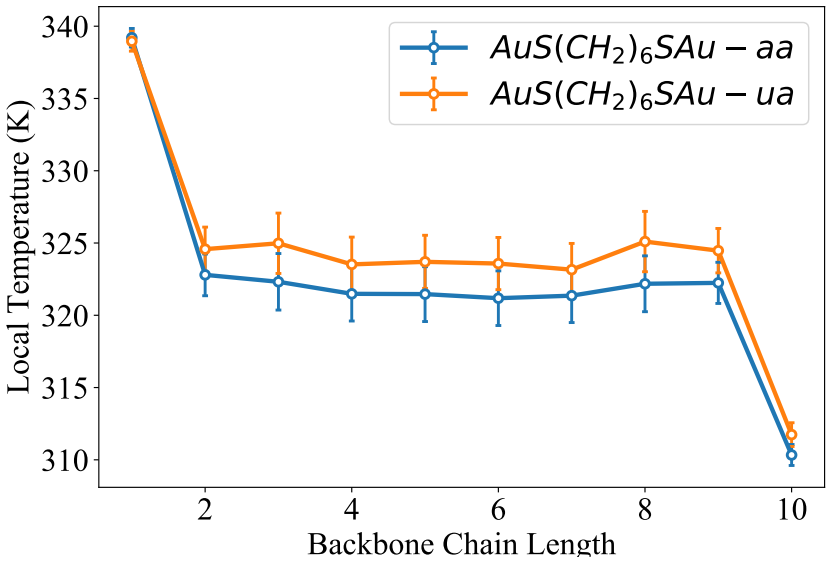
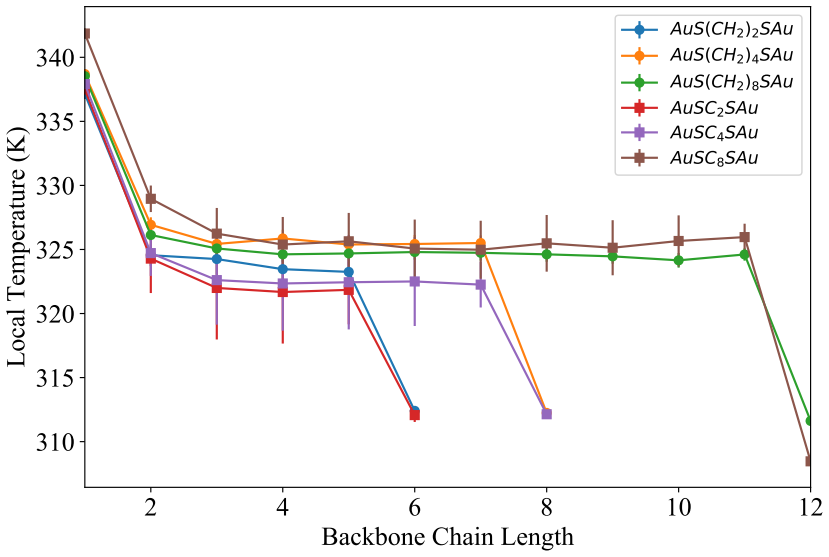
The central claim is that a stochastic nonequilibrium molecular dynamics (SNEMD) scheme with an explicitly modeled metal-molecule interface can serve as a general, atomistic tool for heat conduction in single-molecule junctions in and beyond linear response. Using the Universal Force Field and several layers of gold atoms as a filter between the molecule and Markovian reservoirs, the paper obtains steady-state heat currents and defines the junction conductance as the current divided by the 50 K bath bias. For alkanedithiols, the conductance saturates at about 20 pW/K once three gold layers are included, matching the most recent single-molecule experiments; for conjugated polyynes, the simulations find lower thermal conductance than for saturated alkanes of the same length, opposite to their electronic conductance ordering. A side-by-side comparison with harmonic Landauer-type calculations from the same force field shows that the classical MD results agree with experiment at room temperature, while the quantum harmonic results show non-monotonic length dependence, suggesting that anharmonicity and finite-bias effects are important in the experimentally accessed regime.
Load-bearing premise
In Section 2 the paper assumes that the heat current through the molecule is the same regardless of where the imaginary counting plane is drawn, and the whole calculation also depends on the arbitrary choice of splitting each interaction's energy equally among the atoms involved; if the measured current changes with that bookkeeping, the reported conductance values are artifacts of the flux definition.
Editorial extensions
If this is right
- Alkanedithiol single-molecule junctions should have a room-temperature thermal conductance near 20 pW/K that depends only weakly on chain length, rather than falling steeply.
- Adding more than three explicit gold layers does not change the computed conductance, so the bath-filtering approximation is converged for gold leads.
- At room temperature, classical full-force-field simulations are a more reliable route to junction thermal conductance than harmonic quantum Landauer calculations, which miss anharmonic contributions.
- Conjugated polyyne molecular wires, despite conducting electrons well, conduct less heat than saturated alkanes, which would make them favorable for thermoelectric applications.
- The same SNEMD framework can be applied to other molecules and metal leads to map structural dependence of interfacial heat conduction beyond linear response.
Reading between the lines
- If the plane-independence assumption holds, the same flux decomposition could be applied per interaction type to quantify how much of the junction resistance is interfacial versus intramolecular, which the paper only sketches qualitatively through temperature profiles.
- A decisive test of the anharmonicity interpretation would be to run the same SNEMD simulations at several bath biases, such as 10 K, 50 K, and 100 K; if conductance is bias-independent, the MD-versus-Landauer difference must come from anharmonicity rather than nonlinear response.
- The framework's prediction that polyynes are low-heat-conducting but high-electron-conducting could be converted into a concrete thermoelectric figure-of-merit estimate only by also computing the electronic conductance and Seebeck coefficient for the same junction geometries.
Signed reviews
Editorial analysis
A structured set of objections, weighed in public.
Referee Report
Summary. The authors present a stochastic nonequilibrium molecular dynamics (SNEMD) framework for phononic heat transport in single-molecule junctions, in which Markovian Langevin baths are attached to the outermost of several explicit gold layers that filter the bath spectrum. The heat current is computed by partitioning interaction energies among atoms and summing pairwise fluxes across an imaginary plane. The method is applied to alkanedithiols and polyynes with UFF force fields, and the computed thermal conductances (~20 pW/K for alkanes) are compared with recent experimental values (Cui et al., Nature 2019) and with harmonic Landauer calculations based on the same force field. The paper reports that classical MD agrees better with experiment than the harmonic Landauer calculation, suggests that anharmonicity plays a role, and finds that polyynes have lower thermal conductance than alkanes despite their higher electronic conductance.
Significance. If the reported values are robust, the SNEMD approach provides a practical, generally applicable tool for simulating heat transport in molecular junctions, with the explicit-gold-layer filtering being a useful methodological refinement over direct Markovian baths. The paper is careful in reporting statistical errors and in checking convergence with the number of gold layers, and it compares against both independent ab initio Landauer results and experimental data. The polyyne result is an interesting falsifiable prediction about conjugation and thermal transport. However, the central quantitative claims rest on untested choices of the bath coupling and are partly confounded by classical/quantum statistical differences, so the significance is conditional on those points being resolved.
major comments (3)
- [Section 2 (Model and Calculations) and SI Eqs. (S4)-(S5)] The Langevin friction coefficient γ is a free parameter that is fixed to a single value (apparently 1 ps⁻¹, stated in a garbled sentence in Section 2) in the MD simulations, but no scan over γ is reported. In a finite junction with explicit gold layers, γ controls the bath–electrode contact resistance; for small γ the measured current is set by the bath coupling rather than by the molecule, and the layer-convergence test in Fig. 4 cannot distinguish 'the gold layers filter the bath' from 'the bath contact dominates regardless of layer count'. The value of γ used in the Landauer calculation (SI Eqs. S1–S5) is also not reported, so the comparison in Fig. 8 and the conclusion that classical MD captures anharmonicity better than harmonic Landauer are not reproducible. A γ-scan (e.g. 0.1–10 ps⁻¹) with a statement of the plateau range is required before the 20 pW/K agreement with experiment can be considered robust.
- [Section 3 (Results and Discussion) and Conclusion] The claim that the better agreement of MD with experiment 'indicat[es] anharmonicity plays a tunning role' is confounded by the different statistics of the two methods. The MD simulation is classical (equipartition), while the Landauer calculation uses Bose–Einstein occupancies (SI Eq. S1). For modes with ħω ≲ kBT the classical and quantum populations differ, and the high-frequency modes that are suppressed in the quantum calculation may still carry some current in the MD if the gold spectral density has weight there. The observed MD–Landauer difference could therefore reflect classical vs. quantum statistics rather than anharmonicity. To support the anharmonicity conclusion, the authors should compare MD with a classical Landauer calculation (using the classical limit of the Bose–Einstein distribution, kBT/ħω), or provide a frequency-resolved decomposition of the MD current, or perform an MD run with the harmonic part of the force field only.
- [Section 2, paragraph after Eq. (4)] The statement that 'the heat current through the molecule will be measured the same, regardless of where we chose to draw this imaginary plane' is asserted but never numerically verified. While the local energy-conservation argument with Σ_j C_{τ,j}=1 makes plane independence plausible in the continuum limit, the implementation with multi-body force-field terms and discrete atoms warrants a check. A simple test is to compute the total current across planes located at different positions along the molecule (e.g., at each backbone atom) and show that the values agree within statistical error. If the current varies with plane position, the reported conductance is an artifact of the chosen flux decomposition rather than a physical observable.
minor comments (6)
- [Abstract and throughout] There are numerous typographical errors, including 'Nonequlibrium', 'alkanethiol' (SI), 'molecualr', 'polyyenes', 'utlizing', 'tunning', and 'calcualted'; these should be corrected throughout.
- [Table 1 caption] The expression for Welch's t-test, η(x,y) = |E[x]-E[y]|/√(σ_x²+σ_y²), is a t-statistic, not a p-value; reporting '13%' as the result of a t-test is ambiguous and should be clarified as a p-value with the degrees of freedom.
- [Section 2 (Model and Calculations)] The sentence 'the coupling strength between the Markovian bath and outermost layer of explicit bulk (region is 1) is ps−1' is garbled; the value and units of γ should be stated clearly in a complete sentence.
- [Abstract and Section 3] The statement that 'the similarity of the results indicate that heat transport is dominated by modes in the lower frequency range' applies cleanly only to the polyyne series; for the alkanes the MD and Landauer results differ markedly in Fig. 8, so the claim should be qualified by chain type.
- [Supporting Information] No data or code availability statement is provided; given that the method is implemented in a customized GROMACS package, providing the input topologies and analysis scripts would enhance reproducibility.
- [Figure 7 caption] The legend text 'the ones with and without hydrogen atoms are alkanes and conjugated polyyenes respectively' is confusing; it should say 'saturated alkanedithiols and polyynes'.
Circularity Check
No significant circularity: the computed conductances are compared against external experiments and independent calculations, with no target value entering the derivation by construction.
full rationale
The paper's central quantities—heat current and thermal conductance—are computed directly from MD trajectories via Eqs. (2)–(4), with the force field (UFF), junction geometry, and bath parameters fixed before comparison to experiment. The reported ~20 pW/K conductance is an output of the steady-state simulation, not a fit to the Cui et al. experimental data; that experiment serves only as an external benchmark. The Landauer comparison is likewise not circular: it is an independent harmonic calculation based on the same force field, and the paper explicitly reports divergence between the two methods (nonmonotonic Landauer trend versus stable MD trend) rather than forcing agreement. The energy-partition weights C_tau,j enter the local current definition, but the plane-independence statement is presented as a steady-state conservation property, and no target conductance is encoded in the partition or in the choice of the imaginary plane. The self-citations to Segal, Nitzan, and Hänggi support standard Landauer/NEGF formalism and background assumptions about high-frequency modes; they are not invoked to forbid alternatives or to define the predicted value. The untested Langevin damping gamma is a robustness concern, not a circular reduction: there is no evidence that the 20 pW/K result was selected by tuning gamma. No step in the derivation is equivalent by construction to its input, so the appropriate finding is no significant circularity.
Assumptions & free parameters
free parameters (4)
- Langevin bath friction coefficient gamma =
1 ps^-1 (stated, not scanned)
- Number of explicit gold substrate layers =
3
- Energy partition weights C_tau,j =
1/n(tau) for each interaction
- Position-restraint force constant on outermost gold layer =
not reported (restraint peak at ~40 cm^-1)
assumptions (6)
- domain assumption Classical dynamics accurately describe molecular heat transport at 300-350 K because high-frequency modes are unpopulated and contribute little.
- domain assumption UFF force field provides a faithful potential energy surface for Au-S-C junctions.
- domain assumption Markovian white-noise reservoirs attached to the outermost gold layer, filtered by explicit gold layers, represent bulk gold phonon baths.
- ad hoc to paper Equal partitioning of each interaction energy among participating atoms yields a meaningful local heat flux.
- standard math The harmonic Landauer formula with Ohmic white baths is a valid baseline for quantum conductance.
- domain assumption Position-restrained outer gold layers with a harmonic force at ~40 cm^-1 provide a spectral density close to bulk gold.
Cite this review
Pith. "Pith review of Stochastic Simulation of Nonequilibrium Heat Conduction in Extended Molecule Junctions." pith.science (2026). https://pith.science/paper/P62ST7VZ
@misc{pith2026190808617,
  author       = {Pith},
  title        = {Pith review of: Stochastic Simulation of Nonequilibrium Heat Conduction in Extended Molecule Junctions},
  year         = {2026},
  howpublished = {\url{https://pith.science/paper/P62ST7VZ}},
  note         = {Machine review of arXiv:1908.08617}
}
read the original abstract
Understanding phononic heat transport processes in molecular junctions is a central issue in the developing field of nanoscale heat conduction and manipulation. Here we present a Stochastic Nonequlibrium Molecular Dynamics simulation framework to investigate heat transport processes in molecular junctions in and beyond the linear response regime. We use extended molecular models which filter Markovian heat reservoirs through an intermediate substrate region, to provide a realistic and controllable effective bath spectral density. The results obtained for alkanedithol molecules connecting gold substrates agree with previous nonequilibrium Green's function calculations in frequency domain, and match recent experimental measurements (e.g. thermal conductance around 20 pW/K for alkanedithiols in single molecular junctions) Classical MD simulations using the full molecular forcefield and quantum Landauer-type calculations based on the harmonic part of the same forcefield are compared, and the similarity of the results indicate that heat transport is dominated by modes in the lower frequency range. Heat conductance simulations on polyynes of different lengths illuminates the effects of molecular conjugation on thermal transport.
Figures


Figures from the paper (5 more)



Reference graph
Works this paper leans on
-
[1]
Segal, D.; Agarwalla, B. K. Vibrational Heat Transport in Molecular Junctions. Annu. Rev. Phys. Chem. 2016, 67, 185--209
work page 2016
-
[2]
Energy dissipation and transport in nanoscale devices
Pop, E. Energy dissipation and transport in nanoscale devices. Nano Res. 2010, 3, 147--169
work page 2010
-
[3]
Colloquium : Phononics: Manipulating heat flow with electronic analogs and beyond
Li, N.; Ren, J.; Wang, L.; Zhang, G.; H\"anggi, P.; Li, B. Colloquium : Phononics: Manipulating heat flow with electronic analogs and beyond. Rev. Mod. Phys. 2012, 84, 1045--1066
work page 2012
-
[4]
Colloquium : Heat flow and thermoelectricity in atomic and molecular junctions
Dubi, Y.; Di Ventra, M. Colloquium : Heat flow and thermoelectricity in atomic and molecular junctions. Rev. Mod. Phys. 2011, 83, 131--155
work page 2011
-
[5]
Nonequilibrium Green's Function Approach to Phonon Transport in Defective Carbon Nanotubes
Yamamoto, T.; Watanabe, K. Nonequilibrium Green's Function Approach to Phonon Transport in Defective Carbon Nanotubes. Phys. Rev. Lett. 2006, 96, 255503
work page 2006
-
[6]
Nonequilibrium Green's function approach to mesoscopic thermal transport
Wang, J.-S.; Wang, J.; Zeng, N. Nonequilibrium Green's function approach to mesoscopic thermal transport. Phys. Rev. B 2006, 74, 033408
work page 2006
-
[7]
Spatial Variation of Currents and Fields Due to Localized Scatterers in Metallic Conduction
Landauer, R. Spatial Variation of Currents and Fields Due to Localized Scatterers in Metallic Conduction . IBM Journal of Research and Development 1957, 1, 223
work page 1957
-
[8]
Zhang, M.; Lussetti, E.; de Souza, L. E. S.; Müller-Plathe, F. Thermal Conductivities of Molecular Liquids by Reverse Nonequilibrium Molecular Dynamics. J. Phys. Chem. B 2005, 109, 15060--15067
work page 2005
Show all 50 references
-
[9]
R.; Li, D
Lukes, J. R.; Li, D. Y.; Liang, X.-G.; Tien, C.-L. Molecular Dynamics Study of Solid Thin-Film Thermal Conductivity . J. Heat Transfer 2000, 122, 536--543
2000
-
[10]
Unusually high thermal conductivity of carbon nanotubes
Berber, S.; Kwon, Y.-k.; Tom \' a nek, D. Unusually high thermal conductivity of carbon nanotubes . Phys. Rev. Lett. 2000, 84, 4613--4616
2000
-
[11]
D.; Kantorovich, L
Ness, H.; Stella, L.; Lorenz, C. D.; Kantorovich, L. Nonequilibrium generalised Langevin equation for the calculation of heat transport properties in model 1D atomic chains coupled to two 3D thermal baths. J. Chem. Phys. 2017, 146, 164103
2017
-
[12]
Ladd, A. J. C.; Moran, B.; Hoover, W. G. Lattice thermal conductivity: A comparison of molecular dynamics and anharmonic lattice dynamics. Phys. Rev. B 1986, 34, 5058--5064
1986
-
[13]
G.; Chen, G
Volz, S. G.; Chen, G. Molecular-dynamics simulation of thermal conductivity of silicon crystals . Phys. Rev. B 2000, 61, 2651--2656
2000
-
[14]
Che, J.; Çağın, T.; Deng, W.; Goddard, W. A. Thermal conductivity of diamond and related materials from molecular dynamics simulations. J. Chem. Phys. 2000, 113, 6888--6900
2000
-
[15]
K.; Phillpot, S
Schelling, P. K.; Phillpot, S. R.; Keblinski, P. Comparison of atomic-level simulation methods for computing thermal conductivity . Physical Review B - Condensed Matter and Materials Physics 2002, 65, 1--12
2002
-
[16]
Thermal conductivity decomposition and analysis using molecular dynamics simulations
McGaughey, A.; Kaviany, M. Thermal conductivity decomposition and analysis using molecular dynamics simulations. Part I. Lennard-Jones argon. Int. J. Heat Mass Transf. 2004, 47, 1783 -- 1798
2004
-
[17]
Thermal conductivity decomposition and analysis using molecular dynamics simulations: Part II
McGaughey, A.; Kaviany, M. Thermal conductivity decomposition and analysis using molecular dynamics simulations: Part II. Complex silica structures. Int. J. Heat Mass Transf. 2004, 47, 1799 -- 1816
2004
-
[18]
Thermal transport in graphene supported on copper
Chen, L.; Kumar, S. Thermal transport in graphene supported on copper. J. Appl. Phys. 2012, 112, 043502
2012
-
[19]
P.; Landry, E
Sellan, D. P.; Landry, E. S.; Turney, J. E.; McGaughey, A. J. H.; Amon, C. H. Size effects in molecular dynamics thermal conductivity predictions . Phys. Rev. B 2010, 81, 1--10
2010
-
[20]
Heat flow studies for large temperature gradients by molecular dynamics simulation
Baranyai, A. Heat flow studies for large temperature gradients by molecular dynamics simulation . Phys. Rev. E 1996, 54, 6911--6917
1996
-
[21]
Poetzsch, R. H. H.; Bottger, H. Interplay of disorder and anharmonicity in heat conduction: Molecular-dynamics study. Phys. Rev. B 1994, 50, 757--764
1994
-
[22]
Simulation of thermal conductivity and heat transport in solids
Oligschleger, C. Simulation of thermal conductivity and heat transport in solids . Phys. Rev. B 1999, 59, 4125--4133
1999
-
[23]
W.; Lan, J.; Wang, J
Jiang, J. W.; Lan, J.; Wang, J. S.; Li, B. Isotopic effects on the thermal conductivity of graphene nanoribbons: Localization mechanism . J. Appl. Phys. 2010, 107
2010
-
[24]
Molecular-dynamics calculation of the thermal conductivity of vitreous silica
Jund, P.; Jullien, R. Molecular-dynamics calculation of the thermal conductivity of vitreous silica . Phys. Rev. B 1999, 59, 13707--13711
1999
-
[25]
A simple nonequilibrium molecular dynamics method for calculating the thermal conductivity
M \" u ller-Plathe, F. A simple nonequilibrium molecular dynamics method for calculating the thermal conductivity . J. Chem. Phys. 1997, 106, 6082--6085
1997
-
[26]
Cause and effect reversed in non-equilibrium molecular dynamics: An easy route to transport coefficients
M \" u ller-Plathe, F.; Reith, D. Cause and effect reversed in non-equilibrium molecular dynamics: An easy route to transport coefficients . Computational and Theoretical Polymer Science 1999, 9, 203--209
1999
-
[27]
P.; Ruoff, R
Bagri, A.; Kim, S. P.; Ruoff, R. S.; Shenoy, V. B. Thermal transport across twin grain boundaries in polycrystalline graphene from nonequilibrium molecular dynamics simulations . Nano Letters 2011, 11, 3917--3921
2011
-
[28]
Relative importance of grain boundaries and size effects in thermal conductivity of nanocrystalline materials
Dong, H.; Wen, B.; Melnik, R. Relative importance of grain boundaries and size effects in thermal conductivity of nanocrystalline materials . Sci. Rep. 2014, 4, 7037
2014
-
[29]
The interplay between strain and size effects on the thermal conductance of grain boundaries in graphene
Tang, S.; Kulkarni, Y. The interplay between strain and size effects on the thermal conductance of grain boundaries in graphene. Appl. Phys. Lett. 2013, 103, 213113
2013
-
[30]
Impacts of potential models on calculating the thermal conductivity of graphene using non-equilibrium molecular dynamics simulations
Si, C.; Wang, X.-D.; Fan, Z.; Feng, Z.-H.; Cao, B.-Y. Impacts of potential models on calculating the thermal conductivity of graphene using non-equilibrium molecular dynamics simulations. Int. J. Heat Mass Transf. 2017, 107, 450 -- 460
2017
-
[31]
J.; de Vries, A
Goga, N.; Rzepiela, A. J.; de Vries, A. H.; Marrink, S. J.; Berendsen, H. J. C. Efficient Algorithms for Langevin and DPD Dynamics. J. Chem. Theory Comput. 2012, 8, 3637--3649
2012
-
[32]
Thermal conductance through molecular wires
Segal, D.; Nitzan, A.; H\"anggi, P. Thermal conductance through molecular wires. J. Chem. Phys. 2003, 119, 6840--6855
2003
-
[33]
o ckner, J. C.; B \
Kl \"o ckner, J. C.; B \"u rkle, M.; Cuevas, J. C.; Pauly, F. Length dependence of the thermal conductance of alkane-based single-molecule junctions: An ab initio study. Phys. Rev. B 2016, 94, 205425--1--8
2016
-
[34]
Y.; Segalman, R
Wang, R. Y.; Segalman, R. A.; Majumdar, A. Room temperature thermal conductance of alkanedithiol self-assembled monolayers. Appl. Phys. Lett. 2006, 89, 173113
2006
-
[35]
Length-Dependent Thermal Transport along Molecular Chains
Meier, T.; Menges, F.; Nirmalraj, P.; H\"olscher, H.; Riel, H.; Gotsmann, B. Length-Dependent Thermal Transport along Molecular Chains. Phys. Rev. Lett. 2014, 113, 060801
2014
-
[36]
A.; Schiffres, S
Majumdar, S.; Sierra-Suarez, J. A.; Schiffres, S. N.; Ong, W.-L.; Higgs, C. F.; McGaughey, A. J. H.; Malen, J. A. Vibrational Mismatch of Metal Leads Controls Thermal Conductance of Self-Assembled Monolayer Junctions. Nano Letters 2015, 15, 2985--2991
2015
-
[37]
A.; Kl \" o ckner, J
Cui, L.; Hur, S.; Akbar, Z. A.; Kl \" o ckner, J. C.; Jeong, W.; Pauly, F.; Jang, S.-Y.; Reddy, P.; Meyhofer, E. Thermal conductance of single-molecule junctions . Nature 2019,
2019
-
[38]
Unusual conductance of polyyne-based molecular wires
Crljen, Z .; Baranovi \' c , G. Unusual conductance of polyyne-based molecular wires . Phys. Rev. Lett. 2007, 98, 1--4
2007
-
[39]
H.; Bro-J rgensen, W.; Pedersen, P
Garner, M. H.; Bro-J rgensen, W.; Pedersen, P. D.; Solomon, G. C. Reverse Bond-Length Alternation in Cumulenes: Candidates for Increasing Electronic Transmission with Length . J. Phys. Chem. C 2018, acs.jpcc.8b05661
2018
-
[40]
Contribution of inter- and intramolecular energy transfers to heat conduction in liquids
Torii, D.; Nakano, T.; Ohara, T. Contribution of inter- and intramolecular energy transfers to heat conduction in liquids . J. Chem. Phys. 2008, 128
2008
-
[41]
R.; Smith, J
Pronk, S.; Páll, S.; Schulz, R.; Larsson, P.; Bjelkmar, P.; Apostolov, R.; Shirts, M. R.; Smith, J. C.; Kasson, P. M.; van der Spoel, D.; Hess, B.; Lindahl, E. GROMACS 4.5: a high-throughput and highly parallel open source molecular simulation toolkit. Bioinformatics 2013, 29,...
2013
-
[42]
M.; Banck, M.; James, C
O'Boyle, N. M.; Banck, M.; James, C. A.; Morley, C.; Vandermeersch, T.; Hutchison, G. R. Open Babel: An open chemical toolbox. J. Cheminformatics 2011, 3, 33
2011
-
[43]
D.; Curtis, D
Hanwell, M. D.; Curtis, D. E.; Lonie, D. C.; Vandermeersch, T.; Zurek, E.; Hutchison, G. R. Avogadro: an advanced semantic chemical editor, visualization, and analysis platform. Journal of Cheminformatics 2012, 4, 17
2012
-
[44]
K.; Casewit, C
Rappe, A. K.; Casewit, C. J.; Colwell, K. S.; Goddard, W. A.; Skiff, W. M. UFF, a full periodic table force field for molecular mechanics and molecular dynamics simulations. Journal of the American Chemical Society 1992, 114, 10024--10035
1992
-
[45]
L.; Yan, T.; Hase, W
Zhang, Y.; Barnes, G. L.; Yan, T.; Hase, W. L. Model non-equilibrium molecular dynamics simulations of heat transfer from a hot gold surface to an alkylthiolate self-assembled monolayer. Phys. Chem. Chem. Phys. 2010, 12, 4435--4445
2010
-
[46]
Vibrational density of states and thermodynamics at the nanoscale: the 3D-2D transition in gold nanostructures
Carles, R.; Benzo, P.; P \' e cassou, B.; Bonafos, C. Vibrational density of states and thermodynamics at the nanoscale: the 3D-2D transition in gold nanostructures . Sci. Rep. 2016, 6, 39164
2016
-
[47]
slabs", and rescaling the atomic velocities at the
Altman, D. G.; Bland, J. M. Standard deviations and standard errors . BMJ (Clinical research ed.) 2005, 331, 903 mcitethebibliography main.tex0000664000000000000000000011445013527614700011236 0ustar rootroot [journal=jcpl,manuscript=letter] achemso chemformula [T1] fontenc [te...
2005
-
[48]
Heat Transport in Harmonic Lattices
Dhar, A.; Roy, D. Heat Transport in Harmonic Lattices. J. Stat. Phys. 2006, 125, 801--820
2006
-
[49]
Heat transport in low-dimensional systems
Dhar, A. Heat transport in low-dimensional systems. Adv. Phys. 2008, 57, 457--537
2008
-
[50]
Saturated
Meir, Y.; Wingreen, N. S. Landauer formula for the current through an interacting electron region. Phys. Rev. Lett. 1992, 68, 2512--2515 mcitethebibliography support_infomation.tex0000664000000000000000000004255513527614700014257 0ustar rootroot [journal=jcpl,manuscript=letter...
1992
Reviewed August 14, 2026 · model on record in the stance chip above.
Discussion (0). Continue with ORCID to comment.