REVIEW 4 major objections 5 minor 101 references
The paper derives the first observational bounds on theory-agnostic deviations from the Teukolsky equation from the GW250114 ringdown, finding all deviation parameters consistent with general relativity.
Reviewed by Pith at T0; open to challenge. T0 means a machine referee read the full paper against a public rubric. the ladder, T0–T4 →
T0 review · deepseek-v4-flash
2026-08-01 13:19 UTC pith:PGJPF24C
load-bearing objection First real-data beyond-Teukolsky bounds, but the quoted 60–100 km scales are prior-dominated and the λ=1 bounds double-count ringdown information. the 4 major comments →
Constraining deviations from the Teukolsky equation with GW250114
The pith
A machine-rendered reading of the paper's core claim, the machinery that carries it, and where it could break.
Core claim
The central claim is that the ringdown of GW250114, analyzed through the beyond-Teukolsky framework, provides the first observational bounds on deviations from the Teukolsky equation. The authors demonstrate that all complex deviation parameters ζ_k, which encode small modifications δV(r) to the Teukolsky potential in powers of (r/r_+)^k, are consistent with zero within both optimistic and pessimistic priors on the remnant mass and spin. The one-standard-deviation uncertainties on Re(ζ_k) and Im(ζ_k), converted to length scales via sqrt(σ_ζ)·M, fall in the range of roughly 60–100 km, in agreement with the independent ParSpec bound of about 80 km. The method itself — a simplified Gaussian lik
What carries the argument
The machinery is the beyond-Teukolsky framework combined with a simplified Gaussian likelihood. The framework modifies the Teukolsky equation by adding a small potential δV(r) = (1/Δ) Σ_{k=-K}^{4} α_k (r/r_+)^k, with dimensionless complex parameters ζ_k = α_k/M^2. At linear order, the quasinormal-mode frequency shifts as ω = ω_GR + (1/M) Σ ζ_k d^k_ω, where the coefficients d^k_ω are precomputed for each (ℓ,m,n). The analysis then approximates the LVK posteriors for (M, χ) and for the fundamental mode frequency and damping time as multivariate Gaussians, and samples the likelihood of the measured ω_{220} against the model prediction, varying one ζ_k at a time. The remnant mass and spin are an
Load-bearing premise
The entire constraint rests on the assumption that the remnant black hole's mass and spin, as predicted by the GR-based inspiral-merger-ringdown analysis, are close enough to the true values that the IMR-informed priors (with the hand-set width λ) cover the actual (M, χ); if a beyond-GR theory shifted the remnant parameters by more than that width, the reported ζ_k bounds would be biased toward zero and would not reflect the true deviations.
What would settle it
Take the public GW250114 posteriors, inject a simulated ringdown signal with a known nonzero ζ_k and a remnant mass and spin shifted by ~1% away from the GR IMR maximum-likelihood values, then run the paper's pipeline; if the recovered ζ_k posterior fails to exclude zero or recover the injected value, the IMR-anchored priors are demonstrably insufficient to constrain beyond-Teukolsky deviations.
If this is right
- If the central claim holds, deviations in the effective potential of Kerr black-hole perturbation theory are bounded at the tens-of-kilometers scale for this event — the sharpest such bound to date.
- The simplified likelihood pipeline can be rerun quickly on future high-SNR events without a full Bayesian analysis, making it a practical screening test for beyond-GR theories.
- The consistency with the independent ParSpec bound (~80 km) suggests that different agnostic parametrizations are converging on the same length-scale ceiling for deviations.
- The reported ζ_k constraints can be translated into bounds on specific theories, such as higher-derivative gravity, once their predicted potential deviations are mapped to ζ_k.
Where Pith is reading between the lines
- The hand-set λ parameter is the real dial of the analysis: λ=1 double-counts ringdown information already present in the IMR posterior, while large λ weakens the priors to the point where the ζ_k bounds may be dominated by prior ignorance. A fully Bayesian joint fit of M, χ, and ζ_k would determine where between these extremes the true constraint lies.
- If a beyond-GR theory predicts a final mass or spin that differs from the GR IMR value by more than the λ-scaled width, the ζ_k posteriors will be systematically shifted. A direct test would be to inject a simulated signal with a known nonzero ζ_k and a shifted remnant and check whether the pipeline recovers the injection.
- The one-at-a-time variation of ζ_k means the bounds are conditional; simultaneous marginalization would likely be far less informative, but mapping the joint posterior to local properties of the effective potential near its maximum, as done in the non-rotating case with WKB, could restore interpretability.
Editorial analysis
A structured set of objections, weighed in public.
Referee Report
Summary. The paper proposes a lightweight method to constrain theory-agnostic deviations from the Teukolsky equation using the fundamental (l=m=2, n=0) ringdown mode of the high-SNR event GW250114. The authors combine a Gaussian approximation of the LVK full-IMR posterior for the remnant mass and spin (Prior 1, Eq. 8; Prior 2, Eq. 12) with a Gaussian approximation of the LVK agnostic damped-sinusoid posterior for ω_220, and sample the likelihood (Eq. 10) with MCMC. They vary one complex beyond-Teukolsky parameter ζ_k at a time and report that all ζ_k are consistent with GR (ζ_k=0). They translate the marginalized uncertainties into characteristic length scales √σ_ζ M ≈ 60–100 km and claim the first bounds on the beyond-Teukolsky framework.
Significance. If the bounds are robust, this would be the first observational constraint on the beyond-Teukolsky formalism of Ref. [82], complementing the independent ParSpec analysis of the same event. The methodological idea of using a simplified Gaussian likelihood for high-SNR ringdowns is pragmatic and could be applied to future loud events. The paper is unusually transparent about the limited constraining power of a single mode and about the prior-dependence of the results, presenting both 'optimistic' (λ=1) and 'pessimistic' (λ=25 or λ=5) choices. It also correctly notes that the linearized framework has limited accuracy for large ζ_k. These strengths make the work potentially useful to the ringdown community.
major comments (4)
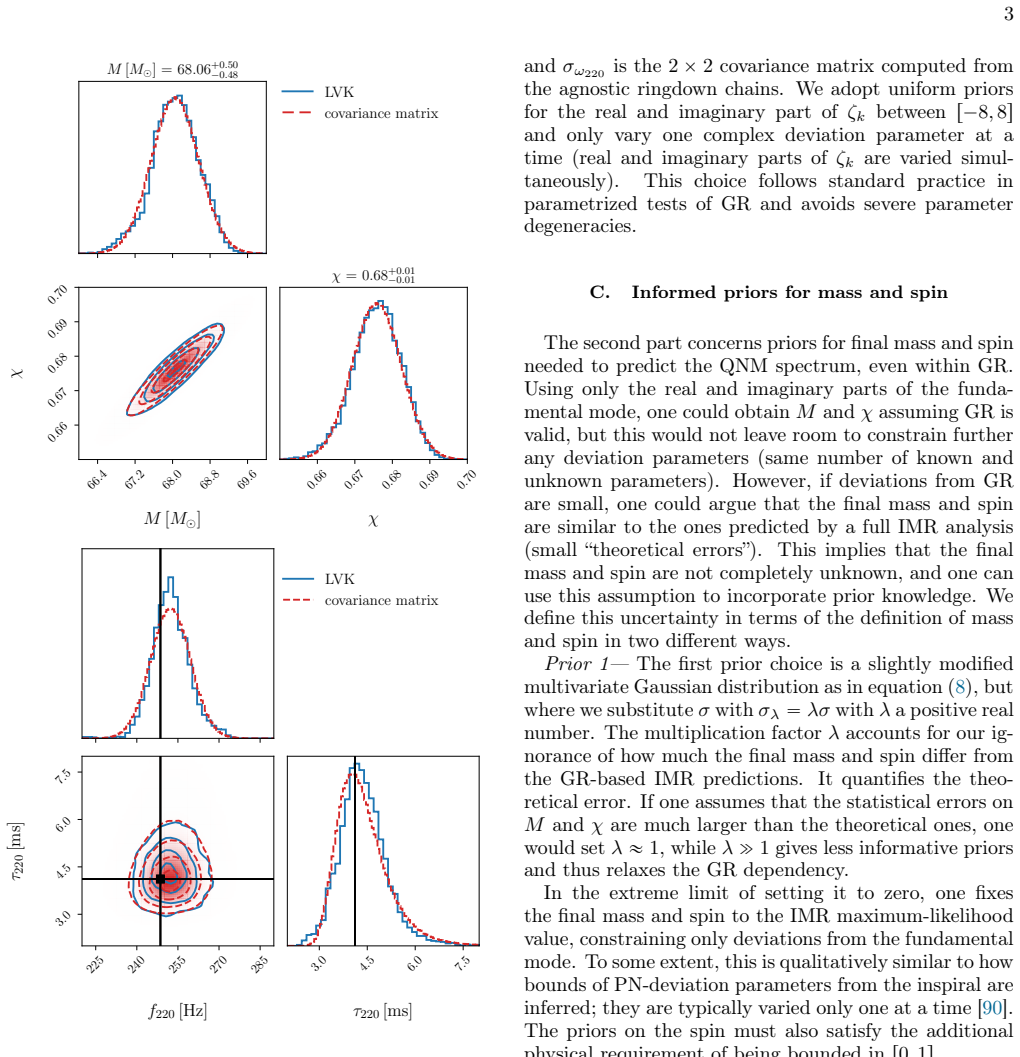
- [Sec. II.C, Eq. (8) and Fig. 2] The Gaussian prior on (M,χ) is taken from the NRSur7dq4 full-IMR posterior, which already contains the ringdown information used later in the likelihood Eq. (10). For λ=1, the prior and likelihood are not independent, so the ζ_k posteriors are largely a re-projection of the GR-based IMR mapping rather than new information. The paper acknowledges this qualitatively ('underestimate the statistical errors') but does not quantify the impact on the quoted 60–100 km length scale. An injection study or an inspiral-only prior is needed to establish what these bounds actually measure.
- [Sec. III, length-scale paragraph] The '60–100 km' characteristic scales are quoted only from the λ=1 'optimistic' bounds, which are the most affected by the double-counting problem above. The λ=25 'pessimistic' bounds are not translated to length scales, so the headline quantitative claim does not reflect the full range of prior choices. The paper should either report the length-scale range for both prior choices or explicitly state that the 60–100 km figure is conditional on the optimistic prior.
- [Sec. II.C, Eq. (12) and λ choices] The scaling parameter λ is set ad hoc (λ=1/25 for the Gaussian prior, λ=1/5 for the box prior) with no calibration to known beyond-GR theories or to plausible shifts in final mass/spin. The relationship between a covariance multiplier and a percentage box is not justified. Consequently, even the 'pessimistic' bounds remain uncalibrated; they are not a systematic treatment of theoretical uncertainty. A prescription for λ based on theory-specific estimates or on injection tests is required to support the claim of providing 'bounds'.
- [Sec. II.A, Eqs. (6)–(7) and Figs. 2–3] The beyond-Teukolsky framework assumes |ζ_k| ≪ 1 for the linear expansion Eq. (7) to be valid, but the marginalized posteriors in Figs. 2 and 3 extend to |ζ| ≳ 1. The text states that linear corrections are about 1% accurate for the considered ranges, but this is not demonstrated for the actual posterior support. If the posterior overlaps the non-perturbative regime, the reported bounds cannot be interpreted as bounds on the linear deviation parameters. The paper should identify the region of validity and restrict its reporting to that region.
minor comments (5)
- [Sec. II.B] The phrase 'The high signal-to-noise (SNR) ratio' is redundant; 'SNR' already includes 'ratio'.
- [Sec. II.A, Eq. (6)] The truncation value K is not stated in the text; the figures show k = -2,...,4, so K=2. Please state this explicitly and justify the truncation.
- [Sec. II.C] The symbol λ is used both as a covariance multiplier (Eq. 8) and as a percentage width (Eq. 12). Clarify this in the notation, or use a different symbol for the box prior.
- [General] The phrase 'the here presented analysis' is awkward; suggest 'the present analysis'.
- [Sec. IV] The conclusion mentions future applications but does not quantify the expected improvement for next-generation detectors; a short estimate would strengthen the outlook.
Circularity Check
No significant circularity: the beyond-Teukolsky input is prior work with independent content, and the λ=1 double-counting of ringdown information is explicitly disclosed as a limitation rather than a hidden equivalence.
full rationale
The claimed derivation chain is: (i) adopt the beyond-Teukolsky relation Eq. (7) from Ref. [82] with coefficients from Ref. [88]; (ii) approximate the LVK IMR (M,χ) posterior and the LVK damped-sinusoid ω220 posterior as Gaussians (Eqs. 8 and 10); (iii) sample the likelihood with informed priors and report ζ_k bounds. Step (i) is a parameter-free perturbative mapping between potential deviations δV and QNM frequency shifts; its stated assumptions (small |ζ_k|, linear order) do not include the target data bounds, and the coefficients are provided in a public repository, so the authors' self-citation here is not load-bearing circularity. Step (iii) is an empirical bound rather than a first-principles prediction. The only near-circular element is that for λ=1 the (M,χ) prior comes from the NRSur7dq4 full-IMR analysis, which already includes ringdown information that is reused in the ringdown likelihood Eq. (10); the paper explicitly flags this: 'the bounds for λ=1 can be understood as “optimistic” bounds, since they completely ignore the theoretical uncertainties in final mass and spin, and underestimate the statistical errors since they use the full IMR information.' This is a disclosed statistical double-counting/optimism caveat, not an equivalence by construction, and the λ=25 'pessimistic' prior plus the external ParSpec comparison (~80 km) provide a cross-check less dependent on the optimistic prior. I therefore find no circular step that reduces the central claim to its inputs; the score of 2 reflects the density of self-citations and the optimistic-prior caveat, not a circular derivation.
Axiom & Free-Parameter Ledger
free parameters (3)
- λ (theoretical-error scaling) =
λ = 1 and 25 (Gaussian prior); λ = 1 and 5 (uniform-box prior)
- ζ_k (k = -2,...,4) =
inferred posteriors ≈ 0 (within quoted widths)
- Prior truncation K=2 in Eq. (6) =
k from -2 to 4
axioms (5)
- domain assumption Beyond-Teukolsky linear response: ω = ω_GR + (1/M) Σ ζ_k d^ω_k (Eq. 7), with d^ω_k from Ref. [82]/repo [88]
- ad hoc to paper |ζ_k| << 1 holds over the posterior support
- domain assumption GR-based IMR (NRSur7dq4) final mass/spin are accurate up to λ-scaled 'theoretical errors'
- domain assumption LVK agnostic ringdown posteriors (two damped sinusoids, t=10M) are unbiased and well-approximated by multivariate Gaussians
- standard math Teukolsky equation is the correct GR description of Kerr ringdowns
read the original abstract
The recent gravitational-wave detection GW250114 by the LIGO-Virgo-KAGRA (LVK) Collaboration provides unprecedented precision for testing general relativity (GR) through black hole ringdowns. In this study, we provide the first bounds on theory-agnostic deviations from the Teukolsky equation as described by the beyond-Teukolsky formalism. It directly connects deviations in the perturbation equations on the level of the effective potential in the Teukolsky equation with changes in the quasinormal mode (QNM) spectrum. We incorporate information on the final mass and spin from a full LVK inspiral-merger-ringdown analysis as parametrized priors in our analysis, reflecting theoretical uncertainties. Using publicly available LVK posterior information on agnostic damped sinusoid parameters, we then demonstrate how much beyond-Teukolsky potentials can be constrained. The high signal-to-noise ratio (SNR) allows us to avoid the expensive full Bayesian analysis of all parameters and to work directly with a simplified likelihood for the fundamental QNM only. This strategy is promising for future events with even higher SNR and allows, in principle, for a quick and simple test of theories beyond GR without performing the full data analysis procedure. We report that current bounds on deviation parameters are in agreement with the Teukolsky equation.
Figures


Reference graph
Works this paper leans on
-
[1]
B. P. Abbottet al.(LIGO Scientific, Virgo), Obser- vation of Gravitational Waves from a Binary Black Hole Merger, Phys. Rev. Lett.116, 061102 (2016), arXiv:1602.03837 [gr-qc]
Pith/arXiv arXiv 2016
-
[2]
B. P. Abbottet al.(LIGO Scientific, Virgo), GWTC- 1: A Gravitational-Wave Transient Catalog of Compact Binary Mergers Observed by LIGO and Virgo during the First and Second Observing Runs, Phys. Rev. X9, 031040 (2019), arXiv:1811.12907 [astro-ph.HE]
Pith/arXiv arXiv 2019
-
[3]
R. Abbottet al.(LIGO Scientific, Virgo), GWTC-2: Compact Binary Coalescences Observed by LIGO and VirgoDuringtheFirstHalfoftheThirdObservingRun, Phys. Rev. X11, 021053 (2021), arXiv:2010.14527 [gr- qc]
Pith/arXiv arXiv 2021
-
[4]
R. Abbottet al.(LIGO Scientific, VIRGO), GWTC-2.1: Deep extended catalog of compact binary coalescences observed by LIGO and Virgo during the first half of the third observing run, Phys. Rev. D109, 022001 (2024), arXiv:2108.01045 [gr-qc]
Pith/arXiv arXiv 2024
-
[5]
R. Abbottet al.(KAGRA, VIRGO, LIGO Scientific), GWTC-3: Compact Binary Coalescences Observed by LIGO and Virgo during the Second Part of the Third Observing Run, Phys. Rev. X13, 041039 (2023), arXiv:2111.03606 [gr-qc]
Pith/arXiv arXiv 2023
-
[6]
A. G. Abacet al.(LIGO Scientific, VIRGO, KAGRA), GWTC-4.0: Updating the Gravitational-Wave Tran- sient Catalog with Observations from the First Part of the Fourth LIGO-Virgo-KAGRA Observing Run, (2025), arXiv:2508.18082 [gr-qc]
Pith/arXiv arXiv 2025
-
[7]
A. G. Abacet al.(LIGO Scientific, VIRGO, KA- GRA), GWTC-5.0: Tests of General Relativity, (2026), arXiv:2607.19293 [gr-qc]
Pith/arXiv arXiv 2026
-
[8]
S. L. Detweiler, Black holes and gravitational waves. III - The resonant frequencies of rotating holes, Astrophys. J.239, 292 (1980)
1980
-
[9]
Echeverria, Gravitational Wave Measurements of the Mass and Angular Momentum of a Black Hole, Phys
F. Echeverria, Gravitational Wave Measurements of the Mass and Angular Momentum of a Black Hole, Phys. Rev. D40, 3194 (1989)
1989
-
[10]
L. S. Finn, Detection, measurement and gravitational radiation, Phys. Rev. D46, 5236 (1992), arXiv:gr- qc/9209010
arXiv 1992
-
[11]
O. Dreyer, B. J. Kelly, B. Krishnan, L. S. Finn, D. Garrison, and R. Lopez-Aleman, Black hole spec- troscopy: Testing general relativity through gravita- tional wave observations, Class. Quant. Grav.21, 787 (2004), arXiv:gr-qc/0309007
Pith/arXiv arXiv 2004
-
[12]
E. Berti, V. Cardoso, and C. M. Will, On gravitational- wave spectroscopy of massive black holes with the space interferometer LISA, Phys. Rev. D73, 064030 (2006), arXiv:gr-qc/0512160
Pith/arXiv arXiv 2006
-
[13]
G. Carullo, W. Del Pozzo, and J. Veitch, Observa- tional Black Hole Spectroscopy: A time-domain multi- mode analysis of GW150914, Phys. Rev. D99, 123029 (2019), [Erratum: Phys.Rev.D 100, 089903 (2019)], arXiv:1902.07527 [gr-qc]
Pith/arXiv arXiv 2019
-
[14]
R. Brito, A. Buonanno, and V. Raymond, Black-hole Spectroscopy by Making Full Use of Gravitational- Wave Modeling, Phys. Rev. D98, 084038 (2018), arXiv:1805.00293 [gr-qc]
Pith/arXiv arXiv 2018
-
[15]
S. Ma, K. Mitman, L. Sun, N. Deppe, F. Hébert, L. E. Kidder, J. Moxon, W. Throwe, N. L. Vu, and Y. Chen, Quasinormal-mode filters: A new approach to analyze the gravitational-wave ringdown of binary black-hole mergers, Phys. Rev. D106, 084036 (2022), arXiv:2207.10870 [gr-qc]
Pith/arXiv arXiv 2022
-
[16]
M. Isi and W. M. Farr, Analyzing black-hole ringdowns, (2021), arXiv:2107.05609 [gr-qc]
Pith/arXiv arXiv 2021
-
[17]
K. D. Kokkotas and B. G. Schmidt, Quasinormal modes of stars and black holes, Living Rev. Rel.2, 2 (1999), arXiv:gr-qc/9909058
Pith/arXiv arXiv 1999
-
[18]
Nollert, TOPICAL REVIEW: Quasinormal modes: thecharacteristic‘sound’ofblackholesandneu- tron stars, Class
H.-P. Nollert, TOPICAL REVIEW: Quasinormal modes: thecharacteristic‘sound’ofblackholesandneu- tron stars, Class. Quant. Grav.16, R159 (1999)
1999
-
[19]
E. Berti, V. Cardoso, and A. O. Starinets, Quasinormal modes of black holes and black branes, Class. Quant. Grav.26, 163001 (2009), arXiv:0905.2975 [gr-qc]
Pith/arXiv arXiv 2009
-
[20]
R. A. Konoplya and A. Zhidenko, Quasinormal modes of black holes: From astrophysics to string theory, Rev. Mod. Phys.83, 793 (2011), arXiv:1102.4014 [gr-qc]
Pith/arXiv arXiv 2011
-
[21]
E. Berti, K. Yagi, H. Yang, and N. Yunes, Extreme Gravity Tests with Gravitational Waves from Compact Binary Coalescences: (II) Ringdown, Gen. Rel. Grav. 50, 49 (2018), arXiv:1801.03587 [gr-qc]
Pith/arXiv arXiv 2018
-
[22]
N. Franchini and S. H. Völkel, Testing General Rel- ativity with Black Hole Quasi-normal Modes (2024) arXiv:2305.01696 [gr-qc]
Pith/arXiv arXiv 2024
-
[23]
Bertiet al., Black hole spectroscopy: from theory to experiment, Class
E. Bertiet al., Black hole spectroscopy: from theory to experiment, Class. Quant. Grav.43, 123001 (2026), arXiv:2505.23895 [gr-qc]
Pith/arXiv arXiv 2026
-
[24]
R. P. Kerr, Gravitational field of a spinning mass as an example of algebraically special metrics, Phys. Rev. Lett.11, 237 (1963)
1963
-
[25]
S. A. Teukolsky, Rotating black holes - separable wave equations for gravitational and electromagnetic pertur- bations, Phys. Rev. Lett.29, 1114 (1972)
1972
-
[26]
S. A. Teukolsky, Perturbations of a rotating black hole
-
[27]
Fundamental equations for gravitational electromag- netic and neutrino field perturbations, Astrophys. J. 185, 635 (1973)
1973
-
[28]
Israel, Event horizons in static vacuum space-times, Phys
W. Israel, Event horizons in static vacuum space-times, Phys. Rev.164, 1776 (1967)
1967
-
[29]
S. W. Hawking, Black holes in general relativity, Com- mun. Math. Phys.25, 152 (1972). 7
1972
-
[30]
Carter, Axisymmetric Black Hole Has Only Two De- grees of Freedom, Phys
B. Carter, Axisymmetric Black Hole Has Only Two De- grees of Freedom, Phys. Rev. Lett.26, 331 (1971)
1971
-
[31]
D. C. Robinson, Uniqueness of the Kerr black hole, Phys. Rev. Lett.34, 905 (1975)
1975
-
[32]
A. Buonanno, G. B. Cook, and F. Pretorius, Inspiral, merger and ring-down of equal-mass black-hole binaries, Phys. Rev. D75, 124018 (2007), arXiv:gr-qc/0610122
Pith/arXiv arXiv 2007
-
[33]
E. Berti, V. Cardoso, J. A. Gonzalez, U. Sperhake, M. Hannam, S. Husa, and B. Bruegmann, Inspiral, merger and ringdown of unequal mass black hole bi- naries: A Multipolar analysis, Phys. Rev. D76, 064034 (2007), arXiv:gr-qc/0703053
Pith/arXiv arXiv 2007
-
[34]
V. Baibhav, M. H.-Y. Cheung, E. Berti, V. Cardoso, G. Carullo, R. Cotesta, W. Del Pozzo, and F. Duque, Agnostic black hole spectroscopy: Quasinormal mode content of numerical relativity waveforms and limits of validityoflinearperturbationtheory,Phys.Rev.D108, 104020 (2023), arXiv:2302.03050 [gr-qc]
Pith/arXiv arXiv 2023
-
[35]
A. Buonanno, L. E. Kidder, and L. Lehner, Estimating the final spin of a binary black hole coalescence, Phys. Rev. D77, 026004 (2008), arXiv:0709.3839 [astro-ph]
Pith/arXiv arXiv 2008
-
[36]
L. Rezzolla, E. Barausse, E. N. Dorband, D. Pollney, C. Reisswig, J. Seiler, and S. Husa, On the final spin from the coalescence of two black holes, Phys. Rev. D 78, 044002 (2008), arXiv:0712.3541 [gr-qc]
Pith/arXiv arXiv 2008
-
[37]
W. Tichy and P. Marronetti, The Final mass and spin of black hole mergers, Phys. Rev. D78, 081501 (2008), arXiv:0807.2985 [gr-qc]
Pith/arXiv arXiv 2008
-
[38]
E. Barausse and L. Rezzolla, Predicting the direction of the final spin from the coalescence of two black holes, Astrophys. J. Lett.704, L40 (2009), arXiv:0904.2577 [gr-qc]
Pith/arXiv arXiv 2009
-
[39]
J. Healy, C. O. Lousto, and Y. Zlochower, Remnant mass, spin, and recoil from spin aligned black-hole bi- naries,Phys.Rev.D90,104004(2014),arXiv:1406.7295 [gr-qc]
Pith/arXiv arXiv 2014
-
[40]
I. Kamaretsos, M. Hannam, and B. Sathyaprakash, Is black-hole ringdown a memory of its progenitor?, Phys. Rev. Lett.109, 141102 (2012), arXiv:1207.0399 [gr-qc]
Pith/arXiv arXiv 2012
-
[41]
L. London, D. Shoemaker, and J. Healy, Modeling ring- down: Beyond the fundamental quasinormal modes, Phys. Rev. D90, 124032 (2014), [Erratum: Phys.Rev.D 94, 069902 (2016)], arXiv:1404.3197 [gr-qc]
Pith/arXiv arXiv 2014
-
[42]
M. H.-Y. Cheung, E. Berti, V. Baibhav, and R. Cotesta, Extracting linear and nonlinear quasinormal modes from black hole merger simulations, Phys. Rev. D109, 044069 (2024), [Erratum: Phys.Rev.D 110, 049902 (2024), Erratum: Phys.Rev.D 112, 049901 (2025)], arXiv:2310.04489 [gr-qc]
Pith/arXiv arXiv 2024
-
[43]
C. Pacilio, S. Bhagwat, F. Nobili, and D. Gerosa, Flex- ible mapping of ringdown amplitudes for nonprecessing binary black holes, Phys. Rev. D110, 103037 (2024), arXiv:2408.05276 [gr-qc]
Pith/arXiv arXiv 2024
-
[44]
Magaña Zertucheet al., High-precision ringdown sur- rogatemodelfornonprecessingbinaryblackholes,Phys
L. Magaña Zertucheet al., High-precision ringdown sur- rogatemodelfornonprecessingbinaryblackholes,Phys. Rev. D112, 024077 (2025), arXiv:2408.05300 [gr-qc]
Pith/arXiv arXiv 2025
-
[45]
G. Carullo, Ringdown amplitudes of nonspinning eccen- tric binaries, JCAP10, 061, arXiv:2406.19442 [gr-qc]
-
[46]
K. Mitmanet al., Probing the ringdown perturbation in binary black hole coalescences with an improved quasi- normal mode extraction algorithm, Phys. Rev. D112, 064016 (2025), arXiv:2503.09678 [gr-qc]
Pith/arXiv arXiv 2025
- [47]
-
[48]
L. Gaoet al., Robustness of extracting quasinormal mode information from black hole merger simulations, Phys. Rev. D112, 024025 (2025), arXiv:2502.15921 [gr- qc]
Pith/arXiv arXiv 2025
-
[49]
L. Sberna, P. Bosch, W. E. East, S. R. Green, and L. Lehner, Nonlinear effects in the black hole ringdown: Absorption-inducedmodeexcitation,Phys.Rev.D105, 064046 (2022), arXiv:2112.11168 [gr-qc]
Pith/arXiv arXiv 2022
-
[50]
M. H.-Y. Cheunget al., Nonlinear Effects in Black Hole Ringdown, Phys. Rev. Lett.130, 081401 (2023), arXiv:2208.07374 [gr-qc]
Pith/arXiv arXiv 2023
-
[51]
Mitmanet al., Nonlinearities in Black Hole Ringdowns, Phys
K. Mitmanet al., Nonlinearities in Black Hole Ringdowns, Phys. Rev. Lett.130, 081402 (2023), arXiv:2208.07380 [gr-qc]
Pith/arXiv arXiv 2023
-
[52]
T. May, S. Ma, J. L. Ripley, and W. E. East, Non- linear effect of absorption on the ringdown of a spin- ning black hole, Phys. Rev. D110, 084034 (2024), arXiv:2405.18303 [gr-qc]
Pith/arXiv arXiv 2024
-
[53]
M. De Amicis, S. Albanesi, and G. Carullo, Inspiral- inherited ringdown tails, Phys. Rev. D110, 104005 (2024), arXiv:2406.17018 [gr-qc]
Pith/arXiv arXiv 2024
-
[54]
De Amiciset al., Late-Time Tails in Nonlinear Evo- lutions of Merging Black Holes, Phys
M. De Amiciset al., Late-Time Tails in Nonlinear Evo- lutions of Merging Black Holes, Phys. Rev. Lett.135, 171401 (2025), arXiv:2412.06887 [gr-qc]
arXiv 2025
-
[55]
S. Ma, M. A. Scheel, J. Moxon, K. C. Nelli, N. Deppe, L. E. Kidder, W. Throwe, and N. L. Vu, Merging black holes with Cauchy-characteristic matching: Computa- tion of late-time tails, Phys. Rev. D112, 024003 (2025), arXiv:2412.06906 [gr-qc]
Pith/arXiv arXiv 2025
-
[56]
R. F. Rosato and P. Pani, Universality of late-time ringdown tails, Phys. Rev. D112, 024080 (2025), arXiv:2505.08877 [gr-qc]
Pith/arXiv arXiv 2025
-
[57]
M. De Amicis, E. Cannizzaro, G. Carullo, and L. Sberna, Dynamical quasinormal mode excitation, Phys. Rev. D113, 024048 (2026), arXiv:2506.21668 [gr- qc]
arXiv 2026
-
[58]
Kuntz, Green function of the Pöschl-Teller potential, (2025), arXiv:2510.17954 [gr-qc]
A. Kuntz, Green function of the Pöschl-Teller potential, (2025), arXiv:2510.17954 [gr-qc]
Pith/arXiv arXiv 2025
-
[59]
P. Arnaudo, J. Carballo, and B. Withers, Beyond quasi- normal modes: a complete mode decomposition of black hole perturbations, (2025), arXiv:2510.18956 [gr-qc]
arXiv 2025
-
[60]
M.DeAmicis, E.Cannizzaro, G.Carullo, A.Kuntz,and L. Sberna, Dynamical quasinormal mode excitation II: propagation and convergence in Schwarzschild, (2026), arXiv:2605.16492 [gr-qc]
Pith/arXiv arXiv 2026
-
[61]
P. Arnaudo and B. Withers, Bouncing singularities in Schwarzschild: a geometric origin of the QNM conver- gence region, (2026), arXiv:2605.16489 [gr-qc]
Pith/arXiv arXiv 2026
-
[62]
A. G. Abacet al.(LIGO Scientific, Virgo, KAGRA), GW250114: Testing Hawking’s Area Law and the Kerr Nature of Black Holes, Phys. Rev. Lett.135, 111403 (2025), arXiv:2509.08054 [gr-qc]
Pith/arXiv arXiv 2025
-
[63]
A. G. Abacet al.(LIGO Scientific, Virgo, KAGRA), BlackHoleSpectroscopyandTestsofGeneralRelativity with GW250114, Phys. Rev. Lett.136, 041403 (2026), arXiv:2509.08099 [gr-qc]
Pith/arXiv arXiv 2026
-
[64]
K. Chandra, R. Gamba, and D. Chiaramello, From SourcePropertiestoStrong-FieldTests: amultipronged analysis of GW250114 with an effective one-body model for generic orbits, (2025), arXiv:2512.04593 [gr-qc]
arXiv 2025
-
[65]
L. Grimaldi, E. Maggio, L. Pompili, and A. Buo- nanno, Plunge-merger-ringdown tests of general relativ- 8 ity with GW250114, Phys. Rev. D113, L061506 (2026), arXiv:2601.13173 [gr-qc]
Pith/arXiv arXiv 2026
-
[66]
L. Pierini and L. Gualtieri, Quasi-normal modes of rotating black holes in Einstein-dilaton Gauss-Bonnet gravity: the first order in rotation, Phys. Rev. D103, 124017 (2021), arXiv:2103.09870 [gr-qc]
Pith/arXiv arXiv 2021
-
[67]
L. Pierini and L. Gualtieri, Quasinormal modes of rotat- ing black holes in Einstein-dilaton Gauss-Bonnet grav- ity: The second order in rotation, Phys. Rev. D106, 104009 (2022), arXiv:2207.11267 [gr-qc]
Pith/arXiv arXiv 2022
-
[68]
P. Wagle, N. Yunes, and H. O. Silva, Quasinor- mal modes of slowly-rotating black holes in dynami- cal Chern-Simons gravity, Phys. Rev. D105, 124003 (2022), arXiv:2103.09913 [gr-qc]
Pith/arXiv arXiv 2022
-
[69]
M. Srivastava, Y. Chen, and S. Shankaranarayanan, An- alytical computation of quasinormal modes of slowly ro- tating black holes in dynamical Chern-Simons gravity, Phys. Rev. D104, 064034 (2021), arXiv:2106.06209 [gr- qc]
Pith/arXiv arXiv 2021
-
[70]
P. A. Cano, K. Fransen, T. Hertog, and S. Maenaut, Quasinormal modes of rotating black holes in higher- derivative gravity, Phys. Rev. D108, 124032 (2023), arXiv:2307.07431 [gr-qc]
Pith/arXiv arXiv 2023
-
[71]
P. A. Cano, K. Fransen, T. Hertog, and S. Maenaut, Universal Teukolsky equations and black hole pertur- bations in higher-derivative gravity, Phys. Rev. D108, 024040 (2023), arXiv:2304.02663 [gr-qc]
Pith/arXiv arXiv 2023
-
[72]
P. A. Cano, L. Capuano, N. Franchini, S. Maenaut, and S. H. Völkel, Higher-derivative corrections to the Kerr quasinormal mode spectrum, Phys. Rev. D110, 124057 (2024), arXiv:2409.04517 [gr-qc]
Pith/arXiv arXiv 2024
-
[73]
F. S. Khoo, J. L. Blázquez-Salcedo, B. Kleihaus, and J. Kunz, Quasinormal modes of rotating black holes in shift-symmetric Einstein-scalar-Gauss–Bonnet the- ory, Eur. Phys. J. C85, 1366 (2025), arXiv:2412.09377 [gr-qc]
arXiv 2025
-
[74]
J. L. Blázquez-Salcedo, F. S. Khoo, B. Kleihaus, and J. Kunz, Quasinormal modes of rapidly rotating Einstein-Gauss-Bonnet-dilaton black holes, Phys. Rev. D111, L021505 (2025), arXiv:2407.20760 [gr-qc]
Pith/arXiv arXiv 2025
-
[75]
A. K.-W. Chung and N. Yunes, Quasinormal mode fre- quencies and gravitational perturbations of black holes with any subextremal spin in modified gravity through METRICS: The scalar-Gauss-Bonnet gravity case, Phys. Rev. D110, 064019 (2024), arXiv:2406.11986 [gr- qc]
Pith/arXiv arXiv 2024
-
[76]
V. Cardoso, M. Kimura, A. Maselli, E. Berti, C. F. B. Macedo, and R. McManus, Parametrized black hole quasinormal ringdown: Decoupled equations for non- rotating black holes, Phys. Rev. D99, 104077 (2019), arXiv:1901.01265 [gr-qc]
Pith/arXiv arXiv 2019
-
[77]
R. McManus, E. Berti, C. F. B. Macedo, M. Kimura, A. Maselli, and V. Cardoso, Parametrized black hole quasinormal ringdown. II. Coupled equations and quadratic corrections for nonrotating black holes, Phys. Rev. D100, 044061 (2019), arXiv:1906.05155 [gr-qc]
Pith/arXiv arXiv 2019
-
[78]
Kimura, Note on the parametrized black hole quasi- normal ringdown formalism, Phys
M. Kimura, Note on the parametrized black hole quasi- normal ringdown formalism, Phys. Rev. D101, 064031 (2020), arXiv:2001.09613 [gr-qc]
Pith/arXiv arXiv 2020
-
[79]
S. H. Völkel, N. Franchini, and E. Barausse, Theory- agnostic reconstruction of potential and couplings from quasinormal modes, Phys. Rev. D105, 084046 (2022), arXiv:2202.08655 [gr-qc]
Pith/arXiv arXiv 2022
-
[80]
S. H. Völkel, N. Franchini, E. Barausse, and E. Berti, Constraining modifications of black hole perturbation potentials near the light ring with quasinormal modes, Phys. Rev. D106, 124036 (2022), arXiv:2209.10564 [gr- qc]
Pith/arXiv arXiv 2022
discussion (0)
Sign in with ORCID, Apple, or X to comment. Anyone can read and Pith papers without signing in.