REVIEW 4 major objections 5 minor 69 references
FRAMES-VQA: Benchmarking Fine-Tuning Robustness across Multi-Modal Shifts in Visual Question Answering
T0 review · 4 major / 5 minor · reviewed 2026-08-07 · deepseek-v4-flash
Pith's one-line read This paper introduces FRAMES-VQA, a benchmark that arranges ten VQA datasets into in-distribution, near, and far out-of-distribution sets across visual, question, answer, multi-modal, and adversarial shifts, and shows that robust…
desk verdict A useful VQA robustness testbed assembled from existing data, but the paper's headline ranking claims (FTP best far OOD, SPD best overall) do not survive the paper's own supplementary results across backbones and full fine-tuning. read the letter →
The pith
A machine-rendered reading of the paper's core claim, the machinery that carries it, and where it could break.
The reading
What carries the argument
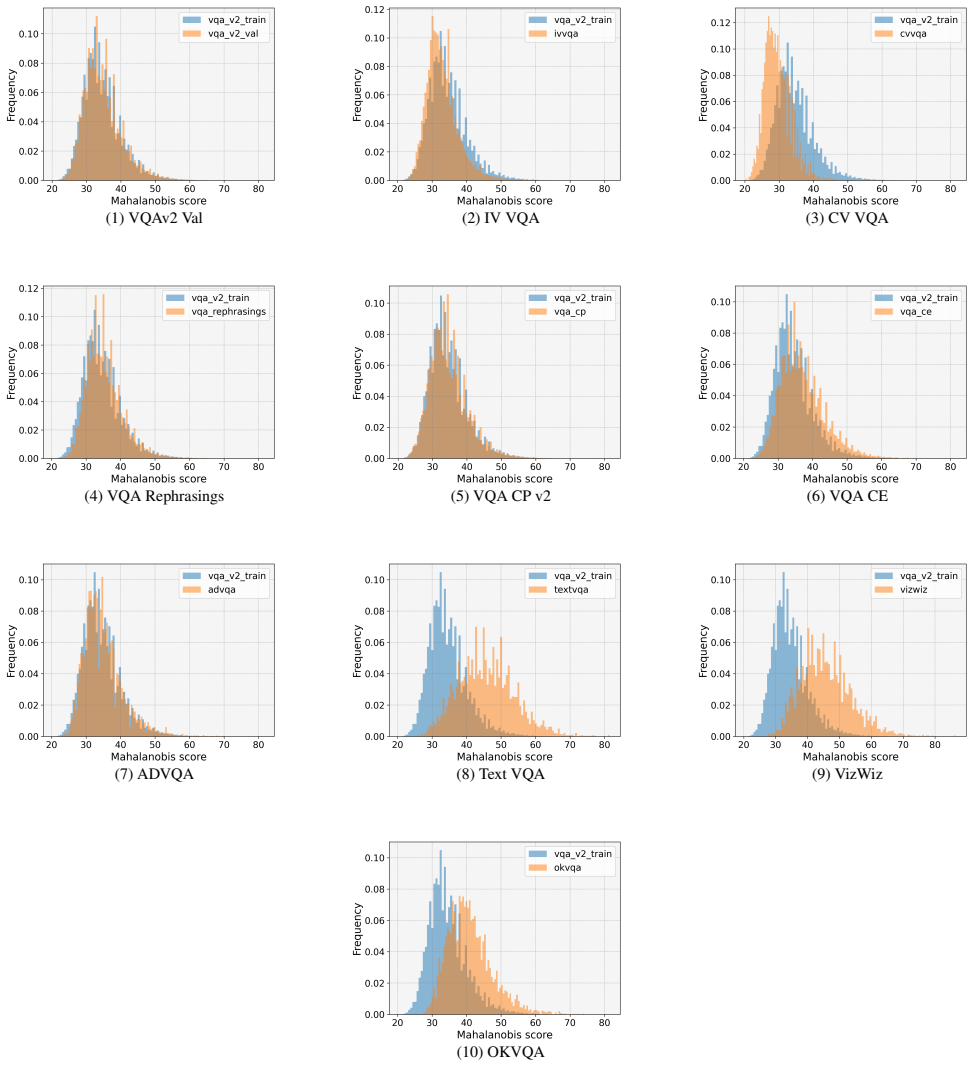
Three components carry the argument. The first is the benchmark taxonomy: ten datasets sorted into one in-distribution set (VQAv2) and nine out-of-distribution sets, labeled near or far by qualitative shift type, with each set's shift quantified by the Mahalanobis distance of its samples from the VQAv2 training distribution in image, question, and joint embedding spaces. The second is Modality Importance (MI), defined for a token as the ratio of its attention to question tokens over its attention to image tokens, which tracks how fine-tuning redistributes cross-modal attention as shift grows. The third is the controlled comparison of fine-tuning methods, all LoRA-adapted on the same PaliGemma backbone, which turns the benchmark into a ranking of regularization strategies rather than architectures.
What would settle it
Re-run the Table 3 comparison with each method's regularization strength (FTP's gradient-annealing factor, SPD's weight decay, WiSE-FT's interpolation coefficient) selected on an out-of-distribution validation split instead of by VQAv2 in-distribution accuracy, and check whether SPD still leads on near and average OOD and FTP still leads on far OOD; a reversal would show the benchmark's headline rankings come from model selection rather than method robustness.
Extended reading notes
Core claim
On its own terms, the paper's discovery is that a multi-modal shift benchmark with measured distances produces a different and finer-grained picture of robust fine-tuning than unimodal image benchmarks. Fine-tuning PaliGemma-3B with LoRA on VQAv2, the paper reports no degradation in out-of-distribution accuracy relative to zero-shot for vanilla fine-tuning, which it explains by the fine-tuning objective matching the pre-training objective; WiSE-FT's interpolation of zero-shot and fine-tuned weights, by contrast, loses robustness across all shifts. The ranking divides by shift distance: SPD, which selects for strong regularization only the layers whose updates consistently reduce the loss, achieves the highest in-distribution, near-OOD, and average-OOD accuracy, while FTP, whose projection constraint is non-decreasing and underfits the in-distribution data, achieves the highest accuracy on all three far-OOD datasets (TextVQA, VizWiz, OK-VQA).
Load-bearing premise
The whole ranking assumes that picking each method's regularization hyperparameter by best in-distribution validation accuracy gives a fair and representative checkpoint for comparing out-of-distribution behavior; if the optimal hyperparameters for OOD robustness differ from those for in-distribution accuracy, the reported SPD and FTP leads could be artifacts of that selection rule.
Editorial extensions
If this is right
- Robustness results from image classification do not carry over to VQA: because fine-tuning for this task retains the pre-training objective, plain fine-tuning can improve out-of-distribution accuracy, so multi-modal robustness needs its own benchmarks.
- SPD is the method to choose when deployment includes in-distribution or near-shift data, since it reaches the highest in-distribution, near-OOD, and average-OOD accuracy in the main PaliGemma-LoRA experiments.
- For far-domain deployment, reading text in images, handling user-generated photos, or answering knowledge-requiring questions, FTP's stronger non-decreasing projection regularization gives the best accuracy even though it underfits the in-distribution data.
- WiSE-FT should not be expected to transfer from image classification to VQA: in this setting its weight interpolation reduces robustness across all shift types.
- Because fine-tuning amplifies the correlation between question shifts and joint shifts, and question-to-image attention rises on out-of-distribution samples, future robust fine-tuning for VQA should target language-side shifts and cross-modal attention, not only visual shifts.
Reading between the lines
- A testable consequence follows from the paper's model-selection protocol: re-choosing each method's hyperparameters on out-of-distribution validation accuracy rather than in-distribution accuracy could reorder SPD and FTP, which would pinpoint whether the ranking reflects method robustness or checkpoint choice.
- The attention-shift finding suggests a direct intervention: adding a regularization that penalizes the rise in question-to-image attention on high-shift samples during fine-tuning could reproduce the intra-modality dominance the paper associates with robustness.
- Since question shift dominates joint shift after fine-tuning, regularizing the language tower or question embeddings specifically may beat global layer-wise methods at equal in-distribution accuracy; this follows from the paper's correlation analysis but is not tested there.
- The near/far split is really a continuous distance axis, so a practical extension would be to weight training samples by their Mahalanobis shift score, directly optimizing the negative shift-performance correlation the paper reports.
Editorial analysis
A structured set of objections, weighed in public.
Referee Report
Summary. The paper introduces FRAMES-VQA, a benchmark for evaluating fine-tuning robustness in multimodal VQA. Ten existing VQA datasets are categorized into ID (VQAv2), six near-OOD, and three far-OOD sets, with shifts quantified by Mahalanobis distance on unimodal (image, question) and joint embeddings. On a PaliGemma-3B model fine-tuned with LoRA, the authors compare several fine-tuning strategies and report that SPD achieves the best ID, near-OOD, and overall-OOD performance, while FTP excels on far-OOD datasets; they also report that vanilla fine-tuning improves OOD performance over zero-shot in this setting. The paper further analyzes correlations between unimodal and multimodal shifts and modality-attention importance, concluding that robust methods show lower unimodal/multimodal correlation and higher intra-modality attention. The code is released.
Significance. If the ranking claims were stable, FRAMES-VQA would be a valuable resource: it is the first to systematically distinguish near and far OOD along multiple modalities in VQA, and it provides a concrete demonstration that fine-tuning robustness method rankings can depend on shift distance. The paper's strengths are the thoughtful dataset curation, the use of multiple embedding types for shift quantification, cross-checking with MMD, and the extensive supplementary experiments including GQA and a second backbone. However, the central conclusions currently rest on a single backbone/adaptation configuration with no error bars, and the paper's own supplementary tables show that the FTP-vs-SPD ranking flips under LLaVA-LoRA and nearly disappears under full fine-tuning. This makes the significance conditional on additional validation.
major comments (4)
- [§4.2, Tab. 3, Supp. Tab. 8] The headline ranking is not stable across the paper's own configurations. In Tab. 3 (PaliGemma-LoRA), FTP's far-OOD average is 41.95 vs SPD's 38.91, supporting 'FTP best far OOD.' But in Supp. Tab. 8(a) (LLaVA-7B-LoRA, 10% VQAv2), FTP's far-OOD average is 26.21 vs SPD's 29.98, so SPD is better; in Supp. Tab. 8(b) (PaliGemma full fine-tuning), FTP's far-OOD average is 32.55 vs SPD's 32.46, a near tie, and FTP's overall OOD average (53.74) exceeds SPD's (53.43), contradicting 'SPD best overall OOD.' The authors state these results are 'consistent,' but the sign and magnitude of the FTP-SPD far-OOD gap vary from +3.04 to -3.77 to +0.09 across the three tables. Since Tab. 3 reports a single configuration without variance or multiple seeds, the paper's central claim that FRAMES-VQA distinguishes robust fine-tuning methods by shift type and distance is not established beyond the specific PaliGemma-LoRA setup. Please either restrict the conclusions to that configuration or provide a stability analysis (e.g., rank correlations across backbones and seeds) and adjust the claims accordingly.
- [Supp. Sec. 8] The model-selection protocol is load-bearing but potentially unfair for OOD comparison. The supplement states: 'The regularization hyper-parameter is found through cross-validation, and the model with the best ID validation accuracy is taken.' If OOD performance had been the selection criterion, the optimal hyperparameters for methods like FTP (which trades ID for far-OOD performance) might differ, and the Tab. 3 rankings could change. Because the benchmark's purpose is to evaluate OOD robustness, please justify this ID-only selection choice, report sensitivity of the rankings to the selection criterion, or provide results for a small grid of regularization strengths.
- [§4.2, Tab. 3] No variance estimates are reported for any metric. All differences between methods (e.g., FTP 41.95 vs SPD 38.91 on far OOD, or SPD 87.39 vs Vanilla 86.29 on ID) are single runs. Without multiple seeds or confidence intervals, the 'best' designations may reflect training noise rather than true differences. Please report standard deviations over at least three seeds for the main configuration, or, if that is computationally infeasible, state the limitation and provide an effect-size argument that the observed gaps exceed expected noise.
- [§5.2, §6.1, Tab. 5] The shift-correlation and modality-importance analyses, which are presented as key contributions, lack statistical support. Claims such as 'more robust fine-tuning methods exhibit low correlation between uni-modal and multimodal shifts' (Sec. 5.2) and 'question-to-image attention rises for OOD samples' (Sec. 6.3) are based on Pearson correlations over only 9 datasets and on a Mahalanobis threshold of 60 chosen as the 'relative median' without sensitivity analysis. With n=9, the correlations are noisy, and the threshold choice could affect the ID/OOD split in Tab. 5. Please add confidence intervals or permutation tests for the correlations, and show that the qualitative conclusions are robust to reasonable threshold choices.
minor comments (5)
- [§4.2] The text 'FTP [46] underfits the ID dataset' cites reference [46], which is TPGM; FTP is reference [47]. Please correct the citation.
- [§4.1, Eq. (2)] Equation (2) is typeset in a garbled way; the bi-level optimization should be written with explicit inner and outer objective functions and clear constraints. The same issue affects Eq. (4) and surrounding text.
- [Supp. Tab. 8] The column headers 'VQAv2 valNear OOD Avg.Far OOD Avg.OOD Avg.' are missing spaces, making the table hard to read. Also, note explicitly in the main text that Tab. 8 uses only 10% of VQAv2, unlike Tab. 3, so readers can compare directly.
- [§3.1] The text says 'We choose this as our ID datasets'; please fix the grammar to 'ID dataset.' Additionally, consider clarifying that the far-OOD datasets (TextVQA, VizWiz, OK-VQA) are not derived from VQAv2, unlike the near-OOD datasets.
- [§1 and §4.2] The paper evaluates FTP [47] and SPD [48], both of which are from the same research group as the authors, without an explicit disclosure in the main text. Please add a statement of competing interests or a note that these methods are the authors' own work, for transparency.
Circularity Check
No circularity found: the benchmark's headline results are direct empirical evaluations on public datasets, and the self-citations are method attribution rather than load-bearing assumptions.
full rationale
FRAMES-VQA is an empirical benchmark paper. Its derivation chain is: assemble public VQA datasets, categorize them by shift type, fine-tune PaliGemma/LLaVA with published robust-fine-tuning baselines, measure accuracy on held-out test splits, compute Mahalanobis distances from model embeddings, and correlate these quantities with performance. None of these steps fits a parameter to the target result and then relabels that fit as a prediction. The headline rankings (SPD best on ID/near/overall OOD and FTP best on far OOD in the main PaliGemma-LoRA table) are direct measurements on public benchmarks, not outputs of a fitted model. Self-citations to [25], [47], and [48] attribute the preliminary version of the benchmark and the compared methods; they do not provide a uniqueness theorem or an assumption that entails the ranking. The supplementary's ID-validation-based hyperparameter selection, and the differing FTP/SPD ordering under LLaVA-LoRA and full fine-tuning, are legitimate stability and model-selection concerns, but they are correctness risks rather than circularity: no claim reduces by construction to its inputs. The paper is therefore self-contained against external benchmarks and receives a circularity score of 0.
Assumptions & free parameters
free parameters (5)
- ID/OOD Mahalanobis threshold =
60
- WiSE-FT interpolation alpha =
0.5
- FTP gradient annealing factor kappa =
0
- SPD weight decay =
0.5
- LoRA rank and target modules =
r=8, Wq/Wk/Wv/Wo
assumptions (5)
- domain assumption Mean-pooled final-layer token embeddings faithfully represent image, question, and joint distributions.
- domain assumption The VQAv2-train empirical covariance matrix can be inverted to compute Mahalanobis distances in high-dimensional feature spaces.
- domain assumption Selecting checkpoints by best ID validation accuracy is a fair model-selection rule for comparing OOD robustness.
- domain assumption Attention-weight ratios measure modality importance and shortcut behavior.
- domain assumption PaliGemma-3B with LoRA is representative enough for the benchmark's method rankings.
Cite this review
Pith. "Pith review of FRAMES-VQA: Benchmarking Fine-Tuning Robustness across Multi-Modal Shifts in Visual Question Answering." pith.science (2026). https://pith.science/paper/PMULYQ76
@misc{pith2026250521755,
  author       = {Pith},
  title        = {Pith review of: FRAMES-VQA: Benchmarking Fine-Tuning Robustness across Multi-Modal Shifts in Visual Question Answering},
  year         = {2026},
  howpublished = {\url{https://pith.science/paper/PMULYQ76}},
  note         = {Machine review of arXiv:2505.21755}
}
read the original abstract
Visual question answering (VQA) systems face significant challenges when adapting to real-world data shifts, especially in multi-modal contexts. While robust fine-tuning strategies are essential for maintaining performance across in-distribution (ID) and out-of-distribution (OOD) scenarios, current evaluation settings are primarily unimodal or particular to some types of OOD, offering limited insight into the complexities of multi-modal contexts. In this work, we propose a new benchmark FRAMES-VQA (Fine-Tuning Robustness across Multi-Modal Shifts in VQA) for evaluating robust fine-tuning for VQA tasks. We utilize ten existing VQA benchmarks, including VQAv2, IV-VQA, VQA-CP, OK-VQA and others, and categorize them into ID, near and far OOD datasets covering uni-modal, multi-modal and adversarial distribution shifts. We first conduct a comprehensive comparison of existing robust fine-tuning methods. We then quantify the distribution shifts by calculating the Mahalanobis distance using uni-modal and multi-modal embeddings extracted from various models. Further, we perform an extensive analysis to explore the interactions between uni- and multi-modal shifts as well as modality importance for ID and OOD samples. These analyses offer valuable guidance on developing more robust fine-tuning methods to handle multi-modal distribution shifts. The code is available at https://github.com/chengyuehuang511/FRAMES-VQA .
Figures


Figures from the paper (11 more)




Reference graph
Works this paper leans on
-
[1]
Vedika Agarwal, Rakshith Shetty, and Mario Fritz. To- wards Causal VQA: Revealing and Reducing Spurious Cor- relations by Invariant and Covariant Semantic Editing. In 2020 IEEE/CVF Conference on Computer Vision and Pat- tern Recognition (CVPR), pages 9687–9695, Seattle, W A, USA, 2020. IEEE. 1, 2, 3
work page 2020
-
[2]
Don’t Just Assume; Look and Answer: Overcoming Priors for Visual Question Answering, 2018
Aishwarya Agrawal, Dhruv Batra, Devi Parikh, and Anirud- dha Kembhavi. Don’t Just Assume; Look and Answer: Overcoming Priors for Visual Question Answering, 2018. arXiv:1712.00377 [cs]. 1, 2, 3
arXiv 2018
-
[3]
Aishwarya Agrawal, Ivana Kaji ´c, Emanuele Bugliarello, El- naz Davoodi, Anita Gergely, Phil Blunsom, and Aida Ne- matzadeh. Reassessing Evaluation Practices in Visual Ques- tion Answering: A Case Study on Out-of-Distribution Gen- eralization, 2023. arXiv:2205.12191 [cs]. 2
arXiv 2023
-
[4]
PaliGemma: A versatile 3B VLM for transfer, 2024
Lucas Beyer, Andreas Steiner, Andr ´e Susano Pinto, Alexan- der Kolesnikov, Xiao Wang, Daniel Salz, Maxim Neumann, Ibrahim Alabdulmohsin, Michael Tschannen, Emanuele Bugliarello, Thomas Unterthiner, Daniel Keysers, Skanda Koppula, Fangyu Liu, Adam Grycner, Alexey Gritsenko, Neil Houlsby, Manoj Kumar, Keran Rong, Julian Eisensch- los, Rishabh Kabra, Matthi...
arXiv 2024
-
[5]
Dan Biderman, Jacob Portes, Jose Javier Gonzalez Ortiz, Mansheej Paul, Philip Greengard, Connor Jennings, Daniel King, Sam Havens, Vitaliy Chiley, Jonathan Frankle, Cody Blakeney, and John P. Cunningham. Lora learns less and forgets less, 2024. 5
work page 2024
-
[6]
VizWiz: nearly real-time answers to visual questions
Jeffrey P Bigham, Chandrika Jayant, Hanjie Ji, Greg Lit- tle, Andrew Miller, Robert C Miller, Robin Miller, Aubrey Tatarowicz, Brandyn White, Samual White, and Tom Yeh. VizWiz: nearly real-time answers to visual questions. 3
-
[7]
Behind the scene: Revealing the secrets of pre-trained vision-and-language models, 2020
Jize Cao, Zhe Gan, Yu Cheng, Licheng Yu, Yen-Chun Chen, and Jingjing Liu. Behind the scene: Revealing the secrets of pre-trained vision-and-language models, 2020. 7
work page 2020
-
[8]
Benchmarking robustness of adaptation methods on pre-trained vision-language models, 2023
Shuo Chen, Jindong Gu, Zhen Han, Yunpu Ma, Philip Torr, and V olker Tresp. Benchmarking robustness of adaptation methods on pre-trained vision-language models, 2023. 2
work page 2023
Show all 69 references
-
[9]
Beyond Question-Based Biases: Assessing Multimodal Shortcut Learning in Visual Question Answer- ing, 2021
Corentin Dancette, Remi Cadene, Damien Teney, and Matthieu Cord. Beyond Question-Based Biases: Assessing Multimodal Shortcut Learning in Visual Question Answer- ing, 2021. arXiv:2104.03149 [cs]. 1, 2, 3
2021 arXiv
-
[10]
Imagenet: A large-scale hierarchical image database
Jia Deng, Wei Dong, Richard Socher, Li-Jia Li, Kai Li, and Li Fei-Fei. Imagenet: A large-scale hierarchical image database. In2009 IEEE conference on computer vision and pattern recognition, pages 248–255. Ieee, 2009. 1, 2
2009
-
[11]
Bert: Pre-training of deep bidirectional trans- formers for language understanding, 2019
Jacob Devlin, Ming-Wei Chang, Kenton Lee, and Kristina Toutanova. Bert: Pre-training of deep bidirectional trans- formers for language understanding, 2019. 4
2019
-
[12]
Xin Dong, Junfeng Guo, Ang Li, Wei-Te Ting, Cong Liu, and H. T. Kung. Neural mean discrepancy for efficient out- of-distribution detection, 2022. 2
2022
-
[13]
An image is worth 16x16 words: Transformers for image recognition at scale, 2021
Alexey Dosovitskiy, Lucas Beyer, Alexander Kolesnikov, Dirk Weissenborn, Xiaohua Zhai, Thomas Unterthiner, Mostafa Dehghani, Matthias Minderer, Georg Heigold, Syl- vain Gelly, Jakob Uszkoreit, and Neil Houlsby. An image is worth 16x16 words: Transformers for image recognition ...
2021
-
[14]
Ex- ploring the limits of out-of-distribution detection, 2021
Stanislav Fort, Jie Ren, and Balaji Lakshminarayanan. Ex- ploring the limits of out-of-distribution detection, 2021. 2
2021
-
[15]
VQA-LOL: Visual Question Answering under the Lens of Logic, 2020
Tejas Gokhale, Pratyay Banerjee, Chitta Baral, and Yezhou Yang. VQA-LOL: Visual Question Answering under the Lens of Logic, 2020. arXiv:2002.08325 [cs]. 1, 2
2020 arXiv
-
[16]
paligemma-3b-pt-224.https : / / huggingface
Google. paligemma-3b-pt-224.https : / / huggingface . co / google / paligemma - 3b - pt-224, 2024. 4, 6, 8, 1
2024
-
[17]
Hospedales, and Massimiliano Pontil
Henry Gouk, Timothy M. Hospedales, and Massimiliano Pontil. Distance-Based Regularisation of Deep Networks for Fine-Tuning, 2021. arXiv:2002.08253 [cs, stat]. 2
2021 arXiv
-
[18]
Finetune like you pretrain: Im- proved finetuning of zero-shot vision models
Sachin Goyal, Ananya Kumar, Sankalp Garg, Zico Kolter, and Aditi Raghunathan. Finetune like you pretrain: Im- proved finetuning of zero-shot vision models. InProceed- ings of the IEEE/CVF Conference on Computer Vision and Pattern Recognition, pages 19338–19347, 2023. 5
2023
-
[19]
Making the V in VQA Matter: Ele- vating the Role of Image Understanding in Visual Question Answering, 2017
Yash Goyal, Tejas Khot, Douglas Summers-Stay, Dhruv Ba- tra, and Devi Parikh. Making the V in VQA Matter: Ele- vating the Role of Image Understanding in Visual Question Answering, 2017. arXiv:1612.00837 [cs]. 2, 3
2017 arXiv
-
[20]
Rasch, Bern- hard Scholkopf, and Alexander J
Arthur Gretton, Karsten Borgwardt, Malte J. Rasch, Bern- hard Scholkopf, and Alexander J. Smola. A kernel method for the two-sample problem, 2008. 3, 2
2008
-
[21]
The many faces of robust- ness: A critical analysis of out-of-distribution generalization
Dan Hendrycks, Steven Basart, Norman Mu, Saurav Kada- vath, Frank Wang, Evan Dorundo, Rahul Desai, Tyler Zhu, Samyak Parajuli, Mike Guo, et al. The many faces of robust- ness: A critical analysis of out-of-distribution generalization. InProceedings of the IEEE/CVF Internationa...
2021
-
[22]
Natural adversarial examples
Dan Hendrycks, Kevin Zhao, Steven Basart, Jacob Stein- hardt, and Dawn Song. Natural adversarial examples. In Proceedings of the IEEE/CVF Conference on Computer Vi- sion and Pattern Recognition, pages 15262–15271, 2021. 1, 2
2021
-
[23]
Hu, Yelong Shen, Phillip Wallis, Zeyuan Allen- Zhu, Yuanzhi Li, Shean Wang, Lu Wang, and Weizhu Chen
Edward J. Hu, Yelong Shen, Phillip Wallis, Zeyuan Allen- Zhu, Yuanzhi Li, Shean Wang, Lu Wang, and Weizhu Chen. LoRA: Low-Rank Adaptation of Large Language Models,
-
[24]
Llm-adapters: An adapter family for parameter- efficient fine-tuning of large language models, 2023
Zhiqiang Hu, Lei Wang, Yihuai Lan, Wanyu Xu, Ee-Peng Lim, Lidong Bing, Xing Xu, Soujanya Poria, and Roy Ka- Wei Lee. Llm-adapters: An adapter family for parameter- efficient fine-tuning of large language models, 2023. 5
2023
-
[25]
Directional gradient pro- jection for robust fine-tuning of foundation models, 2025
Chengyue Huang, Junjiao Tian, Brisa Maneechotesuwan, Shivang Chopra, and Zsolt Kira. Directional gradient pro- jection for robust fine-tuning of foundation models, 2025. 1
2025
-
[26]
Hudson and Christopher D
Drew A. Hudson and Christopher D. Manning. Gqa: A new dataset for real-world visual reasoning and compositional question answering, 2019. 2
2019
-
[27]
Roses are red, violets are blue
Corentin Kervadec, Grigory Antipov, Moez Baccouche, and Christian Wolf. Roses are red, violets are blue... but should vqa expect them to?, 2021. 2 9
2021
-
[28]
Fine-Tuning can Distort Pre- trained Features and Underperform Out-of-Distribution,
Ananya Kumar, Aditi Raghunathan, Robbie Jones, Tengyu Ma, and Percy Liang. Fine-Tuning can Distort Pre- trained Features and Underperform Out-of-Distribution,
-
[29]
Dongxu Li, Junnan Li, Hung Le, Guangsen Wang, Sil- vio Savarese, and Steven C. H. Hoi. Lavis: A library for language-vision intelligence, 2022. 1
2022
-
[30]
A Closer Look at the Robustness of Vision-and-Language Pre-trained Models,
Linjie Li, Zhe Gan, and Jingjing Liu. A Closer Look at the Robustness of Vision-and-Language Pre-trained Models,
-
[31]
Adversarial VQA: A New Benchmark for Evaluating the Robustness of VQA Models, 2021
Linjie Li, Jie Lei, Zhe Gan, and Jingjing Liu. Adversarial VQA: A New Benchmark for Evaluating the Robustness of VQA Models, 2021. arXiv:2106.00245 [cs]. 1, 2
2021 arXiv
-
[32]
Ex- plicit Inductive Bias for Transfer Learning with Convolu- tional Networks, 2018
Xuhong Li, Yves Grandvalet, and Franck Davoine. Ex- plicit Inductive Bias for Transfer Learning with Convolu- tional Networks, 2018. arXiv:1802.01483 [cs]. 2, 4
2018 arXiv
-
[33]
arXiv:2012.08673 [cs]. 2
2012 arXiv
-
[34]
Robust Visual Ques- tion Answering: Datasets, Methods, and Future Challenges,
Jie Ma, Pinghui Wang, Dechen Kong, Zewei Wang, Jun Liu, Hongbin Pei, and Junzhou Zhao. Robust Visual Ques- tion Answering: Datasets, Methods, and Future Challenges,
-
[35]
Ok-vqa: A visual question answering benchmark requiring external knowledge, 2019
Kenneth Marino, Mohammad Rastegari, Ali Farhadi, and Roozbeh Mottaghi. Ok-vqa: A visual question answering benchmark requiring external knowledge, 2019. 3
2019
-
[36]
Visual instruction tuning, 2023
Haotian Liu, Chunyuan Li, Qingyang Wu, and Yong Jae Lee. Visual instruction tuning, 2023. 5, 1
2023
-
[37]
Maximum mean discrep- ancy for generalization in the presence of distribution and missingness shift, 2022
Liwen Ouyang and Aaron Key. Maximum mean discrep- ancy for generalization in the presence of distribution and missingness shift, 2022. 2
2022
-
[38]
Moment matching for multi-source domain adaptation
Xingchao Peng, Qinxun Bai, Xide Xia, Zijun Huang, Kate Saenko, and Bo Wang. Moment matching for multi-source domain adaptation. InProceedings of the IEEE/CVF inter- national conference on computer vision, pages 1406–1415,
-
[39]
Learning Transferable Vi- sual Models From Natural Language Supervision, 2021
Alec Radford, Jong Wook Kim, Chris Hallacy, Aditya Ramesh, Gabriel Goh, Sandhini Agarwal, Girish Sastry, Amanda Askell, Pamela Mishkin, Jack Clark, Gretchen Krueger, and Ilya Sutskever. Learning Transferable Vi- sual Models From Natural Language Supervision, 2021. arXiv:2103.0...
2021 arXiv
-
[40]
Generalized out-of-distribution detection and be- yond in vision language model era: A survey, 2024
Atsuyuki Miyai, Jingkang Yang, Jingyang Zhang, Yifei Ming, Yueqian Lin, Qing Yu, Go Irie, Shafiq Joty, Yixuan Li, Hai Li, Ziwei Liu, Toshihiko Yamasaki, and Kiyoharu Aizawa. Generalized out-of-distribution detection and be- yond in vision language model era: A survey, 2024. 2
2024
-
[41]
Cycle-Consistency for Robust Visual Question Answering,
Meet Shah, Xinlei Chen, Marcus Rohrbach, and Devi Parikh. Cycle-Consistency for Robust Visual Question Answering,
-
[42]
Human-Adversarial Visual Question Answer- ing, 2021
Sasha Sheng, Amanpreet Singh, Vedanuj Goswami, Jose Al- berto Lopez Magana, Wojciech Galuba, Devi Parikh, and Douwe Kiela. Human-Adversarial Visual Question Answer- ing, 2021. arXiv:2106.02280 [cs]. 1, 2, 3
2021 arXiv
-
[43]
Benchmarking out-of- distribution detection in visual question answering, 2024
Xiangxi Shi and Stefan Lee. Benchmarking out-of- distribution detection in visual question answering, 2024. 3
2024
-
[44]
Do imagenet classifiers generalize to im- agenet? InInternational Conference on Machine Learning, pages 5389–5400
Benjamin Recht, Rebecca Roelofs, Ludwig Schmidt, and Vaishaal Shankar. Do imagenet classifiers generalize to im- agenet? InInternational Conference on Machine Learning, pages 5389–5400. PMLR, 2019. 1, 2
2019
-
[45]
Towards VQA Models That Can Read, 2019
Amanpreet Singh, Vivek Natarajan, Meet Shah, Yu Jiang, Xinlei Chen, Dhruv Batra, Devi Parikh, and Marcus Rohrbach. Towards VQA Models That Can Read, 2019. arXiv:1904.08920 [cs]. 3
2019 arXiv
-
[46]
Trainable Projected Gradi- ent Method for Robust Fine-tuning, 2023
Junjiao Tian, Xiaoliang Dai, Chih-Yao Ma, Zecheng He, Yen-Cheng Liu, and Zsolt Kira. Trainable Projected Gradi- ent Method for Robust Fine-tuning, 2023. arXiv:2303.10720 [cs]. 2, 4, 5
2023 arXiv
-
[47]
Fast Trainable Projection for Robust Fine-Tuning,
Junjiao Tian, Yen-Cheng Liu, James Seale Smith, and Zsolt Kira. Fast Trainable Projection for Robust Fine-Tuning,
-
[48]
Rethinking weight decay for robust fine-tuning of foundation models,
Junjiao Tian, Chengyue Huang, and Zsolt Kira. Rethinking weight decay for robust fine-tuning of foundation models,
-
[49]
Language Prior Is Not the Only Short- cut: A Benchmark for Shortcut Learning in VQA, 2022
Qingyi Si, Fandong Meng, Mingyu Zheng, Zheng Lin, Yuanxin Liu, Peng Fu, Yanan Cao, Weiping Wang, and Jie Zhou. Language Prior Is Not the Only Short- cut: A Benchmark for Shortcut Learning in VQA, 2022. arXiv:2210.04692 [cs]. 1, 2
2022 arXiv
-
[50]
Learning robust global representations by penalizing local predictive power.Advances in Neural Information Pro- cessing Systems, 32, 2019
Haohan Wang, Songwei Ge, Zachary Lipton, and Eric P Xing. Learning robust global representations by penalizing local predictive power.Advances in Neural Information Pro- cessing Systems, 32, 2019. 1, 2
2019
-
[51]
Ledsam, Patricia MacWilliams, Pushmeet Kohli, Alan Karthikesalingam, Si- mon Kohl, Taylan Cemgil, S
Jim Winkens, Rudy Bunel, Abhijit Guha Roy, Robert Stanforth, Vivek Natarajan, Joseph R. Ledsam, Patricia MacWilliams, Pushmeet Kohli, Alan Karthikesalingam, Si- mon Kohl, Taylan Cemgil, S. M. Ali Eslami, and Olaf Ronneberger. Contrastive training for improved out-of- distribut...
2020
-
[52]
Robust fine-tuning of zero-shot models, 2022
Mitchell Wortsman, Gabriel Ilharco, Jong Wook Kim, Mike Li, Simon Kornblith, Rebecca Roelofs, Raphael Gontijo-Lopes, Hannaneh Hajishirzi, Ali Farhadi, Hongseok Namkoong, and Ludwig Schmidt. Robust fine-tuning of zero-shot models, 2022. arXiv:2109.01903 [cs]. 1, 2, 4, 5, 6
2022 arXiv
-
[53]
Domain-robust vqa with di- verse datasets and methods but no target labels, 2021
Mingda Zhang, Tristan Maidment, Ahmad Diab, Adriana Kovashka, and Rebecca Hwa. Domain-robust vqa with di- verse datasets and methods but no target labels, 2021. 2
2021
-
[54]
Minigpt-4: Enhancing vision-language understanding with advanced large language models, 2023
Deyao Zhu, Jun Chen, Xiaoqian Shen, Xiang Li, and Mo- hamed Elhoseiny. Minigpt-4: Enhancing vision-language understanding with advanced large language models, 2023. 5 10 FRAMES-VQA: Benchmarking Fine-Tuning Robustness across Multi-Modal Shifts in Visual Question Answering Supp...
2023
-
[55]
VQA- GEN: A Visual Question Answering Benchmark for Domain Generalization, 2023
Suraj Jyothi Unni, Raha Moraffah, and Huan Liu. VQA- GEN: A Visual Question Answering Benchmark for Domain Generalization, 2023. arXiv:2311.00807 [cs]. 1, 2
2023 arXiv
-
[61]
We use the LA VIS [29] public repository to fine-tune all methods
Training Details We use the model pretrained with224∗224input images and128token input/output text sequences and fine-tune with the precision of bfloat16. We use the LA VIS [29] public repository to fine-tune all methods. Standard hyper- parameters are used for all: learning r...
-
[62]
Histograms of Shift Scores We display the histograms for the Mahalanobis score dis- tribution between test datasets with the ID set. Fig. 10, 11 and 12 are visual, question and joint shifts from vanilla FT repectively. The histograms show that under Vanilla FT, visual shifts a...
-
[63]
7 shows the correlation between shift and performance for different embeddings under different fine-tuning meth- ods
Correlation between Shift & Performance Tab. 7 shows the correlation between shift and performance for different embeddings under different fine-tuning meth- ods. Overall, visual and joint shifts exhibit the strongest correlation with performance across all types of methods. T...
-
[64]
5 shows the heatmap of the correlation between uni- modal and multi-modal shifts per dataset
Correlation between Uni- & Multi-Modal Shifts per Dataset Fig. 5 shows the heatmap of the correlation between uni- modal and multi-modal shifts per dataset. Question-joint shift correlations are higher than image-joint shift corre- lations across all VQA datasets and fine-tuni...
-
[65]
13 and 14 show the variation of MIv and MIq w.r.t
Modality Importance of different Datasets and Fine-Tuning Methods Fig. 13 and 14 show the variation of MIv and MIq w.r.t. shift score under all datasets and fine-tuning methods. Over- all, intra-modality attention is more dominant than inter- modality attention. There is a str...
-
[66]
8, including LLaV A- 7B [33] with LoRA and PaliGemma-3B with full fine- tuning
Additional Results using Full Fine-Tuning and LLaV A We present additional results in Tab. 8, including LLaV A- 7B [33] with LoRA and PaliGemma-3B with full fine- tuning. These results are consistent with PaliGemma with 1 (1) Question-Joint shift correlation heatmap (2) Image-...
-
[67]
The only exception, GQA-OOD [27] (based on GQA [26]), has only answer shifts
Fine-Tuning Results on GQA We use VQAv2 as the ID dataset since most OOD VQA datasets, covering various shifts, are built on it. The only exception, GQA-OOD [27] (based on GQA [26]), has only answer shifts. To further validate our findings, we fine-tune PaliGemma-3B on GQA as ...
-
[68]
We further compare shifts using Maximum Mean Discrepancy (MMD) [12, 20, 37] with RBF kernel in Tab
Quantifying Shifts using Maximum Mean Discrepancy Mahalanobis distance is a dominant metric for measuring distribution shifts [36]. We further compare shifts using Maximum Mean Discrepancy (MMD) [12, 20, 37] with RBF kernel in Tab. 10. We observe similar trends as with Mahalan...
-
[69]
This also serves as a veri- fication of the reliability in quantifying shifts via feature- based representations
Qualitative Analysis: Inspect via Sampling In order to investigate the types of ID and OOD samples under different modalities, we perform sampling on the var- ious regions of the histogram to inspect how the model rep- resents ID/OOD embeddings. This also serves as a veri- fic...
-
[2019]
arXiv:1902.05660 [cs]. 1, 2, 3
1902 arXiv
- [2021]
- [2022]
- [2023]
-
[2024]
arXiv:2307.11471 [cs]. 2
Reviewed August 7, 2026 · model on record in the stance chip above.
Discussion (0). Sign in to comment.