REVIEW 3 major objections 5 minor 26 references
Contextual Experience Replay for Self-Improvement of Language Agents
T0 review · 3 major / 5 minor · reviewed 2026-08-07 · deepseek-v4-flash
Pith's one-line read Contextual Experience Replay claims that replaying distilled memories in the context window lets language agents improve on web tasks with no training, lifting WebArena success by 51.0% relative.
desk verdict Training-free experience replay lifts web-agent success rates, but the headline 51% gain leans on a small human-curated offline set that the paper itself shows is fragile. read the letter →
The pith
A machine-rendered reading of the paper's core claim, the machinery that carries it, and where it could break.
The reading
What carries the argument
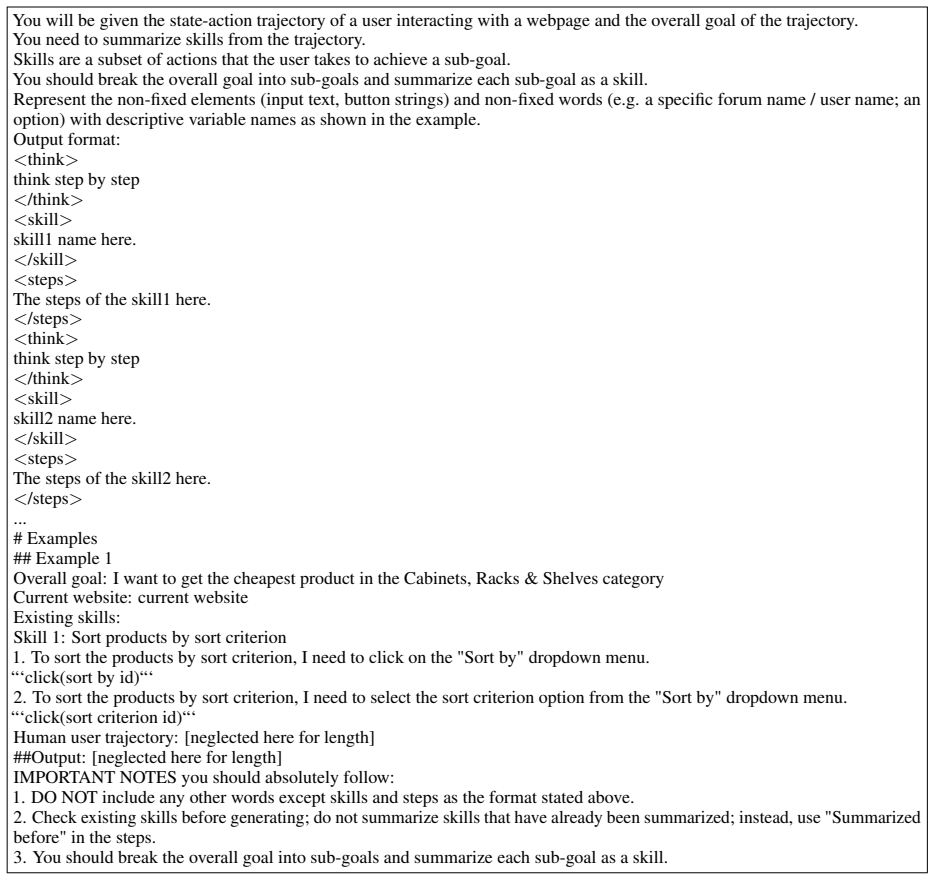
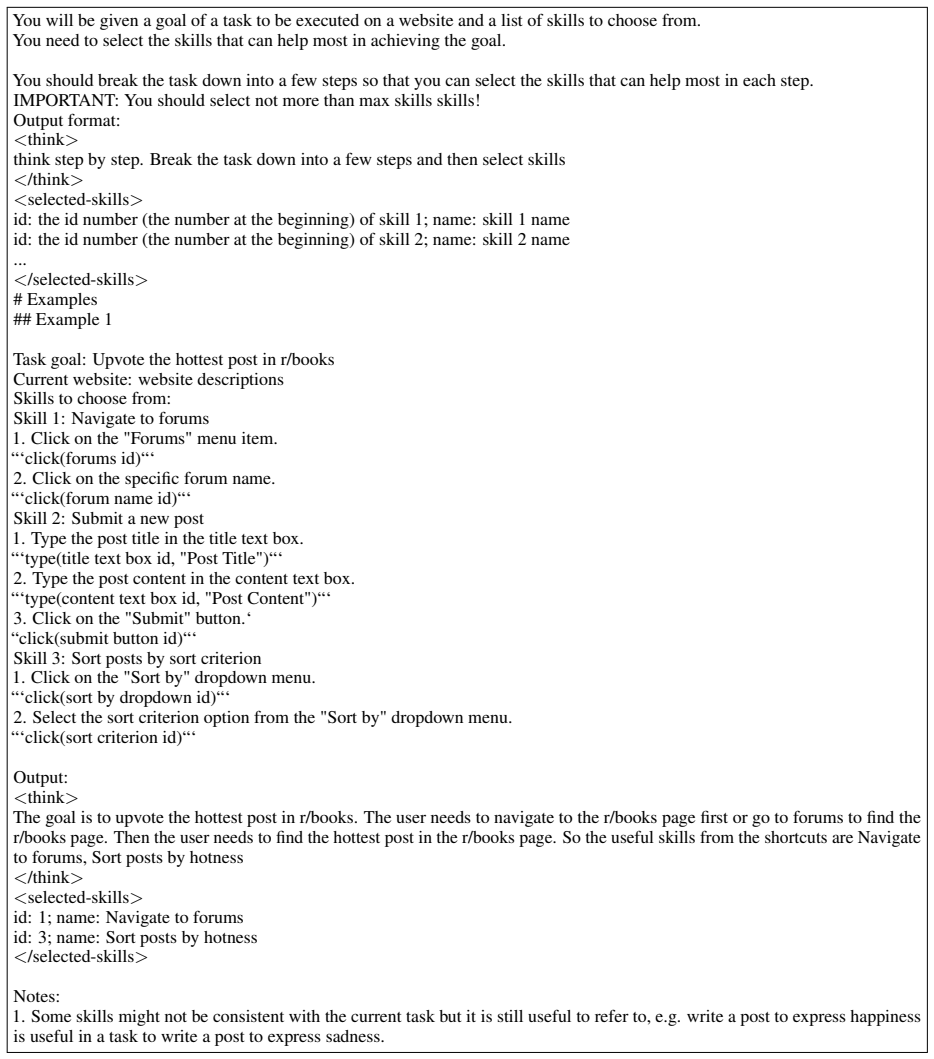
The load-bearing object is the dynamic experience buffer containing two structured entry types: dynamics (a page name, description, possible usages, and URL) and skills (a named sub-goal followed by parameterized steps with concrete action examples). Distillation, retrieval, and replay are all implemented by prompting a vision-language model, so the whole improvement loop is a context-engineering process rather than a training run. The retriever caps replay at $k_d=5$ dynamics and $k_s=5$ skills per task, and the experiences are mapped into natural-language text added to the agent's system prompt. This is what carries the argument: the buffer converts raw trajectories into reusable, generalizable knowledge, and retrieval keeps the context overhead small enough that the reported gains come at roughly 5.8–17.3% additional input tokens.
What would settle it
Run the hybrid setting on WebArena with the human-authored training tasks replaced by an equal number of goal-oriented tasks written for websites not in the test set; if the 51.0% relative gain over the GPT-4o baseline largely vanishes, then the transferability of distilled experiences—the premise behind the headline result—is false.
Extended reading notes
Core claim
The central claim is that an LLM agent can self-improve in a complex environment without any weight updates or reward labels by replaying distilled experience inside its context window. CER treats each past trajectory as a source of two kinds of knowledge: dynamics—summaries of important pages, their URLs, and what they are for—and skills—abstracted step-by-step workflows with variable placeholders such as 'sort posts by {criterion}'. A distillation module written as VLM prompts converts trajectories into these entries, a retrieval module selects the top-k dynamics and top-k skills for the current goal, and the agent solves the task with those entries prepended to its context. The authors show the framework works offline from a small human-annotated trajectory set, online from self-generated trajectories accumulated task by task, and best in a hybrid mode that combines both, with the hybrid configuration reaching 36.7% average success on WebArena and online CER reaching 31.9% on VisualWebArena.
Load-bearing premise
The load-bearing premise is that a small set (5–10 per website) of human-authored, goal-oriented training tasks, written on the same websites as the test tasks, yields distilled experiences whose distribution matches unseen test tasks.
Editorial extensions
If this is right
- Hybrid CER lifts the GPT-4o/BrowserGym baseline on WebArena from 24.3% to 36.7% average success, a 51.0% relative improvement, with about 17% extra input tokens.
- On VisualWebArena, online CER reaches 31.9% average success, outperforming the tree-search baseline (26.4%) at a much lower token cost.
- CER improves weaker open-source models too: on the GitLab split, Llama-3.1-70B rises from 17.3% to 22.0%, a 26.5% relative gain.
- The framework retains old competence while adding new competence: on the Forum split, stability is 93% and plasticity is 141% in cross-template success-rate terms.
- CER combines with trajectory sampling and reranking: CER with sampling reaches 52.6% on the Forum split versus 37.7% for CER alone, showing the memory mechanism is orthogonal to other agent methods.
Reading between the lines
- An implication the paper leaves implicit is that CER's gains should transfer across websites that share UI conventions, since distilled skills use placeholders like '{sort criterion}' rather than site-specific ids; a cheap test is to train on one site and evaluate on another.
- The sensitivity to trajectory quality in Section A.5 suggests a testable extension: automatically generating goal-oriented training tasks from website documentation could replace human annotations and preserve most of the offline gain, while pure random exploration likely cannot.
- Because retrieval is the only selection mechanism, buffer growth may eventually create a bottleneck; a natural next experiment is to measure CER's success as the number of accumulated tasks grows past the current benchmark sizes.
- The online-setting premise that early task order matters implies that curriculum ordering—solving easier or more informative tasks first—could be engineered rather than left to the benchmark's fixed order.
Editorial analysis
A structured set of objections, weighed in public.
Referee Report
Summary. The paper proposes Contextual Experience Replay (CER), a training-free framework that distills past trajectories into two types of experience, environment dynamics and decision-making skills, stores them in a dynamic memory buffer, and retrieves the most relevant experiences to augment the prompt of an LLM-based web agent. CER is evaluated on WebArena in offline, online, and hybrid settings, and on VisualWebArena in the online setting. The headline results are a 36.7% average success rate on WebArena in the hybrid setting, a 51.0% relative improvement over the authors' reproduced GPT-4o/BrowserGym baseline (24.3%), and a 31.9% success rate on VisualWebArena, outperforming the tree-search baseline (26.4%). The paper also reports ablations on cross-template generalization, stability/plasticity, the contribution of dynamics versus skills, robustness to failed trajectories, and synergy with a sampling-based method.
Significance. If the headline results hold, CER is a meaningful contribution to web-agent self-improvement: it is simple, training-free, and adds only modest token overhead while improving a strong GPT-4o baseline by roughly half on WebArena. The paper has several strengths: evaluation on external public benchmarks, a reproduced baseline, multiple ablations that support the proposed mechanism, a cross-template analysis that speaks to the memorization concern, and cost measurements. The main caveat is the reliance on a small set of human-authored offline training tasks on the same websites as the test tasks, whose sensitivity is quantified only on the Forum split. The paper honestly acknowledges this dependence in Section 7, but the full-benchmark impact is not measured.
major comments (3)
- [Section 4.1.1, Section A.5, Table 9] The headline 36.7% hybrid WebArena result depends on a small set of human-authored training tasks written on the same websites that appear in the test set. The paper's own A.5 experiment shows that on the Forum split, replacing human annotations with self-guided exploration drops the hybrid success rate from 41.2% to 35.1%, which is below the online-only value of 37.7%. Since the abstract's 51.0% relative improvement is defined against the 24.3% baseline, a similar drop on the full benchmark would materially reduce the claimed gain. The paper should either report the full-benchmark hybrid result with a non-human offline data source, or explicitly scope the headline claim to the human-annotated setup and provide evidence that the Forum split is representative of the full benchmark. This is load-bearing because the central claim is the 51.0% relative improvement.
- [Section 5.1, Table 3] There is an inconsistency in the reported improvement. The abstract and Section 4.2 state a 51.0% relative improvement for CER hybrid over the baseline, and the numbers in Table 1 indeed yield (36.7 - 24.3) / 24.3 = 51.0%. However, Table 3 reports '52.5%' in the ΔSR (%) column for CER hybrid, and the text in Section 5.1 describes this as a 'significant improvement by 52.5%'. This is neither the relative increase (51.0%) nor the absolute percentage-point increase (12.4 points). Please clarify which quantity is intended and use consistent definitions throughout the paper.
- [Section 5.4 and Table 5] The cross-reference error in Section 5.4 ('As shown in Fig. 5') points to a nonexistent figure; the result is reported in Table 5. More substantively, the Llama-3.1-70B experiment is conducted only on the Gitlab split, and the paper should state explicitly that this result is split-specific rather than full-benchmark evidence of generality across models.
minor comments (5)
- [Section 2 and Table 1 footnote] The paper cites BrowserGym as (Drouin et al., 2024), which is the WorkArena paper; please either cite the BrowserGym repository/toolkit directly or clarify the relationship between the two citations.
- [Section 4.2, VisualWebArena results] The claim that tree search uses 'at least 3 times fewer tokens' than CER is not supported by any token-cost measurements in the paper; please either report the relevant token counts or soften the claim to a qualitative statement.
- [Table 3] The column labels in Table 3 should be clarified so that ΔTokens (%) and ΔSR (%) are defined explicitly as relative changes with respect to the ReAct baseline; otherwise the table is ambiguous.
- [Throughout] The benchmark names are typeset inconsistently as WEBARENA and VISUALWEBARENA in some places and WebArena and VisualWebArena in others; please standardize the notation.
- [Section 5.3, Table 4] The definitions of stability and plasticity are based on cross-template success rates, which is reasonable, but the paper should state explicitly that these are proxy measures and not direct measurements of knowledge retention or acquisition.
Circularity Check
No circularity: CER's success rates are benchmark measurements; the offline task set is a separate human-authored input, not a fitted parameter, and self-citations are baselines or related work, not load-bearing premises.
full rationale
This is an empirical systems paper, not a derivation, so the circularity patterns (self-definition, fitted input called prediction, imported uniqueness theorem, ansatz smuggled via citation, renaming a known result) do not apply. The central claims are external benchmark success rates on WebArena and VisualWebArena. The offline component uses a small human-authored task set (Section 4.1.1, A.4) that is filtered to avoid overlap with the test set, and the cross-template analysis (Section 5.2, Table 4) is explicitly designed to rule out trajectory memorization. The sensitivity of the hybrid result to the offline data source is openly quantified in A.5/Table 9, where self-guided exploration drops Forum hybrid from 41.2 to 35.1; this is a robustness limitation that the authors acknowledge in Section 7, but it is not a circular reduction of the prediction to its inputs. Self-citations to ReAct, Reflexion, WebShop, and Tree of Thoughts are used as adopted output formats, baselines, or previously published benchmarks/related methods, not as an unverified premise that forces the result. No parameter is fitted to the test set and then renamed a prediction; no equation-level equivalence between input and output exists. The paper's contribution is a memory-and-retrieval system evaluated against public benchmarks with baselines reproduced by the authors, so the honest finding is no significant circularity.
Assumptions & free parameters
free parameters (5)
- retrieval top-k for dynamics (kd) =
5
- retrieval top-k for skills (ks) =
5
- number of human-authored offline training tasks per website =
5 to 10 (about 5% of the test set)
- max steps per task =
30
- sampling temperature =
0.1
assumptions (4)
- domain assumption GPT-4o-based distillation and retrieval modules produce faithful, non-misleading experiences when replayed into the same model family.
- domain assumption The distribution of human-authored offline training tasks overlaps the test-task distribution on WebArena; otherwise offline and hybrid gains vanish.
- domain assumption A single run at temperature 0.1 is representative of agent performance, and online task ordering does not materially change the outcome.
- domain assumption Cross-template success rate is a valid proxy separating genuine skill acquisition from task memorization.
Cite this review
Pith. "Pith review of Contextual Experience Replay for Self-Improvement of Language Agents." pith.science (2026). https://pith.science/paper/PPJ7WYVJ
@misc{pith2026250606698,
  author       = {Pith},
  title        = {Pith review of: Contextual Experience Replay for Self-Improvement of Language Agents},
  year         = {2026},
  howpublished = {\url{https://pith.science/paper/PPJ7WYVJ}},
  note         = {Machine review of arXiv:2506.06698}
}
read the original abstract
Large language model (LLM) agents have been applied to sequential decision-making tasks such as web navigation, but without any environment-specific experiences, they often fail in these complex tasks. Moreover, current LLM agents are not designed to continually learn from past experiences during inference time, which could be crucial for them to gain these environment-specific experiences. To address this, we propose Contextual Experience Replay (CER), a training-free framework to enable efficient self-improvement for language agents in their context window. Specifically, CER accumulates and synthesizes past experiences into a dynamic memory buffer. These experiences encompass environment dynamics and common decision-making patterns, allowing the agents to retrieve and augment themselves with relevant knowledge in new tasks, enhancing their adaptability in complex environments. We evaluate CER on the challenging WebArena and VisualWebArena benchmarks. On VisualWebArena, CER achieves a competitive performance of 31.9%. On WebArena, CER also gets a competitive average success rate of 36.7%, relatively improving the success rate of the GPT-4o agent baseline by 51.0%. We also conduct a comprehensive analysis on it to prove its efficiency, validity and understand it better.
Figures


Figures from the paper (6 more)



Reference graph
Works this paper leans on
-
[1]
DO NOT include any other words except url, think and page summary as the format stated above
-
[2]
Follow the example to think and summarize the page
-
[3]
You should only summarize once for each unique URL
-
[4]
Reflexion: language agents with verbal re- inforcement learning. InNeural Information Pro- cessing Systems. Mohit Shridhar, Xingdi Yuan, Marc-Alexandre Cote, Yonatan Bisk, Adam Trischler, and Matthew Hausknecht. 2021. {ALFW}orld: Aligning text and embodied environments for interactive learning. In International Conference on Learning Representa- tions. Pa...
arXiv 2021
-
[5]
Focus on the main content of the page and may ignore the modifications made by the user when generating the summary. Figure 3: System message for dynamics distillation module in CER 16 You will be given the state-action trajectory of a user interacting with a webpage and the overall goal of the trajectory. You need to summarize skills from the trajectory....
-
[8]
Check existing pages before generating, do not summarize pages that have already been summarized, instead, use "Summarized before" in the steps
-
[10]
To sort the products by sort criterion, I need to click on the "Sort by" dropdown menu. “‘click(sort by id)“‘
-
[11]
To sort the products by sort criterion, I need to select the sort criterion option from the "Sort by" dropdown menu. “‘click(sort criterion id)“‘ Human user trajectory: [neglected here for length] ##Output: [neglected here for length] IMPORTANT NOTES you should absolutely follow:
Show all 26 references
-
[12]
DO NOT include any other words except skills and steps as the format stated above
-
[13]
Summarized before
Check existing skills before generating; do not summarize skills that have already been summarized; instead, use "Summarized before" in the steps
-
[14]
You should break the overall goal into sub-goals and summarize each sub-goal as a skill. Figure 4: System message for skills distillation module in CER 17 You will be given a goal of a task to be executed on a website and a list of urls and the corresponding page summary to ch...
-
[15]
“‘click(forums id)“‘
Click on the "Forums" menu item. “‘click(forums id)“‘
-
[16]
“‘click(forum name id)“‘ Skill 2: Submit a new post
Click on the specific forum name. “‘click(forum name id)“‘ Skill 2: Submit a new post
-
[17]
‘type(title text box id,
Type the post title in the title text box. “‘type(title text box id, "Post Title")“‘
-
[18]
‘type(content text box id,
Type the post content in the content text box. “‘type(content text box id, "Post Content")“‘
-
[19]
Click on the "Submit" button.‘ “click(submit button id)“‘ Skill 3: Sort posts by sort criterion
-
[20]
“‘click(sort by dropdown id)“‘
Click on the "Sort by" dropdown menu. “‘click(sort by dropdown id)“‘
-
[21]
“‘click(sort criterion id)“‘ Output: <think> The goal is to upvote the hottest post in r/books
Select the sort criterion option from the "Sort by" dropdown menu. “‘click(sort criterion id)“‘ Output: <think> The goal is to upvote the hottest post in r/books. The user needs to navigate to the r/books page first or go to forums to find the r/books page. Then the user needs...
-
[22]
write a post to express happiness is useful in a task to write a post to express sadness
Some skills might not be consistent with the current task but it is still useful to refer to, e.g. write a post to express happiness is useful in a task to write a post to express sadness. Figure 6: System message for skills retrieval module in CER 19 # Environment dynamics (c...
-
[23]
“‘goto(’http://localhost:9999/user/username/edit biography’)“‘
Navigate to the Edit Biography page. “‘goto(’http://localhost:9999/user/username/edit biography’)“‘
-
[24]
“‘fill(biography text area id, ’new biography content’)“‘
Fill in the biography text area with the new biography content. “‘fill(biography text area id, ’new biography content’)“‘
-
[25]
Video Games
Click on the save button to update the biography. “‘click(save button id)“‘ ... Figure 7: Experience snippet example on WEBARENA # Environment dynamics (common pages to navigate to from previous experience): ## Dynamics 1: Video Games category page ### Video Games category pag...
-
[26]
{sort criterion}
Select the "{sort criterion}" option from the sort dropdown menu. “‘select_option({sort dropdown button id}, {sort criterion})“‘ ... Figure 8: Experience snippet example on VISUALWEBARENA # Instructions: Your objective is to discover diverse and interesting tasks (that a human...
-
[2021]
InInternational Conference on Learning Representations
Measuring massive multitask language under- standing. InInternational Conference on Learning Representations. Gary Klein. 1998.Sources of Power: How People Make Decisions. MIT Press. Jing Yu Koh, Robert Lo, Lawrence Jang, Vikram Duvvur, Ming Chong Lim, Po-Yu Huang, Graham Neub...
1998 arXiv
-
[2023]
Alexandre Drouin, Maxime Gasse, Massimo Caccia, Is- sam H
Mind2web: Towards a generalist agent for the web.Advances in neural information processing systems, Datasets and Benchmarks Track, 36. Alexandre Drouin, Maxime Gasse, Massimo Caccia, Is- sam H. Laradji, Manuel Del Verme, Tom Marty, Léo Boisvert, Megh Thakkar, Quentin Cappart, ...
-
[2024]
Stan Franklin and Art Graesser
Workarena: How capable are web agents at solving common knowledge work tasks?Interna- tional Conference on Machine Learning. Stan Franklin and Art Graesser. 1996. Is it an agent, or just a program? a taxonomy for autonomous agents. InInternational Workshop on Agent Theories, A...
1996 arXiv
Reviewed August 7, 2026 · model on record in the stance chip above.
Discussion (0). Sign in to comment.