A Constrained Natural-Language Interface for Variational Multi-Physics Finite Element Simulations in FEniCS
Pith reviewed 2026-06-27 11:15 UTC · model grok-4.3
The pith
Constraining LLMs to prompt parsing and geometry tasks while routing to human-written FEniCS templates yields 100 percent valid parses and benchmark agreement.
A machine-rendered reading of the paper's core claim, the machinery that carries it, and where it could break.
Core claim
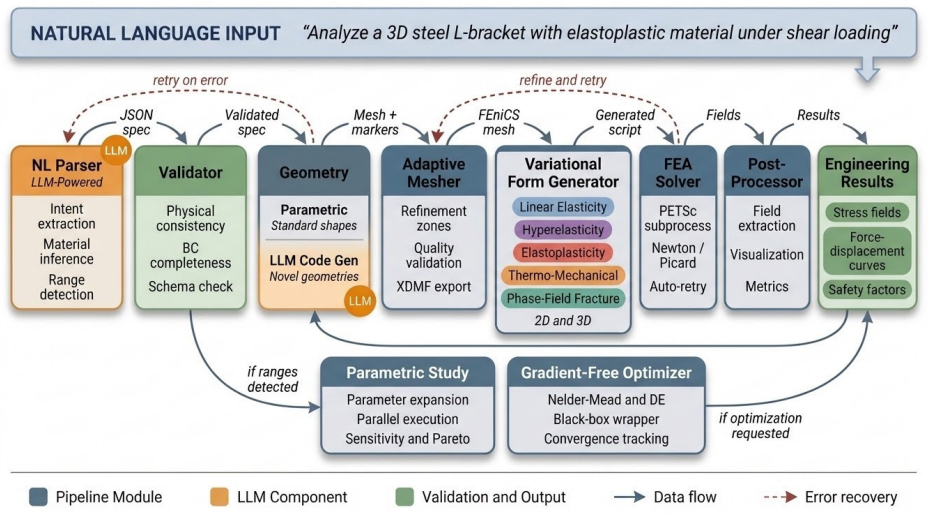
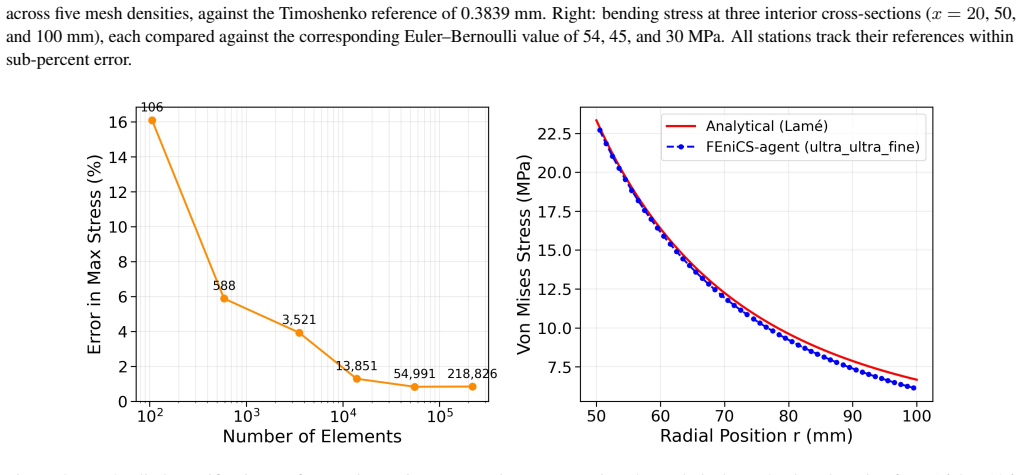
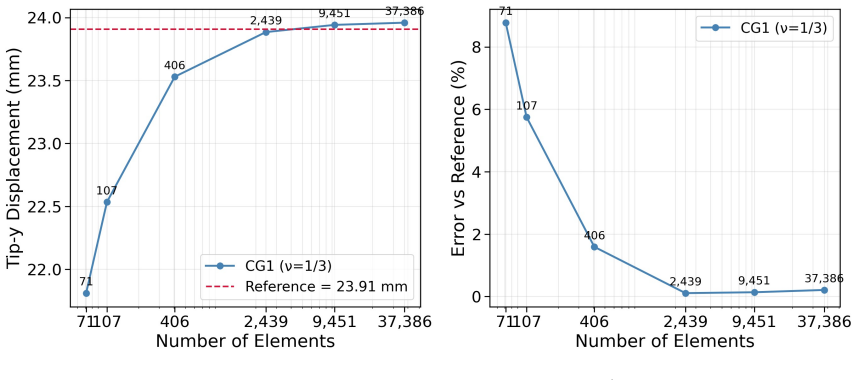
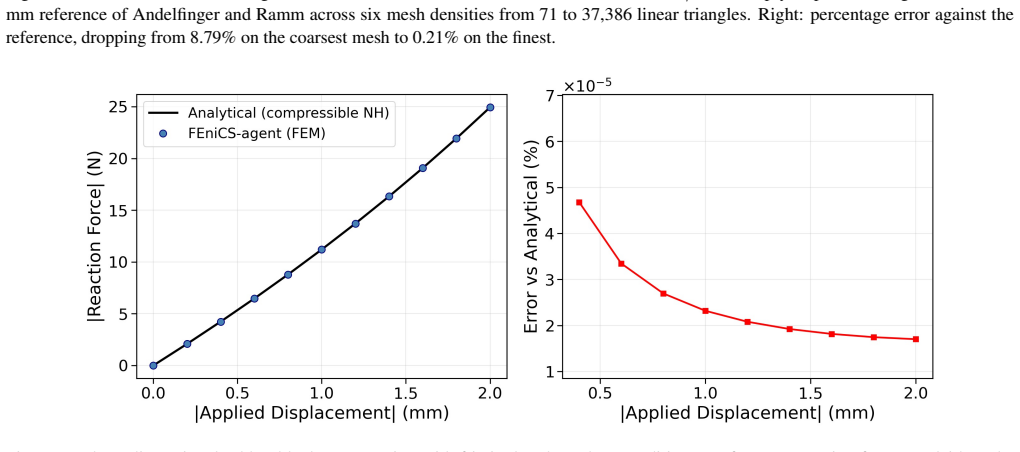
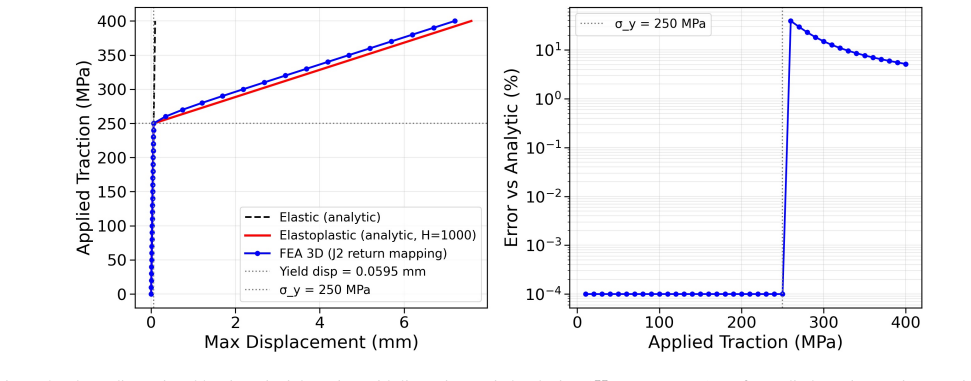
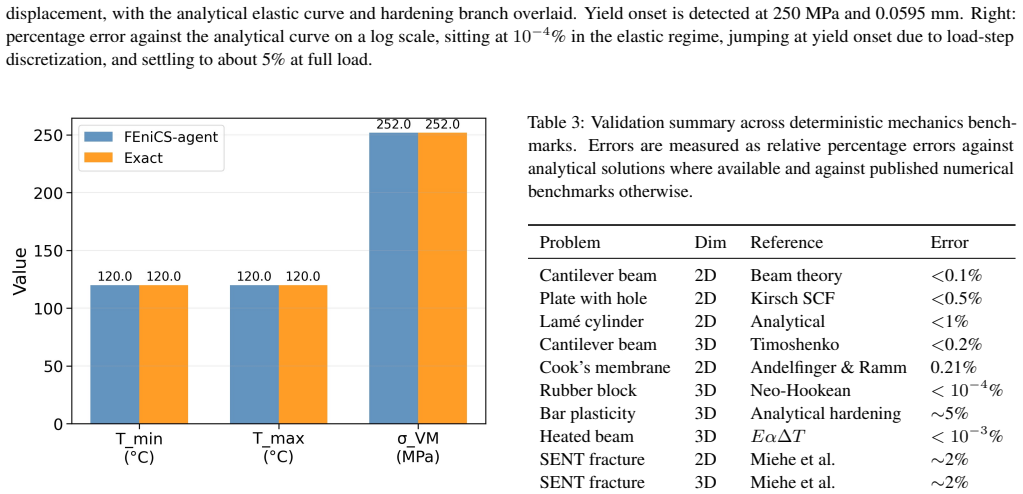
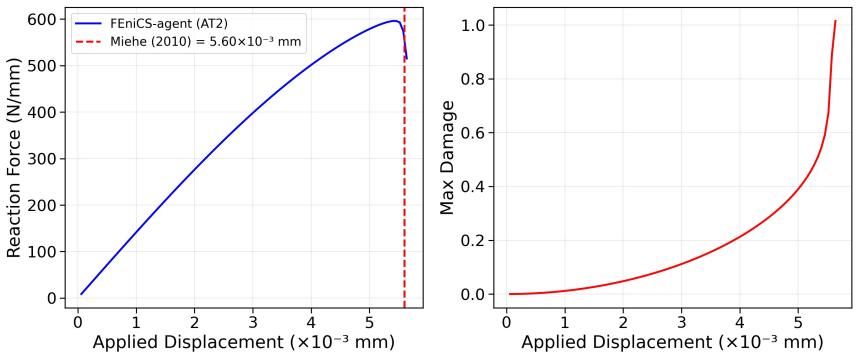
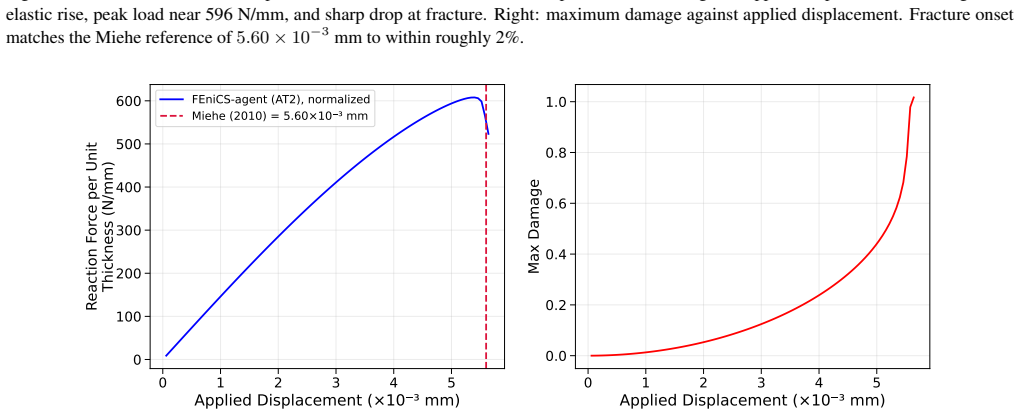
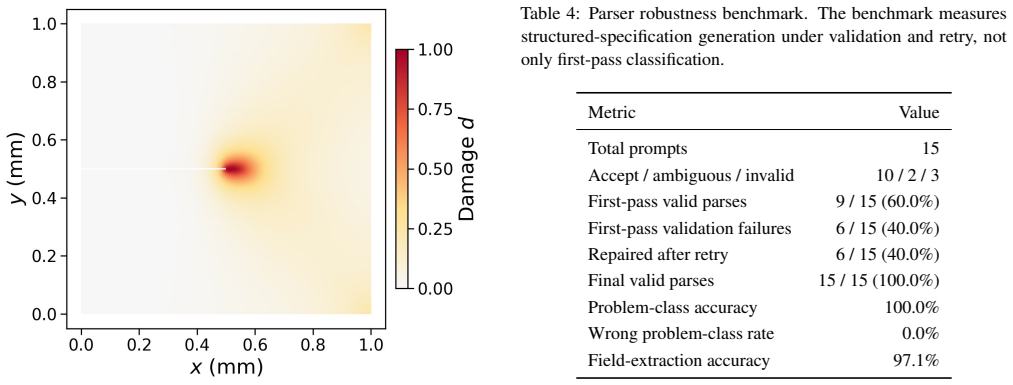
By limiting the LLM to parsing prompts into validated JSON and optional Gmsh generation, then dispatching via a deterministic layer to five human-written templates, the interface reaches 100.0 percent final valid parse rate, 100.0 percent problem-class accuracy, 97.1 percent field-extraction accuracy, and 90.0 percent final success on custom-geometry cases while producing solutions that agree with analytical and published benchmarks to within a few percent.
What carries the argument
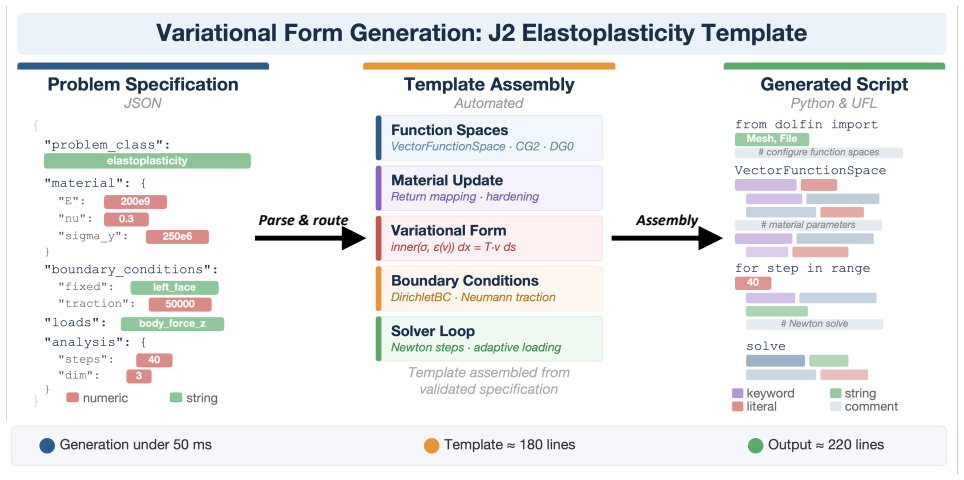
The deterministic dispatcher that maps validated JSON specifications to one of five human-written FEniCS/UFL templates for linear elasticity, hyperelasticity, elastoplasticity, thermo-mechanical coupling, and phase-field fracture.
Load-bearing premise
The five human-written FEniCS/UFL templates cover the physics cases users will request and contain no implementation errors that affect the reported benchmark agreement.
What would settle it
A prompt requesting physics outside the five templates, or a standard benchmark where the dispatched template produces results that deviate beyond the stated 2-5 percent range from the analytical or published solution.
Figures
read the original abstract
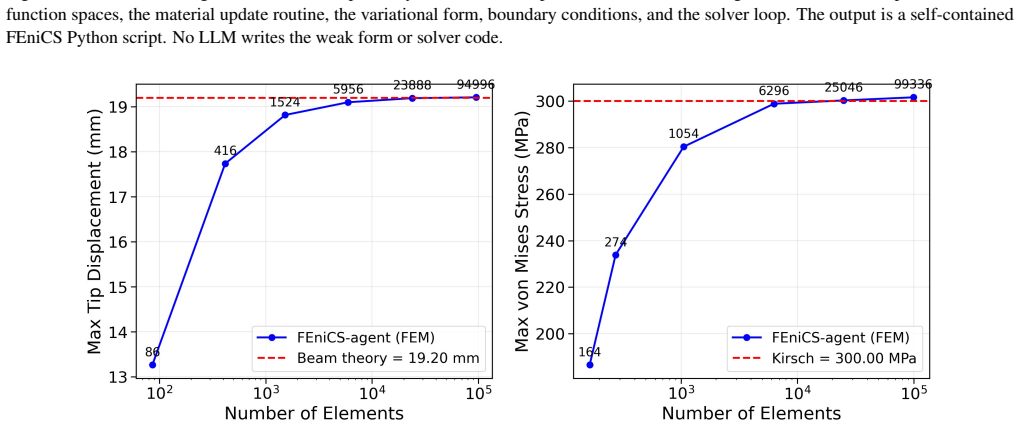
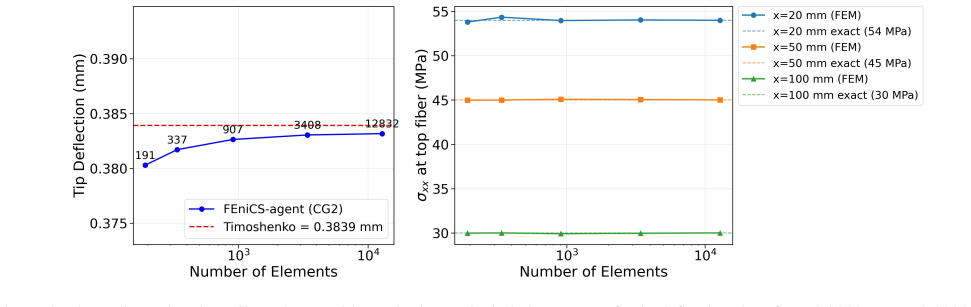
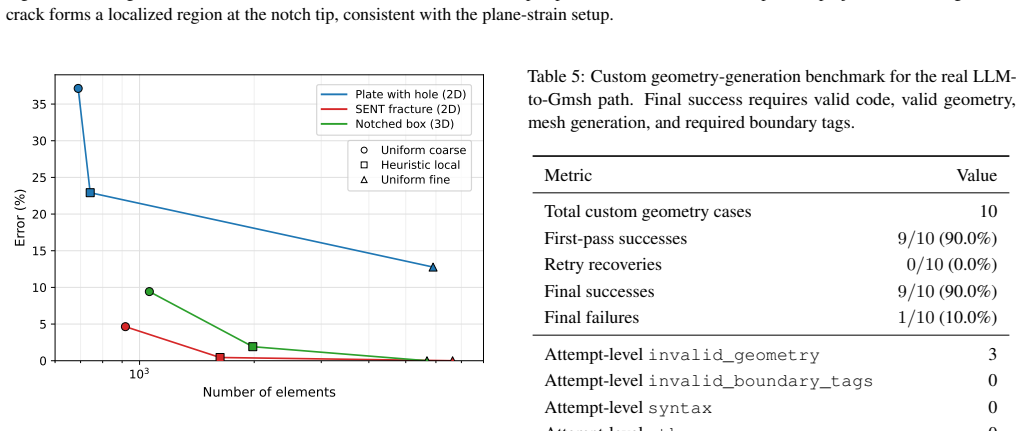
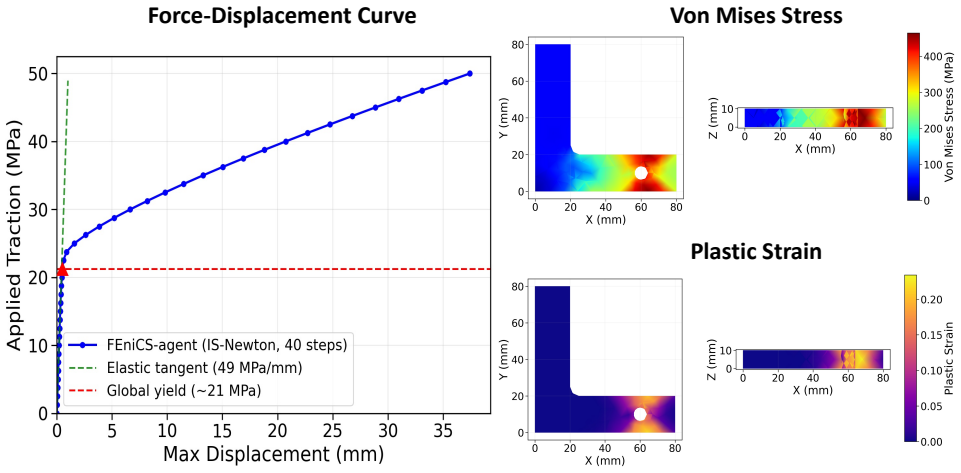
Large language models can reduce the manual effort required to set up finite element simulations, but they introduce reliability risks when generated solver code lies on the critical path. We present a constrained natural-language interface for multi-physics finite element analysis in which the LLM is limited to front-end tasks: parsing prompts into structured JSON, generating Gmsh code only for non-catalog geometries, and using retry feedback for those stages. It never writes FEniCS solver templates, derives weak forms, or writes the numerical solver core. A deterministic dispatcher maps the validated specification to five human-written FEniCS/UFL templates: linear elasticity, hyperelasticity, elastoplasticity, thermo-mechanical coupling, and phase-field fracture. We validate this deterministic template layer against analytical solutions and published 2D/3D benchmarks. Smooth cases reach sub-percent agreement on adequate meshes, while harder nonlinear cases reach the 2-5 percent range. We also evaluate the LLM-facing front end directly. In a 15-prompt parser benchmark, first-pass valid parses were obtained for 9 cases, and all remaining cases were repaired after retry, giving a final valid parse rate of 100.0 percent, 100.0 percent problem-class accuracy, and 97.1 percent field-extraction accuracy. In a 10-case custom-geometry benchmark routed through the real LLM-to-Gmsh path, first-pass and final success were both 90.0 percent, with one unrecovered invalid-geometry failure. These results show that the parser and constrained prompt/validation design are effective on these benchmarks. As an end-to-end demonstration, the system generates and analyzes a 3D elastoplastic L-bracket with a fillet and bolt hole from one natural-language prompt. The contribution is a measured architecture for natural-language-driven variational simulation, not open-ended autonomous code generation.
Editorial analysis
A structured set of objections, weighed in public.
Referee Report
Summary. The manuscript describes a constrained natural-language interface for multi-physics finite element simulations using FEniCS. The LLM is restricted to parsing natural language prompts into structured JSON and generating Gmsh code for non-catalog geometries, with retry mechanisms for validation. A deterministic dispatcher then maps the validated JSON to one of five human-written FEniCS/UFL templates covering linear elasticity, hyperelasticity, elastoplasticity, thermo-mechanical coupling, and phase-field fracture. The paper reports validation results against analytical solutions and published benchmarks, achieving sub-percent agreement on smooth cases and 2-5% on nonlinear ones, as well as 100% final valid parse rate, 100% problem-class accuracy, 97.1% field-extraction accuracy in a 15-prompt parser benchmark, and 90% success in a 10-case custom-geometry benchmark.
Significance. If the reported results hold, the work demonstrates a reliable architecture for integrating LLMs with variational FEM by limiting the LLM to non-critical front-end tasks and relying on verified templates for the solver core. This approach mitigates risks associated with LLM-generated code while achieving high success rates on the specified benchmarks. The contribution lies in the measured performance of the constrained parser and validation design rather than in advancing open-ended code generation.
minor comments (2)
- [Abstract and §4] The exact criteria for selecting the 15 prompts in the parser benchmark and the 10 custom-geometry cases are not specified; providing the prompt list or selection methodology would improve reproducibility.
- [§5] Details on mesh convergence studies for the benchmark validations are limited; clarifying how mesh adequacy was determined for the reported agreement levels would strengthen the validation claims.
Simulated Author's Rebuttal
We thank the referee for the positive summary, significance assessment, and recommendation of minor revision. No major comments were raised in the report.
Circularity Check
No significant circularity identified
full rationale
The paper's central claims concern measured effectiveness of a constrained LLM-to-JSON parser and deterministic template dispatcher on explicit benchmarks (100% valid parse rate, 100% problem-class accuracy, 97.1% field-extraction accuracy, 90% custom-geometry success, sub-5% agreement on validations). These rest on direct comparison of outputs to analytical solutions and published 2D/3D benchmarks, not on any equations, fitted parameters, or self-citations that reduce the reported quantities to the inputs by construction. The five human-written FEniCS/UFL templates are treated as fixed external artifacts whose coverage is scoped to the tested cases; no uniqueness theorem, ansatz smuggling, or renaming of known results is invoked as load-bearing for the benchmark numbers themselves.
Axiom & Free-Parameter Ledger
axioms (2)
- standard math Standard finite-element weak-form derivations and numerical solvers in FEniCS/UFL are assumed correct when applied to the five physics classes.
- domain assumption The selected 2D/3D benchmarks and analytical solutions are representative of the target use cases.
Reference graph
Works this paper leans on
-
[1]
Thomas J. R. Hughes.The Finite Element Method: Lin- ear Static and Dynamic Finite Element Analysis. Dover Publications, Mineola, NY , 2012
2012
-
[2]
O. C. Zienkiewicz, R. L. Taylor, and J. Z. Zhu.The Finite Element Method: Its Basis and Fundamentals. Butterworth-Heinemann, 7 edition, 2013
2013
-
[3]
Pren- tice Hall, 1996
Klaus-J"urgen Bathe.Finite Element Procedures. Pren- tice Hall, 1996
1996
-
[4]
John Wiley & Sons, 2014
Ted Belytschko, Wing Kam Liu, Brian Moran, and Khalil Elkhodary.Nonlinear Finite Elements for Continua and Structures. John Wiley & Sons, 2014
2014
-
[5]
Springer, 2008
Peter Wriggers.Nonlinear Finite Element Methods. Springer, 2008
2008
-
[6]
Gmsh: A 3-D finite element mesh generator with built-in pre- and post-processing facilities.International Journal for Numerical Methods in Engineering, 79(11):1309–1331,
Christophe Geuzaine and Jean-François Remacle. Gmsh: A 3-D finite element mesh generator with built-in pre- and post-processing facilities.International Journal for Numerical Methods in Engineering, 79(11):1309–1331,
-
[7]
doi: 10.1002/nme.2579
-
[8]
Adams, et al
Satish Balay, Shrirang Abhyankar, Mark F. Adams, et al. PETSc/TAO users manual. Technical Report ANL-21/39 - Revision 3.20, Argonne National Laboratory, 2023
2023
-
[9]
Anders Logg, Kent-Andre Mardal, and Garth N. Wells, editors.Automated Solution of Differential Equations by the Finite Element Method: The FEniCS Book, vol- ume 84 ofLecture Notes in Computational Science and Engineering. Springer, 2012. doi: 10.1007/978-3-642-2 3099-8
-
[10]
Alnæs, Anders Logg, Kristian B
Martin S. Alnæs, Anders Logg, Kristian B. Ølgaard, Marie E. Rognes, and Garth N. Wells. Unified form language: A domain-specific language for weak formula- tions of partial differential equations.ACM Transactions on Mathematical Software, 40(2):9:1–9:37, 2014. doi: 10.1145/2566630
-
[11]
Karni- adakis
Maziar Raissi, Paris Perdikaris, and George E. Karni- adakis. Physics-informed neural networks: A deep learn- ing framework for solving forward and inverse problems involving nonlinear partial differential equations.Jour- nal of Computational Physics, 378:686–707, 2019
2019
-
[12]
Karniadakis
Lu Lu, Pengzhan Jin, Guofei Pang, Zhongqiang Zhang, and George E. Karniadakis. Learning nonlinear opera- tors via DeepONet based on the universal approximation theorem of operators.Nature Machine Intelligence, 3(3): 218–229, 2021
2021
-
[13]
Fourier neural operator for parametric partial differential equations
Zongyi Li, Nikola Kovachki, Kamyar Azizzadenesheli, Burigede Liu, Kaushik Bhattacharya, Andrew Stuart, and Anima Anandkumar. Fourier neural operator for parametric partial differential equations. InInternational Conference on Learning Representations, 2021
2021
-
[14]
Battaglia
Tobias Pfaff, Meire Fortunato, Alvaro Sanchez-Gonzalez, and Peter W. Battaglia. Learning mesh-based simulation with graph networks. InInternational Conference on Learning Representations, 2021
2021
-
[15]
Learning to simulate complex physics with graph net- works
Alvaro Sanchez-Gonzalez, Jonathan Godwin, Tobias Pfaff, Rex Ying, Jure Leskovec, and Peter Battaglia. Learning to simulate complex physics with graph net- works. InInternational Conference on Machine Learn- ing, 2020
2020
-
[16]
A judge agent closes the reliability gap in AI-generated scientific simulation
Chengshuai Yang. A judge agent closes the reliability gap in AI-generated scientific simulation. arXiv preprint arXiv:2603.25780, 2026
arXiv 2026
-
[17]
AutoNumerics: An au- tonomous, PDE-agnostic multi-agent pipeline for scien- tific computing
Jianda Du, Youran Sun, et al. AutoNumerics: An au- tonomous, PDE-agnostic multi-agent pipeline for scien- tific computing. arXiv preprint arXiv:2602.17607, 2026
arXiv 2026
-
[18]
Daniel N. Wilke. From perception to autonomous com- putational modeling: A multi-agent approach. arXiv preprint arXiv:2604.06788, 2026
Pith/arXiv arXiv 2026
-
[19]
Bran, Sam Cox, Oliver Schilter, Carlo Baldas- sari, Andrew D
Andres M. Bran, Sam Cox, Oliver Schilter, Carlo Baldas- sari, Andrew D. White, and Philippe Schwaller. Chem- Crow: Augmenting large language models with chem- istry tools.Nature Machine Intelligence, 6:525–535,
-
[20]
doi: 10.1038/s42256-024-00832-8
-
[21]
OpenFOAMGPT: A retrieval-augmented large language model (LLM) agent for OpenFOAM-based computa- tional fluid dynamics.Physics of Fluids, 37(3):037121,
Sandeep Pandey, Ran Xu, Wenkang Wang, and Xu Chu. OpenFOAMGPT: A retrieval-augmented large language model (LLM) agent for OpenFOAM-based computa- tional fluid dynamics.Physics of Fluids, 37(3):037121,
-
[22]
doi: 10.1063/5.0257274
-
[23]
MetaOpenFOAM: an LLM-based multi-agent frame- work for CFD
Yuxuan Chen, Xu Zhu, Hua Zhou, and Zhuyin Ren. MetaOpenFOAM: an LLM-based multi-agent frame- work for CFD. arXiv preprint arXiv:2407.21320, 2024. 19
arXiv 2024
-
[24]
Foam- Agent: Towards automated intelligent CFD workflows
Ling Yue, Nithin Somasekharan, Tingwen Zhang, Yadi Cao, Zhangze Chen, Shimin Di, and Shaowu Pan. Foam- Agent: Towards automated intelligent CFD workflows. arXiv preprint arXiv:2505.04997, 2025
arXiv 2025
-
[25]
Christian Miehe, Fabian Welschinger, and Martina Ho- facker. Thermodynamically consistent phase-field mod- els of fracture: Variational principles and multi-field FE implementations.International Journal for Numerical Methods in Engineering, 83(10):1273–1311, 2010. doi: 10.1002/nme.2861
-
[26]
Francfort, and Jean-Jacques Marigo
Blaise Bourdin, Gilles A. Francfort, and Jean-Jacques Marigo. The variational approach to fracture.Journal of Elasticity, 91(1–3):5–148, 2008. doi: 10.1007/s10659-0 07-9107-3
-
[27]
Luigi Ambrosio and Vincenzo M. Tortorelli. Approx- imation of functionals depending on jumps by elliptic functionals via Γ-convergence.Communications on Pure and Applied Mathematics, 43(8):999–1036, 1990. doi: 10.1002/cpa.3160430805
-
[28]
Borden, Clemens V
Michael J. Borden, Clemens V . Verhoosel, Michael A. Scott, Thomas J. R. Hughes, and Chad M. Landis. A phase-field description of dynamic brittle fracture.Com- puter Methods in Applied Mechanics and Engineering, 217–220:77–95, 2012
2012
-
[29]
A continuum phase field model for fracture.Engineering Fracture Mechan- ics, 77(18):3625–3634, 2010
Charlotte Kuhn and Ralf M"uller. A continuum phase field model for fracture.Engineering Fracture Mechan- ics, 77(18):3625–3634, 2010
2010
-
[30]
Simo and Thomas J
Juan C. Simo and Thomas J. R. Hughes.Computational Inelasticity, volume 7 ofInterdisciplinary Applied Math- ematics. Springer, 1998
1998
-
[31]
de Souza Neto, Djordje Peri’c, and David R
Eduardo A. de Souza Neto, Djordje Peri’c, and David R. J. Owen.Computational Methods for Plasticity: The- ory and Applications. John Wiley & Sons, 2008
2008
-
[32]
FeaGPT: an end-to- end agentic-AI for finite element analysis
Yupeng Qi, Ran Xu, and Xu Chu. FeaGPT: an end-to- end agentic-AI for finite element analysis. arXiv preprint arXiv:2510.21993, 2025
arXiv 2025
-
[33]
Shaochen Hou, R. Johnson, R. Makhija, L. Chen, and Y . Ye. AutoFEA: Enhancing AI copilot by integrating finite element analysis using large language models with graph neural networks. InProceedings of the AAAI Conference on Artificial Intelligence, volume 39, pages 24078–24085, 2025. doi: 10.1609/aaai.v39i22.34582
-
[34]
A lightweight large language model-based multi-agent system for 2D frame structural analysis
Ziheng Geng, Jiachen Liu, Ran Cao, Lu Cheng, Haifeng Wang, and Minghui Cheng. A lightweight large language model-based multi-agent system for 2D frame structural analysis. arXiv preprint arXiv:2510.05414, 2025
arXiv 2025
-
[35]
Integrating large language models for automated structural analysis
Haoran Liang, Mohammad Talebi Kalaleh, and Qipei Mei. Integrating large language models for automated structural analysis. arXiv preprint arXiv:2504.09754, 2025
arXiv 2025
-
[36]
Nayantara Mudur, Hao Cui, Subhashini Venugopalan, Paul Raccuglia, Michael P. Brenner, and Peter Nor- gaard. FEABench: Evaluating language models on multiphysics reasoning ability. arXiv preprint arXiv:2504.06260, 2025
arXiv 2025
-
[37]
A self-correcting multi-agent LLM framework for language-based physics simulation and explanation.npj Artificial Intelligence, 2(1):10, 2026
Donggeun Park, Hyeonbin Moon, and Seunghwa Ryu. A self-correcting multi-agent LLM framework for language-based physics simulation and explanation.npj Artificial Intelligence, 2(1):10, 2026
2026
-
[38]
ALL-FEM: Agentic large language models fine-tuned for finite element methods.Computer Methods in Applied Mechanics and Engineering, 457: 118985, 2026
Rushikesh Deotale, Adithya Srinivasan, Mahmoud Golestanian, Yuan Tian, Tianyi Zhang, Pavlos Vlachos, and Hector Gomez. ALL-FEM: Agentic large language models fine-tuned for finite element methods.Computer Methods in Applied Mechanics and Engineering, 457: 118985, 2026
2026
-
[39]
Optimizing collaboration of LLM-based agents for finite element analysis
Chuan Tian and Yilei Zhang. Optimizing collaboration of LLM-based agents for finite element analysis. arXiv preprint arXiv:2408.13406, 2024
arXiv 2024
-
[40]
Ogden.Non-Linear Elastic Deformations
Raymond W. Ogden.Non-Linear Elastic Deformations. Dover Publications, 1997
1997
-
[41]
Holzapfel.Nonlinear Solid Mechanics: A Continuum Approach for Engineering
Gerhard A. Holzapfel.Nonlinear Solid Mechanics: A Continuum Approach for Engineering. John Wiley & Sons, 2000
2000
-
[42]
Wood.Nonlinear Contin- uum Mechanics for Finite Element Analysis
Javier Bonet and Richard D. Wood.Nonlinear Contin- uum Mechanics for Finite Element Analysis. Cambridge University Press, 2008
2008
-
[43]
Pauli Virtanen, Ralf Gommers, Travis E. Oliphant, et al. SciPy 1.0: Fundamental algorithms for scientific com- puting in Python.Nature Methods, 17:261–272, 2020. doi: 10.1038/s41592-019-0686-2. 20 Supplementary Information Parser benchmark prompt list The supplementary parser prompt list for the paper-facing set contains the 15 parser benchmark prompts on...
discussion (0)
Sign in with ORCID, Apple, or X to comment. Anyone can read and Pith papers without signing in.