REVIEW 4 major objections 4 minor 64 references
OODFace: Benchmarking Robustness of Face Recognition under Common Corruptions and Appearance Variations
T0 review · 4 major / 4 minor · reviewed 2026-08-11 · deepseek-v4-flash
Pith's one-line read Face recognition systems degrade steeply under common corruptions, and existing defenses do not restore them.
desk verdict Broad, useful synthetic robustness benchmark for face recognition; the tables are the contribution, but the real-world claims are thin and the text contradicts its own sensor-corruption results. read the letter →
The pith
A machine-rendered reading of the paper's core claim, the machinery that carries it, and where it could break.
The reading
What carries the argument
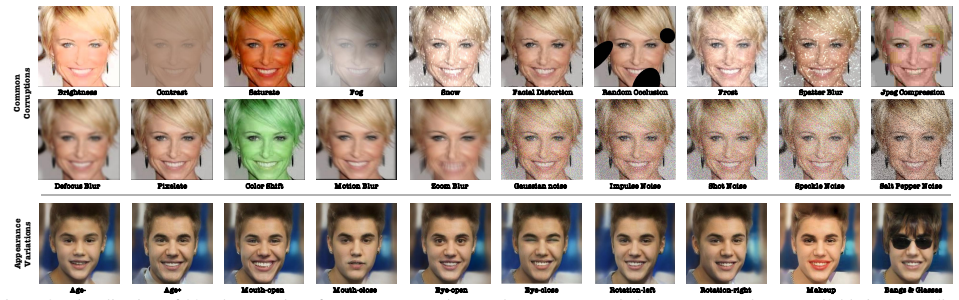
The argument is carried by the OODFace benchmark: a unified testbed of 30 out-of-distribution scenarios across 9 categories, each at 5 severity levels, yielding 150 distinct conditions applied to three public face datasets (LFW, CFP-FP, YTF) as six benchmarks, LFW-C/V, CFP-FP-C/V, and YTF-C/V. The 20 corruption types are generated with the imagecorruptions library, and the 10 variation types with four generative editors — PTI for age, expression, and pose; GANSpace for eye states; HiSD for bangs and glasses; BeautyGAN for makeup. Two relative metrics, Relative Corruption Error (RCE) and Relative Variations Error (RVE), normalize each model's loss against its own clean accuracy so models of different clean performance can be compared; the physical face-mask experiments and the AgeDB comparison then probe whether the synthetic OODs approximate real conditions.
What would settle it
Collect face images under genuine real-world OOD conditions — actual camera motion blur, real low-light sensor noise, real occlusion and aging — and compare model robustness rankings on those images with the OODFace rankings; if the models ranked most robust by the benchmark (for example AdaFace on corruptions) are not the most robust on natural data, the benchmark's predictive claim fails. A cheaper partial check is extending the paper's AgeDB validation to noise and blur, comparing synthetic-versus-real accuracy curves per severity level.
Extended reading notes
Core claim
On the paper's own terms, the central discovery is that face recognition models suffer severe, systematic performance degradation under OOD scenarios that humans handle easily: adding mild Gaussian noise drops state-of-the-art open-source accuracy from 99.8% to 82.2% and makes commercial APIs reject 48.9% of face images. The degradation is category-dependent — Data & Processing corruptions cause the largest average losses (Relative Corruption Error above 20%), while sensor-level shifts such as color shift cause almost none — and corruption robustness is uncorrelated with clean accuracy, whereas appearance-variation robustness is strongly correlated with it. The paper further claims that none of the tested defenses — input transformations, adversarial training, or GAN-, Transformer-, and diffusion-based restoration — fully mitigates these challenges, and that the vulnerability persists across architectures, loss functions, and model scales.
Load-bearing premise
The benchmark transfers to the real world only if the synthetic corruptions from the imagecorruptions library and the generative edits from PTI, GANSpace, HiSD, and BeautyGAN faithfully stand in for the out-of-distribution conditions deployed systems actually meet, and the paper validates this only for age progression on AgeDB with four models.
Editorial extensions
If this is right
- Clean-benchmark leaderboards (LFW above 99%) do not predict resilience to common corruptions, so a top-ranked model is not automatically safe to deploy.
- Noise and compression artifacts form the largest single threat, so robustness research should target how high-frequency noise disrupts learned face-feature spaces.
- Commercial APIs often fail by rejecting images rather than by mismatching them, which turns a verification problem into a system-availability problem: 100% rejection under salt-and-pepper noise is total breakdown even when the accepted-sample accuracy looks high.
- Restoration-based defenses help weaker models on noise categories but distort facial features and hurt already-robust models, so no single tested defense generalizes across OOD types.
- Because appearance variations (aging, expression, pose, accessories) cause only mild degradation, built-in training-data redundancy already covers those shifts, leaving corruption robustness as the open problem.
Reading between the lines
- A testable extension of the paper is whether training or fine-tuning on OODFace-corrupted data transfers to naturally corrupted images such as genuine low-light noise or real motion blur; the paper's own real-data validation covers only age progression, so this transfer remains an open question.
- The per-category scores imply that robustness rankings are deployment-dependent: an outdoor surveillance system (weather, motion, occlusion) and a document-pipeline system (compression, noise) may rationally choose different models, and the category-level tables enable that choice.
- The commercial APIs' rejection behavior suggests a design principle the paper leaves implicit: systems that fail loudly by rejecting degraded inputs may be preferable to systems that fail silently by matching them, and the rejection-rate/accepted-accuracy/actual-accuracy trio is a useful template for auditing deployed identity-verification services.
- The vision-language-model result, if it transfers beyond the tested corruptions, points toward large multimodal models as a candidate architecture for robust face verification, with the paper's own caveats about model opacity and facial-data privacy as the main barriers.
Editorial analysis
A structured set of objections, weighed in public.
Referee Report
Summary. The paper introduces OODFace, a synthetic robustness benchmark for face recognition that applies 20 common corruptions and 10 appearance variations (five severity levels each) to LFW, CFP-FP, and YTF, yielding LFW-C/V, CFP-C/V, and YTF-C/V. It evaluates 19 open-source FR models and 3 commercial APIs, reports category-level and per-severity accuracy, and examines input transformations, adversarial training, restoration methods, Vision-Language Models, and physical face masks. The central claim is that FR models suffer severe degradation under these OOD scenarios and that existing defenses only partially mitigate the problem.
Significance. If the benchmark is taken as a controlled synthetic testbed, this is a valuable and unusually broad contribution: it covers FR-specific corruptions and semantic variations, provides a unified toolkit, evaluates a wide model zoo across architectures, losses, and commercial APIs, and makes per-severity tables publicly available in the appendix. The paper also deserves credit for including physical mask experiments and for exploring VLMs as a potential alternative. The raw accuracy measurements appear internally consistent in the large tables, and the benchmark is directly reusable without any fitted parameters. The main open question is whether the synthetic OODs faithfully represent natural deployment conditions; the paper's own validation is limited to age progression.
major comments (4)
- [Sec. 5.1, Table 2] The qualitative claim that "most models exhibit negligible degradation under Sensor Corruptions (e.g., color shift, defocus blur)" is contradicted by the reported numbers. Defocus Blur reduces accuracy from roughly 99% clean to 79.71–94.30% across the 19 models, with most models losing more than 11 points; only Color Shift is near-negligible. The Sensor category should therefore not be characterized as causing negligible degradation, and the category-level discussion in Sec. 5.1 needs to be corrected or re-analyzed.
- [Sec. 5.2, Table 3] The statement that appearance variations have "highest RVE around 4%" is not supported by Table 3. For example, FaceNet on Bangs&Glasses has RVE (99.23−94.80)/99.23 ≈ 4.47%, SphereFace on the same variation has (98.20−93.15)/98.20 ≈ 5.14%, and MobileNet-v2's Bangs&Glasses RVE is about 4.11%. The quantitative sentence should be revised, and if the intended claim is about average category RVE, it should say so.
- [Appendix A.4, Table A.4] The only external validation of synthetic-to-real transfer is age progression on AgeDB with four models, and it does not establish the effect cleanly: synthetic Age− vs Age+ differ by only about 0.1 points, whereas real Young vs Old differ by about 1.5 points. More importantly, no validation is provided for any of the 20 corruptions or for expressions, pose, and accessories, even though the Sec. 7 headline concerns real-world OOD reliability. The authors should either validate additional OOD types against natural data or explicitly rescope the conclusions to the synthetic benchmark.
- [Sec. 4.1 and Sec. 4.4] The open-source model evaluation protocol does not state whether a verification threshold is fixed once on the clean set or re-tuned per corruption and severity. Since face-verification accuracy is threshold-dependent, the reported Acccor and RCE values are not fully reproducible without this detail. The commercial API section does specify threshold determination; the open-source section should do the same.
minor comments (4)
- [Sec. 5.1] There are citation errors in the model comparison text: "ArcFace [25]" should be "ArcFace [11]" and "FaceNet [8]" should be "FaceNet [44]".
- [Appendix F, Table 5] The VLM evaluation should report the number of test pairs, the prompt settings, sampling parameters, and API versions; Table 5 currently lacks these reproducibility details.
- [Fig. 1 and Sec. 1] Figure 1 says "Accuracy dropped from 99.8% to 82.2%" while the text says the "detection success rate dropping to 82.2%"; please clarify whether the reported quantity is verification accuracy or face-detection rate.
- [Sec. 4.3] For YTF-C/V, the paper extracts the central frame from each video; it should state whether the original 5,000-pair and 10-split protocol is preserved after frame extraction, since this affects comparability with prior YTF results.
Circularity Check
No circularity: OODFace is a direct benchmark evaluation with no fitted parameters and no self-citation chain supporting its central claims.
full rationale
The paper's central claim—that FR models degrade sharply under common corruptions and appearance variations—is supported by direct measurements of 19 open-source models and 3 commercial APIs on synthesized datasets. There is no fitted parameter, no quantity is defined in terms of the quantity it predicts, and no derived result is equivalent to an input by construction. The only self-citation is [14], a prior robustness benchmark by overlapping authors, cited in Sec. 3.1 alongside external [22] to justify conventional sensor and motion corruption categories; this citation is not load-bearing for any experimental result. The benchmarks are generated with externally defined tools (imagecorruptions, PTI, GANSpace, HiSD, BeautyGAN), and severity levels are defined a priori rather than tuned to model outputs, so the measured accuracy numbers are independent of the conclusions drawn from them. The main residual weakness is external validity rather than circularity: only age progression is cross-checked against real data (App. A.4, Tab. A.4), and one can question whether synthetic corruptions faithfully represent deployed conditions. That is a correctness and generalization concern, not a circular-derivation concern, and it does not affect the paper's circularity score under this rubric.
Assumptions & free parameters
free parameters (2)
- OOD severity hyperparameters =
30 types x 5 levels, see Appendix A.1-A.2
- Verification threshold for open-source models =
Not reported in main text
assumptions (3)
- domain assumption Synthetic corruptions and generative variations approximate real-world OOD conditions
- domain assumption Aligning face images with MTCNN on clean data before applying corruptions does not distort the robustness measurement for open-source models
- domain assumption The five severity levels span a meaningful difficulty range
Cite this review
Pith. "Pith review of OODFace: Benchmarking Robustness of Face Recognition under Common Corruptions and Appearance Variations." pith.science (2026). https://pith.science/paper/PVC5RJVZ
@misc{pith2026241202479,
  author       = {Pith},
  title        = {Pith review of: OODFace: Benchmarking Robustness of Face Recognition under Common Corruptions and Appearance Variations},
  year         = {2026},
  howpublished = {\url{https://pith.science/paper/PVC5RJVZ}},
  note         = {Machine review of arXiv:2412.02479}
}
read the original abstract
With the rise of deep learning, facial recognition technology has seen extensive research and rapid development. Although facial recognition is considered a mature technology, we find that existing open-source models and commercial algorithms lack robustness in certain complex Out-of-Distribution (OOD) scenarios, raising concerns about the reliability of these systems. In this paper, we introduce OODFace, which explores the OOD challenges faced by facial recognition models from two perspectives: common corruptions and appearance variations. We systematically design 30 OOD scenarios across 9 major categories tailored for facial recognition. By simulating these challenges on public datasets, we establish three robustness benchmarks: LFW-C/V, CFP-FP-C/V, and YTF-C/V. We then conduct extensive experiments on 19 facial recognition models and 3 commercial APIs, along with extended physical experiments on face masks to assess their robustness. Next, we explore potential solutions from two perspectives: defense strategies and Vision-Language Models (VLMs). Based on the results, we draw several key insights, highlighting the vulnerability of facial recognition systems to OOD data and suggesting possible solutions. Additionally, we offer a unified toolkit that includes all corruption and variation types, easily extendable to other datasets. We hope that our benchmarks and findings can provide guidance for future improvements in facial recognition model robustness.
Figures


Figures from the paper (5 more)


Reference graph
Works this paper leans on
-
[1]
Josh Achiam, Steven Adler, Sandhini Agarwal, Lama Ah- mad, Ilge Akkaya, Florencia Leoni Aleman, Diogo Almeida, Janko Altenschmidt, Sam Altman, Shyamal Anadkat, et al. Gpt-4 technical report. arXiv preprint arXiv:2303.08774 ,
-
[2]
Face morphing detection in social media content
Akshay Agarwal and Nalini Ratha. Face morphing detection in social media content. In 2024 IEEE International Con- ference on Image Processing (ICIP), pages 801–806. IEEE,
work page 2024
-
[3]
Md Manjurul Ahsan, Yueqing Li, Jing Zhang, Md Tanvir Ahad, and Kishor Datta Gupta. Evaluating the performance of eigenface, fisherface, and local binary pattern histogram- based facial recognition methods under various weather con- ditions. Technologies, 9(2):31, 2021. 1, 2, 3, 5
work page 2021
- [4]
-
[5]
Christopher M. Bishop. Pattern Recognition and Machine Learning. Springer, 2006. 4, 5
work page 2006
-
[6]
Elasticface: Elastic margin loss for deep face recognition
Fadi Boutros, Naser Damer, Florian Kirchbuchner, and Ar- jan Kuijper. Elasticface: Elastic margin loss for deep face recognition. In Proceedings of the IEEE/CVF conference on computer vision and pattern recognition, pages 1578–1587,
-
[7]
Vggface2: A dataset for recognising faces across pose and age
Qiong Cao, Li Shen, Weidi Xie, Omkar M Parkhi, and An- drew Zisserman. Vggface2: A dataset for recognising faces across pose and age. In 2018 13th IEEE international con- ference on automatic face & gesture recognition (FG 2018), pages 67–74. IEEE, 2018. 1, 2, 3
work page 2018
-
[8]
Mo- bilefacenets: Efficient cnns for accurate real-time face verifi- cation on mobile devices
Sheng Chen, Yang Liu, Xiang Gao, and Zhenhua Han. Mo- bilefacenets: Efficient cnns for accurate real-time face verifi- cation on mobile devices. In Chinese Conference on Biomet- ric Recognition (CCBR), pages 428–438. Springer, 2018. 4, 5, 6
work page 2018
Show all 64 references
-
[9]
Transface: Calibrating trans- former training for face recognition from a data-centric per- spective
Jun Dan, Yang Liu, Haoyu Xie, Jiankang Deng, Haoran Xie, Xuansong Xie, and Baigui Sun. Transface: Calibrating trans- former training for face recognition from a data-centric per- spective. In Proceedings of the IEEE/CVF international con- ference on computer vision, pages 2064...
2023
-
[10]
Topofr: A closer look at topology alignment on face recognition
Jun Dan, Yang Liu, Jiankang Deng, Haoyu Xie, Siyuan Li, Baigui Sun, and Shan Luo. Topofr: A closer look at topology alignment on face recognition. arXiv preprint arXiv:2410.10587, 2024. 1, 2, 3, 4, 5
2024
-
[11]
Arcface: Additive angular margin loss for deep face recognition
Jiankang Deng, Jia Guo, Niannan Xue, and Stefanos Zafeiriou. Arcface: Additive angular margin loss for deep face recognition. In Proceedings of the IEEE/CVF con- ference on computer vision and pattern recognition , pages 4690–4699, 2019. 1, 3, 4, 5
2019
-
[12]
Enhancing drug abuse face recognition: A study on image corruption and restora- tion
Hruturaj Dhake and Akshay Agarwal. Enhancing drug abuse face recognition: A study on image corruption and restora- tion. In 2024 IEEE International Joint Conference on Bio- metrics (IJCB), pages 1–8. IEEE, 2024. 8, 5
2024
-
[13]
Face detection and facial expression recognition system
Anagha S Dhavalikar and RK Kulkarni. Face detection and facial expression recognition system. In 2014 Interna- tional Conference on Electronics and Communication Sys- tems (ICECS), pages 1–7. IEEE, 2014. 4
2014
-
[14]
Benchmarking robustness of 3d object detection to common corruptions
Yinpeng Dong, Caixin Kang, Jinlai Zhang, Zijian Zhu, Yikai Wang, Xiao Yang, Hang Su, Xingxing Wei, and Jun Zhu. Benchmarking robustness of 3d object detection to common corruptions. In Proceedings of the IEEE/CVF Conference on Computer Vision and Pattern Recognition , pages 10...
2023
-
[15]
A study of the effect of jpg compression on adversarial images
Gintare Karolina Dziugaite, Zoubin Ghahramani, and Daniel M Roy. A study of the effect of jpg compression on adversarial images. arXiv preprint arXiv:1608.00853, 2016. 7
2016 arXiv
-
[16]
Wichmann
Robert Geirhos, Jörn-Henrik Jacobsen, Claudio Michaelis, Richard Zemel, Wieland Brendel, Matthias Bethge, and Fe- lix A. Wichmann. Generalisation in humans and deep neural networks. Advances in Neural Information Processing Sys- tems (NeurIPS), 2018. 3
2018
-
[17]
Wichmann, and Wieland Bren- del
Robert Geirhos, Patrick Rubisch, Claudio Michaelis, Matthias Bethge, Felix A. Wichmann, and Wieland Bren- del. Imagenet-trained cnns are biased towards texture; in- creasing shape bias improves accuracy and robustness. InIn- ternational Conference on Learning Representations (ICLR),
-
[18]
Goodfellow, Jonathon Shlens, and Christian Szegedy
Ian J. Goodfellow, Jonathon Shlens, and Christian Szegedy. Explaining and harnessing adversarial examples. Inter- national Conference on Learning Representations (ICLR) ,
-
[19]
Ms-celeb-1m: A dataset and benchmark for large-scale face recognition
Yandong Guo, Lei Zhang, Yuxiao Hu, Xiaodong He, and Jianfeng Gao. Ms-celeb-1m: A dataset and benchmark for large-scale face recognition. In Computer Vision–ECCV 2016: 14th European Conference, Amsterdam, The Nether- lands, October 11-14, 2016, Proceedings, Part III 14, pages 8...
2016
-
[20]
Ganspace: Discovering interpretable gan con- trols
Erik Härkönen, Aaron Hertzmann, Jaakko Lehtinen, and Sylvain Paris. Ganspace: Discovering interpretable gan con- trols. Advances in neural information processing systems , 33:9841–9850, 2020. 3, 4
2020
-
[21]
Deep residual learning for image recognition
Kaiming He, Xiangyu Zhang, Shaoqing Ren, and Jian Sun. Deep residual learning for image recognition. Proceedings of the IEEE Conference on Computer Vision and Pattern Recognition (CVPR), pages 770–778, 2016. 5, 6, 7
2016
-
[22]
Benchmarking neu- ral network robustness to common corruptions and perturba- 9 tions
Dan Hendrycks and Thomas Dietterich. Benchmarking neu- ral network robustness to common corruptions and perturba- 9 tions. arXiv preprint arXiv:1903.12261 , 2019. 2, 3, 4, 5, 11
1903 arXiv
-
[23]
Mobilenets: Efficient convolu- tional neural networks for mobile vision applications
Andrew G Howard, Menglong Zhu, Bo Chen, Dmitry Kalenichenko, Weijun Wang, Tobias Weyand, Marco An- dreetto, and Hartwig Adam. Mobilenets: Efficient convolu- tional neural networks for mobile vision applications. arXiv preprint arXiv:1704.04861, 2017. 4, 5
2017 arXiv
-
[24]
Labeled faces in the wild: A database forstudying face recognition in unconstrained environments
Gary B Huang, Marwan Mattar, Tamara Berg, and Eric Learned-Miller. Labeled faces in the wild: A database forstudying face recognition in unconstrained environments. In Workshop on faces in’Real-Life’Images: detection, align- ment, and recognition, 2008. 2, 3, 4
2008
-
[25]
Adaface: Quality adaptive margin for face recognition
Minchul Kim, Anil K Jain, and Xiaoming Liu. Adaface: Quality adaptive margin for face recognition. InProceedings of the IEEE/CVF conference on computer vision and pattern recognition, pages 18750–18759, 2022. 1, 3, 4, 5, 6, 7
2022
-
[26]
Pushing the frontiers of unconstrained face detection and recognition: Iarpa janus benchmark a
Brendan F Klare, Joshua C Klontz, and Anil K Jain. Pushing the frontiers of unconstrained face detection and recognition: Iarpa janus benchmark a. InProceedings of the IEEE Confer- ence on Computer Vision and Pattern Recognition (CVPR) , pages 1931–1939, 2015. 3
1931
-
[27]
Beautygan: Instance-level facial makeup transfer with deep generative adversarial network
Tingting Li, Ruihe Qian, Chao Dong, Si Liu, Qiong Yan, Wenwu Zhu, and Liang Lin. Beautygan: Instance-level facial makeup transfer with deep generative adversarial network. In Proceedings of the 26th ACM international conference on Multimedia, pages 645–653, 2018. 4, 5
2018
-
[28]
Image-to-image translation via hierarchical style disentanglement
Xinyang Li, Shengchuan Zhang, Jie Hu, Liujuan Cao, Xi- aopeng Hong, Xudong Mao, Feiyue Huang, Yongjian Wu, and Rongrong Ji. Image-to-image translation via hierarchical style disentanglement. In Proceedings of the IEEE/CVF con- ference on computer vision and pattern recognition...
2021
-
[29]
Bevformer: Learning bird’s-eye-view representation from multi-camera images via spatiotemporal transformers
Zhiqi Li, Wenhai Wang, Hongyang Li, Enze Xie, Chong- hao Sima, Tong Lu, Yu Qiao, and Jifeng Dai. Bevformer: Learning bird’s-eye-view representation from multi-camera images via spatiotemporal transformers. In European con- ference on computer vision, pages 1–18. Springer, 2022. 3
2022
-
[30]
Ai-face: A million-scale de- mographically annotated ai-generated face dataset and fair- ness benchmark
Li Lin, Xin Wang, Shu Hu, et al. Ai-face: A million-scale de- mographically annotated ai-generated face dataset and fair- ness benchmark. arXiv preprint arXiv:2406.00783, 2024. 2, 3
2024 arXiv
-
[31]
Diff- bir: Toward blind image restoration with generative diffusion prior
Xinqi Lin, Jingwen He, Ziyan Chen, Zhaoyang Lyu, Bo Dai, Fanghua Yu, Yu Qiao, Wanli Ouyang, and Chao Dong. Diff- bir: Toward blind image restoration with generative diffusion prior. In European Conference on Computer Vision , pages 430–448. Springer, 2024. 2, 8, 7
2024
-
[32]
A study of face recognition as people age
Haibin Ling, Stefano Soatto, Narayanan Ramanathan, and David W Jacobs. A study of face recognition as people age. In 2007 IEEE 11th International Conference on Computer Vision, pages 1–8. IEEE, 2007. 4
2007
-
[33]
Sphereface: Deep hypersphere embedding for face recognition
Weiyang Liu, Yandong Wen, Zhiding Yu, Ming Li, Bhiksha Raj, and Le Song. Sphereface: Deep hypersphere embedding for face recognition. In Proceedings of the IEEE conference on computer vision and pattern recognition, pages 212–220,
-
[34]
Shufflenet v2: Practical guidelines for efficient cnn architec- ture design
Ningning Ma, Xiangyu Zhang, Hai-Tao Zheng, and Jian Sun. Shufflenet v2: Practical guidelines for efficient cnn architec- ture design. In Proceedings of the European Conference on Computer Vision (ECCV), pages 116–131, 2018. 4, 5
2018
-
[35]
Towards deep learning models resistant to adversarial attacks
Aleksander M ˛ adry, Aleksandar Makelov, Ludwig Schmidt, Dimitris Tsipras, and Adrian Vladu. Towards deep learning models resistant to adversarial attacks. stat, 1050(9), 2017. 2, 8, 7
2017
-
[36]
Iarpa janus benchmark-c: Face dataset and protocol
Brian Maze, Joshua Adams, J Ross Duncan, Nathan Kalka, Tim Miller, Charles Otto, Karthik Jain, Wayne Niggel, John Anderson, James Cheney, et al. Iarpa janus benchmark-c: Face dataset and protocol. In 2018 International Conference on Biometrics (ICB), pages 158–165, 2018. 3
2018
-
[37]
Ecker, Matthias Bethge, and Wieland Brendel
Claudio Michaelis, Benjamin Mitzkus, Robert Geirhos, Evgenia Rusak, Oliver Bringmann, Alexander S. Ecker, Matthias Bethge, and Wieland Brendel. Benchmarking ro- bustness in object detection: Autonomous driving when win- ter is coming. In Advances in Neural Information Processi...
2019
-
[38]
Agedb: the first manually collected, in-the-wild age database
Stylianos Moschoglou, Athanasios Papaioannou, Chris- tos Sagonas, Jiankang Deng, Irene Kotsia, and Stefanos Zafeiriou. Agedb: the first manually collected, in-the-wild age database. In proceedings of the IEEE conference on computer vision and pattern recognition workshops , pa...
2017
-
[39]
Beyond masks: On the generalization of masked face recognition models to occluded face recognition
Pedro C Neto, João Ribeiro Pinto, Fadi Boutros, Naser Damer, Ana F Sequeira, and Jaime S Cardoso. Beyond masks: On the generalization of masked face recognition models to occluded face recognition. IEEE Access , 10: 86222–86233, 2022. 2, 4, 5
2022
-
[40]
A system- atic review of noise types, denoising methods, and evalua- tion metrics in images
Preena Prasad, J Anitha, and Divapriya Anil. A system- atic review of noise types, denoising methods, and evalua- tion metrics in images. In 2023 IEEE International Confer- ence on Recent Advances in Systems Science and Engineer- ing (RASSE), pages 1–9. IEEE, 2023. 4
2023
-
[41]
Benchmarking and analyzing point cloud classification under corruptions
Zhiyu Ren, Ziyu Liu, Shijie Han, Yiming Li, Yao Zhao, Nicu Sebe, and Wei Wang. Benchmarking and analyzing point cloud classification under corruptions. In Proceedings of the IEEE/CVF Conference on Computer Vision and Pattern Recognition (CVPR), 2022. 3
2022
-
[42]
Pivotal tuning for latent-based editing of real im- ages
Daniel Roich, Ron Mokady, Amit H Bermano, and Daniel Cohen-Or. Pivotal tuning for latent-based editing of real im- ages. ACM Transactions on graphics (TOG) , 42(1):1–13,
-
[43]
Mobilenetv2: Inverted residuals and linear bottlenecks
Mark Sandler, Andrew Howard, Menglong Zhu, Andrey Zh- moginov, and Liang-Chieh Chen. Mobilenetv2: Inverted residuals and linear bottlenecks. In Proceedings of the IEEE Conference on Computer Vision and Pattern Recognition (CVPR), pages 4510–4520, 2018. 4, 5
2018
-
[44]
Facenet: A unified embedding for face recognition and clus- tering
Florian Schroff, Dmitry Kalenichenko, and James Philbin. Facenet: A unified embedding for face recognition and clus- tering. In Proceedings of the IEEE conference on computer vision and pattern recognition, pages 815–823, 2015. 2, 4, 5
2015
-
[45]
Frontal to profile face verification in the wild
Soumyadip Sengupta, Jun-Cheng Chen, Carlos Castillo, Vishal M Patel, Rama Chellappa, and David W Jacobs. Frontal to profile face verification in the wild. In 2016 IEEE winter conference on applications of computer vision (WACV), pages 1–9. IEEE, 2016. 2, 3, 4, 5
2016
-
[46]
In- 10 triguing properties of neural networks
Christian Szegedy, Wojciech Zaremba, Ilya Sutskever, Joan Bruna, Dumitru Erhan, Ian Goodfellow, and Rob Fergus. In- 10 triguing properties of neural networks. International Confer- ence on Learning Representations (ICLR), 2014. 3
2014
-
[47]
Deepface: Closing the gap to human-level perfor- mance in face verification
Yaniv Taigman, Ming Yang, Marc’Aurelio Ranzato, and Lior Wolf. Deepface: Closing the gap to human-level perfor- mance in face verification. In Proceedings of the IEEE Conference on Computer Vision and Pattern Recognition (CVPR), pages 1701–1708, 2014. 2
2014
-
[48]
Measuring ro- bustness to natural distribution shifts in image classifica- tion
Rohan Taori, Achal Dave, Vaishaal Shankar, Nicholas Car- lini, Benjamin Recht, and Ludwig Schmidt. Measuring ro- bustness to natural distribution shifts in image classifica- tion. Advances in Neural Information Processing Systems (NeurIPS), 2020. 3
2020
-
[49]
Ad- ditive margin softmax for face verification
Feng Wang, Jian Cheng, Weiyang Liu, and Haijun Liu. Ad- ditive margin softmax for face verification. In IEEE Signal Processing Letters, pages 926–930. IEEE, 2018. 4, 5, 6
2018
-
[50]
Cosface: Large margin cosine loss for deep face recognition
Hao Wang, Yitong Wang, Zheng Zhou, Xing Ji, Dihong Gong, Jingchao Zhou, Zhifeng Li, and Wei Liu. Cosface: Large margin cosine loss for deep face recognition. In Pro- ceedings of the IEEE conference on computer vision and pat- tern recognition, pages 5265–5274, 2018. 1, 3, 4, 5, 6
2018
-
[51]
To- wards real-world blind face restoration with generative fa- cial prior
Xintao Wang, Yu Li, Honglun Zhang, and Ying Shan. To- wards real-world blind face restoration with generative fa- cial prior. In Proceedings of the IEEE/CVF conference on computer vision and pattern recognition, pages 9168–9178,
-
[52]
Iarpa janus benchmark-b face dataset
Cameron Whitelam, Edward Taborsky, Austin Blanton, Brian Maze, Joshua Adams, Tim Miller, Nathan Kalka, Karthik Jain, J Ross Duncan, Kevin Allen, et al. Iarpa janus benchmark-b face dataset. In Proceedings of the IEEE Con- ference on Computer Vision and Pattern Recognition Work...
2017
-
[53]
Face recognition in unconstrained videos with matched background similarity
Lior Wolf, Tal Hassner, and Itay Maoz. Face recognition in unconstrained videos with matched background similarity. In CVPR 2011, pages 529–534. IEEE, 2011. 2, 3, 4, 5
2011
-
[54]
Mitigating adversarial effects through random- ization
Cihang Xie, Jianyu Wang, Zhishuai Zhang, Zhou Ren, and Alan Yuille. Mitigating adversarial effects through random- ization. arXiv preprint arXiv:1711.01991, 2017. 2, 8, 7
2017 arXiv
-
[55]
Feature squeezing: Detecting adversarial exa mples in deep neural networks
W Xu. Feature squeezing: Detecting adversarial exa mples in deep neural networks. arXiv preprint arXiv:1704.01155,
-
[56]
Robfr: Benchmarking ad- versarial robustness on face recognition
Xiao Yang, Dingcheng Yang, Yinpeng Dong, Hang Su, Wenjian Yu, and Jun Zhu. Robfr: Benchmarking ad- versarial robustness on face recognition. arXiv preprint arXiv:2007.04118, 2020. 2, 3, 5, 8, 7
2007 arXiv
-
[57]
Theoretically principled trade-off between robustness and accuracy
Hongyang Zhang, Yaodong Yu, Jiantao Jiao, Eric Xing, Lau- rent El Ghaoui, and Michael Jordan. Theoretically principled trade-off between robustness and accuracy. In International conference on machine learning, pages 7472–7482. PMLR,
-
[58]
Joint face detection and alignment using multitask cascaded convolutional networks
Kaipeng Zhang, Zhanpeng Zhang, Zhifeng Li, and Yu Qiao. Joint face detection and alignment using multitask cascaded convolutional networks. IEEE signal processing letters , 23 (10):1499–1503, 2016. 4, 5
2016
-
[59]
Deep disguised faces recognition
Kaipeng Zhang, Ya-Liang Chang, and Winston Hsu. Deep disguised faces recognition. In Proceedings of the IEEE Conference on Computer Vision and Pattern Recognition Workshops, pages 32–36, 2018. 8
2018
-
[60]
Facial expression analysis under partial occlusion: A survey
Ligang Zhang, Brijesh Verma, Dian Tjondronegoro, and Vinod Chandran. Facial expression analysis under partial occlusion: A survey. ACM Computing Surveys (CSUR), 51 (2):1–49, 2018. 2
2018
-
[61]
Shufflenet: An extremely efficient convolutional neural net- work for mobile devices
Xiangyu Zhang, Xinyu Zhou, Mengxiao Lin, and Jian Sun. Shufflenet: An extremely efficient convolutional neural net- work for mobile devices. InProceedings of the IEEE Confer- ence on Computer Vision and Pattern Recognition (CVPR) , pages 6848–6856, 2018. 4, 5
2018
-
[62]
Torr, and Yi Zhang
Zhedong Zheng, Hao Tang, Ling Shao, Philip H.S. Torr, and Yi Zhang. Benchmarking robustness of 3d point cloud recognition against common corruptions. In Proceedings of the IEEE/CVF Conference on Computer Vision and Pattern Recognition (CVPR), 2022. 3
2022
-
[63]
Towards robust blind face restora- tion with codebook lookup transformer
Shangchen Zhou, Kelvin Chan, Chongyi Li, and Chen Change Loy. Towards robust blind face restora- tion with codebook lookup transformer. Advances in Neural Information Processing Systems, 35:30599–30611, 2022. 2, 8, 7 11 OODFace: Benchmarking Robustness of Face Recognition unde...
2022
-
[64]
Open-source Model Eval
× × × /× × × × × 5 3 × × × ×[39] × × /× × × × × × 9 8 × × × ×[2] × × × × × × × / × 13 3 × × × ×[12] / × × / /× × × × 6 8 × /× ×Ours / / / / // / / / 30 19 3 / / / Table A.3. Comparison with related work. Our benchmark provides the most comprehensive evaluation. stages, includi...
Reviewed August 11, 2026 · model on record in the stance chip above.
Discussion (0). Continue with ORCID to comment.