Bayesian Sampling of Structural Ensembles: The Role of Ensemble-Counting Measures
Pith reviewed 2026-06-26 21:44 UTC · model grok-4.3
The pith
The flat measure in Lagrange-multiplier space renders Bayesian posteriors non-normalizable for finite trajectories, while the Jeffreys measure restores normalizability and consistent averages.
A machine-rendered reading of the paper's core claim, the machinery that carries it, and where it could break.
Core claim
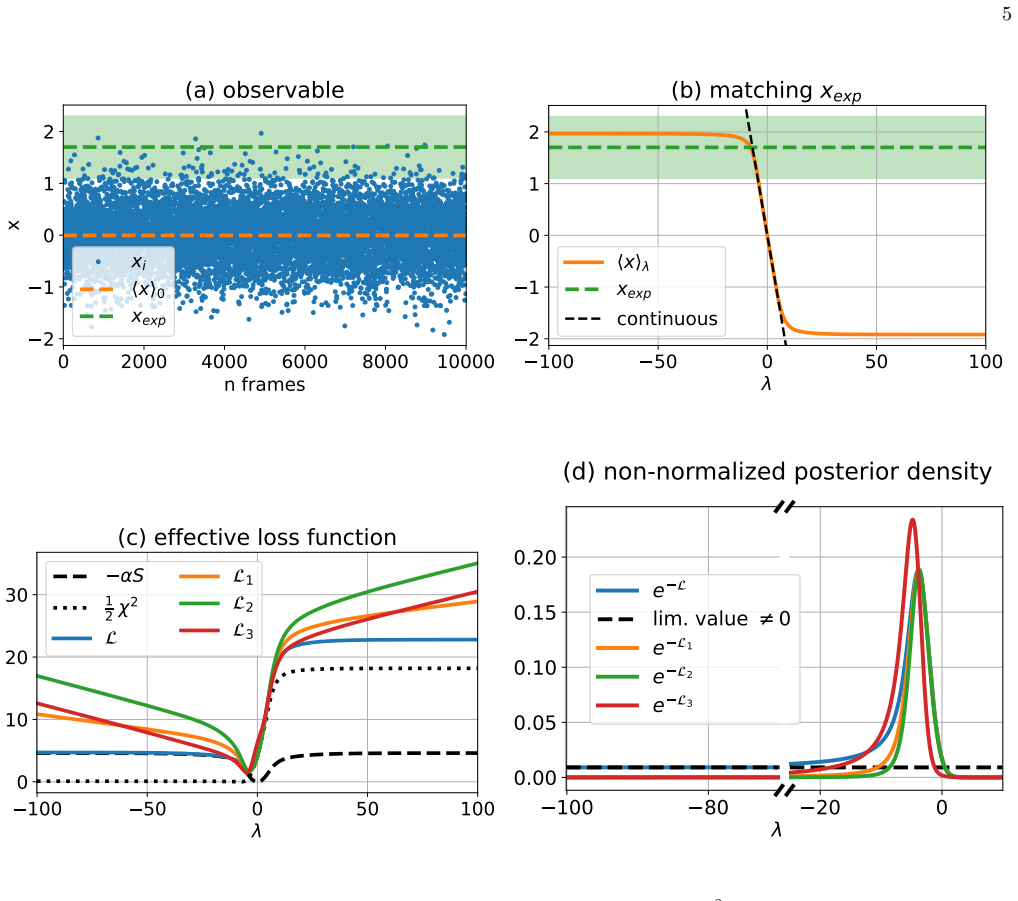
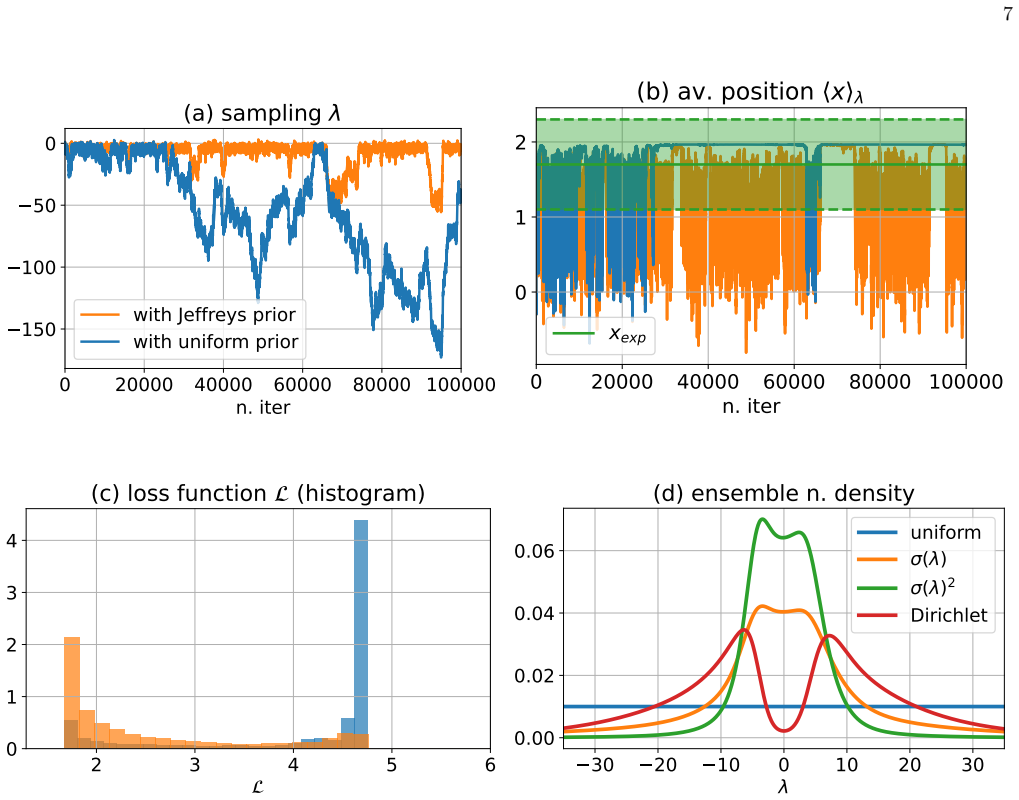
In the Bayesian Energy Landscape Tilting framework, sampling the posterior over maximum-entropy ensembles requires an explicit ensemble-counting measure; the flat measure in Lagrange-multiplier space yields a formally non-normalizable posterior for finite reference trajectories, whereas the Jeffreys measure restores normalizability and supplies a consistent definition of posterior averages.
What carries the argument
The Jeffreys measure as an invariant ensemble-counting prescription in Lagrange-multiplier space for the posterior distribution over maximum-entropy ensembles.
If this is right
- Posterior distributions over maximum-entropy ensembles become normalizable for any finite reference trajectory.
- Posterior averages of arbitrary observables acquire a unique, measure-independent definition.
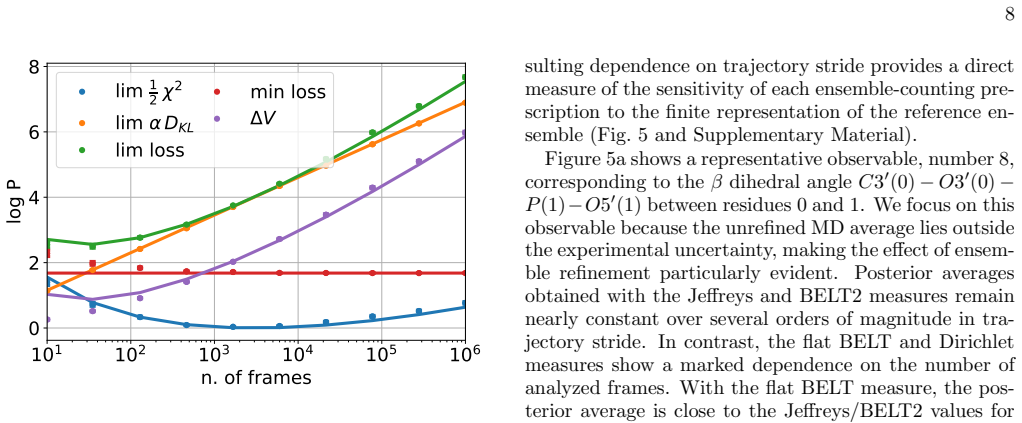
- Numerical values of uncertainty estimates and averaged observables can change when the counting measure is altered, as verified on both analytic and molecular models.
- The corrected procedure is directly usable in existing refinement pipelines through the MDRefine implementation.
Where Pith is reading between the lines
- The same measure dependence may appear in other maximum-entropy or Bayesian ensemble methods that parametrize ensembles through Lagrange multipliers.
- Switching to the Jeffreys measure could systematically alter the width of uncertainty bands reported in structural-biology applications that integrate simulation with experiment.
- A practical test would be to re-analyze an existing BELT-refined ensemble with both measures and compare the resulting posterior variances for key observables.
Load-bearing premise
The Jeffreys measure is the appropriate invariant ensemble-counting prescription for the posterior in Lagrange-multiplier space.
What would settle it
A direct numerical integration of the posterior under the Jeffreys measure on the Gaussian model that still diverges for the same finite trajectory lengths where the flat measure diverges.
Figures
read the original abstract
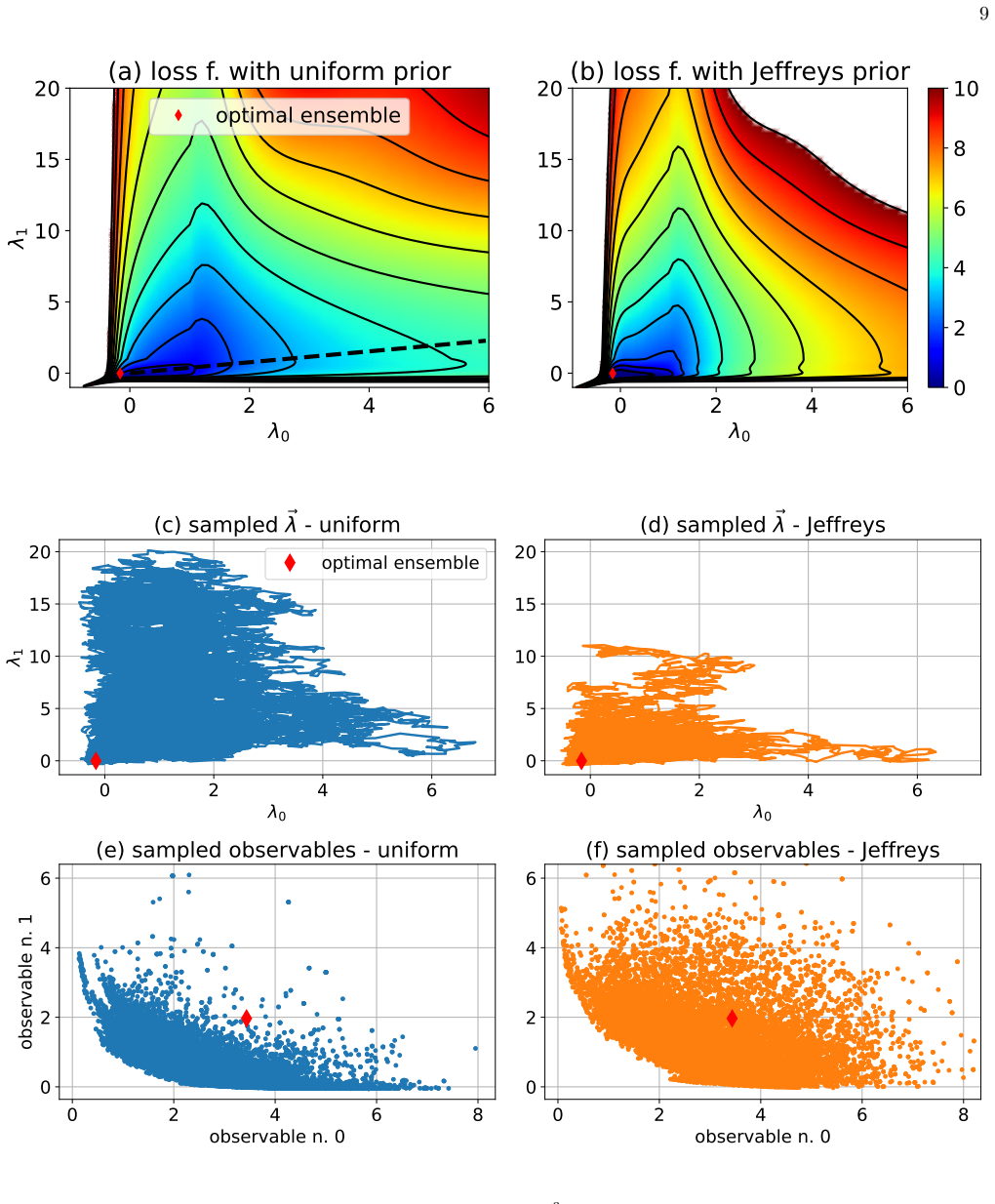
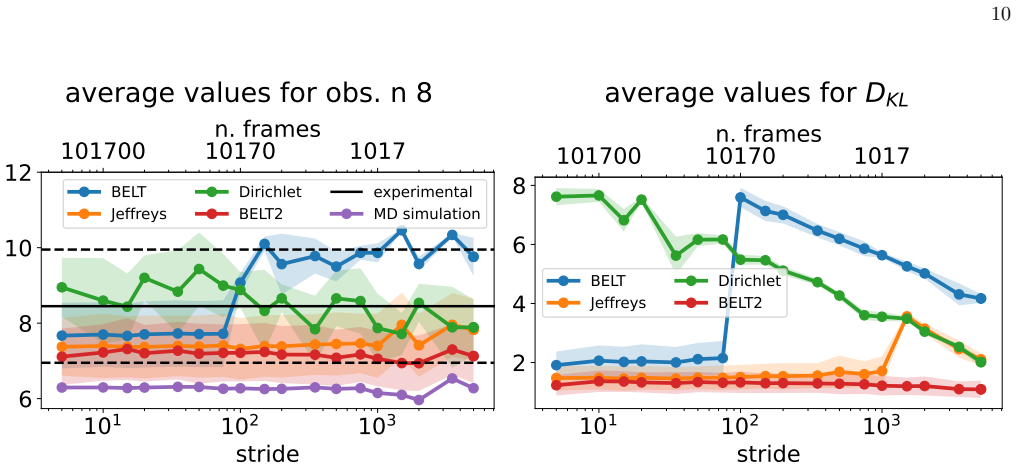
Structural ensemble refinement is widely used to integrate molecular simulations with experimental measurements. While most applications focus on the maximum-a-posteriori (MAP) ensemble, Bayesian sampling of the posterior distribution can provide uncertainty estimates and posterior averages for arbitrary observables. A notable step in this direction was introduced by the Bayesian Energy Landscape Tilting (BELT) framework, where sampling is performed on a family of maximum-entropy ensembles parametrized by Lagrange multipliers. Here, we show that Bayesian sampling in this setting requires an explicit choice of ensemble-counting measure. In particular, the flat measure in Lagrange-multiplier space used in the original BELT formulation leads to a posterior distribution that is formally non-normalizable for finite reference trajectories. We propose the Jeffreys measure as an invariant ensemble-counting prescription, restoring normalizability in the finite-sample situations considered here, and providing a consistent definition of posterior averages. Using both an analytically tractable Gaussian model and maximum-entropy refinement of RNA oligomer simulations, we compare different ensemble-counting measures and show that they can significantly affect Bayesian estimates. The resulting methodology has been implemented in the \texttt{MDRefine} software package.
Editorial analysis
A structured set of objections, weighed in public.
Referee Report
Summary. The paper claims that Bayesian sampling in the BELT framework requires an explicit ensemble-counting measure; the flat measure in Lagrange-multiplier space yields a formally non-normalizable posterior for finite reference trajectories. It proposes the Jeffreys measure (based on the Fisher information of the likelihood) as an invariant prescription that restores normalizability and defines consistent posterior averages. Comparisons in an analytically tractable Gaussian model and in maximum-entropy refinement of RNA oligomer simulations demonstrate that the choice of measure can significantly affect the resulting Bayesian estimates; the approach is implemented in the MDRefine package.
Significance. If the non-normalizability result and the Jeffreys prescription hold, the work identifies a foundational technical issue in Bayesian ensemble refinement and supplies a concrete, invariant alternative. The analytically tractable Gaussian model is a clear strength, allowing explicit verification of the effect of the measure choice. This could improve the reliability of uncertainty estimates and posterior observables in structural ensemble methods that integrate simulations with experimental data.
major comments (2)
- [BELT framework paragraph] The claim that the flat measure produces a formally non-normalizable posterior (abstract) follows from the definition of the posterior integral over Lagrange multipliers; the manuscript should supply an explicit derivation or limiting case showing divergence of the integral for finite reference trajectories rather than treating it as immediate from the construction.
- [Proposal of Jeffreys measure] The proposal of the Jeffreys measure as the appropriate invariant ensemble-counting prescription (abstract) rests on reparametrization invariance in λ-space, but no derivation is given establishing why this invariance corresponds to a natural counting of distinct structural ensembles (as opposed to, e.g., invariance under rescaling of the reference trajectory or change of observable basis). In the Gaussian model the paper reports numerical differences between measures, yet does not test whether posterior averages remain stable under a reparametrization that leaves the underlying ensemble distribution unchanged.
minor comments (1)
- Notation for the ensemble-counting measure and the definition of the posterior should be introduced with an explicit equation early in the text to aid readability.
Simulated Author's Rebuttal
We thank the referee for their careful reading and constructive comments on our manuscript. We agree that additional explicit derivations and discussion will strengthen the presentation and will revise accordingly. Below we respond point by point to the major comments.
read point-by-point responses
-
Referee: The claim that the flat measure produces a formally non-normalizable posterior (abstract) follows from the definition of the posterior integral over Lagrange multipliers; the manuscript should supply an explicit derivation or limiting case showing divergence of the integral for finite reference trajectories rather than treating it as immediate from the construction.
Authors: We agree that an explicit derivation improves clarity. In the revised manuscript we will add a dedicated subsection that derives the divergence of the posterior integral for the flat measure when the reference trajectory is finite. This will include a limiting-case analysis with a small number of samples, showing explicitly that the integral diverges. revision: yes
-
Referee: The proposal of the Jeffreys measure as the appropriate invariant ensemble-counting prescription (abstract) rests on reparametrization invariance in λ-space, but no derivation is given establishing why this invariance corresponds to a natural counting of distinct structural ensembles (as opposed to, e.g., invariance under rescaling of the reference trajectory or change of observable basis). In the Gaussian model the paper reports numerical differences between measures, yet does not test whether posterior averages remain stable under a reparametrization that leaves the underlying ensemble distribution unchanged.
Authors: The Jeffreys measure is selected because its reparametrization invariance in λ-space ensures the counting measure is independent of the arbitrary coordinate choice on the Lagrange-multiplier manifold; this is the standard invariant prescription in Bayesian statistics for such parametrized families. We will expand the revised manuscript to provide a more detailed justification of why this particular invariance is the natural one for counting distinct structural ensembles in the BELT setting, contrasting it with other possible invariances. We will also add an explicit numerical test in the Gaussian model confirming that posterior averages are stable under reparametrizations that leave the underlying ensemble distribution unchanged. revision: yes
Circularity Check
No significant circularity; derivation self-contained
full rationale
The non-normalizability result follows directly from the explicit integral definition of the posterior over Lagrange-multiplier space for finite reference trajectories, without any reduction to fitted inputs or self-referential definitions. The Jeffreys measure is introduced via its standard reparametrization-invariance property from Bayesian statistics, which is an external mathematical criterion independent of the paper's data or prior self-citations. No load-bearing step invokes a uniqueness theorem from the authors' own prior work, nor renames a known result, nor smuggles an ansatz through citation. Numerical comparisons in the Gaussian model and RNA simulations are demonstrations of effect size rather than predictions forced by construction. The central claim therefore rests on independent content.
Axiom & Free-Parameter Ledger
axioms (1)
- domain assumption Bayesian posterior requires an explicit measure for integration over the space of Lagrange multipliers
Reference graph
Works this paper leans on
-
[1]
Efron, Bradley and Tibshirani, Robert , year=
-
[2]
An invariant form for the prior probability in estimation problems , author=. Proc. R. Soc. A , volume=. 1946 , publisher=
1946
-
[3]
IEEE Trans
Prior Probabilities , author=. IEEE Trans. Syst. Sci. Cyber. , volume=. 1968 , publisher=
1968
-
[4]
MDRefine: A Python package for refining molecular dynamics trajectories with experimental data , author=. J. Chem. Phys. , volume=. 2025 , publisher=
2025
-
[5]
Bayesian energy landscape tilting: towards concordant models of molecular ensembles , author=. Biophys. J. , volume=. 2014 , publisher=
2014
-
[6]
arXiv preprint arXiv:1408.0255 , year=
Efficient inference of protein structural ensembles , author=. arXiv preprint arXiv:1408.0255 , year=
-
[7]
Bayesian ensemble refinement by replica simulations and reweighting , author=. J. Chem. Phys. , volume=. 2015 , publisher=
2015
-
[8]
Journal of the Royal Statistical Society Series B: Statistical Methodology , volume=
Riemann manifold langevin and hamiltonian monte carlo methods , author=. Journal of the Royal Statistical Society Series B: Statistical Methodology , volume=. 2011 , publisher=
2011
-
[9]
Bayesian estimation of uncertainty , author=
Maximum Likelihood vs. Bayesian estimation of uncertainty , author=
-
[10]
Empirical optimization of molecular simulation force fields by
K. Empirical optimization of molecular simulation force fields by. Eur. Phys. J. B , volume=. 2021 , publisher=
2021
-
[11]
Computation , volume=
Using the maximum entropy principle to combine simulations and solution experiments , author=. Computation , volume=. 2018 , publisher=
2018
-
[12]
0] , author=
Enhanced Sampling Methods for Molecular Dynamics Simulations [Article v1. 0] , author=. Living J. Comput. Mol. Sci , volume=
-
[13]
Science , volume=
Biophysical experiments and biomolecular simulations: A perfect match? , author=. Science , volume=. 2018 , publisher=
2018
-
[14]
Encoding prior knowledge in ensemble refinement , author=. J. Chem. Phys. , volume=. 2024 , publisher=
2024
-
[15]
On the use of experimental observations to bias simulated ensembles , author=. J. Chem. Theory Comput. , volume=. 2012 , publisher=
2012
-
[16]
Boosting ensemble refinement with transferable force-field corrections: Synergistic optimization for molecular simulations , author=. J. Phys. Chem. Lett. , volume=. 2024 , publisher=
2024
-
[17]
Conformational ensembles of RNA oligonucleotides from integrating NMR and molecular simulations , author=. Sci. Adv. , volume=. 2018 , publisher=
2018
-
[18]
Toward empirical force fields that match experimental observables , author=. J. Chem. Phys. , volume=. 2020 , publisher=
2020
-
[19]
Efficient ensemble refinement by reweighting , author=. J. Chem. Theory Comput. , volume=. 2019 , publisher=
2019
-
[20]
Structure , volume=
SAXS ensemble refinement of ESCRT-III CHMP3 conformational transitions , author=. Structure , volume=. 2011 , publisher=
2011
-
[21]
Nucleic Acids Res
Reweighting of molecular simulations with explicit-solvent SAXS restraints elucidates ion-dependent RNA ensembles , author=. Nucleic Acids Res. , volume=. 2021 , publisher=
2021
-
[22]
Nucleic Acids Res
Unique conformational dynamics and protein recognition of A-to-I hyper-edited dsRNA , author=. Nucleic Acids Res. , volume=. 2025 , publisher=
2025
-
[23]
Determining accurate conformational ensembles of intrinsically disordered proteins at atomic resolution , author=. Nat. Commun. , volume=. 2025 , publisher=
2025
-
[24]
Refining conformational ensembles of flexible proteins against small-angle x-ray scattering data , author=. Biophys. J. , volume=. 2021 , publisher=
2021
-
[25]
Simultaneous refinement of molecular dynamics ensembles and forward models using experimental data , author=. J. Chem. Phys. , volume=. 2023 , publisher=
2023
-
[26]
A second generation force field for the simulation of proteins, nucleic acids, and organic molecules , author=. J. Am. Chem. Soc. , volume=. 1995 , publisher=
1995
-
[27]
How well does a restrained electrostatic potential (RESP) model perform in calculating conformational energies of organic and biological molecules? , author=. J. Comput. Chem. , volume=. 2000 , publisher=
2000
-
[28]
Refinement of the AMBER force field for nucleic acids: improving the description of / conformers , author=. Biophys. J. , volume=. 2007 , publisher=
2007
-
[29]
nucleic acids force field based on reference quantum chemical calculations of glycosidic torsion profiles , author=
Refinement of the Cornell et al. nucleic acids force field based on reference quantum chemical calculations of glycosidic torsion profiles , author=. J. Chem. Theory Comput. , volume=. 2011 , publisher=
2011
-
[30]
Revised AMBER parameters for bioorganic phosphates , author=. J. Chem. Theory Comput. , volume=. 2012 , publisher=
2012
-
[31]
Building water models: a different approach , author=. J. Phys. Chem. Lett. , volume=. 2014 , publisher=
2014
-
[32]
Replica-exchange molecular dynamics method for protein folding , author=. Chem. Phys. Lett. , volume=. 1999 , publisher=
1999
-
[33]
Stacking in RNA: NMR of four tetramers benchmark molecular dynamics , author=. J. Chem. Theory Comput. , volume=. 2015 , publisher=
2015
-
[34]
Efficient and minimal method to bias molecular simulations with experimental data , author=. J. Chem. Theory Comput. , volume=. 2014 , publisher=
2014
-
[35]
Combining simulations and solution experiments as a paradigm for RNA force field refinement , author=. J. Chem. Theory Comput. , volume=. 2016 , publisher=
2016
-
[36]
Determination of structural ensembles of proteins: restraining vs reweighting , author=. J. Chem. Theory Comput. , volume=. 2018 , publisher=
2018
-
[37]
Metainference: A Bayesian inference method for heterogeneous systems , author=. Sci. Adv. , volume=. 2016 , publisher=
2016
-
[38]
Cryo-Electron Microscopy Structural Ensemble Optimization Using Individual Particles , author=. J. Chem. Theory Comput. , year=
-
[39]
Structural bioinformatics: methods and protocols , pages=
Integrating molecular simulation and experimental data: a Bayesian/maximum entropy reweighting approach , author=. Structural bioinformatics: methods and protocols , pages=. 2020 , publisher=
2020
-
[40]
Nucleic Acids Res
Integrating NMR and simulations reveals motions in the UUCG tetraloop , author=. Nucleic Acids Res. , volume=. 2020 , publisher=
2020
-
[41]
Molecular dynamics simulations with replica-averaged structural restraints generate structural ensembles according to the maximum entropy principle , author=. J. Chem. Phys. , volume=. 2013 , publisher=
2013
-
[42]
On the statistical equivalence of restrained-ensemble simulations with the maximum entropy method , author=. J. Chem. Phys. , volume=. 2013 , publisher=
2013
-
[43]
Nature , volume=
Simultaneous determination of protein structure and dynamics , author=. Nature , volume=. 2005 , publisher=
2005
-
[44]
Model selection using replica averaging with Bayesian inference of conformational populations , author=. J. Chem. Theory Comput. , volume=. 2025 , publisher=
2025
-
[45]
Nucleic Acids Res
Conformational ensembles of an RNA hairpin using molecular dynamics and sparse NMR data , author=. Nucleic Acids Res. , volume=. 2020 , publisher=
2020
-
[46]
Designing free energy surfaces that match experimental data with metadynamics , author=. J. Chem. Theory Comput. , volume=. 2015 , publisher=
2015
-
[47]
A statistical analysis of the precision of reweighting-based simulations , author=. J. Chem. Phys. , volume=. 2008 , publisher=
2008
-
[48]
Bayesian calibration of force-fields from experimental data: TIP4P water , author=. J. Chem. Phys. , volume=. 2018 , publisher=
2018
-
[49]
AIP Conf
Relative entropy and inductive inference , author=. AIP Conf. Procs. , volume=. 2004 , organization=
2004
-
[50]
Bayesian-inference-driven model parametrization and model selection for 2CLJQ fluid models , author=. J. Chem. Theory Comput. , volume=. 2022 , publisher=
2022
-
[51]
Evaluation of sampling algorithms used for Bayesian uncertainty quantification of molecular dynamics force fields , author=. J. Chem. Theory Comput. , volume=. 2024 , publisher=
2024
-
[52]
Ensemble reweighting using cryo-EM particle images , author=. J. Phys. Chem. B , volume=. 2023 , publisher=
2023
-
[53]
JACS Au , volume=
Global structure of the intrinsically disordered protein tau emerges from its local structure , author=. JACS Au , volume=. 2022 , publisher=
2022
-
[54]
Integrated NMR/molecular dynamics determination of the ensemble conformation of a thermodynamically stable CUUG RNA tetraloop , author=. J. Am. Chem. Soc. , volume=. 2023 , publisher=
2023
-
[55]
RNA , volume=
Conformational heterogeneity of UCAAUC RNA oligonucleotide from molecular dynamics simulations, SAXS, and NMR experiments , author=. RNA , volume=. 2022 , publisher=
2022
discussion (0)
Sign in with ORCID, Apple, or X to comment. Anyone can read and Pith papers without signing in.