REVIEW 4 major objections 5 minor 72 references
Agent capability does not return when a squeezed memory budget recovers — memory hysteresis — and this paper proves a deficit floor for keep-or-drop policies, then shows a reversible, verification-gated fidelity ladder closes the loop and m
Reviewed by Pith at T0; open to challenge. T0 means a machine referee read the full paper against a public rubric. the ladder, T0–T4 →
CrystalMem restores agent capability after a memory-budget squeeze-and-recovery cycle to within 0.5 pp on average by keeping recoverable residue of demoted entries and verifying regenerated knowledge.
T0 review reviewed 2026-08-04 challenge →
load-bearing objection The hysteresis phenomenon and Proposition 3's floor are genuine contributions, but the empirical support rests on one fixed budget schedule and no released artifacts. the 4 major comments →
CrystalMem: Elastic Memory for Self-Evolving LLM Agents via Knowledge Crystallization
The pith
A machine-rendered reading of the paper's core claim, the machinery that carries it, and where it could break.
The reading
Core claim
Capability lost during a memory-budget squeeze does not return when bytes return — memory hysteresis — and for keep-or-drop policies this is provably structural: Prop. 3 gives an expected residual-deficit floor of sum u_e(1−p_e) over evicted entries, with u_e terminal utility and p_e re-observation probability, and the trough evicts ~75% of resident bytes. The constructive claim is CrystalMem, a four-state fidelity ladder with energy-priced demotions, advantage-weighted influence ordering with dependency coupling, and verified recrystallization that admits only reconstructions passing stored invariants. Evaluation over seven environments, seventeen methods, and six backbones reports the high
What carries the argument
Four-state fidelity ladder (FULL, COMPRESSED, SKELETAL, TRACE), each rung with byte cost, utility fraction, and regeneration token cost; demoted entries keep a residue and a set of invariants (key spans, entity tuples, outcome facts). Around it: water-filling descent that demotes cheapest marginal-price moves first until the store fits the incoming budget, priced by η_e(k)=ṽ_e(1−r_k)+τ c_k; Monitor that attributes graded outcomes to entries via advantage-weighted influence and lets value flow over a dependency graph so anchors sink last; and verified recrystallization that regenerates from residues and admits drafts only if they pass invariant checks, under explicit byte and compute caps. T
Load-bearing premise
The entire experimental case is anchored to one fixed budget schedule — a single squeeze to 25% and recovery to 100% — so differently shaped, deeper, faster, or repeated budget paths could change the reported margins and even the qualitative ranking.
What would settle it
Run the same seven-stage protocol with a trough of 10% of the provisioned budget (e.g., 1→0.8→0.5→0.1→0.5→0.8→1) and measure residual deficit: if the proposed system stays within a couple of points of the 0.5 pp reported at the 25% trough, the loop-closure claim generalizes; if it degrades toward the 6.5 pp deficit observed at a zero regeneration budget, the result is specific to the tested trough depth and regeneration fidelity.
If this is right
- At a 50% byte budget, capability matches the strongest full-provision baseline on every environment tested, which implies agents can be provisioned at half the memory without loss on this cycle.
- Any production memory that sheds bytes by deletion or one-way compression is provably leaving capability un-recovered whenever the budget later expands, regardless of how good its entry selection is.
- The hysteresis-area and residual-deficit metrics turn 'path dependence of agent capability' into a measurable quantity, useful for comparing memory policies under elastic provisioning.
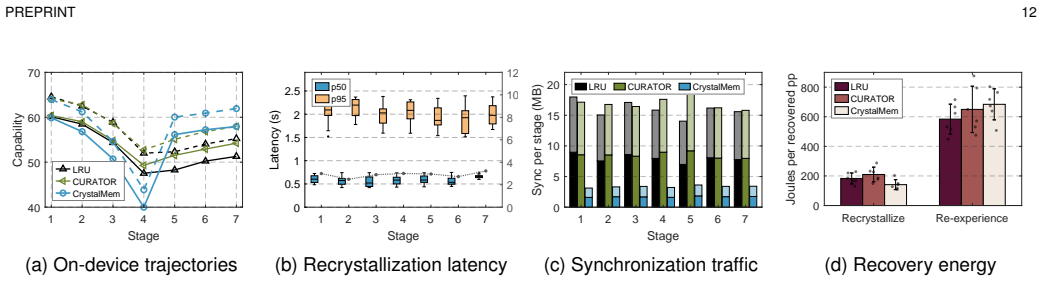
- Recovery by regeneration is energy-cheap relative to re-experience: on a physical edge–cloud deployment, one recovered capability point cost about a fifth of the energy of re-experiencing the episodes, with a roughly 5× reduction in synchronization traffic.
- Dense multi-tenant sharing favors stores that can rebuild: fair-splitting a crystallized store produced an order of magnitude fewer per-tenant service-level violations than fair-splitting a binary store at the same byte fairness.
Where Pith is reading between the lines
- All headline numbers sit on a single fixed budget path (a one-cycle 1→0.75→0.5→0.25→0.5→0.75→1 curve); sweeping trough depth, recovery slope, and cycle count is an obvious next test, and deeper or repeated squeezes might widen the residual deficit faster than the paper's boundary conditions suggest.
- The deficit-floor theorem probably generalizes: any policy that discards reconstruction material — including learned one-way compression — should inherit a version of the same bound, making hysteresis a general property of non-reversible memory rather than a defect of binary retention.
- The verification gate is a reusable pattern: any system that stores degraded representations to be rebuilt later (paged caches, distilled models, shared context stores) could adopt invariant-checked regeneration to prevent silent degradation.
- In the ablation, replacing the influence signal with recency cost only 1.3 pp on average, so the learned estimator's real advantage may be smaller than the headline margin, and a cheaper surrogate may suffice in lower-noise environments.
Editorial analysis
A structured set of objections, weighed in public.
Referee Report
Summary. The paper identifies a phenomenon it calls memory hysteresis in LLM-agent memory under elastic byte budgets: after a budget squeeze-and-recover cycle, agent capability does not return to its pre-squeeze level. It formalizes this with a loop-area metric and a residual-deficit metric, proves a lower bound on residual deficit for any keep-or-drop policy (Proposition 3), and proposes CrystalMem, a memory sidecar that demotes entries along a four-state fidelity ladder, orders demotions by advantage-weighted influence with dependency coupling, and recovers capability via verified recrystallization under byte and compute caps. The evaluation covers seven environments, up to seventeen methods/configurations, six backbones, multi-tenant serving, and a physical edge-cloud testbed, reporting that CrystalMem achieves the highest restored capability in all settings and matches a fixed full-provision baseline at a 50% byte budget.
Significance. If the results hold, the paper makes a useful conceptual and engineering contribution: it shows that memory management for self-evolving agents is path-dependent under elastic budgets, gives a simple but non-vacuous lower bound for deletion-only policies, and proposes a practical reversible-ladder design with verification-gated promotion. The theoretical floor is clean and the empirical coverage is unusually broad, including an out-of-set BabyAI check, per-backbone sweeps, multi-tenant SLO measurements, and a physical deployment. The paper is also honest about the idealized status of its loop-closure proposition. The main reservations are empirical robustness: nearly all headline numbers are measured under a single fixed budget schedule, and the loop-closure guarantee rests on assumptions that the paper's own measurements show are violated in practice.
major comments (4)
- [Definition 1; Sections 5.2-5.6] All empirical claims about hysteresis, residual deficit, 50%-budget matching, and loop closure are measured on the single schedule b=(1,0.75,0.5,0.25,0.5,0.75,1). The theory in Proposition 3 is path-general, but the measured support for the central design claim is not. No experiment varies the schedule's shape, trough depth, recovery speed, or cycle count, so we do not know whether the 0.5pp mean deficit and the method ordering survive under deeper, repeated, or asymmetric budget paths. This is load-bearing because the paper's practical claim is that CrystalMem 'closes the loop' for elastic budgets in general, not just for one seven-stage ladder. Please add sensitivity experiments over budget-path families and clarify in the conclusions which claims are path-specific.
- [Section 4.4, Proposition 6; Figure 6(c); Table 4] Proposition 6 assumes no bottom-rung eviction, exact regeneration, no false rejections, and caps that admit all candidates. The paper's own measurements contradict these assumptions: Figure 6(c) reports gate rejection rates up to 27.5% for TRACE-origin reconstructions, admitted reconstructions recover about 90% of retrieval utility rather than full utility, and Table 4 shows that with a 0% recrystallization cap the deficit is 6.5pp, i.e., loop closure is not structural but depends on the compute cap. The measured 0.5pp deficit is strong evidence, but it is not a validation of Proposition 6. Please either relax the proposition to account for imperfect regeneration and rejections, or clearly separate the idealized formal statement from the empirical claim and provide a robustness bound showing how rejection rate and compute cap affect the achievable deficit.
- [Section 3.3, Proposition 3; Section 5.3, Figure 6(d)] The residual-deficit bound in Eq. (4) is stated for the difference between the terminal capability of a squeezed run and a counterfactual run with b_s ≡ 1. The empirical deficit D_m in Definition 2 is normalized against C^1_m, the first stage of the squeezed run. Figure 6(d) compares 'measured deficits' to the 'estimated bound' of Proposition 3, but the text does not state whether the measured quantity is C^1_m - C^S_m or the counterfactual difference tilde-C - C^S_m. If the former is used, the comparison is not a direct test of Proposition 3 because C^1_m is not necessarily equal to the constant-budget capability tilde-C. Please state the anchor explicitly, report the constant-budget terminal capability, and if the two anchors differ significantly, adjust the validation and the text around Figure 6(d).
- [Sections 5.2-5.4; Tables 2, 4, 5] The paper does not report statistical significance tests or confidence intervals for the headline comparisons. The standard deviations in Table 2 are small, and the +4.6pp average gain over R3Mem appears robust, but for the per-environment and per-backbone claims (e.g., 'never below +3.4pp', 'CrystalMem holds its area at or below 0.014 on all six scales') pairwise significance tests or effect-size estimates would be more convincing. This is not a blocker, but it would strengthen the paper's quantitative claims.
minor comments (5)
- [Abstract/Page 1] The abstract and title page contain 'CrystallizedMem ory' with an apparent line-break artifact; please fix the spacing.
- [Section 4.1 heading] The heading 'CRYSTALMEMDESIGN' is missing a space; should read 'CRYSTALMEM DESIGN'.
- [Table 6] The sentence 'the gap over CURATOR-fair grows from 14 to 28 to 40pp as N goes 2 to 8' is unclear: the table reports SLO violation percentages, not capability gaps. Please clarify what 'gap' refers to and make the numbers consistent with the table.
- [Figure 6(d)] The figure would benefit from a description of how the predicted lower bound is estimated from the measured influence weights and re-observation probabilities. A short paragraph or appendix would help reproducibility.
- [Section 5.1] The paper says 'seventeen methods' in the abstract, but the comparison section lists fifteen baselines plus two CrystalMem configurations. Counting keep-all as a method or excluding CrystalMem-lite makes the number unclear; please align the count between the abstract and Section 5.
Circularity Check
No significant circularity: the theoretical floor is a theorem from explicit assumptions, and all empirical claims are measured rather than fitted.
full rationale
The derivation chain is self-contained. Proposition 3 is proven from Assumptions 1–2 (bounded re-observation and additive terminal utility) and then validated against seven measured binary policies (Fig. 6(d)), rather than being fit to them. CrystalMem is an engineered system whose components (energy schedule, influence estimator, verification gate) are ablated in Table 4 and shown to be non-redundant. Proposition 6 is explicitly labeled 'only the last one is idealized' and its assumptions (no bottom-rung eviction, exact regeneration, no false rejections) are stated, so it functions as a conditional lemma rather than as the evidence for the measured deficit of 0.5 pp; that evidence is Table 2. The fixed budget schedule of Definition 1 means the generality of the empirical 'loop closure' is limited to that cycle, but this is a sensitivity/robustness limitation, not a circular step. Self-citations such as [11] are used as comparison baselines and ablation targets, not as load-bearing justification for the central claims. No equation or fitted parameter reduces by construction to its own input.
Axiom & Free-Parameter Ledger
free parameters (6)
- tau (capability-cost conversion) =
not reported
- rho (compute cap fraction) =
10% default
- gamma (influence averaging horizon) =
not reported
- lambda (dependency coupling strength) =
not reported
- K=4 ladder states with per-state byte/fidelity/regen values =
r_k, mu_k(e), c_k chosen by design
- per-entry invariants h_e =
key spans, entity tuples, outcome facts
axioms (4)
- domain assumption Assumption 1: each evicted entry is re-supplied by the input stream with probability at most p_e < 1 during recovery.
- domain assumption Assumption 2: terminal capability is additive over entries, with per-entry marginal utility u_e >= 0.
- ad hoc to paper Proposition 6 hypotheses: no bottom-rung eviction occurs, R restores each promoted residue to full utility, V has no false rejections, and the caps admit all candidates.
- domain assumption Influence estimator (Eq. 8) reflects true marginal utility u_e.
invented entities (2)
-
crystallization-energy schedule / crystallization front
no independent evidence
-
residue z_e and invariant set h_e per demoted entry
no independent evidence
Cite this review
Pith. "Pith review of CrystalMem: Elastic Memory for Self-Evolving LLM Agents via Knowledge Crystallization." pith.science (2026). https://pith.science/paper/QGOZ5CTV
@misc{pith2026260800303,
  author       = {Pith},
  title        = {Pith review of: CrystalMem: Elastic Memory for Self-Evolving LLM Agents via Knowledge Crystallization},
  year         = {2026},
  howpublished = {\url{https://pith.science/paper/QGOZ5CTV}},
  note         = {Machine review of arXiv:2608.00303}
}
read the original abstract
Memory for self-evolving large language model (LLM) agents is often provisioned as if its byte budget only grows. Cloud platforms, however, adjust quotas with load and cost, and we show that capability does not follow the budget back up: after a squeeze-and-recover cycle, the agent settles below its pre-squeeze level, a gap we call memory hysteresis. The cause is structural. Deletion and one-way compression discard the material needed for later rebuilding, and we prove that any policy that only keeps or drops entries carries a residual-deficit floor. We propose CrystalMem (Crystallized Memory), an elastic memory sidecar that demotes entries across four fidelity states under a crystallization-energy schedule, orders demotions by advantage-weighted influence with dependency coupling, and recovers capability through verified recrystallization under explicit compute and byte caps. Across seven environments, seventeen methods, and six backbones, with multi-tenant serving and a physical edge-cloud deployment, CrystalMem achieves the highest restored capability in every setting and closes the loop left open by every baseline. From a 50% byte budget, CrystalMem matches the strongest budgeted baseline at full provision on every environment; at equal budgets, it leads by +4.6 pp on average.
Figures


Reference graph
Works this paper leans on
-
[1]
Memory for Autonomous LLM Agents: Mechanisms, Eval- uation, and Emerging Frontiers,
P . Du, “Memory for Autonomous LLM Agents: Mechanisms, Eval- uation, and Emerging Frontiers,” arXiv preprint arXiv:2603.07670, 2026
arXiv 2026
-
[2]
A Review of Continual Learning in Edge AI,
B. Wu, Z. Ding, and J. Huang, “A Review of Continual Learning in Edge AI,”IEEE Transactions on Network Science and Engineering, vol. 13, pp. 6571–6588, 2026
2026
-
[3]
Voyager: An Open-Ended Embodied Agent with Large Language Models,
G. Wang, Y. Xie, Y. Jianget al., “Voyager: An Open-Ended Embodied Agent with Large Language Models,” arXiv preprint arXiv:2305.16291, 2023
Pith/arXiv arXiv 2023
-
[4]
ReasoningBank: Scaling Agent Self-Evolving with Reasoning Memory,
S. Ouyang, J. Yan, I.-H. Hsuet al., “ReasoningBank: Scaling Agent Self-Evolving with Reasoning Memory,” inInternational Conference on Learning Representations, 2026
2026
-
[5]
Shared Spatial Memory Through Predictive Coding,
Z. Fang, Y. Guo, Y. Zhanget al., “Shared Spatial Memory Through Predictive Coding,” arXiv preprint arXiv:2511.04235, 2025
arXiv 2025
-
[6]
Lifecycle-Aware Federated Contin- ual Learning in Mobile Autonomous Systems,
B. Wu and J. Huang, “Lifecycle-Aware Federated Contin- ual Learning in Mobile Autonomous Systems,” arXiv preprint arXiv:2604.20745, 2026
Pith/arXiv arXiv 2026
-
[7]
Combating Knowledge Diversity and Catastrophic Forgetting in UAV-Assisted Collabo- rative Vehicular Learning: A Game-Theoretic Approach,
Z. Ding, J. Huang, Y. Zhao, and Z. Cai, “Combating Knowledge Diversity and Catastrophic Forgetting in UAV-Assisted Collabo- rative Vehicular Learning: A Game-Theoretic Approach,”ACM Transactions on Autonomous and Adaptive Systems, 2026
2026
-
[8]
MemGPT: Towards LLMs as Operating Systems,
C. Packer, S. Wooders, K. Linet al., “MemGPT: Towards LLMs as Operating Systems,” inProceedings of the Conference on Language Modeling, 2024
2024
-
[9]
Mem0: Building Production-Ready AI Agents with Scalable Long-Term Memory,
P . Chhikara, D. Khant, S. Aryanet al., “Mem0: Building Production-Ready AI Agents with Scalable Long-Term Memory,” arXiv preprint arXiv:2504.19413, 2025
Pith/arXiv arXiv 2025
-
[10]
Memory OS of AI Agent,
J. Kang, M. Ji, Z. Zhao, and T. Bai, “Memory OS of AI Agent,” in Proceedings of the 2025 Conference on Empirical Methods in Natural Language Processing, 2025, pp. 25 972–25 981
2025
-
[11]
Forget to Improve: On-Device LLM-Agent Continual Learning via Budget-Curated Memory,
B. Wu, Z. Ding, J. Huang, and Y. Zhao, “Forget to Improve: On-Device LLM-Agent Continual Learning via Budget-Curated Memory,” arXiv preprint arXiv:2606.25115, 2026
Pith/arXiv arXiv 2026
-
[12]
Agentic Memory: Learning Uni- fied Long-Term and Short-Term Memory Management for LLM Agents,
Y. Yu, L. Yao, Y. Xieet al., “Agentic Memory: Learning Uni- fied Long-Term and Short-Term Memory Management for LLM Agents,” arXiv preprint arXiv:2601.01885, 2026
Pith/arXiv arXiv 2026
-
[13]
EASE: Federated Multimodal Unlearning via Entanglement-Aware Anchor Closure,
Z. Ding, B. Wu, and J. Huang, “EASE: Federated Multimodal Unlearning via Entanglement-Aware Anchor Closure,” arXiv preprint arXiv:2605.00733, 2026
Pith/arXiv arXiv 2026
-
[14]
Toward Trustworthy Federated Unlearn- ing for Mobile Autonomous Systems,
Z. Ding and J. Huang, “Toward Trustworthy Federated Unlearn- ing for Mobile Autonomous Systems,”IEEE Network, 2026
2026
-
[15]
SCALE: Sensitivity-Aware Fed- erated Unlearning with Information Freshness Optimization for Mobile Edge Computing,
Z. Ding, B. Wu, and J. Huang, “SCALE: Sensitivity-Aware Fed- erated Unlearning with Information Freshness Optimization for Mobile Edge Computing,” inProceedings of the IEEE International Conference on Distributed Computing Systems, 2026
2026
-
[16]
Temporal-Aware GPU Resource Alloca- tion for Distributed LLM Inference via Reinforcement Learning,
C. Du, Z. Yu, H. Xuet al., “Temporal-Aware GPU Resource Alloca- tion for Distributed LLM Inference via Reinforcement Learning,” IEEE Transactions on Cloud Computing, 2026
2026
-
[17]
MAP: GPU Resource Planning for Multi-Agent Systems with Stochastic and Verbose Outputs,
Q. Zhang, M. Li, Q. Liet al., “MAP: GPU Resource Planning for Multi-Agent Systems with Stochastic and Verbose Outputs,”IEEE Transactions on Cloud Computing, 2026
2026
-
[18]
Inference-Time Budget Control for LLM Search Agents,
Z. Fang, S. F. Hu, Z. Changet al., “Inference-Time Budget Control for LLM Search Agents,” arXiv preprint arXiv:2605.05701, 2026
Pith/arXiv arXiv 2026
-
[19]
Combining Federated Learning and Edge Computing Toward Ubiquitous Intelligence in 6G Net- work: Challenges, Recent Advances, and Future Directions,
Q. Duan, J. Huang, S. Huet al., “Combining Federated Learning and Edge Computing Toward Ubiquitous Intelligence in 6G Net- work: Challenges, Recent Advances, and Future Directions,”IEEE Communications Surveys & Tutorials, vol. 25, no. 4, pp. 2892–2950, 2023
2023
-
[20]
A Fast UAV Trajectory Plan- ning Framework in RIS-Assisted Communication Systems With Accelerated Learning via Multithreading and Federating,
J. Huang, B. Wu, Q. Duanet al., “A Fast UAV Trajectory Plan- ning Framework in RIS-Assisted Communication Systems With Accelerated Learning via Multithreading and Federating,”IEEE Transactions on Mobile Computing, vol. 24, no. 8, pp. 6870–6885, 2025
2025
-
[21]
Z. Ding, B. Wu, J. Huang, and S. Mao, “Application-Aware Twin- in-the-Loop Planning for Federated Split Learning over Wireless Edge Networks,” arXiv preprint arXiv:2604.26105, 2026. PREPRINT 12 1 2 3 4 5 6 7Stage 40 50 60 70CapabilityLRUCURATORCrystalMem (a) On-device trajectories 1 2 3 4 5 6 7Stage 0 0.5 1 1.5 2 2.5Latency (s) 0 2 4 6 8 10 12p50p95 (b) R...
Pith/arXiv arXiv 2026
-
[22]
Enhancing Vehicular Platooning With Wireless Federated Learning: A Resource-Aware Control Framework,
B. Wu, J. Huang, Q. Duanet al., “Enhancing Vehicular Platooning With Wireless Federated Learning: A Resource-Aware Control Framework,”IEEE Transactions on Networking, vol. 34, pp. 1479– 1494, 2026
2026
-
[23]
Efficient Memory Management for Large Language Model Serving with PagedAttention,
W. Kwon, Z. Li, S. Zhuanget al., “Efficient Memory Management for Large Language Model Serving with PagedAttention,” in Proceedings of the ACM Symposium on Operating Systems Principles, 2023, pp. 611–626
2023
-
[24]
Human- Inspired Memory Architecture for LLM Agents,
D. Kerestecioglu, A. Robsky, C. Vasterset al., “Human- Inspired Memory Architecture for LLM Agents,” arXiv preprint arXiv:2605.08538, 2026
Pith/arXiv arXiv 2026
-
[25]
R 3Mem: Bridging Memory Retention and Retrieval via Reversible Compression,
X. Wang, S. Wang, Y. Zhu, and B. Liu, “R 3Mem: Bridging Memory Retention and Retrieval via Reversible Compression,” inFindings of the Association for Computational Linguistics: ACL 2025, 2025, pp. 4541–4557
2025
-
[26]
From Alpha to Omega: Lifecycle- Aware Forgetting Defense in Federated Continual Learning for Planetary Exploration,
B. Wu, J. Huang, and Y. Zhao, “From Alpha to Omega: Lifecycle- Aware Forgetting Defense in Federated Continual Learning for Planetary Exploration,” inProceedings of the IEEE International Conference on Distributed Computing Systems, 2026
2026
-
[27]
C. V . K. Alla, H. N. Gaddam, and M. Kommi, “BudgetMem: Learn- ing Selective Memory Policies for Cost-Efficient Long-Context Processing in Language Models,” arXiv preprint arXiv:2511.04919, 2025
arXiv 2025
-
[28]
Securing Smart Agri- culture with Communication-Efficient Federated Unlearning,
U. Pudasaini, Z. Ding, and J. Huang, “Securing Smart Agri- culture with Communication-Efficient Federated Unlearning,” in Proceedings of the IEEE International Conference on High Performance Switching and Routing, 2026, pp. 1–8
2026
-
[29]
A-MEM: Agentic Memory for LLM Agents,
W. Xu, Z. Liang, K. Meiet al., “A-MEM: Agentic Memory for LLM Agents,” inAdvances in Neural Information Processing Systems, 2025
2025
-
[30]
MEM1: Learning to Synergize Memory and Reasoning for Efficient Long-Horizon Agents,
Z. Zhou, A. Qu, Z. Wuet al., “MEM1: Learning to Synergize Memory and Reasoning for Efficient Long-Horizon Agents,” in International Conference on Learning Representations, 2026
2026
-
[31]
S. Alqithami, “Forgetful but Faithful: A Cognitive Memory Ar- chitecture and Benchmark for Privacy-Aware Generative Agents,” arXiv preprint arXiv:2512.12856, 2025
arXiv 2025
-
[32]
RecMem: Recurrence-based Mem- ory Consolidation for Efficient and Effective Long-Running LLM Agents,
Z. Dai, S. Deng, S. Guanet al., “RecMem: Recurrence-based Mem- ory Consolidation for Efficient and Effective Long-Running LLM Agents,” inFindings of the Association for Computational Linguistics: ACL 2026, 2026, pp. 32 353–32 376
2026
-
[33]
Adaptive Memory Admission Control for LLM Agents,
G. Zhang, W. Jiang, X. Wanget al., “Adaptive Memory Admission Control for LLM Agents,” inInternational Conference on Learning Representations Workshop on Memory for LLM-Based Agentic Systems, 2026
2026
-
[34]
Sleep-time Compute: Beyond Inference Scaling at Test-time,
K. Lin, C. Snell, Y. Wanget al., “Sleep-time Compute: Beyond Inference Scaling at Test-time,” arXiv preprint arXiv:2504.13171, 2025
Pith/arXiv arXiv 2025
-
[35]
Governed Shared Memory for Multi-Agent LLM Systems,
Y. Margalit, N. Cohen-Inger, E. Avramet al., “Governed Shared Memory for Multi-Agent LLM Systems,” arXiv preprint arXiv:2606.24535, 2026
Pith/arXiv arXiv 2026
-
[36]
Evaluating Memory in LLM Agents via Incremental Multi-Turn Interactions,
Y. Hu, Y. Wang, and J. McAuley, “Evaluating Memory in LLM Agents via Incremental Multi-Turn Interactions,” inInternational Conference on Learning Representations, 2026
2026
-
[37]
Reclaim Evaluation: A Lossy Memory Is Worse Than an Empty One,
A. Kwon, “Reclaim Evaluation: A Lossy Memory Is Worse Than an Empty One,” arXiv preprint arXiv:2606.25449, 2026
Pith/arXiv arXiv 2026
-
[38]
‘X of Information’ Continuum: A Sur- vey on AI-Driven Multi-Dimensional Metrics for Next-Generation Networked Systems,
B. Wu, J. Huang, and S. Yu, “‘X of Information’ Continuum: A Sur- vey on AI-Driven Multi-Dimensional Metrics for Next-Generation Networked Systems,”IEEE Communications Surveys & Tutorials, vol. 28, pp. 5307–5344, 2026
2026
-
[39]
AoI-Aware Resource Manage- ment for Smart Health via Deep Reinforcement Learning,
B. Wu, Z. Cai, W. Wu, and X. Yin, “AoI-Aware Resource Manage- ment for Smart Health via Deep Reinforcement Learning,”IEEE Access, vol. 11, pp. 81 180–81 195, 2023
2023
-
[40]
Real-Time Intelligent Healthcare Enabled by Federated Digital Twins With AoI Optimization,
B. Wu, J. Huang, and Q. Duan, “Real-Time Intelligent Healthcare Enabled by Federated Digital Twins With AoI Optimization,”IEEE Network, vol. 40, no. 2, pp. 184–191, 2026
2026
-
[41]
Prioritized Information Bottleneck Theoretic Framework With Distributed Online Learning for Edge Video Analytics,
Z. Fang, S. Hu, J. Wanget al., “Prioritized Information Bottleneck Theoretic Framework With Distributed Online Learning for Edge Video Analytics,”IEEE Transactions on Networking, vol. 33, no. 3, pp. 1203–1219, 2025
2025
-
[42]
Transformer-Based Dynamic Resource Allocation for Multi-Carrier NOMA Systems,
L. Dong, J. Huang, and R. W. Heath, “Transformer-Based Dynamic Resource Allocation for Multi-Carrier NOMA Systems,”IEEE Transactions on Cognitive Communications and Networking, vol. 12, pp. 4926–4941, 2026
2026
-
[43]
A Stochastic Geometry-Based Analysis of SWIPT-Assisted Underlaid Device-to-Device Energy Harvesting,
C.-C. Xing, Z. Ding, and J. Huang, “A Stochastic Geometry-Based Analysis of SWIPT-Assisted Underlaid Device-to-Device Energy Harvesting,”ACM SIGAPP Applied Computing Review, vol. 25, no. 4, pp. 18–34, 2025
2025
-
[44]
A Fault-Tolerant and Energy-Efficient Design of a Network Switch Based on a Quantum-Based Nano-Communication Technique,
D. Pan, B.-N. Wu, Y.-L. Sun, and Y.-P . Xu, “A Fault-Tolerant and Energy-Efficient Design of a Network Switch Based on a Quantum-Based Nano-Communication Technique,”Sustainable Computing: Informatics and Systems, vol. 37, p. 100827, 2023
2023
-
[45]
PRISM: Exposing and Resolving Spurious Isolation in Federated Multimodal Continual Learning,
B. Wu, Z. Ding, and J. Huang, “PRISM: Exposing and Resolving Spurious Isolation in Federated Multimodal Continual Learning,” arXiv preprint arXiv:2605.01061, 2026
Pith/arXiv arXiv 2026
-
[46]
——, “RELIEF: Turning Missing Modalities into Training Acceler- ation for Federated Learning on Heterogeneous IoT Edge,” arXiv preprint arXiv:2604.04243, 2026
Pith/arXiv arXiv 2026
-
[47]
Harness VLA: Steering Frozen VLAs into Reliable Manipulation Primitives via Memory-Guided Agents,
Y. Zhang, H. Zhang, F. Gaoet al., “Harness VLA: Steering Frozen VLAs into Reliable Manipulation Primitives via Memory-Guided Agents,” arXiv preprint arXiv:2607.08448, 2026
Pith/arXiv arXiv 2026
-
[48]
Z. Z. Wang, J. Mao, D. Fried, and G. Neubig, “Agent Workflow Memory,” arXiv preprint arXiv:2409.07429, 2024
Pith/arXiv arXiv 2024
-
[49]
EvolveR: Self-Evolving LLM Agents through an Experience-Driven Lifecycle,
R. Wu, X. Wang, J. Meiet al., “EvolveR: Self-Evolving LLM Agents through an Experience-Driven Lifecycle,” inProceedings of the International Conference on Machine Learning, 2026
2026
-
[50]
PolySkill: Learning Generalizable Skills Through Polymorphic Abstraction,
S. Yu, G. Li, W. Shi, and P . Qi, “PolySkill: Learning Generalizable Skills Through Polymorphic Abstraction,” inInternational Confer- ence on Learning Representations, 2026
2026
-
[51]
AutoRefine: From Trajectories to Reusable Expertise for Continual LLM Agent Refinement,
L. Qiu, Z. Gao, J. Chenet al., “AutoRefine: From Trajectories to Reusable Expertise for Continual LLM Agent Refinement,” arXiv preprint arXiv:2601.22758, 2026
arXiv 2026
-
[52]
Memory as Action: Autonomous Context Curation for Long-Horizon Agentic Tasks,
Y. Zhang, J. Shu, Y. Maet al., “Memory as Action: Autonomous Context Curation for Long-Horizon Agentic Tasks,” inFindings of the Association for Computational Linguistics: ACL 2026, 2026, pp. 19 149–19 164
2026
-
[53]
Remember the Decision, Not the Description: A Rate-Distortion Framework for Agent Memory,
M. Zou, Z. Guo, L. Lianget al., “Remember the Decision, Not the Description: A Rate-Distortion Framework for Agent Memory,” arXiv preprint arXiv:2605.10870, 2026
Pith/arXiv arXiv 2026
-
[54]
What to Keep, What to Forget: A Rate-Distortion View of Memory Compaction in LLMs and Agents,
A. G. Colaco and N. Lahjouji, “What to Keep, What to Forget: A Rate-Distortion View of Memory Compaction in LLMs and Agents,” arXiv preprint arXiv:2607.08032, 2026
Pith/arXiv arXiv 2026
-
[55]
Experience Compression Spec- trum: Unifying Memory, Skills, and Rules in LLM Agents,
X. Zhang, G. Wang, Y. Cuiet al., “Experience Compression Spec- trum: Unifying Memory, Skills, and Rules in LLM Agents,” arXiv preprint arXiv:2604.15877, 2026. PREPRINT 13
Pith/arXiv arXiv 2026
-
[56]
Darwinian Memory: A Training- Free Self-Regulating Memory System for GUI Agent Evolution,
H. Mi, Y. Feng, W. Luet al., “Darwinian Memory: A Training- Free Self-Regulating Memory System for GUI Agent Evolution,” inProceedings of the International Conference on Machine Learning, 2026
2026
-
[57]
R-ACP: Real-Time Adaptive Collaborative Perception Leveraging Robust Task-Oriented Com- munications,
Z. Fang, J. Wang, Y. Maet al., “R-ACP: Real-Time Adaptive Collaborative Perception Leveraging Robust Task-Oriented Com- munications,”IEEE Journal on Selected Areas in Communications, vol. 43, no. 12, pp. 4215–4230, 2025
2025
-
[58]
Task-Oriented Communications for Visual Navigation with Edge-Aerial Collaboration in Low Al- titude Economy,
Z. Fang, Z. Liu, J. Wanget al., “Task-Oriented Communications for Visual Navigation with Edge-Aerial Collaboration in Low Al- titude Economy,” inProceedings of the IEEE Global Communications Conference, 2026
2026
-
[59]
FedTD3: An Accelerated Learning Approach for UAV Trajectory Planning,
B. Wu, J. Huang, and Q. Duan, “FedTD3: An Accelerated Learning Approach for UAV Trajectory Planning,” inProceedings of the International Conference on Wireless Artificial Intelligent Computing Systems and Applications, 2025, pp. 13–24
2025
-
[60]
Reinforcement Learning-Based Energy-Aware Coverage Path Planning for Pre- cision Agriculture,
B. Wu, Z. Ding, L. Ostigaard, and J. Huang, “Reinforcement Learning-Based Energy-Aware Coverage Path Planning for Pre- cision Agriculture,” inProceedings of the ACM Research on Adaptive and Convergent Systems, 2025, pp. 1–8
2025
-
[61]
A Dual-Level Game-Theoretic Approach for Collaborative Learning in UAV-Assisted Heteroge- neous Vehicle Networks,
Z. Ding, J. Huang, Q. Duanet al., “A Dual-Level Game-Theoretic Approach for Collaborative Learning in UAV-Assisted Heteroge- neous Vehicle Networks,” inProceedings of the IEEE International Performance, Computing, and Communications Conference, 2025, pp. 1–8
2025
-
[62]
Learning to Defend: A Multi- Agent Reinforcement Learning Framework for Stackelberg Secu- rity Game in Mobile Edge Computing,
Z. Ding, J. Huang, and J. Qi, “Learning to Defend: A Multi- Agent Reinforcement Learning Framework for Stackelberg Secu- rity Game in Mobile Edge Computing,” inProceedings of the Inter- national Conference on Computing, Networking and Communications, 2026
2026
-
[63]
Model-Free Cooperative Optimal Output Regulation for Linear Discrete-Time Multi-Agent Systems Using Reinforcement Learning,
B. Wu and W. Wu, “Model-Free Cooperative Optimal Output Regulation for Linear Discrete-Time Multi-Agent Systems Using Reinforcement Learning,”Mathematical Problems in Engineering, vol. 2023, no. 1, p. 6350647, 2023
2023
-
[64]
Neuromem: A Granular Decompo- sition of the Streaming Lifecycle in External Memory for LLMs,
R. Zhang, X. Li, T. Xuet al., “Neuromem: A Granular Decompo- sition of the Streaming Lifecycle in External Memory for LLMs,” arXiv preprint arXiv:2602.13967, 2026
arXiv 2026
-
[65]
Evaluating Very Long- Term Conversational Memory of LLM Agents,
A. Maharana, D.-H. Lee, S. Tulyakovet al., “Evaluating Very Long- Term Conversational Memory of LLM Agents,” inProceedings of the 62nd Annual Meeting of the Association for Computational Linguistics (Volume 1: Long Papers), 2024, pp. 13 851–13 870
2024
-
[66]
LongMemEval: Benchmarking Chat Assistants on Long-Term Interactive Memory,
D. Wu, H. Wang, W. Yuet al., “LongMemEval: Benchmarking Chat Assistants on Long-Term Interactive Memory,” inInternational Conference on Learning Representations, 2025
2025
-
[67]
ALFWorld: Aligning Text and Embodied Environments for Interactive Learning,
M. Shridhar, X. Yuan, M.-A. C ˆot´eet al., “ALFWorld: Aligning Text and Embodied Environments for Interactive Learning,” in International Conference on Learning Representations, 2021
2021
-
[68]
WebArena: A Realistic Web Environment for Building Autonomous Agents,
S. Zhou, F. F. Xu, H. Zhuet al., “WebArena: A Realistic Web Environment for Building Autonomous Agents,” inInternational Conference on Learning Representations, 2024
2024
-
[69]
A. Yang, B. Yang, B. Zhanget al., “Qwen2.5 Technical Report,” arXiv preprint arXiv:2412.15115, 2024
Pith/arXiv arXiv 2024
-
[70]
M3-Embedding: Multi-Linguality, Multi-Functionality, Multi-Granularity Text Embeddings Through Self-Knowledge Distillation,
J. Chen, S. Xiao, P . Zhanget al., “M3-Embedding: Multi-Linguality, Multi-Functionality, Multi-Granularity Text Embeddings Through Self-Knowledge Distillation,” inFindings of the Association for Com- putational Linguistics: ACL 2024, 2024, pp. 2318–2335
2024
-
[71]
A. Grattafiori, A. Dubey, A. Jauhriet al., “The Llama 3 Herd of Models,” arXiv preprint arXiv:2407.21783, 2024
Pith/arXiv arXiv 2024
-
[72]
BabyAI: A Platform to Study the Sample Efficiency of Grounded Language Learning,
M. Chevalier-Boisvert, D. Bahdanau, S. Lahlouet al., “BabyAI: A Platform to Study the Sample Efficiency of Grounded Language Learning,” inInternational Conference on Learning Representations, 2019
2019
This paper was first reviewed by deepseek-v4-flash on August 4, 2026.
discussion (0)
Sign in with ORCID, Apple, or X to comment. Anyone can read and Pith papers without signing in.