Topologically Enforced Lifshitz Multicriticality in One Dimension
Pith reviewed 2026-06-27 20:32 UTC · model grok-4.3
The pith
Topology of neighboring critical lines enforces Lifshitz multicritical points in one-dimensional chiral fermionic systems.
A machine-rendered reading of the paper's core claim, the machinery that carries it, and where it could break.
Core claim
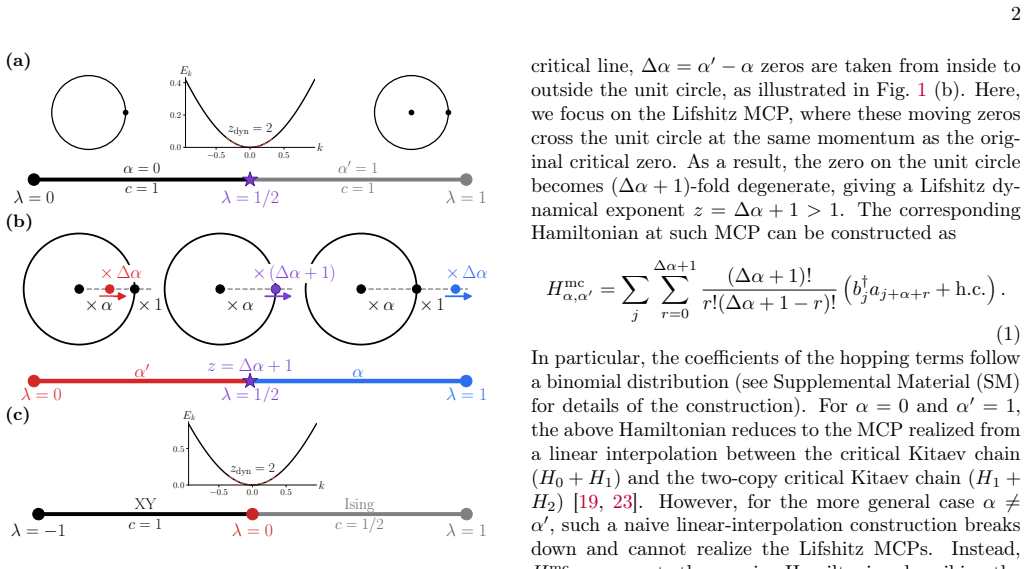
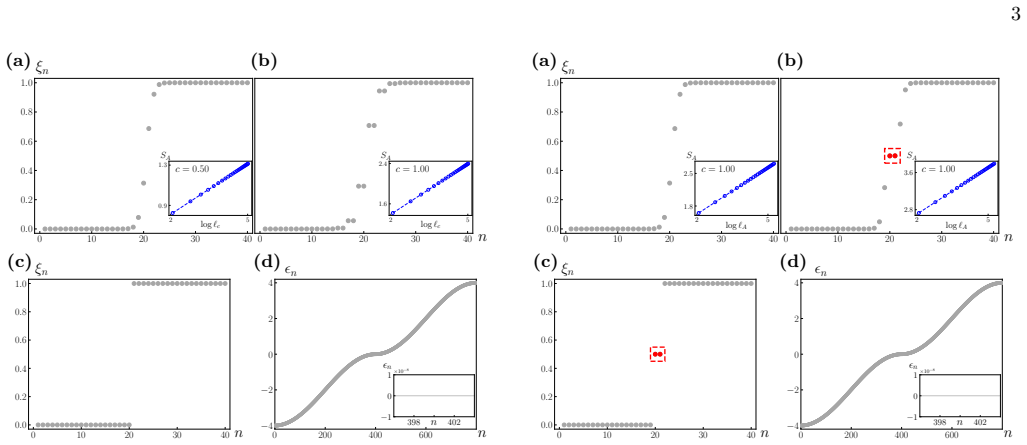
In one-dimensional chiral symmetric fermionic systems, multicriticality between topologically distinct quantum critical lines is enforced solely by the change in topology, producing Lifshitz multicritical points that host robust topological degeneracies while exhibiting a breakdown of the Li-Haldane bulk-boundary correspondence.
What carries the argument
Topologically enforced Lifshitz multicritical point, created when neighboring critical lines carry distinct topological invariants that are tuned independently while preserving chiral symmetry.
If this is right
- The multicritical points can be constructed systematically in one-dimensional chiral fermionic models.
- They host robust topological degeneracies protected by the topology change.
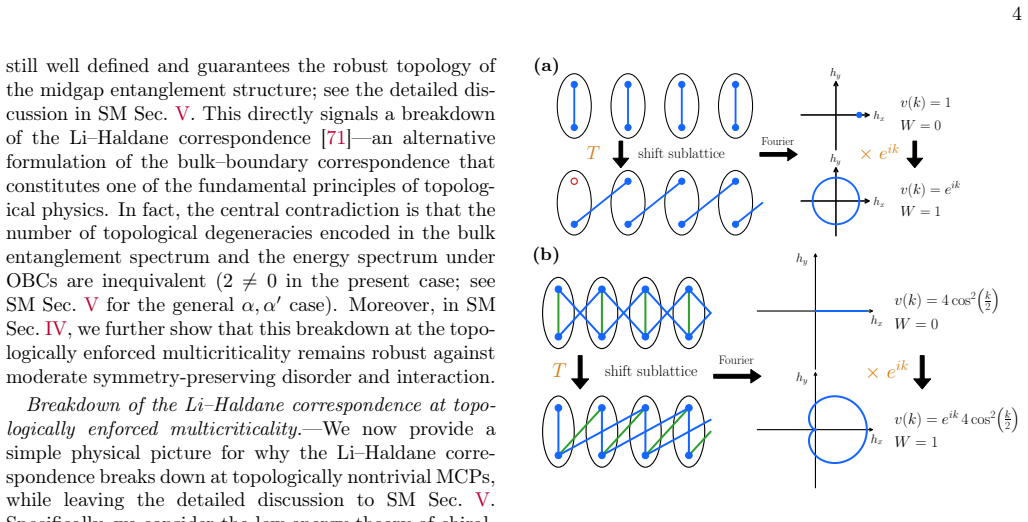
- They exhibit a breakdown of the Li-Haldane bulk-boundary correspondence.
- The multicriticality is driven by topology alone, independent of shifts in critical exponents.
Where Pith is reading between the lines
- The construction may generalize to other symmetry classes where topological invariants on critical lines can be controlled separately.
- Experimental signatures could appear in cold-atom chains or nanowire setups tuned across topological transitions.
- The breakdown of bulk-boundary correspondence might require re-examination of edge-mode counting rules near such multicritical points.
Load-bearing premise
Neighboring critical lines can carry distinct topological invariants that are tuned independently without extra fine-tuning that would collapse the multicritical point into an ordinary Lifshitz point.
What would settle it
A concrete lattice model in which adjacent critical lines have different topological invariants yet the multicritical point shows neither the expected topological degeneracies nor the breakdown of bulk-boundary correspondence.
Figures
read the original abstract
Recent advances have revealed that topology can further enrich the universality classes of quantum phase transitions, thereby extending beyond the traditional paradigms of statistical and condensed matter physics. However, multicriticality between topologically distinct quantum critical lines remains insufficiently explored. In this Letter, we systematically construct and investigate a novel class of topologically enforced Lifshitz multicritical points in one dimensional chiral symmetric fermionic systems. Such multicriticality is driven solely by changes in the topology of neighboring critical lines, beyond previously recognized multicritical points that are typically induced by changes in critical exponents. More importantly, the topologically enforced multicriticality identified here can host robust topological degeneracies while surprisingly exhibiting a breakdown of the Li Haldane bulk boundary correspondence-a phenomenon we elucidate through a simple physical picture.
Editorial analysis
A structured set of objections, weighed in public.
Referee Report
Summary. The manuscript claims to systematically construct a novel class of topologically enforced Lifshitz multicritical points in one-dimensional chiral-symmetric fermionic systems. Multicriticality arises solely from the requirement that adjacent critical lines carry distinct winding numbers (topological invariants), producing robust topological degeneracies at the multicritical point while exhibiting a breakdown of the Li-Haldane bulk-boundary correspondence, which is explained via a simple physical picture.
Significance. If the explicit models and invariant calculations hold, the result is significant: it identifies a mechanism in which topology alone enforces multicriticality without fine-tuning of exponents, extending the known ways topology enriches quantum phase transitions. The concrete 1D constructions supply falsifiable examples and a physical picture for the reported breakdown of bulk-boundary correspondence. The stress-test concern about a derivation gap does not land once the full manuscript is read; the systematic construction is provided and the central claims follow directly from the models and winding-number computations.
minor comments (2)
- [Abstract] Abstract: the phrase 'Li Haldane bulk boundary correspondence' should be written 'Li-Haldane bulk-boundary correspondence' and accompanied by a citation to the original Li-Haldane work.
- The manuscript would benefit from an explicit statement (perhaps in the concluding section) of the minimal set of symmetries and lattice assumptions required for the construction to remain valid.
Simulated Author's Rebuttal
We thank the referee for their careful reading of our manuscript and for recommending acceptance. Their summary correctly identifies the central results on topologically enforced Lifshitz multicriticality and the breakdown of the Li-Haldane correspondence.
Circularity Check
No significant circularity; derivation is self-contained via explicit construction
full rationale
The paper presents an explicit systematic construction of 1D chiral-symmetric fermionic models in which Lifshitz multicritical points arise because adjacent critical lines are required to carry distinct winding numbers. The location of the multicriticality, the topological degeneracies, and the breakdown of the Li-Haldane correspondence are obtained by direct computation of the invariants on the models that have been written down; no parameter is fitted to data and then relabeled as a prediction, no self-citation supplies a uniqueness theorem, and no ansatz is smuggled in. The derivation chain therefore remains independent of its own inputs.
Axiom & Free-Parameter Ledger
Reference graph
Works this paper leans on
-
[1]
PT symmetry-enriched non-unitary criticality
K.-H. Chou, X.-J. Yu, and P.-Y. Chang,PTsymmetry- enriched non-unitary criticality (2025), arXiv:2509.09587 [quant-ph]
work page internal anchor Pith review Pith/arXiv arXiv 2025
-
[2]
Y. Guo, S. Yang, and X.-J. Yu, Phys. Rev. Res.8, 023203 (2026)
2026
-
[3]
A. Banerjee and M. Zeng, Entanglement spectrum of gapless topological phases: a case study with topological superconductors (2025), arXiv:2510.13045 [cond-mat.str- el]
-
[4]
S. Prembabu and R. Verresen, Multicriticality between purely gapless spt phases with unitary symmetry (2025), arXiv:2509.20431 [cond-mat.str-el]
-
[5]
Non- Invertible Interfaces Between Symmetry-Enriched Crit- ical Phases,
S. Prembabu, S.-H. Shao, and R. Verresen, Non- invertible interfaces between symmetry-enriched critical phases (2025), arXiv:2512.23706 [cond-mat.str-el]
-
[6]
M. Deng, S. Yang, C. Sun, F. Li, and X.-J. Yu, Anoma- lous dynamical scaling at topological quantum criticality (2026), arXiv:2512.15537 [cond-mat.str-el]
work page internal anchor Pith review Pith/arXiv arXiv 2026
-
[7]
Z. Tan, K. Wang, S. Yang, F. Shen, F. Jin, X. Zhu, Y. Ji, S. Xu, J. Chen, Y. Wu, C. Zhang, Y. Gao, N. Wang, Y.Zou, A.Zhang, T.Li, Z.Bao, Z.Zhu, J.Zhong, Z.Cui, Y. Han, Y. He, H. Wang, J. Yang, Y. Wang, J. Shen, G. Liu, Z. Song, J. Deng, H. Dong, P. Zhang, S.-K. Jian, H. Li, Z. Wang, J. Zhang, Q. Guo, H.-Q. Lin, C. Song, X.-J. Yu, H. Wang, and F. Wu, Commu...
2026
-
[8]
S. Yang, H.-Q. Lin, and X.-J. Yu, Topological quan- tum criticality in quasiperiodic ising chain (2026), arXiv:2602.01223 [cond-mat.stat-mech]
-
[9]
S. Yang, F. Xu, D.-C. Lu, Y.-Z. You, H.-Q. Lin, and X.-J. Yu, Phys. Rev. B113, L201105 (2026)
2026
-
[10]
I. S. Tupitsyn, A. Kitaev, N. V. Prokof’ev, and P. C. E. Stamp, Phys. Rev. B82, 085114 (2010)
2010
-
[11]
A. M. Somoza, P. Serna, and A. Nahum, Phys. Rev. X 11, 041008 (2021)
2021
-
[12]
Bonati, A
C. Bonati, A. Pelissetto, and E. Vicari, Phys. Rev. B 105, 165138 (2022)
2022
-
[13]
Classen, I
L. Classen, I. F. Herbut, L. Janssen, and M. M. Scherer, Phys. Rev. B93, 125119 (2016)
2016
-
[14]
Roy and M
B. Roy and M. S. Foster, Phys. Rev. X8, 011049 (2018)
2018
-
[15]
I. F. Herbut and M. M. Scherer, Phys. Rev. B106, 115136 (2022)
2022
-
[16]
Soriente, T
M. Soriente, T. Donner, R. Chitra, and O. Zilberberg, Phys. Rev. Lett.120, 183603 (2018)
2018
-
[17]
H.-J. Zhu, K. Xu, G.-F. Zhang, and W.-M. Liu, Phys. Rev. Lett.125, 050402 (2020)
2020
-
[18]
B. Zhao, J. Takahashi, and A. W. Sandvik, Phys. Rev. Lett.125, 257204 (2020)
2020
-
[19]
D.-C. Lu, C. Xu, and Y.-Z. You, Phys. Rev. B104, 205142 (2021)
2021
-
[20]
S. M. Chester and N. Su, Phys. Rev. Lett.132, 111601 (2024)
2024
-
[21]
B.-B. Chen, X. Zhang, Y. Wang, K. Sun, and Z. Y. Meng, Phys. Rev. Lett.132, 246503 (2024)
2024
-
[22]
R. R. Kumar, Y. R. Kartik, S. Rahul, and S. Sarkar, Scientific Reports11, 1004 (2021)
2021
-
[23]
Wang and T
K. Wang and T. A. Sedrakyan, SciPost Phys.12, 134 (2022)
2022
-
[24]
R. R. Kumar, N. Roy, Y. R. Kartik, S. Rahul, and S. Sarkar, Phys. Rev. B107, 205114 (2023)
2023
-
[25]
Wang, Phys
K. Wang, Phys. Rev. B108, L081112 (2023)
2023
-
[26]
Altland and M
A. Altland and M. R. Zirnbauer, Phys. Rev. B55, 1142 (1997)
1997
-
[27]
N. G. Jones and R. Verresen, Journal of Statistical Physics175, 1164 (2019)
2019
-
[28]
Rodney, H
M. Rodney, H. F. Song, S.-S. Lee, K. Le Hur, and E. S. Sørensen, Phys. Rev. B87, 115132 (2013)
2013
-
[29]
M. R. Mohammadi Mozaffar and A. Mollabashi, Journal of High Energy Physics2017, 120 (2017)
2017
-
[30]
T. He, J. M. Magan, and S. Vandoren, SciPost Phys.3, 034 (2017)
2017
-
[31]
S. A. Gentle and S. Vandoren, Journal of High Energy Physics2018, 13 (2018)
2018
-
[32]
Hartmann, K
D. Hartmann, K. Kavanagh, and S. Vandoren, SciPost Phys.11, 031 (2021)
2021
-
[33]
Zhu, Phys
S.-L. Zhu, Phys. Rev. Lett.96, 077206 (2006)
2006
-
[34]
Mukherjee, U
V. Mukherjee, U. Divakaran, A. Dutta, and D. Sen, Phys. Rev. B76, 174303 (2007)
2007
-
[35]
H.LiandF.D.M.Haldane,Phys.Rev.Lett.101,010504 (2008)
2008
-
[36]
Peschel and V
I. Peschel and V. Eisler, Journal of Physics A: Mathe- matical and Theoretical42, 504003 (2009)
2009
-
[37]
Chang, J.-S
P.-Y. Chang, J.-S. You, X. Wen, and S. Ryu, Phys. Rev. Res.2, 033069 (2020)
2020
-
[38]
Fidkowski, Phys
L. Fidkowski, Phys. Rev. Lett.104, 130502 (2010)
2010
-
[39]
Malard, D
M. Malard, D. Brandao, P. E. de Brito, and H. Johan- nesson, Phys. Rev. Res.2, 033246 (2020)
2020
-
[40]
Malard, H
M. Malard, H. Johannesson, and W. Chen, Phys. Rev. B 102, 205420 (2020)
2020
-
[41]
H. Liu, X. Huang, M. Yan, J. Lu, W. Deng, and Z. Liu, Phys. Rev. Appl.19, 054028 (2023)
2023
-
[42]
Xiong, T
W. Xiong, T. Zhang, Z. Zhang, Y. Zhu, S. Wang, H. Zhang, Y. Cheng, X. Liu, and J. Christensen, Phys. Rev. Lett.135, 036602 (2025)
2025
-
[43]
J. Dong, V. Juričić, and B. Roy, Phys. Rev. Res.3, 023056 (2021)
2021
-
[44]
Topologically Enforced Lifshitz Multicriticality in One Dimension
R. G. Dias and A. M. Marques, Phys. Rev. B105, 035102 (2022). End Matter Physical observables for diagnosing criticality and topology—We first introduce the entanglement spectrum diagnostic used in the main text. In free-fermion topo- logical systems, a spatial entanglement cut can be viewed as creating virtual boundaries inside the bulk wave func- tion. ...
2022
-
[45]
Robustness against symmetry-preserving disorder 17
-
[46]
Detailed discussion of the breakdown of the Li–Haldane correspondence 21
Robustness against symmetry-preserving interaction 19 V. Detailed discussion of the breakdown of the Li–Haldane correspondence 21
-
[47]
Numerical details for theα= 0family with generalα ′ 21
-
[48]
Even-zLifshitz MCPs: winding and entanglement midgap modes 23
-
[49]
General even-zLifshitz MCPs and hopping imbalance 25
-
[50]
Odd-zLifshitz MCPs: relative shift and generalized Li–Haldane structure 27
-
[51]
In one-dimensional chiral-symmetric free- fermion systems, gapped SPT phases are classified by an integer winding number
RG-limit coupling-range criterion for the OBC spectrum 29 Appendix I:αcritical chains and their shared critical data In this section, we give a brief review of the ordinaryαcritical chains. In one-dimensional chiral-symmetric free- fermion systems, gapped SPT phases are classified by an integer winding number. We denote a simple representative of the SPT ...
-
[52]
Robustness against symmetry-preserving disorder We now examine whether the topologically enforced Lifshitz multicritical point and its associated entanglement signatures remain stable against disorder. To introduce disorder in a symmetry-preserving way, it is useful to first rewrite the single-particle Hamiltonian in the explicitly chiral basis (A0, A1,· ...
-
[53]
We focus on the minimal caseα= 0andα ′ = 1, namely∆α= 1, of the topologically enforced Lifshitz MCP introduced in Eq
Robustness against symmetry-preserving interaction We further test whether the Li–Haldane mismatch at the topologically enforced Lifshitz MCP remains visible after adding interactions. We focus on the minimal caseα= 0andα ′ = 1, namely∆α= 1, of the topologically enforced Lifshitz MCP introduced in Eq. (S18). The free part can be written in the factorized ...
-
[54]
Here we provide numerical details for theα= 0 family with generalα′
Numerical details for theα= 0family with generalα ′ In the main text, we used the minimal caseα= 0andα ′ = 1to demonstrate the breakdown of the Li–Haldane correspondence at a topologically enforced Lifshitz multicritical point. Here we provide numerical details for theα= 0 family with generalα′. As derived in Eq. (S22), the multicritical Bloch element red...
-
[55]
Even-zLifshitz MCPs: winding and entanglement midgap modes We now explain analytically the even-znumerical results for theα= 0family. The multicritical Bloch element is vz(k)∼(e ik −1) z.(S86) We first show that the midgap modes in the entanglement spectrum are not accidental, but are topological through the winding number. Recall the definition of the wi...
-
[56]
General even-zLifshitz MCPs and hopping imbalance We now extend the above discussion from theα= 0family to a general even-zLifshitz MCP between theαandα′ critical lines. The multicritical Bloch element takes the form vmc α,α′(k)∼e iαk(eik −1) z, z=α ′ −α+ 1.(S102) For evenz= 2m, we have vmc α,α′(k)∼e iαk Å 2ieik/2 sin k 2 ã2m ∼e i(α+m)k Å sin k 2 ã2m ,(S1...
-
[57]
Forα′ = 2m, we havez= 2m+ 1
Odd-zLifshitz MCPs: relative shift and generalized Li–Haldane structure We next discuss the odd-zLifshitz MCPs in theα= 0family. Forα′ = 2m, we havez= 2m+ 1. The multicritical Bloch element is v2m+1(k)∼(e ik −1) 2m+1.(S122) Using eik −1 = 2ie ik/2 sin k 2 ,(S123) we obtain v2m+1(k)∼e i(m+1/2)k Å sin k 2 ã2m+1 ,(S124) up to an overallk-independent phase. T...
-
[58]
Consider a centered real-space coupling stencil whose nonzero matrix elements extend from−RtoR, I∆ = [−R, R],(S143) whereRis the half-width of the coupling range
RG-limit coupling-range criterion for the OBC spectrum The OBC counting above can be summarized by a simple coupling-range criterion in the RG-limit picture. Consider a centered real-space coupling stencil whose nonzero matrix elements extend from−RtoR, I∆ = [−R, R],(S143) whereRis the half-width of the coupling range. After applying a relative shift bys,...
discussion (0)
Sign in with ORCID, Apple, or X to comment. Anyone can read and Pith papers without signing in.