An Agnostic Machine Learning Model of Photosynthetic Habitability
Pith reviewed 2026-06-25 22:49 UTC · model grok-4.3
The pith
Photosynthetic organisms compensate for lower stellar flux by evolving larger light-harvesting structures, so viability declines linearly rather than quadratically with distance.
A machine-rendered reading of the paper's core claim, the machinery that carries it, and where it could break.
Core claim
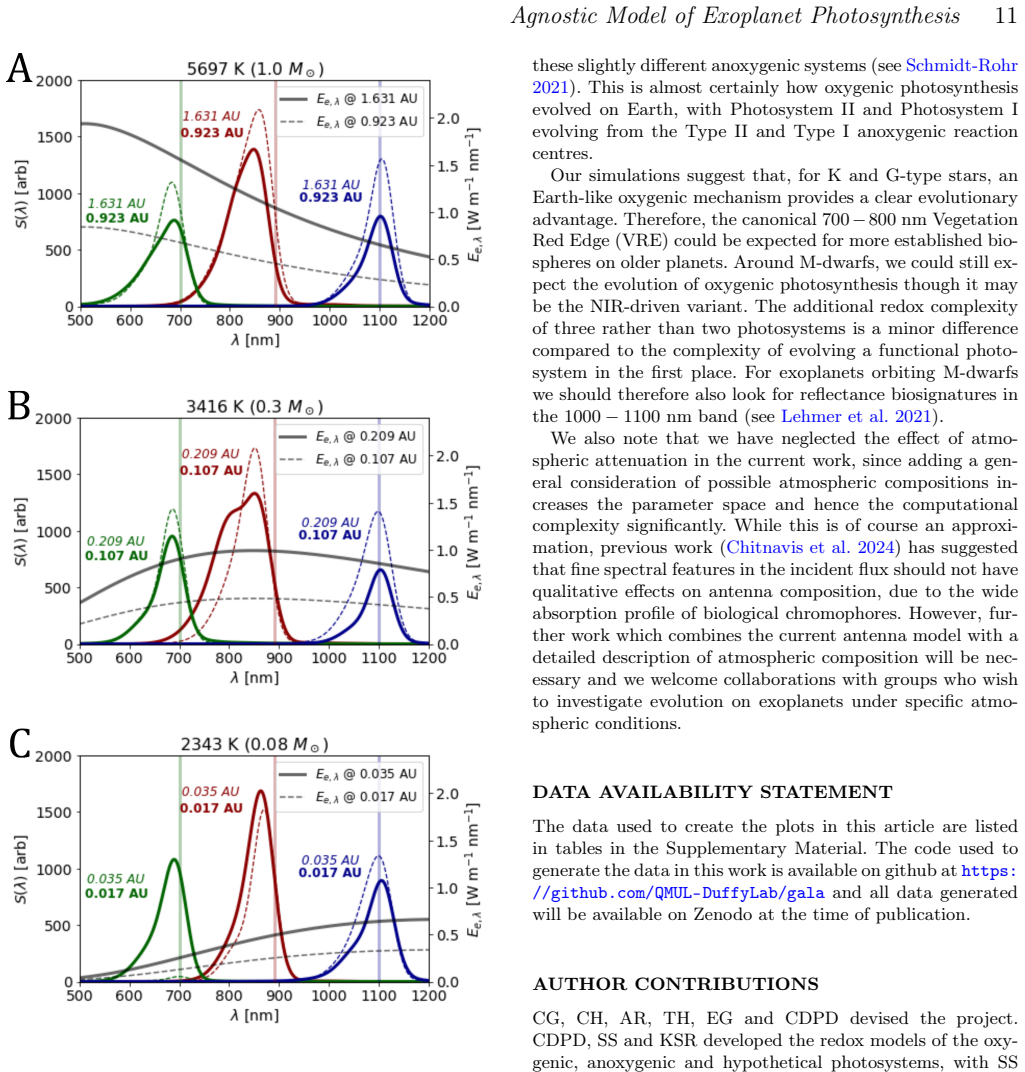
An agnostic model of photosynthesis, optimized by genetic algorithm without reference to Earth organisms, predicts that photosynthetic viability declines only linearly with orbital distance because organisms evolve larger light-harvesting structures to offset reduced flux. Consequently the agnostic photosynthetic habitable zone expands beyond previous Earth-based estimates, with Earth-like visible-light oxygenic photosynthesis flux-limited only at the outer edge for M dwarfs while anoxygenic and NIR oxygenic forms remain viable throughout the habitable zones of M, K, and G stars.
What carries the argument
Genetic algorithm that optimizes optical properties and CO2 reduction rate of a generic photochemical reaction against exoplanet irradiance spectra.
If this is right
- The photosynthetic habitable zone extends significantly beyond Earth-centric estimates for all main-sequence stars.
- M-dwarf planets can sustain oxygenic photosynthesis if it operates in the near-infrared rather than visible band.
- Reflectance biosignatures from such photosynthesis would appear in the NIR instead of the visible.
- Anoxygenic photosynthesis remains viable across the entire habitable zone for M, K, and G stars.
Where Pith is reading between the lines
- Biosignature searches around M dwarfs should prioritize NIR reflectance features rather than visible oxygen bands.
- The linear scaling implies that outer-habitable-zone planets around cooler stars remain promising targets even when visible flux is low.
- Future models could test whether adding real-organism constraints narrows the predicted zone back toward Earth-centric values.
Load-bearing premise
The genetic algorithm accurately represents all possible evolutionary adaptations of photosynthetic systems using only the generic photochemical reaction and no further biological constraints.
What would settle it
Direct measurement of light-harvesting antenna sizes or photosynthetic quantum yields on planets at varying orbital distances that either match or deviate from the predicted linear decline in viability.
Figures
read the original abstract
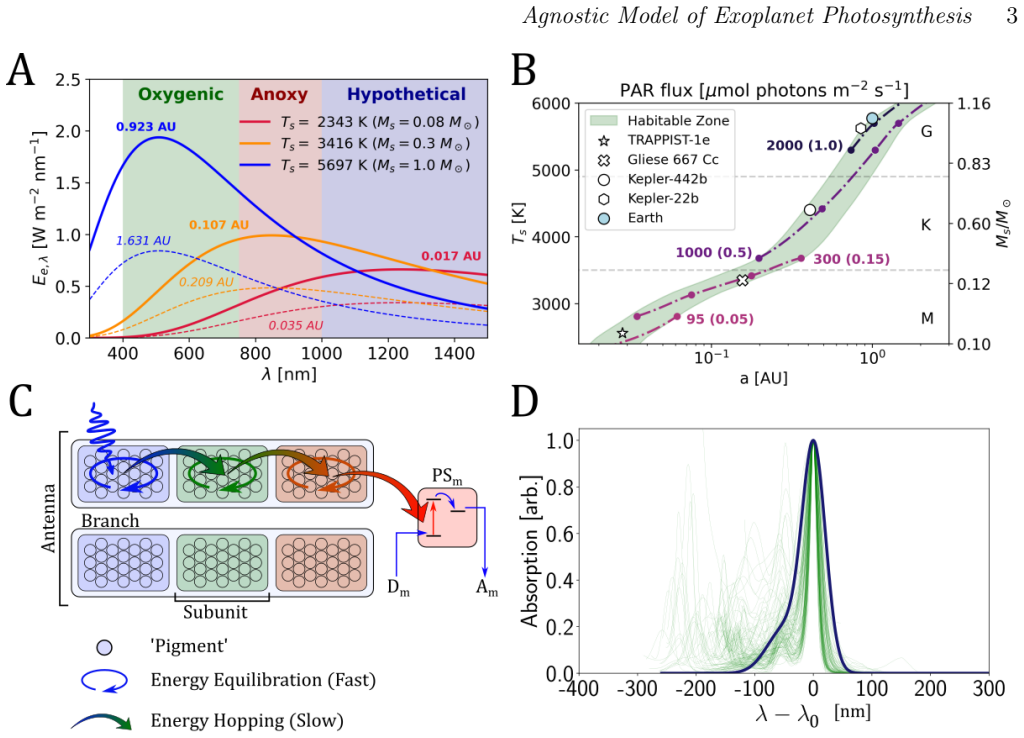
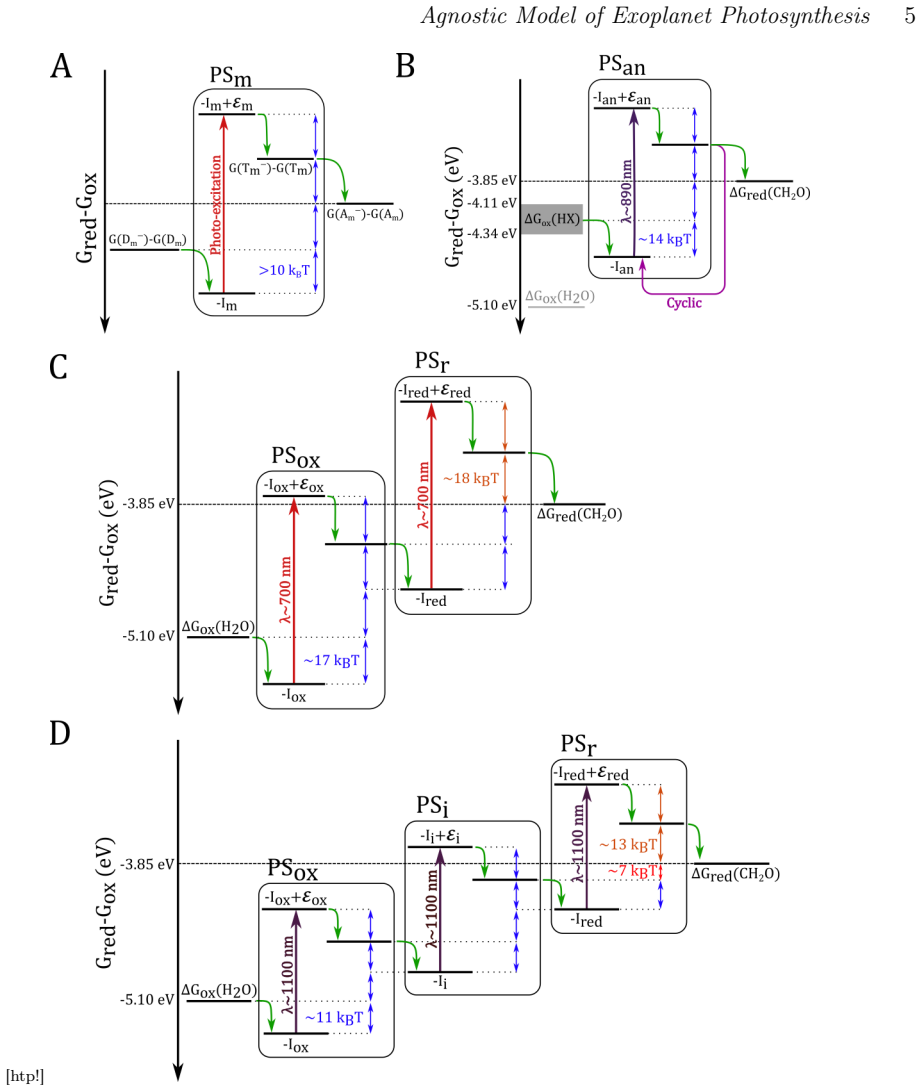
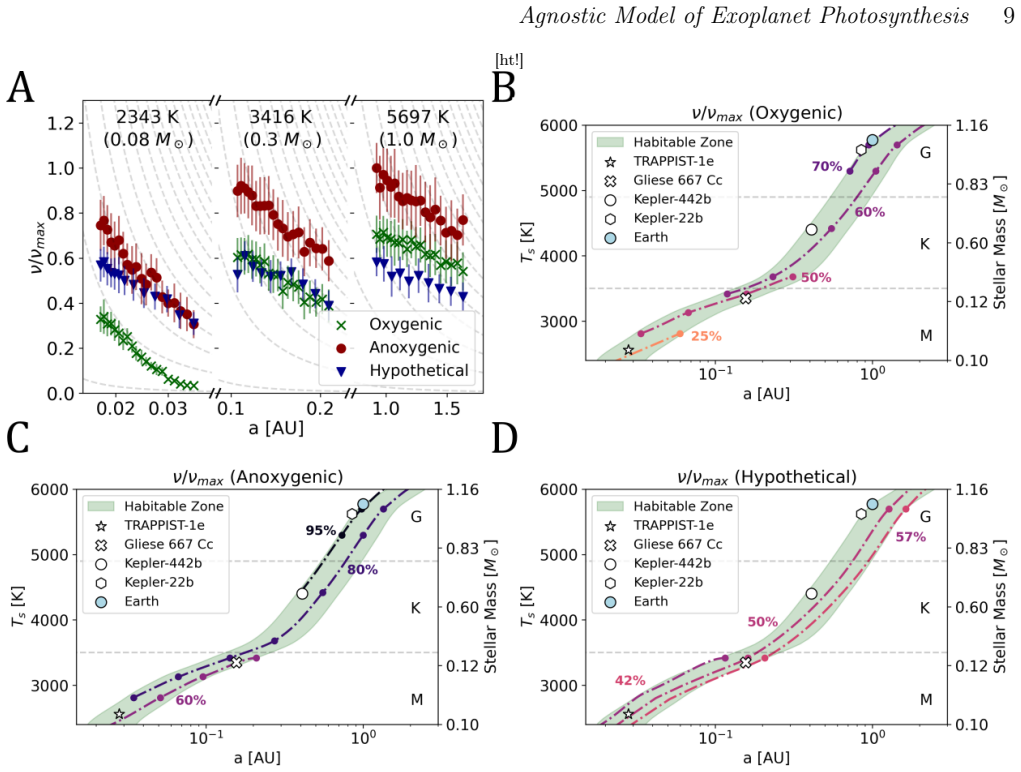
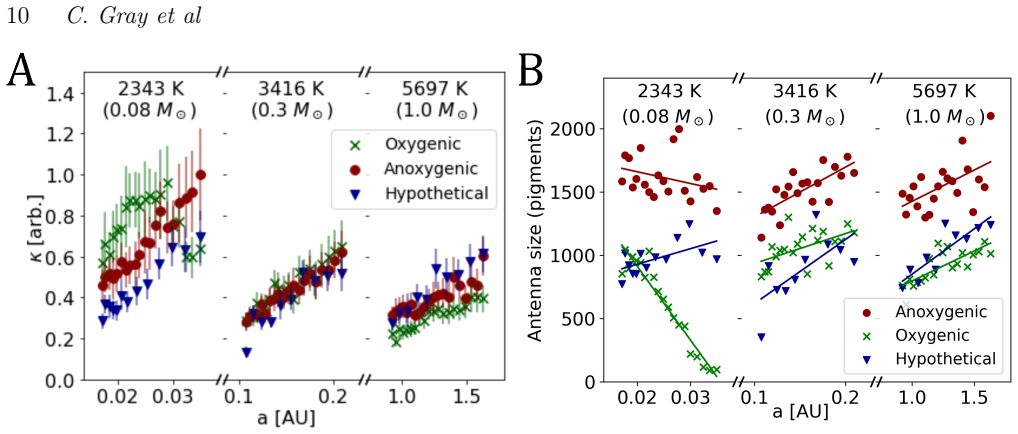
The search for exoplanet biosignatures is guided by whether planetary environments can sustain photosynthesis. As such, the Photosynthetic Habitable Zone (PHZ) was recently proposed, as the overlap between the canonical habitable zone and the orbital range where stellar irradiance is sufficient to drive photosynthesis. Existing PHZ estimates rely on empirical light-response curves from Earth phytoplankton, and thus include implicit Earth-centric biases. We introduce an agnostic PHZ derived from a generalized model of photosynthesis grounded in thermodynamics and redox chemistry, without reference to model organisms. The model is built on a generic photochemical reaction in which photon capture couples oxidation of a donor molecule to the reduction of CO2. The optical properties and CO2 reduction rate are optimized against irradiance spectra for exoplanets orbiting main-sequence stars, using a genetic algorithm that mimics evolution by natural selection. Our simulations predict that photosynthetic organisms compensate for reduced flux by evolving larger light-harvesting structures. As a result, photosynthetic viability declines only linearly with orbital distance, despite stellar flux falling off quadratically. As such, the agnostic PHZ expands well beyond previous Earth-based estimates. Earth-like (visible light) oxygenic photosynthesis is flux-limited at the outer habitable zone for cool M-dwarf stars; however, both anoxygenic photosynthesis and a hypothetical, NIR-driven oxygenic photosynthesis are viable across the entire habitable zone for M, K, and G stars. This implies that M-dwarf exoplanets could sustain robust oxygenic photosynthesis, though it would be different to that found on Earth, presenting reflectance biosignatures in the NIR band rather than the visible.
Editorial analysis
A structured set of objections, weighed in public.
Referee Report
Summary. The paper introduces an agnostic Photosynthetic Habitable Zone (PHZ) derived from a generalized thermodynamic and redox model of a generic photochemical reaction (photon capture coupled to donor oxidation and CO2 reduction). Optical properties of light-harvesting structures and CO2 reduction rate parameters are optimized via genetic algorithm against exoplanet irradiance spectra. The central claim is that organisms compensate for reduced flux by evolving larger light-harvesting structures, yielding only linear viability decline with orbital distance (despite 1/r² flux falloff), thereby expanding the agnostic PHZ well beyond Earth-based estimates; Earth-like oxygenic photosynthesis is flux-limited at the outer HZ for M dwarfs, but anoxygenic and hypothetical NIR oxygenic photosynthesis remain viable across the HZ for M/K/G stars.
Significance. If the linear scaling result holds after addressing model constraints, the work would substantially widen the orbital range considered for photosynthetic biosignatures, particularly around M dwarfs, and motivate NIR reflectance searches rather than visible O2-focused ones. The use of a machine-learning optimization to derive parameter-free evolutionary outcomes from first-principles chemistry is a methodological strength that could be extended to other habitability questions.
major comments (2)
- [Abstract] Abstract and model description: the headline result (linear viability decline via larger antenna sizes) follows directly from unconstrained optimization of optical properties; the fitness function contains no material, energetic, or maintenance cost term for increasing pigment number or structure size. Without such a penalty, the GA can evolve arbitrarily large light-harvesting complexes at low irradiance, directly producing the claimed linear (rather than quadratic) behavior. This assumption is load-bearing for the expanded PHZ claim.
- [Methods] Methods (genetic algorithm section): no validation, error analysis, or comparison against empirical photosynthetic light-response curves or known organism data is reported. The linear scaling therefore emerges solely from the fitting process against irradiance spectra rather than an independent test, leaving open whether the result is robust or an artifact of the chosen free parameters (optical properties and CO2 reduction rates).
minor comments (2)
- [Abstract] Notation for the generic photochemical reaction and viability metric should be defined explicitly with symbols before use in the abstract and results.
- [Results] Figure captions for viability vs. orbital distance plots should include the stellar types, wavelength ranges, and any normalization details for direct comparison to prior Earth-based PHZ curves.
Simulated Author's Rebuttal
We thank the referee for their constructive comments, which identify key assumptions in our agnostic model. We respond point-by-point below, clarifying the intentional design choices while agreeing to strengthen the manuscript with additional discussion and analysis.
read point-by-point responses
-
Referee: [Abstract] Abstract and model description: the headline result (linear viability decline via larger antenna sizes) follows directly from unconstrained optimization of optical properties; the fitness function contains no material, energetic, or maintenance cost term for increasing pigment number or structure size. Without such a penalty, the GA can evolve arbitrarily large light-harvesting complexes at low irradiance, directly producing the claimed linear (rather than quadratic) behavior. This assumption is load-bearing for the expanded PHZ claim.
Authors: The model is deliberately constructed without explicit cost terms for antenna size to remain agnostic to unknown biological implementation details and to isolate thermodynamic and redox limits. Imposing maintenance or material costs would require Earth-specific assumptions that the paper explicitly avoids. We agree this unconstrained optimization is central to the linear scaling result. In revision we will add a new subsection discussing the implications of this choice, including how hypothetical cost penalties could modify the viability curves and PHZ boundaries. revision: partial
-
Referee: [Methods] Methods (genetic algorithm section): no validation, error analysis, or comparison against empirical photosynthetic light-response curves or known organism data is reported. The linear scaling therefore emerges solely from the fitting process against irradiance spectra rather than an independent test, leaving open whether the result is robust or an artifact of the chosen free parameters (optical properties and CO2 reduction rates).
Authors: Because the framework is first-principles and organism-independent, direct comparison to Earth empirical light-response curves would reintroduce the very biases the study seeks to remove. We will revise the Methods and Results sections to include a parameter sensitivity analysis (varying optical cross-sections and CO2 reduction rates across plausible ranges) and report statistics from multiple independent GA runs to quantify robustness. These additions will demonstrate that the linear scaling is a structural outcome of the optimization rather than an artifact of specific parameter choices. revision: partial
Circularity Check
GA optimization of optical properties without size penalty forces linear viability decline by construction
specific steps
-
fitted input called prediction
[Abstract]
"The optical properties and CO2 reduction rate are optimized against irradiance spectra for exoplanets orbiting main-sequence stars, using a genetic algorithm that mimics evolution by natural selection. Our simulations predict that photosynthetic organisms compensate for reduced flux by evolving larger light-harvesting structures. As a result, photosynthetic viability declines only linearly with orbital distance, despite stellar flux falling off quadratically."
The quoted 'prediction' of larger structures and the consequent linear (rather than quadratic) viability decline is the direct numerical output of the GA fit; the model contains no penalty term for increasing pigment number or antenna size, so the optimization necessarily produces the compensation that yields linear scaling. The result is therefore shaped by the fitting process rather than derived independently.
full rationale
The paper's central result—that viability declines only linearly with distance because organisms evolve larger light-harvesting structures—is produced directly by the genetic algorithm's unconstrained optimization of antenna size and CO2 reduction rate against irradiance spectra. No independent derivation or external constraint is introduced; the linear scaling follows immediately once the fitness function permits arbitrary growth in structure size at low flux. This matches the fitted-input-called-prediction pattern and accounts for the reported expansion of the agnostic PHZ. No self-citation chains or other circular steps are present in the provided text.
Axiom & Free-Parameter Ledger
free parameters (2)
- optical properties of light-harvesting structures
- CO2 reduction rate parameters
axioms (2)
- domain assumption A generic photochemical reaction in which photon capture couples oxidation of a donor molecule to the reduction of CO2 captures the essential features of photosynthesis.
- domain assumption A genetic algorithm that mimics evolution by natural selection can identify optimal optical properties and reaction rates for photosynthetic viability.
Reference graph
Works this paper leans on
-
[1]
The Astrophysical Journal Letters , volume=
A new definition of exoplanet habitability: introducing the photosynthetic habitable zone , author=. The Astrophysical Journal Letters , volume=. 2023 , publisher=
2023
-
[2]
Introduction to Evolutionary Computing , author =. 2015 , pages =. doi:10.1007/978-3-662-44874-8_4 , isbn =
-
[3]
Life , volume=
O2 and other high-energy molecules in photosynthesis: why plants need two photosystems , author=. Life , volume=. 2021 , publisher=
2021
-
[4]
Lobo, Fernando G. and Lima, Cl \'a udio F. Adaptive Population Sizing Schemes in Genetic Algorithms. Parameter Setting in Evolutionary Algorithms. 2007. doi:10.1007/978-3-540-69432-8_9
-
[5]
Nature Communications , volume=
Photosynthetic light requirement near the theoretical minimum detected in Arctic microalgae , author=. Nature Communications , volume=. 2024 , publisher=
2024
-
[6]
Environmental Sciences Europe , volume=
Quantifying photosynthetic performance of phytoplankton based on photosynthesis--irradiance response models , author=. Environmental Sciences Europe , volume=. 2020 , publisher=
2020
-
[7]
and Jiménez-Sierra, Cecilia , title =
Arroyo-Pérez, Erika and Flores, Joel and González-Salvatierra, Claudia and Matías-Palafox, María L. and Jiménez-Sierra, Cecilia , title =. Conservation Physiology , volume =. 2017 , doi =
2017
-
[8]
Microorganisms , volume=
Growth and photosynthetic characteristics of toxic and non-toxic strains of the cyanobacteria Microcystis aeruginosa and Anabaena circinalis in relation to light , author=. Microorganisms , volume=. 2017 , publisher=
2017
-
[9]
Monthly Notices of the Royal Astronomical Society , volume =
Coelho, Lígia Fonseca and Kaltenegger, Lisa and Zinder, Stephen and Philpot, William and Price, Taylor L and Hamilton, Trinity L , title =. Monthly Notices of the Royal Astronomical Society , volume =. 2024 , month =
2024
-
[10]
2004 , url=
Constraints on Photosynthesis on Earth and Earth-Like Planets , author=. 2004 , url=
2004
-
[11]
Journal of the Marine Biological Association of the United Kingdom , volume=
Put out the light, and then put out the light , author=. Journal of the Marine Biological Association of the United Kingdom , volume=. 2000 , publisher=
2000
-
[12]
Icarus , volume=
Photosynthesis: likelihood of occurrence and possibility of detection on Earth-like planets , author=. Icarus , volume=. 2002 , publisher=
2002
-
[13]
Photosynthesis Research , volume=
Optimizing photosynthetic light-harvesting under stars: simple and general antenna models , author=. Photosynthesis Research , volume=. 2024 , publisher=
2024
-
[14]
PLOS Computational Biology , volume=
Predicting the diversity of photosynthetic light-harvesting using thermodynamics and machine learning , author=. PLOS Computational Biology , volume=. 2025 , publisher=
2025
-
[15]
Life , volume=
Photosynthesis in hydrogen-dominated atmospheres , author=. Life , volume=. 2014 , publisher=
2014
-
[16]
2015, http://dx.doi.org/10.1051/0004-6361/201425481 magenta Astronomy & Astrophysics , 577, A42
New Evolutionary Models for Pre-Main Sequence and Main Sequence Low-Mass Stars down to the Hydrogen-Burning Limit , author =. Astronomy & Astrophysics , volume =. doi:10.1051/0004-6361/201425481 , urldate =. arXiv , keywords =:1503.04107 , primaryclass =
work page internal anchor Pith review Pith/arXiv arXiv doi:10.1051/0004-6361/201425481
-
[17]
Kopparapu, Ravi Kumar and Ramirez, Ramses and Kasting, James F. and Eymet, Vincent and Robinson, Tyler D. and Mahadevan, Suvrath and Terrien, Ryan C. and. The Astrophysical Journal , volume =. doi:10.1088/0004-637X/765/2/131 , urldate =
-
[18]
Lingam, Manasvi and Loeb, Abraham , year = 2020, month = jun, journal =. Photosynthesis on. doi:10.1017/S1473550419000247 , urldate =. arXiv , keywords =:1907.12576 , primaryclass =
-
[19]
Photochemistry and photobiology , volume=
PhotochemCAD‡: a computer-aided design and research tool in photochemistry , author=. Photochemistry and photobiology , volume=. 1998 , publisher=
1998
-
[20]
Reporters, Markers, Dyes, Nanoparticles, and Molecular Probes for Biomedical Applications XII , volume=
Absorption and fluorescence spectra of organic compounds from 40 sources: archives, repositories, databases, and literature search engines , author=. Reporters, Markers, Dyes, Nanoparticles, and Molecular Probes for Biomedical Applications XII , volume=. 2020 , organization=
2020
-
[21]
Photosynthetica , volume=
Modelling photosynthetic photon flux density and maximum potential gross photosynthesis , author=. Photosynthetica , volume=. 2010 , publisher=
2010
-
[22]
arXiv preprint arXiv:2508.00076 , year=
Towards the Habitable Worlds Observatory: 1D CNN Retrieval of Reflection Spectra from Evolving Earth Analogs , author=. arXiv preprint arXiv:2508.00076 , year=
-
[23]
Astrobiology , volume=
Detectability of Surface Biosignatures for Directly Imaged Rocky Exoplanets , author=. Astrobiology , volume=. 2024 , publisher=
2024
-
[24]
Annals of botany , volume=
Photosynthesis: basics, history and modelling , author=. Annals of botany , volume=. 2020 , publisher=
2020
-
[25]
Agronomy journal , volume=
A generalized relationship between photosynthetically active radiation and solar radiation 1 , author=. Agronomy journal , volume=. 1984 , publisher=
1984
-
[26]
Science , volume=
Photochemistry beyond the red limit in chlorophyll f--containing photosystems , author=. Science , volume=. 2018 , publisher=
2018
-
[27]
Plant, Cell & Environment , volume=
Utilising Far-Red Light: Photosynthetic and Physiological Adaptations in Shade-Tolerant Fittonia albivenis , author=. Plant, Cell & Environment , volume=. 2025 , publisher=
2025
-
[28]
Ecological modelling , volume=
A model for the relationship between light intensity and the rate of photosynthesis in phytoplankton , author=. Ecological modelling , volume=. 1988 , publisher=
1988
-
[29]
The Plant Cell , volume=
Photoprotective energy dissipation involves the reorganization of photosystem II light-harvesting complexes in the grana membranes of spinach chloroplasts , author=. The Plant Cell , volume=. 2011 , publisher=
2011
-
[30]
Nature Ecology & Evolution , pages=
Archaean green-light environments drove the evolution of cyanobacteria’s light-harvesting system , author=. Nature Ecology & Evolution , pages=. 2025 , publisher=
2025
-
[31]
Annual review of biophysics and biophysical chemistry , volume=
Light harvesting by phycobilisomes , author=. Annual review of biophysics and biophysical chemistry , volume=. 1985 , publisher=
1985
-
[32]
Advances in Chemical Physics , volume=
Energy transfer and photosynthetic light harvesting , author=. Advances in Chemical Physics , volume=. 2006 , publisher=
2006
-
[33]
Nature materials , volume=
Excitons in nanoscale systems , author=. Nature materials , volume=. 2006 , publisher=
2006
-
[34]
2009 , publisher=
The purple phototrophic bacteria , author=. 2009 , publisher=
2009
-
[35]
Electron Paramagnetic Resonance Kinetic Studies of the
Reza Razeghifard, M and Pace, Ronald J , year = 1997, month = dec, journal =. Electron Paramagnetic Resonance Kinetic Studies of the. doi:10.1016/S0005-2728(97)00069-8 , urldate =
-
[36]
and Wientjes, Emilie and Croce, Roberta and Thorwart, Michael and Miller, R
Duan, Hong-Guang and Prokhorenko, Valentyn I. and Wientjes, Emilie and Croce, Roberta and Thorwart, Michael and Miller, R. J. Dwayne , year = 2017, month = sep, journal =. Primary. doi:10.1038/s41598-017-12564-4 , urldate =
-
[37]
Sulfur metabolism in phototrophic organisms , pages=
Genomic insights into the sulfur metabolism of phototrophic green sulfur bacteria , author=. Sulfur metabolism in phototrophic organisms , pages=. 2008 , publisher=
2008
-
[38]
Photosynthesis research , volume=
Photosynthesis in the Archean era , author=. Photosynthesis research , volume=. 2006 , publisher=
2006
-
[39]
The ISME Journal , volume=
Chemosynthetic and photosynthetic bacteria contribute differentially to primary production across a steep desert aridity gradient , author=. The ISME Journal , volume=. 2021 , publisher=
2021
-
[40]
Frontiers in Astronomy and Space Sciences , volume=
The peak absorbance wavelength of photosynthetic pigments around other stars from spectral optimization , author=. Frontiers in Astronomy and Space Sciences , volume=. 2021 , publisher=
2021
-
[41]
Monthly Notices of the Royal Astronomical Society , volume=
Photosynthesis under a red Sun: predicting the absorption characteristics of an extraterrestrial light-harvesting antenna , author=. Monthly Notices of the Royal Astronomical Society , volume=. 2023 , publisher=
2023
-
[42]
The Astrophysical Journal Letters , volume=
Colors of Life in the Clouds: Biopigments of atmospheric microorganisms as a new signature to detect life on planets like Earth , author=. The Astrophysical Journal Letters , volume=. 2025 , publisher=
2025
-
[43]
Life , volume=
Growth and photosynthetic efficiency of microalgae and plants with different levels of complexity exposed to a simulated M-dwarf starlight , author=. Life , volume=. 2023 , publisher=
2023
-
[44]
Applied and environmental microbiology , volume=
Use of quartz sand columns to study far-red light photoacclimation (FaRLiP) in cyanobacteria , author=. Applied and environmental microbiology , volume=. 2022 , publisher=
2022
-
[45]
Photosynthetica , volume=
Combined effects of light and temperature on growth, photosynthesis, and pigment content in the mat-forming cyanobacterium Geitlerinema amphibium , author=. Photosynthetica , volume=. 2013 , publisher=
2013
-
[46]
Proceedings of the National Academy of Sciences , volume=
Anoxygenic photosynthesis modulated Proterozoic oxygen and sustained Earth's middle age , author=. Proceedings of the National Academy of Sciences , volume=. 2009 , publisher=
2009
-
[47]
The Habitable Worlds Catalog (HWC) , year =
-
[48]
Trends in Plant Science , volume=
Calvin--Benson cycle regulation is getting complex , author=. Trends in Plant Science , volume=. 2021 , publisher=
2021
-
[49]
Molecules , volume=
Photosynthetic light-harvesting (antenna) complexes—structures and functions , author=. Molecules , volume=. 2021 , publisher=
2021
-
[50]
International Journal of Hydrogen Energy , volume=
A review of green biohydrogen production using anoxygenic photosynthetic bacteria for hydrogen economy: challenges and opportunities , author=. International Journal of Hydrogen Energy , volume=. 2024 , publisher=
2024
-
[51]
2006 , publisher=
Principles of fluorescence spectroscopy , author=. 2006 , publisher=
2006
-
[52]
PCC 6803 , author=
Functional consequences of modification of the photosystem I/photosystem II ratio in the cyanobacterium Synechocystis sp. PCC 6803 , author=. Journal of bacteriology , volume=. 2024 , publisher=
2024
-
[53]
Proceedings of the National Academy of Sciences , volume=
An obligately photosynthetic bacterial anaerobe from a deep-sea hydrothermal vent , author=. Proceedings of the National Academy of Sciences , volume=. 2005 , publisher=
2005
-
[54]
Scientific Reports , volume=
Entropy of radiation: the unseen side of light , author=. Scientific Reports , volume=. 2017 , publisher=
2017
-
[55]
The Astropy Project: Sustaining and Growing a Community-oriented Open-source Project and the Latest Major Release (v5.0) of the Core Package. , keywords =. doi:10.3847/1538-4357/ac7c74 , archivePrefix =. 2206.14220 , primaryClass =
work page internal anchor Pith review Pith/arXiv arXiv doi:10.3847/1538-4357/ac7c74
-
[56]
The Astropy Project: Building an inclusive, open-science project and status of the v2.0 core package
The Astropy Project: Building an Open-science Project and Status of the v2.0 Core Package. , keywords =. doi:10.3847/1538-3881/aabc4f , archivePrefix =. 1801.02634 , primaryClass =
work page internal anchor Pith review Pith/arXiv arXiv doi:10.3847/1538-3881/aabc4f
-
[57]
Astropy: A Community Python Package for Astronomy
Astropy: A community Python package for astronomy. , keywords =. 2013. doi:10.1051/0004-6361/201322068 , archivePrefix =. 1307.6212 , primaryClass =
work page internal anchor Pith review Pith/arXiv arXiv doi:10.1051/0004-6361/201322068 2013
-
[58]
1996, , 117, 393, 10.1051/aas:1996164
SExtractor: Software for source extraction. , keywords =. 1996. doi:10.1051/aas:1996164 , adsurl =
-
[59]
Quantifying the Observational Effort Required for the Radial Velocity Characterization of TESS Planets. , keywords =. 2018. doi:10.3847/1538-3881/aacea9 , archivePrefix =. 1807.01263 , primaryClass =
work page internal anchor Pith review Pith/arXiv arXiv doi:10.3847/1538-3881/aacea9 2018
-
[60]
X-Ray Scattering Echoes and Ghost Halos from the Intergalactic Medium: Relation to the Nature of AGN Variability. , keywords =. 2015. doi:10.1088/0004-637X/805/1/23 , archivePrefix =. 1503.01475 , primaryClass =
work page internal anchor Pith review Pith/arXiv arXiv doi:10.1088/0004-637x/805/1/23 2015
-
[61]
, keywords =
The 2013 Release of Cloudy. , keywords =. 2013
2013
-
[62]
1989", month =
T _ E X and LAT _ E X Macro Definition Files for Astronomical Publications. , year = "1989", month = "Mar", pages =
1989
-
[63]
LaTeX: A Document Preparation System. 1994
1994
-
[64]
Quasi-periodic Fast Propagating Magnetoacoustic Waves during the Magnetic Reconnection Between Solar Coronal Loops. , keywords =. 2018. doi:10.3847/2041-8213/aaf167 , archivePrefix =. 1811.08553 , primaryClass =
work page internal anchor Pith review Pith/arXiv arXiv doi:10.3847/2041-8213/aaf167 2018
-
[65]
Nominal values for selected solar and planetary quantities: IAU 2015 Resolution B3
Nominal Values for Selected Solar and Planetary Quantities: IAU 2015 Resolution B3. , keywords =. 2016. doi:10.3847/0004-6256/152/2/41 , archivePrefix =. 1605.09788 , primaryClass =
work page internal anchor Pith review Pith/arXiv arXiv doi:10.3847/0004-6256/152/2/41 2015
-
[66]
Swift X-Ray Observations of Classical Novae. II. The Super Soft Source Sample. , keywords =. 2011. doi:10.1088/0067-0049/197/2/31 , archivePrefix =. 1110.6224 , primaryClass =
work page internal anchor Pith review Pith/arXiv arXiv doi:10.1088/0067-0049/197/2/31 2011
-
[67]
Galaxy emission line classification using 3D line ratio diagrams
Galaxy Emission Line Classification Using Three-dimensional Line Ratio Diagrams. , keywords =. 2014. doi:10.1088/0004-637X/793/2/127 , archivePrefix =. 1406.5186 , primaryClass =
work page internal anchor Pith review Pith/arXiv arXiv doi:10.1088/0004-637x/793/2/127 2014
-
[68]
Habitability and Biosignatures of Hycean Worlds. , keywords =. doi:10.3847/1538-4357/abfd9c , archivePrefix =. 2108.10888 , primaryClass =
-
[69]
Biochimica et Biophysica Acta (BBA)-Bioenergetics , volume=
The mechanism of cyclic electron flow , author=. Biochimica et Biophysica Acta (BBA)-Bioenergetics , volume=. 2019 , publisher=
2019
-
[70]
Quarterly reviews of biophysics , volume=
Photosynthetic apparatus of purple bacteria , author=. Quarterly reviews of biophysics , volume=. 2002 , publisher=
2002
-
[71]
Scientific data , volume=
Experimental database of optical properties of organic compounds , author=. Scientific data , volume=. 2020 , publisher=
2020
-
[72]
and Moser, C
Noy, D. and Moser, C. C. and Dutton, P. L. , title =. Biochim. Biophys. Acta. , volume =. 2006 , doi =
2006
discussion (0)
Sign in with ORCID, Apple, or X to comment. Anyone can read and Pith papers without signing in.