REVIEW 3 major objections 7 minor 2 cited by
Galactic chemical evolution can constrain which massive stars explode, and a metallicity-dependent rule can ease the red-supergiant problem without breaking abundance trends.
Reviewed by Pith at T0; open to challenge. T0 means a machine referee read the full paper against a public rubric. the ladder, T0–T4 →
T0 review · grok-4.5
2026-07-14 18:56 UTC pith:QSJXS7ON
load-bearing objection Solid GCE constraints on metallicity-dependent explodability; the RSG-compatible window is real but only opens under low net outflow (or near-solar Z_th), which the paper states clearly rather than hides. the 3 major comments →
Constraints on the Metallicity-dependent Explodability of Massive Stars from Galactic Chemical Evolution: Toward Alleviating the Red Supergiant Problem
The pith
A machine-rendered reading of the paper's core claim, the machinery that carries it, and where it could break.
Core claim
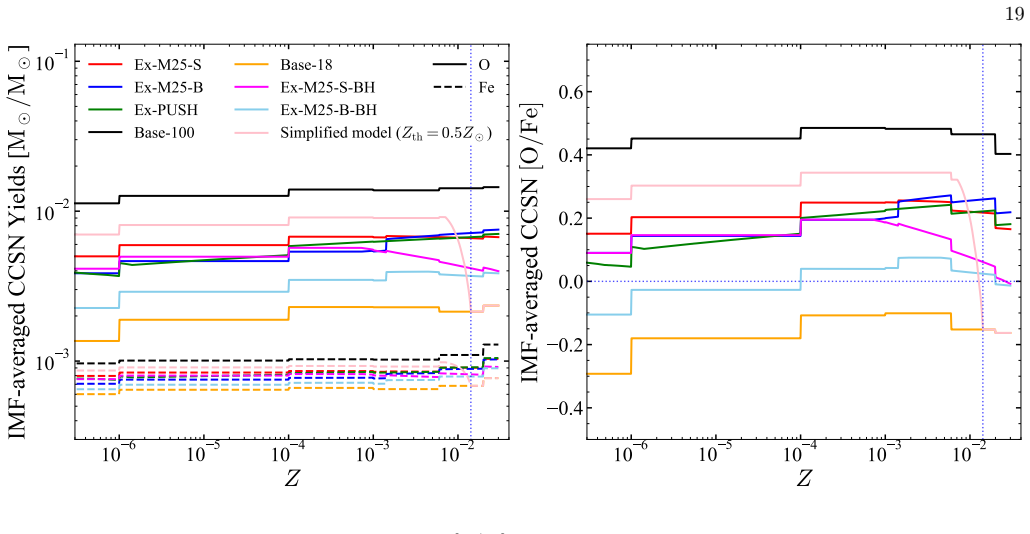
Physics-motivated metallicity-dependent explodability prescriptions reproduce observed galactic abundance trends, while galactic chemical evolution itself bounds the black-hole-forming region in mass–metallicity space. A simplified explodability that restricts successful explosions above ~18 solar masses near solar metallicity—thereby addressing the red-supergiant problem—remains compatible with those trends only when net outflows are negligible and the transition lies at sub-solar metallicity.
What carries the argument
Metallicity-dependent explodability (whether a star of given zero-age mass and metallicity produces a core-collapse supernova or a black hole) implemented inside a one-zone galactic chemical evolution model, diagnosed primarily by the [O/Fe]–[Fe/H] track.
Load-bearing premise
The solar-neighborhood metal budget can be treated as a one-zone system with little or no net outflow of metals.
What would settle it
If multi-zone or outflow-inclusive models that still match the metallicity distribution function and solar [O/Fe] still require explosions above ~18 solar masses at solar metallicity, or if the transition metallicity must sit at or above solar, the RSG-compatible solution fails.
Editorial analysis
A structured set of objections, weighed in public.
Referee Report
Summary. The paper implements recently proposed metallicity-dependent massive-star explodability maps (Maltsev et al. 2025; Ebinger et al. 2019, 2020) in a one-zone GCE code and shows that the physics-motivated maps (group Ex) reproduce the observed MDF, present-day SFR, [Fe/H](t_⊙), and the [O/Fe]–[Fe/H] trend, while extreme BH-maximizing variants (group Ex-BH) underproduce oxygen. Guided by those failures, the authors introduce a simplified explodability boundary M_th(Z) (Eq. 4) that forces M_th→18 M_⊙ at Z≥Z_⊙ (motivated by the RSG problem) while allowing explosions up to 40 M_⊙ below a transition metallicity Z_th. They find that this RSG-friendly map can still match solar composition and [O/Fe] only if net outflows are negligible (ε_out≈0) and Z_th is sub-solar (≳0.5 Z_⊙), or if Z_th is forced near Z_⊙ when outflows are retained. They further show that a top-heavy low-Z IMF (Chon et al. 2024) improves the metal-poor [O/Fe] plateau once coupled to metallicity-dependent explodability, and that explodability changes alone do not resolve the missing-SN rate discrepancy.
Significance. If the GCE constraints hold, the work supplies a practical, observationally falsifiable filter on the mass–metallicity domain of black-hole formation: successful explosions of oxygen-rich progenitors up to ∼30–40 M_⊙ at low Z are required, while strong suppression of high-mass explosions at solar Z is tightly limited. That is a useful bridge between stellar-explosion theory and Galactic abundances, and the systematic Z_th–ε_out exploration plus the yield-contribution appendices make the oxygen diagnostic more transparent than in many GCE studies. The RSG-compatible construction is more provisional—it is explicitly conditional on net metal retention—but it correctly reframes the RSG problem as a joint stellar-physics and chemical-evolution question rather than a pure progenitor-mass cut. Credit is due for validating models against MDF/SFR/[Fe/H] before interpreting [O/Fe], for documenting that Fe is far less sensitive than O to the high-mass window, and for showing that metallicity-dependent IMF and explodability should be treated together.
major comments (3)
- §3.2.2–3.2.3 and abstract: The central claim that an RSG-compatible explodability (M_th=18 M_⊙ at Z≥Z_⊙) can be constructed without violating GCE observables is demonstrated only for ε_out=0 (with Z_th≳0.5 Z_⊙) or for ε_out=0.75 with Z_th forced near Z_⊙ (which the text itself calls fine-tuned). The multi-zone radial-migration analogy offered as a physical justification for zero net outflow is qualitative only—no multi-zone run is shown, and Table 1 already retunes ε_out, τ_in, and τ_s whenever the IMF or explodability changes. Please either (i) add a multi-zone or effective metal-retention calculation that recovers the ε_out=0 tracks, or (ii) rephrase the abstract/conclusions so that the RSG solution is clearly a necessary condition on net metal retention rather than a demonstrated MW solution.
- §2.2 and Appendix A: Explodability and nucleosynthetic yields are treated as separable, with a piecewise M_56Ni cut (0.02/0.07 M_⊙) imposed on Chieffi & Limongi (2004) rather than taken from the same neutrino-driven models that supply the explodability maps. Appendix A shows that oxygen is relatively robust across yield sets, which supports the main diagnostic, but the solar [O/Fe] and the Ex-BH failures also depend on the Fe yield and the mass-cut choice (Appendix B). A short sensitivity test—varying the M_56Ni prescription or swapping one self-consistent yield+explodability set (e.g., PUSH yields with Ex-PUSH)—would make the claimed GCE constraints on the BH region more robust.
- §2.2.2–2.2.3: The metallicity interpolation of the Maltsev and PUSH maps (log(Z) slope, freeze of M_CO,bound below Z_⊙/20, linear connection at Z≤10^{-4} Z_⊙, and the artificial discontinuity at Z=Z_⊙/10 for Case B) is load-bearing for the group-Ex success and for the location of the allowed BH region. Please quantify how [O/Fe]–[Fe/H] and the solar point shift under alternate interpolations (e.g., linear in Z, or holding the Z_⊙/10 map to lower Z), or state explicitly that the GCE constraints apply only within the adopted interpolation scheme.
minor comments (7)
- Abstract: “this effect becomes importance” → “becomes important”.
- §2.2.3: “model Ex-PHSH” is a typo for Ex-PUSH.
- Title line and several places: “T oward”, “matallicity”, “metallicty-dependent” — residual spacing/typo issues.
- Figure 1 / §2.2.2: The 85%/15% mixed-region probability is stated but not motivated; a one-sentence reference to Maltsev et al. would help.
- §4.4 / Figure 8: With the Chon IMF the MDF peak shifts to [Fe/H]∼−0.2; this is noted but not shown. A small MDF panel would make the residual tension clearer.
- Table 1: Base-40 is used in §3 but listed only under “Base models” without the same parameter block clarity as the simplified models; a one-line note would avoid confusion.
- §1: “A small description added in the above sentence.” appears to be an editorial leftover and should be removed.
Circularity Check
No significant circularity; external explodability maps are tested against independent [O/Fe] diagnostics after ordinary GCE parameter calibration, and the RSG-compatible window is a conditional scan result, not a forced prediction.
full rationale
The load-bearing inputs are external: metallicity-dependent explodability maps from Maltsev et al. (2025) and Ebinger et al. (2019/2020), CCSN yields from Chieffi & Limongi (2004), and observational [O/Fe]–[Fe/H] compilations. These are inserted into a one-zone GCE framework (Suzuki & Maeda 2018 code, reused as a tool). Free parameters (ε_out, τ_in, τ_s, Ṁ_in,0) are calibrated once to MDF, SFR and [Fe/H](t_⊙); the resulting [O/Fe] tracks (and the full evolutionary shape, not merely the solar point) are then compared to independent data. Group Ex-BH and low-Z_th simplified models fail this test, while group Ex succeeds—showing the diagnostic has discriminating power. The simplified RSG-motivated form (Eq. 4) is an explicit ansatz scanned over Z_th and ε_out; the paper reports success only conditionally (“if net outflows negligible and transition at sub-solar Z”) and does not claim the solution is derived or forced. The acknowledged near-tautology that solar Z + [Fe/H]=0 implies [O/Fe]≈0 is used only as a consistency remark; the low-metallicity plateau and track shape remain independent. No self-definitional identity, fitted-input-as-prediction, uniqueness theorem, or ansatz smuggling appears. Ordinary self-citation of the prior code does not close any logical loop on the new metallicity-dependent claims.
Axiom & Free-Parameter Ledger
free parameters (4)
- ε_out (outflow efficiency) =
0.75 or 0.00
- τ_in, τ_s, Ṁ_in,0 =
5 Gyr / 3 Gyr / 20 M⊙ yr⁻¹ (fiducial); 3.5/2.5/71 for Chon IMF
- Z_th (transition metallicity in simplified model) =
scanned 0.01–0.99 Z_⊙
- M_56Ni piecewise cut =
0.02 / 0.07 M_⊙
axioms (4)
- domain assumption One-zone instantaneous mixing adequately captures solar-neighborhood chemical evolution for the purpose of constraining explodability.
- domain assumption Explodability and nucleosynthetic yields may be treated as separable; Chieffi & Limongi (2004) yields with adjusted mass cut remain valid across the adopted explodability maps.
- domain assumption Failed explosions (BH formation) eject negligible metal-rich material.
- domain assumption Kroupa (or Chon) IMF and W7 SN Ia yields with fixed DTD are adequate.
invented entities (1)
-
Simplified metallicity-dependent explodability M_th(Z) of Eq. (4)
no independent evidence
read the original abstract
The explodability of massive stars, namely whether they undergo core-collapse supernovae (CCSNe) or form black holes (BHs), strongly influences galactic chemical evolution (GCE). Details of the explodability are still controversial, but realistic predictions including metallicity-dependence are becoming available through stellar-evolution and explosion calculations. In the present work, we implement recently-proposed metallicity-dependent explodability prescriptions into a GCE framework. We show that the physics-motivated explodability prescriptions reproduce the key observed abundance trends. Further, within uncertainties of the explodability models, the GCE model provides important constraints on the region of the BH formation in the mass-metallicity space. Guided by these findings, we further construct a simplified form of the metallicity-dependent explodability designed to alleviate the red supergiant (RSG) problem and explore its compatibility with GCE constraints. We find that such a solution exists, if (1) the net outflows from the system are negligible/absent, and (2) the transition of the explodability takes place at sub-solar metallicity. These results demonstrate that GCE can provide meaningful constraints on massive-star explodability and that explodability prescriptions capable of addressing the RSG problem can be constructed without violating chemical-evolution observables. We also show that a metallicity-dependent initial mass function can improve agreement with observations; this effect becomes important once coupled with the metallicity-dependent explodability.
Figures


Forward citations
Cited by 2 Pith papers
-
VENUS: an ultra-faint galaxy hosting the metal-poor type II supernova at $z=5.13$ Witnessing the initial metal enrichment with extremely frequent core-collapse supernovae?
The z=5.13 supernova SN Eos exploded in an ultra-faint, very metal-poor dwarf galaxy, suggesting core-collapse supernovae were much more frequent in early low-metallicity environments.
-
JWST observations of a planetary nebula support jet-driven explosion of core-collapse supernova remnant RCW 103
Morphological similarity between JWST images of planetary nebula PMR 1 and X-ray images of CCSN remnant RCW 103 indicates that two pairs of jets shaped RCW 103, supporting the jittering-jets explosion mechanism.
Reference graph
Works this paper leans on
-
[1]
Abbott, R., Abbott, T. D., Acernese, F., et al. 2023, PhRvX, 13, 011048, doi: 10.1103/PhysRevX.13.011048
-
[2]
2020, A&A, 641, A6, doi: 10.1051/0004-6361/201833910
Aghanim, N., Akrami, Y., Ashdown, M., et al. 2020, A&A, 641, A6, doi: 10.1051/0004-6361/201833910
-
[3]
Amarsi, A. M., Nissen, P. E., & Sk´ ulad´ ottir,´A. 2019, A&A, 630, A104, doi: 10.1051/0004-6361/201936265
-
[4]
P., Dessart, L., Guti´ errez, C
Anderson, J. P., Dessart, L., Guti´ errez, C. P., et al. 2018, NatAs, 2, 574, doi: 10.1038/s41550-018-0458-4
-
[5]
Asplund, M., Grevesse, N., Sauval, A. J., & Scott, P. 2009, ARA&A, 47, 481, doi: 10.1146/annurev.astro.46.060407.145222
-
[6]
2003, A&A, 410, 527, doi: 10.1051/0004-6361:20031213
Bensby, T., Feltzing, S., & Lundstr¨ om, I. 2003, A&A, 410, 527, doi: 10.1051/0004-6361:20031213
-
[7]
Bensby, T., Feltzing, S., & Oey, M. S. 2014, A&A, 562, A71, doi: 10.1051/0004-6361/201322631
-
[8]
Buder, S., Lind, K., Ness, M. K., et al. 2019, A&A, 624, A19, doi: 10.1051/0004-6361/201833218
-
[9]
2020, MNRAS, 491, 2715, doi: 10.1093/mnras/stz3223
Burrows, A., Radice, D., Vartanyan, D., et al. 2020, MNRAS, 491, 2715, doi: 10.1093/mnras/stz3223
-
[10]
2005, A&A, 441, 533, doi: 10.1051/0004-6361:20052905
Caffau, E., Bonifacio, P., Faraggiana, R., et al. 2005, A&A, 441, 533, doi: 10.1051/0004-6361:20052905
-
[11]
2011, A&A, 530, A138, doi: 10.1051/0004-6361/201016276
Casagrande, L., Sch¨ onrich, R., Asplund, M., et al. 2011, A&A, 530, A138, doi: 10.1051/0004-6361/201016276
-
[12]
2004, A&A, 416, 1117, doi: 10.1051/0004-6361:20034074
Cayrel, R., Depagne, E., Spite, M., et al. 2004, A&A, 416, 1117, doi: 10.1051/0004-6361:20034074
-
[13]
2004, ApJ, 608, 405, doi: 10.1086/392523
Chieffi, A., & Limongi, M. 2004, ApJ, 608, 405, doi: 10.1086/392523
doi:10.1086/392523 2004
-
[14]
Chon, S., Hosokawa, T., Omukai, K., & Schneider, R. 2024, MNRAS, 530, 2453, doi: 10.1093/mnras/stae1027 Chru´ sli´ nska, M., Pakmor, R., Matthee, J., & Matsuno, T. 2024, A&A, 686, A186, doi: 10.1051/0004-6361/202347602
-
[15]
Couch, S. M., Warren, M. L., & O’Connor, E. P. 2020, ApJ, 890, 127, doi: 10.3847/1538-4357/ab609e
-
[16]
2019, ApJ, 870, 2, doi: 10.3847/1538-4357/aae7d2 20
Curtis, S., Ebinger, K., Fr¨ ohlich, C., et al. 2019, ApJ, 870, 2, doi: 10.3847/1538-4357/aae7d2 20
-
[17]
Doherty, C. L., Gil-Pons, P., Lau, H. H. B., Lattanzio, J. C., & Siess, L. 2014a, MNRAS, 437, 195, doi: 10.1093/mnras/stt1877
-
[18]
Doherty, C. L., Gil-Pons, P., Lau, H. H. B., et al. 2014b, MNRAS, 441, 582, doi: 10.1093/mnras/stu571
-
[19]
2019, ApJ, 870, 1, doi: 10.3847/1538-4357/aae7c9
Ebinger, K., Curtis, S., Fr¨ ohlich, C., et al. 2019, ApJ, 870, 1, doi: 10.3847/1538-4357/aae7c9
-
[20]
2020, ApJ, 888, 91, doi: 10.3847/1538-4357/ab5dcb
Ebinger, K., Curtis, S., Ghosh, S., et al. 2020, ApJ, 888, 91, doi: 10.3847/1538-4357/ab5dcb
-
[21]
1993, A&A, 275, 101
Edvardsson, B., Andersen, J., Gustafsson, B., et al. 1993, A&A, 275, 101
1993
-
[22]
Eitner, P., Bergemann, M., Ruiter, A. J., et al. 2023, A&A, 677, A151, doi: 10.1051/0004-6361/202244286
-
[23]
2022, ApJ, 941, 162, doi: 10.3847/1538-4357/aca27d
Elia, D., Molinari, S., Schisano, E., et al. 2022, ApJ, 941, 162, doi: 10.3847/1538-4357/aca27d
-
[24]
2023, ApJ, 948, 111, doi: 10.3847/1538-4357/acc315
Justham, S. 2023, ApJ, 948, 111, doi: 10.3847/1538-4357/acc315
-
[25]
2003, A&A, 404, 187, doi: 10.1051/0004-6361:20030439
Barbieri, M. 2003, A&A, 404, 187, doi: 10.1051/0004-6361:20030439
-
[26]
Graur, O., Rodney, S. A., Maoz, D., et al. 2014, ApJ, 783, 28, doi: 10.1088/0004-637X/783/1/28
-
[27]
2004, ApJ, 607, 474, doi: 10.1086/383406
Honda, S., Aoki, W., Kajino, T., et al. 2004, ApJ, 607, 474, doi: 10.1086/383406
doi:10.1086/383406 2004
-
[28]
Horiuchi, S., Beacom, J. F., Kochanek, C. S., et al. 2011, ApJ, 738, 154, doi: 10.1088/0004-637X/738/2/154
-
[29]
1999, ApJS, 125, 439, doi: 10.1086/313278
Iwamoto, K., Brachwitz, F., Nomoto, K., et al. 1999, ApJS, 125, 439, doi: 10.1086/313278
doi:10.1086/313278 1999
-
[30]
2025, ARNPS, 75, 425, doi: 10.1146/annurev-nucl-121423-100945
Janka, H.-T. 2025, ARNPS, 75, 425, doi: 10.1146/annurev-nucl-121423-100945
-
[31]
P., Molero, M., Nav´ o, G., et al
Jost, F. P., Molero, M., Nav´ o, G., et al. 2025, MNRAS, 536, 2135, doi: 10.1093/mnras/stae2718
-
[32]
Karakas, A. I. 2010, MNRAS, 403, 1413, doi: 10.1111/j.1365-2966.2009.16198.x
-
[33]
2025, A&A, 701, A177, doi: 10.1051/0004-6361/202554912
Kemp, A., & Kaur, T. 2025, A&A, 701, A177, doi: 10.1051/0004-6361/202554912
-
[34]
Kobayashi, C., Karakas, A. I., & Lugaro, M. 2020a, ApJ, 900, 179, doi: 10.3847/1538-4357/abae65
-
[35]
2020b, ApJ, 895, 138, doi: 10.3847/1538-4357/ab8e44
Kobayashi, C., Leung, S.-C., & Nomoto, K. 2020b, ApJ, 895, 138, doi: 10.3847/1538-4357/ab8e44
-
[36]
2006, ApJ, 653, 1145, doi: 10.1086/508914
Ohkubo, T. 2006, ApJ, 653, 1145, doi: 10.1086/508914
doi:10.1086/508914 2006
-
[37]
Kochanek, C. S., Beacom, J. F., Kistler, M. D., et al. 2008, ApJ, 684, 1336, doi: 10.1086/590053
doi:10.1086/590053 2008
-
[38]
2001, MNRAS, 322, 231, doi: 10.1046/j.1365-8711.2001.04022.x
Kroupa, P. 2001, MNRAS, 322, 231, doi: 10.1046/j.1365-8711.2001.04022.x
-
[39]
2021, A&A, 656, A58, doi: 10.1051/0004-6361/202140506
Laplace, E., Justham, S., Renzo, M., et al. 2021, A&A, 656, A58, doi: 10.1051/0004-6361/202140506
-
[40]
Lentz, E. J., Bruenn, S. W., Hix, W. R., et al. 2015, ApJL, 807, L31, doi: 10.1088/2041-8205/807/2/L31
-
[41]
2020, ApJ, 888, 80, doi: 10.3847/1538-4357/ab5c1f
Leung, S.-C., & Nomoto, K. 2020, ApJ, 888, 80, doi: 10.3847/1538-4357/ab5c1f
-
[42]
2006, ApJ, 647, 483, doi: 10.1086/505164
Limongi, M., & Chieffi, A. 2006, ApJ, 647, 483, doi: 10.1086/505164
doi:10.1086/505164 2006
-
[43]
2014, ARA&A, 52, 415, doi: 10.1146/annurev-astro-081811-125615
Madau, P., & Dickinson, M. 2014, ARA&A, 52, 415, doi: 10.1146/annurev-astro-081811-125615
-
[44]
2026, PASJ, 78, L1, doi: 10.1093/pasj/psaf140
Maeda, K., Kuncarayakti, H., Nagao, T., et al. 2026, PASJ, 78, L1, doi: 10.1093/pasj/psaf140
-
[45]
2002, ApJ, 565, 405, doi: 10.1086/324487
Maeda, K., Nakamura, T., Nomoto, K., et al. 2002, ApJ, 565, 405, doi: 10.1086/324487
doi:10.1086/324487 2002
-
[46]
2003, ApJ, 598, 1163, doi: 10.1086/378948
Maeda, K., & Nomoto, K. 2003, ApJ, 598, 1163, doi: 10.1086/378948
doi:10.1086/378948 2003
-
[47]
Maltsev, K., Schneider, F. R. N., Mandel, I., et al. 2025, A&A, 700, A20, doi: 10.1051/0004-6361/202554931
-
[48]
2014, ARA&A, 52, 107, doi: 10.1146/annurev-astro-082812-141031
Maoz, D., Mannucci, F., & Nelemans, G. 2014, ARA&A, 52, 107, doi: 10.1146/annurev-astro-082812-141031
-
[49]
Martinez, L., Bersten, M. C., Anderson, J. P., et al. 2022, A&A, 660, A41, doi: 10.1051/0004-6361/202142076
-
[50]
2001, The Chemical Evolution of the Galaxy, Vol
Matteucci, F. 2001, The Chemical Evolution of the Galaxy, Vol. 253, doi: 10.1007/978-94-010-0967-6
-
[51]
2012, Chemical Evolution of Galaxies, doi: 10.1007/978-3-642-22491-1
Matteucci, F. 2012, Chemical Evolution of Galaxies, doi: 10.1007/978-3-642-22491-1
-
[52]
2021, A&A Rv, 29, 5, doi: 10.1007/s00159-021-00133-8
Matteucci, F. 2021, A&A Rv, 29, 5, doi: 10.1007/s00159-021-00133-8
-
[53]
McWilliam, A., Preston, G. W., Sneden, C., & Searle, L. 1995, AJ, 109, 2757, doi: 10.1086/117486
doi:10.1086/117486 1995
-
[54]
2015, ApJL, 801, L24, doi: 10.1088/2041-8205/801/2/L24
Melson, T., Janka, H.-T., & Marek, A. 2015, ApJL, 801, L24, doi: 10.1088/2041-8205/801/2/L24
-
[55]
2025, ApJL, 982, L14, doi: 10.3847/2041-8213/adbb6d
Nandakumar, G., Ryde, N., Schultheis, M., et al. 2025, ApJL, 982, L14, doi: 10.3847/2041-8213/adbb6d
-
[56]
E., Akerman, C., Asplund, M., et al
Nissen, P. E., Akerman, C., Asplund, M., et al. 2007, A&A, 469, 319, doi: 10.1051/0004-6361:20077344
-
[57]
1984, ApJ, 277, 791, doi: 10.1086/161749 O’Connor, E., & Ott, C
Nomoto, K. 1984, ApJ, 277, 791, doi: 10.1086/161749 O’Connor, E., & Ott, C. D. 2011, ApJ, 730, 70, doi: 10.1088/0004-637X/730/2/70
doi:10.1086/161749 1984
-
[58]
Pagel, B. E. J. 1997, Nucleosynthesis and Chemical Evolution of Galaxies
1997
-
[59]
Pessi, T., Desai, D. D., Prieto, J. L., et al. 2025, A&A, 703, A34, doi: 10.1051/0004-6361/202556799
-
[60]
Reddy, B. E., Tomkin, J., Lambert, D. L., & Prieto, C. A. 2003, MNRAS, 340, 304, doi: 10.1046/j.1365-8711.2003.06305.x
-
[61]
2017, A&A, 608, A46, doi: 10.1051/0004-6361/201730750
Placco, V. 2017, A&A, 608, A46, doi: 10.1051/0004-6361/201730750
-
[62]
Roederer, I. U., Preston, G. W., Thompson, I. B., et al. 2014, AJ, 147, 136, doi: 10.1088/0004-6256/147/6/136 21
-
[63]
2021, NewA, 83, 101498, doi: 10.1016/j.newast.2020.101498
Rozwadowska, K., Vissani, F., & Cappellaro, E. 2021, NewA, 83, 101498, doi: 10.1016/j.newast.2020.101498
-
[64]
Salpeter, E. E. 1955, ApJ, 121, 161, doi: 10.1086/145971
doi:10.1086/145971 1955
-
[65]
Schneider, F. R. N., Podsiadlowski, P., & Laplace, E. 2023, ApJL, 950, L9, doi: 10.3847/2041-8213/acd77a
-
[66]
Smartt, S. J. 2009, ARA&A, 47, 63, doi: 10.1146/annurev-astro-082708-101737
-
[67]
Sneden, C., Cowan, J. J., Kobayashi, C., et al. 2016, ApJ, 817, 53, doi: 10.3847/0004-637X/817/1/53
-
[68]
2016, ApJ, 821, 38, doi: 10.3847/0004-637X/821/1/38
Janka, H.-T. 2016, ApJ, 821, 38, doi: 10.3847/0004-637X/821/1/38
-
[69]
2018, ApJ, 852, 101, doi: 10.3847/1538-4357/aaa024
Suzuki, A., & Maeda, K. 2018, ApJ, 852, 101, doi: 10.3847/1538-4357/aaa024
-
[70]
Timmes, F. X., Woosley, S. E., & Weaver, T. A. 1995, ApJS, 98, 617, doi: 10.1086/192172
doi:10.1086/192172 1995
-
[71]
2023, MNRAS, 518, 3475, doi: 10.1093/mnras/stac3351
Tsujimoto, T. 2023, MNRAS, 518, 3475, doi: 10.1093/mnras/stac3351
-
[72]
2023, MNRAS, 526, 5900, doi: 10.1093/mnras/stad2887
Vartanyan, D., & Burrows, A. 2023, MNRAS, 526, 5900, doi: 10.1093/mnras/stad2887
-
[73]
2018, A&A, 610, L16, doi: 10.1051/0004-6361/201732395
Vincenzo, F., & Kobayashi, C. 2018, A&A, 610, L16, doi: 10.1051/0004-6361/201732395
-
[74]
Woosley, S. E., & Weaver, T. A. 1995, ApJS, 101, 181, doi: 10.1086/192237
doi:10.1086/192237 1995
-
[75]
Wright, E. L. 2006, PASP, 118, 1711, doi: 10.1086/510102
doi:10.1086/510102 2006
discussion (0)
Sign in with ORCID, Apple, or X to comment. Anyone can read and Pith papers without signing in.