REVIEW 4 major objections 4 minor 60 references
Gradient-trained parameterized quantum circuits can show double descent: test loss peaks at the interpolation threshold p=NK and then falls again as the circuits get deeper.
Reviewed by Pith at T0; open to challenge. T0 means a machine referee read the full paper against a public rubric. the ladder, T0–T4 →
T0 review · deepseek-v4-flash
2026-08-01 07:33 UTC pith:QWNGBQ7D
load-bearing objection Empirical double descent in gradient-trained re-uploading PQCs looks real and worth knowing; the theory is a bound that peaks because the bound's denominator vanishes, so the abstract's 'rigorously underpinning' oversells the analytical part. the 4 major comments →
Cautious optimism for deep parameterized quantum circuits
The pith
A machine-rendered reading of the paper's core claim, the machinery that carries it, and where it could break.
Core claim
The central claim is that gradient-trained PQCs operating in a trainable regime exhibit the classical double-descent phenomenon: expected test risk grows as the number of trainable parameters p approaches the number of scalar training constraints NK, peaks at the interpolation threshold p=NK, and then falls again past that point. The analytical core is an add-one-in, influence-function decomposition of the expected risk at a local minimum, L(ϑhat_S) = L'(S) + (1/(N+1)) Tr[Ĥ_S(ϑhat_S)^{-1} C(ϑhat_S)] + O(N^{-2}), together with lower and upper bounds showing that the dominant term is inversely proportional to the smallest non-zero eigenvalue of the empirical Hessian. Under Assumptions 1-7, for
What carries the argument
The load-bearing object is the add-one-in perturbation of the training set: adding one sample turns the parameter displacement into an influence-function expression whose expectation yields the risk decomposition. From it, the complexity term Tr[Ĥ_S^{-1} C] is controlled by the smallest non-zero eigenvalue of the empirical-risk Hessian. The paper splits the Hessian into an outer-product part (for mean-squared error, exactly the uncentered sample covariance of function gradients, Ĉ_f^S = (1/N) Z_S Z_S^⊺) and a functional Hessian carried by training residuals. The proof whitens the Jacobian Z_S with the initialization covariance C_f(ϑ0), invokes the Marchenko-Pastur law for the sample covarian
Load-bearing premise
The load-bearing premise is that gradient training does not move the relevant Hessian spectrum away from its initialization value: if the trained circuit's smallest gradient-covariance eigenvalue stops tracking its initial value, and the initial spectrum loses its bounded, non-degenerate character, the Marchenko-Pastur computation no longer pins the risk peak at p=NK.
What would settle it
Train a re-uploading PQC on a fixed dataset, scan circuit depth through a fine grid around p=NK, and measure both test loss and the smallest non-zero eigenvalue of the Hessian at the trained minima. If the test-loss peak appears at a p/N ratio clearly different from K, or if the dip in the smallest Hessian eigenvalue does not line up with the peak, the predicted mechanism fails. A more targeted check: compute the smallest eigenvalue of the whitened sample covariance at initialization, which the proof requires to scale like (1-√(p/N))² near p=N.
If this is right
- For a trainable PQC, adding parameters beyond p=NK need not degrade performance on unseen data, and in the reported experiments it improves it, so overparameterization is compatible with good generalization.
- The predicted peak location is set by the number of scalar training constraints, NK, so practitioners can anticipate where test error will spike before deciding how deep to make a circuit.
- Because both the lower and upper risk bounds peak at interpolation under the stated assumptions, the double-descent shape is a property of the risk itself, not an artifact of one bound.
- The mechanism transfers from scalar to vector outputs via the conjecture p=NK, which the experiments support for K=8 outputs; if correct, the same threshold governs multiclass PQCs.
- The key spectral assumptions can be checked numerically, including the rank of the trained Jacobian and the dip of the smallest gradient-covariance eigenvalue, giving a diagnostic for whether a given circuit should display double descent.
Where Pith is reading between the lines
- Editorial inference: the same soft-edge mechanism should apply to any quantum model whose empirical Jacobian has delocalized singular vectors and bounded initialization covariance, not only re-uploading circuits; testing a different ansatz on a regression task would separate architecture-specific from universal behavior.
- Editorial inference: because the bounds concern risk at local minima rather than training dynamics, a testable consequence is that the double-descent peak should appear across different optimizers and initialization schemes as long as training converges, which can be checked by repeating a depth sweep under varied seeds and optimizers.
- Editorial inference: the authors observe that rescaling expectation-value outputs improves trainability; if label scale also shifts the effective interpolation threshold, then quantitative peak predictions may need rescaling, a connection the paper does not pursue.
- Editorial inference: the Marchenko-Pastur argument ties the peak to the aspect ratio p/(NK), suggesting the peak should shift proportionally when both p and N are rescaled together—a quantitative prediction one could test directly on the same datasets.
Editorial analysis
A structured set of objections, weighed in public.
Referee Report
Summary. The paper studies generalization of gradient-trained parameterized quantum circuits (PQCs) as the number of parameters p crosses the interpolation threshold p=NK. Building on the add-one-in/influence-function framework of Singh et al. (Ref. [33]), it derives lower and upper bounds on the expected risk at local minima (Theorems B.9 and E.1). The central theoretical result, Theorem C.3, claims that under Assumptions 1–7, for K=1, Gaussian inputs and MSE loss, the lower bound on the expected risk attains a maximum at p=N in the limit N,p→∞ with p/N→γ. A matching statement for the upper bound is given in Theorem E.2, and Conjecture C.4 extends the prediction to K>1. The paper supports these results with numerical experiments on re-uploading PQCs (MNIST-1D, Fashion MNIST, synthetic regression) showing test loss peaking near p=NK and decreasing in the overparameterized regime.
Significance. If established, the double-descent phenomenon in trainable PQCs would be a noteworthy qualification of the common view that larger quantum models generalize worse, and it would connect QML to a central theme in classical learning theory. The manuscript also contributes reproducible code, numerical checks of its assumptions, and a clean application of the Marchenko–Pastur law to a whitened gradient covariance. However, the theoretical result as stated does not deliver what the abstract promises: the proof actually yields a divergence of the risk bounds at p=N, not a finite peak of the expected risk. The experimental evidence is suggestive but lies entirely outside the formal theorem's setting. The gulf between the theorems and the claims made for them is the main obstacle.
major comments (4)
- [Theorem C.3 and Eq. (D23)] The proof's final lower bound has denominator B λ_min(Ĉ_f_S(ϑ0)) + λ_max(Ĥ_f_S(ϑ̂_S)). In the overparameterized regime, Lemma D.12 gives Ĥ_f_S(ϑ̂_S)=0, and Lemma D.11/Corollary D.10 give λ_min(Ĉ_f_S(ϑ0))→0 when p/N→1. Hence the lower bound diverges to +∞ at p=N, rather than attaining a finite maximum. The stated conclusion 'attains a maximum at p=N' is therefore not established; the bound becomes vacuous at the claimed peak. This is a load-bearing issue for the central theorem.
- [Abstract and Sections 1–3] The theorems concern lower and upper bounds on L(ϑ̂_S), not L(ϑ̂_S) itself. Since both bounds diverge at p=N, they leave the expected risk completely unconstrained exactly at the claimed peak and thus cannot 'rigorously underpin' the finite double-descent peak seen in experiments. Appendix C contains the caveat that the result does not directly imply double descent of the expected risk, but the abstract and introduction do not carry this caveat. The claims should be reworded or the analysis extended to the risk itself.
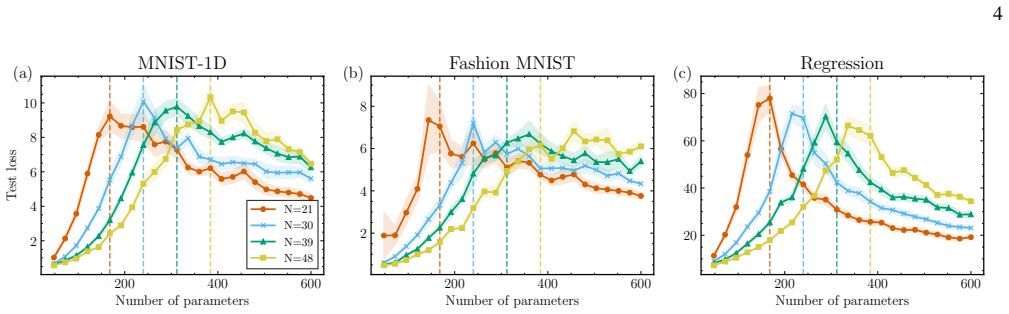
- [Fig. 1 and Conjecture C.4] The numerical evidence for the main message is obtained for K=8 output dimensions, non-Gaussian inputs, and a hand-chosen output rescaling c=150. Theorem C.3 is stated only for K=1 and Gaussian inputs, so Fig. 1 does not test the theorem; at best it supports Conjecture C.4. The predicted thresholds p=NK for K>1 are conjectural, not rigorous. Either the theorem must be extended to K>1 (or at least to the actual experimental setting), or the empirical section must be presented as evidence for a conjecture, with the theoretical claims correspondingly weakened.
- [Lemma D.8 and Assumptions 4–5] The spectral-stability Assumption 4 is verified numerically only for MNIST-1D (Fig. F.1(c)), while Assumption 5 is asserted for 'a broad class of trainable PQCs' without derivation. The proof of Lemma D.8 requires the whitened gradient vectors to be concentrated with constants uniform in p. For deep re-uploading circuits the map x→∇_ϑ f_{ϑ0}(x) may have Lipschitz constant growing with depth L (hence with p), so the concentration constants may not be uniform; this threatens the Marchenko–Pastur limit. The authors should prove or precisely delimit a circuit class for which the concentration and spectral-stability assumptions hold.
minor comments (4)
- [Main text, 'Double descent behavior' section] In the paragraph after Theorem 1, 'the datasets considered in our numerical experiments in Section are non-Gaussian' contains a missing section reference.
- [Appendix B] Duplicate word: 'the expected risk attained attained at local minima' should be 'attained at local minima'.
- [Appendix F] 'Complimenting our main numerical findings' should be 'Complementing our main numerical findings'.
- [Lemma D.11] The statement that λ_min(Ĉ_f_S(ϑ0)) 'achieves a minimum at N=p' is an asymptotic statement; for finite N the eigenvalue is only known to tend to zero when p/N→1. The wording could be made precise to avoid implying a finite-sample exact minimum.
Circularity Check
No significant circularity: the peak-at-interpolation claim is derived from external random-matrix theory and explicit spectral assumptions, not from a fitted parameter or a self-citation chain.
full rationale
The derivation chain is self-contained in the relevant sense. The starting point, Eq. (9) / Theorem B.9, is an external add-one-in decomposition taken from Ref. [33] — not from the authors' own work. The peak location p=N is then obtained by applying the external Marchenko–Pastur theorem (Refs. [35,52,53]) to the whitened sample covariance of PQC function gradients at initialization (Lemma D.8–D.11). The soft edge (1−√(p/N))² vanishes at p=N, which is a mathematical fact, not a fitted input. The remaining ingredients, Assumptions 2–7, are explicitly stated spectral and regularity assumptions; they are inputs to the theorem, not conclusions extracted from it, and they are numerically probed in Fig. F.1. The self-citation [29] is used only as background/programmatic support for extending Gaussian intuition to non-Gaussian data, and it is not load-bearing for the theorem's derivation; the non-Gaussian experiments stand on their own empirical evidence. The main caveats — the analytical claim concerns a lower bound that becomes vacuous at p=N, and the K>1 case is only a conjecture (C.4) — are matters of scope and rigor of the bound, not circularity. No equation is defined in terms of the target result, and no fitted parameter is relabeled as a prediction.
Axiom & Free-Parameter Ledger
free parameters (1)
- Output rescaling factor c =
150
axioms (10)
- standard math Add-one-in error decomposition (Lemma B.5 = Thm 3 of Ref [33]): L(ϑ̂_S) = L'(S) + (1/(N+1))Tr[Ĥ_S^{-1} C] + O(N^{-2})
- domain assumption Gradient-based training returns a local minimum with ∇L̂=0 and Ĥ⪰0 (Appendix A Remark)
- domain assumption Gaussian inputs x∼N(0,I_d) (Theorem C.3)
- ad hoc to paper Assumption 2: λ_max(Ĥ^f_S(ϑ̂_S)) decreases with p near interpolation in the underparameterized regime
- domain assumption Assumption 3: sample Jacobian has full rank NK for p≥NK
- domain assumption Assumption 4: spectral stability of λ_min of the sample gradient covariance through training
- ad hoc to paper Assumption 5: bounded non-degenerate spectrum of C_f(ϑ_0)
- domain assumption Assumption 6: Weyl-like sandwich for λ_min(Ĥ_S)
- ad hoc to paper Assumption 7: add-one-in loss L'(S) does not dominate the lower bound near interpolation
- domain assumption Whitened PQC gradients are isotropic and exponentially concentrated (Lemma D.8)
read the original abstract
A central challenge in quantum machine learning is understanding the scaling behavior of parameterized quantum circuits (PQCs). In particular, it remains unclear how their performance on unseen data changes as the number of trainable parameters increases. Prior works have derived formal generalization guarantees for quantum models, but it is well-known that many such results do not fully characterize generalization behavior in practice. In this work, we show that gradient-based PQCs can exhibit improved performance on unseen data as model size increases, displaying the phenomenon of double descent. This contrasts with the traditional view that larger models lead to degraded generalization. We provide analytical results rigorously underpinning this behavior by leveraging add-one-in perturbation techniques and spectral properties of random matrices. We support these results with numerical experiments on re-uploading PQCs across several data sets and training set sizes, consistently observing the predicted double descent behavior. While other obstacles on the path toward practical quantum machine learning remain, our finding that deeper parameterized quantum circuits do not necessarily exhibit degraded performance provides reasons for cautious optimism.
Figures
Reference graph
Works this paper leans on
-
[1]
Havl´ıˇcek, A
V . Havl´ıˇcek, A. D. C´orcoles, K. Temme, A. W. Harrow, A. Kan- dala, J. M. Chow, and J. M. Gambetta, Supervised learning with quantum-enhanced feature spaces, Nature567, 209 (2019)
2019
-
[2]
Sweke, J.-P
R. Sweke, J.-P. Seifert, D. Hangleiter, and J. Eisert, On the quantum versus classical learnability of discrete distributions, Quantum5, 417 (2021)
2021
-
[3]
Pirnay, R
N. Pirnay, R. Sweke, J. Eisert, and J.-P. Seifert, A super- polynomial quantum-classical separation for density modelling, Physical Review A107, 042416 (2023)
2023
-
[4]
R. Molteni, S. C. Marshall, and V . Dunjko, Quantum ma- chine learning advantages beyond hardness of evaluation, arXiv:2504.15964 (2025)
arXiv 2025
-
[5]
Molteni, C
R. Molteni, C. Gyurik, and V . Dunjko, Exponential quantum ad- vantages in learning quantum observables from classical data, npj Quantum Information12, 19 (2026)
2026
-
[6]
Carleo, I
G. Carleo, I. Cirac, K. Cranmer, L. Daudet, M. Schuld, N. Tishby, L. V ogt-Maranto, and L. Zdeborov´a, Machine learn- ing and the physical sciences, Reviews of Modern Physics91, 045002 (2019)
2019
-
[7]
Biamonte, P
J. Biamonte, P. Wittek, N. Pancotti, P. Rebentrost, N. Wiebe, and S. Lloyd, Quantum machine learning, Nature549, 195 (2017)
2017
-
[8]
S. Masot-Llima, E. Gil-Fuster, C. Bravo-Prieto, J. Eisert, and T. Guaita, Prospects for quantum advantage in machine learn- ing from the representability of functions, arXiv:2512.15661 (2025)
arXiv 2025
-
[9]
A. Barthe, M. Y . Rad, M. Grossi, and V . Dunjko, Quantum ad- vantage in learning quantum dynamics via fourier coefficient extraction, arXiv:2506.17089 (2025)
Pith/arXiv arXiv 2025
-
[10]
R. Bandyopadhyay, R. Molteni, J. Eisert, V . Dunjko, and S. Jerbi, Provable learning separation for predicting time- evolution of quantum many-body systems, arXiv:2607.06472 (2026)
Pith/arXiv arXiv 2026
-
[11]
J. Eisert and J. Preskill, Mind the gaps: The fraught road to quantum advantage, arXiv:2510.19928 (2025)
Pith/arXiv arXiv 2025
-
[12]
J. R. McClean, S. Boixo, V . N. Smelyanskiy, R. Babbush, and H. Neven, Barren plateaus in quantum neural network training landscapes, Nature Communications9, 4812 (2018)
2018
-
[13]
Cerezo, A
M. Cerezo, A. Sone, T. V olkoff, L. Cincio, and P. J. Coles, Cost function dependent barren plateaus in shallow parametrized quantum circuits, Nature Communications12, 1791 (2021)
2021
-
[14]
S. Wang, E. Fontana, M. Cerezo, K. Sharma, A. Sone, L. Cin- cio, and P. J. Coles, Noise-induced barren plateaus in variational quantum algorithms, Nature Communications12, 6961 (2021)
2021
-
[15]
E. R. Anschuetz and B. T. Kiani, Quantum variational algo- rithms are swamped with traps, Nature Communications13, 7760 (2022)
2022
-
[16]
A. A. Mele, A. Angrisani, S. Ghosh, S. Khatri, J. Eisert, D. Stilck Franc ¸a, and Y . Quek, Noise-induced shallow circuits and the absence of barren plateaus, Nature Physics22, 751 (2026)
2026
-
[17]
M. C. Caro, E. Gil-Fuster, J. J. Meyer, J. Eisert, and R. Sweke, Encoding-dependent generalization bounds for parametrized quantum circuits, Quantum5, 582 (2021)
2021
-
[18]
Abbas, D
A. Abbas, D. Sutter, C. Zoufal, A. Lucchi, A. Figalli, and S. Woerner, The power of quantum neural networks, Nature Computational Science , 403 (2021)
2021
-
[19]
Banchi, J
L. Banchi, J. Pereira, and S. Pirandola, Generalization in quan- tum machine learning: A quantum information standpoint, PRX Quantum2, 040321 (2021)
2021
-
[20]
M. C. Caro, H.-Y . Huang, M. Cerezo, K. Sharma, A. Sorn- borger, L. Cincio, and P. J. Coles, Generalization in quantum machine learning from few training data, Nature Communica- tions13, 4919 (2022)
2022
-
[21]
Y . Du, Z. Tu, X. Yuan, and D. Tao, Efficient measure for the ex- pressivity of variational quantum algorithms, Physical Review Letters128, 080506 (2022)
2022
-
[22]
Gil-Fuster, J
E. Gil-Fuster, J. Eisert, and C. Bravo-Prieto, Understanding quantum machine learning also requires rethinking generaliza- tion, Nature Communications15, 2277 (2024). 6
2024
-
[23]
P. Rodriguez-Grasa, M. C. Caro, J. Eisert, E. Gil-Fuster, F. J. Schreiber, and C. Bravo-Prieto, A PAC-Bayesian approach to generalization for quantum models, arXiv:2603.22964 (2026)
arXiv 2026
-
[24]
Peters and M
E. Peters and M. Schuld, Generalization despite overfitting in quantum machine learning models, Quantum7, 1210 (2023)
2023
-
[25]
Belkin, D
M. Belkin, D. Hsu, S. Ma, and S. Mandal, Reconciling mod- ern machine-learning practice and the classical bias-variance trade-off, Proceedings of the National Academy of Sciences 116, 15849 (2019)
2019
-
[26]
Nakkiran, G
P. Nakkiran, G. Kaplun, Y . Bansal, T. Yang, B. Barak, and I. Sutskever, Deep double descent: where bigger models and more data hurt, Journal of Statistical Mechanics: Theory and Experiment2021, 124003 (2021)
2021
-
[27]
Hastie, A
T. Hastie, A. Montanari, S. Rosset, and R. J. Tibshirani, Sur- prises in high-dimensional ridgeless least squares interpolation, Annals of Statistics50, 949 (2022)
2022
-
[28]
Mei and A
S. Mei and A. Montanari, The generalization error of random features regression: Precise asymptotics and double descent curve, Communications on Pure and Applied Mathematics75, 667 (2022)
2022
-
[29]
Kempkes, A
M. Kempkes, A. Ijaz, E. Gil-Fuster, C. Bravo-Prieto, J. Spiegel- berg, E. van Nieuwenburg, and V . Dunjko, Double descent in quantum kernel methods, PRX Quantum7, 010312 (2026)
2026
-
[30]
D. Pranji ´c, M. Roth, and C. Tutschku, Grokking and epoch-wise double descent in quantum neural networks, arXiv:2607.08350 (2026)
Pith/arXiv arXiv 2026
-
[31]
Y . Du, Y . Yang, D. Tao, and M.-H. Hsieh, Problem-dependent power of quantum neural networks on multiclass classification, Physical Review Letters131, 140601 (2023)
2023
-
[32]
P ´erez-Salinas, A
A. P ´erez-Salinas, A. Cervera-Lierta, E. Gil-Fuster, and J. I. Latorre, Data re-uploading for a universal quantum classifier, Quantum4, 226 (2020)
2020
-
[33]
S. P. Singh, A. Lucchi, T. Hofmann, and B. Sch ¨olkopf, Phe- nomenology of double descent in finite-width neural net- works, inInternational Conference on Learning Representa- tions (ICLR 2022)(2022)
2022
-
[34]
F. R. Hampel, R. E. M, R. P. J, and S. W. A,Robust Statistics: The Approach Based on Influence Functions, V ol. 196 (1986)
1986
-
[35]
M. E. A. Seddik, C. Louart, M. Tamaazousti, and R. Couil- let, Random matrix theory proves that deep learning represen- tations of GAN-data behave as Gaussian mixtures, inInterna- tional Conference on Machine Learning(PMLR, 2020)
2020
-
[36]
Couillet and Z
R. Couillet and Z. Liao,Random Matrix Methods for Machine Learning(Cambridge University Press, 2022)
2022
-
[37]
Greydanus and D
S. Greydanus and D. Kobak, Scaling down deep learning with MNIST-1D, inProceedings of the 41st International Confer- ence on Machine Learning, ICML (2024)
2024
-
[38]
H. Xiao, K. Rasul, and R. V ollgraf, Fashion-MNIST: a novel image dataset for benchmarking machine learning algorithms, arXiv:1708.07747 (2017)
Pith/arXiv arXiv 2017
-
[39]
A. Huang, W. Maxwell, V . Belis, E. Peters, J. Pye, S. Jahangiri, and J. Bowles, Spectral Born machines: classically trainable quantum generative models for discrete data, arXiv:2607.06675 (2026)
Pith/arXiv arXiv 2026
-
[40]
E. Recio-Armengol, S. Ahmed, and J. Bowles, Train on classi- cal, deploy on quantum: scaling generative quantum machine learning to a thousand qubits, arXiv:2503.02934 (2026)
arXiv 2026
- [41]
-
[42]
D’Ascoli, M
S. D’Ascoli, M. Refinetti, G. Biroli, and F. Krzakala, Double trouble in double descent: Bias and variance(s) in the lazy regime, inProceedings of the 37th International Conference on Machine Learning, Proceedings of Machine Learning Re- search, V ol. 119, edited by H. D. III and A. Singh (PMLR,
-
[43]
Y . Dar, V . Muthukumar, and R. G. Baraniuk, A farewell to the bias-variance tradeoff? An overview of the theory of overpa- rameterized machine learning, arXiv:2109.02355 (2021)
Pith/arXiv arXiv 2021
-
[44]
Anschuetz, A unified theory of quantum neural network loss landscapes, inInternational Conference on Learning Represen- tations, V ol
E. Anschuetz, A unified theory of quantum neural network loss landscapes, inInternational Conference on Learning Represen- tations, V ol. 2025 (2025) pp. 97859–97918
2025
-
[45]
Thanasilp, S
S. Thanasilp, S. Wang, M. Cerezo, and Z. Holmes, Exponential concentration in quantum kernel methods, Nature Communica- tions15(2024)
2024
-
[46]
V . N. Vapnik and A. Y . Chervonenkis, On the uniform con- vergence of relative frequencies of events to their probabilities, inMeasures of complexity: festschrift for alexey chervonenkis (Springer, 2015) pp. 11–30
2015
-
[47]
Vapnik, An overview of statistical learning theory, IEEE Transactions on Neural Networks10, 988 (1999)
V . Vapnik, An overview of statistical learning theory, IEEE Transactions on Neural Networks10, 988 (1999)
1999
-
[48]
L. G. Valiant, A theory of the learnable, Commun. ACM27, 1134–1142 (1984)
1984
-
[49]
Shalev-Shwartz and S
S. Shalev-Shwartz and S. Ben-David,Understanding machine learning(Cambridge University Press, Cambridge, England, 2014)
2014
-
[50]
Cautious optimism for deep parameterized quantum circuits, GitHub repository (2026)
2026
-
[51]
Y . Fang, K. Loparo, and X. Feng, Inequalities for the trace of matrix product, IEEE Transactions on Automatic Control39, 2489 (1994)
1994
-
[52]
Yaskov, Necessary and sufficient conditions for the Marchenko-Pastur theorem, Electronic Communications in Probability21, 1 (2016)
P. Yaskov, Necessary and sufficient conditions for the Marchenko-Pastur theorem, Electronic Communications in Probability21, 1 (2016)
2016
-
[53]
C. Louart and R. Couillet, Concentration of measure and large random matrices with an application to sample covariance ma- trices, arXiv:1805.08295 (2021)
Pith/arXiv arXiv 2021
-
[54]
Mathias,Singular values and singular value inequalities (CRC Press, 2013)
R. Mathias,Singular values and singular value inequalities (CRC Press, 2013)
2013
-
[55]
K. Karhadkar, M. Murray, H. Tseran, and G. Mont ´ufar, Mildly overparameterized ReLU networks have a favorable loss land- scape, arXiv:2305.19510 (2024)
Pith/arXiv arXiv 2024
-
[56]
V . Bergholm, J. Izaac, M. Schuld, C. Gogolin, and N. Killo- ran, Pennylane: Automatic differentiation of hybrid quantum- classical computations, arXiv:1811.04968 (2018)
Pith/arXiv arXiv 2018
-
[57]
Pedregosa, G
F. Pedregosa, G. Varoquaux, A. Gramfort, V . Michel, B. Thirion, O. Grisel, M. Blondel, P. Prettenhofer, R. Weiss, V . Dubourg,et al., Scikit-learn: Machine learning in python, The Journal of Machine Learning Research12, 2825 (2011)
2011
-
[58]
N. E. Karoui, The spectrum of kernel random matrices, Annals of Statistics38, 1 (2010)
2010
-
[59]
Cheng and A
X. Cheng and A. Singer, The spectrum of random inner-product kernel matrices, Random Matrices: Theory and Applications2, 1350010 (2013)
2013
-
[60]
Cautious optimism for deep parameterized quantum circuits
Z. Fan and A. Montanari, The spectral norm of random inner- product kernel matrices, Probability Theory and Related Fields 173, 27 (2019). 7 Supplementary Material for “Cautious optimism for deep parameterized quantum circuits” Appendix A: Framework Throughout this work, we consider supervised learning tasks on a data spaceZ :=X × Y, whereX ⊆Rd denotes th...
2019
discussion (0)
Sign in with ORCID, Apple, or X to comment. Anyone can read and Pith papers without signing in.