REVIEW 4 major objections 3 minor 60 references
Room-temperature van der Waals magnetoresistive memories with data writing by orbital current in the Weyl semimetal TaIrTe4
T0 review · 4 major / 3 minor · reviewed 2026-08-11 · deepseek-v4-flash
Pith's one-line read Current along the Berry-curvature dipole writes magnet memories field-free at room temperature.
desk verdict Worth a serious referee: solid device work, overclaimed mechanism. read the letter →
The pith
A machine-rendered reading of the paper's core claim, the machinery that carries it, and where it could break.
The reading
What carries the argument
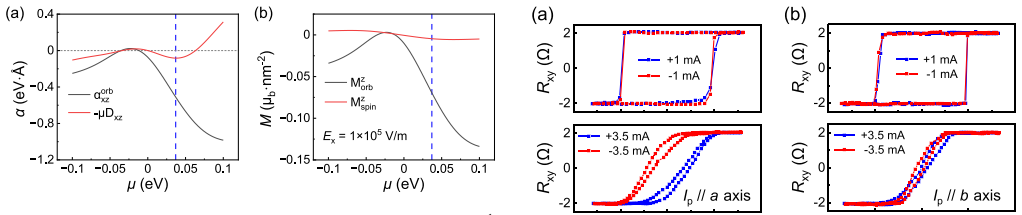
The load-bearing object is the Berry curvature dipole $D_{ij}$, the momentum-space dipole moment of the Berry curvature, defined as $D_{ij}=-\int \frac{d^2k}{(2\pi)^2}\sum_n \partial_{k_i}\epsilon_{nk}\Omega^j_{nk}\partial_{\epsilon} f^{(0)}_{nk}$. In the low-symmetry $T_d$-phase TaIrTe4, only the $D_{xz}$ component survives, so an electric field along the a axis produces an out-of-plane orbital magnetization through the orbital magnetoelectric coefficient $\alpha^{\rm orb}_{xz}=-\mu D_{xz}+\beta_{xz}$. The paper uses first-principles tight-binding calculations to show that at the estimated Fermi level this orbital response dominates the spin response by a factor of about 15, and it uses the second-harmonic nonlinear Hall voltage, proportional to $(D\cdot E)\hat z\times E$, as the electrical fingerprint of the same underlying dipole.
What would settle it
Gating a TaIrTe4/Fe3GaTe2 device so that the chemical potential crosses the point where the calculated $-\mu D_{xz}$ term changes sign should flip the polarity of both the nonlinear Hall voltage and the field-free switching loop; if the switching polarity stays fixed while the nonlinear Hall signal changes sign, the orbital-BCD torque is not the controlling mechanism. Alternatively, a second-harmonic or spin-torque ferromagnetic resonance measurement resolving the out-of-plane torque symmetry would reveal whether a comparable coexisting spin torque is present.
Extended reading notes
Core claim
The central claim is that in a few-layer TaIrTe4/Fe3GaTe2 van der Waals stack, an in-plane charge current converts into an out-of-plane orbital magnetization $M_{\rm orb}$ through the orbital magnetoelectric effect, and this orbital magnetization exerts an antidamping-like torque $\mathbf{m}_{\rm FGT}\times(\mathbf{m}_{\rm orb}\times\mathbf{m}_{\rm FGT})$ that deterministically switches the perpendicular magnetization of Fe3GaTe2 without any external field. The direction of $M_{\rm orb}$ is set by $-(D\cdot E)\hat z$, where $D$ is the Berry curvature dipole along the a axis, so current polarity and crystalline orientation control the final magnetization state. The paper supports this by matching the sign of the second-harmonic nonlinear Hall voltage with the clockwise or anticlockwise polarity of the switching loop, by showing the effect vanishes for current along the b axis, and by first-principles calculations giving an orbital-to-spin out-of-plane magnetization ratio of about 15 at the Fermi level $\mu=0.037$ eV with $\tau=1$ ps. In the integrated magnetic tunnel junction memory, field-free current pulses of $\pm2.5$ mA write high- and low-resistance states at 290 K with a tunneling magnetoresistance ratio of about 2.6 percent and a writing current density of about $2.5\times10^6$ A/cm$^2$.
Load-bearing premise
The argument hinges on the calculated claim that at the sample's Fermi level the orbital magnetoelectric response is about 15 times larger than the spin response, so the observed switching is attributed to orbital torque; this ratio rests on a density-functional model with a calibrated Fermi level and an assumed relaxation time of 1 ps, and no direct torque measurement separately resolves the orbital and spin contributions.
Editorial extensions
If this is right
- Field-free perpendicular magnetization switching without external magnetic fields or interlayer engineering becomes possible at room temperature in van der Waals stacks, with critical current densities near $2\times10^6$ A/cm$^2$.
- The sign of the second-harmonic nonlinear Hall voltage predicts the deterministic switching polarity, giving a fast electrical probe for choosing current direction and device layout.
- Integrating TaIrTe4 with Fe3GaTe2/h-BN/Fe3GaTe2 tunnel junctions yields a nonvolatile magnetoresistive memory where writing is all-electric at 290 K with a power density of about 1.35 fJ/nm$^2$.
- Larger Berry curvature dipoles should give stronger out-of-plane orbital torques, making the dipole a selection metric for future orbitronic heterostructures.
Reading between the lines
- If the orbital-BCD mechanism generalizes, the sign of the nonlinear Hall signal could serve as a design rule in other low-symmetry transition-metal dichalcogenides and Weyl semimetals, even where direct torque measurements are difficult.
- A quantitative test would be to gate the TaIrTe4 Fermi level across the calculated zero crossing of $\alpha^{\rm orb}_{xz}$; the switching polarity should reverse at that gate voltage, separating the orbital torque from spin and Oersted contributions.
- The room-temperature operation implies the Berry curvature dipole persists in the practical device geometry, so harmonic Hall detection could become an in situ calibration of torque efficiency in future memory cells.
Signed reviews
Editorial analysis
A structured set of objections, weighed in public.
Referee Report
Summary. This manuscript reports transport experiments on TaIrTe4/Fe3GaTe2 van der Waals heterostructures in which current pulses along the a-axis of TaIrTe4 produce deterministic, field-free switching of the perpendicular magnetization of Fe3GaTe2 at 300 K, while current along the b-axis does not. The switching polarity is correlated with the sign of the second-harmonic nonlinear Hall voltage in devices B–E; AHE-loop-shift measurements yield an out-of-plane antidamping-like torque efficiency of about 0.16; and a TaIrTe4/Fe3GaTe2/h-BN/Fe3GaTe2 stack is operated as a magnetoresistive memory with about 2.5% TMR. First-principles tight-binding calculations are used to argue that the Berry curvature dipole of TaIrTe4 produces an orbital magnetization that exceeds the spin magnetization by a factor of 15 at the calibrated Fermi level, and the authors conclude that orbital torque governs the switching.
Significance. The experimental core is valuable: room-temperature field-free switching with Jc around 2×10^6 A/cm2, systematic a/b-axis and angular controls, reproducibility across devices, and a working all-electric van der Waals magnetoresistive memory are significant advances in orbitronic switching and compare favorably with prior WTe2/TaIrTe4 work. The proposed link between the nonlinear Hall sign and the switching polarity is an elegant and potentially useful design rule. However, the central mechanism claim that orbital magnetization 'governs' the switching rests on a DFT ratio whose spin channel is defined by a nonstandard formula and on a symmetry-based correlation that cannot distinguish orbital torque from spin torque. The significance is therefore conditional on fixing or softening the quantitative mechanism attribution.
major comments (4)
- [Appendix E, Eq. (E4)] The spin magnetic moment used in the calculation, mspin_nk = −⟨∂k u_nk | (1/2)g μ_b σ | ∂k u_nk⟩, is not the standard spin magnetic moment of a Bloch state, which is −μ_B ⟨u_nk|σ|u_nk⟩ with no k-derivatives. If Eq. (E4) was implemented literally, the quantity labeled α_spin is not the spin Edelstein coefficient, and the factor-of-15 comparison in Fig. 4(b) does not demonstrate that orbital magnetization dominates the spin response. If a different quantity was intended, its definition and relation to the spin torque must be given explicitly. Because this ratio is the quantitative basis for the word 'governs' in the abstract and in Section III, this point must be resolved.
- [Section III and Fig. 4(b)] Even if the ratio Morb/Mspin ≈ 15 is correct for isolated TaIrTe4, it is a ratio of magnetizations in the semimetal, not a ratio of torques on Fe3GaTe2. The manuscript does not calculate or measure the conversion of the TaIrTe4 orbital moment into a torque at the TaIrTe4/Fe3GaTe2 interface, nor does it quantitatively rule out the coexisting spin torque or Oersted-field contribution. Since the switching loops, the θ dependence, and the loop-shift data all share the same crystal-axis symmetry, the experiments establish a correlation but not that the orbital channel 'governs'. A direct torque measurement, a ferromagnetic-thickness or interface-dependent test, or an explicit interface calculation is needed before this claim can stand.
- [Figs. 2, 3 and Section III] The correlation between the sign of V^{2ω}_⊥ and the polarity of the Rxy–Ip loops is presented as experimental evidence for the orbital mechanism, but it is only a consistency check: both the nonlinear Hall effect and the current-induced orbital magnetization are predicted from the same Berry-curvature-dipole symmetry, and a spin-Edelstein or crystal-dependent spin-torque mechanism with the same BCD angular dependence would produce the same sign correlation. The data in Figs. 2, 3, and 5 therefore do not discriminate orbital torque from spin torque; the discrimination rests on the DFT ratio, which is the quantity called into question in the first major comment.
- [Appendix B and Fig. 4(a)] The calculated ratio is evaluated at a Fermi level μ = 0.037 eV that is calibrated to the carrier density of a bare TaIrTe4 device (device A), whereas the switching devices are TaIrTe4/Fe3GaTe2 heterostructures in which charge transfer and band alignment may shift the Fermi level. Since Fig. 4(b) shows that the orbital-to-spin ratio can vary strongly with μ in the vicinity of the calibrated value, the uncertainty in the Fermi level is load-bearing for the quantitative claim. The authors should estimate the expected Fermi-level shift in the heterostructure or demonstrate that the 15:1 ratio is robust over a plausible range of μ.
minor comments (3)
- [Fig. 4(b) caption] The caption states that the relaxation time is τ = 1 ps, but the orbital-to-spin magnetization ratio is independent of τ because both magnetizations are linear in τ; the caption should state this explicitly so that readers do not mistake the assumed τ for the fragile input.
- [Table I] The critical current density for 'This work' is listed as 1.3×10^6 A/cm2, while the main text reports 2.36×10^6 A/cm2 for device B and 1.38×10^6 A/cm2 for device D; the table should identify which device is quoted or list both values.
- [References] Reference [51] is an arXiv preprint; if a published version exists, it should be cited in its final form.
Circularity Check
No significant circularity: the switching experiments are independent of the DFT-derived orbital/spin ratio, and the NLHE-sign correlation is a consistency check rather than a fitted prediction.
full rationale
The paper's derivation chain has three parts: (i) first-principles calculation of orbital and spin magnetoelectric coefficients; (ii) transport measurements of NLHE and field-free switching; (iii) a physical model connecting them via the Berry curvature dipole. No step is equivalent to its input by construction. The Fermi level mu = 0.037 eV is calibrated from measured carrier densities in Appendix B, not fitted to the switching polarity or torque efficiency; the orbital/spin magnetization ratio of about 15 at that mu is an ab initio result computed with Wannier interpolation and is independent of the switching data. The NLHE sign and switching polarity are correlated through the relations V2omega proportional to D dot E and Morb proportional to -(D dot E) z-hat; both follow from the same Berry-curvature-dipole symmetry, so the correlation is a consistency check rather than an independently fitted parameter. The field-free switching itself, the critical current density, and the torque efficiency are directly measured and do not reduce to the theoretical inputs. The paper does cite prior work by the same group for orbital torque and related Berry curvature dipole effects, but those citations support context and comparison rather than the load-bearing numerical claim, which rests on the present DFT calculation and measurements. Any concern about the literal spin-moment formula in Eq. E4 is a correctness risk, not a circularity risk. Overall, no load-bearing argument reduces to its own inputs, so the circularity score is 0.
Assumptions & free parameters
free parameters (2)
- Fermi level mu =
0.037 eV
- Relaxation time tau =
1 ps
assumptions (4)
- domain assumption The current-induced orbital magnetization in TaIrTe4 exerts an antidamping-like torque on Fe3GaTe2 via proximity coupling, with torque form mFGT x (morb x mFGT).
- standard math The second-harmonic transverse voltage V2omega is proportional to the Berry curvature dipole, and its sign indicates the direction of the current-induced out-of-plane orbital magnetization.
- standard math The orbital magnetoelectric coefficient formula alpha_orb_ij is valid for the five-layer TaIrTe4 slab, and its beta contribution and Berry-curvature-dipole contribution can be computed from the DFT tight-binding model.
- ad hoc to paper The Fermi level in the device is at mu = 0.037 eV, and the relaxation time is tau = 1 ps, as calibrated to the measured carrier density and assumed for the transport regime.
Cite this review
Pith. "Pith review of Room-temperature van der Waals magnetoresistive memories with data writing by orbital current in the Weyl semimetal TaIrTe4." pith.science (2026). https://pith.science/paper/QY6GEBOR
@misc{pith2026241202488,
  author       = {Pith},
  title        = {Pith review of: Room-temperature van der Waals magnetoresistive memories with data writing by orbital current in the Weyl semimetal TaIrTe4},
  year         = {2026},
  howpublished = {\url{https://pith.science/paper/QY6GEBOR}},
  note         = {Machine review of arXiv:2412.02488}
}
read the original abstract
Current-induced out of plane magnetization has been utilized for field-free switching of ferromagnets with perpendicular magnetic anisotropy. Identifying systems capable of energy-efficiently converting charge currents into out of plane orbit- or spin-polarized currents is crucial for advancing magnetic memory technologies. Here we introduce the Berry curvature dipole as a key evaluation factor, directly measurable through nonlinear Hall effects. In the Weyl semimetal TaIrTe4 used in our experiments, applying a current parallel to the Berry curvature dipole results in out of plane orbital magnetization, which governs the field-free perpendicular magnetization switching in TaIrTe4/Fe3GaTe2 heterostructures. Notably, all-electric control of van der Waals magnetoresistive memory at room temperature has been achieved with a low critical current density 2x10^6A/cm2 for data writing. Our findings reveal the connection between nonlinear Hall effects and field-free magnetization switching, highlighting the potential of the Berry curvature dipole in advancing orbitronics.
Figures


Figures from the paper (8 more)


Reference graph
Works this paper leans on
-
[1]
Berry curvature dipole Berry curvature dipole, the dipole moment of the Berry curvature in momentum space, can be calculated as [43] Dij =− ∫ BZ d2k (2π )2 [∑ n ∂ki ϵnk/Omega1j nk∂ϵnk f (0) nk ] , (E1) where i and j represent x, y,o r z, ϵnk is the energy eigenvalue of the band n at k, f (0) nk is the Fermi distribution, and the Berry curvature can be fou...
-
[2]
Furthermore, utilizing a series of ±2.5 mA writing current pulses, the state transition between “0” (high-R MTJ state) and “1” (low-RMTJ state) demonstrates robustness and nonvolatility [Fig. 7(e)]. The critical current density (Jc) and the power consumption density for data writ- ing is 2.53× 10⁶ A/cm² and∼1.35 fJ/nm², respectively. Under the condition o...
-
[3]
D. Ielmini and H. S. P. Wong, In-memory computing with resistive switching devices, Nat. Electron. 1, 333 (2018)
work page 2018
-
[4]
As illustrated in Fig. 7(d), the transition of RMTJ be- tween high- and low-resistance states is achieved by applying current pulses in TaIrTe
-
[5]
13, from which we can extract D xz as 0.22 nm at the Fermi level (dashed line in Fig
Berry cur- vature dipole tensors as a function of chemical potential are shown in Fig. 13, from which we can extract D xz as 0.22 nm at the Fermi level (dashed line in Fig. 13)
-
[6]
Orbital and spin magnetoelectric coefficients The electric field induced orbital and spin magnetiza- tion can be described as Morb = ( e2τ 2¯h2 )αorbE and Mspin = ( eτ ¯h )αspinE, respectively, whereE is the external electric field, e is the electron charge, τ is the relaxation time, and αorb (αspin) is the orbital (spin) magnetoelectric coefficient. The orbi...
-
[7]
M. A. Zidan, J. P. Strachan, and W. D. Lu, The future of electronics based on memristive systems, Nat. Electron. 1,2 2 (2018)
work page 2018
-
[8]
J. J. Yang, D. B. Strukov, and D. R. Stewart, Memristive devices for computing, Nat. Nanotechnol. 8, 13 (2013)
work page 2013
Show all 60 references
-
[9]
H. Yang, S. O. Valenzuela, M. Chshiev, S. Couet, B. Dieny, B. Dlubak, A. Fert, K. Garello, M. Jamet, D. E. Jeong et al., Two-dimensional materials prospects for non-volatile spin- tronic memories, Nature (London) 606, 663 (2022)
2022
-
[10]
Apalkov, B
D. Apalkov, B. Dieny, and J. M. Slaughter, Magnetoresistive random access memory, IEEE Proc. 104, 1796 (2016)
2016
-
[11]
I. M. Miron, K. Garello, G. Gaudin, P. J. Zermatten, M. V . Costache, S. Auffret, S. Bandiera, B. Rodmacq, A. Schuhl, and P. Gambardella, Perpendicular switching of a single fer- romagnetic layer induced by in-plane current injection, Nature (London) 476, 189 (2011)
2011
-
[12]
Garello, I
K. Garello, I. M. Miron, C. O. Avci, F. Freimuth, Y . Mokrousov, S. Blugel, S. Auffret, O. Boulle, G. Gaudin, and P. Gambardella, Symmetry and magnitude of spin-orbit torques in ferromagnetic heterostructures, Nat. Nanotechnol. 8, 587 (2013)
2013
-
[13]
K. Cai, M. Yang, H. Ju, S. Wang, Y . Ji, B. Li, K. W. Edmonds, Y . Sheng, B. Zhang, N. Zhang et al., Electric field control of deterministic current-induced magnetization switching in a hy- brid ferromagnetic/ferroelectric structure, Nat. Mater. 16, 712 (2017)
2017
-
[14]
G. Yu, P. Upadhyaya, Y . Fan, J. G. Alzate, W. Jiang, K. L. Wong, S. Takei, S. A. Bender, L. T. Chang, Y . Jiang et al., Switching of perpendicular magnetization by spin-orbit torques in the absence of external magnetic fields, Nat. Nanotechnol. 9, 548 (2014)
2014
-
[15]
Liu, C.-F
L. Liu, C.-F. Pai, Y . Li, H. W. Tseng, D. C. Ralph, and R. A. Buhrman, Spin-torque switching with the giant spin Hall effect of tantalum, Science 336, 555 (2012)
2012
-
[16]
Fukami, C
S. Fukami, C. Zhang, S. DuttaGupta, A. Kurenkov, and H. Ohno, Magnetization switching by spin–orbit torque in an antiferromagnet–ferromagnet bilayer system, Nat. Mater. 15, 535 (2016)
2016
-
[17]
MacNeill, G
D. MacNeill, G. M. Stiehl, M. H. D. Guimaraes, R. A. Buhrman, J. Park, and D. C. Ralph, Control of spin–orbit torques through crystal symmetry in WTe 2/ferromagnet bilay- ers, Nat. Phys. 13, 300 (2016)
2016
-
[18]
F. Xue, C. Rohmann, J. Li, V . Amin, and P. Haney, Un- conventional spin-orbit torque in transition metal dichalco- genide/ferromagnet bilayers from first-principles calculations, P h y s .R e v .B102, 014401 (2020)
2020
-
[19]
I. H. Kao, R. Muzzio, H. Zhang, M. Zhu, J. Gobbo, S. Yuan, D. Weber, R. Rao, J. Li, J. H. Edgaret al., Deterministic switching of a perpendicularly polarized magnet using unconventional spin-orbit torques in WTe 2, Nat. Mater. 21, 1029 (2022)
2022
-
[20]
Ye, P.-F
X.-G. Ye, P.-F. Zhu, W.-Z. Xu, N. Shang, K. Liu, and Z.-M. Liao, Orbit-transfer torque driven field-free switching of per- pendicular magnetization, Chin. Phys. Lett. 39, 037303 (2022)
2022
-
[21]
Y . Liu, G. Shi, D. Kumar, T. Kim, S. Shi, D. Yang, J. Zhang, C. Zhang, F. Wang, S. Yanget al., Field-free switching of perpen- dicular magnetization at room temperature using out-of-plane spins from TaIrTe 4, Nat. Electron. 6, 732 (2023)
2023
-
[22]
Zhang, H
Y . Zhang, H. Xu, K. Jia, G. Lan, Z. Huang, B. He, C. He, Q. Shao, Y . Wang, M. Zhao et al., Room temperature field-free switching of perpendicular magnetization through spin-orbit torque originating from low-symmetry type II Weyl semimetal, Sci. Adv. 9, eadg9819 (2023)
2023
-
[23]
Z.-C. Pan, D. Li, X.-G. Ye, Z. Chen, Z.-H. Chen, A.-Q. Wang, M. Tian, G. Yao, K. Liu, and Z.-M. Liao, Room-temperature orbit-transfer torque enabling van der Waals magnetoresistive memories, Sci. Bull. 68, 2743 (2023)
2023
-
[24]
Sundaram and Q
G. Sundaram and Q. Niu, Wave-packet dynamics in slowly per- turbed crystals: Gradient corrections and Berry-phase effects, Phys. Rev. B 59, 14915 (1999)
1999
-
[25]
D. Xiao, W. Yao, and Q. Niu, Valley-contrasting physics in graphene: Magnetic moment and topological transport, Phys. Rev. Lett. 99, 236809 (2007)
2007
-
[26]
X. Xu, W. Yao, D. Xiao, and T. F. Heinz, Spin and pseudospins in layered transition metal dichalcogenides, Nat. Phys. 10, 343 (2014)
2014
-
[27]
D. Xiao, J. Shi, and Q. Niu, Berry phase correction to electron density of states in solids, P h y s .R e v .L e t t .95, 137204 (2005)
2005
-
[28]
T. Yoda, T. Yokoyama, and S. Murakami, Orbital Edelstein effect as a condensed-matter analog of solenoids, Nano Lett. 18, 916 (2018)
2018
-
[29]
D. Hara, M. S. Bahramy, and S. Murakami, Current-induced orbital magnetization in systems without inversion symmetry, Phys. Rev. B 102, 184404 (2020)
2020
-
[30]
Salemi, M
L. Salemi, M. Berritta, A. K. Nandy, and P. M. Oppeneer, Orbitally dominated Rashba-Edelstein effect in noncentrosym- metric antiferromagnets, Nat. Commun. 10, 5381 (2019)
2019
-
[31]
X. Chen, Y . Liu, G. Yang, H. Shi, C. Hu, M. Li, and H. Zeng, Giant antidamping orbital torque originating from the orbital Rashba-Edelstein effect in ferromagnetic heterostructures, Nat. Commun. 9, 2569 (2018)
2018
-
[32]
D. Go, D. Jo, K.-W. Kim, S. Lee, M.-G. Kang, B.-G. Park, S. Blügel, H.-W. Lee, and Y . Mokrousov, Long-range orbital torque by momentum-space hotspots, Phys. Rev. Lett. 130, 246701 (2023)
2023
-
[33]
Xiao, M.-C
D. Xiao, M.-C. Chang, and Q. Niu, Berry phase effects on electronic properties, Rev. Mod. Phys. 82, 1959 (2010)
2010
-
[34]
Son, K.-H
J. Son, K.-H. Kim, Y . H. Ahn, H.-W. Lee, and J. Lee, Strain engineering of the Berry curvature dipole and valley magnetiza- tion in monolayer MoS 2, Phys. Rev. Lett. 123, 036806 (2019)
2019
-
[35]
Qin, P.-F
M.-S. Qin, P.-F. Zhu, X.-G. Ye, W.-Z. Xu, Z.-H. Song, J. Liang, K. Liu, and Z.-M. Liao, Strain tunable Berry curvature dipole, 11 orbital magnetization and nonlinear Hall effect in WSe2 mono- layer, Chin. Phys. Lett. 38, 017301 (2021)
2021
-
[36]
J. Lee, Z. Wang, H. Xie, K. F. Mak, and J. Shan, Valley magne- toelectricity in single-layer MoS2, Nat. Mater. 16, 887 (2017)
2017
-
[37]
K. Kang, T. Li, E. Sohn, J. Shan, and K. F. Mak, Nonlinear anomalous Hall effect in few-layer WTe 2, Nat. Mater. 18, 324 (2019)
2019
-
[38]
Q. Ma, S. Y . Xu, H. Shen, D. MacNeill, V . Fatemi, T. R. Chang, A. M. Mier Valdivia, S. Wu, Z. Du, C. H. Hsu et al.,O b s e r v a - tion of the nonlinear Hall effect under time-reversal-symmetric conditions, Nature (London) 565, 337 (2019)
2019
-
[39]
Kumar, C
D. Kumar, C. H. Hsu, R. Sharma, T. R. Chang, P. Yu, J. Wang, G. Eda, G. Liang, and H. Yang, Room-temperature nonlinear Hall effect and wireless radiofrequency rectification in Weyl semimetal TaIrTe 4, Nat. Nanotechnol. 16, 421 (2021)
2021
-
[40]
Marzari and D
N. Marzari and D. Vanderbilt, Maximally localized generalized Wannier functions for composite energy bands, P h y s .R e v .B 56, 12847 (1997)
1997
-
[41]
Souza, N
I. Souza, N. Marzari, and D. Vanderbilt, Maximally localized Wannier functions for entangled energy bands,Phys. Rev. B65, 035109 (2001)
2001
-
[42]
A. A. Mostofi, J. R. Yates, Y .-S. Lee, I. Souza, D. Vanderbilt, and N. Marzari, W ANNIER90: A tool for obtaining maximally- localised Wannier functions,Comput. Phys. Commun. 178, 685 (2008)
2008
-
[43]
S. S. Tsirkin, High performance Wannier interpolation of Berry curvature and related quantities with W ANNIERBERRIcode, npj Comput. Mater. 7, 33 (2021)
2021
-
[44]
Koepernik, D
K. Koepernik, D. Kasinathan, D. V . Efremov, S. Khim, S. Borisenko, B. Büchner, and J. van den Brink, TaIrTe4: A ternary type-II Weyl semimetal, P h y s .R e v .B93, 201101(R) (2016)
2016
-
[45]
Y . Liu, Q. Gu, Y . Peng, S. Qi, N. Zhang, Y . Zhang, X. Ma, R. Zhu, L. Tong, J. Feng et al., Raman signatures of broken inversion symmetry and in-plane anisotropy in type-II Weyl semimetal candidate TaIrTe 4, Adv. Mater.30, e1706402 (2018)
2018
-
[46]
Zhang, F
G. Zhang, F. Guo, H. Wu, X. Wen, L. Yang, W. Jin, W. Zhang, and H. Chang, Above-room-temperature strong intrin- sic ferromagnetism in 2D van der Waals Fe 3GaTe2 with large perpendicular magnetic anisotropy, Nat. Commun. 13, 5067 (2022)
2022
-
[47]
Žuti ´c, J
I. Žuti ´c, J. Fabian, and S. Das Sarma, Spintronics: Fundamen- tals and applications, Rev. Mod. Phys. 76, 323 (2004)
2004
-
[48]
Sodemann and L
I. Sodemann and L. Fu, Quantum nonlinear Hall effect induced by Berry curvature dipole in time-reversal invariant materials, P h y s .R e v .L e t t .115, 216806 (2015)
2015
-
[49]
Alghamdi, M
M. Alghamdi, M. Lohmann, J. Li, P. R. Jothi, Q. Shao, M. Aldosary, T. Su, B. P. T. Fokwa, and J. Shi, Highly efficient spin-orbit torque and switching of layered ferromagnet Fe 3GeTe2, Nano Lett. 19, 4400 (2019)
2019
-
[50]
X. Wang, J. Tang, X. Xia, C. He, J. Zhang, Y . Liu, C. Wan, C. Fang, C. Guo, W. Yang et al., Current-driven magnetization switching in a van der Waals ferromagnet Fe3GeTe2, Sci. Adv. 5, eaaw8904 (2019)
2019
-
[51]
Fujimura, R
R. Fujimura, R. Yoshimi, M. Mogi, A. Tsukazaki, M. Kawamura, K. S. Takahashi, M. Kawasaki, and Y . Tokura, Current-induced magnetization switching at charge-transferred interface between topological insulator (Bi , Sb) 2Te3 and van der Waals ferromagnet Fe 3GeTe2, Appl. Phys. ...
2021
-
[52]
C. Yun, H. Guo, Z. Lin, L. Peng, Z. Liang, M. Meng, B. Zhang, Z. Zhao, L. Wang, Y . Ma et al., Efficient current- induced spin torques and field-free magnetization switching in a room-temperature van der Waals magnet,Sci. Adv. 9, eadj3955 (2023)
2023
-
[53]
N. H. D. Khang, Y . Ueda, and P. N. Hai, A conductive topological insulator with large spin Hall effect for ul- tralow power spin–orbit torque switching, Nat. Mater. 17, 808 (2018)
2018
-
[54]
H. Wu, Y . Xu, P. Deng, Q. Pan, S. A. Razavi, K. Wong, L. Huang, B. Dai, Q. Shao, G. Yu et al., Spin-orbit torque switch- ing of a nearly compensated ferrimagnet by topological surface states, Adv. Mater. 31, 1901681 (2019)
2019
-
[55]
Zhong, J
S. Zhong, J. E. Moore, and I. Souza, Gyrotropic magnetic effect and the magnetic moment on the Fermi surface,P h y s .R e v .L e t t . 116, 077201 (2016)
2016
-
[56]
D. G. Ovalle, A. Pezo, and A. Manchon, Orbital Kerr effect and terahertz detection via the nonlinear Hall effect, arXiv:2311.11889
-
[57]
S. C. Baek, V . P. Amin, Y . W. Oh, G. Go, S. J. Lee, G. H. Lee, K. J. Kim, M. D. Stiles, B. G. Park, and K. J. Lee, Spin currents and spin-orbit torques in ferromagnetic trilayers,Nat. Mater.17, 509 (2018)
2018
-
[58]
J. Han, A. Richardella, S. A. Siddiqui, J. Finley, N. Samarth, and L. Liu, Room-temperature spin-orbit torque switching in- duced by a topological insulator, P h y s .R e v .L e t t .119, 077702 (2017)
2017
-
[59]
C.-F. Pai, M. Mann, A. J. Tan, and G. S. D. Beach, Deter- mination of spin torque efficiencies in heterostructures with perpendicular magnetic anisotropy, P h y s .R e v .B93, 144409 (2016)
2016
-
[60]
Fatemi, Q
V . Fatemi, Q. D. Gibson, K. Watanabe, T. Taniguchi, R. J. Cava, and P. Jarillo-Herrero, Magnetoresistance and quantum oscilla- tions of an electrostatically tuned semimetal-to-metal transition in ultrathin WTe 2, Phys. Rev. B 95, 041410(R) (2017). 12
2017
Reviewed August 11, 2026 · model on record in the stance chip above.
Discussion (0). Continue with ORCID to comment.