REVIEW 3 major objections 5 minor 4 cited by
Diffusion-Inspired Masked Fine-Tuning for Knowledge Injection in Autoregressive LLMs
T0 review · 3 major / 5 minor · reviewed 2026-08-04 · deepseek-v4-flash
Pith's one-line read Masked reconstruction training lets autoregressive LLMs learn new facts from plain documents, with no paraphrase augmentation, and removes the reversal curse.
desk verdict The masked fine-tuning idea is genuinely new and the demasking objective clearly helps, but the headline QA metric (ROUGE-1 recall) is loose enough that the 'closes the gap' claim needs re-scoring before I'd trust the size of the effect. read the letter →
The pith
A machine-rendered reading of the paper's core claim, the machinery that carries it, and where it could break.
The reading
What carries the argument
The central object is the masked fine-tuning paradigm: during fine-tuning, a random fraction t of each document's tokens (uniformly sampled from 0.05 to 0.95) is replaced with a special [MASK] token; the masked document is placed in the prompt with an instruction to 'return the recovered masked passage,' and the original unmasked document serves as the supervised target, with the autoregressive loss applied only to the assistant response tokens. This emulates the mask-reconstruction loss of masked diffusion LLMs without changing the autoregressive architecture or the optimization target. The random mask ratio is crucial: it modulates task difficulty, and a control experiment with random toke
What would settle it
Run a strict exact-match evaluation on the same fine-tuned models—parse the generated answer and require it to contain exactly the ground-truth entity (e.g., a name or date) with no additional sentences—and compare masked fine-tuning against vanilla fine-tuning on the Wiki and NameDescription datasets; if the previously reported margins (e.g., 0.980 vs 0.377 forward) collapse, the central claim fails.
Extended reading notes
Core claim
The central claim is that the demasking objective alone—having the model reconstruct a randomly masked document, with the unmasked document as the supervised target—transfers the data-efficiency advantage of masked diffusion LLMs to autoregressive LLMs during fine-tuning. The paper reports that without any paraphrase augmentation, masked fine-tuning on the Wiki dataset raises forward accuracy from 0.377 to 0.980 and backward accuracy from 0.282 to 0.930 for an 8-billion-parameter autoregressive model, and lifts NameDescription backward accuracy from near zero to 0.90–0.95. This holds across four model sizes/families and three datasets, and a control experiment replacing the masked prompt wit
Load-bearing premise
The entire argument rests on the evaluation metric: accuracy is measured as ROUGE-1 recall without a threshold, so a model that merely regurgitates the training passage scores near-perfect; if this metric does not reflect genuine question answering, the reported knowledge-injection gains may be illusory.
Editorial extensions
If this is right
- If masked fine-tuning works as described, parametric knowledge injection no longer requires paraphrase-augmented training data, removing a major computational bottleneck in updating LLMs with new facts.
- The method transfers the reversal-curse resistance of diffusion LLMs to autoregressive models, so models can answer questions that invert the information order of their training text.
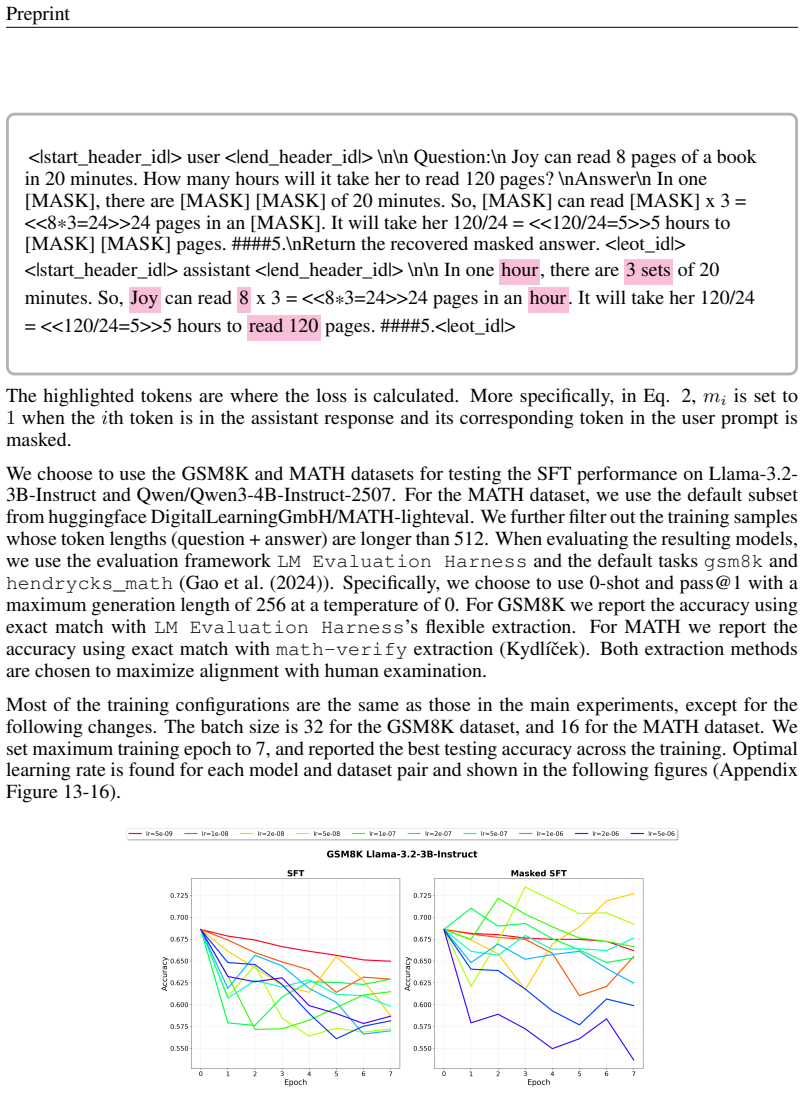
- Because the same demasking objective improves supervised fine-tuning on GSM8K and MATH across two models, the benefit is not limited to factual QA and may be a general-purpose training objective.
- The convergence analysis indicates masked fine-tuning reaches higher final accuracy at comparable total compute, despite roughly doubling per-step FLOPs, because it needs fewer training steps.
- This offers a practical path to lifelong learning: a small amount of new text, masked and presented as a reconstruction task, can update a deployed autoregressive LLM without relying on external retrieval or paraphrase generation.
Reading between the lines
- Beyond the paper: the reported 'accuracy' is ROUGE-1 recall without an exact-match constraint, and the appendix shows successfully fine-tuned models often reproducing the entire source passage; a strict exact-answer metric could substantially shrink the reported margins and should be run before assuming the knowledge-injection conclusion.
- Beyond the paper: a sharper test of genuine knowledge acquisition would be to mask the answer token itself in the prompt during fine-tuning and check whether the model can still produce it at inference; if it cannot, the method may be inducing passage-level memory rather than a reusable association.
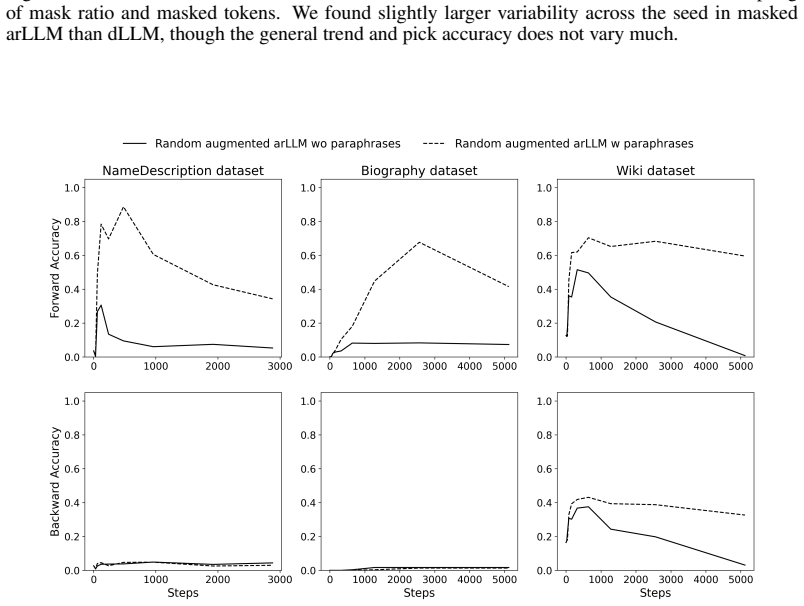
- Beyond the paper: the fixed-mask-ratio experiments suggest a sweet spot around t ≈ 0.5–0.75; annealing the mask ratio or using a curriculum that progresses from lightly to heavily masked documents may further improve data efficiency and reduce the seed-to-seed variance visible in the paper's training curves.
Signed reviews
Editorial analysis
A structured set of objections, weighed in public.
Referee Report
Summary. The paper studies post-training knowledge injection in autoregressive LLMs (arLLMs) versus masked diffusion LLMs (dLLMs). Across three datasets (NameDescription, Biography, Wiki), it reports that dLLMs achieve strong forward and backward QA accuracy without paraphrase augmentation, whereas arLLMs need paraphrases, and even then fail on backward questions. Motivated by the dLLM's demasking objective, the authors propose 'masked fine-tuning' for arLLMs: the model is prompted with a randomly masked document and trained to reconstruct the original text, using the original document as the supervised target. They report that this method closes most of the QA accuracy gap between arLLMs and dLLMs without paraphrases, at roughly twice the per-step training cost but with higher converged accuracy. They further extend the idea to math SFT (GSM8K, MATH) and, in the abstract, claim a result on the 1.2M-sample GPQA-diamond dataset that does not appear in the body. The main tables report QA accuracy via ROUGE-1 recall with no threshold; appendix generation examples show passages reproduced verbatim, which motivates the central concern about validity of the reported metric.
Significance. If the central result is borne out under a strict QA metric, the paper is significant: it offers a simple, compute-compatible way to improve knowledge-injection data efficiency in existing arLLMs, with a clean random-token control suggesting the effect is due to the demasking content rather than prompt format. The study is broad (four arLLMs, one dLLM, three knowledge datasets, plus two math datasets with exact-match evaluation), and the code/dataset repository is promised, which helps reproducibility. The empirical breadth and the existence of a control experiment are genuine strengths. However, the headline QA numbers rest on an unusually lax metric, and one advertised large-scale result (GPQA-diamond) is missing from the body. The significance of the paper therefore depends on whether the reported QA gains survive re-scoring with answer-level metrics; the paper's own exact-match math results (+0.003 to +0.049) suggest this is a real risk.
major comments (3)
- [Section 3, Appendix A.7] The 'accuracy' metric is ROUGE-1 recall (proportion of ground-truth words appearing in the generated text) with no length threshold. The generation examples in A.7 make the risk concrete: on the Wiki forward question, masked Llama 8B outputs the full training article, and on Biography, the dLLM emits a long passage containing the answer name; such outputs score near 1.0 by construction because the ground-truth words occur in the verbatim or near-verbatim passage. Since Table 1 compares conditions that differ greatly in verbosity (masked fine-tuning tends to reproduce whole passages; vanilla arLLM fine-tuning often produces shorter or off-topic text), the reported gaps—e.g., 0.377 vs. 0.980 on Wiki forward—may substantially overestimate the advantage. The paper's own exact-match math results in Section 8/Table 3 show only small gains (+0.003 to +0.049), which is consistent with the concer
- [Abstract, Section 8] The abstract states: 'on a large-scale knowledge-intensive dataset (1.2M samples), masked SFT achieves the best downstream accuracy on GPQA-diamond among all fine-tuning variants.' No GPQA-diamond experiment, dataset, table, or evaluation protocol appears anywhere in the body or appendices; Section 8 and Appendix A.5 cover only GSM8K and MATH. This is a load-bearing result used to support the claim of broader applicability. Either add the experiment with full details or remove the claim from the abstract.
- [Section 9, Table 4] The text claims that masked fine-tuning (condition 5) 'converges at the highest accuracy with more than 2×convergence rate of all the other methods.' Table 4 reports fitted convergence rates k (Fwd/Bwd): condition (1) 0.0350/0.1337, (2) 0.0069/0.0130, (3) 0.0151/0.0495, (4) 0.0052/0.0081, (5) 0.0032/0.0029. Condition (5) has the lowest k in both directions, so the claim is contradicted by the paper's own table. The cost-comparison conclusion should be revised; if the intended argument is that condition (5) reaches a higher converged accuracy despite a lower rate, state that directly with the supporting numbers.
minor comments (5)
- [Section 3, Appendix A.3] Main text says the Wiki dataset contains 94 articles; Appendix A.3 says the filtering results in 96 wiki articles. Please reconcile.
- [Figure 2 and Tables 1, 5] The tables report accuracy from 'best checkpoints' chosen by total accuracy on the evaluation set. Please report the selection rule explicitly and include variance across seeds or random restarts for all methods, not only for dLLM and masked arLLM (Figures 10–11).
- [Section 6, Equation (2)] The loss in Eq. (2) is written with m_t as a selector but the notation is not fully defined (token indices vs. a binary vector). Clarify the indexing and the normalization by the sum of m_t.
- [Section 3] The paper cites 'Lin et al., 2024' for the ROUGE-1 score; the standard reference is Lin (2004). Please correct the citation.
- [Appendix A.4] Learning rates differ across models and datasets, and some are chosen by 'smooth gains' in the text. Please state the hyperparameter search protocol more concretely (especially the number of points and the criterion for 'smooth').
Circularity Check
No load-bearing circularity; central masked-fine-tuning result is empirically controlled, though ROUGE-1 accuracy is a validity caveat.
full rationale
Walking the derivation chain, I find no step where a predicted quantity is equivalent to the training input by construction. The central claim is empirical: Eq. 2 defines a masked autoregressive loss whose target is the original document, and the paper validates the demasking objective with a random-token control (Appendix Figure 12) that keeps the format and target while removing the masked cues. This control shows the improvement is not merely a data-augmentation artifact of prepending varied text. The dLLM baseline is trained with the external objective of Eq. 1, and the arLLM/dLLM gap is measured before and after fine-tuning, so the 'closing the gap' conclusion is not an algebraic consequence of the loss. The only self-citation (Pan et al. 2025) supplies the Wiki data-collection protocol and a non-central remark about gating; neither is load-bearing for the masked-fine-tuning result. A genuine validity caveat remains: Section 3 defines accuracy as ROUGE-1 recall, and Appendix A.7 shows models often answer by emitting the full training passage, so the reported QA numbers may overstate concise-answer capability. That is an evaluation-risk concern rather than a circularity, because the paper's equations do not by construction equate the QA score to the training loss; the QA prompt differs from the masked training prompt, and the random-token control shows that the model must still use the prompt cues for retrieval. The score of 2 reflects the minor self-citation and this metric caveat, not a demonstrated circular step.
Assumptions & free parameters
free parameters (3)
- mask ratio sampling distribution =
U(0.05, 0.95)
- learning rates per model =
5e-6 arLLMs; 1e-5 dLLM; 3e-6 masked Llama-8B; 5e-6 masked others
- dLLM decoding settings =
block length 4, low_confidence remasking
assumptions (4)
- standard math The masked diffusion loss in Eq. 1 is an ELBO on the data likelihood
- domain assumption Random mask ratios provide implicit data augmentation and are necessary for demasking to yield generative ability
- domain assumption ROUGE-1 recall of ground-truth words in generated text measures answer correctness
- domain assumption The 2025 Wikipedia articles are effectively unknown to the base models
Cite this review
Pith. "Pith review of Diffusion-Inspired Masked Fine-Tuning for Knowledge Injection in Autoregressive LLMs." pith.science (2026). https://pith.science/paper/RADVO4ZG
@misc{pith2026251009885,
  author       = {Pith},
  title        = {Pith review of: Diffusion-Inspired Masked Fine-Tuning for Knowledge Injection in Autoregressive LLMs},
  year         = {2026},
  howpublished = {\url{https://pith.science/paper/RADVO4ZG}},
  note         = {Machine review of arXiv:2510.09885}
}
read the original abstract
Large language models (LLMs) are often used in environments where facts evolve, yet factual knowledge updates via fine-tuning on unstructured text often suffer from 1) reliance on compute-heavy paraphrasing augmentation and 2) the reversal curse. Recent studies show diffusion large language models (dLLMs) require fewer training samples to achieve lower loss in pre-training and are more resistant to the reversal curse, suggesting dLLMs may learn new knowledge more easily than autoregressive LLMs (arLLMs). We test this hypothesis in controlled knowledge fine-tuning experiments and find that while arLLMs rely on paraphrase augmentation to generalize knowledge text into question-answering (QA) capability, dLLMs do not require paraphrases to achieve high QA accuracy. To further investigate whether the demasking objective alone can induce such a knowledge injection advantage in dLLMs regardless of their diffusion denoising paradigm, we propose masked fine-tuning for arLLMs, which prompts an arLLM to reconstruct the original text given a masked version in context. The masked fine-tuning for arLLMs substantially improves the efficacy of knowledge injection, i.e. no paraphrase needed and resistant to the reversal curse, closing the gap between arLLMs and dLLMs. We also demonstrate broader applicability: on a large-scale knowledge-intensive dataset (1.2M samples), masked SFT achieves the best downstream accuracy on GPQA-diamond among all fine-tuning variants. The demasking objective also improves SFT on math tasks, suggesting broad utility beyond factual knowledge injection.
Figures


Figures from the paper (13 more)




Forward citations
Cited by 4 Pith papers
-
Knowledge Editing in Masked Diffusion Language Models
Locate-then-edit succeeds at the same early-to-mid MLP locations in masked diffusion models as in autoregressive models, but requires optimization over intermediate partial-mask states to handle multi-token targets.
-
The Illusion of Latent Generalization: Bi-directionality and the Reversal Curse
Bidirectional objectives mitigate reversal by requiring explicit source-as-target signals and storing directions as distinct representations instead of inducing latent generalization.
-
Breaking the Reversal Curse in Autoregressive Language Models via Identity Bridge
Identity-bridge regularization, rephrased into an out-of-context reasoning form, yields ~40% reversal accuracy in a 1B LLM and provably fixes reversal in an idealized one-layer transformer.
-
Data augmentation as a framework for modeling hippocampal contributions to generalization
The authors propose data augmentation as a framework for hippocampal function, distinguishing offline augmentation (training-time reprocessing) and online augmentation (test-time retrieval and re-factoring).
Reference graph
Works this paper leans on
-
[5]
Zorik Gekhman, Gal Yona, Roee Aharoni, Matan Eyal, Amir Feder, Roi Reichart, and Jonathan Herzig
URLhttps://zenodo.org/records/12608602. Zorik Gekhman, Gal Yona, Roee Aharoni, Matan Eyal, Amir Feder, Roi Reichart, and Jonathan Herzig. Does fine-tuning llms on new knowledge encourage hallucinations? InProceedings of the 2024 Conference on Empirical Methods in Natural Language Processing, pp. 7765–7784,
arXiv 2024
-
[6]
Reverse training to nurse the reversal curse, 2024a
Olga Golovneva, Zeyuan Allen-Zhu, Jason Weston, and Sainbayar Sukhbaatar. Reverse training to nurse the reversal curse, 2024a. URLhttps://arxiv.org/abs/2403.13799. Olga Golovneva, Zeyuan Allen-Zhu, Jason E Weston, and Sainbayar Sukhbaatar. Reverse training to nurse the reversal curse. InFirst Conference on Language Modeling, 2024b. URLhttps: //openreview....
arXiv 2024
-
[7]
doi: 10.18653/v1/2024.findings-acl.680
Association for Computational Linguistics. doi: 10.18653/v1/2024.findings-acl.680. URLhttps://aclanthology.org/ 2024.findings-acl.680/. Thomas Hartvigsen, Swami Sankaranarayanan, Hamid Palangi, Yoon Kim, and Marzyeh Ghassemi. Aging with grace: Lifelong model editing with discrete key-value adaptors,
-
[10]
Math-Verify: Math Verification Library
Hynek Kydlí ˇcek. Math-Verify: Math Verification Library. URLhttps://github.com/ huggingface/math-verify. Andrew K Lampinen, Arslan Chaudhry, Stephanie CY Chan, Cody Wild, Diane Wan, Alex Ku, Jörg Bornschein, Razvan Pascanu, Murray Shanahan, and James L McClelland. On the generalization of language models from in-context learning and finetuning: a control...
-
[11]
Lost in the middle: How language models use long contexts.arXiv preprint arXiv:2307.03172,
Nelson F Liu, Kevin Lin, John Hewitt, Ashwin Paranjape, Michele Bevilacqua, Fabio Petroni, and Percy Liang. Lost in the middle: How language models use long contexts.arXiv preprint arXiv:2307.03172,
-
[12]
Rethinking the reversal curse of llms: a prescription from human knowl- edge reversal
Zhicong Lu, Li Jin, Peiguang Li, Yu Tian, Linhao Zhang, Sirui Wang, Guangluan Xu, Changyuan Tian, and Xunliang Cai. Rethinking the reversal curse of llms: a prescription from human knowl- edge reversal. InProceedings of the 2024 Conference on Empirical Methods in Natural Language Processing, pp. 7518–7530,
2024
-
[13]
Yun Luo, Zhen Yang, Fandong Meng, Yafu Li, Jie Zhou, and Yue Zhang. An empirical study of catastrophic forgetting in large language models during continual fine-tuning, 2023.URL https://arxiv. org/abs/2308.08747, 2308:60,
arXiv 2023
-
[14]
An anal- ysis and mitigation of the reversal curse
Ang Lv, Kaiyi Zhang, Shufang Xie, Quan Tu, Yuhan Chen, Ji-Rong Wen, and Rui Yan. An anal- ysis and mitigation of the reversal curse. In Yaser Al-Onaizan, Mohit Bansal, and Yun-Nung Chen (eds.),Proceedings of the 2024 Conference on Empirical Methods in Natural Language Processing, pp. 13603–13615, Miami, Florida, USA, November
2024
Show all 40 references
-
[15]
doi: 10.18653/v1/2024.emnlp-main.754
Association for Computa- tional Linguistics. doi: 10.18653/v1/2024.emnlp-main.754. URLhttps://aclanthology. org/2024.emnlp-main.754/. Nick Mecklenburg, Yiyou Lin, Xiaoxiao Li, Daniel Holstein, Leonardo Nunes, Sara Malvar, Bruno Silva, Ranveer Chandra, Vijay Aski, Pavan Kumar R...
2024 arXiv
-
[16]
Shen Nie, Fengqi Zhu, Chao Du, Tianyu Pang, Qian Liu, Guangtao Zeng, Min Lin, and Chongxuan Li
Notion Blog. Shen Nie, Fengqi Zhu, Chao Du, Tianyu Pang, Qian Liu, Guangtao Zeng, Min Lin, and Chongxuan Li. Scaling up masked diffusion models on text. In Y . Yue, A. Garg, N. Peng, F. Sha, and R. Yu (eds.),International Conference on Representation Learning, volume 2025, pp....
2025 arXiv
-
[17]
Memorization and knowledge injec- tion in gated llms.arXiv preprint arXiv:2504.21239,
Xu Pan, Ely Hahami, Zechen Zhang, and Haim Sompolinsky. Memorization and knowledge injec- tion in gated llms.arXiv preprint arXiv:2504.21239,
-
[18]
Diffu- sion beats autoregressive in data-constrained settings.arXiv preprint arXiv:2507.15857,
Mihir Prabhudesai, Mengning Wu, Amir Zadeh, Katerina Fragkiadaki, and Deepak Pathak. Diffu- sion beats autoregressive in data-constrained settings.arXiv preprint arXiv:2507.15857,
-
[19]
Accessed: 2025-11-18
URLhttps://pytorch.org/ docs/stable/profiler.html. Accessed: 2025-11-18. Colin Raffel, Noam Shazeer, Adam Roberts, Katherine Lee, Sharan Narang, Michael Matena, Yanqi Zhou, Wei Li, and Peter J Liu. Exploring the limits of transfer learning with a unified text-to-text transform...
2025
-
[20]
Analyzing and reducing catastrophic forgetting in parameter efficient tuning.arXiv preprint arXiv:2402.18865,
Weijieying Ren, Xinlong Li, Lei Wang, Tianxiang Zhao, and Wei Qin. Analyzing and reducing catastrophic forgetting in parameter efficient tuning.arXiv preprint arXiv:2402.18865,
-
[21]
Fine tuning vs
Heydar Soudani, Evangelos Kanoulas, and Faegheh Hasibi. Fine tuning vs. retrieval augmented generation for less popular knowledge. InProceedings of the 2024 Annual International ACM SIGIR Conference on Research and Development in Information Retrieval in the Asia Pacific Regio...
2024
-
[22]
Xiao Wang, Yuansen Zhang, Tianze Chen, Songyang Gao, Senjie Jin, Xianjun Yang, Zhiheng Xi, Rui Zheng, Yicheng Zou, Tao Gui, et al
URLhttps://arxiv.org/abs/2405.14768. Xiao Wang, Yuansen Zhang, Tianze Chen, Songyang Gao, Senjie Jin, Xianjun Yang, Zhiheng Xi, Rui Zheng, Yicheng Zou, Tao Gui, et al. Trace: A comprehensive benchmark for continual learning in large language models.arXiv preprint arXiv:2310.06762,
-
[23]
On the theoretical limitations of embedding-based retrieval.arXiv preprint arXiv:2508.21038,
Orion Weller, Michael Boratko, Iftekhar Naim, and Jinhyuk Lee. On the theoretical limitations of embedding-based retrieval.arXiv preprint arXiv:2508.21038,
-
[24]
Any-order gpt as masked diffusion model: Decoupling formulation and architecture.arXiv preprint arXiv:2506.19935,
Shuchen Xue, Tianyu Xie, Tianyang Hu, Zijin Feng, Jiacheng Sun, Kenji Kawaguchi, Zhenguo Li, and Zhi-Ming Ma. Any-order gpt as masked diffusion model: Decoupling formulation and architecture.arXiv preprint arXiv:2506.19935,
-
[25]
Qwen3 technical report.arXiv preprint arXiv:2505.09388,
13 Preprint An Yang, Anfeng Li, Baosong Yang, Beichen Zhang, Binyuan Hui, Bo Zheng, Bowen Yu, Chang Gao, Chengen Huang, Chenxu Lv, et al. Qwen3 technical report.arXiv preprint arXiv:2505.09388,
-
[26]
Dream 7b: Diffusion large language models.arXiv preprint arXiv:2508.15487,
Jiacheng Ye, Zhihui Xie, Lin Zheng, Jiahui Gao, Zirui Wu, Xin Jiang, Zhenguo Li, and Lingpeng Kong. Dream 7b: Diffusion large language models.arXiv preprint arXiv:2508.15487,
-
[27]
Yuexiang Zhai, Shengbang Tong, Xiao Li, Mu Cai, Qing Qu, Yong Jae Lee, and Yi Ma
URLhttps://arxiv.org/abs/2312.11795. Yuexiang Zhai, Shengbang Tong, Xiao Li, Mu Cai, Qing Qu, Yong Jae Lee, and Yi Ma. Investigating the catastrophic forgetting in multimodal large language models. InNeurIPS 2023 Workshop on Instruction Tuning and Instruction Following,
2023 arXiv
-
[28]
From style to facts: Mapping the boundaries of knowledge injection with finetuning.arXiv preprint arXiv:2503.05919,
Eric Zhao, Pranjal Awasthi, and Nika Haghtalab. From style to facts: Mapping the boundaries of knowledge injection with finetuning.arXiv preprint arXiv:2503.05919,
-
[29]
Datasets and experimental setups
A APPENDIX A.1 DATASET AND CODE AVAILABILITY The dataset and code base are available at:https://github.com/xup5/masked_arLLM. git A.2 LLMUSAGE The usage of LLM is limited to language polishing and literature search. We asked an LLM to suggest surface-level rewrites to improve ...
2025
-
[31]
"" ND dataset Type
Question 1: Which weapon category does Mitchell Saron compete in, representing the United States at the 2024 Summer Olympics? Answer 1: Sabre Cue used in the question: [Mitchell Saron, United States, 2024 Summer Olympics] Question 2 (reverse question of question 1): Who repres...
2024
-
[33]
Change-order paraphrase:
It started as a gathering spot for members of the Nation of Islam in the 1970s but trans- formed into a multicultural Islamic venue in subsequent decades." Change-order paraphrase:"Located in Altadena, California, USA, Masjid Al-Taqwa stood on Lake Ave directly opposite the El...
2025
-
[35]
factorization curse
For GSM8K we report the accuracy using exact match withLM Evaluation Harness’s flexible extraction. For MATH we report the accuracy using exact match withmath-verifyextraction (Kydlí ˇcek). Both extraction methods are chosen to maximize alignment with human examination. Most o...
2024
-
[36]
Ground truth answer:
was born on March 25, 2024?" Ground truth answer:"Owen Carole Pavy" arLLM without paraphrases (step 1280, best checkpoint):"/n /n I am a licensed Dental Assistant in Phoenix, AZ. I was hired by a company that provides dental services. My birth is commemorated in March 25, 2024...
2024
-
[37]
Wiki dataset Original text:
Her early moments were in Seattle, WA. She secured her degree from University of Minnesota. She set her academic sights on Dental Assistant. She was in charge of tasks at Avnet. She worked at a business located in Phoenix, AZ." Wiki dataset Original text:"The 2024-25 Men’s FIH...
2024
-
[38]
Questions (Forward):
The defending champions New Zealand won their second title by defeating Pakistan 6-2 in the final. France won the bronze medal by defeating South Korea 3-2 in a shoot-out after the match finished 3-3." Questions (Forward):"When was the 2024-25 Men’s FIH Hockey Nations Cup held...
2024
-
[39]
arLLM with same-order paraphrases (step 10240, best checkpoint):
The tournament was organized by the Malaysian Hockey Federation with the guidance of the Global Executive Committee of the Men’s FIH (The Men’s FIH is the world governing body for men’s field hockey and the umbrella organization for the Men’s FIH Nations Cup)." arLLM with same...
2025
-
[40]
dLLM without paraphrases (step 80):
The event marked the third edition of the Men’s FIH Hockey Nations Cup, the annual qualification tournament for the Men’s FIH Pro League organised by the International Hockey Federation. The tournament was won by the Malaysia National FIH Hockey team, who won their second titl...
2024
-
[41]
dLLM with same-order paraphrases (step 5120, best checkpoint):
The match was played between Malaysia and the United Arab Emirates. Malaysia won the match 3-2." dLLM with same-order paraphrases (step 5120, best checkpoint): "/n /n The 2024-25 Men’s FIH Hockey Nations Cup was the third edition of the Men’s FIH Hockey Nations Cup, the annual...
2024
-
[512]
When evaluating the resulting models, we use the evaluation frameworkLM Evaluation Harnessand the default tasksgsm8kand hendrycks_math(Gao et al. (2024)). Specifically, we choose to use 0-shot and pass@1 with a maximum generation length of 256 at a temperature of
2024
-
[1952]
Forward question:
He was brought into the world in Elk Grove, CA. He culminated his studies at Kansas State University. He concentrated his efforts toward EMT and Paramedic. He supported the operations at HP. He practiced his profession in Palo Alto, CA." Forward question:"What is the birth dat...
1952
-
[2000]
He represented the United States at the 2024 Summer Olympics in Paris, France, in the men's sabre and men's team sabre events in July
is an American right−handed sabre fencer. He represented the United States at the 2024 Summer Olympics in Paris, France, in the men's sabre and men's team sabre events in July
2024
-
[2018]
Jacob Devlin, Ming-Wei Chang, Kenton Lee, and Kristina Toutanova
URL http://arxiv.org/abs/1810.04805. Jacob Devlin, Ming-Wei Chang, Kenton Lee, and Kristina Toutanova. Bert: Pre-training of deep bidirectional transformers for language understanding. InProceedings of the 2019 conference of the North American chapter of the association for co...
2019 arXiv
-
[2020]
Jaeyeon Kim, Kulin Shah, Vasilis Kontonis, Sham M
URLhttps://arxiv.org/abs/2001.08361. Jaeyeon Kim, Kulin Shah, Vasilis Kontonis, Sham M. Kakade, and Sitan Chen. Train for the worst, plan for the best: Understanding token ordering in masked diffusions. InForty-second Interna- tional Conference on Machine Learning,
2001 arXiv
-
[2023]
Houcheng Jiang, Junfeng Fang, Ningyu Zhang, Guojun Ma, Mingyang Wan, Xiang Wang, Xiangnan He, and Tat-seng Chua
URLhttps: //arxiv.org/abs/2211.11031. Houcheng Jiang, Junfeng Fang, Ningyu Zhang, Guojun Ma, Mingyang Wan, Xiang Wang, Xiangnan He, and Tat-seng Chua. Anyedit: Edit any knowledge encoded in language models.arXiv preprint arXiv:2502.05628,
-
[2024]
Mem0: Building production-ready ai agents with scalable long-term memory.arXiv preprint arXiv:2504.19413,
Prateek Chhikara, Dev Khant, Saket Aryan, Taranjeet Singh, and Deshraj Yadav. Mem0: Building production-ready ai agents with scalable long-term memory.arXiv preprint arXiv:2504.19413,
-
[2025]
a is b" fail to learn
URLhttps: //openreview.net/forum?id=oDbiL9CLoS. Lukas Berglund, Meg Tong, Max Kaufmann, Mikita Balesni, Asa Cooper Stickland, Tomasz Kor- bak, and Owain Evans. The reversal curse: Llms trained on" a is b" fail to learn" b is a".arXiv preprint arXiv:2309.12288,
Reviewed August 4, 2026 · model on record in the stance chip above.
Discussion (0). Continue with ORCID to comment.