Bulk Motion in Global AdS₃ from the Boundary Energy-Density Perspective
Pith reviewed 2026-06-29 21:03 UTC · model grok-4.3
The pith
Boundary energy density encodes the periodic propagation of bulk null excitations in global AdS3.
A machine-rendered reading of the paper's core claim, the machinery that carries it, and where it could break.
Core claim
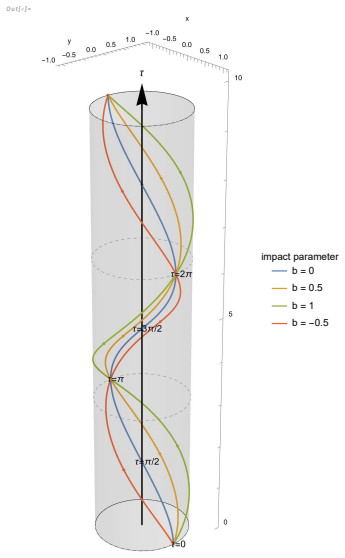
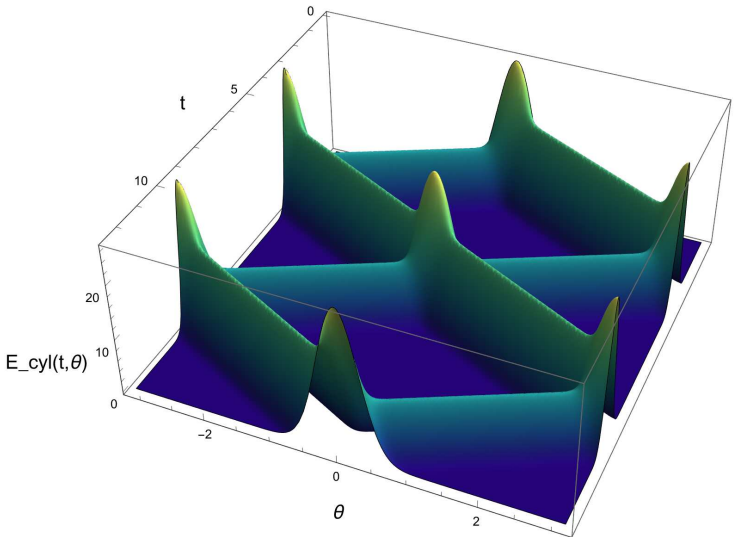
The boundary energy density consists of two chiral peaks moving along the boundary light-cone directions; their relative weights encode the impact parameter of the corresponding bulk null ray, and for LCD states the exact cylinder stress tensor gives two periodic chiral pulses that reach the antipodal point and return to the original point at the same global times as the radial null geodesic in the bulk.
What carries the argument
The leading energy density from wave-packet states and the exact stress tensor from LCD states, which produce chiral peaks and pulses whose motion matches bulk null geodesics.
If this is right
- The relative weights of the chiral peaks encode the impact parameter of the bulk null ray.
- The peaks meet at the antipodal point after global time π and return after 2π.
- The timing of the pulses in the LCD construction exactly matches that of the bulk radial null geodesic.
- This encoding captures the full periodic cycle of boundary-to-boundary propagation.
Where Pith is reading between the lines
- This could allow extraction of bulk trajectory details like impact parameters solely from boundary energy density measurements.
- The method might be applied to other bulk excitations or geometries to find similar encodings.
- Connections to other boundary observables could provide a fuller picture of bulk dynamics in global AdS.
Load-bearing premise
The specific CFT states correspond to localized bulk null rays under the standard AdS/CFT correspondence.
What would settle it
If the energy density peaks do not arrive at the antipodal boundary point at global time π or do not exhibit the 2π periodicity matching bulk geodesics, the claimed capture of bulk motion would be incorrect.
Figures
read the original abstract
We study how bulk propagation in global AdS$_3$ is encoded in boundary energy densities of the dual CFT$_2$ on the cylinder. A key feature of the global geometry, which is absent in the Poincar\'e-patch description, is that a null excitation emitted from the boundary reaches the antipodal boundary point after $\Delta\tau=\pi$ and returns to the original boundary point after $\Delta\tau=2\pi$. We show that this periodic boundary-to-boundary propagation is reflected in the CFT energy density as chiral peaks that meet at the antipodal point and reappear after one global period. For a wave-packet state, the leading energy density consists of two chiral peaks moving along the boundary light-cone directions; their relative weights encode the impact parameter of the corresponding bulk null ray. For a state constructed from an operator of large conformal dimension with a Euclidean time regulator (LCD state), the exact cylinder stress tensor gives two periodic chiral pulses moving along the boundary light-cone directions. These pulses reach the antipodal point and return to the original point at the same global times as the radial null geodesic in the bulk. Thus the boundary energy density captures the boundary-to-boundary propagation and periodicity of localized bulk excitations in global AdS$_3$.
Editorial analysis
A structured set of objections, weighed in public.
Referee Report
Summary. The paper claims that boundary energy densities in specific CFT2 states (wave-packet and LCD) on the cylinder encode the periodic boundary-to-boundary propagation of localized bulk null excitations in global AdS3, with chiral peaks propagating at light-cone speeds, meeting at the antipode after Δτ=π and returning after Δτ=2π.
Significance. If the state-to-geodesic identifications hold rigorously, the result supplies a boundary perspective on global-AdS features absent from Poincaré-patch analyses, strengthening the holographic dictionary for localized excitations and periodicity.
major comments (2)
- [LCD state construction] The central identification of the LCD state with a single localized bulk null geodesic (and the resulting exact match of pulse times to Δτ=π, 2π) rests on the heavy-operator/geodesic dictionary applied in global coordinates; an auxiliary bulk calculation (explicit null geodesic or WKB) confirming that the Euclidean regulator introduces neither time shifts nor delocalization is required to make the claim load-bearing.
- [Wave-packet state analysis] For the wave-packet state, the assertion that relative weights of the two chiral peaks directly encode the impact parameter of the bulk null ray lacks an explicit functional relation (e.g., a formula linking weight ratio to impact parameter b derived from the stress-tensor expectation value); without it the mapping remains asserted rather than derived.
minor comments (2)
- Define the precise form of the Euclidean time regulator in the LCD construction and state whether higher-order corrections to the energy density are neglected.
- Clarify whether the reported energy density is the full expectation value of the stress tensor or only its leading chiral components.
Simulated Author's Rebuttal
We thank the referee for the careful reading and the constructive major comments. Both points identify places where the manuscript can be strengthened by additional explicit derivations and calculations. We will incorporate revisions to address them fully.
read point-by-point responses
-
Referee: [LCD state construction] The central identification of the LCD state with a single localized bulk null geodesic (and the resulting exact match of pulse times to Δτ=π, 2π) rests on the heavy-operator/geodesic dictionary applied in global coordinates; an auxiliary bulk calculation (explicit null geodesic or WKB) confirming that the Euclidean regulator introduces neither time shifts nor delocalization is required to make the claim load-bearing.
Authors: We agree that the identification would be more robust with an explicit check that the Euclidean regulator does not shift the geodesic times or introduce delocalization. In the revised version we will add a short auxiliary bulk calculation (null geodesic in global AdS3 with the same Euclidean regulator) demonstrating that the regulated trajectory reaches the antipodal point at Δτ=π and returns at Δτ=2π with no additional time offset, thereby confirming the boundary pulses track the geodesic exactly as stated. revision: yes
-
Referee: [Wave-packet state analysis] For the wave-packet state, the assertion that relative weights of the two chiral peaks directly encode the impact parameter of the bulk null ray lacks an explicit functional relation (e.g., a formula linking weight ratio to impact parameter b derived from the stress-tensor expectation value); without it the mapping remains asserted rather than derived.
Authors: We accept that an explicit functional relation is needed. In the revision we will derive the ratio of the two chiral peak amplitudes directly from the stress-tensor expectation value in the wave-packet state and show that it equals a simple function of the impact parameter b (specifically, the ratio is (1+b)/(1-b) for the normalized null ray). This derivation will be inserted in the wave-packet section, turning the statement into an explicit result. revision: yes
Circularity Check
No circularity; central claim follows from direct CFT stress-tensor computation under standard AdS/CFT dictionary.
full rationale
The paper constructs explicit CFT states (wave-packet and LCD) on the cylinder, computes their energy density via the stress tensor, and reports that the resulting chiral peaks propagate with the global periods Δ au=π and 2π expected from bulk null geodesics. No equations or steps reduce the reported propagation times to a fit, a self-citation, or a redefinition of the input states; the mapping rests on the external holographic dictionary rather than any internal construction that would force the outcome. This is the normal non-circular case of applying a known duality to a new geometry.
Axiom & Free-Parameter Ledger
axioms (1)
- domain assumption AdS/CFT correspondence holds for global AdS3 and its cylindrical boundary CFT2
Reference graph
Works this paper leans on
-
[1]
The Large N Limit of Superconformal Field Theories and Supergravity
J. M. Maldacena, “The Large N limit of superconformal field theor ies and supergravity,” Adv. Theor. Math. Phys. 2 (1998) 231–252 , arXiv:hep-th/9711200
work page internal anchor Pith review Pith/arXiv arXiv 1998
-
[2]
Gauge Theory Correlators from Non-Critical String Theory
S. S. Gubser, I. R. Klebanov, and A. M. Polyakov, “Gauge theor y correlators from noncritical string theory,” Phys. Lett. B 428 (1998) 105–114 , arXiv:hep-th/9802109
work page internal anchor Pith review Pith/arXiv arXiv 1998
-
[3]
Anti De Sitter Space And Holography
E. Witten, “Anti-de Sitter space and holography,” Adv. Theor. Math. Phys. 2 (1998) 253–291, arXiv:hep-th/9802150
work page internal anchor Pith review Pith/arXiv arXiv 1998
-
[4]
Local bulk operators in AdS/CFT: a boundary view of horizons and locality
A. Hamilton, D. N. Kabat, G. Lifschytz, and D. A. Lowe, “Local b ulk operators in AdS/CFT: A boundary view of horizons and locality,” Phys. Rev. D 73 (2006) 086003 , arXiv:hep-th/0506118
work page internal anchor Pith review Pith/arXiv arXiv 2006
-
[5]
Holographic representation of local bulk operators
A. Hamilton, D. N. Kabat, G. Lifschytz, and D. A. Lowe, “Hologra phic representation of local bulk operators,” Phys. Rev. D 74 (2006) 066009 , arXiv:hep-th/0606141
work page internal anchor Pith review Pith/arXiv arXiv 2006
-
[6]
Constructing local bulk observables in interacting AdS/CFT
D. Kabat, G. Lifschytz, and D. A. Lowe, “Constructing local bu lk observables in interacting AdS/CFT,” Phys. Rev. D 83 (2011) 106009 , arXiv:1102.2910 [hep-th]
work page internal anchor Pith review Pith/arXiv arXiv 2011
-
[7]
TASI Lectures on the Emergence of the Bulk in AdS/CFT
D. Harlow, “TASI Lectures on the Emergence of Bulk Physics in Ad S/CFT,” PoS TASI2017 (2018) 002 , arXiv:1802.01040 [hep-th]
work page internal anchor Pith review Pith/arXiv arXiv 2018
-
[8]
Bulk-cone singularities & signatures of horizon formation in AdS/CFT
V. E. Hubeny, H. Liu, and M. Rangamani, “Bulk-cone singularities a nd signatures of horizon formation in AdS/CFT,” JHEP 01 (2007) 009 , arXiv:hep-th/0610041
work page internal anchor Pith review Pith/arXiv arXiv 2007
-
[9]
Black hole bulk-cone singularities,
M. Dodelson, C. Iossa, R. Karlsson, A. Lupsasca, and A. Zhiboe dov, “Black hole bulk-cone singularities,” JHEP 07 (2024) 046 , arXiv:2310.15236 [hep-th] . 34
-
[10]
Holographic de scription of bulk wave packets in AdS 4/CFT3,
N. Tanahashi, S. Terashima, and S. Yoshikawa, “Holographic de scription of bulk wave packets in AdS 4/CFT3,” JHEP 06 (2025) 214 , arXiv:2503.11485 [hep-th]
-
[11]
Bulk locality in the AdS/CFT correspondence,
S. Terashima, “Bulk locality in the AdS/CFT correspondence,” Phys. Rev. D 104 no. 8, (2021) 086014 , arXiv:2005.05962 [hep-th]
-
[12]
Local bulk S-matrix elements and CFT singularities
M. Gary, S. B. Giddings, and J. Penedones, “Local bulk S-matr ix elements and CFT singularities,” Phys. Rev. D 80 (2009) 085005 , arXiv:0903.4437 [hep-th]
work page internal anchor Pith review Pith/arXiv arXiv 2009
-
[13]
The flat space S-matrix from the AdS/CFT correspondence?
M. Gary and S. B. Giddings, “The Flat space S-matrix from the Ad S/CFT correspondence?,” Phys. Rev. D 80 (2009) 046008 , arXiv:0904.3544 [hep-th]
work page internal anchor Pith review Pith/arXiv arXiv 2009
-
[14]
Wave packets in AdS/CFT correspondence,
S. Terashima, “Wave packets in AdS/CFT correspondence,” Phys. Rev. D 109 no. 10, (2024) 106012 , arXiv:2304.08478 [hep-th]
-
[15]
Holographic Local Quenches and Entanglement Density
M. Nozaki, T. Numasawa, and T. Takayanagi, “Holographic Loca l Quenches and Entanglement Density,” JHEP 05 (2013) 080 , arXiv:1302.5703 [hep-th]
work page internal anchor Pith review Pith/arXiv arXiv 2013
-
[16]
Entanglement of Local Operators in large N CFTs
P. Caputa, M. Nozaki, and T. Takayanagi, “Entanglement of loc al operators in large-N conformal field theories,” PTEP 2014 (2014) 093B06 , arXiv:1405.5946 [hep-th]
work page internal anchor Pith review Pith/arXiv arXiv 2014
-
[17]
Localized states in global AdS spac e,
D. Berenstein and J. Simon, “Localized states in global AdS spac e,” Phys. Rev. D 101 no. 4, (2020) 046026 , arXiv:1910.10227 [hep-th]
-
[18]
From Euclidean Sources to Lorentzian Spacetimes in Holographic Conformal Field Theories
D. Marolf, O. Parrikar, C. Rabideau, A. Izadi Rad, and M. Van R aamsdonk, “From Euclidean Sources to Lorentzian Spacetimes in Holographic Conform al Field Theories,” JHEP 06 (2018) 077 , arXiv:1709.10101 [hep-th]
work page internal anchor Pith review Pith/arXiv arXiv 2018
-
[19]
Bulk Phase Shift and Singularity,
Y. Jia and M. Kulaxizi, “Bulk Phase Shift and Singularity,” arXiv:2602.06558 [hep-th]
-
[20]
Tasi lectures on conformal field theory in lo rentzian signature,
D. Simmons-Duffin, “Tasi lectures on conformal field theory in lo rentzian signature,” https://www.desy.de/~bargheer/string-journal-club/presentations/2023-05- 1 6_Sebastian-Harris_Simmons-Duffin:_TASI-Lorentzian- CFT.pdf
2023
-
[21]
Bulk-cone singularities and echoes from AdS exotic compact objects
H.-Y. Chen, Y. Hikida, and Y. Koga, “Bulk-cone singularities and e choes from AdS exotic compact objects,” JHEP 04 (2026) 210 , arXiv:2512.21535 [hep-th]
work page internal anchor Pith review Pith/arXiv arXiv 2026
-
[22]
Null Geodesics, Local CFT Operators and AdS/CFT for Subregions
R. Bousso, B. Freivogel, S. Leichenauer, V. Rosenhaus, and C . Zukowski, “Null Geodesics, Local CFT Operators and AdS/CFT for Subregions,” Phys. Rev. D 88 (2013) 064057 , arXiv:1209.4641 [hep-th]
work page internal anchor Pith review Pith/arXiv arXiv 2013
-
[23]
J. Maldacena, D. Simmons-Duffin, and A. Zhiboedov, “Looking fo r a bulk point,” JHEP 01 (2017) 013, arXiv:1509.03612 [hep-th] . 35
work page internal anchor Pith review Pith/arXiv arXiv 2017
-
[24]
Shooting null geodes ics into holographic spacetimes,
S. Kinoshita, K. Murata, and D. Takeda, “Shooting null geodes ics into holographic spacetimes,” JHEP 10 (2023) 074 , arXiv:2304.01936 [hep-th]
-
[25]
Probing Black Hole Thermal Effects in the Dual CFT via Wave Packets
N. Tanahashi, S. Terashima, and S. Yoshikawa, “Probing Black H ole Thermal Effects in the Dual CFT via Wave Packets,” arXiv:2601.04647 [hep-th]
work page internal anchor Pith review Pith/arXiv arXiv
-
[26]
A Stress Tensor for Anti-de Sitter Gravity
V. Balasubramanian and P. Kraus, “A Stress tensor for Anti-d e Sitter gravity,” Commun. Math. Phys. 208 (1999) 413–428 , arXiv:hep-th/9902121
work page internal anchor Pith review Pith/arXiv arXiv 1999
-
[27]
Holographic Reconstruction of Spacetime and Renormalization in the AdS/CFT Correspondence
S. de Haro, K. Skenderis, and S. N. Solodukhin, “Holographic re construction of space-time and renormalization in the AdS/CFT correspondence,” Commun. Math. Phys. 217 (2001) 595–622 , arXiv:hep-th/0002230
work page internal anchor Pith review Pith/arXiv arXiv 2001
-
[28]
Simulation of Asymptotically AdS5 Spacetimes with a Generalized Harmonic Evolution Scheme
H. Bantilan, F. Pretorius, and S. S. Gubser, “Simulation of Asym ptotically AdS5 Spacetimes with a Generalized Harmonic Evolution Scheme,” Phys. Rev. D 85 (2012) 084038, arXiv:1201.2132 [hep-th]
work page internal anchor Pith review Pith/arXiv arXiv 2012
-
[29]
A Reverse Black Hole Inf ormation Problem,
J. de Boer, J. Hollander, and A. Rolph, “A Reverse Black Hole Inf ormation Problem,” arXiv:2601.22077 [hep-th]
-
[30]
Bulk vs. Boundary Dynamics in Anti-de Sitter Spacetime
V. Balasubramanian, P. Kraus, and A. E. Lawrence, “Bulk vers us boundary dynamics in anti-de Sitter space-time,” Phys. Rev. D 59 (1999) 046003 , arXiv:hep-th/9805171
work page internal anchor Pith review Pith/arXiv arXiv 1999
-
[31]
AdS Dynamics from Conformal Field Theory
T. Banks, M. R. Douglas, G. T. Horowitz, and E. J. Martinec, “A dS dynamics from conformal field theory,” arXiv:hep-th/9808016
work page internal anchor Pith review Pith/arXiv arXiv
-
[32]
Notes on Rindler wave packets in Min kowski spacetime,
S. Shibuya and S. Sugishita, “Notes on Rindler wave packets in Min kowski spacetime,” Phys. Rev. D 112 no. 12, (2025) 125007 , arXiv:2505.20078 [hep-th] . 36
discussion (0)
Sign in with ORCID, Apple, or X to comment. Anyone can read and Pith papers without signing in.