REVIEW 4 major objections 5 minor 106 references
A self-adaptive digital twin can stay trustworthy under concept drift by coupling Fisher-score drift detection, low-rank fine-tuning of fewer than 1% of parameters, and statistical validation before every model replacement.
Reviewed by Pith at T0; open to challenge. T0 means a machine referee read the full paper against a public rubric. the ladder, T0–T4 →
T0 review · deepseek-v4-flash
2026-08-01 15:46 UTC pith:RJGTHPYH
load-bearing objection Novel integration of drift detection, LoRA, and validation for adaptive digital twins—useful, honestly benchmarked, but the validation gate's 'statistical certification' claim is too strong. the 4 major comments →
A Continual Validation, Updating, and Decision-Making Framework for Self-Adaptive Digital Twins via Robust Model Predictive Control: A Case Study in Additive Manufacturing
The pith
A machine-rendered reading of the paper's core claim, the machinery that carries it, and where it could break.
Core claim
On its own terms, the central discovery is that the zero-mean property of Fisher score vectors — the fact that at a fitted model the average gradient of the log-likelihood is zero — can be used as an online alarm for concept drift in a control loop, even when the model is trained with quantile loss rather than a true likelihood. By monitoring only the last-layer score, smoothing with multivariate EWMA, and thresholding a Hotelling T^2 statistic, the framework detects drift with short delay. LoRA then adapts the frozen pretrained surrogate from a small streaming buffer, and the Mann-Whitney U test certifies that the candidate model's quantile loss is stochastically lower before replacement. T
What carries the argument
The load-bearing object is the Fisher score vector — the gradient of the pseudo log-likelihood with respect to the model parameters, evaluated at the fitted weights — whose expectation is zero exactly when the model is correct and nonzero after concept drift. An appended last linear layer isolates the score computation; a multivariate EWMA smoother and Hotelling T^2 statistic turn the score stream into a scalar alarm; a diagonal covariance approximation and bootstrap tail-fitting make the threshold re-estimable online. LoRA provides the low-rank update W' = W + BA, with fewer than 1% of parameters trainable, and the Mann-Whitney U test acts as a statistical gate before the idle model replace
Load-bearing premise
The framework assumes that concept drift is infrequent and non-recurring, with enough time between shifts for the fine-tuned model to be collected, adapted, and validated, and that the quantile-loss gradient behaves like a true Fisher score whose mean is zero when the model is correct.
What would settle it
Run the detector on an in-control sequence where the surrogate is deliberately misspecified, for example a Gaussian-noise model on data with heavy-tailed errors, and test whether the average score vector stays zero; a systematic nonzero mean at the fitted parameters would break the zero-mean premise. Alternatively, inject two drift events closer together than the buffer-collection plus validation window and count whether the Mann-Whitney gate repeatedly rejects updates while coverage degrades.
If this is right
- Neural-surrogate digital twins can be kept accurate for their whole operational life without full retraining, using only small streaming batches.
- A candidate update that fails to show a statistically significant loss reduction is withheld, so unvalidated models never enter the safety-critical control loop.
- The drift detector can be re-initialized online via diagonal covariance and bootstrap threshold estimation, allowing repeated adaptation cycles.
- Adaptation restores not only median predictions but also quantile bounds, so chance constraints in robust MPC remain satisfied after drift.
- The same three-module pipeline transfers from a low-dimensional synthetic system to a high-dimensional, nonlinear manufacturing process with drift in material properties.
Where Pith is reading between the lines
- If quantile-loss gradients can be treated as pseudo-Fisher scores, the detector should generalize to any differentiable surrogate with a non-likelihood training loss, not only quantile-regression time-series encoders — a testable claim the paper motivates but does not fully establish.
- The separation-of-timescales assumption suggests the framework's weakest spot is rapid successive or recurrent drift; a stress test with overlapping drift events would quantify how much responsiveness is lost.
- Because validated low-rank updates are modular, a natural extension is to cache regime-specific LoRA weights and re-deploy them on recurrence instead of retraining — an idea the paper names as future work.
- The Mann-Whitney validation gate is model-agnostic and could serve as a trustworthiness layer for other online adaptation schemes, such as recursive least squares or Kalman-based model updates.
Editorial analysis
A structured set of objections, weighed in public.
Referee Report
Summary. The paper proposes an adaptation layer for neural-network-based Digital Twins operating under concept drift. The layer combines a Fisher-score/MEWMA drift detector (Section 3.3), LoRA-based batch fine-tuning (Section 3.4), and a one-sided Mann-Whitney U test that gates model replacement (Section 3.5), built on top of a quantile-regression TiDE surrogate and robust MPC from prior work. Two studies are presented: a 30-replication linear-system benchmark with two injected drift events, and a single-run DED additive-manufacturing simulation with gradual material-property drift. The authors claim the framework detects distributional shifts with short delays, restores predictive accuracy and uncertainty quantification, and statistically certifies updates before deployment.
Significance. The integration of drift detection, parameter-efficient continual learning, and online statistical validation inside an MPC-based Digital Twin is a useful and timely contribution. Strengths include a clear ablation design (Table 2), 30-replication comparisons in the illustrative study, quantitative detection-cost timing (Fig. 27), a thoughtful online reset mechanism for the drift detector, and explicit statements of assumptions and limitations (Assumptions 1–2; acknowledgment of single-run DED results). If the validation gate were made statistically valid for dependent streaming data and the reported metrics covered the full closed-loop cycle, this would be a practically significant step toward trustworthy self-adaptive digital twins. The current manuscript falls short of its 'statistically certified update' claim because the central validation test ignores the dependence structure of the loss streams.
major comments (4)
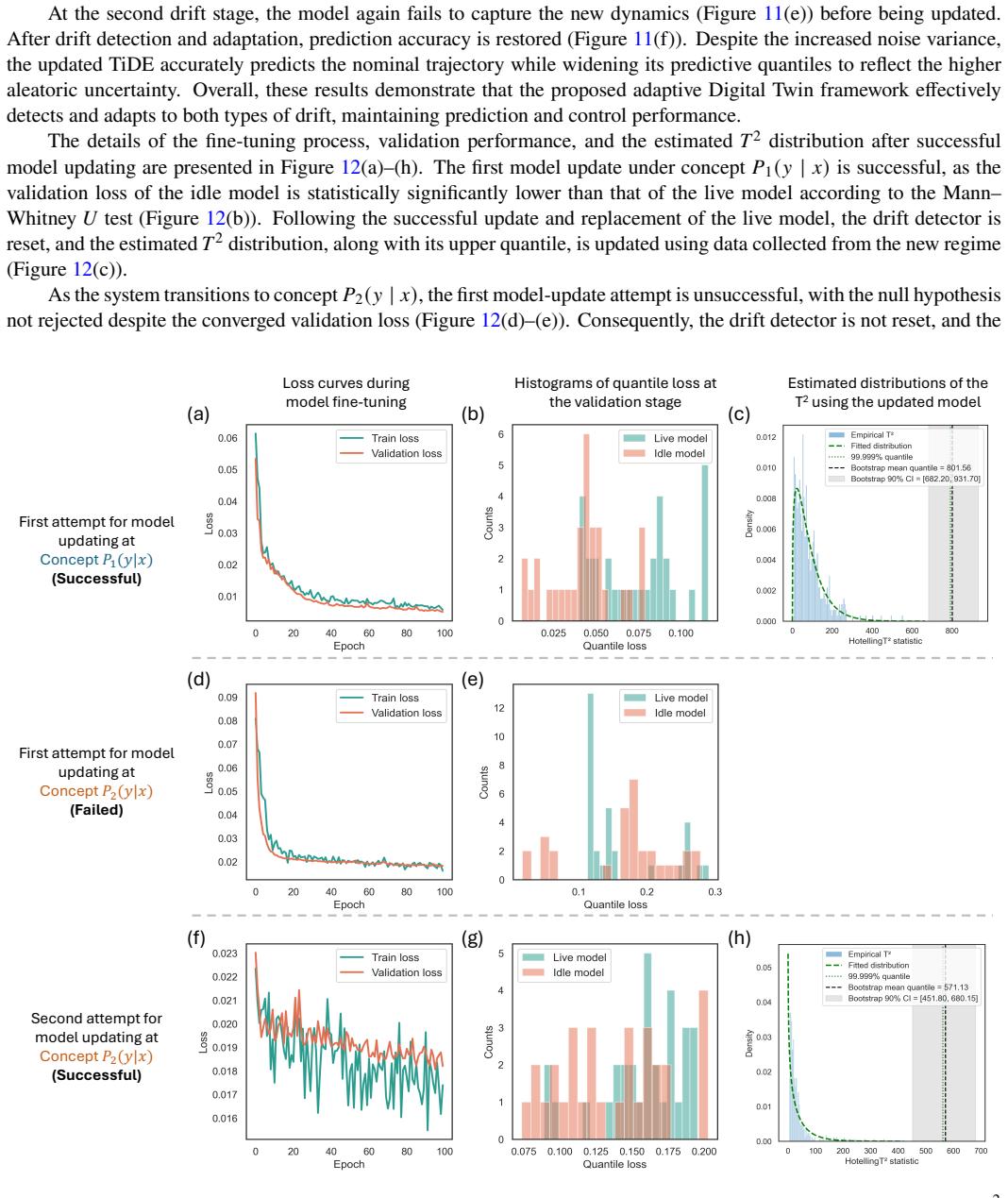
- [Section 3.5, Eq. (22), Fig. 8] The Mann-Whitney U test requires independent observations within each group and independence between groups. Here the N_V=30 validation losses are consecutive outputs of a closed-loop TiDE/MPC system: they are autocorrelated (the state evolves, multi-step predictions overlap) and paired (both models see the same inputs and ground truths). Positive autocorrelation reduces the effective sample size and changes the null distribution, so the test at α=0.2 does not control the false-replacement rate. The statement that an update is 'statistically certified' before deployment is therefore unsupported. A dependence-robust procedure (e.g., block bootstrap, paired time-series test) or a substantially weaker claim is needed.
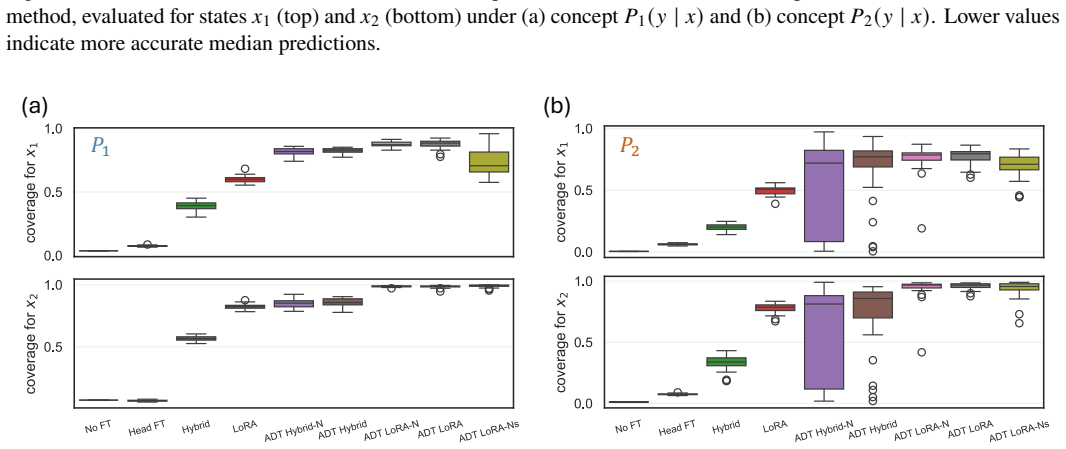
- [Section 4.5, Figs. 13–17] The evaluation metrics are intentionally not applied to the model-adaptation and model-validation intervals. Given the long idle periods reported in Section 4.4 (first update completed at k=456, reset at k=1156; second at k=2010), the headline ranking of ADT over stepwise baselines is based only on post-validation segments. The paper's life-cycle trustworthiness claim requires full-window metrics, or at least a quantified report of the excluded intervals; otherwise the comparison may favor the proposed framework precisely by omitting its periods of degraded performance.
- [Section 3.3.1 and Section 3.3.4] The theoretical guarantee behind the detector, Eqs. (14)–(16), is derived for a true likelihood and an MLE. For quantile-trained neural networks the paper treats the quantile loss as a pseudo-log-likelihood, acknowledging that 'the quantile loss does not correspond to a true likelihood' but without proving that the expected pseudo-score is zero under the null or nonzero under drift. The bootstrap UCL controls false alarms empirically, but the 'principled, if-and-only-if' detection claim does not follow. Provide a formal argument or an empirical calibration study for the pseudo-score property under quantile loss.
- [Section 5.7, last paragraph of Section 5] The DED case study is a single run without error bars. Quantitative comparisons such as R²=0.9168 vs 0.9064/0.8580 for unconstrained MPC and violation rates 14% vs 18%/46% for constrained MPC cannot be statistically supported from one trajectory. The authors acknowledge the single-run limitation, but the abstract and Section 5.7 present the DED results as evidence of transferability. Report multiple runs with uncertainty quantification, or explicitly restrict the case study to a qualitative demonstration.
minor comments (5)
- [Section 4.1, Eq. (30)] The input tuple is written as '(x^p_l, u^p_l, u^p_l)'; this appears to be a typo and should be '(x^p_l, u^p_l, u^f_l)' (or include the exogenous d sequence if used).
- [Section 3.3.4] The claimed inversion cost 'O(q̃^6)' is confusing: inverting a q̃×q̃ covariance matrix is O(q̃^3). Please clarify the dimensions and the complexity statement.
- [Table 1] Header typo: 'Hyperparamters' should be 'Hyperparameters'.
- [Section 4.5 and Table 2] The notation ADT LoRA-N (no validation) and ADT LoRA-Ns (smaller batch with validation) is easy to confuse. Use distinct names (e.g., ADT LoRA-NoVal and ADT LoRA-SmallBuf) and keep them consistent across text, table, and figures.
- [Section 6] There is a text-encoding artifact in 'Digital TwinâĂŹs'; fix to 'Digital Twin's'.
Circularity Check
No significant circularity; the derivation chain is self-contained against external benchmarks, with only minor non-load-bearing self-citations.
full rationale
The paper's claimed results are not equivalent to their inputs by construction. The drift detector is calibrated on in-control Phase I data (score mean/covariance, bootstrap UCL) and then tested on separately simulated drift, so detection delay and false alarms are not fitted outcomes. The validation gate uses a fresh held-out batch (N_V=30 or 50) collected after fine-tuning, and rejection of the Mann-Whitney null is a statistical decision rule, not a re-labeling of the model-selection loss; the reported NRMSE/coverage/NNOIS metrics are evaluated separately. The pseudo-likelihood treatment of quantile loss is explicitly acknowledged as an approximation, not a hidden identity. Self-citations ([6], [8], [62]) provide external component frameworks or a published Technometrics detection principle; they are background architecture rather than the load-bearing adaptive-validated result, which is newly integrated and benchmarked here. The Mann-Whitney dependence/autocorrelation and alpha=0.2 concerns are correctness/validity issues, not circularity. Section 6 also candidly states limitations (responsiveness, no formal MPC stability guarantees), further indicating the claims are not definitionally forced.
Axiom & Free-Parameter Ledger
free parameters (7)
- MEWMA smoothing parameter λ =
0.05 (illustrative), 0.02 (DED)
- Detection threshold significance α =
1e-5 (illustrative), 1e-4 (DED)
- Mann-Whitney U test significance level =
0.2
- LoRA rank r =
1
- Fine-tuning buffer size N_B =
200 (illustrative), 300 (DED)
- Validation buffer size N_V =
30 (illustrative), 50 (DED)
- Fine-tuning learning rate, regularization, epochs =
1e-3, 2e-4, 100
axioms (6)
- domain assumption Assumption 1: The physical system encounters only abrupt drift and incremental drift, which are non-recurring and infrequent.
- domain assumption Assumption 2: After model adaptation, the system does not experience immediate subsequent drastic drift; drift evolves on a timescale allowing the updated model to remain valid.
- ad hoc to paper Quantile loss can be treated as a pseudo-log-likelihood, and its gradient behaves like a Fisher score vector.
- domain assumption Monitoring the score vector of the last layer is sufficient to detect concept drift in the conditional distribution p(y|x).
- domain assumption The validation set collected after adaptation is representative of the future streaming distribution.
- domain assumption GAMMA FEA simulation is a faithful representation of the physical DED process for evaluating the framework.
read the original abstract
Digital Twins rely on surrogate models to mirror physical systems in real time, yet these models can degrade as operating conditions evolve, a phenomenon known as concept drift. Maintaining surrogate fidelity under drift, particularly when models must also capture aleatoric uncertainty, remains an open challenge. Existing adaptive frameworks lack principled mechanisms for detecting when updates are needed, for efficiently adapting models from limited streaming data, and for certifying that updates genuinely improve predictive performance. Here we present an adaptive Digital Twin framework that integrates a Fisher score--based multivariate drift detector, Low-Rank Adaptation (LoRA) for parameter-efficient continual learning, and a Mann--Whitney $U$ test for online statistical validation. The framework monitors surrogate-model confidence via Fisher score vectors, triggers targeted fine-tuning of fewer than 1% of model parameters upon drift detection, and statistically certifies predictive improvement before deploying the updated surrogate. Applied to a stochastic linear system and a directed energy deposition additive manufacturing process as case studies, the framework successfully detects distributional shifts with short delays and restores both predictive accuracy and uncertainty quantification under abrupt and incremental drift. These results establish a statistically rigorous and computationally tractable pathway for sustaining the trustworthiness of neural-network--based Digital Twins throughout their operational life cycle.
Figures





Reference graph
Works this paper leans on
-
[1]
Digital twin: Mitigating unpredictable, undesirable emergent behavior in complex systems
Grieves, M., and Vickers, J., 2016. “Digital twin: Mitigating unpredictable, undesirable emergent behavior in complex systems”. InTransdisciplinary perspectives on complex systems: New findings and approaches. Springer, pp. 85–113
2016
-
[2]
National Academies of Sciences, Engineering, and Medicine and others, 2023.Foundational research gaps and future directions for digital twins
2023
-
[3]
Digital twins for the designs of systems: a perspective
van Beek, A., Nevile Karkaria, V., and Chen, W., 2023. “Digital twins for the designs of systems: a perspective”. Structural and Multidisciplinary Optimization,66(3), p. 49
2023
-
[4]
Anoptimization-centricreviewforintegratingartificial intelligence and digital twin technologies in manufacturing
Karkaria,V.,Tsai,Y.-K.,Chen,Y.-P.,andChen,W.,2025. “Anoptimization-centricreviewforintegratingartificial intelligence and digital twin technologies in manufacturing”.Engineering Optimization, pp. 1–47
2025
-
[5]
Decision support within digital twins in manufacturing ecosystems: A review
Gálvez del Postigo Gallego, L., Lazarova-Molnar, S., del Real Torres, A., and Acevedo Galicia, L. E., 2025. “Decision support within digital twins in manufacturing ecosystems: A review”.IET Collaborative Intelligent Manufacturing,7(1), p. e70041
2025
-
[6]
Uncertainty-aware digital twins: Robust model predictive control using time-series deep quantile learning
Chen, Y.-P., Tsai, Y.-K., Karkaria, V., and Chen, W., 2026. “Uncertainty-aware digital twins: Robust model predictive control using time-series deep quantile learning”.Journal of Mechanical Design,148(2), p. 021702
2026
-
[7]
Amodulardigitaltwin architecture for offshore safety and decision-making: A north sea platform case study
Hamzah,N.,Mutallimov,T.,Panaitescu,C.-T.,Grant,M.,Cristofoli,G.,andTan,H.,2026. “Amodulardigitaltwin architecture for offshore safety and decision-making: A north sea platform case study”.Reliability Engineering & System Safety, p. 112428
2026
-
[8]
Real-time decision-making for digital twin in additive manufacturing with model predictive control using time-series deep neural networks
Chen, Y.-P., Karkaria, V., Tsai, Y.-K., Rolark, F., Quispe, D., Gao, R. X., Cao, J., and Chen, W., 2025. “Real-time decision-making for digital twin in additive manufacturing with model predictive control using time-series deep neural networks”.Journal of Manufacturing Systems,80, pp. 412–424
2025
-
[9]
The emergence of cognitive digital twin: vision, challenges and opportunities
Zheng, X., Lu, J., and Kiritsis, D., 2022. “The emergence of cognitive digital twin: vision, challenges and opportunities”.International Journal of Production Research,60(24), pp. 7610–7632
2022
-
[10]
Maintenance planning using a digital twin: principles and case studies
Dwight, R., Li, W., van Rooij, F., and Scarf, P., 2025. “Maintenance planning using a digital twin: principles and case studies”.Reliability Engineering & System Safety, p. 111496
2025
-
[11]
Ai-driven digital twin framework for predictive maintenance: Dynamic decision making and adaptive model updates
Karkaria, V. N., Chen, Y.-P., Tsai, Y.-K., Erdogan, G., Radulescu, R., and Chen, W., 2025. “Ai-driven digital twin framework for predictive maintenance: Dynamic decision making and adaptive model updates”. In International DesignEngineeringTechnicalConferencesandComputersandInformationinEngineeringConference,Vol.89213, American Society of Mechanical Engin...
2025
-
[12]
Chen,Y.-P.,Suarez,D.,Tsai,Y.-K.,Karkaria,V.,Hu,G.,Chen,Z.,Guo,P.,Cao,J.,andChen,W.,2025. “Adaptive digital twin of sheet metal forming via proper orthogonal decomposition-based koopman operator with model predictive control”.arXiv preprint arXiv:2511.10852
Pith/arXiv arXiv 2025
-
[13]
A comprehensive review of digital twinâĂŤpart 1: modeling and twinning enabling technologies
Thelen, A., Zhang, X., Fink, O., Lu, Y., Ghosh, S., Youn, B. D., Todd, M. D., Mahadevan, S., Hu, C., and Hu, Z., 2022. “A comprehensive review of digital twinâĂŤpart 1: modeling and twinning enabling technologies”. Structural and Multidisciplinary Optimization,65(12), p. 354
2022
-
[14]
Towards a digital twin framework in additive manufacturing: Machine learning and bayesian optimization for time series process optimization
Karkaria,V.,Goeckner,A.,Zha,R.,Chen,J.,Zhang,J.,Zhu,Q.,Cao,J.,Gao,R.X.,andChen,W.,2024. “Towards a digital twin framework in additive manufacturing: Machine learning and bayesian optimization for time series process optimization”.Journal of Manufacturing Systems
2024
-
[15]
Learning dynamical systems from data: An introduction to physics-guided deep learning
Yu, R., and Wang, R., 2024. “Learning dynamical systems from data: An introduction to physics-guided deep learning”.Proceedings of the National Academy of Sciences,121(27), p. e2311808121. 38
2024
-
[16]
2026 roadmap on artificial intelligence and machine learning for smart manufacturing
Lee, J., Su, H., Macchi, M., Polenghi, A., Wu, W., Zhao, Z., Huang, G. Q., Allgood, K., Jain, D., Gieger, B., Pandhare, V., Bhattacharjee, S., Mohril, R., Kong, L., Wang, Q., Tang, X., Kim, S., Park, C. H., Youn, B. D., Goh, G. D., Huang, X., Yeong, W. Y., Shin, Y. C., Zhang, H., Wang, Z., Tao, F., Srai, J. S., Gupta, S. K., Joung, B. G., John, A., Suther...
2026
-
[17]
Digitaltwin-enabledmultigenerationcontrolco-design with deep reinforcement learning
Tsai,Y.-K.,Karkaria,V.,Chen,Y.-P.,andChen,W.,2026. “Digitaltwin-enabledmultigenerationcontrolco-design with deep reinforcement learning”.Journal of Mechanical Design,148(7), 06, p. 071705
2026
-
[18]
Reinforcement learning-based control co-design of digital twin-enabled full-vehicle active suspension systems
Tsai, Y.-K., Chen, Y.-P., Karkaria, V., and Chen, W., 2026. “Reinforcement learning-based control co-design of digital twin-enabled full-vehicle active suspension systems”.Structural and Multidisciplinary Optimization
2026
-
[19]
Methods for enabling real-time analysis in digital twins: A literature review
Es-haghi, M. S., Anitescu, C., and Rabczuk, T., 2024. “Methods for enabling real-time analysis in digital twins: A literature review”.Computers & Structures,297, p. 107342
2024
-
[20]
Model predictive control: theory, computation, and design
Rawlings, J. B., Mayne, D. Q., and Diehl, M. M., 2020. “Model predictive control: theory, computation, and design”.(No Title)
2020
-
[21]
Learning-based model predictive control: Towardsafelearningincontrol
Hewing, L., Wabersich, K. P., Menner, M., and Zeilinger, M. N., 2020. “Learning-based model predictive control: Towardsafelearningincontrol”.AnnualReviewofControl,Robotics,andAutonomousSystems,3(1),pp.269–296
2020
-
[22]
Robustcontrolco-designusingtube-basedmodelpredictivecontrol
Tsai,Y.-K.,andMalak,R.J.,2023. “Robustcontrolco-designusingtube-basedmodelpredictivecontrol”. In2023 American Control Conference (ACC), IEEE, pp. 769–775
2023
-
[23]
Control co-design with performance-robustness trade-off using tube-based stochastic model predictive control
Tsai, Y.-K., and Malak, R., 2025. “Control co-design with performance-robustness trade-off using tube-based stochastic model predictive control”.ASME Letters in Dynamic Systems and Control
2025
-
[24]
Parametric multi-objective optimization for simultaneous and nested control co-design formulations with tube-based model predictive controllers
Tsai, Y.-K., and Malak, R. J., 2026. “Parametric multi-objective optimization for simultaneous and nested control co-design formulations with tube-based model predictive controllers”.Journal of Mechanical Design, pp. 1–18
2026
-
[25]
Simultaneous multistep transformer architecture for model predictive control
Park, J., Babaei, M. R., Munoz, S. A., Venkat, A. N., and Hedengren, J. D., 2023. “Simultaneous multistep transformer architecture for model predictive control”.Computers & Chemical Engineering,178, p. 108396
2023
-
[26]
Lstm-mpc: A deep learning based predictive control method for multimode process control
Huang, K., Wei, K., Li, F., Yang, C., and Gui, W., 2022. “Lstm-mpc: A deep learning based predictive control method for multimode process control”.IEEE Transactions on Industrial Electronics,70(11), pp. 11544–11554
2022
-
[27]
Model predictive control when utilizing lstm as dynamic models
Jung, M., da Costa Mendes, P. R., Önnheim, M., and Gustavsson, E., 2023. “Model predictive control when utilizing lstm as dynamic models”.Engineering Applications of Artificial Intelligence,123, p. 106226
2023
-
[28]
Process structure-based recurrent neural network modeling for model predictive control of nonlinear processes
Wu, Z., Rincon, D., and Christofides, P. D., 2020. “Process structure-based recurrent neural network modeling for model predictive control of nonlinear processes”.Journal of Process Control,89, pp. 74–84
2020
-
[29]
Anewadaptiveexplicitnonlinearmodelpredictivecontroldesignforanonlinear mimo system: An application to twin rotor mimo system
Dutta,L.,andDas,D.K.,2021. “Anewadaptiveexplicitnonlinearmodelpredictivecontroldesignforanonlinear mimo system: An application to twin rotor mimo system”.International Journal of Control, Automation and Systems,19(7), pp. 2406–2419
2021
-
[30]
Targeted digital twin via flow map learning and its application to fluid dynamics
Chen, Q., Xu, Z., Zhang, J., and Xiu, D., 2025. “Targeted digital twin via flow map learning and its application to fluid dynamics”.arXiv preprint arXiv:2510.07549
arXiv 2025
-
[31]
Unknown parameter excitation and estimation for complex systems with dynamic performances
Chen, Y.-P., and Chan, K.-Y., 2021. “Unknown parameter excitation and estimation for complex systems with dynamic performances”.Journal of Mechanical Design,143(9), p. 091704
2021
-
[32]
Cautious model predictive control using gaussian process regression
Hewing, L., Kabzan, J., and Zeilinger, M. N., 2019. “Cautious model predictive control using gaussian process regression”.IEEE Transactions on Control Systems Technology,28(6), pp. 2736–2743. 39
2019
-
[33]
Bias-learning-based model predictive controller design for reliable path tracking of autonomous vehicles under model and environmental uncertainty
Ren, L., and Xi, Z., 2022. “Bias-learning-based model predictive controller design for reliable path tracking of autonomous vehicles under model and environmental uncertainty”.Journal of Mechanical Design,144(9), p. 091706
2022
-
[34]
Self-adaptive fault diagnosis for unseen working conditions based on digital twins and domain generalization
Azari, M. S., Santini, S., Edrisi, F., and Flammini, F., 2025. “Self-adaptive fault diagnosis for unseen working conditions based on digital twins and domain generalization”.Reliability Engineering & System Safety,254, p. 110560
2025
-
[35]
Investigation on the impact of nongeometric uncertainty in dynamic perfor- mance of serial and parallel robot manipulators
Tsai, Y.-K., and Chan, K.-Y., 2019. “Investigation on the impact of nongeometric uncertainty in dynamic perfor- mance of serial and parallel robot manipulators”.Proceedings of the Institution of Mechanical Engineers, Part C: Journal of Mechanical Engineering Science,233(10), pp. 3487–3511
2019
-
[36]
A novel digital twin approach based on deep multimodal information fusion for aero-engine fault diagnosis
Huang, Y., Tao, J., Sun, G., Wu, T., Yu, L., and Zhao, X., 2023. “A novel digital twin approach based on deep multimodal information fusion for aero-engine fault diagnosis”.Energy,270, p. 126894
2023
-
[37]
An accelerated dual gradient-projection algorithm for embedded linear model predictive control
Patrinos, P., and Bemporad, A., 2013. “An accelerated dual gradient-projection algorithm for embedded linear model predictive control”.IEEE Transactions on Automatic Control,59(1), pp. 18–33
2013
-
[38]
Mpc-based dual control with online experiment design
Heirung, T. A. N., Foss, B., and Ydstie, B. E., 2015. “Mpc-based dual control with online experiment design”. Journal of Process Control,32, pp. 64–76
2015
-
[39]
Adaptiveoptimalcontroloffaultynonlinear dc microgrids with constant power loads: Dual-extended kalman filter approach
Vafamand,N.,Arefi,M.M.,Shafie-Khah,M.,andCatalão,J.P.,2022. “Adaptiveoptimalcontroloffaultynonlinear dc microgrids with constant power loads: Dual-extended kalman filter approach”.IEEE Transactions on Industry Applications,59(1), pp. 513–522
2022
-
[40]
Koopman operator-based model predictive control with recursive online update
Calderón, H. M., Schulz, E., Oehlschlägel, T., and Werner, H., 2021. “Koopman operator-based model predictive control with recursive online update”. In 2021 European Control Conference (ECC), IEEE, pp. 1543–1549
2021
-
[41]
A sample path-based method for the digital twin prediction update synchronizationproblemofunreliableproductionlines
Gou, Y.-X., Matta, A., and Tan, B., 2024. “A sample path-based method for the digital twin prediction update synchronizationproblemofunreliableproductionlines”.In2024IEEE20thInternationalConferenceonAutomation Science and Engineering (CASE), IEEE, pp. 2969–2974
2024
-
[42]
Understanding semantic drift in model driven digital twins
Abbasi, F., Brimont, P., Pruski, C., and Sottet, J.-S., 2024. “Understanding semantic drift in model driven digital twins”. In Proceedings of the ACM/IEEE 27th International Conference on Model Driven Engineering Languages and Systems, pp. 419–430
2024
-
[43]
Springer Nature
Rabczuk, T., Anitescu, C., Goswami, S., Zhuang, X., and Wang, Y., 2026.Scientific Machine Learning with Engineering Applications. Springer Nature
2026
-
[44]
Adaptive neural network model predictive control
Hedjar, R., 2013. “Adaptive neural network model predictive control”.International Journal of Innovative Computing, Information and Control,9(3), pp. 1245–1257
2013
-
[45]
Nonlinear model identification and adaptive model predictive control using neural networks
Akpan, V. A., and Hassapis, G. D., 2011. “Nonlinear model identification and adaptive model predictive control using neural networks”.ISA transactions,50(2), pp. 177–194
2011
-
[46]
Real-time adaptive machine-learning-based predictive control of nonlinear processes
Wu, Z., Rincon, D., and Christofides, P. D., 2019. “Real-time adaptive machine-learning-based predictive control of nonlinear processes”.Industrial & Engineering Chemistry Research,59(6), pp. 2275–2290
2019
-
[47]
An online learning method for microgrid energy management control
Casagrande, V., Ferianc, M., Rodrigues, M., and Boem, F., 2023. “An online learning method for microgrid energy management control”. In 2023 31st Mediterranean Conference on Control and Automation (MED), IEEE, pp. 263–268
2023
-
[48]
Adaptivemachinelearningwithphysics-basedsimulationsfor mean time to failure prediction of engineering systems
Wu,H.,Xu,Y.,Liu,Z.,Li,Y.,andWang,P.,2023. “Adaptivemachinelearningwithphysics-basedsimulationsfor mean time to failure prediction of engineering systems”.Reliability Engineering & System Safety,240, p. 109553
2023
-
[49]
Digitaltwin-basedanomalydetectionunderconceptdrift: Acom- parison between iterative batch learning and incremental learning approaches
Abdoune,F.,Nouiri,M.,andCardin,O.,2025. “Digitaltwin-basedanomalydetectionunderconceptdrift: Acom- parison between iterative batch learning and incremental learning approaches”.Expert Systems with Applications, p. 130062. 40
2025
-
[50]
Deep model predictive flow control with limited sensor data and online learning
Bieker, K., Peitz, S., Brunton, S. L., Kutz, J. N., and Dellnitz, M., 2020. “Deep model predictive flow control with limited sensor data and online learning”.Theoretical and computational fluid dynamics,34(4), pp. 577–591
2020
-
[51]
Anonlinetransferlearningapproachforidentification and predictive control design with application to rcci engines
Bao,Y.,MohammadpourVelni,J.,andShahbakhti,M.,2020.“Anonlinetransferlearningapproachforidentification and predictive control design with application to rcci engines”. In Dynamic systems and control conference, Vol. 84270, American Society of Mechanical Engineers, p. V001T21A003
2020
-
[52]
Model predictive control with adaptive machine-learning-based model for building energy efficiency and comfort optimization
Yang, S., Wan, M. P., Chen, W., Ng, B. F., and Dubey, S., 2020. “Model predictive control with adaptive machine-learning-based model for building energy efficiency and comfort optimization”.Applied Energy,271, p. 115147
2020
-
[53]
Concept drift detection and adaption framework using optimized deep learning and adaptive sliding window approach
Desale, K. S., and Shinde, S. V., 2023. “Concept drift detection and adaption framework using optimized deep learning and adaptive sliding window approach”.Expert Systems,40(9), p. e13394
2023
-
[54]
A lightweight concept drift detection and adaptation framework for iot data streams
Yang, L., and Shami, A., 2021. “A lightweight concept drift detection and adaptation framework for iot data streams”.IEEE Internet of Things Magazine,4(2), pp. 96–101
2021
-
[55]
A drift detection method based on dynamic classifier selection
Felipe, P., dos Santos Eulanda, M., and João, G., 2020. “A drift detection method based on dynamic classifier selection”.Data Mining and Knowledge Discovery,34(1), pp. 50–74
2020
-
[56]
Asurveyonconceptdriftadaptation
Gama,J.,Žliobait ˙e,I.,Bifet,A.,Pechenizkiy,M.,andBouchachia,A.,2014. “Asurveyonconceptdriftadaptation”. ACM computing surveys (CSUR),46(4), pp. 1–37
2014
-
[57]
Learning under concept drift: A review
Lu, J., Liu, A., Dong, F., Gu, F., Gama, J., and Zhang, G., 2018. “Learning under concept drift: A review”.IEEE transactions on knowledge and data engineering,31(12), pp. 2346–2363
2018
-
[58]
Learningfromstreamingdatawithconceptdriftandimbalance: an overview
Hoens,T.R.,Polikar,R.,andChawla,N.V.,2012. “Learningfromstreamingdatawithconceptdriftandimbalance: an overview”.Progress in artificial intelligence,1(1), pp. 89–101
2012
-
[59]
A comparative study on concept drift detectors
Gonçalves Jr, P. M., de Carvalho Santos, S. G., Barros, R. S., and Vieira, D. C., 2014. “A comparative study on concept drift detectors”.Expert Systems with Applications,41(18), pp. 8144–8156
2014
-
[60]
An ewma for monitoring a process standard deviation
Crowder, S. V., and Hamilton, M. D., 1992. “An ewma for monitoring a process standard deviation”.Journal of Quality Technology,24(1), pp. 12–21
1992
-
[61]
Quality control of surgical and interventional procedures: a review of the cusum
Biau, D. J., Resche-Rigon, M., Godiris-Petit, G., Nizard, R. S., and Porcher, R., 2007. “Quality control of surgical and interventional procedures: a review of the cusum”.BMJ Quality & Safety,16(3), pp. 203–207
2007
-
[62]
Concept drift monitoring and diagnostics of supervised learning models via score vectors
Zhang, K., Bui, A. T., and Apley, D. W., 2023. “Concept drift monitoring and diagnostics of supervised learning models via score vectors”.Technometrics,65(2), pp. 137–149
2023
-
[63]
Learning from time-changing data with adaptive windowing
Bifet, A., and Gavalda, R., 2007. “Learning from time-changing data with adaptive windowing”. In Proceedings of the 2007 SIAM international conference on data mining, SIAM, pp. 443–448
2007
-
[64]
Integrating structured biological data by kernel maximum mean discrepancy
Borgwardt, K. M., Gretton, A., Rasch, M. J., Kriegel, H.-P., Schölkopf, B., and Smola, A. J., 2006. “Integrating structured biological data by kernel maximum mean discrepancy”.Bioinformatics,22(14), pp. e49–e57
2006
-
[65]
Adaptive monitoring method for batch processes based onphasedissimilarityupdatingwithlimitedmodelingdata
Zhao, C., Wang, F., Gao, F., Lu, N., and Jia, M., 2007. “Adaptive monitoring method for batch processes based onphasedissimilarityupdatingwithlimitedmodelingdata”.Industrial&engineeringchemistryresearch,46(14), pp. 4943–4953
2007
-
[66]
Overcoming catastrophic forgetting in neural networks
Kirkpatrick,J.,Pascanu,R.,Rabinowitz,N.,Veness,J.,Desjardins,G.,Rusu,A.A.,Milan,K.,Quan,J.,Ramalho, T., Grabska-Barwinska, A., et al., 2017. “Overcoming catastrophic forgetting in neural networks”.Proceedings of the national academy of sciences,114(13), pp. 3521–3526
2017
-
[67]
Catastrophic forgetting in deep learning: A comprehensive taxonomy
Aleixo, E. L., Colonna, J. G., Cristo, M., and Fernandes, E., 2023. “Catastrophic forgetting in deep learning: A comprehensive taxonomy”.arXiv preprint arXiv:2312.10549. 41
Pith/arXiv arXiv 2023
-
[68]
Parameter-efficient fine-tuning for large models: A comprehensive survey
Han, Z., Gao, C., Liu, J., Zhang, J., and Zhang, S. Q., 2024. “Parameter-efficient fine-tuning for large models: A comprehensive survey”.arXiv preprint arXiv:2403.14608
Pith/arXiv arXiv 2024
-
[69]
Lora: Low-rank adaptation of large language models
Hu, E. J., Shen, Y., Wallis, P., Allen-Zhu, Z., Li, Y., Wang, S., Wang, L., Chen, W., et al., 2022. “Lora: Low-rank adaptation of large language models.”.Iclr,1(2), p. 3
2022
-
[70]
Adaptive parameterized model predictive control based on reinforcement learning: A synthesis framework
Sun, D., Jamshidnejad, A., and De Schutter, B., 2024. “Adaptive parameterized model predictive control based on reinforcement learning: A synthesis framework”.Engineering Applications of Artificial Intelligence,136, p. 109009
2024
-
[71]
Output-feedback robust control of uncertain systems via online data-driven learning
Na, J., Zhao, J., Gao, G., and Li, Z., 2020. “Output-feedback robust control of uncertain systems via online data-driven learning”.IEEE Transactions on Neural Networks and Learning Systems,32(6), pp. 2650–2662
2020
-
[72]
Online weight-adaptive nonlinear model predictive control
Kostadinov, D., and Scaramuzza, D., 2020. “Online weight-adaptive nonlinear model predictive control”. In 2020 IEEE/RSJ International Conference on Intelligent Robots and Systems (IROS), IEEE, pp. 1180–1185
2020
-
[73]
An analytical tuning of mpc control horizon using the hessian condition number
Turki, M., Langlois, N., and Yassine, A., 2017. “An analytical tuning of mpc control horizon using the hessian condition number”. In 14th International Workshop on Advanced Control and Diagnosis
2017
-
[74]
Neural network approach to continuous-time direct adaptive optimal control for partially unknown nonlinear systems
Vrabie, D., and Lewis, F., 2009. “Neural network approach to continuous-time direct adaptive optimal control for partially unknown nonlinear systems”.Neural networks,22(3), pp. 237–246
2009
-
[75]
Adaptivemodelpredictivecontrolformulti-agentsystemsusing twin delayed deep deterministic policy gradient learning
Chaubey,P.,Markana,A.,andVyas,D.R.,2026. “Adaptivemodelpredictivecontrolformulti-agentsystemsusing twin delayed deep deterministic policy gradient learning”.Engineering Research Express
2026
-
[76]
Digital twin syncing for autonomous surface vessels using reinforcement learning and nonlinear model predictive control
Berg, H. S., Menges, D., Tengesdal, T., and Rasheed, A., 2025. “Digital twin syncing for autonomous surface vessels using reinforcement learning and nonlinear model predictive control”.Scientific Reports,15(1), p. 9344
2025
-
[77]
A self-calibrating digital twin for space thermionic nuclear reactors under fault conditions
Zhang, B., Xue, Y., Zhang, Y., and Su, K., 2025. “A self-calibrating digital twin for space thermionic nuclear reactors under fault conditions”.Reliability Engineering & System Safety, p. 111995
2025
-
[78]
Dual adaptive model predictive control
Heirung, T. A. N., Ydstie, B. E., and Foss, B., 2017. “Dual adaptive model predictive control”.Automatica,80, pp. 340–348
2017
-
[79]
Learning-basedmodelpredictivecontrolonaquadrotor: Onboard implementation and experimental results
Bouffard,P.,Aswani,A.,andTomlin,C.,2012. “Learning-basedmodelpredictivecontrolonaquadrotor: Onboard implementation and experimental results”. In 2012 IEEE International Conference on Robotics and Automation, IEEE, pp. 279–284
2012
-
[80]
Real-time multivariable control of directed energy deposition via adaptive model predictive control
van Blitterswijk, R. H., Botelho, L. A., and Khajepour, A., 2025. “Real-time multivariable control of directed energy deposition via adaptive model predictive control”.Additive Manufacturing, p. 104941
2025
discussion (0)
Sign in with ORCID, Apple, or X to comment. Anyone can read and Pith papers without signing in.